Collecting water from the gutters, correcting water from the tap, reusing water from the house: a guide for local authorities and residents
Yves Nicolas, Expert Consultant in Functional Ecology, yvesnicolas.com
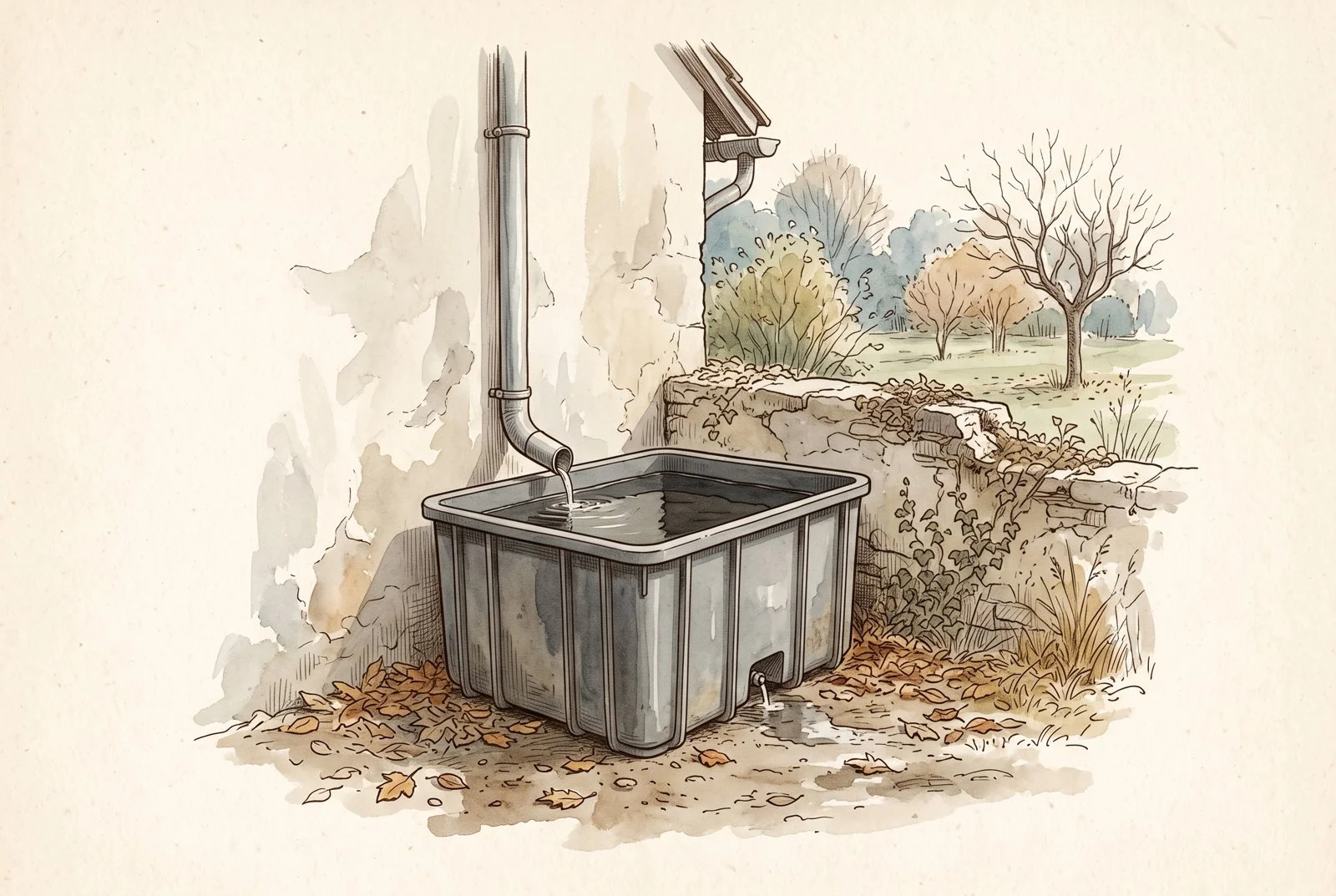
Under the gutter, the one-cubic-metre drinking trough, open: free water, and everything open water attracts.
Under the gutter of my house in Meudon, a thousand-litre plastic drinking trough collects rainwater. It is a livestock trough, the kind you see in fields, and it has stayed what it is: open, without a lid, exposed to the sky. My brother's nursery is on the land, and this trough is used every day to water the small greenhouse of young cuttings and seedlings. It cost me almost nothing, the rainwater in it is soft, and you dip the watering can in without a tap or a pump. For a gardener, it is the ideal reservoir.
And yet I recommend it to no one. This year there are a lot of mosquitoes where we live, above all the tiger mosquito, and an open reservoir is one of the places where it can breed. This article starts from there: what a trough like mine is worth, what it costs, and how a local authority, a school or a resident can collect water from the gutters without paying that price. It then deals with the garden's two other waters: tap water, which often needs correcting, and the house's water, which has already been used once.
What an open reservoir costs
The tiger mosquito. This is what changed the rules. It does not need a pond: a few centilitres are enough, the saucer of a pot, an upturned bottle cap, the bottom of a watering can. The female does not lay in the water but on the wall, just above the waterline, and her eggs survive months of drought before hatching when rain or refilling brings the water back up to them. You can see them with the naked eye if you know where to look: fine black dots lined up on the wall. In summer, a larva becomes a mosquito in about a week. It travels little from where it was born, a hundred to two hundred metres, which means that the mosquito born in my tank bites my neighbours, and my neighbour's bites me. An open reservoir whose level rises and falls is a perfect breeding site for it.
You hear it said that a trough used every day is not a problem. That is not enough. The rule in tiger mosquito control is to empty and scrub everything that holds water every week. Yet a thousand-litre trough from which a few watering cans are drawn is never emptied: the larvae complete their cycle in it undisturbed.
Drowning. A young child can fall into an open trough in a few seconds and drown silently. It is the risk people do not dare to face, and it is the most serious.
Trapped animals. Birds, hedgehogs, frogs and small rodents come to drink, fall in, and cannot climb back up a smooth wall. Without an exit ramp, an open reservoir becomes a trap.
Debris and seedlings. Water in the open air receives leaves, pollen, droppings and dust, and fills with algae. For a mature plant, this changes nothing. For young cuttings and seedlings, it is another matter. Nursery growers know damping-off, a rot at the collar caused by water and soil organisms, Pythium first among them. Stagnant water loaded with organic matter can encourage it. A reservoir that supplies a greenhouse must therefore be filtered at the inlet and kept clean.
Evaporation and heat. An open surface of about one square metre loses around five litres a day in high summer, roughly a seventh of the volume in a month. The water also warms up, which does not suit a young cutting.
None of these drawbacks is a reason to give up roof water. They are reasons to store it differently, and that is what the rest of this article describes.
Key point. An open trough costs little, but it brings three serious risks: a young child drowning, the tiger mosquito, trapped animals. Keep the rainwater; change the way it is stored.
This article is for three readers. To the resident with a gutter and a garden, it says what to install and how to use it. To the block of flats, the school and the shared garden, it says how to organise around a shared roof. To the local authority, it says how to turn its buildings into a network of small reserves that replaces drinking water for irrigation. The first part gives the figures: what a roof delivers and what needs to be stored. The second describes the complete system, from roof to soil, in five components. The third details the buried tank, its centrepiece. The fourth says where the water goes when the tank is full, with the overflow pond. The fifth deals with birds, and how to keep water for them in high summer without creating a mosquito nursery. The next three each address one reader: the resident, the group, the local authority. The ninth deals with the third water, the house's water: greywater, its treatment with reeds and sand, sizing the system to the flow, and the regulations. It also explains how to route roof water through it. The tenth explains what happens to roof water and tap water once in the tank, and how to make them useful to plants, because this is where many installations disappoint. The eleventh sets out what I do on an assignment. Two appendices close the article: a table of doses and a glossary.
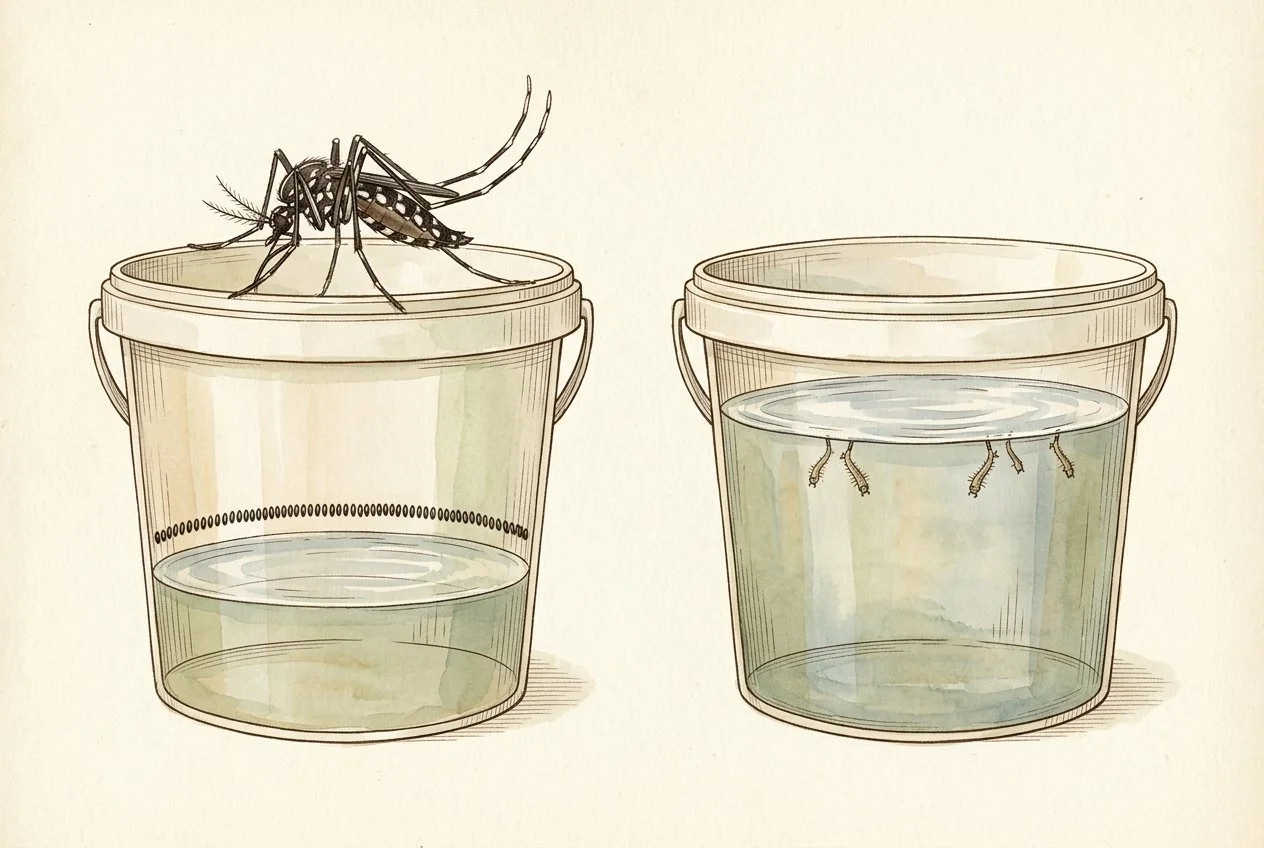
The tiger mosquito lays on the dry wall, just above the water. All it takes is for the level to rise for the eggs to hatch.
Part 1. A roof is a source: the figures
This part says what a roof delivers in a year, and why the volume to be stored matters more than the roof area.
One millimetre of rain falling on one square metre of roof gives one litre of water. In the Île-de-France, where about six hundred millimetres fall a year, a roof of a hundred square metres delivers around fifty thousand litres a year, once losses from the gutters and the first flush are deducted. In Rabat, with a little over five hundred millimetres falling almost entirely between October and April, the calculation is of the same order, but the water arrives in just a few months.
This figure hides the real difficulty: the water falls in winter and the plant needs it in summer. A one-cubic-metre tank fills with ten millimetres of rain on a hundred square metres of roof, that is in one ordinary shower, and overflows at the next. Collection therefore depends on storage volume more than on roof area. To calculate it, start from the need in the dry season. A mulched bed of a hundred square metres needs one to two cubic metres a week in dry weather, a vegetable garden more. Three to five cubic metres therefore cover three weeks without rain for a bed: that is the size of a household tank. A vegetable garden needs twice as much. A young street tree in its first or second year needs, in summer, from a few dozen to a hundred litres a week depending on its size. A ten-cubic-metre tank waters about a hundred of them in a single round, at the high dose. A school with a thousand square metres of roof delivers around five hundred cubic metres a year, enough to fill that ten-cubic-metre tank fifty times. What is almost always missing is not the water, it is the space to keep it until summer.
Key point. One millimetre of rain on one square metre of roof gives one litre. A hundred square metres of roof deliver about fifty cubic metres a year in the Île-de-France. What is missing is not the water, it is the volume to keep it until summer.
Part 2. The complete system, from roof to soil
This part describes the whole system in the order the water passes through it, in five components. The following parts detail the most important ones.
The first component is the downpipe filter. Fitted on the gutter, it holds back leaves and debris, and a first-flush diverter sets aside the first minutes of rain after a dry spell, the ones that wash the roof.
The second is the buried tank: closed, dark, cool and locked. This is where the water waits for summer.
The third is the draw-off: a tap, a hand pump or a small electric pump, which takes water a few centimetres below the surface, where it is cleanest. You no longer dip the watering can.
The fourth is the birdbath, placed on the overflow route. It is shallow, five centimetres of water at most, and in summer it is the one that receives a top-up from the tank.
The fifth is the overflow pond or, more simply, a swale or an infiltration trench. The water the tank can no longer hold is retained there, lives there for a while, then goes back into the ground instead of into the sewer.
This order follows a simple rule: everything deep is closed, and everything open is shallow or protected. The system guarantees clean water for watering and for the greenhouse, with no possibility of drowning, no mosquito breeding site, water for the birds even in August, and a summer storm that no longer goes down the drain. None of these components is original. The work lies in linking them together and setting each threshold for the site.
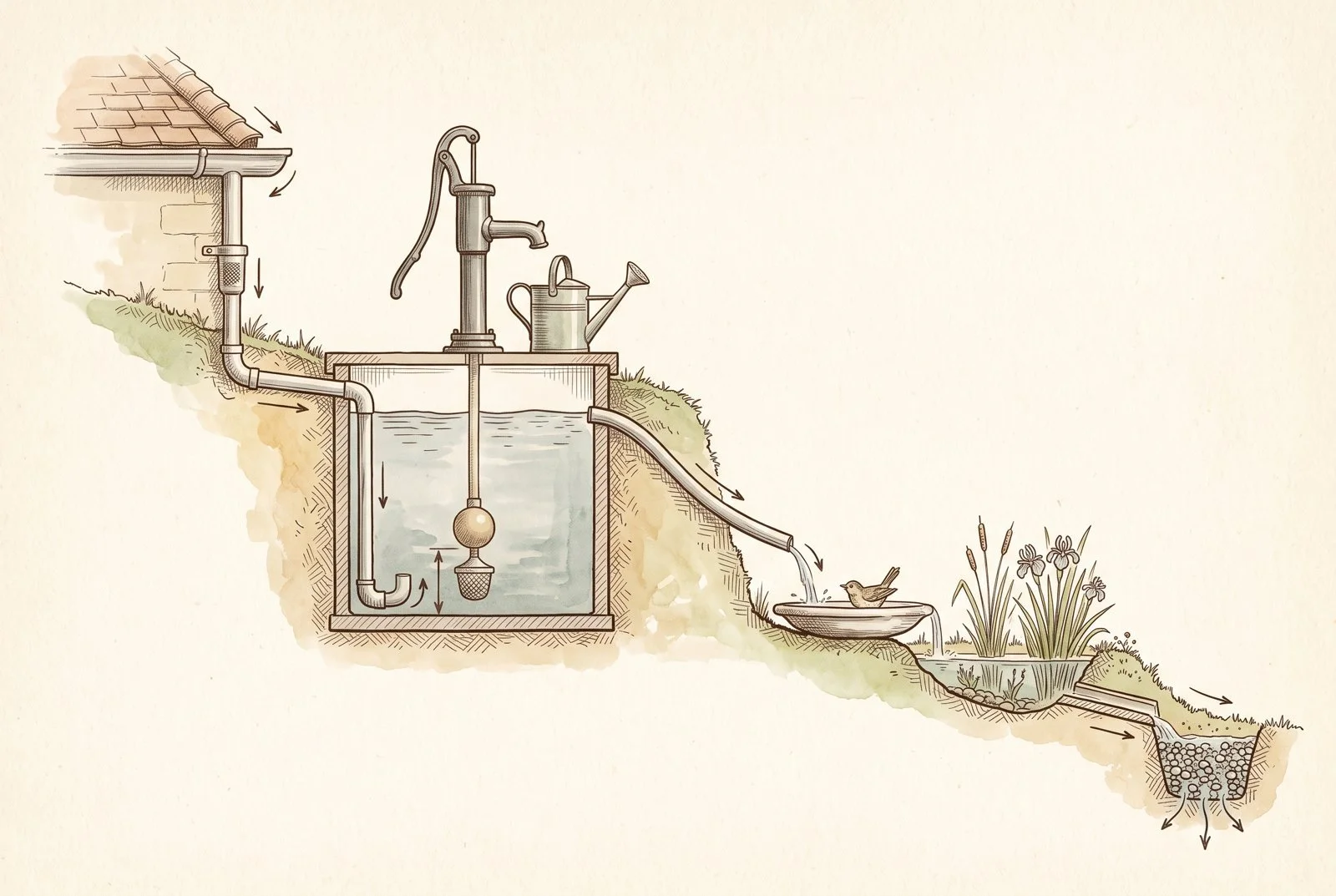
The complete system, by gravity alone on sloping ground: the roof, the buried tank, the birdbath on the overflow, the pond, then the infiltration trench.
Key point. Five components in the order the water passes through them: downpipe filter, buried tank, draw-off, birdbath, pond or swale. One rule: everything deep is closed, everything open is shallow or protected.
Part 3. The buried tank, the centrepiece
This part says why I bury the tank, where to put it, what it contains and how water is drawn from it.
Why bury it. Buried, the tank combines four qualities no above-ground tank combines. It is in the dark, so free of algae. It stays cool, between eight and seventeen degrees depending on the season, without the swings of a tank in the sun, so its water keeps. It does not freeze. And it is closed by nature: a locked access cover, a lid a child cannot lift, no open water surface, so neither drowning nor mosquito breeding. It also frees up the garden, which matters in town.
Where to put it. It is placed away from the house, a few metres from the foundations, and away from the roots of large trees. On clay soil, prone to shrinking and swelling, this is more than a precaution: a leaking tank or an overflow discharging at the foot of a wall wets the clay unevenly. That is how cracks appear. The overflow is therefore led away from the building, and the distance should be confirmed by a professional. Where the water table is high, an empty tank can float: choose a model designed for this or ballast it. Under a vehicle access, it must be designed for the load. And if the land slopes, place it uphill of the birdbath and the pond so the water flows down by itself.
What it contains. Four fittings make the difference between a tank that delivers clean water and a cistern that turns into a quagmire. A calmed inlet brings the water in at the bottom, gently, so as not to stir up the sediment. A floating suction draws water ten or fifteen centimetres below the surface, where it is clearest, away from floating debris and the sediment at the bottom. A siphon overflow carries off surface impurities at each overflow and keeps out rodents and smells. Finally, all openings to the outside, ventilation and overflow, carry a stainless steel insect mesh with holes of one millimetre at most, which meets the insect protection the regulations require. These fittings cost little and are available from all tank manufacturers. The important thing is to insist on them when ordering.
How to draw water. The choice depends on the use. The hand pump, needing no electricity, suits a garden and a greenhouse: a few strokes and the watering can is full. A small electric or solar pump supplies a tap or a hose. And for a local authority, a draw-off point with a quick coupling, where the council's water bowser comes to fill up. In every case, the tap or coupling carries a "non-drinking water" sign, and no pipe connects the tank to the drinking water network. The only exception is a regulatory top-up with backflow prevention, that is with an air gap.
The nursery case. For my brother's nursery, the solution I propose replaces the open trough with a buried tank connected to a hand pump, with a small closed tempering tank in the greenhouse. In the meantime, the trough is made safe as I describe in Part 6. Water from a buried tank comes out between eight and fifteen degrees in spring, too cold for young cuttings. It spends the night in the tempering tank, at air temperature, and is used for watering the next day. It comes out clean, free of debris and algae, which addresses the damping-off risk mentioned above.
Size and maintenance. Three to five cubic metres for a house, ten to thirty for a school or a park. Maintenance comes down to three tasks. Check the access cover and the mesh in spring. Clean the downpipe filter at leaf fall and in spring, at the same time as the access cover. Have the bottom pumped out every few years if sediment builds up. The price to pay is the excavation. Where that is impossible, fall back on the above-ground tank, also closed, which I discuss further on.
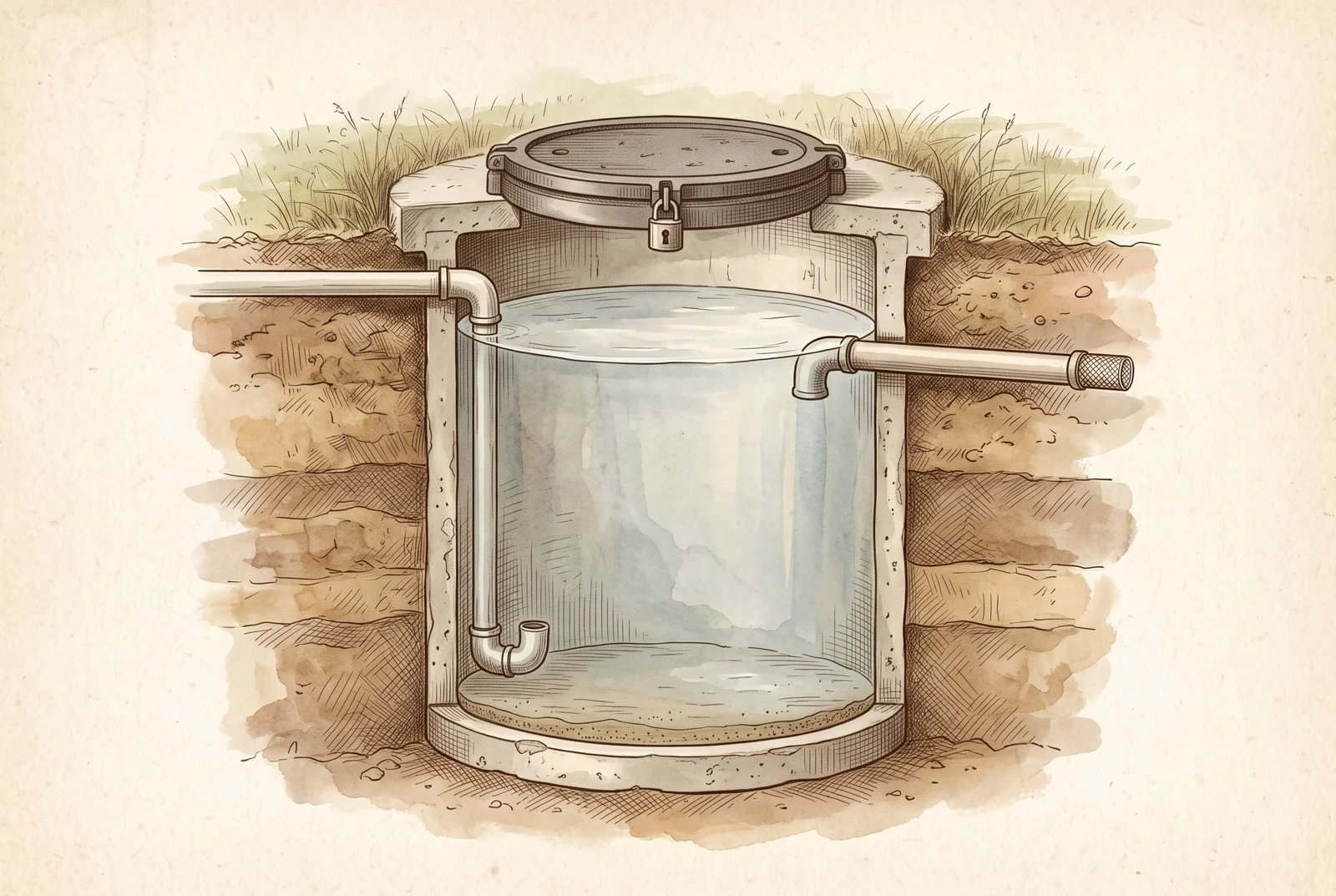
The buried tank: the inlet goes down to the bottom without stirring the sediment, the overflow sets the level, the access cover is locked.
Key point. The buried tank is dark, cool and locked. Four fittings to insist on when ordering: calmed inlet, floating suction, siphon overflow, insect mesh of one millimetre at most. On clay soil, the overflow goes well away from the foundations.
Part 4. The overflow pond
This part says where the water goes when the tank is full, what becomes of the overflow pond, and how to make it safe for children and animals alike.
When the tank is full, the water from the next rain has to go somewhere, and that somewhere is never the sewer. This is even where much of the benefit for the local authority lies: a summer storm that stays on site instead of swelling the network.
The water can go to several places, in order of simplicity. The swale, a wide, shallow ditch, grassed or planted, which holds water for a few hours and lets it soak in. The infiltration trench or soakaway, filled with gravel, invisible, suited to permeable soils. And the overflow pond, a small, shallow, planted body of water, which holds water longer and offers it to wildlife. On clay soil, infiltration is slow and a soakaway cannot be relied on. It is the pond, with its plants that drink, that does the work, supplemented by slow drainage towards a point away from the building.
How to build it. A gently sloping bottom, a beach of pebbles or gravel on one side, marginal and shallow-water plants (rushes, yellow flag iris, water mint, dwarf reedmace). A deeper zone, of fifty to eighty centimetres, completes the whole. The water stays cool there, and a few pond fish live in it and eat mosquito larvae. Never mosquitofish, known to be invasive, and a grille on the secondary overflow so that no fish reaches the wild. Living water, inhabited by fish, dragonfly larvae and predatory insects, does not make the breeding sites a bucket makes. The tiger mosquito prefers to lay in small containers, not in a body of water that defends itself. A new pond, before its predators settle in, can on the other hand produce common mosquitoes for a few weeks: put the fish in as soon as it is filled. What remains is to leave no isolated pocket of stagnant water around the pond: liner, hollow, access chamber, saucer.
Making it safe. There are two cases, and the choice belongs to the client. On a site where young children move around without close supervision, a school, a nursery, a public garden, a private garden with toddlers, no water deeper than a few centimetres should be accessible. The pond is then replaced by a swale or an infiltration trench covered with gravel, dry between rains, and water is offered to the birds through the birdbath. On an enclosed site used by adults, a fenced park, an orchard, a nature reserve, the pond can stay open provided it has gentle slopes, an exit ramp for small wildlife and controlled access. In between, the pond can be made safe with a rigid grid stretched just below the surface, load-bearing, with a fine mesh, through which the plants grow. It stops neither wildlife nor fish, it stops the child from falling in.
The exit ramp. In every case, provide small wildlife with a gentle slope with a pebble edge, or a rough sloping plank, or fixed wire mesh. Without it, hedgehogs, frogs, birds and rodents that fall in drown.
Two waters, two uses. Note that this system gives two different waters. The buried tank, in the dark, grows no algae, but it receives neither movement nor sun: its water is clean and keeps, and that is all. The pond, on the other hand, receives sunlight, and water in the sun fills with all sorts of things: algae, bacteria, daphnia, a whole population that does not live in a closed tank. So I provide a place in the pond where this bacteria-rich, living water can be drawn. A simple elbow of pipe with a strainer, set halfway down the deep zone, under the grid, rising to a hand pump on the bank, is enough; water is drawn without ever opening the pond's protection. Water from the rain tank goes to seedlings and the greenhouse, water from the pond to new plantings and to soils you want to wake up, as I explain in Part 10. And the pond is best placed in morning sun: it is the light that gives it life, and afternoon shade that stops it overheating.
Materials and time. Every time I have installed a water treatment system or a pond, I have preferred natural materials: clay for the pond's underlayer, wood for water tanks. Once everything is in place, all that remains is to let time do its work. At first, small imbalances appear, more or less marked. With slightly polluted water, bad smells come first. Then come the newcomers: algae, mosses, plants. Balance then establishes itself. So patience is needed before correcting anything. A wooden tank remains, like the others, closed and locked.
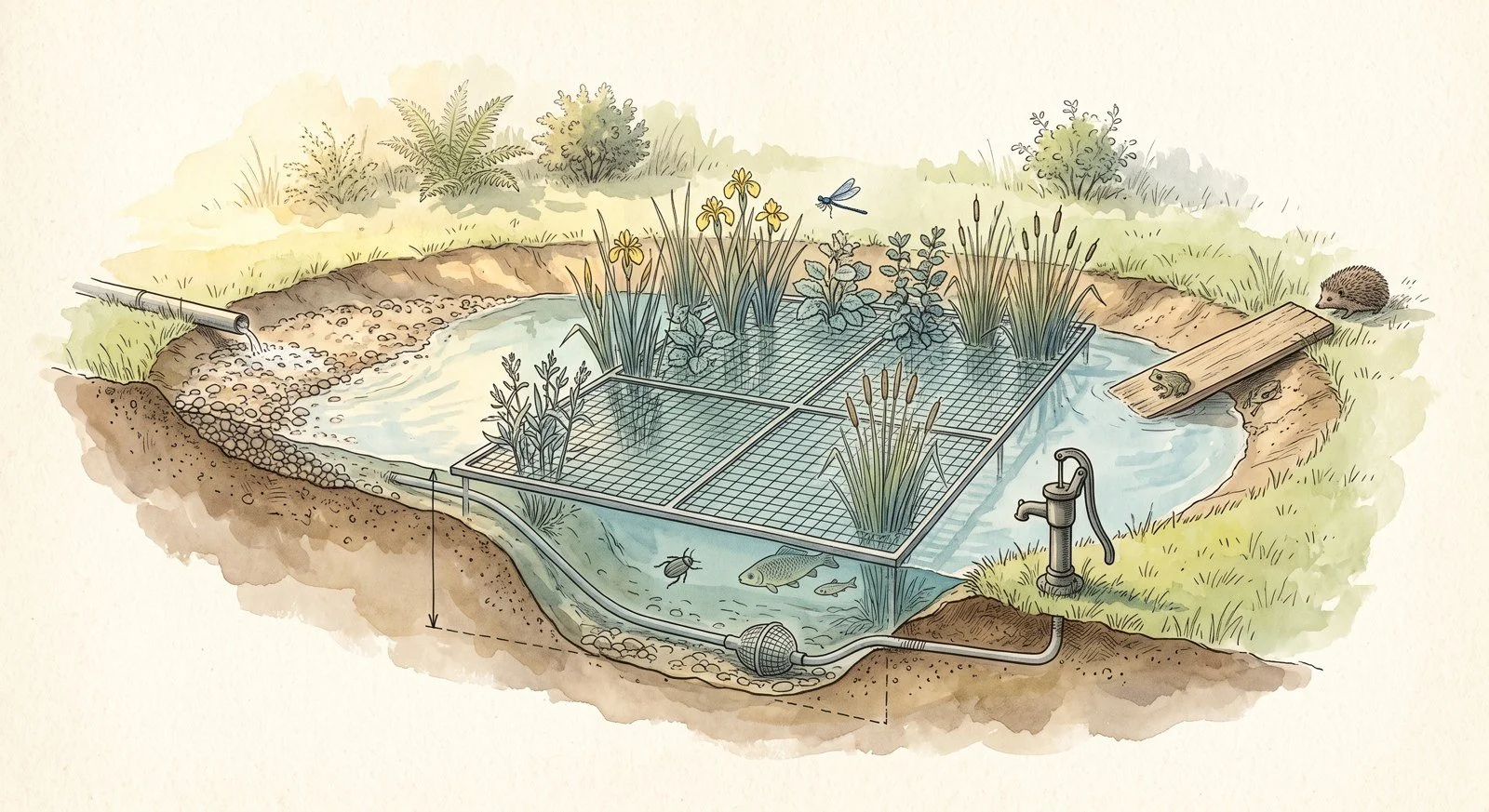
The overflow pond in morning sun: gently sloping edges, an exit plank for small wildlife, a rigid grid over the deep zone, and the strainer under the grid that rises to the pump to draw living water.
Key point. The overflow never goes to the sewer: swale, trench or pond. Where toddlers move around, no deep open water: a swale, or a rigid grid over the whole deep zone. Always an exit ramp for small wildlife. The pond, in morning sun, gives living water, drawn through a strainer under the grid.
Part 5. Birds in summer: the birdbath and its reserve
This part says how to offer water to birds, and above all how to keep some for them in August, without creating a mosquito nursery.
In town, in summer, birds no longer have a single puddle. Watch a blackbird or a sparrow at the first birdbath offered to it: it steps in at the edge, drinks, splashes for a long time, then preens its feathers in the sun. Birds need to drink, and to bathe to keep their feathers in order, several times a day in the hot hours. A well-designed birdbath is one of the cheapest and most useful additions to a tank.
Its shape. Two and a half to five centimetres of water, no more, on a rough bottom, stone, slate or bonded gravel, where feet can grip. Best of all is to put in five centimetres of water and place stones of different sizes in it. The largest stand out and serve as perches, the medium ones are just level with the surface, the small ones stay under water: each bird finds the depth that suits it, the goldcrest at the edge of a pebble, the blackbird between two stones. The stones come out and are scrubbed with the birdbath. A diameter of sixty to eighty centimetres is enough, a surface of a quarter to half a square metre. Place it one or two metres from a shrub that serves as a refuge, but not right against it, so as not to give cats a hiding place.
Its position. On the overflow route. Water leaving the tank passes through the birdbath before reaching the pond or swale, and the outlet sill, set at five centimetres, fixes the level. This requires the birdbath to be lower than the tank overflow: sloping ground, or a birdbath set into a slight hollow in the ground. On flat ground, the overflow of a buried tank goes straight to the pond or swale, and the birdbath is filled by the barrel and its float valve, described below. During rain, its water is renewed continuously, which is the best remedy against mosquitoes.
Summer, the reserve. In summer there is no more overflow, and that is when birds are thirsty. A reserve is then needed. The calculation is simple: a water surface loses around five litres per square metre per day in high summer. A birdbath of half a square metre therefore uses two to three litres a day, a hundred and fifty to two hundred litres for two months without rain. These can be supplied in several ways, depending on the site.
If the tank is raised or the ground slopes, gravity is enough. A float valve, from a toilet cistern or a livestock trough, keeps the level by drawing from the bottom of the tank, above the sediment. With the garden tap placed higher, a few dozen litres reserved for the birds always remain at the bottom. This does not cover a whole summer: top it up by hand during the weekly visit.
If the tank is buried on flat ground, and therefore lower than the birdbath, add a closed barrel of a hundred to two hundred litres, placed on a stand. Fill it from the tank with the pump a few times during the summer. This barrel feeds the birdbath through a float valve.
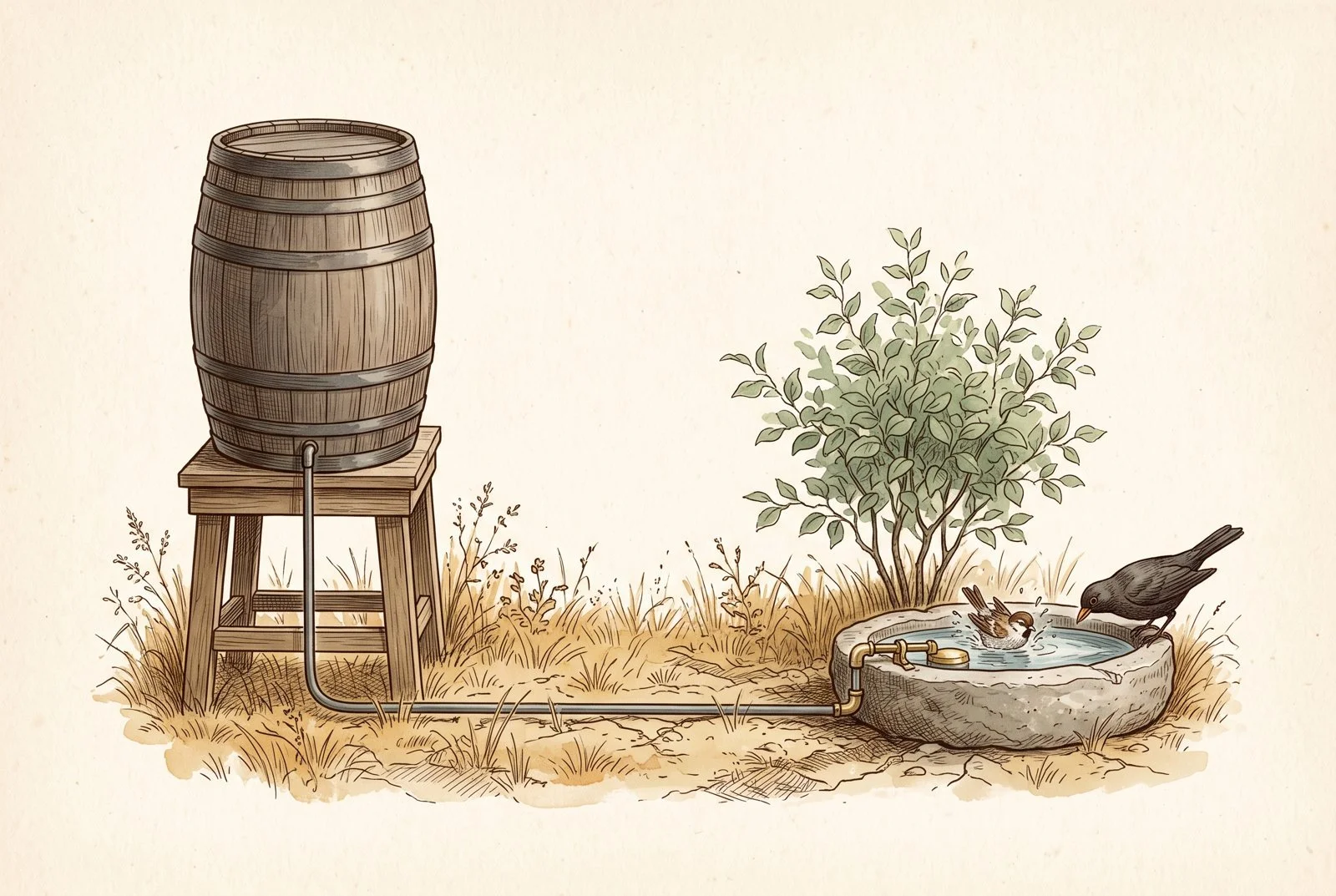
The summer reserve: a closed barrel on a stand feeds the birdbath by gravity, and a float valve keeps the level.
And on small sites, the birdbath is filled by hand during the staff member's weekly visit, since that visit is needed anyway, as we will see.
Keeping it healthy. With the tiger mosquito, the birdbath demands rigour, because five centimetres of water are enough for its eggs. It is emptied and scrubbed every week, walls included, since that is where the eggs are stuck. Drop in a Bti briquette or tablet (Bacillus thuringiensis israelensis), a soil bacterium that attacks only the larvae of mosquitoes and a few related flies, and which mosquito control services use routinely. It does no harm to birds, fish or bees. It supplements scrubbing, never replaces it. And I recommend a birdbath only where someone is named to make this visit: with no named person, do not install one.
Child safety. A toddler can drown in a few centimetres of water. A wide birdbath with a sloping bottom and no high rim is nothing like a tank, but treat it like a fountain: within sight of adults, and outside the toddlers' area in a nursery.
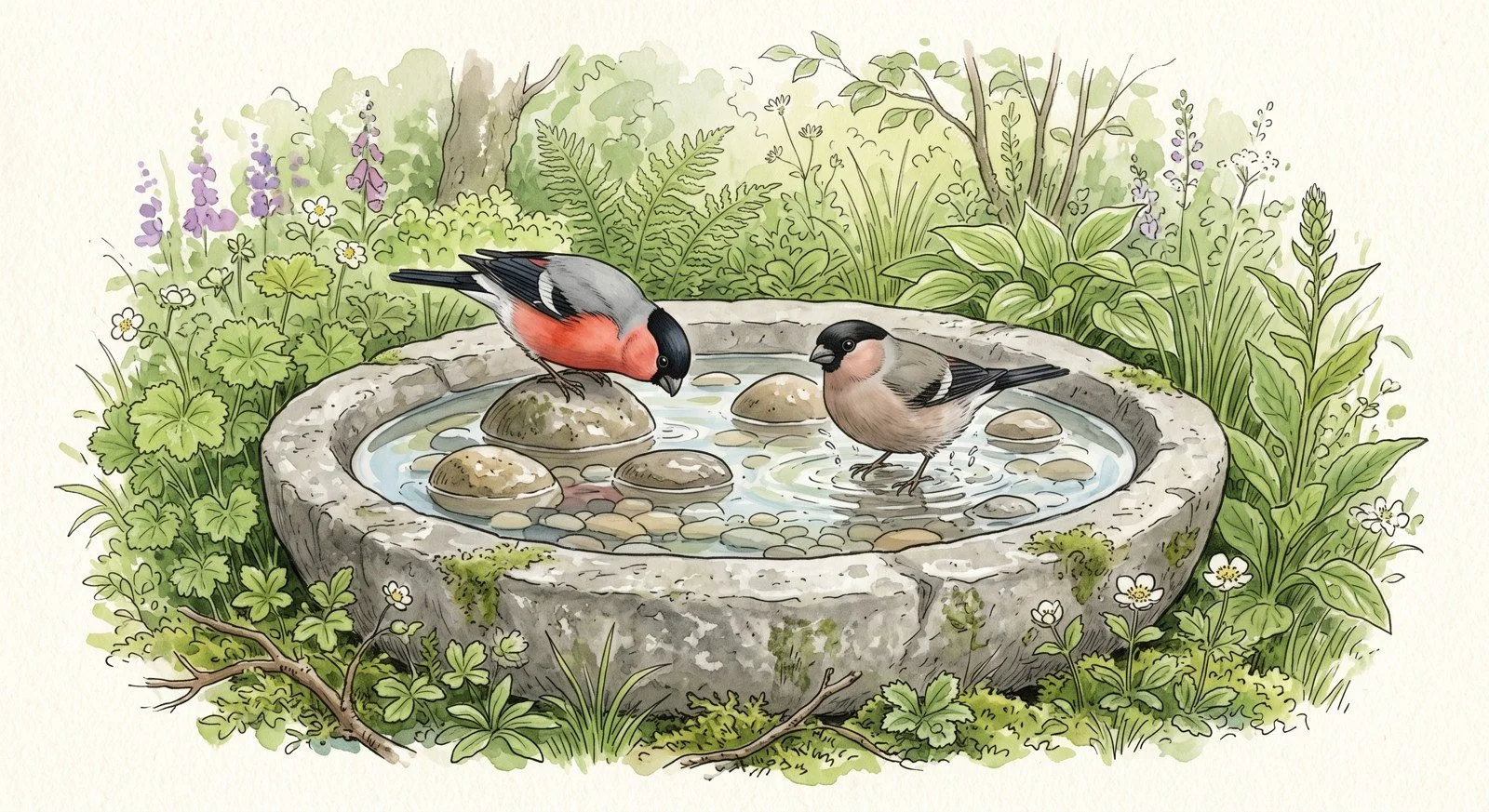
The birdbath: five centimetres of water, stones of different sizes to perch on, and a staff member who empties and scrubs it every week.
Key point. Five centimetres of water at most, stones of different sizes, a reserve for summer. The birdbath is emptied and scrubbed every week. No named person, no birdbath.
Part 6. The resident: a household installation
Here, for anyone with a gutter and a garden, is what to install, in what order, and what it asks of you afterwards.
Two installations are possible, depending on space and budget. The real one is the three-to-five-cubic-metre buried tank described above, with its birdbath and its overflow to the soil. The small one is a closed above-ground tank of three hundred to a thousand litres, suited to a balcony, a courtyard, or a plot where you cannot dig.
For the small one, five items are enough. A collector fitted on the gutter downpipe, with a filter that holds back leaves and debris and, better still, a first-flush diverter. An opaque tank, set on a solid base and in the shade. A lockable lid, strong enough to bear a seated adult, because children climb on tanks, with stainless steel grilles of one millimetre mesh at most on the inlet and overflow. A tap placed ten or fifteen centimetres above the bottom, to leave the sediment where it is. And an overflow connected not to the sewer but to the birdbath and then to the foot of a tree, a bed or a swale. The rain that does not fit in the tank thus goes back to the soil instead of overloading the network.
If you already have an open trough. Like mine, a drinking trough or an old barrel can be saved without replacing it. Cover it with a rigid mesh panel strong enough to bear an adult, lined underneath with fine insect mesh stretched over the whole surface. Fit a tap about ten centimetres from the bottom, and stop dipping the watering can in. The water breathes through the grid, and neither a child nor a mosquito can get in.
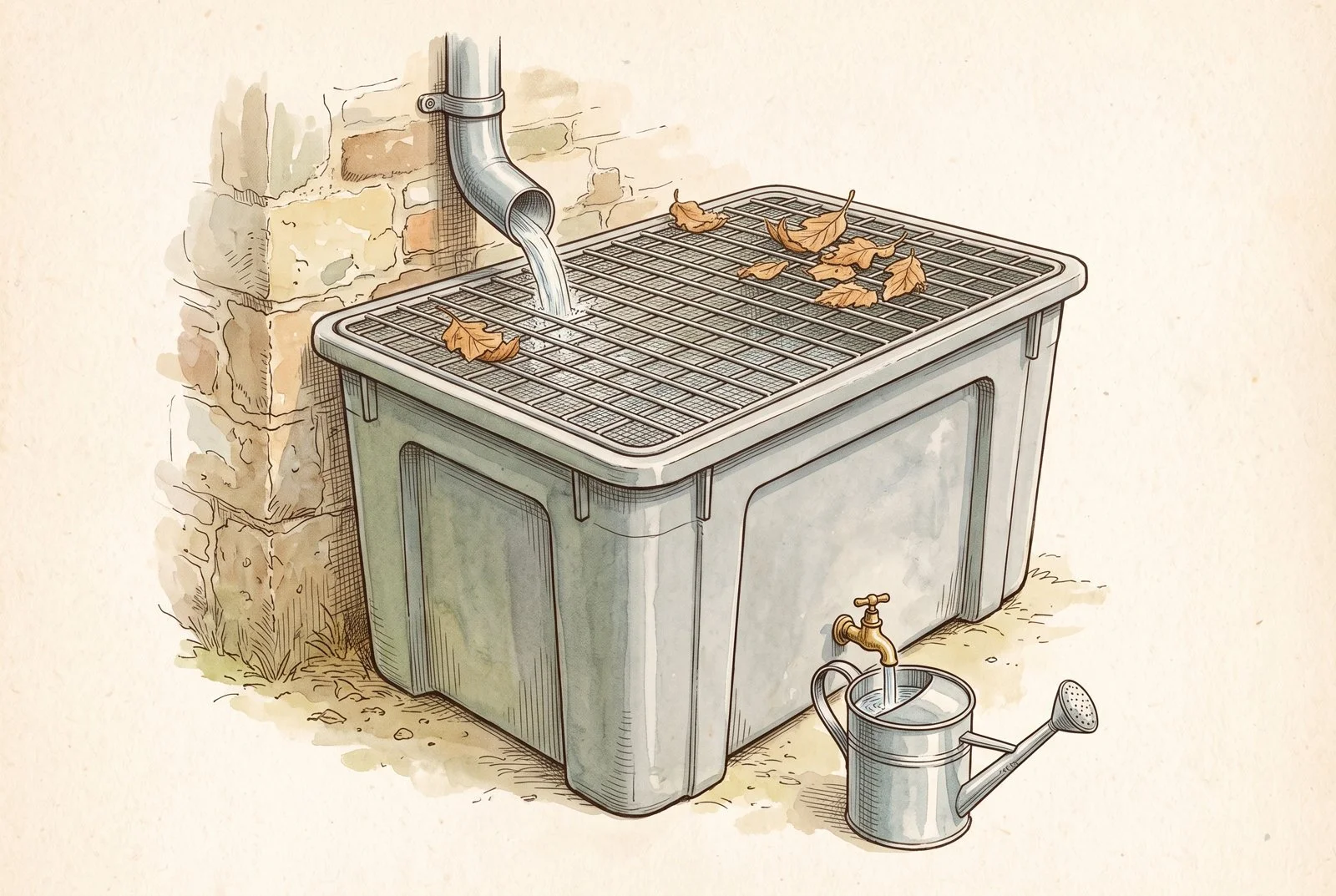
An open trough saved without replacing it: a load-bearing grid, insect mesh underneath, a tap above the sediment.
For the winter, the tank stays in place. Lower the level before frosts or leave the tap slightly open. Twice a year, at leaf fall and in spring, clean the gutter and the filter. That is all the maintenance.
As for use, rainwater may be used freely in the garden of a private house. For toilets or floor washing, a declaration to the town hall is required as soon as the discharge goes to the sewer. The framework has been set since 2024 by a decree and an order of 12 July 2024, which replaced the 2008 order. It requires a separate, labelled installation, never connected to the drinking water network, and an opaque, covered reservoir protected from insects. Many municipalities, inter-municipal bodies and water agencies partly fund the purchase of a rainwater butt: asking at the town hall before buying can save a third of the price.
Key point. A buried tank of three to five cubic metres, or a closed above-ground tank. An open trough can be saved with a load-bearing grid, insect mesh and a tap. Rainwater may be used freely in the garden.
Part 7. Together: blocks of flats, schools, shared gardens
When several people share the use of the same roof, the question becomes one of organisation.
What one resident does for three hundred litres, a group can do for ten cubic metres, and that is where things become serious. A block of flats with a planted courtyard can connect two or three downpipes to a single buried tank, invisible under the courtyard or a bed, and supply the building's garden without using a single litre from the mains. The budget is voted once; the water bill falls every year.
The school is the best candidate of all. Its roof is large, its teaching garden needs water, and children immediately understand the drop's journey, from the sky to the tank and then to the carrot. The tank is buried and locked, and it is the only system I consider acceptable in a playground. The birdbath, for its part, is a classroom resource: the children count the species that bathe in it, under an adult's eye, and the class shares the weekly scrubbing with the staff member.
The shared garden follows the same logic: the garden shed has a small roof, the tank is next to it, and the association decides who fills the watering cans and who comes by each week. A nursery, a community work garden or a neighbourhood vegetable garden can work the same way, with the same basic rule: a closed tank, a tap, and a named person.
Key point. A shared tank, a budget voted once, a named person for maintenance. At school, the tank is buried and locked.
Part 8. The local authority: organising collection
This part sets out, in order, what a technical department can do to turn municipal roofs into a network of reserves. A local authority does not install a tank; it organises a network.
Survey the roofs. Schools, sports halls, town hall, municipal workshops, covered market, library, nurseries: measure each roof, note the local rainfall, calculate the annual volume. This twenty-line table settles many hesitations, because it shows that municipal roofs often deliver more water than is needed to irrigate the whole municipality.
Link each roof to a need. A reserve only makes sense next to what it waters: the neighbouring public garden, the row of street trees, the planters, the cemetery, the school garden. Where roof and need are far apart, the solution is the department's mobile water bowser, which fills up at the tank instead of at a fire hydrant.
Choose the storage format. Three formats are enough. The buried tank of ten to thirty cubic metres, for large roofs and parks, invisible and frost-free, which is my default choice. The closed above-ground tank of one to five cubic metres, the cheapest, suited to small buildings and, outside playgrounds, to gardens where digging is impossible. And several tanks linked in series, which allows storage to be extended without starting again.
Make the department's bowser the first customer. This is the quickest step. The teams that water young plantings in summer currently fill their bowsers with drinking water. They can fill them at the nearest tank, provided the draw-off point is planned, the tank is labelled "non-drinking water", and no pipe connects the tank to the network. The only exception is a top-up through regulatory backflow prevention, a simple air gap. The saving in drinking water is immediate and shows on the bill. One precaution: the 2024 framework in principle limits the use of rainwater to the building or establishment where it is collected. Filling a bowser to water elsewhere should be confirmed with the regional health agency (ARS) before it becomes general practice.
Write the rule once. In the local development plan, require for every new build or major renovation that rain be managed on the plot, with collection and overflow to a permeable area. In the specifications for new municipal buildings, include the tank, its connection, the birdbath and the pond or swale before the very first drawing. Add safety: a locked, load-bearing lid, stainless steel grilles on the inlet and overflow, a "non-drinking water" sign, an exit ramp for small wildlife. The municipality's stormwater zoning can require this on-plot management, and water agencies often fund part of the equipment.
Support residents. A "Gutters" campaign, with group purchase of rainwater butts, a connection kit fitted or explained, a price subsidy, and a first workshop at the market or the school, reaches far more households than a poster alone. The local authority does not need to fund everything: it organises, residents buy, and the water saved belongs to everyone. For those who already have an open trough, the campaign offers the safety kit: load-bearing grid, insect mesh, tap.
Plan who maintains it. Most projects stop here, for want of someone to take charge. A tank with no designated staff member becomes a mosquito breeding site within two summers, as soon as a filter clogs or a mesh tears, and an unscrubbed birdbath becomes one within two weeks. In the survey table, add a column: who cleans the gutter in autumn, who checks the mesh in spring, who scrubs and fills the birdbath every week in summer. Half a day per tank per year, and a weekly visit of a few minutes for the birdbath, are enough.
Measure and show. A simple graduated mark on each tank, and an annual report of a few lines in the municipal newsletter: cubic metres collected, cubic metres of drinking water saved, trees watered, birds seen at the birdbath. A mayor who can say "our roofs watered the town's trees all summer" has an argument residents remember.
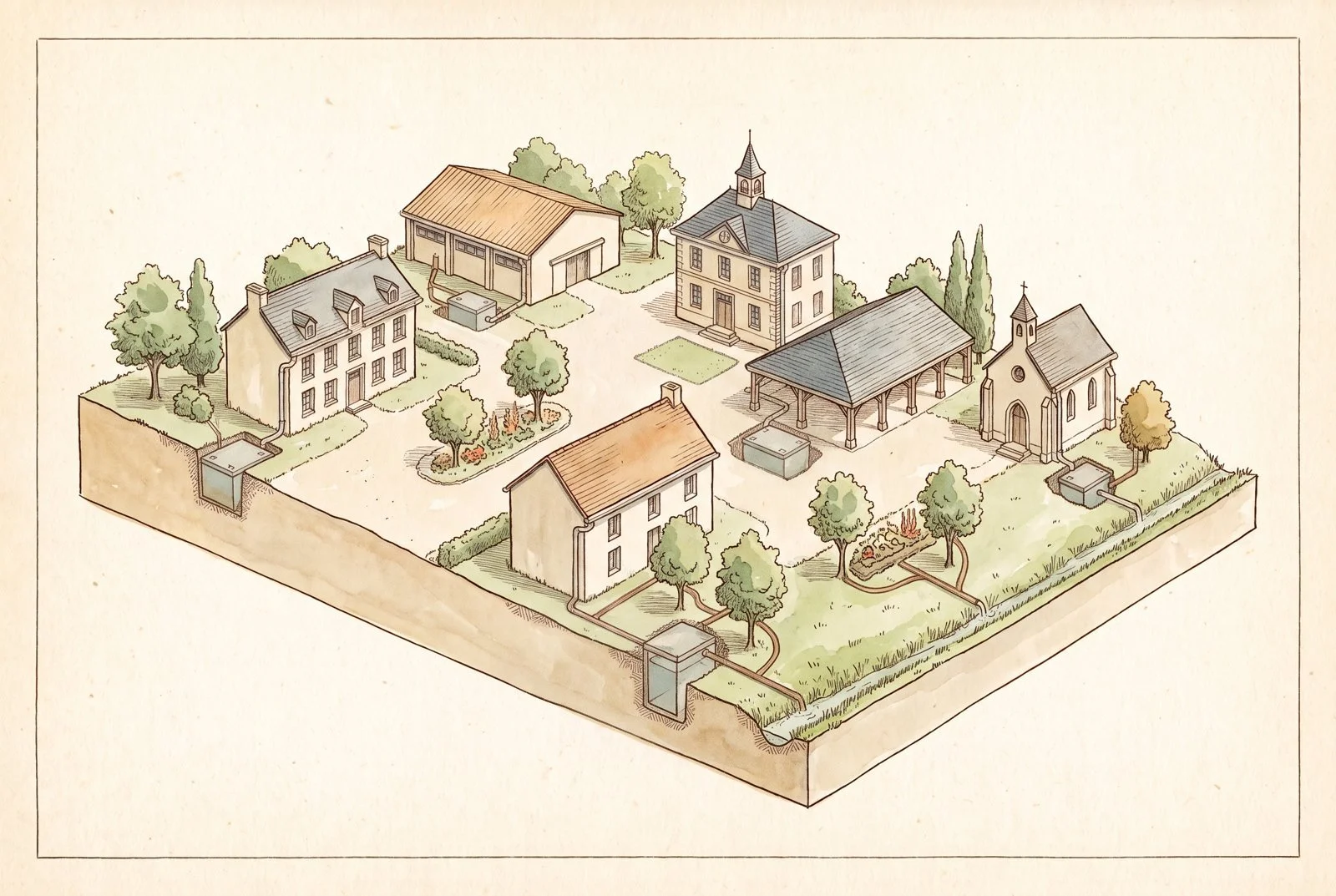
A closed tank under every public roof, each serving the trees around it, and the overflow from all of them to a swale that returns the water to the soil.
Key point. Survey the roofs, link each roof to a need, make the department's bowser the first customer, write the rule into the local development plan, name who maintains it, measure and show.
Part 9. A chosen greywater: from reed to tank
This part explains how to choose which water point in the house to treat. It describes the system in which this water passes through a reed bed and then a sand bed before reaching a buried tank. It then gives the method for sizing according to flow and recalls what the regulations say.
Choose the water point, not the whole house. I do not propose treating all the water of a house. I propose choosing the place where greywater is used most: the kitchen sink, or the washbasin in the shared bathroom, the one the whole family uses every day. The washbasin is the simplest in regulatory terms, the sink the most regular, as we will see. Toilets never enter the circuit. The aim is modest and regular: to recover about fifty litres of our daily consumption, enough to water without the household having to change its habits. A kitchen sink uses ten to twenty-five litres per person per day, and a family of four reaches this figure effortlessly. This small, constant and known flow is what makes the system simple and safe. Household water contains soaps, fats, sodium from detergents, food scraps and bacteria, and it degrades within a day without air, which rules out storing it as it is. It must therefore be treated before the tank.
The system: three stages. Water from the chosen point flows straight outside into a first bed planted with reeds. It is filled in decreasing grain size: large stones at the bottom for drainage, then gravel getting finer towards the top. This is where the roots settle and where the water passes slowly down through the voids. The water stays below the surface of the gravel, which matters for safety: there is no visible water where a mosquito could lay or a child could fall. On the roots and on every grain lives a film of bacteria that digests fats, soaps and organic matter, while the plants bring air to the heart of the bed. The water leaves at the bottom and flows into a second bed filled with sand, where what I call the mother forms, described below. It enters directly into the mass of the sand: there is never water at the surface, only moisture, so this bed too gives the mosquito no foothold. Finally it flows into a buried tank, from which water is drawn for watering. Each stage does what the other does not: the first absorbs the raw load and the surges, the second refines, the third stores.
I do not put a grease trap in front of the first bed. The grease that stays at the surface is not waste: it feeds the bacteria of the bed, then those of the mother. The only risk is clogging of the top layer. It disappears when two conditions are met: a low flow, which is the case here, and a rim high enough above the bed for water to spread out without overflowing if the surface clogs a little. This film of water must remain exceptional and disappear within a few hours: if it lingers, it is the signal that the surface needs reworking, because it would become a mosquito breeding site again. A simple strainer in the sink plughole is enough to hold back large debris.
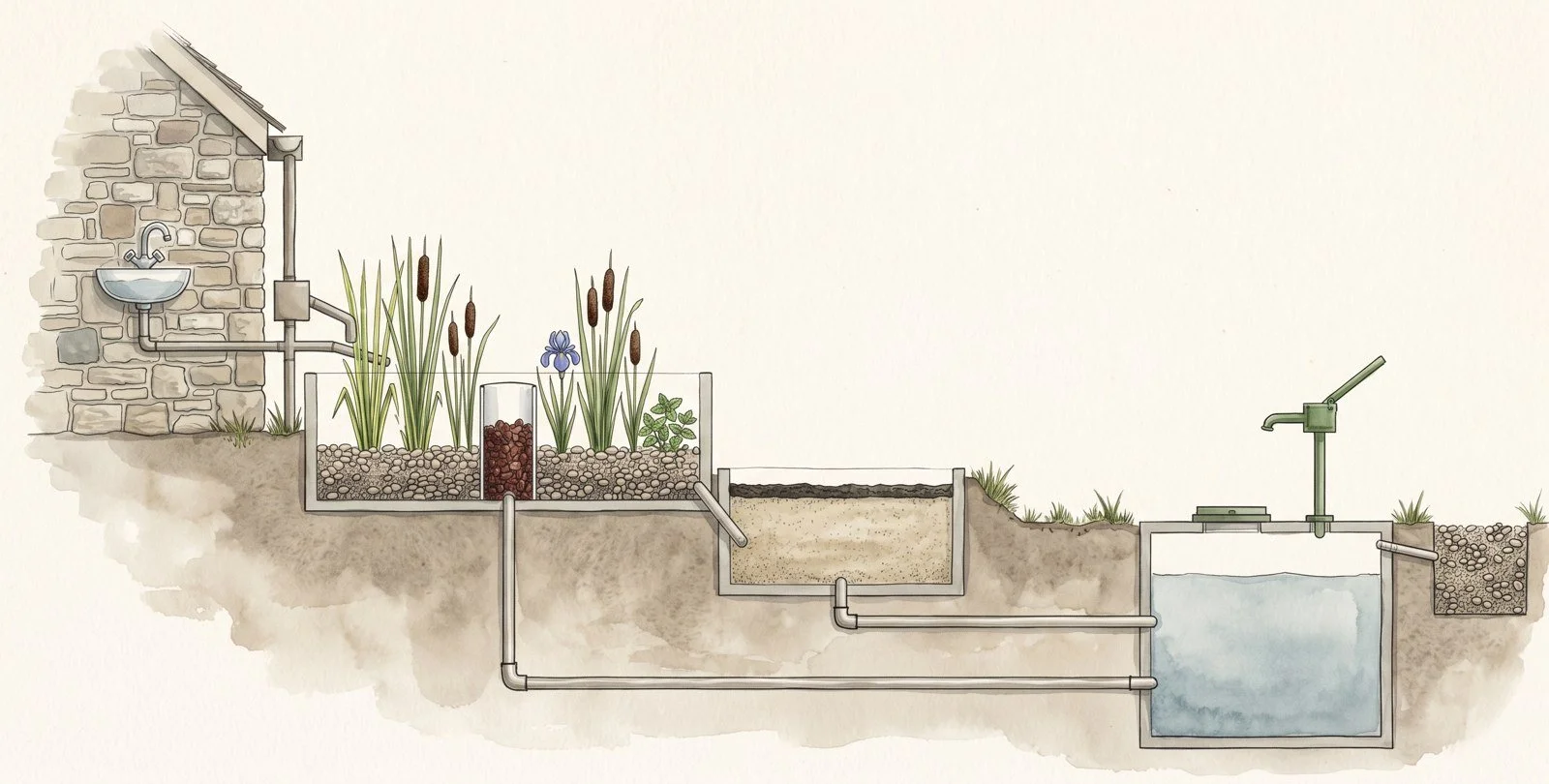
The sink and the gutter, the reed bed with its pozzolana tube, the sand bed and its mother, then the buried tank: the water only ever goes down.
The plants. The first bed receives two plants. Common reed (Phragmites), whose variegated form is more decorative, is the working plant: its roots and rhizomes go deep and carry most of the bacterial life. Dwarf reedmace (Typha minima), with a small pompom, which grows no taller than a metre, completes the bed and does not invade it as the large reedmace does. It is protected in France: buy it from a nursery, never take it from the wild. These plants establish in one season and need cutting back at the end of winter, the cut material going to the compost. They stay in their bed: common reed spreads by its rhizomes, and the bed must be closed on the sides and underneath. Around these two plants, the space freed by oversizing is planted with other wetland species. Add water irises, such as yellow flag or Siberian iris, which flower in May and June, and water mint, which likes wet feet and scents the path. These plants also work, through their roots, and they make the bed a feature of the garden. Do not eat what grows in this bed: the mint is there for its scent and for pollinators, not for tea.
The mother. The sand bed carries what vinegar makers call a mother: a living skin of bacteria, algae and protozoa. It forms in the top few centimetres of the sand, kept moist by the bed, and it does most of the final purification. The principle of the mother is never, ever to touch it. No rake, no sand added or removed, no trampling. It takes two to three months to form, and during that time the water coming out is not used. As with the pond in Part 4, a bad smell may arise at first, then algae, mosses and plants move in and balance establishes itself. Even if the mother looks unwell during these weeks, do not touch it. It fears three things: drought, bleach and disinfectants, chemical drain cleaners. If the house stays empty for more than a few weeks, keep it a little moist, for example with a drip line fed from the tank.
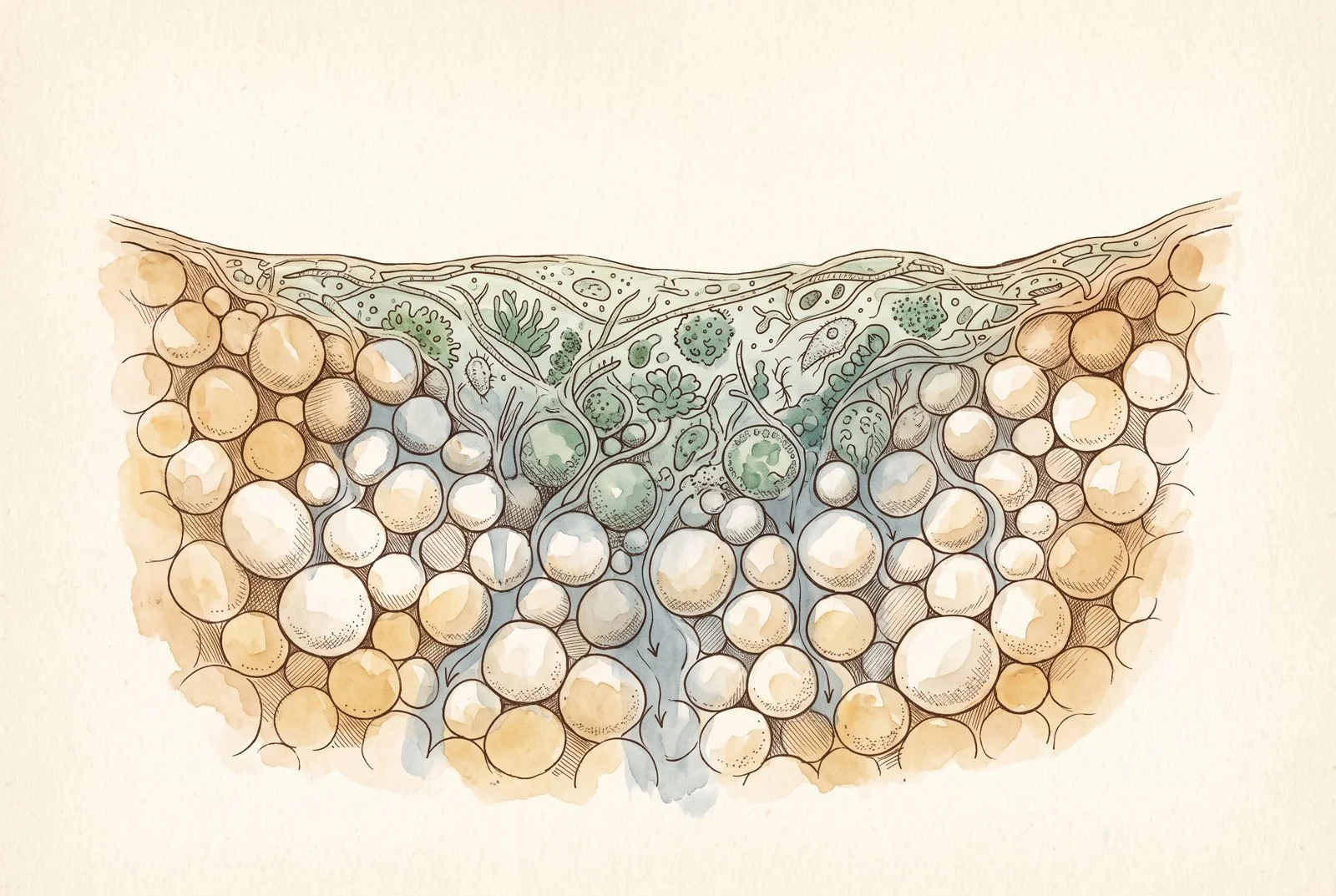
The mother: a living skin in the top few centimetres of the sand, never to be touched.
Sizing: oversize relative to the flow. Everything starts from the flow, fifty litres a day in our case, and you check that it is real by measuring over a week what the sink or washbasin discharges. The dishwasher stays connected to the sewer: its water carries the most alkaline detergents and the salt from its built-in softener, which neither the bed nor the soil can tolerate. A reed bed accepts around fifty to a hundred litres per square metre per day for kitchen water. The strict calculation would therefore give half a square metre to one. I oversize: two to three square metres for fifty litres, a load of twenty litres per square metre per day, two to six times less than the bed can take. This oversizing absorbs the morning and evening peaks, holidays after which everything restarts, a dinner for twenty, and gives the bed long hours of rest. It poses no space problem if it is treated as a garden feature in its own right. Two to three square metres of reeds, irises and mint make a small water garden, with no open water, at the foot of a wall or along the edge of a terrace. The bed is sixty to eighty centimetres deep and takes about four plants per square metre. The rim of the first bed should be generous above the bed, around twenty centimetres, so that a surface that clogs keeps a reserve before overflowing. The sand bed has a similar area, over forty to sixty centimetres of washed, graded sand. The tank is sized for ten to twenty days of production: five hundred litres to one cubic metre. It has an overflow to an infiltration trench, because in winter the plants drink little and the tank overflows. These values are the usual orders of magnitude for planted filters. Final figures are set on site, according to soil, climate and use, and validated by an engineering consultancy. The file follows the procedure described below.
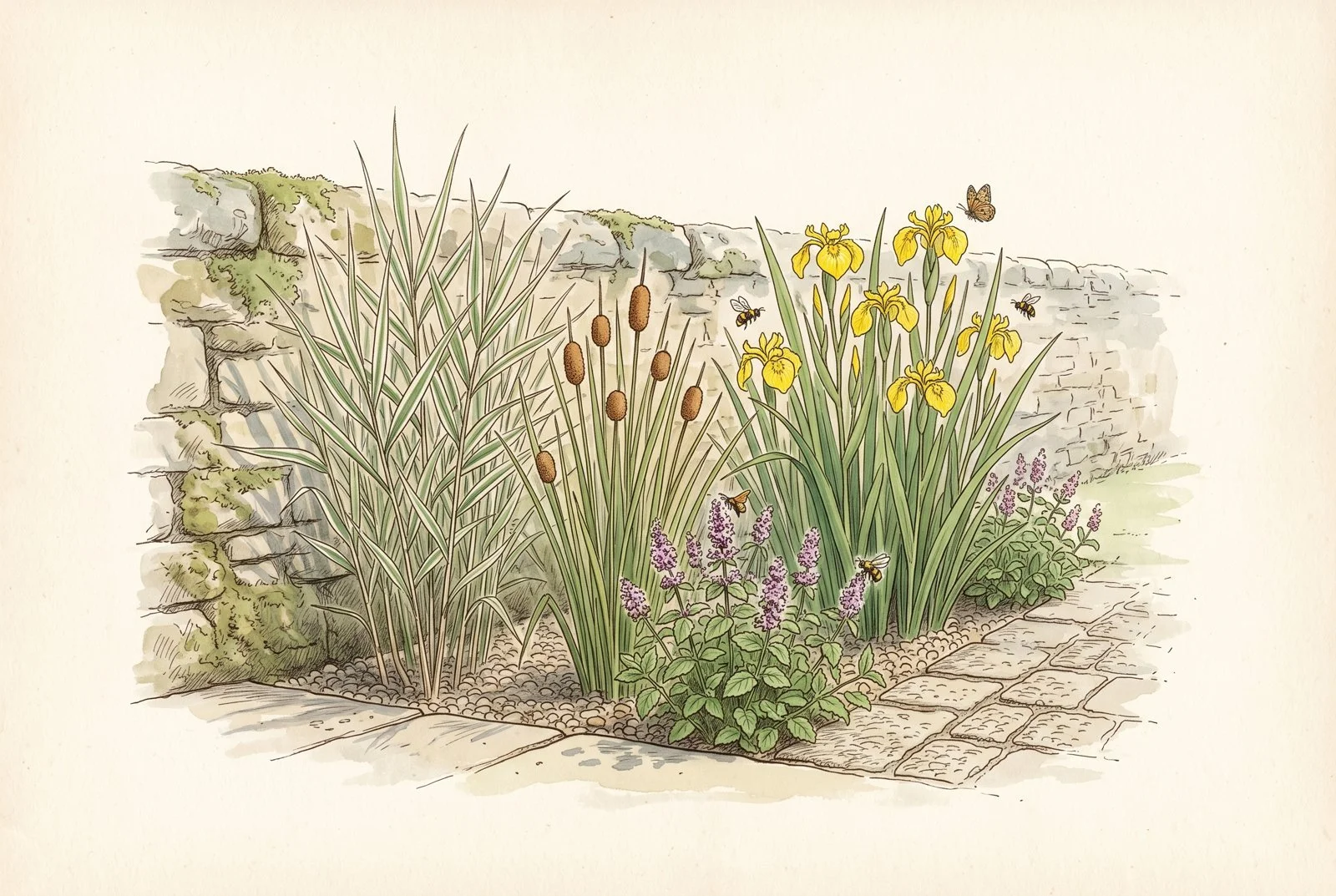
Oversized, the filter becomes a garden bed: reeds, reedmace, irises and mint at the foot of the wall, with no visible water.
What the system cannot tolerate. Bleach and disinfectants, chemical drain cleaners, frying oil poured down the sink in quantity, very alkaline detergents in large quantities. Choose biodegradable washing-up liquids and put oils in the bin, not down the drain.
The regulations. They have changed recently, and you need to know them before digging. In French law, kitchen and bathroom water is domestic wastewater, even when only a small share of it is treated. If your street is served by a sewer, connecting the house remains compulsory. If you are on non-collective sanitation, your installation remains under the control of the public non-collective sanitation service (SPANC), which can only approve a regulatory or approved system. The system I describe therefore does not replace the house's sanitation: it is added to it, for a small share of the water. A different framework applies, that of the reuse of water unfit for human consumption, set by a decree and an order of 12 July 2024. For water from showers, washbasins and washing machines, watering green spaces requires a declaration to the prefect, with a water quality to achieve and regular analyses. Kitchen water, excluded in 2024 because of fats, may since the order of 29 July 2026 be reused on an experimental basis, until 2034, with authorisation from the prefect after the opinion of the regional health agency. The bathroom washbasin therefore requires a declaration, the kitchen sink an authorisation. In both cases the water stays on the plot where it is produced and waters plants that are not eaten, preferably below ground, without spraying. In Morocco, Water Law 36-15 recognises the right to collect rainwater and makes any reuse of wastewater subject to authorisation by the river basin agency. You should also contact the municipality and the regional multi-service company that has taken over distribution. In every case, find out before building anything.
And roof water through the same filter. When possible, I route roof water through the same planted filter as the greywater. A roof collects months of dust, soot, pollen, droppings and traces of metals, and the first rain washes all of this towards the tank. The reed bed and its bacteria capture these pollutants, just as they capture the soaps from the house, and the tank receives much cleaner water: less sediment at the bottom, less muck to pump out. Both inlets, the gutter downpipe and the sink pipe that passes through the wall, discharge at the head of the bed. The downpipe filter stays in place for leaves. The first-flush diverter, on the other hand, becomes unnecessary: this first water, the most loaded, arrives at a low flow before the bed fills, and it is precisely what the bed retains.
Three precautions. The first is flow: a filter of two to three square metres receives fifty litres a day of greywater, and a ten-millimetre shower on a hundred square metres of roof brings a thousand in an hour. It is enough to build, in the centre of the planted bed, a pozzolana overflow that goes straight to the tank: a large PVC tube filled with pozzolana, sealed into the bed, with its outlet below. Its rim stands a few centimetres above the level of the bed, so that it only takes water when the bed fills. This porous volcanic rock lets water through very quickly: light rain passes through the bed and its roots, a storm passes through the pozzolana, which still holds back leaves and grit, and the bed does not drown. With the roof connected, a film of water therefore appears at every heavy rain; it is not the warning sign I mentioned above as long as it drains away through the tube within a few hours. For safety, the bed has a second overflow to the swale at rim height, in case the tube blocks, and on clay soil this is kept away from the wall like the tank itself. The second precaution is the size of the tank. It is no longer the small five-hundred-litre tank, but the three-to-five-cubic-metre tank of Part 6, whose overflow follows the route of the birdbath and the pond. During the two to three months while the mother forms, roof water follows the same path as greywater and is not used either. The third is regulatory: as soon as roof water mixes with treated greywater, the whole tank falls under the stricter framework of the two waters it receives, declaration or authorisation, with its uses limited to the garden. Where you want to keep rainwater free for any use, and rainwater for the greenhouse and seedlings, give the roof its own small planted filter, of the same construction, upstream of its tank.
What to do with the water in the tank. It waters trees, hedges and ornamental beds, preferably below ground, a few centimetres deep. Never on leaves, never on anything eaten, never on the young seedlings in the greenhouse, which keep rainwater. The tank carries a "non-drinking water" sign, a locked lid, and no connection to the drinking water network. In summer, fifty litres a day is the quiet back-up for the rain tank when it runs low, if the two tanks are separate. A local authority can apply the same principle to a heavily used water point, a canteen kitchen or changing room washbasins, under the same framework, with the regional health agency.
Key point. A single water point, about fifty litres a day, excluding toilets and dishwasher. A reed bed, a sand bed, a buried tank, by gravity. When possible, roof water passes through the same filter, with a pozzolana overflow to the tank for storms. The washbasin requires a declaration to the prefect, the sink an experimental authorisation.
Part 10. The tap and the tank: what happens to the water
This part explains what happens to roof water and tap water once stored, and how to make them useful to plants. It deals with chlorine in mains water, limescale, ericaceous plants and lime-loving plants, other waters and salt, then living water for inoculation, and finally how to water. These treatment tanks are auxiliary containers placed near the point of use, separate from the buried rain tank, which stays closed and dark. One rule runs through everything that follows: any tank or container in which water is treated stays covered with a rigid grid and fine insect mesh, which let air through and keep children and mosquitoes out.
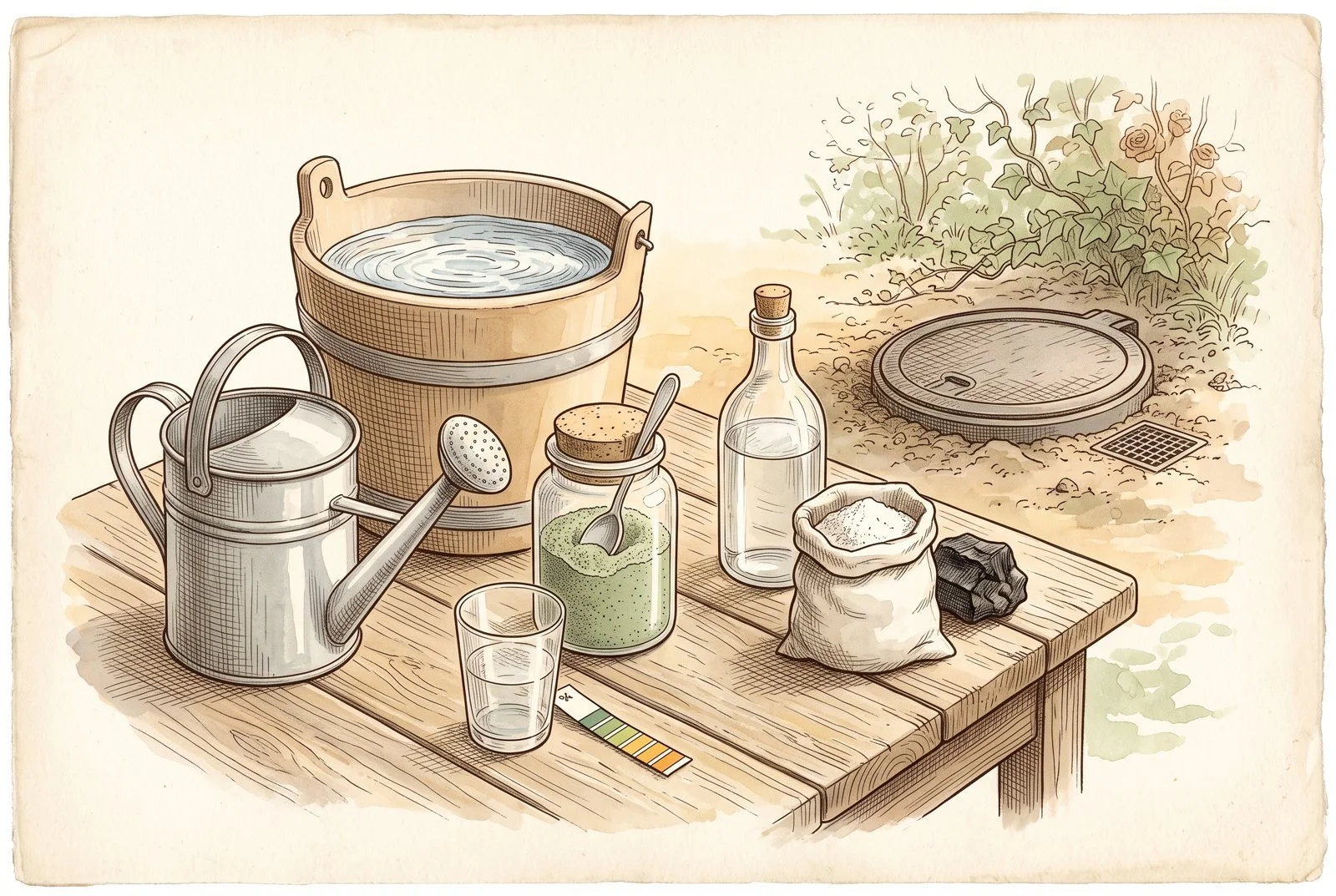
Tap water and its correctors: green clay, vinegar, charcoal, the pH strip.
What the root really drinks
Let us start with something obvious that is often forgotten. The root does not take up water. It takes up a solution. Every drop that passes through the soil carries with it what it has dissolved on the way: calcium and potassium, nitrates, acids left behind by bacteria. It is this very dilute soup that crosses the root hair. The water you pour is therefore never the plant's final drink. It is the raw material of a solution the soil makes within a few centimetres.
From this follows the rest. Imperfect water poured on living soil is corrected before it reaches the root. Chlorine reacts with the first organic matter it meets. Limescale is deposited or combines. Temperature evens out in the mass. Conversely, perfect water poured on a dead substrate, an exhausted bagged compost, a lifeless balcony pot, reaches the root as it is, with its qualities and its faults. Water quality matters all the more the poorer the medium it passes through. That is the first rule, and I will come back to it at the end, because it governs all the others.
Rainwater, the benchmark
Water that falls from the sky has been distilled by the sun. It evaporated from a sea, a lake or a forest, leaving its salts behind, then condensed around a speck of dust, a pollen grain or a bacterium, and it comes back down almost pure. Almost, because as it passes through the air it dissolves a little carbon dioxide, which makes it slightly acidic, between pH 5.5 and 6.5. In thunderstorms it also collects a little of the nitrogen that lightning has torn from the air. Old gardeners used to say that storms make things grow. They were right, modestly: lightning nitrogen weighs only a few hundred grams per hectare per year, but it arrives in an immediately available form, at the very moment when the soil is saturated.
This soft, slightly acidic water suits every plant without exception, and first of all those that shun lime: rhododendrons, camellias, blue hydrangeas, blueberries, heathers, most plants of acid woodland. For a seedling, a cutting, a potted plant, it is the ideal water. For living garden soil, it is one water among others, because the soil will do the rest.
The water you collect, however, is not quite the water from the sky. It has washed a roof. A tile or slate roof gives excellent water. A zinc or copper roof releases traces of metals, harmless for an ornamental bed, but I do not send it to the vegetable garden. A bitumen roof or old fibre cement call for the same caution. In every case, let the first minutes of rain after a long dry spell pass: they carry away the dust, droppings and everything that has built up on the roof. First-flush diverters do this sorting without you having to think about it. Finally, an opaque, covered reservoir kept in the shade keeps its water for months without smell. The film that coats its walls is a film of bacteria. It harms nothing. It is even the first sign that this water is alive.
Tap water and the question of chlorine
Mains water is treated to remain drinkable all the way to your sink. In France as in Morocco, the most common disinfectant is chlorine, injected as a gas or as hypochlorite, which becomes hypochlorous acid in water. A few tenths of a milligram per litre remain at the tap: that is the dose that gives the morning glass of water its swimming-pool taste in some towns. It is there to kill bacteria in the pipes. The gardener's question is therefore legitimate: does what kills bacteria in the pipe not kill those in the soil?
The answer is short: it all depends on what the water meets. Free chlorine is a hasty oxidant. It reacts with the first oxidisable thing it meets, and living soil offers it tonnes of organic matter per hectare. The few milligrams of chlorine in a watering can are neutralised in the first centimetre of soil, long before they reach the mass of bacteria, fungi and worms working further down. Measurements on this subject show that concentrations ten to a hundred times higher than at the tap are needed to see microbial populations in a soil decline, and that they recover within a few days. On a lawn or a garden bed, tap-water chlorine is not the problem people think.
It becomes one again in three specific cases. First, anything living in a medium poor in organic matter: a seedling in vermiculite, a cutting in sand, a crop in rock wool or hydroponics. There, nothing neutralises the chlorine, and it reaches the rootlets intact. Next, anything you prepare to seed life: a compost tea, a fermented extract, biochar soaking water, a plant tea. Pouring chlorine into a bacterial culture you have spent two days waking up is a contradiction in terms. Finally, repetition. A pot watered every day with chlorinated water, in bagged compost that has little left to offer, ends up resembling that pipe the chlorine keeps almost lifeless. It is for these three cases that it is worth knowing how to remove chlorine. For the others, you can do without.
Opening the door to chlorine
Free chlorine is fragile. Part of it escapes into the air, light destroys it, and the slightest organic matter consumes it: the gardener only has to open the door. I have counted six ways of doing so, and observation teaches them all.
The first is to let it stand. A watering can or bucket left open loses a good part of its chlorine in one to two days, faster in the sun. Empty it the same evening or cover it with insect mesh, because the tiger mosquito does not wait. A narrow-necked thousand-litre tank will lose much less, because the exchange happens at the surface: the larger the surface relative to the volume, the faster the degassing. A flat tub in the sun, under its mesh, does in a few hours what a closed drum will never do.
The second is to stir. Each time water is agitated, it renews its surface and releases its gas. Filling the watering can in a cascade from the tap, pouring from one bucket into another, installing a small pond pump that makes a ripple, all of this speeds up the departure of chlorine. You can also water with a rose rather than a jet: chlorine begins to escape in the spray, even before it touches the ground.
The third is to expose it to the sun. Ultraviolet light breaks down hypochlorite. A bucket of tap water left in full July sun is rid of its chlorine in an hour or two; in the shade, allow one to two days. That is why a watering tank left in the sun smells less of swimming pool in the evening than in the morning.
The fourth is to heat it. Heat speeds up the breakdown of chlorine and its escape into the air, and water boiled for a few minutes no longer contains any. This is not practical for a hundred litres, but it suits the litre of water in which you are going to wake up an inoculum or soak seeds.
The fifth is to filter it. Carbon holds chlorine by adsorption. An activated carbon cartridge screwed onto the tap, or a simple drum of charcoal through which the water passes slowly, is enough. The gardener's plant charcoal does the same job, a little more slowly. Tap water dripping slowly through a barrel of crushed biochar comes out dechlorinated, and the charcoal, in doing so, takes on a first load of life.
The sixth is known to aquarists and unknown to gardeners. A pinch of vitamin C, powdered ascorbic acid, instantly neutralises chlorine by simple chemical reaction. You need about two and a half times the weight of chlorine present, less than a hundred milligrams for a hundred litres of tap water. A pinch of a hundred to two hundred milligrams leaves a harmless margin. This is the step for urgent cases, when a fragile seedling must be watered at once or a compost tea diluted without waiting days.
Finally, here is how I proceed for volumes of a cubic metre, those of a site tank or a vegetable garden. I fill it with tap water. I replace its top lid with a rigid mesh panel lined with fine insect mesh: air passes, but neither a child nor a mosquito gets in. I throw in a tablespoon of green clay. Let us see what the mesh and the clay do. It is the air that removes the chlorine, and a tank whose whole surface breathes through its mesh does so in two or three days, while the same tank sealed keeps it for a week. A spoonful of clay in a thousand litres is fifteen milligrams per litre, and clay is not a chlorine neutraliser; what the iron in green clay consumes is real but negligible. What the clay does is something else. It clouds the water with a mineral dust that stays in suspension for a few hours in hard water, before settling as a fine sediment. Each of these particles offers a surface to the bacteria from the air and the dust that fall into the tank. Within a few days, the water stops being the almost lifeless water of the mains and becomes colonised water, with a bed of sediment where life settles, exactly as on the walls of a rain tank. It is not a treatment, it is a seeding, and I come back to it later in this part.
A word, finally, about chloramine. Some networks, especially in North America and Britain, disinfect not with free chlorine but with chloramine, a more stable compound of chlorine and ammonia, which does not evaporate and is not broken down by sunlight. Standing, stirring and heating are then useless; only catalytic activated carbon, with a long contact time, and vitamin C get rid of it. In France and Morocco this process remains rare, but if your water never loses its smell even after two days standing, that is the sign that you need to filter rather than wait. The information appears in the quality report each supplier publishes.
The real enemy is not chlorine
Here is what I have long observed on potted plants and green walls fed with mains water: chlorine has never killed a single one of my plants. Limescale, sodium and cold have.
Limescale first. Water in the Île-de-France is hard, between twenty-five and thirty-five French degrees depending on the area, the exact figure appearing in the supplier's annual report, and each watering deposits a little calcium carbonate in the pot. After a season, the surface of the compost turns white, the pH rises, and plants that need acid soil to take up iron yellow between the veins. That is chlorosis, and it is caused not by chlorine but by lime. In open ground, on soil that is already chalky like ours, hard water changes nothing. In a pot, on a green wall, in a balcony planter, it changes everything.
Sodium next. Many homes have a water softener, and the water it produces seems ideal: no more limescale, no more marks on glasses. For the washing machine, yes. For the garden, it is the worst water there is. The softener does not remove salts; it exchanges calcium for sodium. Sodium, attaching itself to clays in place of calcium, disperses their sheets, clogs the soil, makes it impermeable and suffocating. It is exactly the mechanism that sterilises land irrigated with brackish water. Never water with softened water. Take the water before the softener; there is almost always a garden tap for this.
Cold, finally. In spring and early summer, mains water often comes out noticeably colder than the air. Poured on a pot of basil or tomato warmed by the sun, it can mark the plant, which stays limp for a while after watering. Letting the water reach air temperature, filling the tank the day before to water the next evening, settles the matter, and by the same standing you begin to remove the chlorine. The two steps are one.
A thousand litres of hard water: disarming the lime
So, my thousand-litre tank of hard water, what do I do with it? That depends on where it is going, and I start with the most frequent case, which needs nothing. If this water goes on open-ground soil that is already chalky, it adds only a drop of lime to an ocean of lime. The soil absorbs it without flinching, the deep roots will know nothing of it, and the only useful step is mulching, which stops the water evaporating at the surface and leaving its crust there. Water, and think no more about it.
The case that calls for something is the tank intended for pots, planters, a green wall, ericaceous plants or seedlings. You then need to understand what limescale in water is: calcium bicarbonate, a salt that stays dissolved as long as the water is rich in carbon dioxide, and which is deposited as a crust as soon as that gas escapes. That is why a tank left open to the air does the opposite of what you hope: it loses its carbon dioxide, its pH rises, and a thin white film forms on the walls. Standing alone, so useful against chlorine, removes only a little lime, and at the cost of a rising pH.
The simplest step is to dilute. A cubic metre of rainwater mixed with a cubic metre of tap water gives two cubic metres of moderately hard water, which suits almost everything. When the rain tank is empty in high summer, move on to the next step.
The second step is to acidify, and vinegar is enough. Acetic acid turns the bicarbonate into calcium acetate, which does not precipitate and does not raise the pH. It does not remove the calcium, but it takes away its power to lock up iron, and that is what matters. For water whose alkalinity, the TAC given by test kits, is thirty French degrees, about four and a half litres of eight-per-cent spirit vinegar are needed to neutralise all the bicarbonate in a cubic metre. You do not add that much. Pour in two litres, stir, dip a pH strip, and stop between 6 and 6.5. Below 5.5, you do more harm than good. Powdered citric acid does the same job, at two to three hundred grams per cubic metre, and has the advantage of having no smell. In both cases, acidify at the time of watering, not a week before: acetate and citrate are food that the tank's bacteria would devour, and the water would turn.
The third step is slower and more naturalistic. A tank into which you have thrown the green clay I mentioned, a handful of mature compost or a bag of oak leaves becomes within a week, under its grid and mesh, a small closed pond. Bacterial respiration produces carbon dioxide and organic acids there, which lower the pH by half a point, sometimes a full point, and keep the lime in solution. This does not replace vinegar for a camellia, but it is enough for a green wall or a container vegetable garden, and the water gains what neither vinegar nor rain gives it.
I advise against the softener, for the sodium reason already given. I also advise against reverse osmosis: it sends three litres to the drain for one litre of pure water, and gives water so empty that it must then be remineralised. Lime is an excess, not a poison. Dilute it, neutralise it, or let life work on it.
Making the limescale drop out
Acidifying disarms limescale without removing it. Can we do better and take it out of the water? Yes, by forcing it to do in the tank what it does in the kettle: settle out. The limescale in our waters is almost entirely bicarbonate, what is called temporary hardness, and it has a weakness. Bicarbonate stays dissolved only thanks to carbon dioxide. Remove the gas, or raise the pH, and it falls back as calcium carbonate, the white powder scraped from the bottom of the kettle. All the methods that follow play on this weakness.
The most surprising is the lime method, and you have to read it twice to believe it: you remove limescale by adding lime. A dose of slaked lime poured into hard water brings hydroxides that turn the bicarbonate into carbonate, which precipitates at once, taking with it the calcium from the lime just added. Two calciums go out for one that comes in. This is lime softening, the process of large drinking water plants, and it works in a garden tank. For a cubic metre with a TAC of thirty French degrees, about two hundred and twenty grams of slaked lime are needed, two hundred and fifty allowing for the impurity of the DIY product. The dose is calculated on the TAC, not on total hardness: at twenty degrees, go down towards a hundred and fifty grams, and if you overdose the pH goes above 11. Mix it in a bucket, pour it into the tank, stir for a minute, and the water turns white like milk. Leave it alone for a day. The next day, a white deposit lines the bottom and the water above is clear. Draw it off from the top, leaving the last ten centimetres. The result is water whose limescale has fallen to about eight to ten French degrees, a little more if it is rich in magnesium: soft water, for a gardener. Two precautions. Slaked lime is caustic, so wear gloves, and never use quicklime, which heats the water and is hard to dose, or hydraulic lime. Next, the water drawn off has a high pH, around 9 or 10 if the dose was pushed. Leave it a few more days in the air, where carbon dioxide slowly brings it back towards 8, or add half a litre of vinegar to go faster. As for the sludge at the bottom, it is almost entirely calcium carbonate, with a little lime if the dose was pushed: it goes on the compost or on the lawn, where it serves as liming.
The second route is heat. A black tank in full July sun reaches forty degrees, and warm water holds less carbon dioxide. Part of the limescale settles out, as in a hot water pipe. It is slow and partial, a few degrees gained in a week, but it costs nothing and combines with the standing that removes chlorine.
The third is stirring. A pond pump making a small cascade in the tank drives out carbon dioxide, the pH rises gently, and limescale precipitates on whatever it finds. Help it by giving it something to settle on: a bag of crushed oyster shells, a bucket of limestone sand or, better, the old deposits from a previous tank, because carbonate crystallises faster on carbonate. In two or three weeks of fountain, you gain a few degrees, more if the mains water is loaded with carbon dioxide. This is the route for someone with time and a little electricity.
The fourth is the finest, because the plants do it. In a sunny pond, stoneworts, hornwort and all the submerged plants draw carbon dioxide from the water for their photosynthesis, and when there is none left, they take the bicarbonate itself. Limescale then precipitates on their leaves as a white crust that feels rough to the touch. Stoneworts become so coated that they are what makes the marl of ponds. Take a thousand-litre tank and stock it with two bunches of hornwort, a native submerged plant. I prefer it to waterweed, one species of which is now banned from sale and possession throughout the European Union. Leave the tank in the light, under a rigid grid lined with insect mesh, which let the daylight through, with a few pond fish that eat mosquito larvae. It does this work all summer: the water softens week by week, the plants turn white, and you only need to remove them from time to time to take the limescale away with them. In the meantime the tank has become a small guarded pond, with its fish, its bacteria and its oxygen, and the water drawn from it is among the most alive I discuss here. It comes out alkaline, however, often above pH 9 at the end of the day: it suits the vegetable garden and lime-lovers, not ericaceous plants, unless it is re-acidified.
There is one route I mention for completeness, and which I reserve for cases where analysis reveals permanent hardness, made of calcium sulphate, on which neither lime nor carbon dioxide has any effect. Oxalic acid, the acid of rhubarb and sorrel, sold as a powder to beekeepers and cabinetmakers, precipitates calcium as almost insoluble oxalate, whatever its original form. Four hundred grams per cubic metre remove all the calcium from water at thirty degrees of total hardness, and the deposit is removed by settling like that of lime. But the water left behind is distinctly acidic, because the sulphuric acid released by the reaction is neutralised by nothing: it must be brought back towards pH 6 or 7 with potassium bicarbonate, pH strip in hand, before any use. It is effective, but oxalic acid is toxic if swallowed and the dose must be exact, since any excess stays in the water; I keep it for technical water, not for the everyday watering can. And I will add, since I am asked, that the magnets, magnetic rings and electronic boxes sold against limescale precipitate not a measurable gram of it. Limescale answers only to chemistry and to living things.
Two textbook cases: the ericaceous pit and the lime-loving bed
All the above comes down to two opposite exercises that every gardener eventually meets. The first is an ericaceous pit, camellias, rhododendrons, azaleas, blueberries, pieris, hydrangeas you want blue, planted in a garden where tap water comes out at thirty French degrees. The second is a bed of lime-lovers, lavenders, box, sages, peonies, a fig, watered from a granite well or a rain tank, a water that brings nothing. In both cases you can act on the water, and you can act on the soil. I give both, because the soil is often the better lever.
Perfect water for an ericaceous pit has a pH between 5.5 and 6.5, a hardness below ten French degrees, and no sodium. The pH matters more than the hardness: it decides whether iron stays available, and it is lack of iron that yellows rhododendrons, not calcium as such. Measure both with a pH strip and an aquarium test kit for hardness, two items that cost the price of one rhododendron and save ten.
If the water is soft and acidic, under ten degrees and a pH below 7, there is nothing to do. It is the water of granite, sandstone and schist regions, and it is rainwater. If the water is moderately hard, ten to twenty degrees, dilute it half and half with rain. You can also acidify it with vinegar to pH 6, with one to two litres per cubic metre at these hardnesses. Or change nothing in the water and correct the soil, as I explain below. If the water is hard, twenty to thirty-five degrees, acidification alone becomes costly and leaves too much calcium. That is where lime softening is most useful: around two hundred and twenty to two hundred and fifty grams per cubic metre at thirty degrees of TAC, a hundred and fifty at twenty. Leave it to settle for a day, draw it off, then add one and a half to two litres of vinegar, checking with the strip, to bring the pH back towards 6. In two days and for a few cents, you get water ericaceous soil accepts without reservation. The tank of submerged plants also removes limescale, but its water comes out alkaline and must be re-acidified before going to the camellias. If the water is very hard, or loaded with sulphates and sodium like many waters in Morocco and southern Spain, you must be clear-sighted. You will not make ericaceous water from brackish water: lime removes bicarbonate, not sulphate or sodium. There, the only suitable water is rain, collected from every roof and reserved for these plants, or else you must give up on lime-haters, which is often wisdom in these climates. And if the water goes through a softener, do not use it in any case.
The gardener who has no wish to treat a thousand litres every fortnight can do the opposite: make the pit able to digest hard water. Three means allow this. The first is to build the pit above the ground rather than in it. A pit dug in chalky soil is a bathtub into which garden water, loaded with lime, seeps through the sides and bottom. A mound of forty centimetres of acid substrate laid on the ground, edged with wood or dry stone, receives only the water you give it and drains its excess outwards. It is the difference between a pit that lasts ten years and one that yellows in three. The second is sulphur. A hundred grams of powdered elemental sulphur per square metre, worked into the surface in spring, is turned within a few months by soil bacteria into very dilute sulphuric acid. The pH of the substrate thus falls by about half a point a year. It is slow and gentle, and it is what nursery growers do; it works on a mound of acid substrate, but hardly at all on soil rich in active lime. Repeat each year as long as the strip, dipped into a little soil mixed with rainwater and not with irrigation water, does not show 5.5. The third is acid mulch. Five to ten centimetres of pine needles, pine bark or conifer chippings, renewed every autumn, release organic acids as they decompose. Their effect remains modest and limited to the surface, but that is exactly where the limescale from the water is deposited. It is the litter of conifer forests, under which wild blueberries grow, and at the same time it feeds the fungi ericaceous plants cannot do without. When a camellia yellows despite everything, an iron chelate watered at its foot, in the EDDHA form, one of the few that holds in chalky soil, greens the leaves again within three weeks. It is a plaster, not a water treatment, and it tells you that one of the three means needs revisiting.
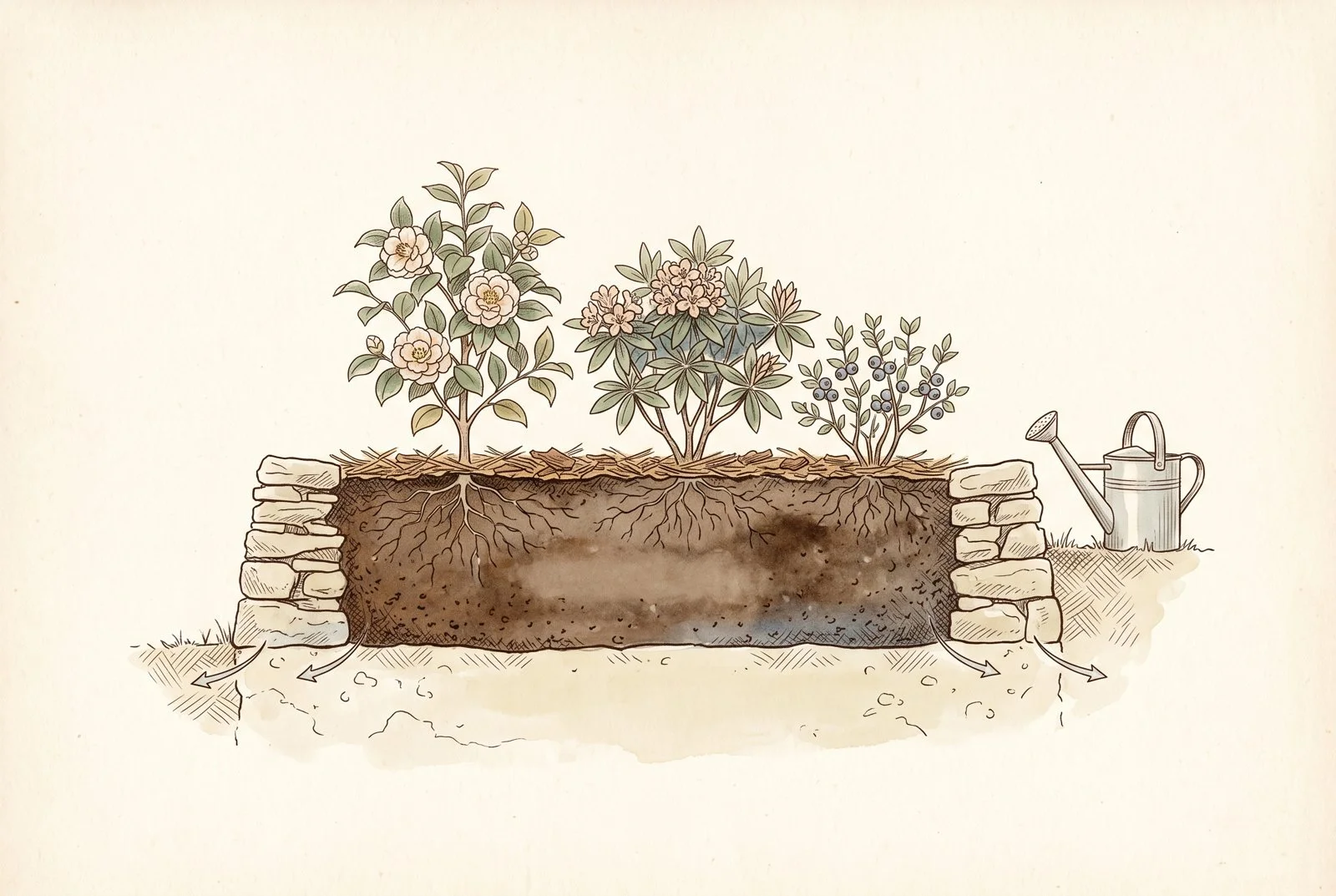
The ericaceous mound laid on chalky soil: it receives only the water you give it and drains its excess through the sides.
The lime-loving bed poses the opposite problem, and it is rarer than people think. A lavender watered with rainwater on chalky soil lacks nothing: the acidic water dissolves a little of the soil's lime, which is precisely what rain has always done. The problem only really arises in two cases: naturally acidic soil on which one insists on planting lime-lovers, and container growing in a lime-free substrate watered with soft water. Then yes, calcium must be supplied, and sometimes a higher pH.
The most natural step is to pass the water over limestone. A bag of crushed oyster shells, limestone sand or crushed marble, sunk in the tank, dissolves slowly under the action of the water's carbon dioxide. The result caps itself, because water open to the air does not dissolve more than five or six degrees of limestone. You get water that is still soft, at about pH 8, which is enough for most lime-lovers. Dissolution is speeded up by adding a handful of compost or by letting the tank come alive: bacterial respiration produces the carbon dioxide that dissolves the shell. This is the slow, risk-free route. If you want distinctly hard, alkaline water, for a container of olives or Mediterranean plants, add the missing salts directly. Potassium bicarbonate, not sodium bicarbonate, at a hundred to two hundred grams per cubic metre, brings five to ten degrees of alkalinity and raises the pH towards 7.5 or 8. At the same time it supplies potassium, which flowering and fruiting plants love. Calcium sulphate, gypsum or agricultural plaster, at three hundred grams per cubic metre, supplies calcium without raising the pH. It is the right choice when calcium alone is lacking, for example for container tomatoes suffering from blossom end rot. That also comes, and often first, from irregular watering. Slaked lime, at only twenty or thirty grams per cubic metre, raises the pH sharply; it is effective but easy to overshoot. Wood ash, a handful of a hundred grams per cubic metre, sieved and from untreated wood, supplies potash and lime and raises the pH by a point in an hour. It is the country gardener's solution, to be checked with a strip, because two handfuls make lye. And here again, the soil is better than the water. Liming the bed with ground limestone, dolomite or shells, at two to three hundred grams per square metre, turns acid soil into soil that suits lime-lovers for years. You can then go on watering it with rainwater, the only water that costs nothing.
In both directions, the lesson is the same. Water is corrected in a few hours and must be corrected again with each tank; soil is corrected in a year and holds for ten. Acid and lime are useful crutches when the plant is suffering. Mulch, sulphur, ground limestone, the raised mound and the tank where hornwort and shells are left to live are the real solutions, because they set up a medium that does the work without us.
Other waters
Wells and springs give water that resembles the soil it has passed through. On granite or sandstone, it is soft and slightly acidic, perfect. On limestone, it is as hard as tap water, without the chlorine. In arable plains, it may carry nitrates that will push leaves at the expense of fruit. By the sea or in arid areas, it may be brackish, which is the subject of the next section. An analysis for a few tens of euros removes all doubt; look at hardness, conductivity, sodium and nitrates.
Aquarium water, the water emptied at each change, is a liquid fertiliser: nitrates, a little phosphorus, a population of bacteria used to digesting animal waste. It is as good as a compost tea, and on indoor foliage plants the effect shows within a fortnight. The only reservation: a marine aquarium suits nothing.
Vegetable cooking water, cooled and unsalted, brings minerals and starches the soil makes good use of. Salted, it falls under the sodium case and goes down the sink.
The house's greywater, from the bath, washbasin and machine, is loaded with soaps, surfactants, sodium and sometimes boron from detergents. Occasionally, in a severe drought, on a hedge or a shrub bed, it helps out. Routinely, on a vegetable garden or in pots, it ends up salinising and suffocating. It only suits living, free-draining soil, alternating with clean water, and never plants eaten raw. If you really want to make use of it, the right route is phytopurification, where reeds and the bacteria of their rhizosphere do the cleaning before the water returns to the garden. That is the subject of Part 9.
Swimming pool water is tap water with ten or twenty times the chlorine, often with salt if the pool uses electrolysis, and sometimes copper if algae have been treated. A pool emptied at the end of the season can water a lawn or a shrubbery after a week standing in the sun without treatment, long enough for the chlorine to go. Salt and copper do not go. A salt pool is emptied according to the municipality's sanitation rules, not into the orchard.
Condensate from air conditioners and tumble dryers is practically distilled water, with no minerals or chlorine. It is water that brings nothing but harms nothing, and in high summer an air conditioner produces several litres a day. On a soil or compost with its own reserves, it is just more rainwater.
The demineralised or reverse-osmosis water some people buy for their plants is a pointless expense. A plant in soil has no need for perfectly pure water, and the soil needs the little calcium the water brings. Keep it only for carnivorous plants, epiphytic orchids and the few species that, in nature, drink only rain.
Salt, or the Mediterranean question
A word must be said about Morocco, Spain and the whole Mediterranean rim, where the question of irrigation water arises not in terms of chlorine but of salt. Well water at one or two grams of salts per litre, which is commonplace in the Haouz or the Souss, brings with every watering a load that nothing carries away, since it does not rain enough to leach it. Drip irrigation, so economical with water, concentrates the problem. The small wet patch at the foot of the dripper evaporates at its edges, and salt is deposited as a white ring at its rim, exactly where the young roots would like to spread. After a few years, the surface soil is sterile and the palms turn yellow.
The answers come down to three verbs, and none of them is a treatment. Mulch, so the water does not evaporate and concentrate its salt. Bury, so the water arrives below the evaporation zone, which the pits and boreholes filled with porous material whose principle I have described in another article make possible. And leach, by taking advantage of the slightest autumn rain to water heavily on top, so that the salt is pushed below the roots. Here again, living soil is the best ally: soil rich in organic matter and calcium keeps its sodium away from the clays and repairs itself with each rain.
Making living water: the tank as an incubator
So far I have spoken of removing what is a nuisance: chlorine, lime, salt. It remains to speak of adding what is missing, and what all mains water lacks, even perfectly corrected, is life. Tap water is poor in life by obligation: ordinary bacteria are tolerated, never faecal germs, and chlorine keeps them few. Rainwater carries only what it has picked up in the air. Yet when watering an impoverished soil, a new substrate, a planting that is getting going or a biochar just soaked, there is only one aim: to bring in bacteria in numbers, and alive. You can buy that in a bottle. You can also make it in a tank, and that is better, because bacteria you culture yourself come from the soil they will return to.
The first question is the source, and the answer is simple: take life where it already is. A mature compost, dark, crumbly, smelling of woodland, contains billions per gram. The litter of a healthy forest, found under the top few centimetres of leaves, contains as many, with a diversity no bottle can match. Soil from an old, never-treated garden, taken from under a mulch, is as good as compost. Wormcast, aquarium water and mud from a clean pond are all good starters. What to avoid is young compost smelling of ammonia, fresh manure, and anything from treated soil, where life is poor and unbalanced. An inoculum is a population. Choose it as you would choose a mother plant.
You also need to know what water carries and what it does not. Bacteria travel in water without difficulty, and it is for them that these pages are written. Mycorrhizal fungi, however, live as filaments and heavy spores that settle at the bottom of the bucket. Water carries few of them, and to establish them you have to move soil, a spadeful taken from the foot of a tree of the same species. The rhizobia of legumes and the Frankia of alders are bacteria and travel in water, but ordinary compost contains few of them: fetch them from under the host plant. A handful of soil taken from under a healthy lucerne or alder, mixed into the seed-soaking water, does what years of waiting do not.
The oldest method is the simple extract. A cloth bag filled with mature compost, ten kilos for a cubic metre of dechlorinated water, is sunk in the tank and left for one to two days at air temperature, stirring it at each visit. The water turns brown, takes on the smell of earth after rain, and you water. You wash the compost more than you culture it: you extract the bacteria that are there, you hardly multiply them. The benefit is real on bare soil or new substrate. Use it within the day, because without air or food this water soon becomes poorer.
To multiply rather than extract, bacteria need two things: air and food. That is aerated compost tea, and it is made in the same tank. You need ten kilos of mature compost in a cloth bag, a cubic metre of dechlorinated, lukewarm water, between eighteen and twenty-five degrees, and a pond air pump. A blower suits better than an aquarium pump: ten to thirty cubic metres of air per hour are needed for a cubic metre of water, and its diffuser goes on the bottom. Add the food: five hundred grams to a kilo of molasses or unrefined sugar dissolved in a bucket of hot water, no more. At the low air rate, add less sugar and the culture is slower; the nose is the judge, as I say below. Too much sugar turns the culture into alcoholic fermentation, and you get water that smells of cider instead of forest. Leave it bubbling for twenty-four to thirty-six hours, the tank staying under its grid and mesh. A beige foam forms on the surface, the water becomes cloudy and smells of mushroom and earth. It is ready.
The nose is the only instrument needed. A smell of woodland, damp earth, mushroom: the culture is good. A smell of rotten egg, vinegar, ammonia or silt: the pump failed, the temperature rose, there was too much sugar, and you have cultured the wrong ones. Empty the tank onto the compost, where these bacteria will find neighbours to put them in their place, and start again. Once the pump stops, oxygen falls within a few hours and the population changes. So water within four to six hours, preferably in the evening, on moist, mulched soil, never in full sun. A cubic metre covers a thousand square metres at one litre per square metre, or soaks a few hundred kilos of biochar. Compost tea is not stored. It is made the day before for the next day. And do not pour it on vegetables that will be eaten raw in the coming weeks: molasses also feeds the bacteria you do not want.
Between the extract and the aerated tea lies the method I practise most often, because it needs neither pump nor sugar: the tank I mentioned in connection with chlorine, left to come alive. A thousand litres of tap water, under the grid and mesh, the spoonful of green clay, a bucket of mature compost or an armful of forest litter thrown in, and time. Within a week, the water has been populated by what it received from the compost and what fell from the sky. Within three weeks, daphnia and a green film have appeared: the tank is a small closed pond. The water drawn from it carries a complete biology, less concentrated than an aerated tea but more stable and more diverse. It is the water for ordinary watering, the kind you can pour at every watering without wondering whether you are doing the right thing. Top it up from above as you draw it, never emptying it, and the bottom of the tank becomes a starter that seeds each refill. The overflow pond of Part 4 does the same thing on a larger scale without anyone touching it. Water taken from its strainer is of the same kind, more diverse still, and it is what I pour first on a planting that is getting going.
There is an even more rustic route. The Korean farmer Youngsang Cho spread it under the name JADAM, and the whole world copies it. Into a drum of rainwater go a mashed boiled potato, a handful of forest litter in a sock and a spoonful of sea salt, with no pump, for two to three days in the shade. The potato feeds, the litter seeds, the salt, according to its promoters, brings minerals, and the bacteria that grow without air, but without rotting, form a milky water whose smell recalls sauerkraut. It is used diluted ten to twenty times. Research has not yet evaluated it. I mention it because it shows that living water costs nothing, and that it is within reach of a gardener in the Souss as much as a market gardener in the Perche.
You might think that with these four methods everything has been said. The work begins afterwards. Living water intended for chalky soil is not the one you prepare for acid soil, for a free-draining sand, or for a salty soil. The biochar you inoculate does not retain the same population depending on the soil it goes into. The choice of source, what you add to the tank to steer the population, the duration, the temperature and the timing of application are set site by site. This setting, with the reading of the soil that comes before it, is what I do on an assignment. The principles are open, and I give them; what is worth something is knowing which of them apply to your land.
How you water matters more than which water
I end with the rule I announced at the beginning, because it governs all the others. Water quality matters in inverse proportion to the life of the soil. On dead soil, everything counts: chlorine, limescale, temperature, sodium. On living soil, mulched, rich in carbon and fungi, almost nothing counts, because the soil corrects, filters, buffers and redistributes.
And what makes a soil alive is first of all the way it is watered. Daily surface watering maintains surface roots, bare soil, a crust of salt and lime, and total dependence on the watering can. Rare, deep watering, on the contrary, forces roots to go down in search of moisture. That is the principle of the jars of Ibn al-Awwam, the twelfth-century agronomist from Seville. They were new clay jars pierced at the bottom, placed near the foot and not against it, and filled rarely. They let their water seep into the soil for two months, at root level and never on the collar. In the garden, this means one evening of watering in four or five in summer, until the water has penetrated twenty centimetres, or a reserve placed at depth that releases its water slowly. And the mulch covering the soil keeps the moisture instead of giving it back to the air. The mirabelle plum in my garden has never been watered, nor the pear tree, nor the kiwi. The summer bed, bananas, bamboos and perennials, receives water from the trough when drought sets in, and nothing else. This garden has received no fertiliser and no treatment for at least fifty years, and it is overflowing. Water counts for less there than the life waiting for it.
So what is the best water for watering? Rainwater, collected from a clean roof, kept cool and dark in a closed tank, preferably buried. And to wake up a soil, water from the overflow pond, which the morning sun has filled with life. Failing that, tap water, drawn before the softener, left a few days in the air in a tank covered with a grid and insect mesh, with its spoonful of clay, poured in the evening on mulched soil. For camellias, water treated with lime and then vinegar, or better, a raised pit, sulphur and pine needles. For lavenders, rainwater and a bag of shells. For what must stay pure, seedlings, cuttings, inocula, a charcoal filter or a pinch of vitamin C. And for what must live, a bucket of compost, an air pump, a night of patience. The rest is the soil's business, and the soil does it better than we do.
Key point. On living soil, water quality matters little. Chlorine goes with standing and sun, limescale is disarmed with vinegar or dropped out with lime, softened water never goes on the garden. Water rarely and deeply, under mulch.
Part 11. What I do on an assignment
It remains to say what I do for a local authority, a social landlord, a block of flats or an institution, and what I do not do.
My job is to make this network of tanks work over time. I start from reading the site, with the survey of roofs and needs. I size the tanks, birdbaths, overflow ponds and planted greywater filters. I write or review your specifications, compare quotes, supervise the works, train the staff who water and maintain, and measure the volumes collected over several years. Each threshold in the system, the height of the overflow, the volume of the birds' reserve, the distance from the building on clay soil, is set on site, and it is this setting that you are commissioning.
I sell no tanks, pumps or equipment, and I am tied to no manufacturer: my opinion on a quote therefore depends on no commission, and that is also what gives it its value. I work to order, with an advisory note and specifications your departments can use as they are.
A local authority that surveys its roofs this autumn can have its first tanks working before next summer. The coming rains are already irrigation water for its trees, and the roofs that receive them are already there.
Appendix 1. Table of doses
The doses below are those given in the text, for Île-de-France tap water and, for the last three rows, for the soil. Doses for water should always be checked with a pH strip and adjusted to the analysis of your water.

Appendix 2. Glossary
River basin agency. In Morocco, the public body that manages the water of a catchment and authorises the reuse of wastewater.
ARS. Regional health agency. It advises the prefect on uses of water unfit for human consumption.
Floating suction. A flexible pipe held by a float, which draws water from the tank ten or fifteen centimetres below the surface, away from the sediment at the bottom.
Bti. Bacillus thuringiensis israelensis, a soil bacterium that kills the larvae of mosquitoes and a few related flies, with no direct effect on birds, fish and bees.
Lime-loving, lime-hating. A lime-loving (calcicole) plant likes limestone (lavender, box, fig). A lime-hating (calcifuge) plant shuns it (camellia, rhododendron, blueberry).
Iron chelate (EDDHA). Iron held by a molecule that keeps it soluble, and therefore available to the plant, even in chalky soil.
Chloramine. A compound of chlorine and ammonia used by some networks; it does not evaporate and resists sunlight.
Free chlorine. The active chlorine in tap water, present as hypochlorous acid; light and organic matter destroy it.
Decarbonation (lime softening). Treatment that makes the limescale in water precipitate, for example with slaked lime.
French degree (°f). Unit of water hardness: one French degree corresponds to ten milligrams of calcium carbonate per litre.
First-flush diverter. A fitting on the gutter downpipe that sets aside the first minutes of rain, the ones that wash the roof.
Backflow prevention (air gap). Physical separation, by an air gap, between a non-drinking water tank and the drinking water network.
Temporary hardness, permanent hardness. Temporary hardness is the part of the limescale carried by bicarbonate, which lime or heat make drop out; permanent hardness, carried by sulphates, yields only to oxalic acid.
Greywater. Household water that has not been used for toilets: shower, washbasin, washing machine. In the regulatory sense of 2024, kitchen water (sink, dishwasher) is not included and requires an experimental authorisation.
Water unfit for human consumption. Regulatory term covering rainwater, greywater, treated wastewater and other non-drinking waters, for domestic or professional uses.
Planted filter. A bed of gravel or sand planted with reeds, where bacteria fixed on the roots and grains purify the water.
Damping-off. Rot at the collar of young plants, caused by water and soil organisms such as Pythium.
The mother. In the filter's sand bed, the living skin of bacteria, algae and protozoa that forms in the top few centimetres and does the final purification.
Swale. A wide, shallow ditch, grassed or planted, that holds rainwater for a few hours and lets it soak in.
pH. Measure of the acidity of water or soil: 7 is neutral, below is acidic, above is alkaline.
Pozzolana. Light, porous volcanic rock, sold as gravel, which lets water through very quickly; here it fills the overflow tube sealed in the centre of the planted bed.
Clay shrink-swell. Movement of a clay soil that shrinks as it dries and swells as it gets wet, and which cracks houses.
SPANC. Public non-collective sanitation service, which inspects the installations of houses not connected to the sewer.
Blower. Pond air pump delivering a high flow at low pressure, to aerate a cubic metre of water.
TAC. Total alkalinity, in French degrees: the water's bicarbonate content. It sets the doses of vinegar and lime.
TH. Total hardness, in French degrees: calcium and magnesium.
Aerated compost tea. Water in which the bacteria of a mature compost are multiplied by giving them air and sugar for a day to a day and a half.
Infiltration trench. A trench filled with gravel that receives water and lets it pass into the soil.
Calmed inlet. An elbow at the end of the inlet pipe, at the bottom of the tank, which lets water in gently without stirring the sediment.
Siphon overflow. An overflow whose shape keeps a water seal that stops smells and rodents, and which skims the surface at each overflow.