Cooling a town with the water it sends down the drain. New plantings, existing trees, roundabouts, facades and buildings on clay: what your departments can do from the very next works.
What you are about to read
This text is long, and it is meant to be read in order. It is addressed to those who decide, mayors, deputy mayors, directors of technical services, social landlords, and to those who then carry out the work. It is built in five parts, each answering a question that a department asks in that order.
The first explains why the trees we plant in towns do not cool as we think. It is the diagnosis, and it comes down to three ideas: cooling is evaporated water, a single tree does almost nothing, and night behaves differently from day.
The second deals with the trees you are going to plant. In what soil, with what water inlet from the road, who looks after them, how to water them in summer, what dies after planting and who pays for it, then which species, how many species per planting, and how many layers of vegetation.
The third deals with trees already planted, the ones that will not be dug up, and how to bring them the same water without opening up the street. The roundabout has its own chapter there.
The fourth deals with streets too narrow for a tree, where we work on the walls with climbing plants, then on the street's ceiling with deciduous canopies stretched from one facade to the other, and with how to supply all of this with water.
The fifth deals with the building itself, its wastewater, and what water can do under its foundations when it stands on clay.
Each part begins by saying which situation it is about. A reader in a hurry can go straight to the one that concerns them, then to the final page, which sums everything up by situation and says what I can do for a local authority. But the first part is short, and without it the rest looks like fantasy.
Part one: a tree is not a parasol
This part explains why the trees we plant do not cool as we think. It does not propose anything yet. It sets out three measured facts without which no urban planting can be reasoned through: where the cold comes from, at what density of trees it occurs, and what happens at night.
The lime tree at two in the afternoon
Look at a street tree on a heatwave day, at around two o'clock. It is planted alone, in a pit of two square metres, surrounded by asphalt. Its foliage makes a patch of shade on the pavement, and that shade is reassuring. You tell yourself the tree is working.
It is working much less than you imagine, and not at all in the way you think.
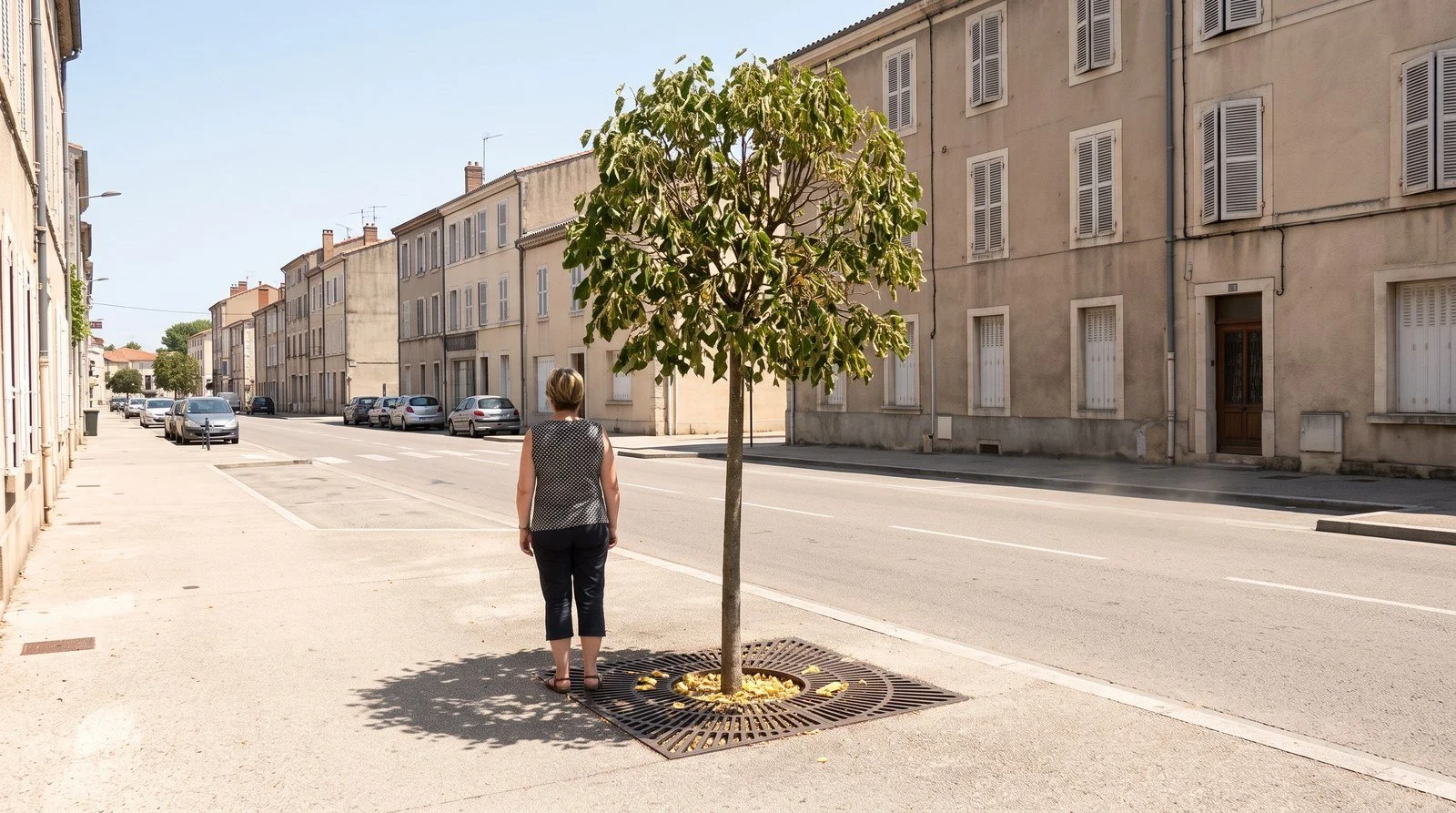
A single tree in its two-square-metre pit: shade that reassures, cooling that hardly exists.
Shade is only half the story, and the more modest half. The real cooling happens in an invisible exchange: each gram of water the leaf lets go carries heat away with it, about 2,450 joules. This is the latent heat flux. A tree that transpires is a refrigerating machine. A thirsty tree is cooling that switches off.
The order of magnitude is worth stating, because it is spectacular. In Geneva, during the summer of 2023 and its two record heatwaves, a team monitored the sap flow of eight street plane trees. With air temperatures reaching 39 degrees, these trees kept evaporating up to 37 kilos of water an hour. That represents 25 kilowatts of cooling power for a single tree, and this evaporation offset about a third of the street's solar heating. Notably, the models in common use predicted a much sharper closing of the stomata and therefore greatly underestimated the service provided.
Two things should be taken from this figure. The first is that a well-watered urban tree is an air-conditioning device of considerable power, free, silent, and making oxygen into the bargain. The second is that the whole performance rests on water being available at the roots. Cut off the water, and only the shade remains.
What Davis measured in 1991
Before going further, justice must be done to a forgotten experiment, because it already contains everything.
A team from the Lawrence Berkeley Laboratory set up seven weather stations in a transect across an isolated vegetation canopy at Davis, California. Dry-bulb temperature, dew point, wind speed and direction, one and a half metres above the ground, recorded every fifteen minutes for two weeks. Taha, Akbari and Rosenfeld published the results in 1991 in Theoretical and Applied Climatology, under a title that says it all: heat island and oasis effects of vegetative canopies.
Less than five metres from the upwind edge, the daytime temperature fell by up to 4.5 degrees, but the night-time temperature rose by 1 degree. Deeper into the canopy and downwind, the daytime drop reached 6 degrees and the night-time rise 2 degrees. Wind speed was reduced by about 2 metres per second in calm conditions and by up to 6.7 metres per second under cyclonic conditions.
Oasis by day, heat island by night, under the same foliage. All measured, published, and rarely reread by those who plant.
Two years earlier, Oke had published in the Philosophical Transactions of the Royal Society his synthesis on the micrometeorology of the urban forest, which remains the best introduction to the subject, and which already treats the tree as an object whose radiative, aerodynamic, thermal and hydric properties differ from those of the city's other materials.
Everything being rediscovered today with three-dimensional models and sky view factors was therefore laid out thirty-five years ago, by seven thermometers lined up under trees. The question is not whether trees cool. It is under what conditions, at what time, and at what cost.
The threshold no one reaches
The bad news for street rows comes now.
An isolated tree cools its own parasol and barely more. To lower the air temperature of a neighbourhood, a coverage threshold must be reached. The work of Ziter and her team in Wisconsin established that canopy cover must exceed 40 per cent within a radius of 60 metres around homes to have a significant effect on air temperature. German studies put the tipping point between 30 and 40 per cent. Below that, only a local shading effect is measured, pleasant for passers-by, with no bearing on the street's climate.
Cecil Konijnendijk translated this in 2021 into a rule that has become popular with elected officials because it is easy to remember: three, thirty, three hundred. Three trees visible from every home, school and workplace. Thirty per cent canopy cover in the neighbourhood. Three hundred metres on foot to reach a good-quality green space.
An assessment published in 2026 in Nature Communications applied this rule to 862 European cities. Fewer than 15 per cent of the population studied meet all three criteria. Twenty-one per cent meet none. And the analysis reveals a consistent inequality, with the highest levels of vegetation systematically associated with the wealthiest neighbourhoods.
A parallel mapping exercise, led by Thami Croeser across 5.5 million buildings in twenty-five European cities, shows that 84 per cent of homes and workplaces lie below the threshold of 30 per cent canopy within 60 metres. For Paris, it is 96 per cent of the 119,000 buildings studied. Seville, which regularly exceeds 44 degrees, reaches 98 per cent. Cologne and Hamburg are the good pupils, with about 45 per cent of buildings properly protected.
The stakes are not decorative. The study published in The Lancet in 2023 by Tamara Iungman and her team, covering 93 European cities and 57 million inhabitants, estimated that more than 4 per cent of urban summer mortality is attributable to the heat island. Raising tree cover to 30 per cent would have lowered the average temperature by 0.4 degrees and prevented 2,644 premature deaths in the summer of 2015 alone, about a third of that excess mortality.
A third of urban heat deaths therefore comes down to a question of coverage. Not of the number of trees. Of coverage, and coverage in the right place, that is within reach of a window.
Hence the field conclusion: stop reasoning in individual trees and reason in groves. A group of closely planted trees creates its own microclimate. The air there stays more humid, the vapour pressure deficit falls, and transpiration continues longer and at lower hydraulic cost to the plant. The ground there is covered, litter accumulates, water soaks in, mycorrhizas connect the individuals. A grove on bare ground loses half its value: the lower layer counts as much as the canopy.
Part two: the trees you are going to plant
We now come to the system itself. This part concerns any new planting, on a redeveloped street, a square, a car park, a housing estate. It follows the order of decisions in a project: first the soil, then the water brought to it, the person who watches over it, summer watering and the guarantee, and only then the species, the composition of the planting and its layers. I describe each element in its design, with enough precision for a client to know what they are ordering and for a highways engineer to have their answers. I will also say where on-site adjustment comes in, in its place.
To follow the system, the simplest thing is to follow a drop of water.
Let us follow a drop
One June evening, at around six, a storm breaks over a boulevard. The drop hits the asphalt at thirty-eight degrees, loses half of itself as vapour, joins its fellows in a trickle running to the gutter, and disappears down the drain. In less than a minute it is underground, on its way to the treatment plant ten kilometres away, mixed with water it should never have met. If it rains hard, the sewer overflows, and it is the river that receives the excess, with everything it carries.
Meanwhile, three metres from the gutter, a lime tree planted twelve years ago in its two-square-metre pit is dying of thirst. It saw the drop go by. It did not get any.
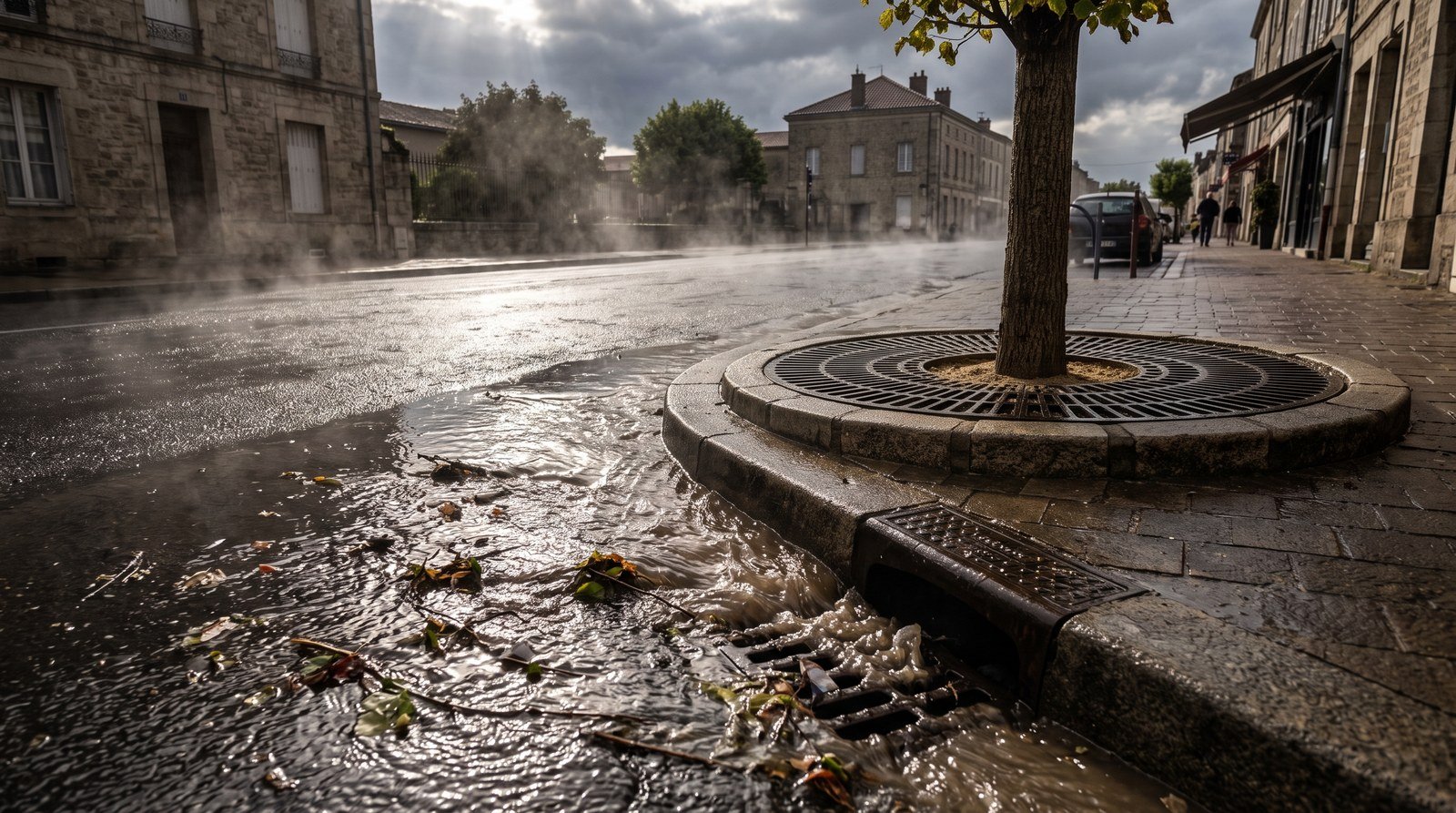
The storm goes down the drain three metres from the tree, and the pit stays dry.
That is the absurdity the whole system corrects. It is not about inventing water. It is about making the drop turn left, and for that there must first be something under the pavement able to receive it.
The Stockholm system, or the tree begins under the pavement
There remains the problem everyone knows and almost no one deals with: under the pavement, there is no soil. There is fill compacted to refusal, impermeable to air and to water, in which a root does not advance. That is why so many street trees struggle along for fifteen years and then die without ever reaching their adult size.
A measurement made in Manchester by Rahman and Ennos's team, and taken up in their 2020 meta-analysis, gives the figure that should end the debate. The transpiration of a Callery pear planted over a lawn reached 4.15 grams per square metre per minute. That of the same pear planted in a pit cut into impermeable paving fell to 0.44 grams. A factor of ten. The same species, the same city, the same age: it is the pit that decides.
Remember this figure, because it overwhelms everything else. The differences between the best and worst species, which we will discuss, are considerable. They weigh less than a factor of ten.
Björn Embrén, then in charge of trees for the City of Stockholm, turned the problem around. Since compaction kills, let us plant in something that cannot be compacted. The principle of structural soil was not new, it has existed since the 1970s, but the Swedish version gave it its effectiveness.
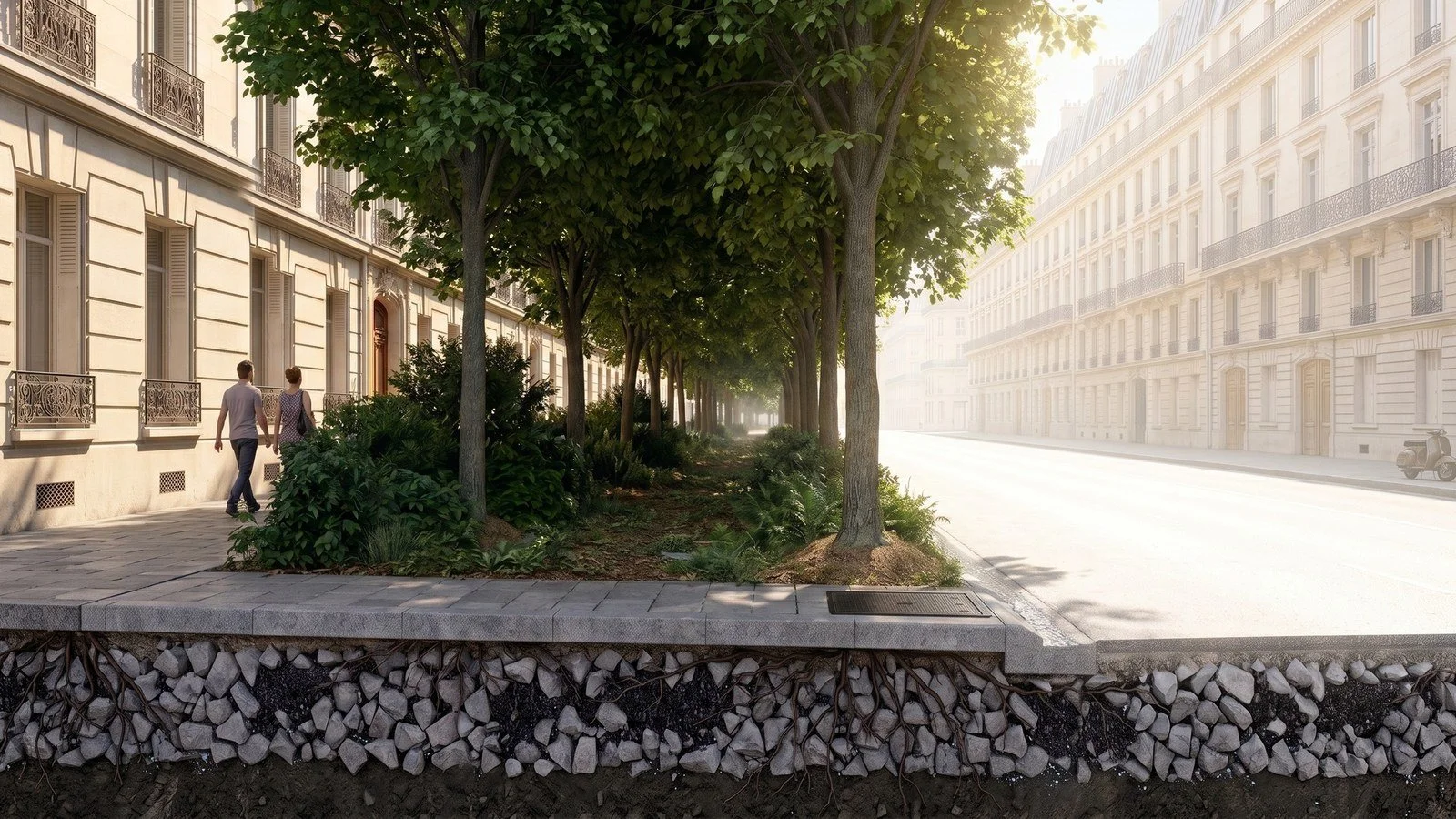
The pit is filled with large, angular crushed stone, compacted until it forms a stable skeleton able to carry traffic. This skeleton leaves a considerable volume of voids between its blocks. A mixture of biochar and compost is then washed in with a water lance and goes down to fill the gaps. Only about 80 per cent of the void volume is deliberately filled, to keep air circulating. The tree is planted above, in topsoil, and the surface can be closed with hard paving. The roots run freely under the roadway, in the nourishing veins of the skeleton.
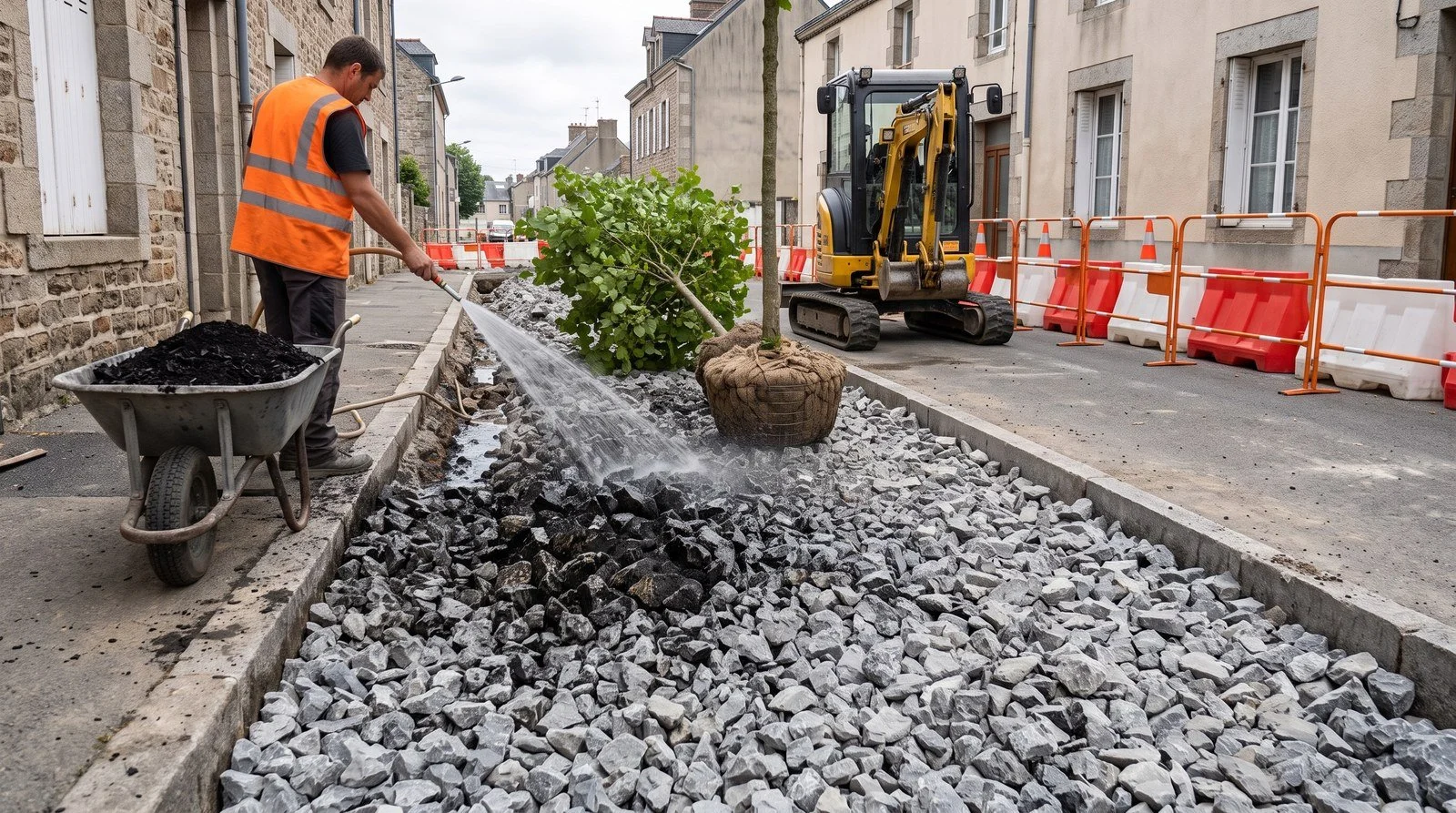
A continuous pit of crushed stone: the biochar and compost mixture is washed into the voids with a lance, and the trees wait their turn.
The City of Stockholm allows about 0.5 tonnes of biochar per tree. In less constrained areas, it uses a simpler mixture, six volumes of gravel to one of biochar and one of compost.
The result reported by Embrén is enough to stop any green-space manager in their tracks: six-year-old trees planted in biochar structural soil had reached five times the size of thirty-year-old trees planted by conventional methods. The process has become the standard for all of the city's public planting pits. Trondheim has adopted it, and Prague and Magdeburg have taken it up.
The detail that matters most, in my view, lies elsewhere. These pits are designed to receive runoff from roofs and roads, diverted from the sewer network into the stone skeleton. The pit becomes a stormwater management structure as much as a planting medium. Biochar, with its porosity and its immense surface area, acts there as both sponge and reef: it retains water, holds nutrients, filters contaminants and provides a habitat for microbial life.
We come back to the first part of this article. Cooling is evaporated water. A continuous, uncompactable pit, loaded with porous carbon and fed by the neighbourhood's runoff, is a buried water reserve. It is what will allow your trees to keep transpiring at four in the afternoon on the day the city needs it.
And for trees already in place, the ones that will not be dug up, there is a way to obtain the same result without opening the street. We will come to it in part three.
The inlet
The first thing to do is simplicity itself: open the kerb. A notch in the kerb, on the uphill side, and the roadway becomes a catchment that pours into the planted area. This is what Stockholm has been doing for fifteen years.
But a wide-open door is a bad door. A structural pit is not a barrel: only four fifths of it are deliberately filled so that air can circulate. If a three-hour storm pours a whole boulevard into it, the water drives out the oxygen, aerobic life dies, the pit ferments and the tree suffocates through its roots. So the dose must be measured. And it must be measured without a sensor, without a battery, without an electronic board or a network, because a tree pit has to work for fifty years, in silt, salt and frost, without anyone coming to change a battery.
The principle is not new, and I do not claim it: rainwater collectors have long used a float chamber that closes when it is full and empties slowly. What is new is applying it to a tree pit, setting its emptying to the breathing of the soil, giving it a winter latch and pairing it with human inspection. The device is purely mechanical and works by gravity. It fits in two adjoining chambers, separated by a low wall, under a cast-iron cover.
The drop enters the first. There it loses its speed, and the sand and grit it was carrying fall to the bottom, into a removable basket. When the first chamber is full, it overflows over the wall into the second. The second holds a float, and the float controls the inlet gate. As the second chamber fills, the float rises, and when it reaches the top, it closes the notch. The street goes on running in its gutter, the pit has had its dose, and not a drop more.
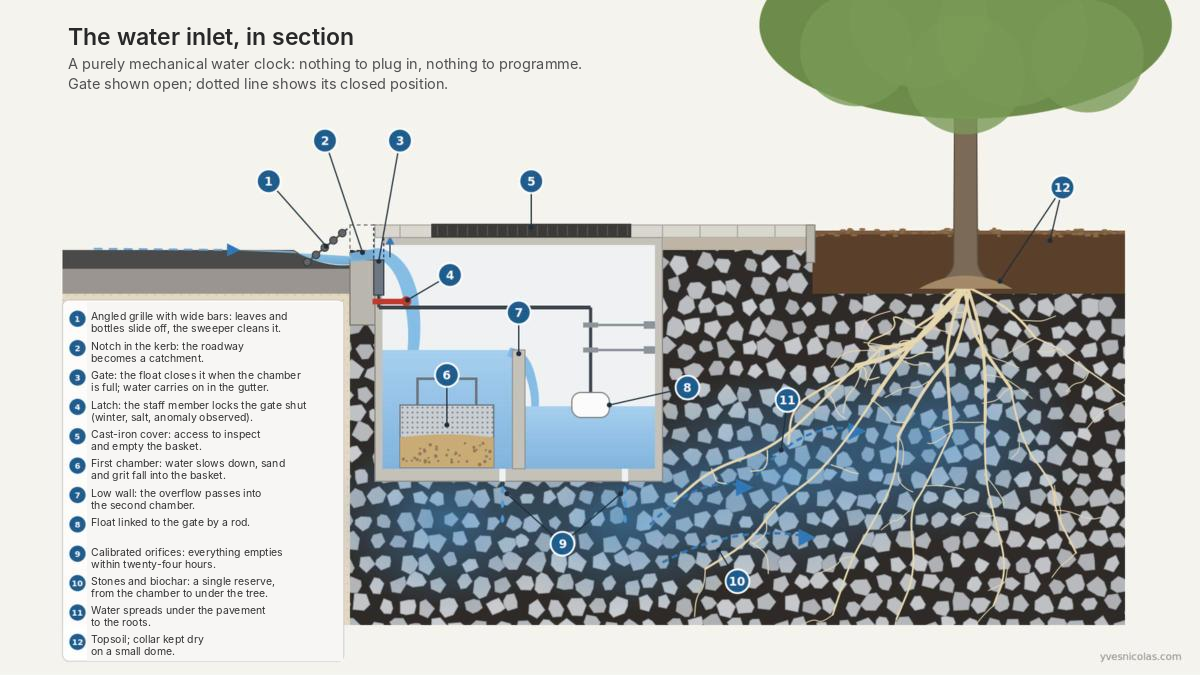
The water inlet, in section: a purely mechanical water clock, with its gate and its latch.
At the bottom of the chambers, a calibrated orifice lets the water trickle out into the stone skeleton and porous carbon below. Its diameter is calculated so that everything is emptied in twenty-four hours. As the level falls, the float goes back down, and when it reaches the bottom, the gate reopens, ready for the next storm.
It is a water clock. The principle is that of the tipping-bucket rain gauge, three centuries old, and of the clepsydra, older still. Nothing to plug in, nothing to programme. The motive energy is the weight of the rain.
The twenty-four hours are not a mechanical convenience. They are the time a pit takes to absorb a dose and draw air back in through the surface. They are the time the porous carbon takes to hold what it must hold. They are the time that separates a devastating storm from fine rain, the only kind roots like. The device turns the first into the second.
A second precaution, and it answers the objection of the geotechnical engineer who will see clay at the bottom of the pit. The bottom does not do the work; the skeleton does: the voids between the stones and the porous carbon store water whatever the nature of the soil below, and a clay bottom, far from being a problem, turns the pit into a reservoir. The only risk is that storms follow one another in a season when the tree hardly transpires, in spring or autumn, and that the water rises to the roots and stays there. The pit therefore has, at the top of its reserve zone and below the root zone, an overflow to the stormwater network: below it the water stays and works, above it the air circulates. Not a bottom drain, which would empty the reserve and ruin the idea. This is how Stockholm does it, and it is what the second notch for existing trees, further on, already does.
A health precaution is needed, because I will be asked about it: both chambers empty completely in twenty-four hours, with no dead volume, and the tiger mosquito, which needs several days of standing water to complete its cycle, has nothing to do there.
Add a latch. In winter, when the road is salted and the tree is dormant, the gate is locked shut rather than letting salt into the pit.
The basket and the plug
The Achilles heel of all urban infiltration is clogging. A pit whose pores fill with silt is no longer a sponge, it is a brick. Three lines of defence, all passive.
At the inlet, a grille with wide bars, set at an angle, holds back bottles, bags and leaves. The angle means the street sweeper cleans it as it passes, without knowing it.
In the first chamber, the basket I mentioned catches sand and grit. Twice a year, someone lifts the cover, pulls the basket out by its handle, empties it into the skip and puts it back, in barely two minutes.
And at the head of each infiltration well, the last twenty centimetres below finished level contain no living material, only large bare aggregate. It is a sacrificial plug. If very fine silt eventually forms a crust there, it forms there, and only there. It is scraped off and replaced, and what is working below is never touched.
The eye
I now come to what, for me, is not negotiable, which is not engineering, and which applies to everything this text describes: new plantings, old trees, roundabouts and facades.
The person who lifts the cover and empties the basket must be the person who looks at the tree. Not another department, not another contractor, not another day. The same man, the same woman, at the same moment. Because when your nose is in the pit, you can smell whether it is healthy or has turned anaerobic, you see what the basket contains and what the street has poured into it, you look up and see whether the crown is dying back, whether the foliage is yellowing, whether this year's shoots have reached their length. No sensor does that, and I doubt one will ever be built that can.
And this person must be able to stop the system. If they observe chlorosis, if the chamber smells bad, if the street has received something that should not have been there, they lock the gate, isolate the tree, note what they saw in the tree's logbook, and leave the pit to breathe while the cause is found, without waiting for any office to approve anything.
This requires something municipal organisation charts cannot yet do: to combine in a single person what today belongs to Street Cleaning and what belongs to Parks. It is not an organisational detail. It is the condition for everything else to work.
Summer, and the bowser
There is a subject planting files deal with in one line and that I want to deal with in a chapter, because it decides everything between June and September: watering.
Every local authority has a bowser. A lorry, a tank of three to six thousand litres, a staff member, a round. Every ten or fifteen days it goes past the young trees, pours fifty or a hundred litres into the planting basin, and leaves. It is the most widespread practice in France, it is written into contracts, and it wastes most of what it delivers. Poured on the surface of a compacted mineral pit, the water runs off to the gutter, evaporates on the scorching asphalt before it has soaked in, or goes down into the first twenty centimetres and is lost there, where the roots no longer are because it is too hot. Of a hundred litres poured, the tree perhaps drinks twenty.
But before the bowser there is the road, and it changes everything.
A road is a water collector of a size no one calculates. Take a hundred metres of an ordinary street, ten metres wide, roadway and pavements included. That is a thousand square metres of perfectly impermeable surface. A ten-millimetre shower, a mere nothing, deposits ten cubic metres on it. Ten thousand litres. Two full bowsers, fallen free of charge, in twenty minutes, three metres from the trees. A twenty-millimetre summer storm deposits twenty thousand, four bowsers. Over a Parisian year of six hundred and forty millimetres, this street receives six hundred and forty cubic metres, more than a hundred bowser rounds, and today it sends all of it down the drain.
Ten trees planted along these hundred metres, fed through openings in the kerb, therefore receive two thousand litres each at every summer storm, compared with the hundred litres the bowser brings them every fortnight. This is not an improvement in watering, it is a change of scale. The street becomes the sprinkler, and the bowser only serves to fill the three or four rainless weeks between two storms, which is exactly its role and what it does well.
These openings are, quite literally, breaths of air. They let water in, but they also let oxygen into a pit that, without them, would be sealed under the asphalt. Soil under a pavement dies of suffocation first, before it dies of thirst. The notch in the kerb, the chamber under its cast-iron cover, the fifth of voids kept free in the pit: all of this breathes, and that is how the soil stays alive between two rains.
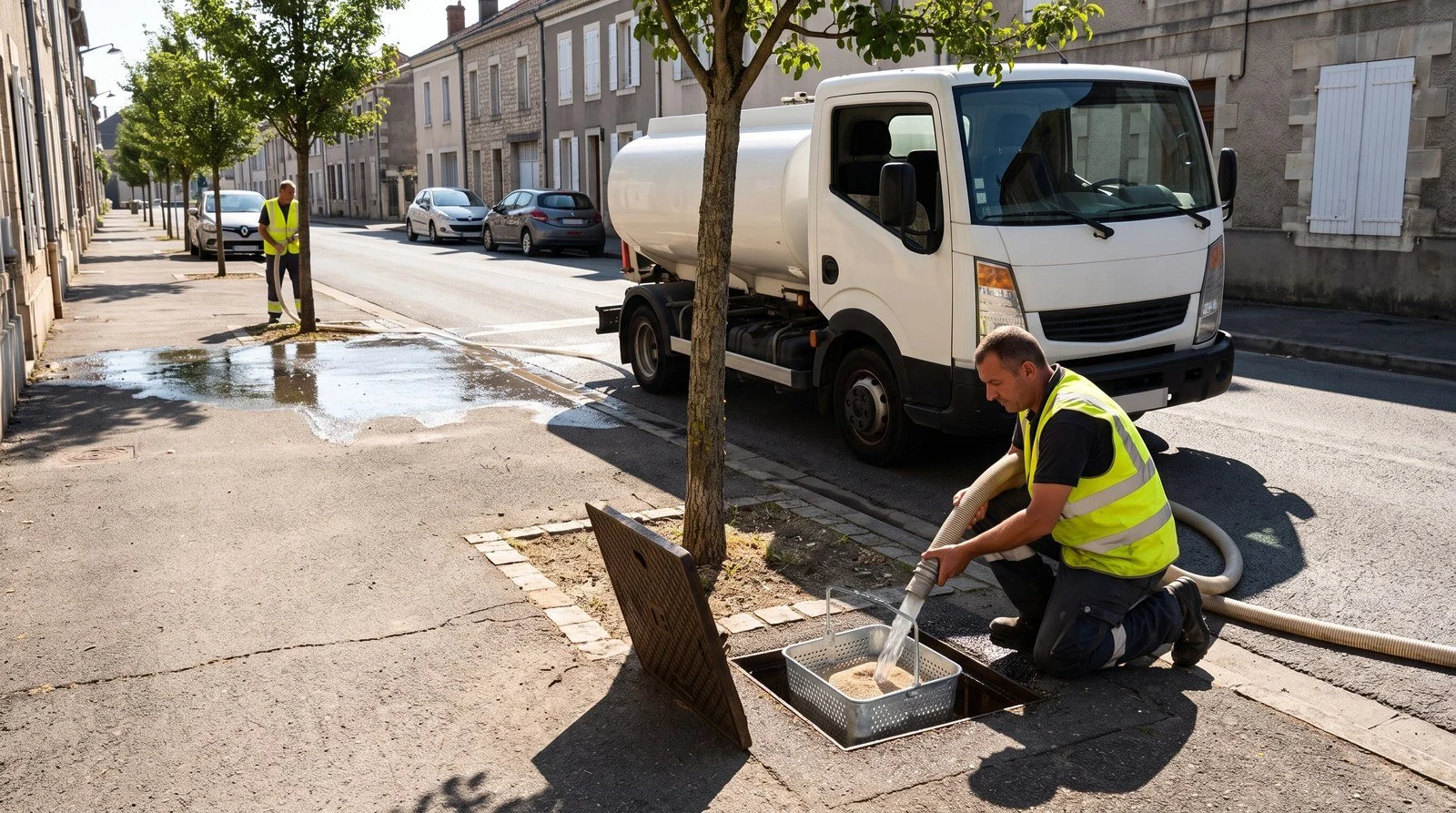
Water the well, not the pavement: the same round, the same lorry, several times more useful water.
So the bowser must be discussed in two ways, and both matter.
The first is survival, and it comes down to one sentence: the water must go where the roots are. The wells described later for existing trees, like the water inlet of new pits, are made for rain, but nothing prevents the bowser from being emptied into them. The staff member lifts the cover and fills the inlet chamber, or pours into the basin formed around the tree, just above the wells, and the clock doses exactly as for a storm. A hundred litres poured, a hundred litres taken down to a metre deep, into the cool, into a porous carbon that holds them and releases them over several days. The same round, the same lorry, the same staff member, and a tree that receives several times more useful water without a single extra drop being poured. That is the only change I ask of departments: stop watering the pavement, water the well. And it is not an extra task. The street now does most of the watering, the round only bridges the gap between two storms, and the staff member who lifts the cover gains the time the lorry used to take for what no lorry can do: look at the tree.
The second way is the one that should interest an elected official more, because it changes the nature of the expenditure. Evaporation means cooling. Each litre of water a tree transpires carries 0.68 kilowatt-hours of heat out of the street. A six-thousand-litre bowser entirely transpired by healthy trees means a little over four thousand kilowatt-hours removed from the neighbourhood, the equivalent of two hundred domestic air conditioners running for eight hours. Poured on the asphalt, the same bowser cools the roadway for two hours and disappears. Poured into the wells, it cools the street for three days, at face height, under the crown, where the people are.
Watering then stops being a line in the green-space maintenance budget. It is public health spending, and by far the cheapest a local authority can make during a heatwave. Provided the water reaches the roots, and that it is not drinking water: retention basins, stored rainwater and, depending on the order in force, municipal boreholes are enough to fill a bowser, and a local authority that waters its trees with tap water in the middle of a drought order exposes itself to a question it would rather not be asked.
What dies after planting, and who pays
A figure must be stated that nursery catalogues do not state. A literature review published in 2019 by Hilbert and co-authors, drawing on sixteen cohort follow-up studies, puts the annual mortality of street trees at 6.6 to 7 per cent during the first five years, then 2.8 to 3.8 per cent thereafter. The first year is the worst: 12.2 per cent in Sacramento, 6.5 to almost 20 per cent depending on the batch in a Belgian study. At these rates, half a planting is dead or removed after thirteen to eighteen years. A local authority that plants a hundred trees is signing up for fifty a generation later, and for fifteen, sometimes twenty, dead before the guarantee has even ended.
These figures are averages for ordinary years. Drought years do something else. France has an official series that measures it, that of the Forest Health Department, which since 2007 has monitored the first year of life of more than a thousand forest plantings. In 2022, the worst year in the series, 21.8 per cent of plants were dead by the first autumn and 37.7 per cent of plantings had failed. In 2023, 15 per cent of plants were dead. In 2024, a wet year, only 7 per cent. In 2025, 11 per cent, with mortality increasing in autumn in the drought-hit centre and west. These are forest plants, small, unwatered, in open ground; but the lesson holds for towns: a dry year triples first-year mortality, and you do not choose the year you plant.
For the summer of 2026, no figures have yet been published, and there will be none before spring. A tree that has lost its leaves in August is not a dead tree, and the count is made at budburst, not at leaf fall. But what I saw in the streets this summer, plantings from 2024 and 2025 standing dry by mid-July, planting basins cracked like the bottom of a dried-up pond, stakes more alive than the tree they hold, makes me think that spring 2027 will be costly. And I note that in Geneva this summer, the dying trees on the boulevard de la Cluse and the place des Augustins were those whose maintenance had been entrusted for five years to a private contractor, while the municipal service claims 90 to 95 per cent success on the trees it looks after itself. It is not the tree that makes the difference. It is who looks at it.
Hence a practical and immediate piece of advice: count your dead now. Plantings from 2024 and 2025 are still under establishment guarantee. An inventory made this autumn, tree by tree, with a photo and date, makes it possible to record the losses in spring and to demand replacements before the guarantee expires. A local authority that waits until summer 2027 to notice will pay out of its own pocket.
The main cause, in the first five years, is water, or rather its absence where the roots are. A transplanted tree takes about a year for every two and a half centimetres of trunk diameter to rebuild the root system that was cut off at the nursery. A 20/25 girth tree, the usual size for street rows, needs three summers. During those three summers, it drinks only what it is given.
But water does not explain everything, and the second cause must be stated, because it contradicts what departments think they know: watering is not enough.
A young tree leaving the nursery has been bottle-fed. It has grown in a container or in irrigated open ground, fertilised, watered daily, in a greenhouse or irrigated-plain climate, with broad, tender foliage carried by short roots that have never had to search. It is taken out of there in spring, planted in a pit surrounded by asphalt, and asked to get through a whole July at thirty-eight degrees, above a roadway at fifty-five. It does not have the tissues for that. Its leaves have a lethal temperature, around forty-seven to fifty degrees for broadleaved trees in our regions, and a critical temperature, the one at which photosynthesis collapses, around forty-two to forty-four for a well-watered tree. Above asphalt in full sun, with no wind, a leaf exceeds these thresholds even when the root is in water. It cooks. Literally. And the thin bark of a young lime, maple or fruit tree facing south-west cooks too: the cambium dies under the skin, the patch peels off the following year, and the tree that was thought saved by watering splits.
That is why, on trees that have nevertheless been watered, whole sections of crown are seen scorched on one side only, as if passed through a flame. It is not thirst. It is heat, on an organism that has never learned to endure it.
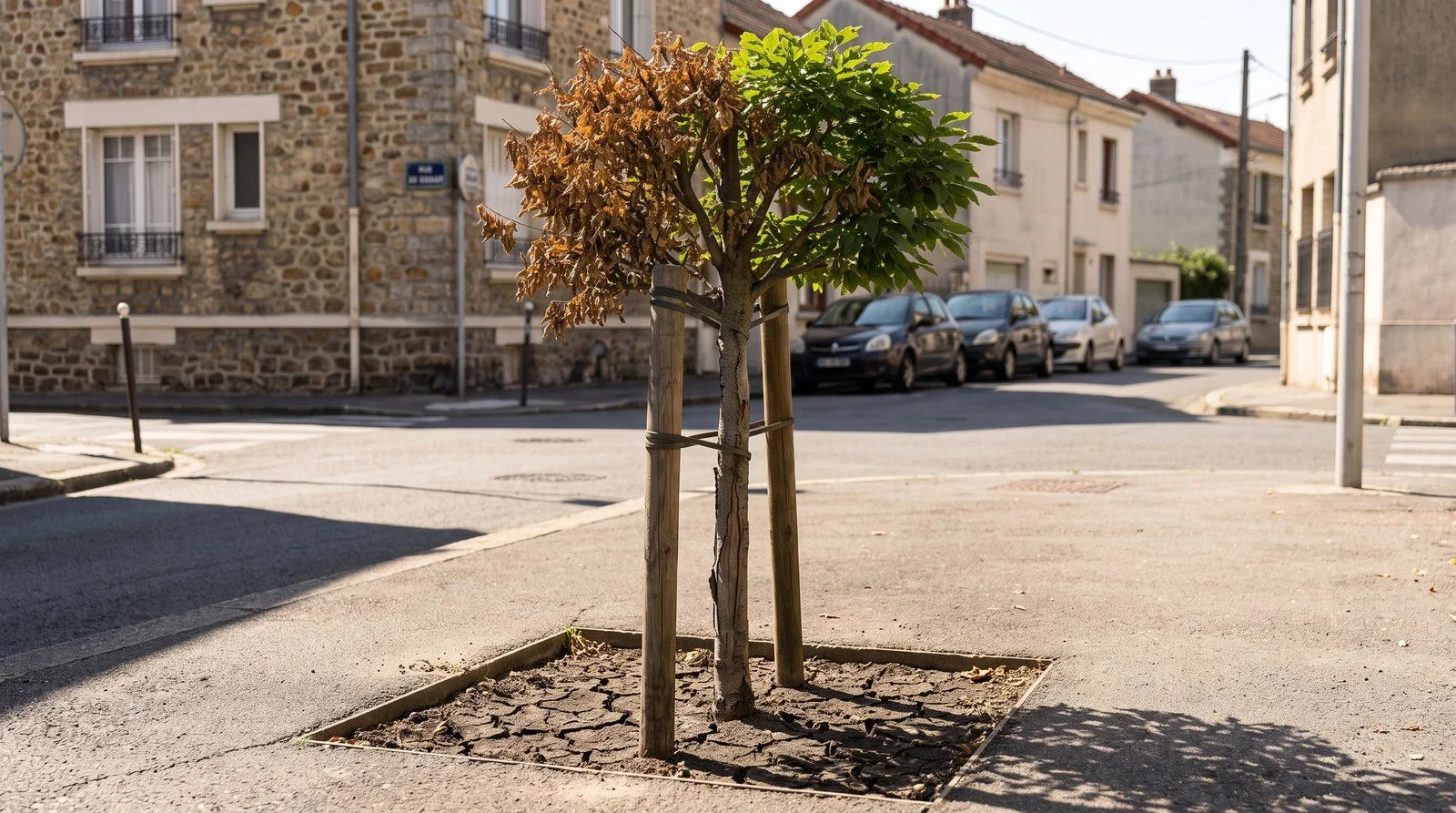
Scorched on one side only, the bark peeling on the same face: it is not thirst, it is heat.
Four practices follow from this, all simple and almost always absent from contracts. Plant small: a whip or young tree of 8/10 girth adapts, rebuilds its roots in one or two summers and catches up with a 20/25 in under ten years, as Stockholm has shown with a factor of five. Plant in autumn, never in the spring before a summer, so that the tree has a cool season to root before the ordeal. Require hardened-off stock from the nursery, grown dry in the final months, and check it. And protect the trunks for the first two summers, with lime wash, reed screening or fleece on the exposed side, as fruit growers have always done and towns have forgotten.
The grove solves part of the problem by itself: a young tree planted in the shelter of older trees or a shrub layer lives in an atmosphere five to six degrees cooler and never reaches the thresholds the isolated tree crosses every afternoon. It is the oasis again, the palm protecting the fig, and it is the most concrete reason to stop planting trees on their own.
This is where the question of responsibility arises, and an elected official should understand it, because it costs them dearly without their seeing it.
The framework is that of booklet 35 of the general technical specifications for public works contracts, in its 2021 version. It provides for an establishment check in the April following planting, once the plants have broken bud, which makes it possible to confirm that the trees delivered were alive without calling into question the maintenance that followed. The establishment target set for trees in urban settings is 100 per cent. The establishment guarantee then runs for two years, and the client can extend it, which professionals recommend above 30/35 girth. So far, so good.
The trap lies elsewhere. The booklet now groups the maintenance that follows planting, formerly called completion and then consolidation, under the name of finalisation works, and it specifies that these works, watering first among them, are only owed by the contractor if the contract's pricing documents include a price for them. In other words, a local authority that has not put a finalisation line in its bill of quantities has bought planted trees, not watered trees. The contractor will replace what dies for two years, then withdraw. In the third year, the authority is left with trees that have never rebuilt their roots, an expired guarantee, and a department that discovers it must water a hundred trees it has never looked after. That is when half of them die, and it is the authority that pays, twice: for the tree and for its removal.
Three things follow for whoever drafts or signs a contract.
The finalisation line must exist, priced, for at least three years for the usual girths, with watering into the wells and not on the surface, and a number of visits fixed per season rather than left to judgement.
The establishment guarantee must be extended to three years from 20/25 girth upwards, because two years do not cover the time needed to rebuild the roots, and the guarantee ends precisely when the risk is greatest.
And the system in this text shifts the question. A tree whose pit receives rain from the road and the bowser in its wells no longer depends on a contractor's visit to drink. It is the street that waters it. The establishment guarantee becomes a safety net, not the only line of defence, and mortality in the first five years stops being an accounting inevitability and becomes what it should be, an accident.
The tree's logbook, kept by the person who empties the basket and looks at the crown, is what will make it possible in the fourth year to say what died and why, and to make the right party pay.
Species have been measured, and the gap is huge
Once the soil is sorted out, the choice of species stops being a matter of catalogues. It has been instrumented, tree by tree, with sap flow sensors and thermometers.
The most telling experiment was conducted in Munich and Würzburg by Rahman and Pauleit's team on two very common and very different species: small-leaved lime and black locust. The lime has a leaf area index about 30 per cent higher, twice the sap flux density and a larger sapwood area. As a result, it transpires three times more than the black locust.
The consequence for the comfort of passers-by is stark. Under a black locust, the physiological equivalent temperature, the one the body actually feels, fell by up to 4 degrees. Under a lime, it fell by up to 11 degrees. Up to seven degrees' difference between two street trees from the same region. The same work measured air temperature reductions of 1.6 to 3 degrees and surface temperature reductions of up to 23 degrees.
Better still, the gap widens as the day heats up. The temperature gradient between outside and inside the crown went from 1.8 to 1.3 degrees for the lime as the heat rose, but from 1.5 to only 0.5 degrees for the black locust. The black locust, in short, lets go at the very moment it was being counted on.
The explanation lies in anatomy. Black locust is an isohydric, ring-porous species, very sparing with water: it closes its stomata early, it survives drought, but it no longer cools. Lime is anisohydric and diffuse-porous: it keeps transpiring longer, it cools better, and it pays more in water. This is not a hierarchy, it is a trade-off. On a Stockholm pit fed by runoff, lime is the right choice. In a dry two-square-metre pit, it will die and the black locust will hold on, while serving almost no purpose.
In Dresden, Gillner and Roloff's team compared six street species of the same age in the same residential neighbourhood. The best cooling came from Turkish hazel and 'Greenspire' lime, the weakest from an elm cultivar. Above all, they established a direct, quantified relationship: each additional unit of leaf area density lowers surface temperature by 4.63 kelvins.
Rahman's meta-analysis generalises these observations and identifies the traits that really count. Foliage density comes clearly first, ahead of everything else. Next comes wood anatomy, with diffuse-porous species cooling better than ring-porous ones, then leaf characteristics: simple leaves do better than compound leaves, and thin leaves under 0.15 millimetres and dark green give the best results.
In Manchester, a comparison of five small species planted six years earlier under the same conditions gave a complementary lesson. Callery pear showed stomatal conductance up to twice that of the others, and it and hawthorn combined a high leaf area index and a broad crown, and therefore the best cooling. Flowering cherry, though one of the fastest growing, cooled surprisingly little and showed signs of water stress. Fast growth guarantees nothing.
Three disqualifying criteria
Choosing a species on its cooling power alone would be a mistake. Three other criteria can disqualify it, and each rests on an old and solid body of literature that French selection grids still largely ignore.
The first is ozone. In September 1988, Chameides, Lindsay, Richardson and Kiang published in Science a three-page article on the role of biogenic hydrocarbons in urban photochemical smog, with Atlanta as a case study. Their conclusion was that trees emit significant quantities of hydrocarbons in urban areas, that these emissions noticeably affect ozone levels, and that ignoring them overestimates the effectiveness of strategies based solely on reducing human sources.
Ten years later, Benjamin and Winer turned this warning into a tool. In Atmospheric Environment, in 1998, they combined the isoprene and monoterpene emission rates of 308 tree and shrub species with the temperature and light data of a typical summer day, normalised them per tree using leaf biomass and crown volume, then crossed them with published chemical reactivities. From this they derived a ranking of the 308 species by ozone-forming potential, explicitly intended for species selection in planting programmes.
So the tool has existed for nearly thirty years. It is still almost absent from specifications.
French figures are now available. A team from CEREA, INRAE and Airparif, led by Alice Maison and Karine Sartelet, built a tree-by-tree inventory from the open database of Paris trees, then fed it into the CHIMERE model for June and July 2022. Emissions from Parisian trees increase particulate organic matter by 4.6 per cent on average, 5.4 per cent during heatwaves, with local peaks of 14.4 per cent. Ozone rises by 1 per cent on average, 2.4 per cent during heatwaves, up to 5.7 per cent locally.
The phenomenon accelerates with heat. Recent measurements in Beijing by the universities of Innsbruck and Jinan show that when the temperature goes from 20 to 35 degrees, the reactivity of compounds emitted by trees is multiplied by seven or eight, while that of compounds of human origin rises by only 40 per cent. And a study published in 2025 on Montreal and Helsinki gives the most operational result: at neighbourhood scale, oaks dominate the ozone-forming potential despite a small share of tree cover. A few high-emitting individuals are enough to drive the result.
One precaution is needed, and it is essential. The genus tells you nothing. Loreto and co-authors established that pedunculate oak and downy oak are strong isoprene emitters, that holm oak and cork oak emit mainly monoterpenes, and that Turkey oak is considered a non-emitter. Three behaviours in a single genus.
The second criterion is allergenicity, and it is even more neglected. Paloma Cariñanos and her team built an index of the allergenicity of urban green spaces, then applied it in 2019 to 355 taxa inventoried in 34 parks in 23 Mediterranean cities, including Nantes and Casablanca, covering more than 110,000 trees. The species with the highest values are box elder, the only wind-pollinated maple, common ash and narrow-leaved ash, dioecious and wind-pollinated, white poplar, plane, the cypress family with cypress first, sclerophyllous oaks and olive.
Plane appeared in 95 per cent of the inventories. And for France, it should be added that cypress pollen has become the leading cause of pollen allergy in the south-east, with more than 30 per cent of the annual pollen spectrum and peaks measured at 63 per cent in Avignon.
Yet the most instructive result of this work is not a list of species. It is that the highest indices were found in parks planted in dense single-species groups, including with species of moderate individual potential. Tree density was the parameter most closely correlated with the index. Monoculture, in short, creates the risk as much as the species itself.
The third criterion is the geometry of the street, and it works both ways.
Mobile measurements in Rotterdam showed higher concentrations of nitrogen dioxide and black carbon in summer in the most tree-lined streets, an effect absent in winter, which clearly points to the foliage as responsible for the trapping. Fine particles behaved the opposite way, slightly lower under the canopy. Modelling of Marylebone Road in London confirms that everything depends on wind direction: parallel to the street, trees help evacuation upwards; perpendicular, they hinder it.
And at night, the Davis transect returns. A closed canopy lowers the sky view factor and traps the infrared radiation the street would like to send back into space. The effect is usually offset by reduced daytime storage in the shade, but it exists, and it is a reason not to close the narrowest canyons.
The tree is therefore not a universal answer applied everywhere in the same way. It is a tool whose effect depends on the soil, the species, the surroundings and the shape of the street. The tables that follow take all four into account.
The species, in three tables
The above comes down to three tables, which I give as I use them. Each species is judged on four criteria based on four distinct bodies of work: cooling, measured or inferred from the traits in Rahman's meta-analysis; ozone-forming potential, after Benjamin and Winer and recent inventories; allergenicity, after Cariñanos's index and the RNSA data; and drought tolerance, after Roloff's climate matrix and German trials. Species from the Maghreb and the Mediterranean coast are included, because the value of winter sun is not the same in Rabat as in Lille and the list must say so.
A word on how much confidence to place in them. Seven species rest on published field measurements: lime, black locust, plane, Turkish hazel, birch, Callery pear and hawthorn. The others rest on functional traits, foliage density, wood anatomy, leaf shape, which is a reasoned inference and not a measurement. And emission rankings must always be checked at species level, never at genus level: the oaks have shown why.
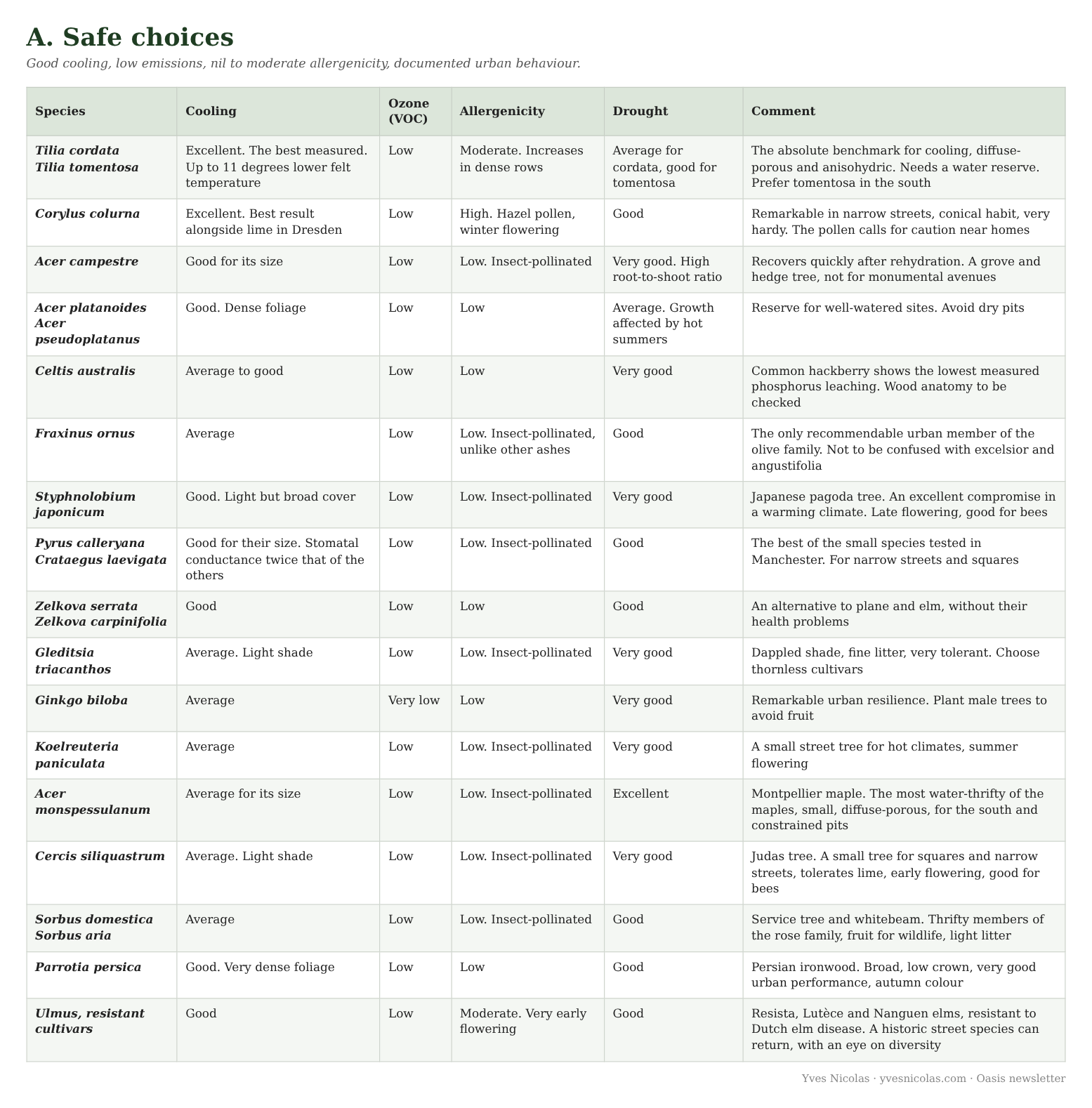
Table A. Safe choices
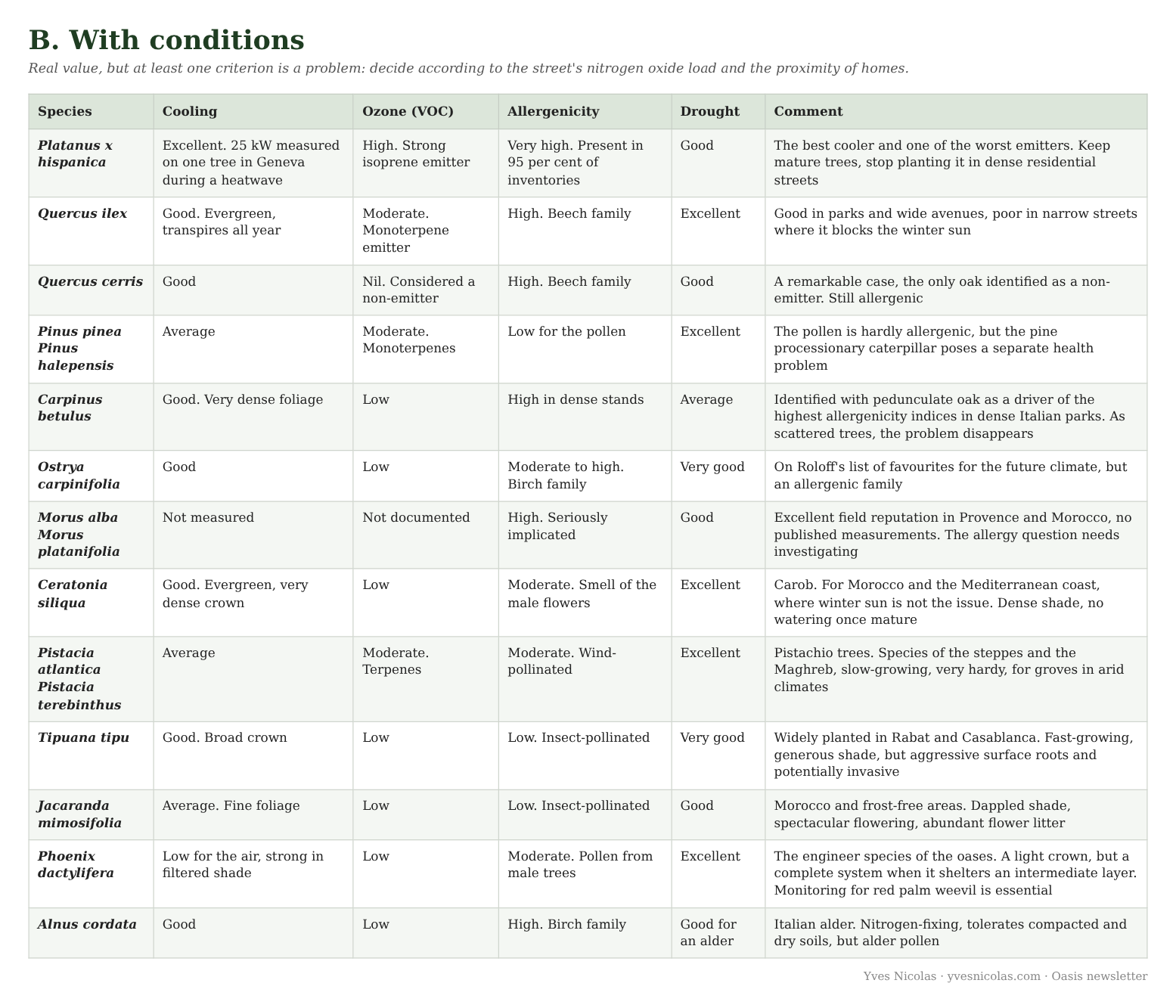
Table B. With conditions
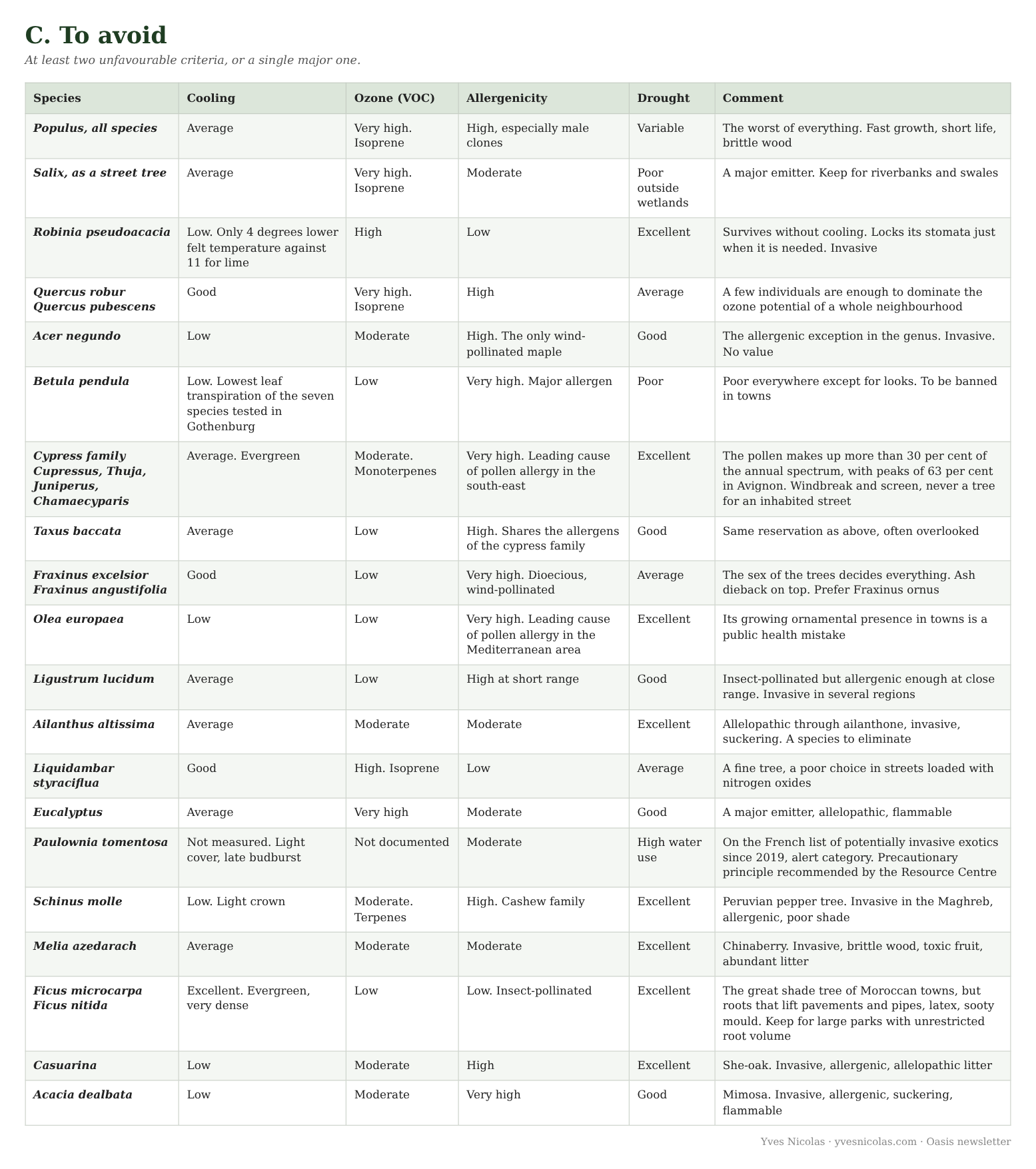
Table C. To avoid
Mulberry deserves a line of its own, because its reputation as a harmless shade tree is misleading. The species often bears its male and female flowers on separate trees, and the cultivars sold as "fruitless", chosen so as not to stain pavements, are male trees: they make no mess, but they release abundant, light and highly allergenic pollen, to the point that several cities in the American south-west have banned planting them. Female trees fruit and make a mess, but release no pollen. In a residential street, it is therefore female or nothing, and preferably nothing.
Plane is the dilemma of these tables. It cools better than anything else and combines the worst on the other two criteria. I have placed it under conditions, with an instruction: keep mature trees, stop planting it in dense residential streets. Black locust illustrates the opposite trap, excellent survival and negligible cooling. You plant a survivor thinking you are planting an air conditioner.
A grove: how many species?
The question arises as soon as you stop planting single trees, and it does not have the obvious answer people think.
The reference on diversity is old. Frank Santamour, a geneticist at the United States National Arboretum, formulated in 1990 the so-called ten, twenty, thirty rule: no more than 10 per cent of one species, 20 per cent of one genus, 30 per cent of one family in a city's tree stock. It was born of plant health disasters, Dutch elm disease, chestnut blight, later the emerald ash borer. Today it is applied everywhere and respected nowhere: inventories show that urban tree stocks average 20 per cent of one species, 26 per cent of one genus and 32 per cent of one family. Central Amsterdam was planted with 47 per cent elms.
But the second half of Santamour's article is systematically forgotten, and it is the half that answers the question. He explicitly recommended placing in the city uniform strips or blocks of species, cultivars or clones of proven adaptation, spread over several locations, so as to obtain spatial diversity as well as biological diversity. In other words, diversity is managed at the scale of the town, not of the planting. Santamour was not asking for one tree of each species in every street.
This reading is the right one, for three reasons.
The first is plant health. A stock made of twenty different single-species groves loses one grove when a pest arrives. A stock made of twenty identically mixed groves loses a twentieth of each grove, and so sees all twenty plantings gapped at the same time. The first structure can be repaired; the second degrades everywhere at once.
The second is technical. A single-species grove is managed, pruned and watered on a single regime. A four-species mix needs four calendars. Parks departments know what that means.
The third is the one that interests me most, and it comes from forest ecology. It is often said that a mixture is always better. That is wrong, and the nuance is decisive for an urban pit.
Mixtures produce their benefits, better growth, greater drought resistance, stability over time, through precise mechanisms: denser packing of crowns when architectures and phenologies differ, complementary use of light when a shade-tolerant species grows under a light-demanding one, sharing of the soil when a deep-rooted species coexists with a shallow-rooted one, and sometimes hydraulic redistribution, with the deep species bringing up water the shallow one uses.
But these mechanisms only work if the traits really differ. Mixtures of conifers, with behaviours too similar and all sparing with water, have shown no gain in drought resistance compared with pure stands. And a study published in PNAS, covering several types of European forest, established in black and white that species diversity does not always improve drought resistance.
There is worse, and it directly concerns a continuous pit. Recent experimental work, still in preprint, has shown that when two species share the same soil volume, the one that keeps transpiring under stress empties the reserve and pushes its thrifty neighbour into hydraulic failure. The risk disappears when the root systems are separate. In a Stockholm pit, they are not.
Translate this to your street. Mixing a lime, which is anisohydric, and a black locust, which is isohydric, in the same trench is not a neutral operation. The lime will keep pumping when the black locust has shut up shop, and it will empty the shared reserve. The black locust will survive, because it is a survivor, but the trade-off will have been made without you.
My answer, then, at three scales.
At the scale of the grove, two to four species at most, chosen for genuinely contrasting crown architectures, phenologies and rooting depths, but compatible water strategies. Do not pair a saver and a spender on the same reserve. One dominant species that gives the structure, one or two companions that fill the layers.
At the scale of the street or square, the unit can stay single-species. That is what gives an avenue its architectural clarity, and it is what Santamour recommended.
At the scale of the town, the ten, twenty, thirty rule, and rather stricter than looser. Some propose going down to 5 per cent per genus, which seems reasonable to me given what is happening to ash trees.
Layers, or what the oasis had understood
Finally comes the most interesting question, and the one on which the city has most to learn from elsewhere.
When Taha, Akbari and Rosenfeld called their 1991 article an oasis effect, they were borrowing a term from dryland agronomy. They could not have put it better.
The traditional oasis is the most accomplished plant-based cooling system humanity has built, and it rests entirely on layering. Three layers. Above, the date palm, which filters radiation, cuts the wind and keeps the soil moist. In the middle, fruit trees: pomegranate, fig, apricot, orange. On the ground, vegetables, cereals, lucerne. France's National Museum of Natural History describes the date palm as an engineer species, because it does not merely produce dates: it creates the microclimate without which almost nothing growing beneath it would grow there.
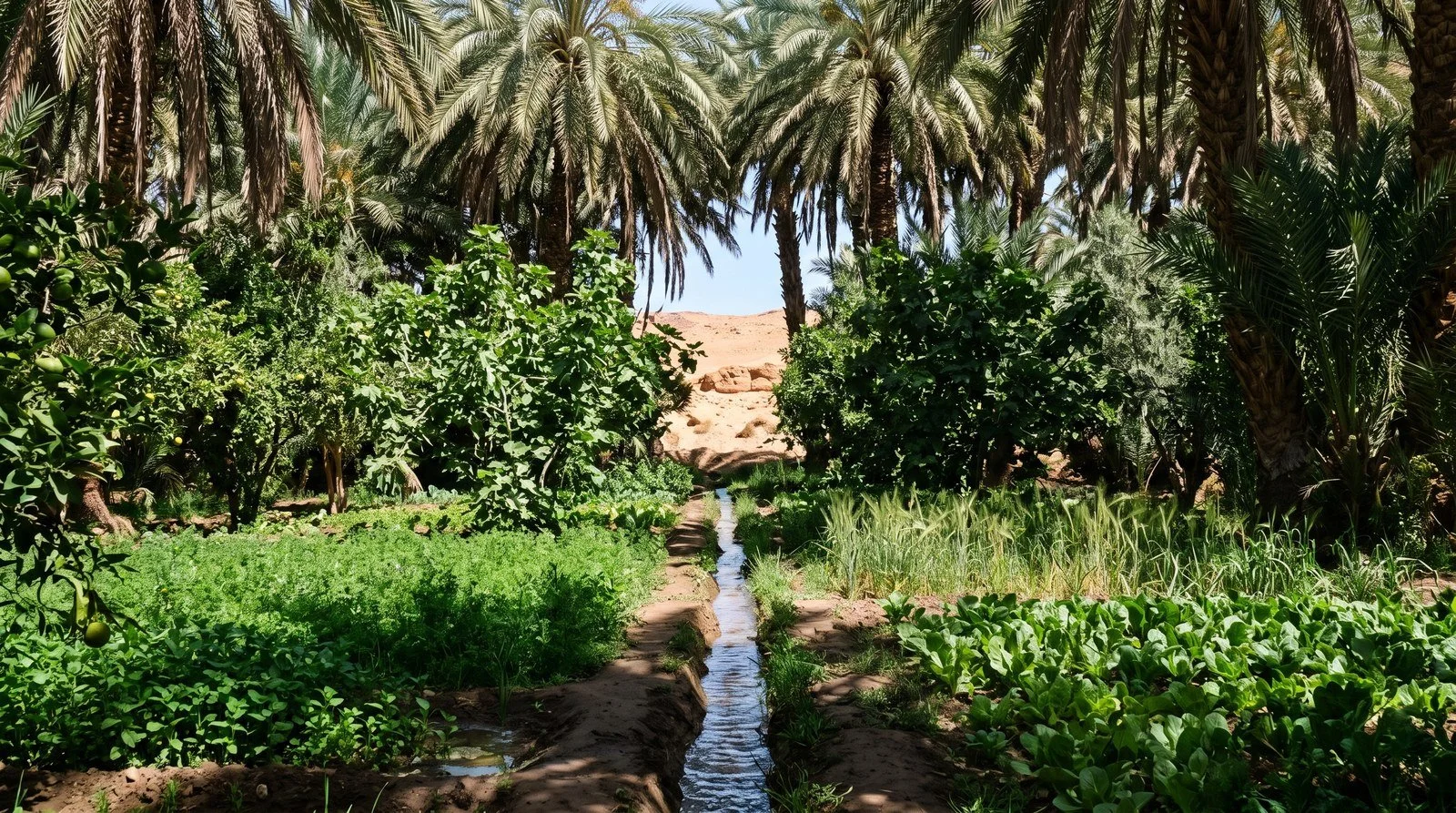
The oasis: three layers, and as many layers as the water reserve can feed.
A field observation, reported in CIRAD's work on the palm groves of the Tafilalet, deserves to be framed and hung in every parks department. The number of layers is linked to the availability of water. Two layers when water is short, three when it is assured. The oasis does not stack because it looks pretty. It stacks what its reserve can feed.
And honesty is required, because the model has its critics. Some agronomists dispute the myth of generalised three-layer systems, arguing that the light reaching beneath a double canopy becomes insufficient for the lower layer to produce properly, and that no serious comparative study can settle the matter between systems. Layering is therefore a trade-off between light and water, not free stacking.
Back to the city, where measurements exist.
The Miyawaki method explicitly adopts this logic: plants set at three to five per square metre, twenty to fifty native species, and four layers, shrub, understorey, canopy and emergents. Earthwatch, which monitors a network of micro-forests in the United Kingdom, recorded air temperatures up to six degrees lower inside a three-year-old micro-forest than in its immediate surroundings. The figure is spectacular. A review published in 2025 in the Journal of Applied Ecology, however, tempers the enthusiasm, noting that several of the benefits regularly claimed still lack rigorous long-term demonstration.
The most solid measurement on lower layers comes from elsewhere. A British team buried temperature sensors at the soil surface on a hundred sites across a medium-sized town, and monitored them for eleven months. Trees and shrubs in non-domestic green spaces lowered the mean maximum summer soil surface temperature by 5.7 degrees compared with surfaces covered by grass alone, while keeping temperatures slightly higher in winter. The same literature notes that an experimental lawn lowered the maximum surface temperature by twenty-four degrees compared with concrete.
There you have the division of roles, and it is clear. Covered ground does the most spectacular work, twenty-four degrees gained over bare concrete. The shrub layer adds nearly six degrees at the soil compared with a simple lawn. The canopy works on the air, on the comfort of passers-by and on facades. Three layers, three functions, and they are not interchangeable.
To this must be added what the lower layer does for the pit itself, which appears in none of these temperature measurements. It covers the ground, so it cuts direct evaporation from the reserve. It produces litter, so it maintains biological activity and porosity. It protects against capping and compaction by trampling. In an urban grove, it does exactly what the palm does in the palm grove.
A grove on bare ground, or worse, a grove mulched with mineral material, deprives itself of all this. Yet that is what is most often delivered, because the herbaceous and shrub layer looks untidy and requires differentiated management that maintenance specifications do not yet know how to write.
The constraint, always the same, resurfaces here, and the oasis had already given it to us. Each layer added is an extra transpiring surface drawing on the same reserve. A three-level layering on a dry pit will kill your trees faster than bare ground. The number of layers is decided after the reserve has been calculated, never before.
This may be the most useful sentence in the whole article, and it was not urban climatologists who found it. It was the oasis dwellers, a very long time ago.
Part three: trees already planted
The city is not a blank page. It has tens of thousands of mature trees planted in dead pits, and no one will open up the streets to replant them. This part explains how to bring them water from the road without demolition, by means of wells, and how to turn the roundabout inside out, which is the most common case and the worst built.
The trees already there
The pit must be brought to the tree without disturbing it, and without touching the street.
The technique is drilling. On either side of the tree, below the edge of the crown, where the active fine roots are, wells are drilled one to one and a half metres deep. They are not drilled to the final diameter in one go: you start with a small-diameter pilot hole, with a fine auger, which goes down feeling its way. If it meets a structural root or a utility, it is abandoned and moved a few dozen centimetres. If it goes down to the bottom without resistance, it is widened to the required diameter along the same axis. In this way a load-bearing root is never cut, and along the way you discover what the subsoil really contains, which no utility plan states exactly.
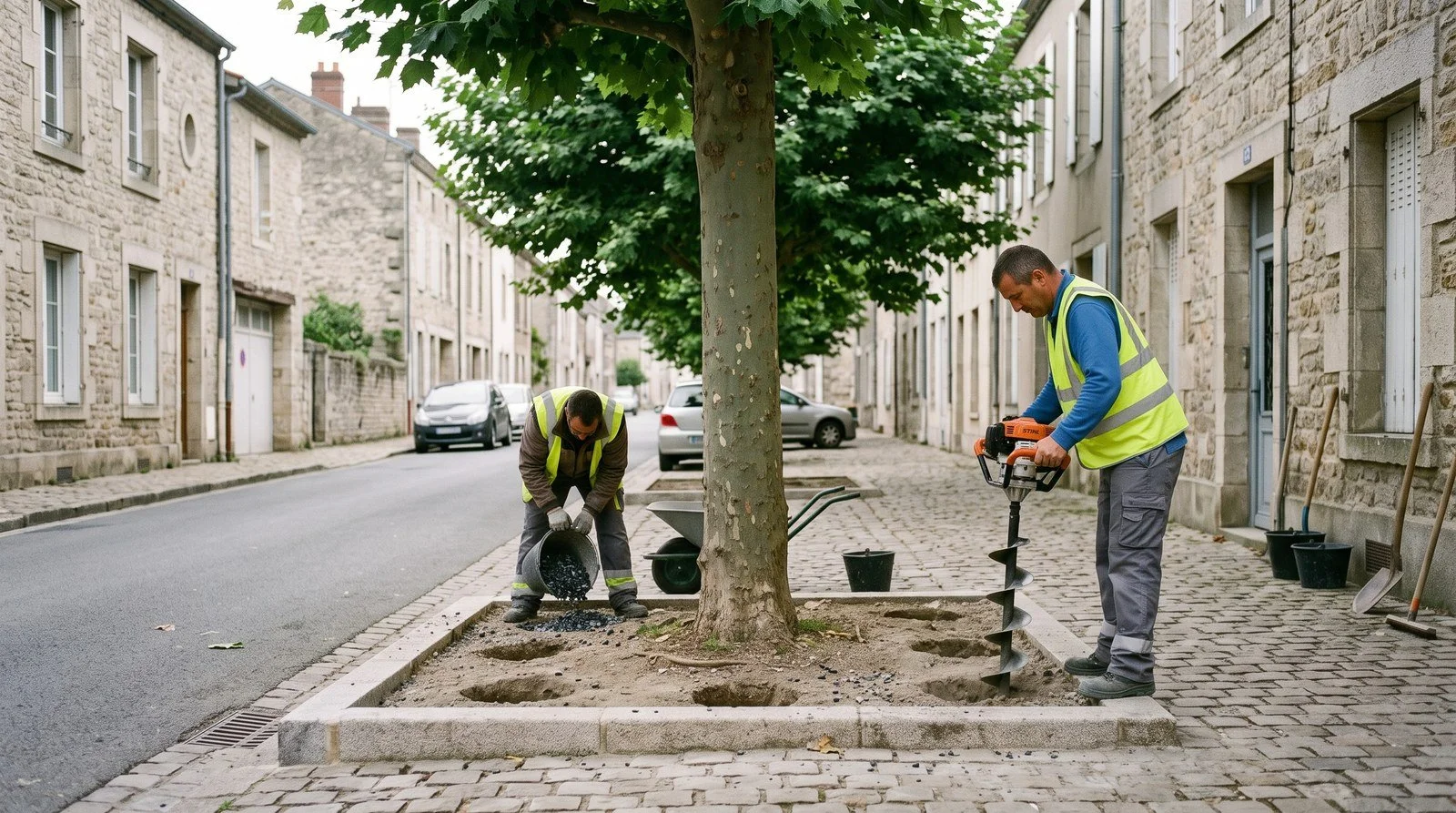
Wells drilled below the edge of the crown, without demolition: one day of light works per tree.
I will be asked whether there is nothing better, and the question must be answered. There is air excavation, a compressed-air lance that breaks up the soil and a vacuum truck that removes it, the roots remaining intact because air cuts nothing; it is what utility companies do to expose a pipe at the foot of a tree, and what Stockholm uses for its work on existing trees. It is faster on a large pit, but for thirty-centimetre wells every metre it needs a truck, an expensive day, noise and mud, for a result the auger achieves with none of these. There is also ground-penetrating radar, which gives an image of the roots without digging, but an image and not a certainty, and one that is misleading in the heterogeneous fills that make up every pavement subsoil. The pilot hole therefore remains the method, because it is the cheapest and the only one that produces real knowledge. I reserve the air lance for one case: a remarkable tree or a listed avenue, where the probe has revealed root growth so dense that it is better to widen without chopping it up, and where the cost of the truck is justified. These wells are filled with an uncompactable skeleton that guarantees the porosity will not collapse under traffic vibration, and with an active matrix whose core is a porous carbon, a biochar, loaded with the biology of the place.
On this last point, a word on method, because it makes all the difference. You can buy selected, standardised strains, raised under controlled atmosphere. I prefer to fetch the biology where it already lives, in the organic matter of the neighbourhood itself, because that biology has survived the neighbourhood's droughts, its heat, what its roads release, and it has already learned to get along with the roots of the species planted there. The adaptation is already written in, and it only needs moving from a compost heap to a planting well.
The composition of this matrix, its proportions and the way it is activated before going into the ground are set site by site, and that is the work I do for those who call on me. What I can say here is what it does: it holds water, it fixes the harmful substances the street brings, it offers soil life a refuge to retreat to when a shock comes, and it draws roots downwards, where it is cool, instead of letting them come back up to lift the asphalt.
At the surface, the geometry is simple. The planted area is surrounded by a raised kerb, with a notch on the uphill side to receive the road, and a second notch on the downhill side, slightly higher than the first. The soil around the tree forms a basin, a little lower than the pavement, with one absolute precaution: a dome of dry soil around the collar, because road water against the bark means certain rot. Water therefore collects around the edge, just above the wells. It soaks into them, and when they are saturated, the level rises in the basin up to the outlet sill, from which the excess simply returns to the gutter, storm after storm, without anyone ever having to touch it again.
No demolition. One day of light works per tree. And a tree that, the following summer, transpires at four in the afternoon instead of shutting up shop at noon.
The roundabout turned inside out
France is said to have nearly half the roundabouts on the planet, and almost all of them are built inside out.
Their central island is domed. It was designed that way so that water leaves it as quickly as possible towards the gullies around the edge, and so that the mound blocks the view and slows drivers down. The result is a mound of dry earth, watered with a hose, planted with things that die.
Turn it inside out. The central island as a basin, the road pouring into it through water openings, a grid of infiltration wells every metre, and an overflow that returns the excess to the road. In the centre, above the reserve, a grove of high-transpiring species, lime, which pumps and cools the junction like a cooling tower. The roundabout stops being leftover space and becomes a structure.
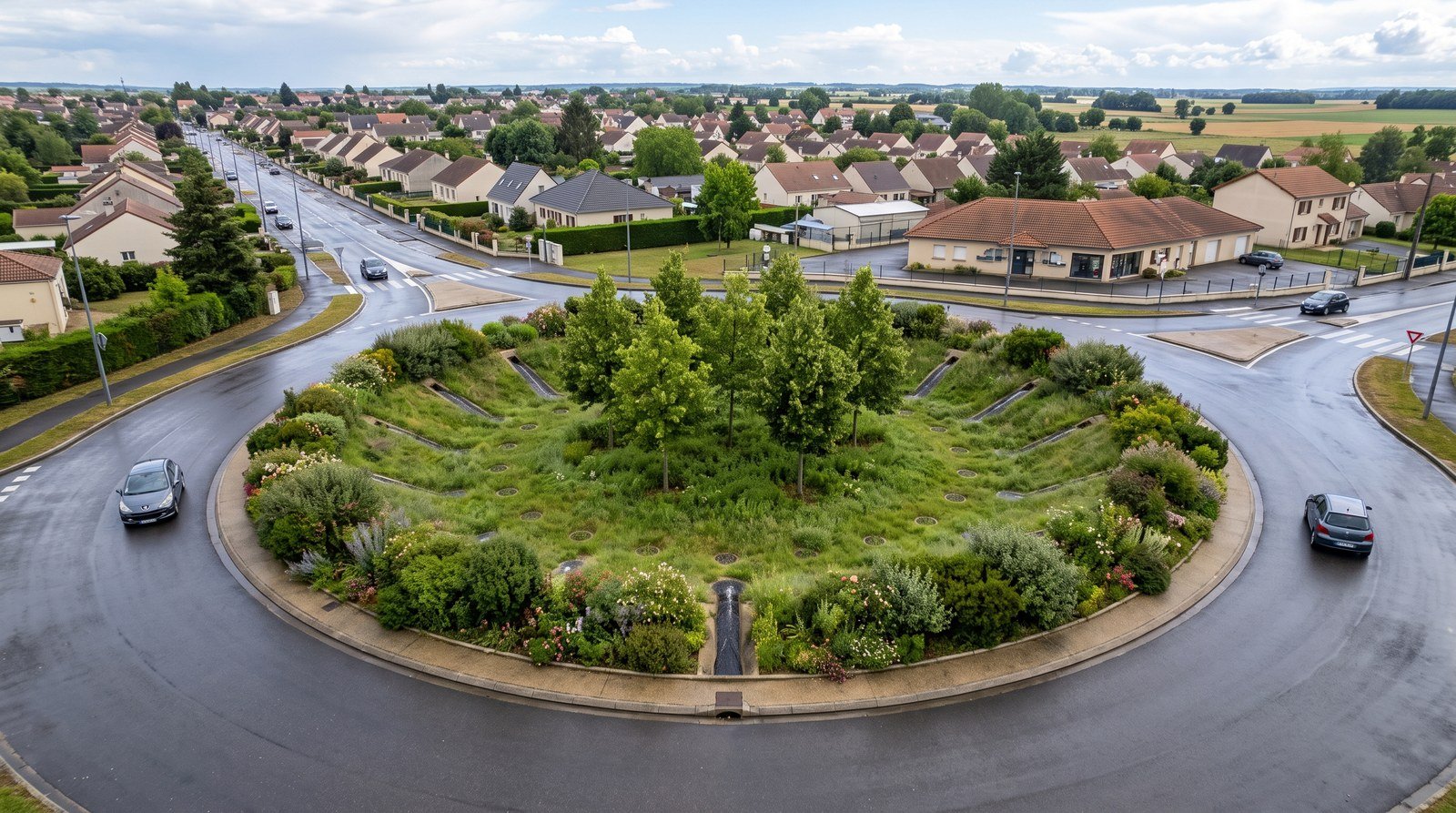
The roundabout turned inside out: a basin, the road pours into it, and the grove sits at the low point.
Three things must be provided for, and I mention them because a highways engineer will ask. First, enclose the subsoil of the island with a vertical waterproof barrier, to the depth of the road layers, so that retained water goes down into the wells and not sideways under the asphalt, where it would make the road subside. Next, deal with the pollutant load, because a roundabout, with its braking and accelerating, concentrates zinc, copper and tyre residues: a first, very mineral sedimentation strip, planted with species that fix metals, mown and removed every year. Finally, keep the visual barrier, which will no longer be the mound but a dense shrub layer at eye height around the edge of the basin, with the centre left free for the large trees.
Part four: streets too narrow for a tree
In historic centres, a tree pit is impossible: subsoil saturated with utilities, facades eight metres apart, endless coordination of works. This part leaves the tree for the wall, then for the street's ceiling. It describes the offset trellis and the climbing plants that cover it, what they do and do not do, which species to choose, how to cover the street itself with a deciduous canopy stretched on cables, and how to bring water from the road to all of this by passing under the pavement.
The trellis fifteen centimetres from the wall
A street in a historic centre has no room for a tree, but it has two huge vertical surfaces that heat up all day and give the heat back all night.
The stone or brick wall of a Haussmann-style building is a heat store. It absorbs solar radiation for six or eight hours, stores that energy in its mass, and gives it back slowly after sunset, exactly when the city needs to shed its heat. It is one of the main drivers of the urban tropical night.
The right answer is not to stick ivy on the wall. It is to offset the planting. A trellis, a net of stainless steel cables or a rigid mesh, is fixed fifteen or twenty centimetres from the facade, and climbers are trained on it. Three effects then combine.
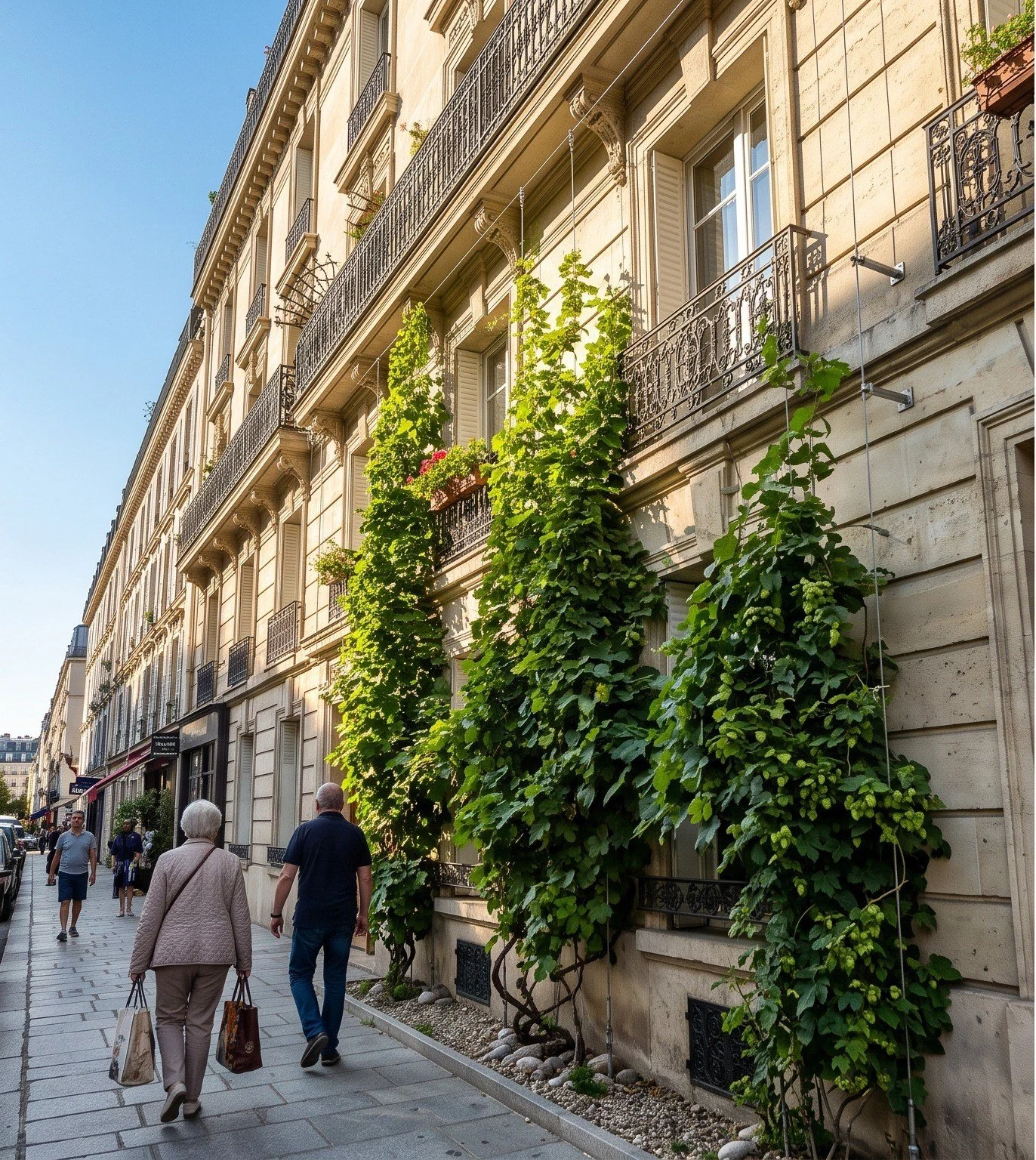
The trellis fifteen centimetres from the wall: radiation is stopped before it reaches the masonry, and the facade remains inspectable.
The first is interception. Radiation is stopped before it reaches the masonry. The wall no longer charges up. Measurements taken in Berlin by Marie-Therese Hoelscher, Thomas Nehls and their team on three green facades in summer recorded surface temperatures on the greened walls 15.5 degrees lower than on bare walls. A wall that rises to 45 degrees stores considerable energy. A wall that stays at 30 has almost nothing to give back.
The second effect is the air gap. Perini and her team measured the behaviour of this cavity: below twenty centimetres thick, the air speed in it stays under 0.2 metres per second, which is enough to add about 0.09 square metre kelvin per watt to the thermal resistance of the wall. The literature places the useful gap between three and twenty centimetres. Setting it at fifteen or twenty centimetres therefore makes perfect sense: enough to create a thermal buffer and let air circulate, enough for the foliage not to heat the masonry by contact, and enough for the facade to remain inspectable and the plant prunable.
The third effect is evaporation. Hoelscher and her team measured transpiration of around 0.5 litres per square metre of leaf area per day, a value remarkably stable across the three species monitored. A well-trained screen commonly develops twice as much leaf area as the wall area it covers. A facade ten metres by fifteen therefore evaporates around a hundred and fifty litres a day, about a hundred kilowatt-hours of latent heat removed from the street.
The night-time consequence is the one we were looking for. The same study measured temperatures 1.7 degrees lower at night on the inner faces of the walls behind the green facades, and found that the screen reduced night-time radiation from the walls. What the wall has not stored, it does not give back.
Two reservations, because an article that only praises a solution helps no one.
The first comes from an Italian trial in Bari on two evergreen climbers. By day, the greened walls were up to 7 degrees cooler than the control wall. But at night, the air in the gap behind the foliage was up to 2.2 degrees warmer than the control. Insulation works both ways: it also slows the release of the little heat accumulated. That is one more argument in favour of deciduous species, which let the wall breathe and recharge for free in winter.
The second is more serious. The Berlin team detected no measurable cooling of the urban canyon itself. The green facade cools the building and its skin; it does not demonstrably cool the street. It deals with one specific driver of night-time overheating, storage in the built mass, and it deals with it well. It should not be asked to do more.
Which climbers, and with what values
Here too, species have been compared, and on offset trellises, which corresponds exactly to the system we are discussing.
A study in Toronto on a three-dimensional steel-wire frame installed in front of a south-facing wall monitored three climbers from May to September: hop, Virginia creeper and riverbank grape. On average over the season, the green facade kept the wall surface 1.84 degrees cooler. The best performance came from the grape, with a 2.91-degree reduction in September. In all three species, cooling increased with the degree of cover, which has a practical consequence: hop, which regrows from its rootstock every year, covers late but massively at the end of the season, whereas grape and Virginia creeper, whose framework stays in place, cover earlier and more irregularly.
The Austrian study in Söll on south-east-facing facades completes the picture over the annual cycle. Crimson glory vine, hop, wisteria and Dutchman's pipe each reduced incident solar radiation by more than 80 per cent. Hop offered the strongest and longest shading capacity in the season.
A simple reading emerges from these two series of measurements.
Hop is the champion of summer shade and the only one to disappear completely in winter, framework included. It is the choice for streets where winter sun has value, and that is why Cerema notes a growing number of local authorities taking it up, its rapid growth giving shade from the first season.
Grape gives the best measured wall cooling, it is light, it is trained and pruned as no one in this country has forgotten, and its winter framework remains modest.
Dutchman's pipe is the most elegant solution for a trellis, with dense, overlapping foliage and a reasonable framework.
Wisteria must be handled with care on a light structure. Its mature framework becomes heavy and destructive, it wrecks what it twines around, and it still intercepts a significant share of low winter light. It needs a structure designed for it.
One last constraint applies, and it brings us back to the first part of this article. An Australian study tested root volumes of 21, 42 and 63 litres for facade climbers. The conclusion fits in one sentence: cover, and therefore cooling, and heat tolerance depend directly on the volume of soil explored and the water available. A climber in a planter is permanent watering. A climber in open ground, on a continuous pit fed by runoff from the pavement, fends for itself.
The climbers have their own table, with different criteria. For an offset trellis, what counts is the density and duration of shade, whether or not the foliage disappears in winter, the framework weight the structure will have to carry, the climbing method, which decides whether the plant stays on its cables or goes to cling to the wall, and water thriftiness. The climbing method is the criterion people forget and the one that decides everything: Boston ivy or common ivy abandon the trellis for the wall, hop or Dutchman's pipe stay on their wires. Seven species in it are measured, the others proposed on the basis of practice, and the table says so.
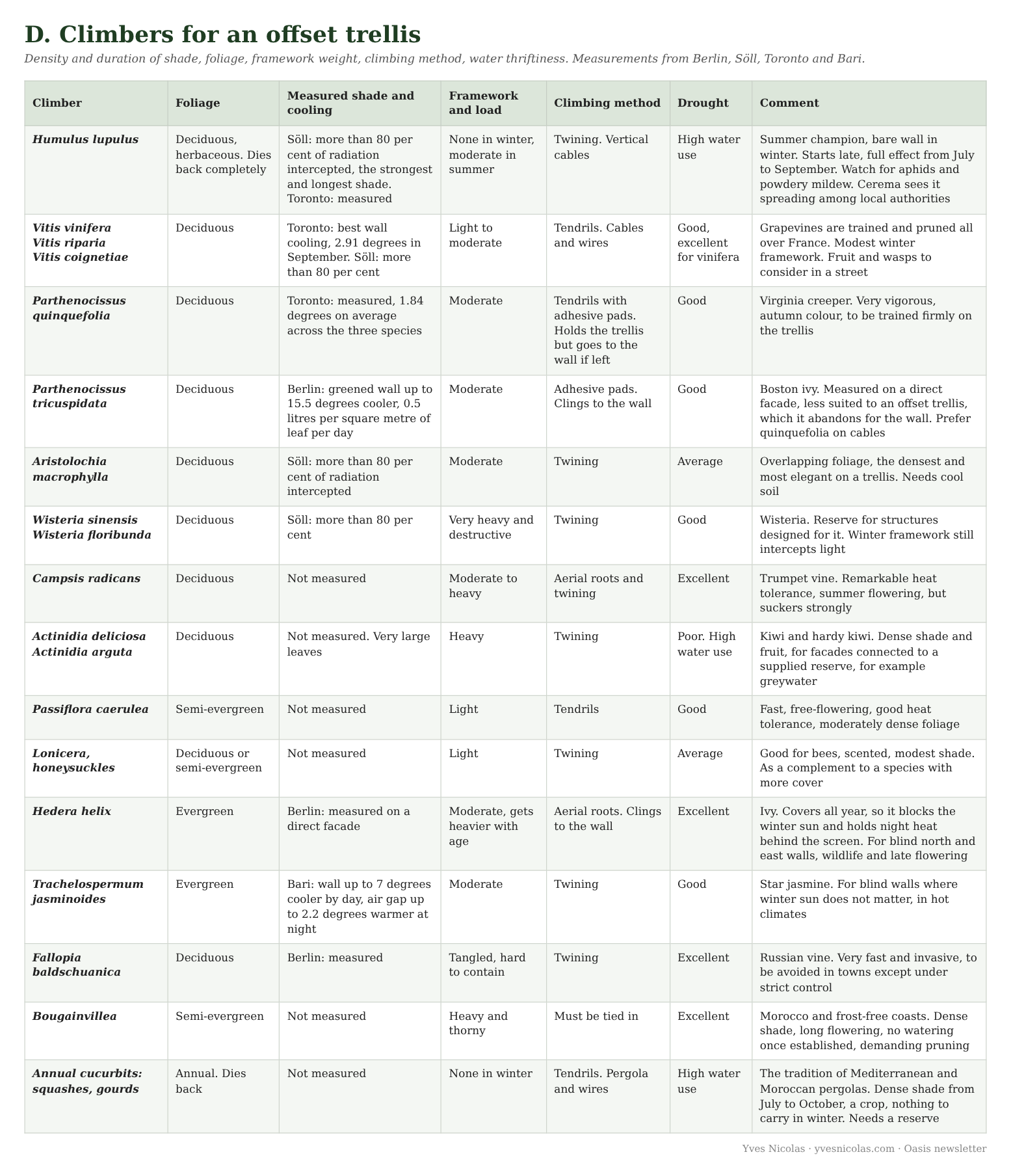
Table D. Climbers for an offset trellis
The living awning
Let us take the logic one step further. The trellis clothes a wall. But the street also has a ceiling, and that is where the sun comes in.
Southern towns have always known this. The souks covered with mats, the toldos of Seville, those canvases stretched from one facade to the other above pedestrian streets, have for centuries done what no tree can do in an eight-metre street: stop the radiation before it reaches the ground. A roadway that stays in the shade does not rise to fifty-five degrees, it does not store heat, it has nothing to give back at night. It is the main driver of the urban tropical night that is switched off, not merely a comfort for passers-by.
The next step is simple to state: replace the canvas with living plants. Cables stretched from one facade to the other, or from one mast to another on public land where the facades are not suitable, four and a half metres high to let emergency and delivery vehicles through, spaced fifty to eighty centimetres apart so that the stems can cross them, and on these cables deciduous climbers planted at the foot of each facade and trained towards the middle of the street. In June the canopy closes. In November it falls. Only the wires remain, casting no shade, and the street gets its winter sun back.
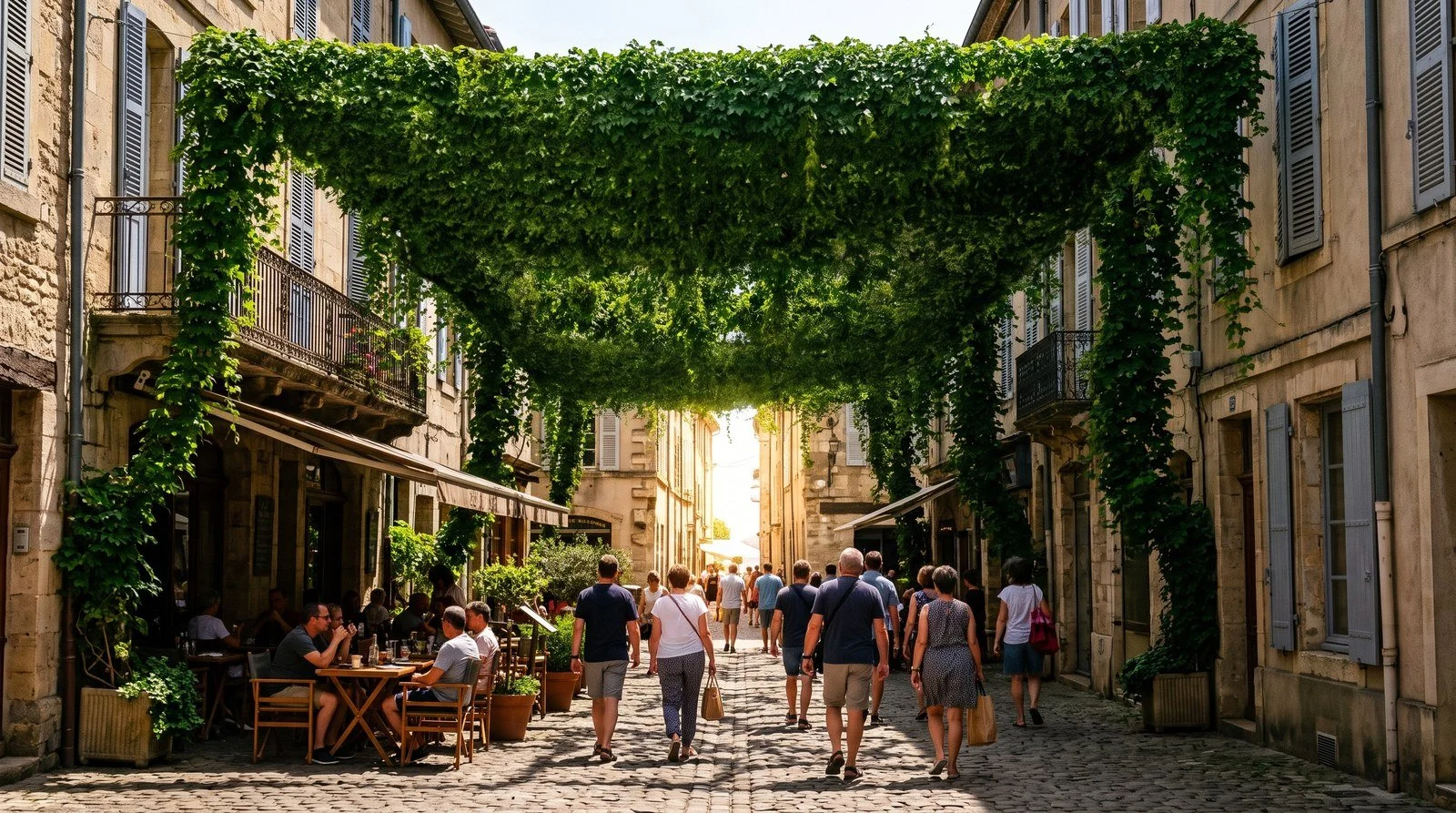
The living awning: a canopy of hop that closes in June and falls in November.
Three species lend themselves to this use, and the table has already given them. Hop, which climbs six to eight metres in a season, covers massively from July to September and dies back to the rootstock, leaving nothing to carry in winter. Grape, which keeps a light framework on the cables and gives the most regular cover, with the pruning know-how the whole country possesses. And, in the south and in Morocco, annual cucurbits, squashes and gourds, which courtyards and alleys have always carried on their pergolas, and which give the thickest shade of all from July to October, with a harvest into the bargain.
What this requires must be stated, because this is where a department will say no. The wind load of a leafy canopy heavy with rain is that of a sail, and it pulls perpendicularly on its anchors: chemical anchors in load-bearing masonry, load calculations, not plugs in render. The facades are private, which requires an agreement with each owner, or a switch to masts on public land. A passage must remain openable for a turntable ladder or a removal lorry, through a removable bay. Pruning is done once a year, from a cherry picker, and the leaf fall is swept up in autumn like that of any avenue. And each plant must have its water reserve, which is the subject of the next chapter.
The result can be measured. Peeters's work cited by Cerema is illuminating: to obtain three and a half degrees of cooling in a street in Tel Aviv, 60 per cent of the street had to be covered with trees, 85 per cent with a bare pergola, and 70 per cent with an ivy-covered pergola. Canvas makes shade; plants make shade and evaporation, and less of them is needed. On a street eight metres wide and a hundred metres long, a hop canopy develops around sixteen hundred square metres of leaves and evaporates, at the values measured in Berlin, eight hundred litres a day, more than five hundred kilowatt-hours of heat removed from the street every day, at head height.
One reservation, the same as for trees, and it comes from Davis in 1991. A closed canopy above a narrow street slows night-time radiation to the sky. Hop has the advantage of being a light canopy, through which you can see the stars, and an eight-metre street between fifteen-metre facades already has such a narrow sky that the loss is small. But in a truly deep canyon, open bays should be kept, one in three, to let the street breathe at night. It is the same trade-off as for the grove, and it is decided street by street.
This system suits precisely the streets that neither the medina nor the avenue can handle: eight to twelve metres wide, too wide to shade themselves, too narrow for a tree. These are the streets of every historic town centre in France.
Passing under the pavement
The green screen of a south-facing facade has the same problem as the tree: it needs its reserve, and the foot of the wall has none. Worse, the pavement subsoil, in its first eighty centimetres, is a tangle of ducts, cables and pipes where a continuous trench will never be dug.
The solution is to offset the reserve. It is not placed under the pavement but under the parking strip or the gutter, where there is room, with the same water inlet and the same clock as for trees. At the foot of the wall, only a micro planting pit is dug. And the two are connected by perforated ducts buried beneath the utilities, over the shortest possible distance, into which the roots grow to drink under the roadway, provided air and moisture circulate in them. Climbers, which have roaming roots, lend themselves well to this.
Two precautions, and they are absolute. The first is a waterproof, root-proof barrier against the building's foundation, going deeper than the lowest point of the reserve, so that no water migrates towards the masonry or the cellars. The second is to put no organic matter in the first twenty centimetres in contact with the facade: bare stone, air, a dry collar. The moisture stays at depth, where it is useful.
And the winter latch, once again. A deciduous plant needs no water from November to March. That is precisely the salt season.
Part five: the building and what lies beneath it
This last part is addressed as much to social landlords and owners as to local authorities. It links the above to the building's wastewater and to the stability of its foundations. This is where the system stops being a matter of green spaces and becomes a matter of built heritage.
What lies beneath the wall
We leave the street for the foundation. What follows is, I believe, the most important reversal in this report, and it concerns building doctrine, not landscape doctrine.
It will be objected that bringing water against a building is madness. My answer is that the greatest risk to buildings, in a good half of France, is not water. It is the drying out of clay layers.
Clay shrink-swell cracks tens of thousands of houses every year; it is the second-largest item of compensated natural disasters in France, and the first in some drought years. The mechanism is simple. Hydrated clay is swollen and carries the wall. Clay that dries shrinks, the ground subsides, and the facade cracks. Yet modern urban planning, obsessed with waterproofing, has spent a century methodically drying out the subsoil of its towns, sealing every surface and sending every drop to the sewer. On the slopes of Meudon as throughout the Paris basin, on highly reactive marls and clays, cutting off the water supply to the ground is structurally far more destructive, in the long run, than controlled infiltration.
So yes, the flow must be controlled. That is the clock's job. But a thousand times yes, water must be supplied.
But first an error must be set aside, because a geotechnical engineer would rightly point it out. What cracks a house is not dry clay, it is unevenly dry clay: one side shrinking while the other holds. Wetting a single facade creates exactly this imbalance. The trench under the south wall air-conditions the south wall, which is already a great deal, but it does not protect the house. For that, you have to go all the way round.
A building standing on known clays must therefore be encircled, on all four sides, by the same trench, fed evenly and closed by the same barrier against the foundation. It then becomes a continuous moisture buffer. The porous carbon it contains soaks up water and releases it slowly, by capillarity, to the neighbouring clays, which stay evenly swollen in the middle of August. If a storm brings too much, the climbers on the surface act as a safety valve: they pump out the excess and evaporate it on the facades. The building is air-conditioned from above and stabilised from below, with the same water, and on all sides at once.
For these buildings, it remains to find the water that will feed the ring when the sky gives nothing more, in the middle of August, when the trench has no more storms to receive. The house produces this water itself, every day, and that is the subject of the next chapter.
The house that waters its foundations
This is where the house's water enters the system, and first we must say which water is meant. Not only the greywater from showers and washbasins: all of the building's wastewater, including that from the toilets. A household of four produces four to six hundred litres a day, winter and summer, rain or no rain, and it is precisely this regularity that makes it a resource for the clay.
The principle fits in one sentence: treat this water away from the house, store it, and return it in summer to the ground under the foundations, in a closed circuit, without it ever seeing daylight again.
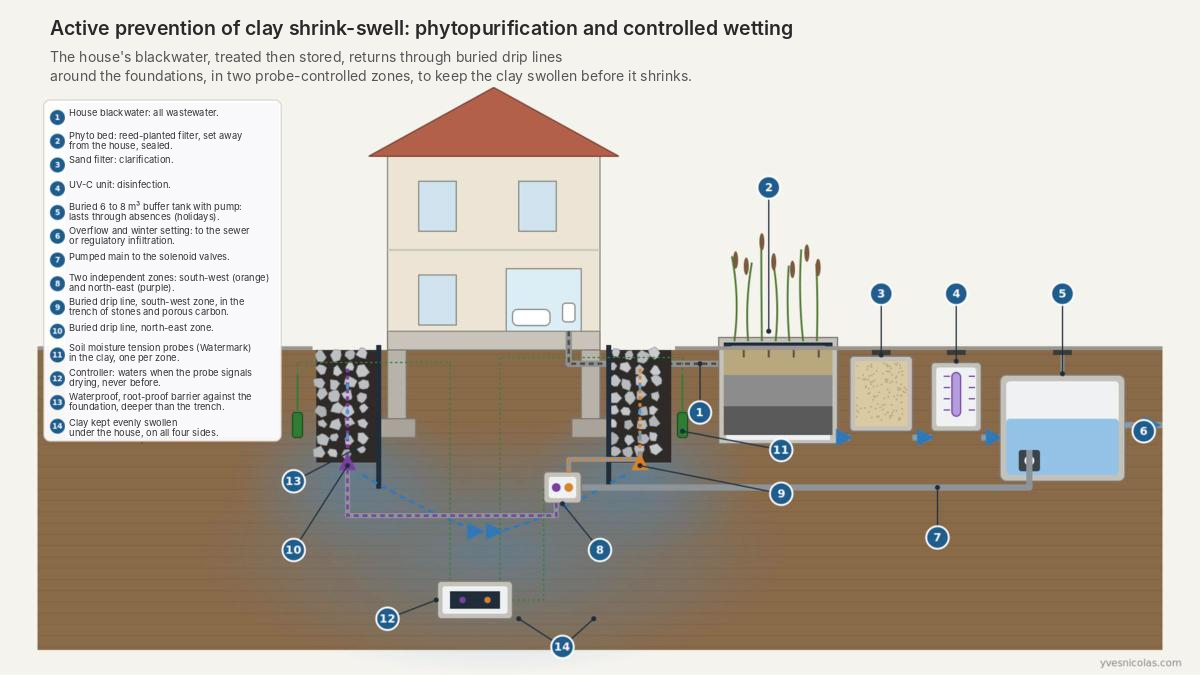
The building on clay: wastewater, treated and then stored, comes back in summer through buried drip lines around the foundations, zone by zone.
Treatment is by phytopurification, as practised for twenty years in houses not connected to the sewer. A sealed bed planted with reeds, filled with gravel and sand, set a few metres away from the house, receives the raw water. Solids stay on the surface and compost there in the air, under the reeds, whose roots maintain porosity and bacterial life; the water passes down through the filter. At the outlet, a sand filter clarifies what remains in suspension, then a UV-C lamp disinfects it. The water that comes out is not drinkable, and that is not asked of it. It is clear, stabilised and free of germs.
It then goes to a buried buffer tank of six to eight cubic metres. This volume is not a luxury. The time when the clay suffers most is August, and that is also when the house is empty. Six to eight cubic metres is two to three weeks of a household's output, enough to keep watering going during the holidays, when the house produces nothing. In winter, and whenever the tank is full, the overflow goes to the network or to regulatory infiltration, as with any sanitation system.
Then comes the watering, and it is not done by guesswork. Around the house, in the trench of stones and porous carbon described in the previous chapter, runs a buried drip line, divided into two independent zones, south-west and north-east, because the two faces of a house do not dry at the same rate and it is precisely their difference that causes cracks. In the clay of each zone, soil moisture tension probes measure the force with which the ground holds its water. A small controller reads the probes, opens the solenoid valve of the zone that is drying out, and of that zone alone, long enough to bring the clay back to its state, then closes it. Watering is not done to a calendar; it is done when the soil asks for it, never before, and the house uses only what it has produced.
This system remains a documented and drawn concept; it has not yet been built. For that I am looking for an insurer who wants a field pilot, a geotechnical engineer to validate it with me, and owners in clay areas willing to host a prototype, equipment provided free in exchange for the measured data.
One point remains that an informed reader would raise, and it is better said here than have someone remind me. The reuse of treated wastewater is very tightly regulated in France: the authorised uses are few and each requires an authorisation. Returning this water to the foundations of a house is a use the texts have not foreseen. It is the only point of the system that depends neither on me nor on the owner. The physics of water and the biology of the soil are ready; the legislation must catch up with them, and I advise no one to get ahead of it.
The cascade
We still need to know where the surplus goes, because there will inevitably be some.
The system works as communicating vessels, and the water goes down from one need to the next by simple gravity. First the foundation ring, for the clay and for the climber, fed by the tank. When the tank is full, a first overflow carries the excess to the pits of the street trees, underground, through a buried pipe, without ever coming back to the surface. Rainwater can additionally be offered to adjacent gardens. The building becomes a water donor for the public realm, and its surplus pays for the growth of the neighbour's trees. When the trees can take no more either, a last spillway, at the lowest point, returns the remainder to the gutter and the network. The sewer only receives what nothing else could drink.
A ten-year storm will not flood the street. It will simply have been clipped, on the way, by the whole absorption capacity of a neighbourhood's porous carbon and biomass.
To finish
What the medina knew
The frame must now be widened, because the city did not wait for urban climatology to cool itself.
The compact medina is a complete thermal system. Narrow, winding alleys, high discontinuous facades, permanent cast shade, direct sun exposure reduced to a minimum, ventilation channelled by the very geometry of the fabric. Add thick earth or stone walls that delay the heat wave, the central patio that works as a well of coolness, the staggered entrance that breaks the hot wind and the dust. All of this without a single street tree, in towns where 47.6 degrees was recorded in Marrakesh in July 2024.
Seville, where the thermometer regularly passes 40 degrees, brought back its toldos this summer, those canvases stretched over the pedestrian streets of the historic centre, on Calle Sierpes and Plaza del Salvador. It is not an innovation, it is a restoration.
Paris did the same with street washing, common practice from the nineteenth century to the middle of the twentieth to lay the dust, and rediscovered for its cooling properties. The city ran an instrumented experiment in 2013, analysed by Martin Hendel and his team. The results are remarkable: up to 15 degrees lower at the road surface, 9 degrees at five centimetres depth, and above all heat absorption by the roadway reduced by more than half during sunshine. Once dry at nine in the evening, the watered roadway releases less energy than under dry conditions.
For passers-by, the impact on heat stress reached 2.5 to 3 degrees less in felt temperature, despite a five-point rise in relative humidity. All for 2.2 litres per square metre per day. Applied to the whole of Paris, that would represent about 25 litres per inhabitant per day, the equivalent of a short shower.
I cite this figure not to promote street washing, which obviously raises a resource question, but because it sheds light on everything else. What the city lacks is not water, it is surface able to evaporate it. A watered roadway does the same work as a tree, less well and at greater cost, because it has neither leaves nor roots. Living soil under trees does the same thing for free, continuously, for twenty years.
Vernacular knowledge tells us a second, more uncomfortable thing. The geometry of the street takes precedence over planting. A narrow, well-oriented street does not need trees to be cool by day. A forty-metre avenue running east to west will never be redeemed by two rows of lime trees. The tree corrects an urban form; it does not replace it.
What to remember
For a reader in a hurry, and for a mayor who would like to pass it on to their departments, here is this text on one page.
In every case, cooling is a flow of evaporated water. A tree with no water at noon is nothing more than a parasol. The first question is therefore never the species, it is the water reserve under the pavement and the way road water reaches it. A factor of ten in transpiration separates a tree on living soil from the same tree in a mineral pit.
If you are planting, make groves rather than rows, aim for 30 to 40 per cent cover within sixty metres of homes, plant in a continuous pit of stone and porous carbon fed by an inlet from the road, dosed by a mechanical clock, with a basket that is emptied and a high overflow to the network. Open the kerb, because a hundred metres of street receive the equivalent of four bowsers at every summer storm, which today go down the drain. Have the bowser poured into the wells and not onto the pavement, with non-drinking water, and write into the contract a finalisation line priced over three years and a three-year establishment guarantee from 20/25 girth upwards, because half the trees planted die before twenty years, a dry year triples first-year losses, and it is the local authority that pays. And count the 2024 and 2025 plantings this autumn, while they are still under guarantee. Plant small, in autumn, hardened-off stock, and protect the trunks for the first two summers, because a tree bottle-fed at the nursery cooks where it stands above the asphalt even when watered. Choose the species on measured criteria: foliage density, diffuse-porous wood, low terpene emissions in busy streets, low allergenicity near homes. Two to four species per grove with compatible water strategies, never more than 10 per cent of one species in the town, and as many vegetation layers as the water reserve can feed.
If your trees are already there, do not dig them up. Drill around them, below the edge of the crown, wells of one to one and a half metres filled with a stone skeleton and an active matrix, surround the planted area with a kerb with a water inlet uphill and an overflow downhill, and keep the collar dry. One day of light works per tree. And turn your roundabouts inside out: a basin, not a dome.
If the street is too narrow for a tree, work on the walls. A trellis fifteen or twenty centimetres from the facade, covered with deciduous climbers, hop and grape first, stops the wall charging up by day and releasing heat at night. It does not cool the street, it cools the building, and that is already a great deal. And on streets eight to twelve metres wide, stretch cables from one facade to the other and cover them with hop or grape: a canopy that closes in June, falls in November, and stops the sun before it reaches the road. The water reserve goes under the parking strip and is connected to the foot of the wall by ducts.
If the building stands on clay, the same water that cools the wall from above can stabilise it from below, provided it goes all the way round the foundation and never along one side only. The house's wastewater, treated by a planted filter, a sand filter and a UV-C lamp, then stored in a buffer tank of six to eight cubic metres, comes back in summer through buried drip lines, zone by zone, when the probes call for it, underground and in a closed circuit.
In every case, again, the person who empties the basket must be the person who looks at the tree, and they must be able to close the gate when the tree tells them to.
A town that plants trees without giving them water is not installing coolness. It is installing expensive parasols that will die in fifteen years.
What I can bring to your local authority
I have described the whole design, and nothing in it is hidden or patented: let those who want to build it build it, and if they go wrong along the way, they will end up calling. What the article cannot give is the fine-tuning. A pit is not sized in a text, a matrix is not composed without having seen the soil, a species is not chosen without having walked the street at two in the afternoon in July. That is the work I do, and here is its scope.
It can start immediately, with what is urgent: an inventory of the last three years' plantings, tree by tree, before the establishment guarantees expire, so that the local authority has what has died replaced by those who were supposed to water it, and not out of its own budget.
It continues with a site reading. Half a day or a day in the town, opening pits, smelling soils, looking at crowns, following the slopes of the roads to know where the water goes today and where it could go tomorrow. From this I produce a survey that says, street by street, which of the four situations in this article applies, what can be saved, what must be replanted, and where to start. It is the document the elected official puts on the table for their departments.
Next comes design, upstream of or alongside the project manager. The choice of species street by street, according to the nitrogen oxide load, the proximity of homes and the water reserve available, and not from a catalogue. The composition of the groves and the number of layers the reserve allows. The sizing of continuous pits, wells around existing trees, water inlets and overflows, and the layout of trellises and street canopies with their anchorages. And the composition of the matrix that fills the pits and wells, set to the soil and the biology of the place, which is the part of the work you will find in no standard specification.
Then the written documents. I write the technical clauses of a specific technical specification, or review the one an engineering consultancy has produced, to put in what is almost always missing: the continuity of the pit rather than holes, the void ratio to be preserved, the nature and inoculation of the porous carbon, the water inlet and its dosing, the overflow, the dry dome at the collar, the sacrificial plug, the inspection points at each phase, the finalisation line and the length of establishment guarantee that genuinely protect the local authority, and the protocol for summer watering through the wells.
Analysing tenders is part of it. Two planting quotes at the same price can cover two unrelated things, one with a stone trench and a water inlet, the other with a two-square-metre pit and a stake. I read quotes to say what they really contain, what is missing, and what the authority will pay in ten years for not having asked for it.
Then site supervision, at the moments that matter, because it is at the opening of the pit, the filling and the injection that everything is decided, and those hours cannot be made up once the pavement is closed again. I am present at these phases, I check, and I sign off.
Training staff, because a system the teams do not understand dies with the first change of personnel. I train the person who empties the basket to look at the tree, and I train departments to produce on site, from their own prunings and their own green waste, the chippings, porous carbon and compost that feed the system. It is a three-day course or a one-week set-up, in France and in Morocco.
And follow-up over time, because living things are adjusted over several seasons. One visit per season in the first year, then one a year, with a logbook per tree or grove, and a direct line for questions that cannot wait.
For social landlords, blocks of flats and owners of buildings on clay, the foundation ring and the wastewater loop are a separate assignment, carried out with a geotechnical engineer, because you do not touch the ground under a house without one.
I work as client's adviser, consultant or trainer, in France and in Morocco. I sell no plants, materials or equipment, and I am tied to no supplier or manufacturer: that is what allows me to tell a local authority what a quote is really worth. The legal questions raised by the last part, public land and the reuse of treated wastewater, are real and belong to the legislator. The physics of water and the biology of the soil do not wait, and next summer will come round again.
Contact details are at yvesnicolas.com.
Sources
Taha H., Akbari H., Rosenfeld A., Heat island and oasis effects of vegetative canopies: micro-meteorological field-measurements, Theoretical and Applied Climatology, 1991. https://doi.org/10.1007/BF00867999
Oke T. R., The micrometeorology of the urban forest, Philosophical Transactions of the Royal Society B, 1989. https://doi.org/10.1098/rstb.1989.0051
Bache et al., transpiration of street plane trees in Geneva during the 2023 heatwaves, Urban Forestry and Urban Greening, 2025. https://www.sciencedirect.com/science/article/pii/S1618866725001530
Konijnendijk C., Promoting health and wellbeing through urban forests: introducing the 3-30-300 rule, 2021. https://iucnurbanalliance.org/promoting-health-and-wellbeing-through-urban-forests-introducing-the-3-30-300-rule/
Assessment of the 3-30-300 rule in 862 European cities, Nature Communications, 2026. https://www.nature.com/articles/s41467-026-71523-8
Iungman T. et al., Cooling cities through urban green infrastructure: a health impact assessment of European cities, The Lancet, 2023. https://www.thelancet.com/journals/lancet/article/PIIS0140-6736(22)02585-5
Croeser T. et al., Urban forestry for cooler cities faces three critical hurdles, Nature Communications, 2026. https://www.nature.com/articles/s41467-026-70723-6
Croeser T., mapping of canopy cover within 60 metres in 25 European cities, 2026. https://euheatwave2026.pages.dev/
Ziter C. et al., Scale-dependent interactions between tree canopy cover and impervious surfaces reduce daytime urban heat during summer, PNAS, 2019. https://www.pnas.org/doi/10.1073/pnas.1817561116
Embrén B., Stockholm planting method, The Biochar Journal. https://www.biochar-journal.org/en/ct/77
Stockholm Tree Pits, technical design guide for structural soil pits. https://stockholmtreepits.co.uk/
Rahman M. A. et al., Traits of trees for cooling urban heat islands: a meta-analysis, Building and Environment, 2020. https://www.sciencedirect.com/science/article/abs/pii/S0360132319308182
Rahman M. A. et al., Tree cooling effects and human thermal comfort under contrasting species and sites, Agricultural and Forest Meteorology, 2020. https://www.sciencedirect.com/science/article/abs/pii/S0168192320300496
Gillner S., Vogt J., Tharang A., Dettmann S., Roloff A., Role of street trees in mitigating effects of heat and drought at highly sealed urban sites, Landscape and Urban Planning, 2015. https://doi.org/10.1016/j.landurbplan.2015.06.005
Rahman M. A., Armson D., Ennos A. R., A comparison of the growth and cooling effectiveness of five commonly planted urban tree species, Urban Ecosystems, 2015. https://link.springer.com/article/10.1007/s11252-014-0407-7
Chameides W. L., Lindsay R. W., Richardson J., Kiang C. S., The role of biogenic hydrocarbons in urban photochemical smog: Atlanta as a case study, Science, 1988. https://doi.org/10.1126/science.3420404
Benjamin M. T., Winer A. M., Estimating the ozone-forming potential of urban trees and shrubs, Atmospheric Environment, 1998. https://doi.org/10.1016/S1352-2310(97)00176-3
Maison A., Sartelet K. et al., Significant impact of urban tree biogenic emissions on air quality, Atmospheric Chemistry and Physics, 2024. https://acp.copernicus.org/articles/24/6011/2024/
Karl T. et al., Tree selection in urban greening shapes air quality for global cities, Science Advances, 2026. https://www.science.org/doi/10.1126/sciadv.aee5583
Variability of volatile compound emissions and effects on air quality in Montreal and Helsinki, Atmospheric Chemistry and Physics, 2025. https://acp.copernicus.org/articles/25/15415/2025/
Cariñanos P. et al., Estimation of the allergenic potential of urban trees and urban parks, International Journal of Environmental Research and Public Health, 2019. https://doi.org/10.3390/ijerph16081357
Effect of street trees on NO2, black carbon and particulate concentrations in Rotterdam, Environmental Science: Atmospheres, 2025. https://pubs.rsc.org/ea/article/5/3/394/848343/Effect-of-street-trees-on-local-air-pollutant
Impact of trees on ventilation and NOx concentrations in the Marylebone Road canyon, London, Sustainable Cities and Society, 2018. https://www.sciencedirect.com/science/article/abs/pii/S2210670717314087
Hoelscher M.-T., Nehls T., Jänicke B., Wessolek G., Quantifying cooling effects of facade greening, Energy and Buildings, 2016. https://doi.org/10.1016/j.enbuild.2015.06.047
Perini K., Ottelé M., Fraaij A. L. A., Haas E. M., Raiteri R., Vertical greening systems and the effect on air flow and temperature on the building envelope, Building and Environment, 2011. https://www.sciencedirect.com/science/article/abs/pii/S036013231100148X
Blanco I., Schettini E., Scarascia Mugnozza G., Vox G., Thermal behaviour of green facades in summer, Journal of Agricultural Engineering, 2018. https://doi.org/10.4081/jae.2018.835
Margolis L. et al., comparative thermal performance of hop, Virginia creeper and riverbank grape on a steel-wire frame, Urban Ecosystems, 2021.
Study of the annual shading cycle of four climbers in Söll, Austria.
Chung P.-W., Livesley S. J., Rayner J. P., Farrell C., Rooting volume impacts growth, coverage and thermal tolerance of green façade climbing plants, Land, 2021. https://doi.org/10.3390/land10121281
Hendel M., Colombert M., Diab Y., Royon L., Experiment on cooling public space during heatwaves in Paris, Techniques Sciences Méthodes, 2015. https://doi.org/10.1051/tsm/201507041
Santamour F. S., Trees for urban planting: diversity, uniformity and common sense, proceedings of the METRIA conference, 1990.
Kendal D., Dobbs C., Lohr V. I., Global patterns of diversity in the urban forest: is there evidence to support the 10/20/30 rule?, Urban Forestry and Urban Greening, 2014. https://www.sciencedirect.com/science/article/abs/pii/S1618866714000387
Grossiord C. et al., Tree diversity does not always improve resistance of forest ecosystems to drought, PNAS, 2014. https://www.pnas.org/doi/10.1073/pnas.1411970111
Haberstroh S., Werner C., The role of species interactions for forest resilience to drought, Plant Biology, 2022. https://onlinelibrary.wiley.com/doi/full/10.1111/plb.13415
Functional diversity and risk of hydraulic failure in tree mixtures, bioRxiv preprint, 2023. https://www.biorxiv.org/content/10.1101/2023.06.09.544345
National Museum of Natural History (Paris), Oasis palm groves, ecosystems invented by humans. https://www.mnhn.fr/fr/des-palmeraies-oasiennes-ecosystemes-inventes-par-les-humains
Khoumsi W. et al., La durabilité du système oasien du Tafilalet, Revue Marocaine des Sciences Agronomiques et Vétérinaires, 2017. https://agritrop.cirad.fr/583802/
CSFD, Oases: the importance of agrobiodiversity. https://www.csf-desertification.org/fiches-csfd/biodiversite-et-degradation-des-terres-en-zones-seches-oasis-importance-de-lagrobiodiversite/
Earthwatch Europe, micro-forest monitoring data, and critical review of the benefits of the Miyawaki method, Journal of Applied Ecology, 2025. https://earthwatch.org.uk/blog/what-is-a-miyawaki-forest-the-science-behind-tiny-forests/
Soil surface temperatures reveal moderation of the urban heat island effect by trees and shrubs, Scientific Reports, 2016. https://www.ncbi.nlm.nih.gov/pmc/articles/PMC5027384/
Hilbert D. R., Roman L. A., Koeser A. K., Vogt J., van Doorn N. S., Urban tree mortality: a literature review, Arboriculture and Urban Forestry, 2019. https://auf.isa-arbor.com/content/45/5/167
Roman L. A. et al., cohort monitoring of trees planted in Sacramento, 2016, and Impens and Delcarte, Belgian cohorts, 1979, cited in Urban Forestry and Urban Greening, 2021. https://www.sciencedirect.com/science/article/abs/pii/S1618866721002727
Forest Health Department (France), annual reports on the success of forest plantings, 2022 to 2025. https://agriculture.gouv.fr/plantations-forestieres-2022-la-plus-mauvaise-annee and https://agriculture.gouv.fr/plantations-de-lannee-21-des-plantations-en-echec-au-niveau-national-en-2025
Léman Bleu, En ville, la canicule fait des victimes végétales, Geneva, summer 2026. https://www.lemanbleu.ch/fr/Actualites/Geneve/En-ville-la-canicule-fait-des-victimes-vegetales.html
Booklet 35 of the CCTG (French general technical specifications), Landscaping, outdoor sports and leisure areas, 2021 version, and presentation note on finalisation works. https://www.lesentreprisesdupaysage.fr/fascicule-35/ and https://www.e-spacevert.com/marches-publics-nouveau-fascicule-35
Cerema, Plus fraîche ma ville platform, solution sheet on shade structures. https://plusfraichemaville.fr/fiche-solution/structure-ombrage