Yves Nicolas | Expert Consultant in Functional Ecology | yvesnicolas.com | France and Morocco
Water newsletter: Reality and Solutions, Episode 5 | September 2026
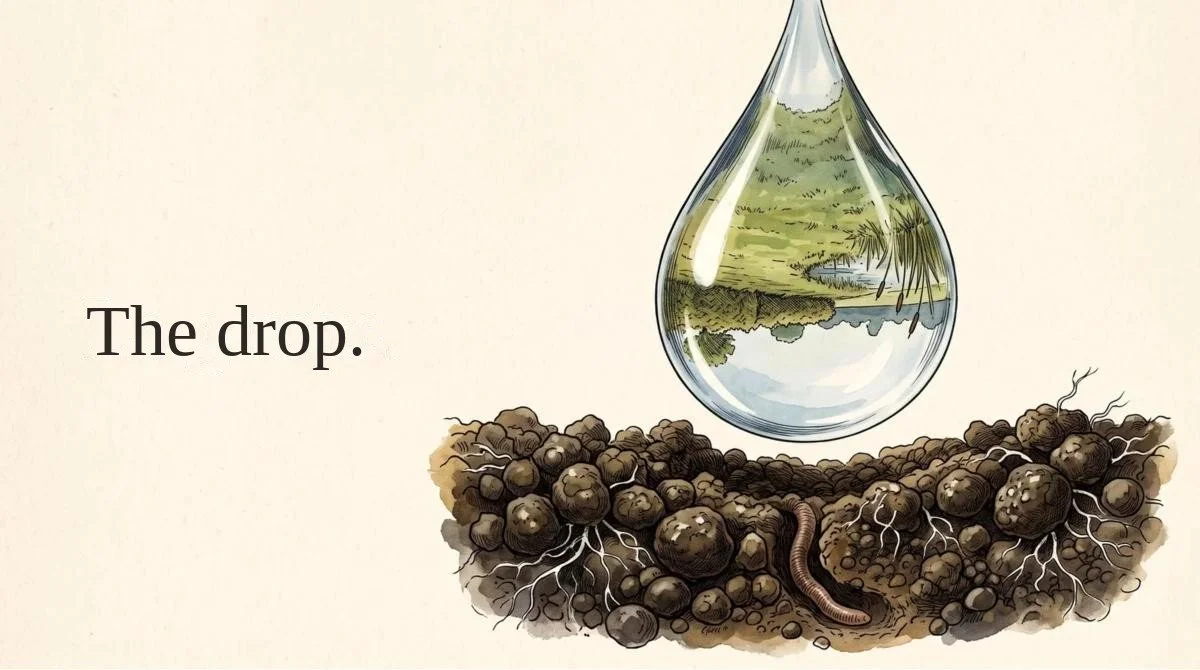
Episode 4 set out two figures, two millimetres an hour against two hundred, and one image, the sponge. It did not say what makes a sponge a sponge, nor who makes it, nor why the same rain vanishes into a meadow and runs off a field. That is what this episode sets out to show. It does so by following a single drop, from the cloud to the water table, and by naming one by one the living things it meets on the way.
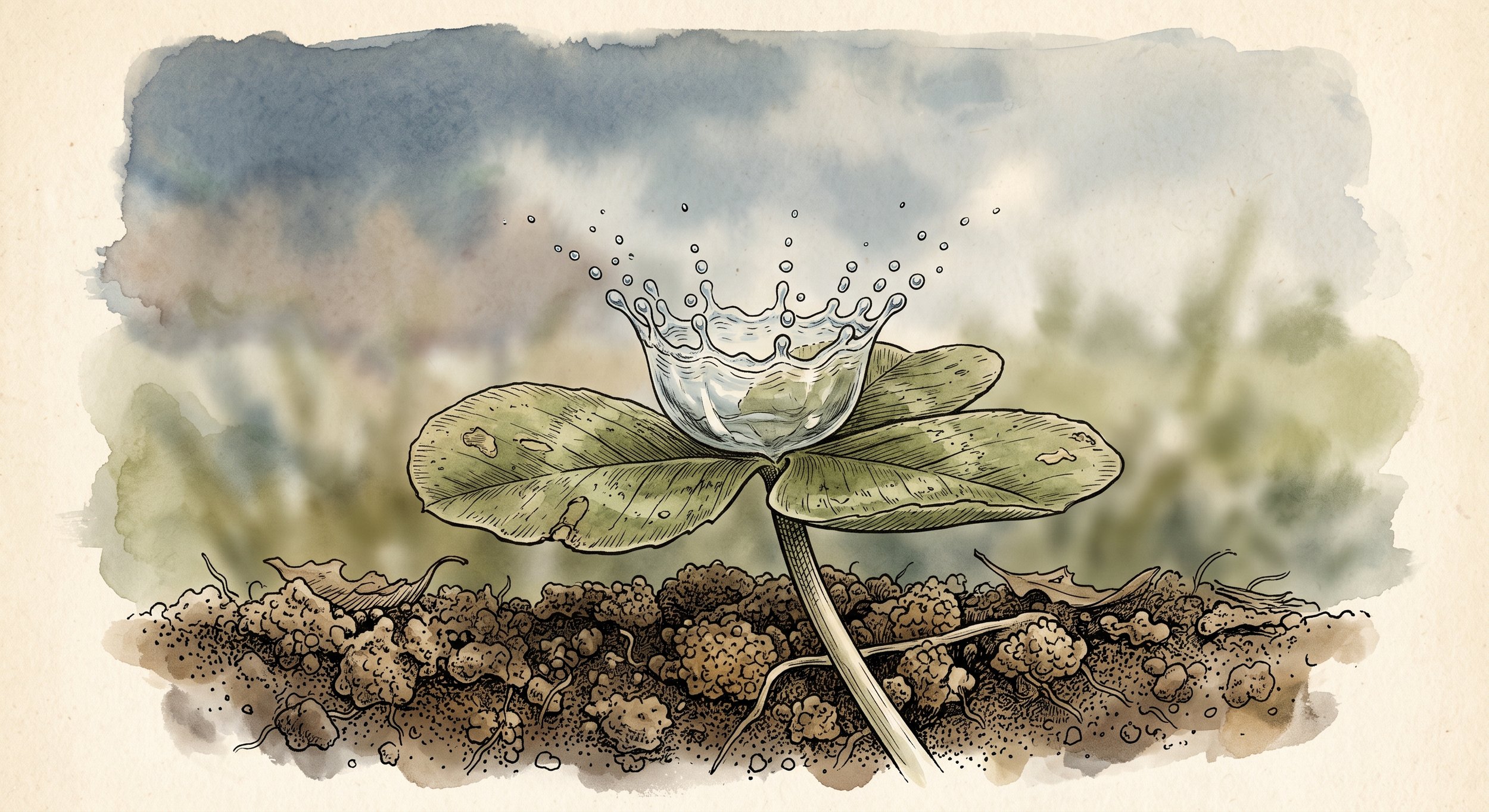
The drop breaks on a clover leaf before touching the earth.
It weighs a few milligrams.
A two-millimetre storm drop weighs four milligrams and falls at seven or eight metres a second. Four milligrams is nothing. But multiply that nothing by the billions of drops in a twenty-millimetre downpour and you get, on one hectare, the equivalent of two hundred tonnes of water dropped from several metres up. Bare soil takes this bombardment unprotected. Living soil never takes it directly. There is someone, before the earth, to break the speed.
The leaf.
Before it touches the earth, the drop touches a leaf. A clover leaf, a rye stem, a blade of fescue, a dead oak leaf. It breaks on it, spreads out, loses its energy. Part of it stays there and will evaporate, and it is not lost for nothing, because it cools the air at ground level. The rest slides down the stem and reaches the ground without force, like water poured from a carafe rather than water flung from a sling.
I invite you, after the next storm, to look at what happens at the foot of a tuft of grass. The earth there is intact, crumbly, dark. Look twenty centimetres further on, where the soil was bare: it is smoothed, shiny, closed in on itself. The leaf did nothing but break the speed. That is already half the work.
Under the living leaves there are the dead leaves, the litter, and under the litter, if someone has taken the trouble to bring some, ramial chipped wood. This is where the drop meets its second travelling companion, and it looks like nothing we imagine when we think of a fungus.
The litter fungus.
Lift a handful of litter or of six-month-old ramial chipped wood. You see white, cottony threads holding the twigs together like a web. These are the hyphae of a basidiomycete fungus, of the same family as the ceps and chanterelles of our forests, and they are the only living things able to digest lignin, the hard wood that almost nothing else can break into. They turn it into that brown, soft, fragrant matter which is humus being born.
For the drop, this white felt is a first sponge. A hypha is a tube whose wall drinks water and keeps it. A gram of this dry mycelium can hold several times its weight. The drop enters, slows down further, spreads out. It will reach the mineral soil no longer as a drop but as a film, a diffuse moisture, the kind roots prefer above all.
And the humus this fungus makes is itself a sponge, the most lasting of all. A gram of stable humus holds up to six grams of water. That figure deserves a pause: each point of organic matter gained in the top thirty centimetres of a hectare adds to that soil a water reserve of around fifteen to twenty millimetres, in other words an entire storm's rainfall, set aside for the days without rain.
The crumb, and what holds it together.
The drop now touches the earth. If the soil is alive, it does not touch a surface but a heap of crumbs, those little balls of two to five millimetres that soil scientists call aggregates and that every gardener recognises when the earth runs through their fingers like couscous. Between the crumbs, gaps. Inside the crumbs, other, finer gaps. The drop enters through the first and will be held by the second. The whole story of the sponge lies in this difference of size.
But who makes the crumb, and above all, why does it hold when the rain wets it? Try the test one day. Take a clod from a living soil, a meadow or an undug garden, and set it gently in a glass of water. It stays whole for hours. Now take a clod from a field ploughed for thirty years and do the same. It collapses in a few minutes into a cloud of mud. The difference is a glue, and here I must be precise about what we know and what we do not.
What we know, since the work of Tisdall and Oades in 1982 and all that followed, is that mycorrhizal fungi hold the crumb together. Their filaments wrap it like a net, they leave sugars and proteins in it as they die, and a soil where these fungi live has aggregates that are clearly more stable in water than a soil where they have been destroyed. This is measured everywhere, on every continent, and it is no longer debated.
What we thought we knew was the name of the glue. In 1996, an American researcher, Sara Wright, extracted from soils an abundant, tenacious protein that withstands the autoclave, and named it glomalin, after the Glomales, the order of these fungi. For twenty years it was written that glomalin made up as much as a quarter of soil carbon and that it was the universal glue of aggregates. Then people looked more closely, and what is extracted under that name turned out to be a mixture of proteins of varied origins, fungal, bacterial and plant, of which the share actually produced by mycorrhizas remains unknown. Careful researchers now speak of glomalin-related soil proteins, and Marc-André Selosse has said in a lecture that the word should be forgotten. I myself long repeated the figure of a quarter of the carbon. I no longer do.
What remains once the name is removed is more solid than the name: a living crumb holds because filaments wrap it and biological glues, whatever they are, soak it. In a ploughed soil these filaments are torn at every pass, the glue is no longer renewed, and the crumb falls apart at the first rain. The drop that should have entered then finds a paste, and this paste, as it dries, becomes a crust. This is called capping. Nearly eighteen per cent of French farmland suffers from it today, and on a capped soil the drop no longer even tries to enter.
The earthworm.
Our drop, however, has entered. It slips between two crumbs and falls into a hole. A round, vertical, smooth hole, six or eight millimetres across, whose wall is coated with a kind of brown plaster. It is the burrow of an anecic earthworm, the large worm that lives head down and comes up at night to fetch dead leaves and pull them into its burrow. Its burrow goes down a metre, sometimes two. It digs a single one and maintains it all its life, several years. Its wall is made of its own casts, rich in mucus, bacteria and nitrogen, and it is the best soil in the whole field. Roots know it: cut through an earthworm burrow and you will almost always find a root that was following it.
For the drop, this burrow is a motorway. It goes down it in a few minutes, a distance it would take hours to cross through the compact mass. It is through these channels, and above all through them, that an old meadow swallows two hundred millimetres of water an hour. In an unploughed meadow there are up to four hundred worms per square metre, two to three tonnes per hectare. In a treated, compacted field, half have disappeared, and those that remain are surface worms that do not dig deep burrows. Ploughing does not only kill the worm. It cuts its channels, and with them the drop's fastest route to the water table.
The root, living then dead.
The drop leaves the burrow through a side crack and meets a root. A lucerne root, which also goes down more than a metre, or rye, or ryegrass. The living root does two things for water. As it grows, it pushes the earth aside, cracks it, compresses it along its flanks. And at its tip, the root cap, it secretes mucilage, a sugar gel that absorbs water like a plant sponge and keeps it around the tip during dry spells. This mucilage also feeds bacteria, and we will come to that.
Then the root dies. They all die, at the end of the season or of the plant's life, and they decompose on the spot. What remains is a channel, an empty tube from a few tenths of a millimetre to a few millimetres across, lined with humus. A ten-year-old meadow has left millions of these channels in its soil. A soil ploughed every year keeps none: the ploughshare mixes them, crushes them, closes them. This is the drop's second motorway, and it is made by the dead.
The root fungus.
Ten centimetres down, on the living root our drop is following, something finer still begins. Filaments a hundredth of a millimetre across, ten times finer than a root hair, leave the root and push into the soil in every direction. These are the hyphae of a mycorrhizal fungus, the very one that holds the crumb together. A single plant can carry several kilometres of them beneath its feet. These filaments go where no root can go, into the micropores of crumbs, into the cracks of clays, as far as water the root alone could never reach.
This fungus is a plumber. It carries water from the finest pores to the root, and in the other direction it carries the sugars the plant pays it in exchange. In drought, a mycorrhizal plant goes on drinking while its neighbour without the fungus wilts. This is measured, and it is reproducible. And it is the reason why the biochar I put down into boreholes is inoculated with these fungi before being buried: we are not putting down charcoal, we are putting down a network that goes looking for water.
The bacterium.
Here is the smallest of the players, and the most numerous. Around every root, in a sheath a few millimetres thick called the rhizosphere, live ten to a hundred times more bacteria than in the rest of the soil. They eat the mucilage and sugars the root lets slip. And in return they make what chemists call exopolysaccharides, in everyday language a jelly. This jelly wraps the bacteria, sticks them to soil particles, and above all, it drinks. A bacterial biofilm can hold several times its weight in water, and it gives it back slowly as the soil dries, protecting the root the way you wrap a damp cloth around a plant you cannot water.
It is the last sponge, the finest, the one that works at the scale of a grain of silt. It is also the first to die. Above forty degrees these bacteria stop working; above fifty, they die. Bare soil in a heatwave reaches sixty to seventy degrees at the surface. That is why the biology I entrust to biochar is put down below fifteen centimetres, where the heat no longer reaches: the jelly survives, and with it the water reserve it carries.
What becomes of the drop.
Our drop has reached forty centimetres. It has three possible fates, and the living soil decides the share of each.
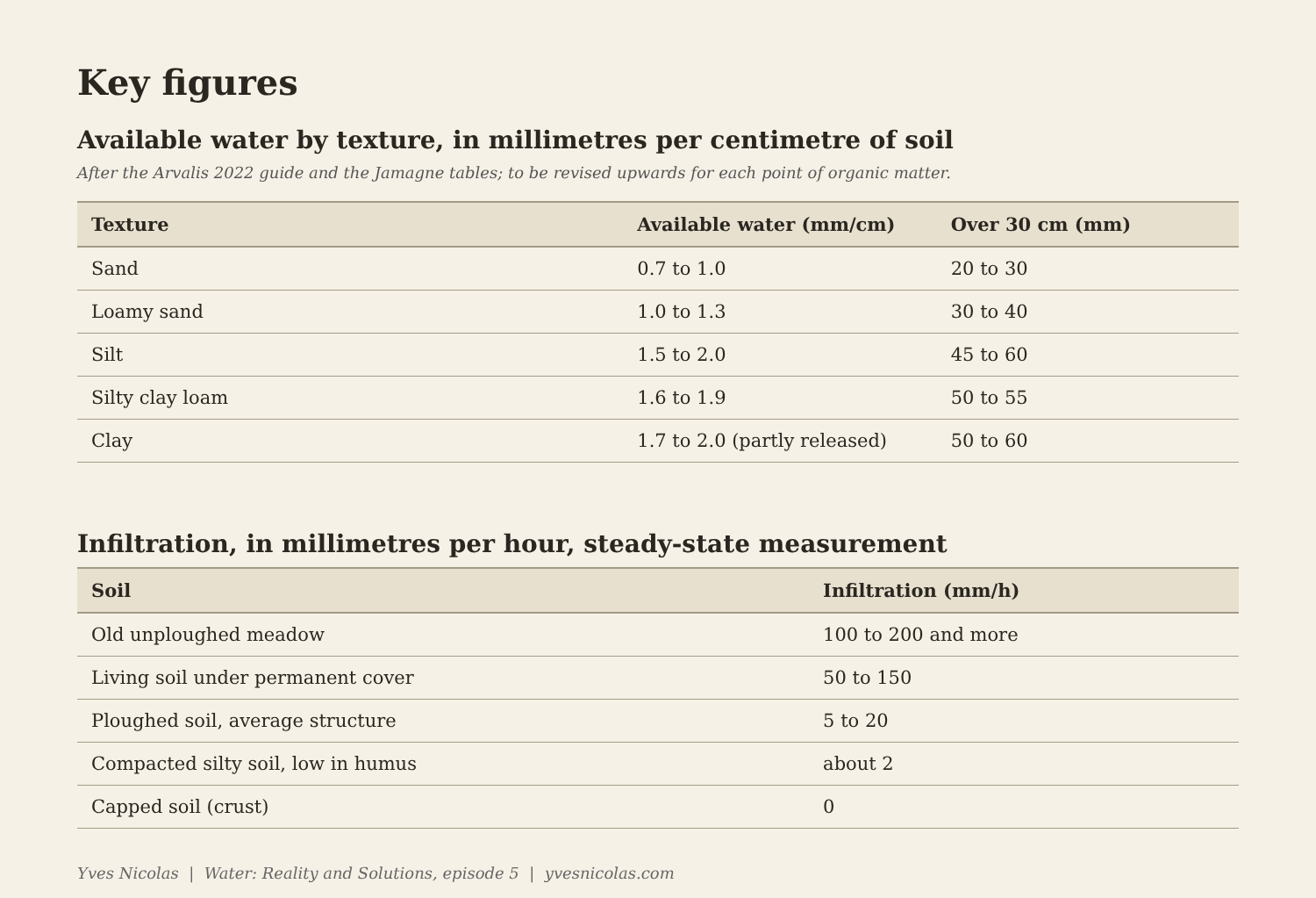
One part stops. It is captured by capillarity in the finest pores, in the humus, in the bacterial jelly, in the fungal filaments. This is the available water, the water the plant can take back during the weeks without rain. It is counted in millimetres per centimetre of soil depth. Over thirty centimetres of useful soil, the gap between a poor sand and a living silt is the gap between twenty-five millimetres and sixty: three days of heatwave or ten.
A second part is drunk straight away, by the root, by the fungus, by the bacterium.
The third keeps going down. It has passed through the crumbs, the burrows, the root channels, the cracks. It has left along the way what the soil could keep. One day, weeks or months later, it reaches the water table. It is this water, and this water alone, that recharges groundwater. Not the drop that ran off. Not the one that evaporated on the crust. The one that had time to pass through a living soil.
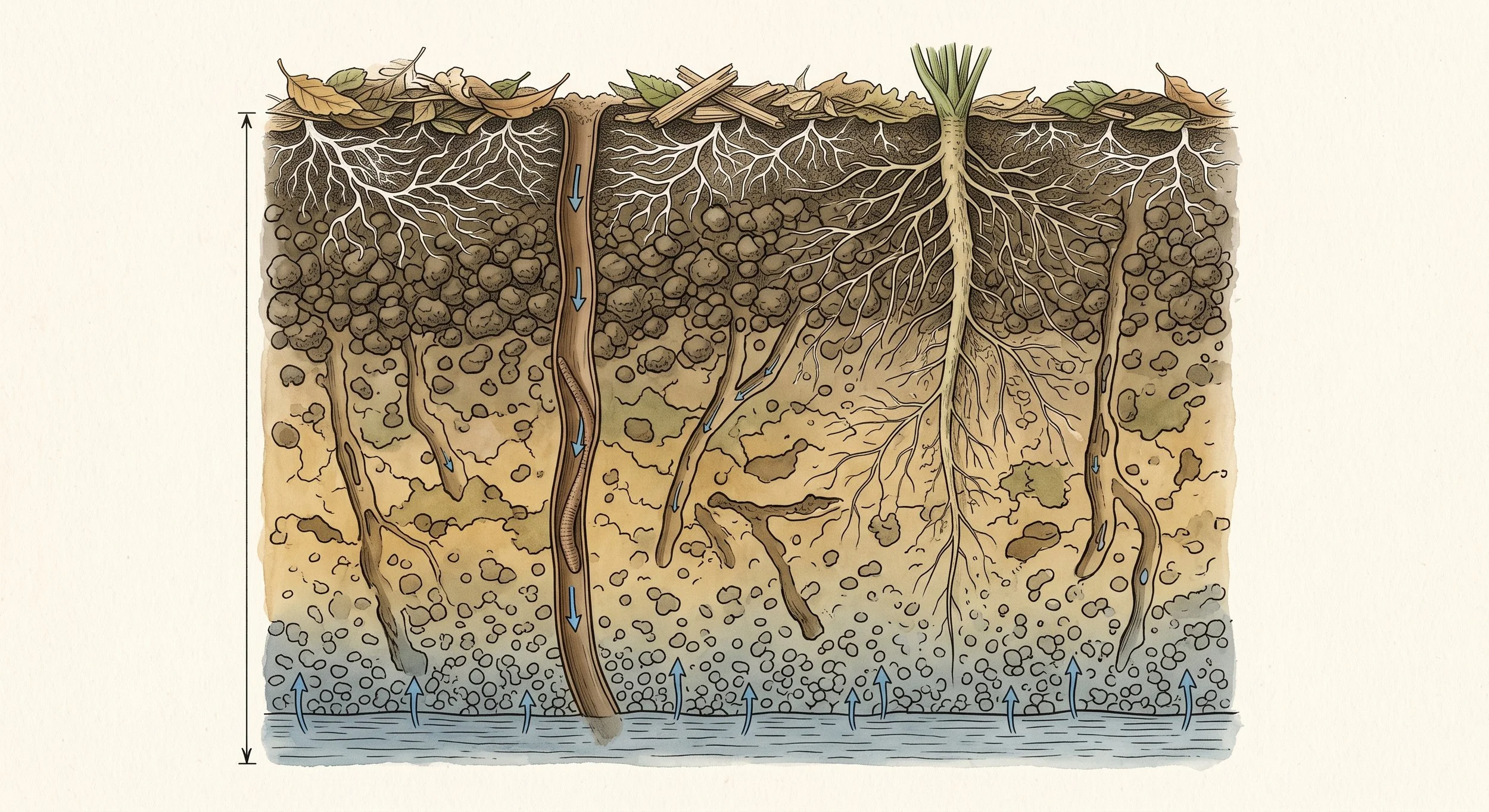
A metre of living soil: litter, crumbs, worm burrow, roots, channels, filaments, capillary fringe above the water table.
The water that rises.
We have followed the drop downwards. Now we must follow it upwards, because it goes back up, and this invisible journey feeds more plants in August than all the summer rain.
Take a sugar lump and set it on a drop of coffee. The coffee climbs into the sugar, against gravity, until half of it is soaked. That is capillarity: in a fine enough tube, water clings to the walls more than it weighs, and it climbs. The finer the tube, the higher it climbs, and the more slowly. Soil is a stack of tubes of every size, and the water table, below, is the coffee.
Above every water table, then, there is a zone no one sees, which hydrogeologists call the capillary fringe. Water has risen there by itself, from the free surface of the water table, through the finest pores. In coarse sand this fringe is a few centimetres thick. In silt it rises a metre, sometimes two. In clay it can reach several metres, but so slowly that the journey takes months. A meadow whose water table is two metres down in April drinks, in July, water that never fell on it that summer. It drinks the water table, by capillarity, in reverse.
And this movement does not concern only the water table. Each time the surface dries, it pulls. A surface pore that loses its water to evaporation calls up the water from the pore below, which calls up the water from the pore below that, and so on, like the wick of an oil lamp. This is how the moisture stored at fifty centimetres after the May rain rises, week after week, to the roots of the June wheat, without a drop having fallen. What the soil stored in its chambers in winter, it gives back through its finest corridors in summer. The sponge does not only drink. It gives back, and it gives back from the top.
This movement has two faces. If the wick reaches a bare surface, it loses its water to the air, and the soil's reserve empties from the top like an uncorked bottle. The old saying has it that one hoeing is worth two waterings: by breaking the fine pores of the surface crust, the hoe cuts the wick, and the rising water stops a few centimetres below the loosened earth, where the root finds it and the air does not take it. Mulch, litter and ramial chipped wood do exactly the same, without a hoe and without effort: they put a lid on the wick. In Morocco, where I have been observing irrigated schemes for years, the other side of this is visible every season: when the wick brings up salt-laden water and that water evaporates on a bare surface, the salts stay behind. The white crust that covers some plots in the Souss or the Gharb is not a curse of the soil. It is the signature of a wick that was left to burn without a lid.
Finally, there is a rise that physics alone does not explain, and which could not be measured until the 1980s. A deep root, that of an oak, a lucerne, a carob tree, plunges into a moist horizon two or three metres down. By day the plant transpires, and water rises from the deep roots to the leaves. At night the leaves close, transpiration stops, but the deep root goes on drinking. Where does this water go, since the leaves no longer want it? It comes out through the surface roots, into the dry soil of the top thirty centimetres, and wets it. Around old California oaks and under the maples of the New World, a night-time rise in surface moisture has been measured, falling again the next day, every day of the summer, and this water has been seen passing directly from the oak's roots into the filaments of its fungi. The tree pumps at night what it will drink the next day, and it leaves some for its neighbours. The grasses growing at its foot in August, the young plants, the fungi, the bacterial jelly we have just discussed live on this water that the tree raises for itself and shares without knowing it. Hydrologists call it hydraulic lift. Fabre would have called it a root's charity.
This return journey is the deep reason for two practices I have described elsewhere and that episode 4 took up again. The borehole at fifteen centimetres or more does not only serve to let water in. It places a reserve at depth, in the biochar, from where it will rise by capillarity and through the fungal filaments to the root during the dry weeks, out of reach of the scorching surface. And the hedge, with its taprooted trees, is a hydraulic lift planted every hundred metres, raising a little deep water each night towards the neighbouring crop. When a farmer tells me that his plots lined with hedges hold out fifteen days longer in drought, he is not describing a windbreak. He is describing water that rises.
What the drop switches on.
We must now say what the drop does when it stops inside the crumb. For the water the soil holds is not only a store for the plant. It is the condition of a machine to which I devoted a whole series in my Oasis newsletter: nitrogenase, the iron and sulphur forge that has been tearing nitrogen from the air for more than three billion years and that founded, molecule by molecule, the whole chemistry of life.
Nitrogenase has one absolute weakness: oxygen destroys it in a few seconds, irreversibly. It only works sheltered from the air. Yet in a soil, shelter from the air is not a place, it is a state, and that state is made by water. Let us go back to the crumb the filaments have wrapped and in which our drop has stopped. In air, oxygen runs; in water, it crawls, ten thousand times more slowly. When the heart of the crumb is wet and bacteria are breathing inside it, they consume oxygen faster than it can get in. Within a few hours this heart becomes a small pocket without air, an Archaean ocean three millimetres across, and the forge can run there. The same crumb when dry never does. Anoxia is not in the charcoal or in the stone. It is in the assembly of water and life, and it disappears with either one.
A soil that keeps water in its micropores keeps at the same time, at the heart of each of its aggregates, the small forges where nitrogen from the air becomes the nitrogen of life. A soil that lets its drop slip away has no anoxic heart: the forge there is out for lack of water. A soil drowned to the surface has none either, or rather it has nothing else: everything is anoxic, and then bacterial respiration, deprived of oxygen, goes down the ladder of what can replace it, nitrate first, then manganese, iron, sulphate, and last of all carbon dioxide, which gives methane. Nothing in this descent has a brake. It goes on as long as there is carbon and water. This is the regime of compacted soils and low corners of fields, and it is the one that releases nitrous oxide, a gas three hundred times more warming than carbon dioxide and most of which, in France, comes from agriculture: denitrification stops halfway there each time air returns in gusts.
There are therefore two absences of oxygen, and they are not alike. One is endured: water has driven out the air, it spends nothing to do so and it does not stop. The other is made: bacteria have breathed up the oxygen in the heart of a crumb faster than it came in, and this respiration switches itself off as soon as the carbon that pays for it stops arriving, or as soon as the oxygen has been used up, since it needs oxygen to burn. The first goes all the way down to methane. The second stops high up, at the window where nitrate and iron are reduced without sulphate being touched, and a soil scientist can read this difference with a simple redox probe, in millivolts, in the same soil. Too little water puts out the forge. Too much water sets up endured anoxia. Between the two lies the crumb that is wet at the heart and aerated at the edge, and that crumb is exactly what the players in this article make.
This regime has a name and a measure. Horn set it out in 1994: when a soil is fully saturated, all its pores are full of water and the mass behaves like a block; when it is only near saturation, at a potential of half a kilopascal to two, only the aggregates are full and the large pores between them still breathe. In this second state, wet and aerated coexist in space, a few millimetres apart, instead of following each other in time. That is what I try to maintain with a light, permanent dripper, and it is what heavy, infrequent watering destroys twice over: it drowns the whole profile for a few hours, then lets everything dry out. We go from sickness to desert without ever stopping at the organ. I have observed for years, in France as in Morocco, that light, continuous water gives a vigour far beyond that of abundant, infrequent watering. It is a field observation, uncontrolled, and it has a competing explanation that would account for everything: a plant that is never water-stressed grows better, without any crumb having anything to do with it. Nothing today separates these two readings. An oxygen probe a few centimetres from the dripper would do so, and no one has yet placed one.
So much for the first matter, that of air. There is a second, and it is a matter of money, or rather of sugar. The forge is expensive: sixteen molecules of ATP burned for a single molecule of nitrogen broken, and that ATP is paid for by the plant in sugars, through its photosynthesis. Yet photosynthesis stops with water. A water-stressed plant closes its stomata, makes fewer sugars, and the first expense it cuts, even before its growth, is its bacteria's wages. Agronomists have been measuring this for thirty years on soya, lucerne and beans: the nodules stop before the leaf wilts. Every millimetre that humus and bacterial jelly hold in July is one more day of forging. A soil with a sponge of a thousand cubic metres that keeps it full fixes nitrogen all summer. A soil that fills it through a hole of twenty fixes nothing after midsummer.
There is a third matter, and it brings us back to the drop going down. The ammonium the forge produces clings to clays and humus, held by the exchange capacity soil scientists call cation exchange capacity. There it waits for the root or the fungal filament. But if the soil no longer has humus, nitrogen has nothing to hold on to; it turns into nitrate, and nitrate is soluble: it leaves with the first drop that passes through. This is how synthetic nitrogen drowns water tables, and this is how even biological nitrogen is lost in a soil with no reserve. The same water that switches on the forge carries off its product if the soil has nothing left to hold it.
These three matters explain why the living cistern, the borehole of inoculated biochar, is above all a water device. Dry biochar is dead biochar: it is one of the most aerated materials there is, and the forge only runs in it if it is moist and inhabited. The clay layer at the bottom, the low-flow dripper, the depth that puts the charcoal out of reach of the scorching surface, all of this has a single aim: to hold the assembly of water and life in which oxygen no longer circulates. We do not put nitrogen into the soil. We put in the conditions for the soil to make it itself.
It remains for me to speak of a gas, and to do so with more caution than I have in the past. For every molecule of nitrogen it breaks, the forge releases hydrogen, forty to sixty per cent of the electrons it spends in most symbionts. I long wrote that this gas was a legume's waste. That is wrong, or rather too narrow. For about ten years we have known that hydrogen is an ordinary soil metabolite: a strictly aerobic soil bacterium, deprived of oxygen, starts producing it to store its excess electrons, and takes it back as soon as air returns; and the enzymes that consume it exist in more than fifty bacterial phyla, in every soil, with oxygen governing their distribution. The wet heart of our crumb therefore probably already produces a little hydrogen by itself, without any nitrogenase, and the surrounding soil already knows how to eat it; I say probably, because this has only been measured in pure culture, and the step to the crumb is a deduction of my own. What a legume nodule adds is not a new gas, it is a point source, continuous, up to twenty thousand times the concentration in air, whose entire flow is consumed within a radius of three to four and a half centimetres, by bacteria that oxidise it with oxygen and multiply fivefold the oxygen consumption of the soil around the root. These figures are measured, some of them are forty years old, and they hold.
What I make of them, and this is mine alone, is the following: this flow digs around the nodule a small made anoxia, of the kind that stops by itself, since the bacteria digging it consume the oxygen they need in order to dig, the gas carries no further than its radius, and the plant stops paying as soon as it stops growing. My hypothesis is that this chamber is fertile, that iron is reduced there, phosphorus released, nitrogen fixed. None of this is demonstrated in a cultivated soil, and a competing explanation must be kept on the same footing: any fresh carbon would dig the same chamber, and the hydrogen would only be the sign of a system in good health. As long as nothing separates them, this second reading is preferable, because it explains the same thing with one mechanism fewer. As for the wisterias and oleasters I have seen green in a heatwave where everything else was yellowing, I keep the observation and have given up explaining it.
What depends on none of these uncertainties is the rule, and that is why it can be published without waiting for the rest. Maintain an anoxia that is paid for, never an anoxia that settles in. Fresh carbon going down continuously, because it is what pays. A structure that holds, so that the hearts of the clods stay airless while the rest breathes. Light, permanent water rather than abundant and infrequent. Mineral nitrogen kept low, because it switches off the enzyme and spares the plant from maintaining its cover. And before any intervention, a single question: does this multiply or erase the closed hearts within an open matrix? What we have been calling the sponge throughout this article is not only the field's water reservoir. It is the place where nitrogen from the air becomes food, and it is so only when wet at the heart and aerated at the edge.
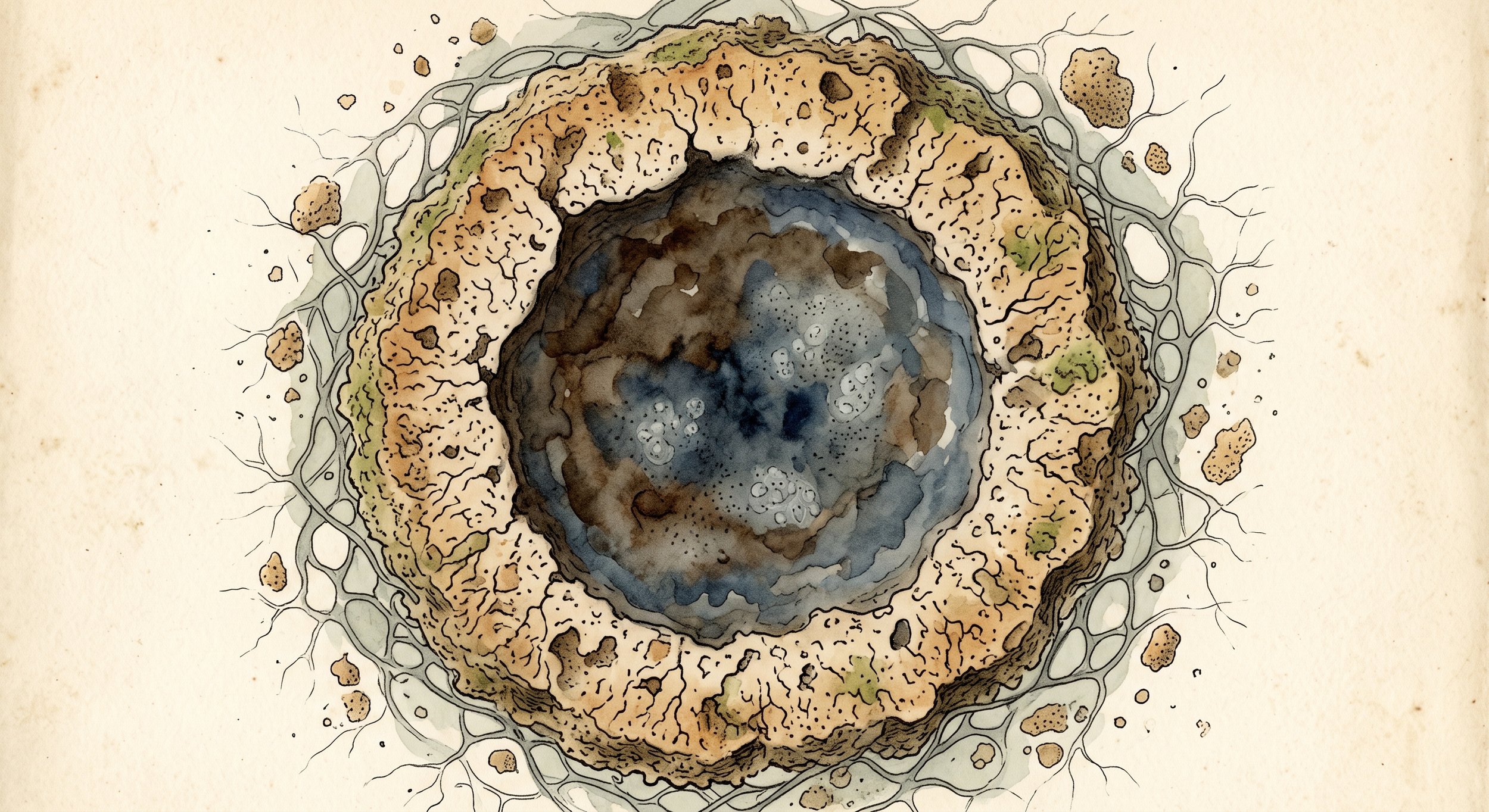
A crumb cut open: the edge breathes, the wet heart has no oxygen left. That is where the forge runs.
The same drop, depending on the soil.
The players are the same everywhere. But the stage changes, and the drop does not tell the same story depending on the soil it passes through.
In sand, it enters effortlessly. The grains are large, the gaps between them wide, and the drop falls through as through a sieve. It is the soil that swallows best and keeps least. A metre down, it has already passed, and the root looking for it the next day finds nothing. Pure sand holds barely seven tenths of a millimetre of water per centimetre, two to three times less than silt. It has the motorways but not the chambers. What it lacks are fine pores, and the only things that can give it them are humus and bacterial jelly. A living sand, under permanent cover, with ramial chipped wood on the surface and biochar in its boreholes, starts to hold what it used to let slip. Biochar plays the part of the micropores the mineral lacks: a grain of porous charcoal in the middle of the sand is a chamber beside the motorway.
In clay, it is the opposite. The particles are a thousand times smaller than a grain of sand, flat as sheets, pressed against one another. The drop enters slowly, very slowly, and once in, it does not leave easily. Clay holds a lot, more than any other soil, but it holds so tightly that the root recovers only part of it. And clay has a character the drop discovers at its expense: it swells when wet and shrinks when dry. When it dries, it splits into cracks as wide as a finger, and the storm drop rushes into them in one go down to a metre. When it is saturated, these cracks close, the surface becomes watertight, and the next drop runs off. It is the same mechanism, at the scale of a house, that cracks foundations in summer: a clay deprived of regular moisture shrinks, and what it splits is not only the soil.
In silt, the drop finds the best and the worst. Silt is the ideal texture: medium grains, a high available water capacity, decent infiltration. It is the soil of the Beauce, of Picardy, of the great wheat plains. But silt has a fragility that sand and clay do not. Its grains are neither large enough to stay open by themselves nor fine enough to stick together. Without humus and fungal filaments, nothing holds them. Under rain they disperse into a smooth paste that dries into a crust. That is capping, and it strikes silt before any other soil. The best soil in France is also the one that closes fastest when its biology is taken away.
In limestone, finally, the drop meets the rock. On a causse, on garrigue, the soil is thin, sometimes a few centimetres, sometimes nothing at all. The drop crosses this little bit of earth in an instant and falls onto the bedrock. If the rock is fissured, and it almost always is, the drop disappears into the cracks, dissolves a little limestone on the way, and within hours joins an underground network that feeds a spring kilometres away. This is karst, an aquifer that fills fast and empties fast, without the buffer of a soil. If the rock is bare and smooth, the drop runs off. Either way, the surface root has had nothing. What saves a limestone soil are the roots that go looking for the drop in the rock: the taproot of the carob, the olive, the fig, which pushes into the fissure and follows it, and which, as it dies, leaves there a channel lined with humus where soil eventually forms. On limestone, the sponge is built from below, starting from the fissures, and it is the tree that builds it.
Four soils, four drops, one rule. Sand lacks chambers, clay lacks corridors, silt lacks glue, limestone lacks soil. And in all four cases, what is missing is exactly what life makes when it is left to work.
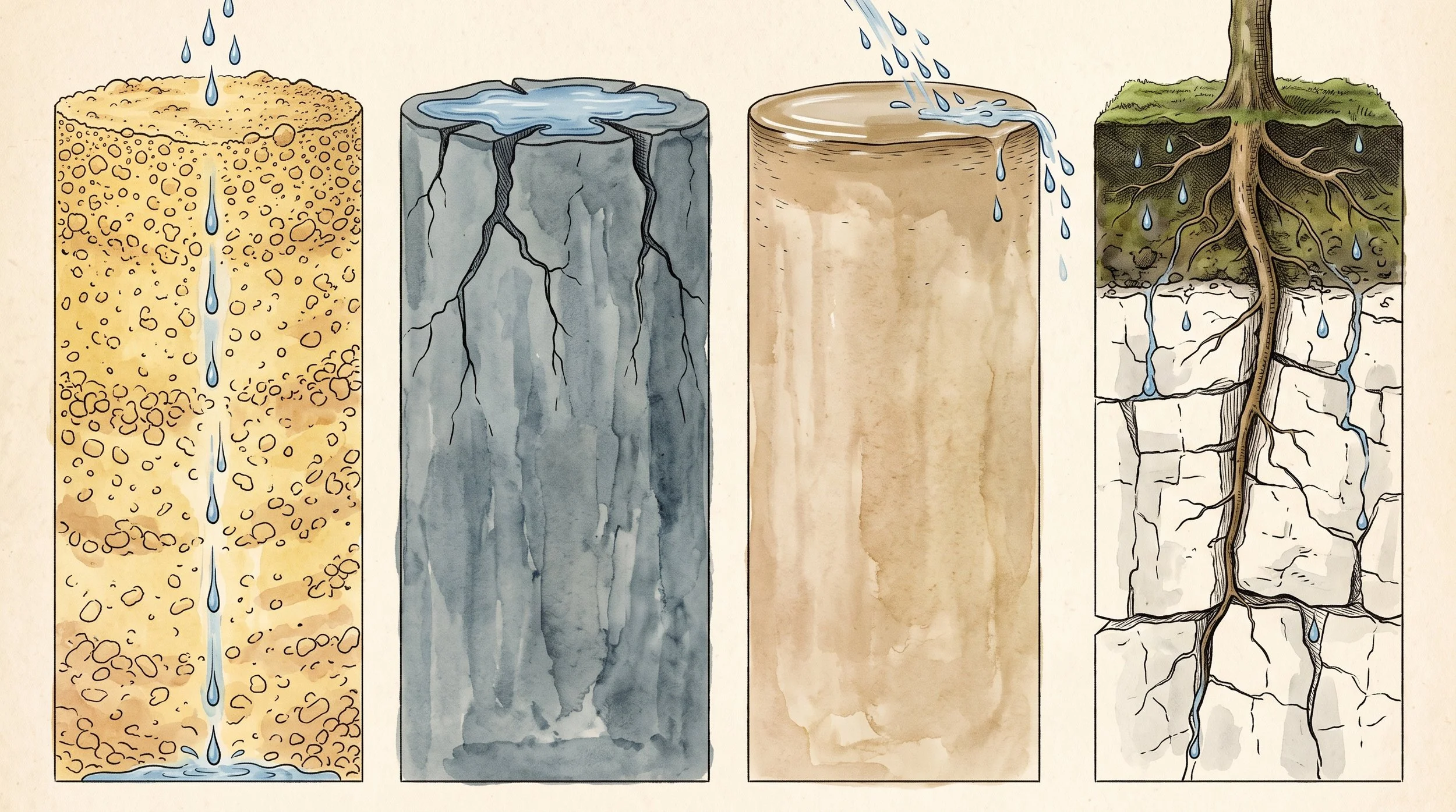
Sand, clay, silt, limestone: four soils, four fates for the same drop.
An agronomist from Seville.
Nothing I have just described is new. What is new is the microscope, the names of the fungi, the measurement in millimetres per hour. The way of looking is at least eight centuries old, and it is worth pausing on for a moment, because it says the same thing without a single instrument.
At the end of the twelfth century, in Seville, an Andalusian agronomist named Ibn al-Awwam, whose dates of birth and death are unknown, gathered in his Kitab al-Filaha, his Book of Agriculture, all that the practitioners of his time and earlier knew about the land. I reread these pages, in the translation Clément-Mullet published in 1864, looking for what they said about our drop. They say a great deal.
The first criterion he uses to judge a soil is neither its richness, nor its colour, nor its yield. It is its permeability. The best soil, he writes, quoting Democritus, is the one that absorbs rainwater well, that leaves no slippery surface on top, and that does not crack when it dries. Reread that sentence. Without crumbs, without fungi, without the word aggregate, it describes exactly what we are looking for: a soil that takes the drop instead of sending it back, and that closes neither under rain nor under heat.
He even gives the field markers, the ones you check with your feet. After continuous rain, he says, good soil is not covered with a sticky slime that clings to your soles when you walk on it. And when the rain has stopped, no white efflorescence appears on its surface. The sticky slime is our capping. The white efflorescence is our rise of salts, the capillary wick I spoke of earlier and which I still see today on some irrigated schemes. Two of the five tests I propose later in this article were already an Andalusian gardener's tests, except that they were done with the feet and the eyes rather than with a jar.
On sand he is categorical, and he is so because he has seen crops die. Water, he writes, does not penetrate the inside of the granules but passes through the gaps between them. That is the sand from earlier, word for word: the motorways without the chambers. And he immediately draws the practical consequence, which is the only thing that matters to whoever farms. Those who know nothing of agronomy, he says, see the water vanish so fast that they think it insufficient, so they add more, and they lose what they have planted. That sentence could be posted today in half the irrigated farms of the Mediterranean basin.
On clay he is just as clear. He describes a soil he calls thick, which splits in the heat like desert earth, whose cracks close when the rains come, and into which water can no longer penetrate, so that it holds a great deal of it on the surface. That is, eight hundred years apart, the exact description of the shrink-swell of clays that our insurers now count in billions. He does not add that these cracks also split houses, because in Seville no one built bungalows on strip foundations. But the mechanism he saw, and he wrote it down.
And the good soil, the one in the middle, he defines in a way I have never managed to put better: it absorbs water, it holds part of it in its cavities, and the rest disappears after a while. Take in, keep a share, let the excess go. The three fates of the drop, stated in the twelfth century in a single line.
The most striking thing, though, is his way of managing water. He recounts, in his own name this time, that he stopped giving water at the foot of the tree and gave it at a distance, so that it would reach the root through underground paths. For by watering on the collar, he says, the water hollows out between the tree and the earth a gap through which the heat of the sun enters. He also recommends new clay jars pierced at the bottom, set near the foot, which let the water seep out slowly for two months. And he sets the dose not in litres but by observation: give in the evening what the soil can drink during the night and the first four hours of the next day, no more, no less.
A pierced jar slowly releasing water into the soil, beside the root and not on it, a dose set by what the earth absorbs overnight, and a covering of earth drawn back over the foot and lightly firmed with the heel so that air still passes. When I first read these pages, I recognised my boreholes. The dripper at five litres an hour, the clay layer at the bottom, the ten centimetres of earth on top, the depth that puts it all out of the sun's reach: I invented nothing, I rediscovered. The only thing I add to Ibn al-Awwam's device is the charcoal, and the biology loaded into it. He had no means of seeing the bacteria. He saw their work, which comes to the same thing when you farm.
I do not quote this man out of a taste for the old. I quote him because agronomic knowledge did not begin with technical institutes, and because a practitioner who watches the same plot for a long time reaches conclusions that instruments later confirm. What the laboratory has added since is the why: micropores, mycorrhizal filaments, oxygen diffusion, the names of the fungi. The what was already in the book. And the how, often, too.
There is something here that should give us pause. From the birth of agriculture to mechanical ploughing, people farmed by following the teaching of their elders. Knowledge passed from hand to hand, from father to son, from master to journeyman, and each generation added what it had seen without throwing away what it had received. Ibn al-Awwam does nothing else: he compiles, he checks, he sometimes corrects, he passes on. Then, in less than a century, we replaced this chain with the tractor and its plough, synthetic fertiliser and the catalogue, and we stopped reading. When a twelfth-century text now confirms, point by point, what the most recent science teaches us about permeability, sand, clay and leading water to the root, it is not the old text that should surprise us. It is the century that separates forgetting from rediscovery. Do you not think we have a problem?
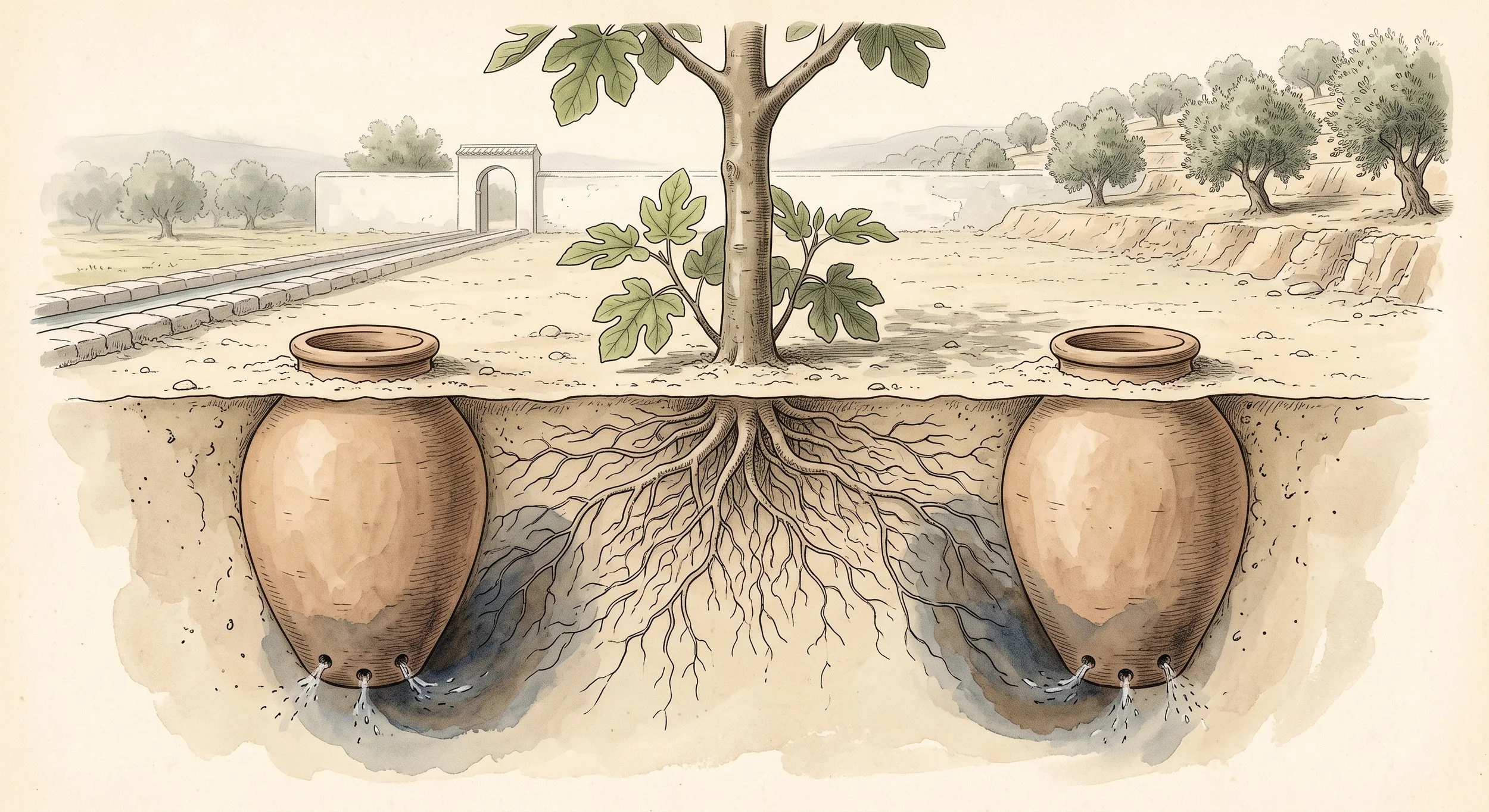
Ibn al-Awwam's pierced jars, set away from the foot so that the water reaches the root through the soil.
The same drop on a ploughed soil.
Now let us follow its twin, which fell a hundred metres further on, on a ploughed plot, bare this summer, with no litter, no surface fungus, no fungal filaments to hold the crumbs, with half its worms and no continuous burrow, with roots cut at harvest and a soil compacted under wheels at a hundred and fifty kilopascals.
It hits at full speed. The crumb it strikes has no glue: it bursts. The fine particles it releases block the pores around it. Within minutes the surface is smoothed, shiny, sealed. The following drops no longer get in. They run to the low point, carrying with them clays, silts, fragments of humus. What you then see is not water: it is soil leaving, brown, in suspension, towards the ditch, towards the river. The stones stay behind. Episode 4 said it: they do not rise. It is the soil that goes down around them.
This drop met none of the players. It left nothing in the soil and gave nothing to the water table. And yet the two drops fell from the same cloud.
The same drop on a car park.
Let us go further still. The drop now falls on the car park of a retail park, two hectares of black asphalt between a DIY store and a roundabout. It is three in the afternoon in July, and the asphalt is at fifty-five degrees. The drop has no time to run. It sizzles, evaporates in a few seconds, rises back into the burning air without having wetted anything. The following drops eventually cool the surface and form a film. This film meets nothing. Not a leaf, not a crumb, not a burrow, not a living crack. Asphalt is perfect capping, the kind ploughing only half achieves. Its infiltration is not two millimetres an hour. It is zero, for ever.
So the drop slides. It follows the slope, joins its fellows in a gutter, passes a grate, falls into a pipe. On the way it has picked up what the car park offered: a film of hydrocarbons, zinc from car bodies, copper from brake pads, and tyre particles, that black rubber worn off on the tarmac which is now one of the leading sources of microplastics in Europe's rivers.
In the pipe it sometimes meets a storm basin. It is a concrete bowl or a hole in bare earth, designed to hold water for a few hours before releasing it to the ditch. It is a marsh without the marsh, a wetland from which the reeds, the bacteria and the soil have been removed, and which therefore can neither clean nor recharge. It buys time. That is all. And when the basin overflows, which happens in summer storms precisely when the water table would have needed water, the stream that once received the water from two hectares of meadow in twelve hours receives it in twelve minutes.
This car park was a field, and before that field a meadow, and under that meadow there was a water table. It is still there. It has received nothing since the day the surfacing was laid. Two hectares of asphalt means fourteen thousand cubic metres of water a year, in a region with seven hundred millimetres of rain, going to the ditch instead of going down. Multiply that by the fifteen to twenty thousand hectares France builds over every year according to Cerema, fifteen thousand in 2024, the lowest figure since records began, and yet the equivalent of the city of Marseille every eighteen months.
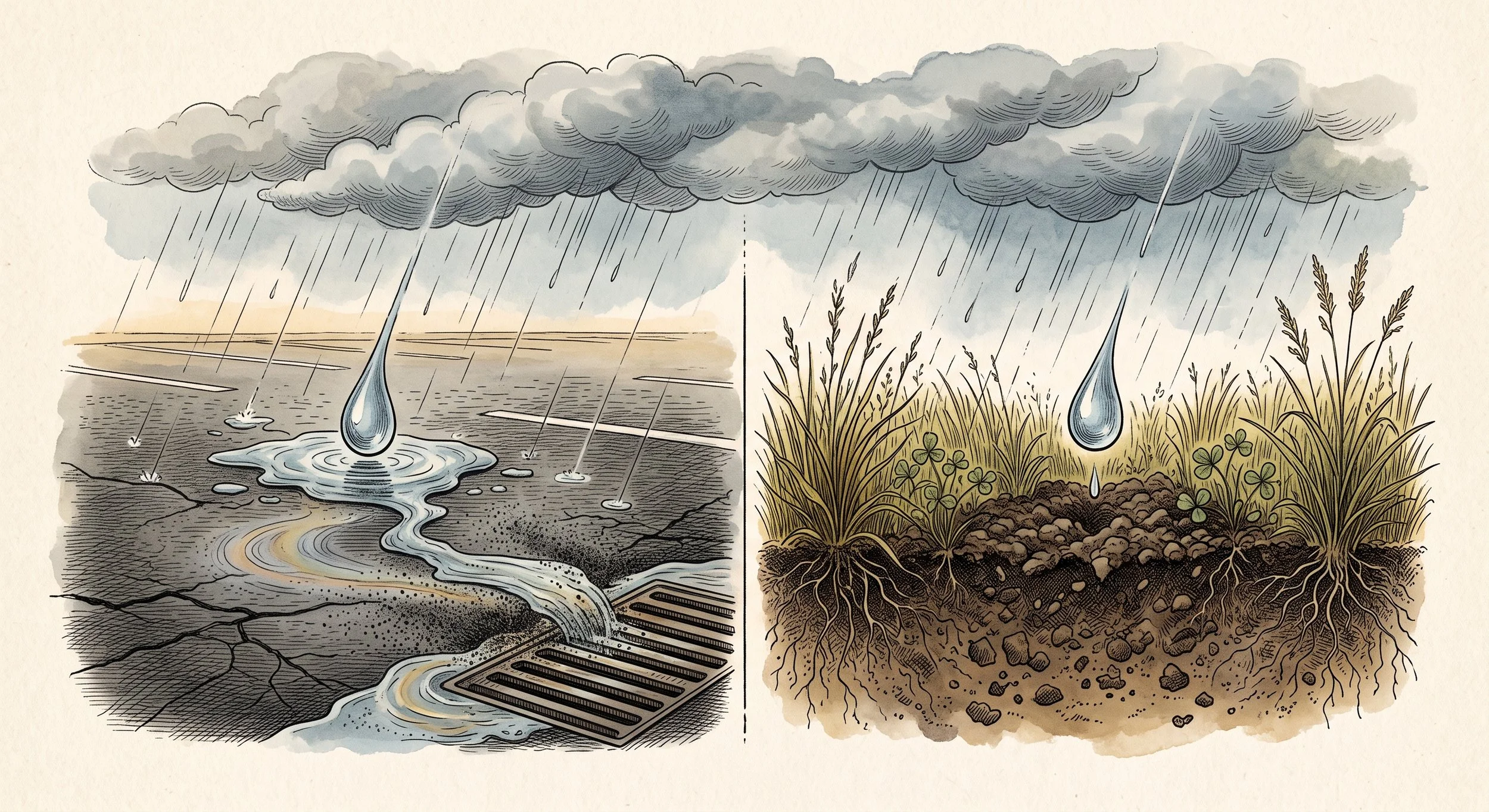
Same cloud, same rain: on asphalt, the drop goes down the drain with what it has picked up; on the meadow, it disappears into the earth.
The same drop in the city.
Let us finally follow the drop into the heart of a large city. It falls on a zinc roof, slides into a gutter, goes down a pipe, disappears into a drain. It has not touched the soil. It never will. In most old cities the sewer is combined: the raindrop joins the water from toilets and kitchens there, and everything goes to the treatment plant. When it rains hard, the plant cannot keep up. An overflow opens and the mixture goes into the river as it is. Every big summer storm over Paris, Lyon or Marseille ends this way.
But what strikes me most, at the scale of the drop, is what the city has done with heat. A wet meadow cools its surroundings by transpiring, as we will see. The city has done the opposite. It has removed every surface that transpires, covered the ground with materials that store the sun by day and give it back at night, and drained away within minutes the only water that could have cooled it. During the August 2003 heatwave, a difference of up to ten degrees was measured between central Paris and the forest of Fontainebleau. This is not a question of comfort. During those two weeks, excess mortality was fifty-five per cent nationally and one hundred and twenty-seven per cent in Paris. The drop that evaporated on the pavement at noon will not come back to cool the night. There is nothing left in the city to keep it until then.
And under the city, the water table. It exists. Under Paris, under Bordeaux, under Lyon, there are aquifers that wells still drew on in the last century. They receive almost nothing from above any more. A city is a ten-thousand-hectare capped soil laid on a sponge that has stopped being wetted.
Yet nothing here is inevitable. Open a two-square-metre tree pit in a pavement, fill it with living soil, and the drop that falls on it instantly finds all its players again. Remove the asphalt from a school playground, and two thousand square metres of soil start drinking again. Replace the gutter with a swale, that wide, planted ditch that receives water from the street and lets it soak in on the spot, and the drop finds a miniature marsh at the edge of the pavement. China, whose restoration of the Yangtze episode 4 described, launched a sponge city programme in 2015. The target set by the State Council for 2030: that eighty per cent of built-up urban area absorb and reuse on site seventy per cent of its rain. The phrase says it all. It is not about draining water away faster. It is about giving back to the city what the meadow had and the car park lost.
From the ploughed field to the car park and from the car park to the city, it is the same drop, the same loss. A soil that does not let it in turns it into flood, pollution and heat, three bills that someone pays. A soil that lets it in turns it into reserve, coolness and groundwater, three services that no one bills for. The difference is never in the rain. It is in what the drop meets.
The wetland, the landscape's sponge.
It remains to follow the drop that did not get in. The one that ran off the crust, the one that overflowed the sand, the one the saturated clay refused. It joined a trickle, then a ditch, and in a landscape that has kept its memory, it arrives at a place long called a marsh, a wet hollow, a wet meadow, a peat bog, and which thirty years ago was still being drained to make land like any other.
Look at this place at the scale of the drop. The soil is black, saturated, spongy underfoot. It is made of peat or organic mud, plant matter accumulated without decomposing because water has deprived it of oxygen. Sphagnum moss holds up to twenty times its weight in water. A wetland in good condition can store up to fifteen thousand cubic metres per hectare, the figure given by the Ramsar Convention. La Bassée, the Seine floodplain upstream of Paris, holds sixty-five million over five thousand hectares, or thirteen thousand per hectare, and it is this storage that protects the capital at every major flood. A hectare of marsh is an entire storm flood set aside.
Set this figure against a field. The map of available water capacity in French soils, drawn up by GIS Sol, places most farm soils between fifty and a hundred and fifty millimetres of available water over the whole depth explored by roots. One millimetre over one hectare is ten cubic metres. The reserve of an average hectare of field therefore holds between five hundred and fifteen hundred cubic metres, and that is a ceiling: what the soil can keep when it is full. The marsh keeps ten times more.
But this ceiling is only reached if the water gets in, and this is where the figure from episode 4 comes back. A thirty-millimetre storm in one hour drops three hundred cubic metres on the hectare. On the meadow that infiltrates two hundred millimetres an hour, all three hundred cubic metres get in. On the ploughed field that infiltrates only two, twenty cubic metres get in and two hundred and eighty run off with the soil. On capped soil, nothing gets in. The average field has a sponge of a thousand cubic metres and it fills it through a hole of twenty. That is why its reserves are empty in July even though it rained in June: it is not the size of the sponge that is lacking, it is the door.
Back to the marsh. Reeds, sedges, rushes and willows run through it with their roots and rhizomes, and these roots do under water what the field's roots do in the earth: they open corridors, they feed bacteria, and these bacteria, in this oxygen-free setting, take the nitrate that arrived with the drop, the nitrate leached from fields that poisons water intakes, and send it back into the air as nitrogen gas. The wetland is a kidney. It holds, and while it holds, it cleans.
But what matters for the water table and the river is what it does next. It does not keep the drop. It gives it back, slowly, in three directions.
Downwards first. A wetland almost always sits on a shallow water table of which it is the outcrop. The water stored in winter percolates for weeks towards this water table, without running off, without evaporating, with the time episode 4 called for. It is the surest recharge there is, because it passes through a soil no one has ever ploughed.
Downstream next. The river that still flows in August does not flow with August rain; there is none. It flows with the water the basin's wetlands stored in March and have been giving back to it drop by drop ever since. This is what hydrologists call baseflow, and it is what disappears when marshes upstream are drained: the river becomes torrential in winter and dry in summer, two disasters for the price of one drainage scheme.
Upwards, finally. A wet meadow transpires several millimetres of water a day in summer, and this water cools the air by several degrees over hundreds of metres around, moistens the passing breeze, and falls again as morning dew on the neighbouring crops. A wetland is open-air air conditioning, and a small rain factory.
So it is not wasted land. It is the catchment's savings account, the one that receives in winter what the fields could not take and redistributes it in summer when nothing falls any more. France has drained, filled in or dried out two thirds of its wetlands since the start of the last century, half of them between 1960 and 1990 alone, in the name of farmland, and is now surprised that its rivers stop in July and its aquifers no longer fill. The ten per cent of a farm's area to be given back to wetlands is not a tribute paid to nature. It is the only drought insurance that costs nothing and whose premium falls every year.
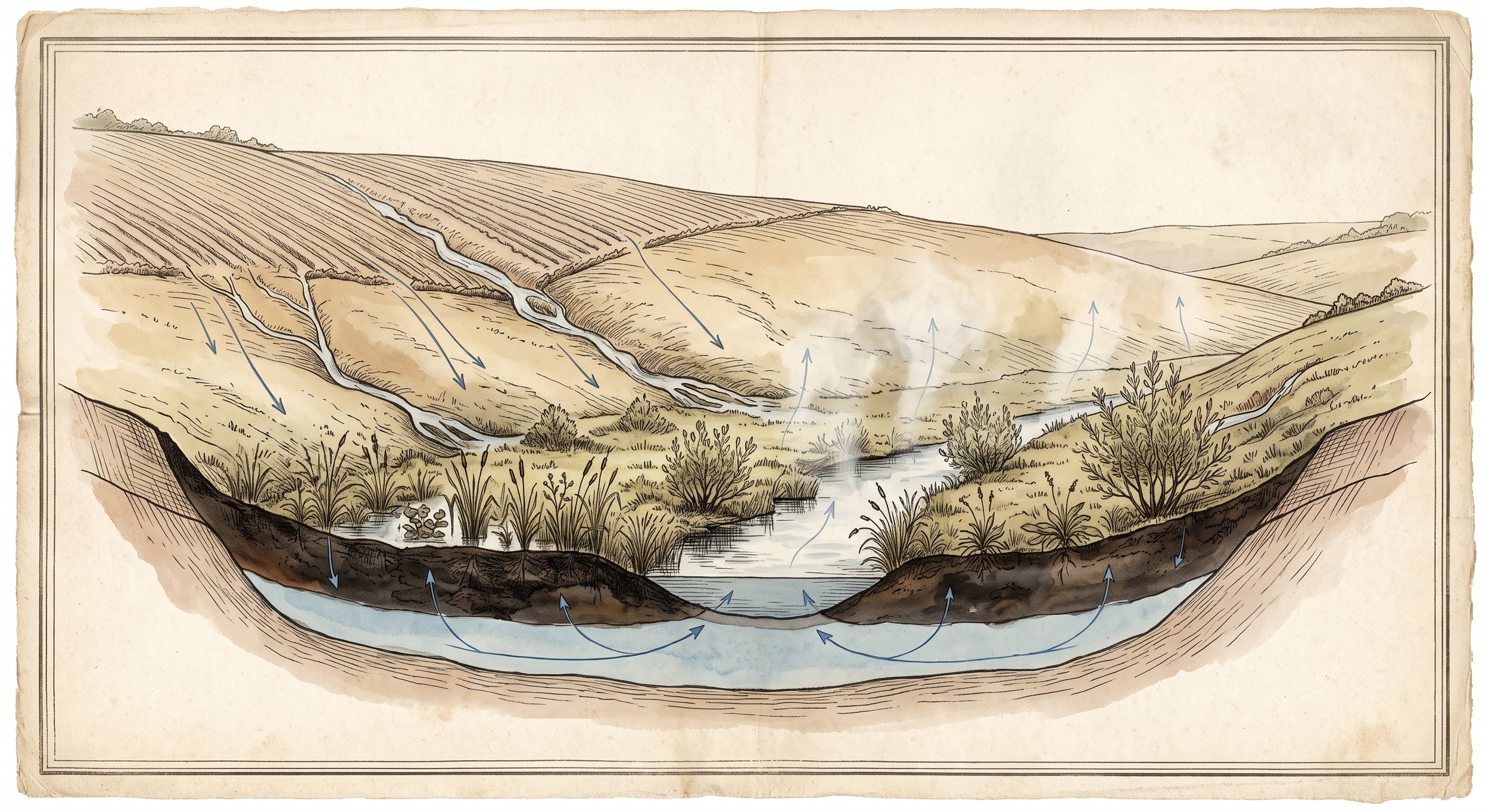
The wetland receives what the fields let go, keeps it, cleans it, and gives it back downwards, downstream and upwards.
Five tests to find out.
You can make this diagnosis yourself in an hour, without a laboratory, with a spade, a jar and a tin can. I describe them in this order because it is the order I follow in the field.
Start with the spade. Lift a block twenty centimetres square and look at how it breaks. If it falls apart into crumbs, if you see roots everywhere, round burrows, worms, if a smell of forest rises from the block: the soil is alive. If it breaks into slabs with smooth faces, with no visible worm, with a harder layer at twenty centimetres that the spade struggles through: that is the plough pan, and your drop stops there.
Next, the glass of water. Take a clod the size of a walnut and set it gently in a glass. If it holds for an hour without falling apart, the mycorrhizal fungi have done their gluing. If it collapses in five minutes, the filaments and their glue are gone.
Next, the jar. Fill it a third with soil, top up with water, shake, and leave it for a day. Sand settles at the bottom, silt in the middle, clay in suspension at the top, sometimes after two days. The thicknesses give you your soil's texture, the skeleton of your sponge.
Next, the tin can. Remove both ends of a large can, push it five centimetres into the soil, pour water up to a mark and time how fast it goes down. Do it a second time, with the soil already wet: it is this second measurement that counts. More than fifty millimetres in an hour, your soil swallows. Less than five, it refuses.
Finally, the colour. Dark, almost black when wet: that is humus. Pale, beige, grey: that is the mineral soil humus has left.
These five tests do not only measure your soil. They measure what the BRGM measures every month in aquifers. Ninety-three per cent of French aquifers falling on 1 July 2026 is the sum of millions of jars, tin cans and clods in a glass of water that would today give the wrong answer.
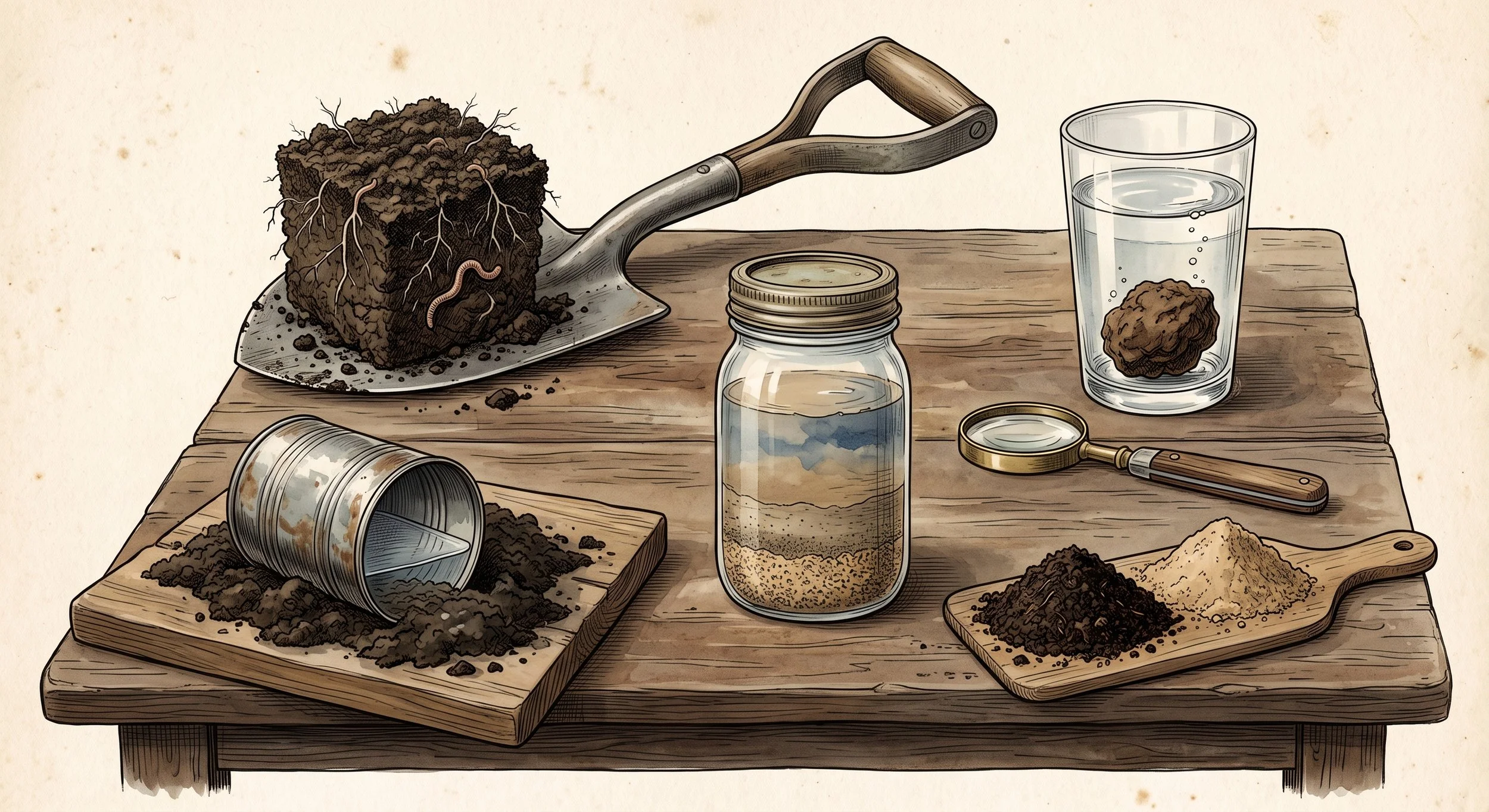
The five tests: the spade, the glass of water, the jar, the tin can, the colour.
The sponge rebuilds itself.
Each player has its own timescale, and this is the order in which they return.
The leaf returns in one season; you only need to cover the soil. The litter fungus returns in six months if it is given ramial chipped wood. Bacteria return within a few weeks as soon as roots feed them. The mycorrhizal fungus takes two to three seasons to weave its network again, less if it is brought in inoculated in biochar. The earthworm takes three to five years to rebuild its deep burrows, and only if we stop cutting them. Dead-root channels accumulate year after year under permanent cover. Humus, the slowest of all, gains a few tenths of a point per decade, each tenth being one more storm's rainfall put in reserve.
None of this needs an input. All of it needs us to stop destroying, and to open a few doors. The borehole at fifteen centimetres is a worm burrow dug for the worm while we wait for it to return. Inoculated biochar is a fungal network put down ready-made while we wait for it to spread. Ramial chipped wood is a litter brought in while we wait for the hedge to provide it. These are accelerators, not substitutes. In the end, it is always life that makes the sponge.
What the drop brings in.
I did not write this article for the beauty of the journey, even if the journey is beautiful. I wrote it because everything it describes is either paid for or earned, and it is worth doing the sums before concluding.
Water first. A soil that lets in a storm's three hundred cubic metres instead of twenty, that keeps them in its chambers instead of losing them to the ditch, and that brings them back up in July through its wick instead of evaporating them on a crust, is a soil that no longer needs the irrigation given to it to make up for what it was made to lose. Ibn al-Awwam already said it of his sand: those who do not understand their land water too much, and lose what they have planted. Giving the sponge back is the first saving, and it shows on the meter.
Fertiliser next. The forge running in the wet heart of the crumbs makes nitrogen on the spot, from the air, with sugar the plant has already paid for. Every day it runs is a day when we do not buy what it produces, and every kilo it fixes stays attached to the humus instead of leaving as nitrate for the water table. Synthetic fertiliser does the opposite: it switches off the enzyme, it spares the plant from maintaining the cover that fed it, and it delivers to the river what the soil no longer has the means to hold. We pay twice, at purchase and at clean-up.
Life, finally, and this is the line no invoice shows. The worms that return, the fungi that weave again, the bacteria that remake their jelly, the dead-root channels that accumulate, the wetland we stop draining and which starts giving water back in August again: none of it costs anything, none of it needs an input, and it rebuilds itself in the order and at the pace this text has given. It is not nature we are restoring. It is our working tool.
Following the rules of this article, covering the soil, no longer turning it, letting carbon go down, keeping water light and permanent, keeping mineral nitrogen low, leaving its ten per cent to the marshes, is not a choice between producing and protecting. It is producing with a sponge instead of producing against it. And the sponge, once restored, works for you every night, free of charge, while you sleep.
The next drop will fall this autumn. What it meets on your land, you now know how to read.
Key figures
Sources
Ibn al-Awwam, Kitab al-Filaha, The Book of Agriculture, Seville, late twelfth century, French translation by J. J. Clément-Mullet, Paris, A. Franck, 1864 to 1867.
GIS Sol, Report on the state of soils in France, Scientific Interest Group on Soils.
BRGM, Groundwater levels at 1 July 2026, French Geological Survey, 7 July 2026.
Tisdall, J. M. and Oades, J. M., Organic matter and water-stable aggregates in soils, Journal of Soil Science, 33, 1982.
Wright, S. F. and Upadhyaya, A., A survey of soils for aggregate stability and glomalin, a glycoprotein produced by hyphae of arbuscular mycorrhizal fungi, Plant and Soil, 198, 1998.
Rillig, M. C. and Mummey, D. L., Mycorrhizas and soil structure, New Phytologist, 171, 2006.
Irving, T. B. et al., A critical review of 25 years of glomalin research: a better mechanical understanding and robust quantification techniques are required, New Phytologist, 232, 2021.
Bouché, M. B., Lombriciens de France : écologie et systématique, INRA, 1972.
Augé, R. M., Water relations, drought and vesicular arbuscular mycorrhizal symbiosis, Mycorrhiza, 11, 2001.
Or, D., Smets, B. F. et al., Physical constraints affecting bacterial habitats and activity in unsaturated porous media, Advances in Water Resources, 30, 2007.
Carminati, A. et al., Dynamics of soil water content in the rhizosphere, Plant and Soil, 332, 2010.
Hudson, B. D., Soil organic matter and available water capacity, Journal of Soil and Water Conservation, 49, 1994.
Lemieux, G., Le Bois Raméal Fragmenté, Université Laval, Groupe de Coordination sur les Bois Raméaux.
Serraj, R., Sinclair, T. R. and Purcell, L. C., Symbiotic N₂ fixation response to drought, Journal of Experimental Botany, 50, 1999.
Dong, Z., Wu, L., Kettlewell, B., Caldwell, C. D. and Layzell, D. B., Hydrogen fertilization of soils: is this a benefit of legumes in rotation?, Plant, Cell and Environment, 26, 2003.
Dong, Z. and Layzell, D. B., H₂ oxidation, O₂ uptake and CO₂ fixation in hydrogen treated soils, Plant and Soil, 229, 2001.
La Favre, J. S. and Focht, D. D., Conservation in soil of H₂ liberated from N₂ fixation by Hup⁻ nodules, Applied and Environmental Microbiology, 46, 1983.
Piché-Choquette, S., Tremblay, J., Tringe, S. G. and Constant, P., H₂-saturation of high affinity H₂-oxidizing bacteria alters the ecological niche of soil microorganisms unevenly among taxonomic groups, PeerJ, 4, 2016.
Berney, M., Greening, C., Conrad, R., Jacobs, W. R. and Cook, G. M., An obligately aerobic soil bacterium activates fermentative hydrogen production to survive reductive stress during hypoxia, Proceedings of the National Academy of Sciences, 111, 2014.
Greening, C., Biswas, A., Carere, C. R. et al., Genomic and metagenomic surveys of hydrogenase distribution indicate H₂ is a widely utilised energy source for microbial growth and survival, ISME Journal, 10, 2015.
Horn, R., The effect of aggregation of soils on water, gas and heat transport, in Flux Control in Biological Systems, Academic Press, 1994.
Le Bas, C., Map of available water capacity from the Geographical Soil Database of France, GIS Sol, INRAE, 2018.
Arvalis, Soil water reservoir available to crops, estimation guide, September 2022.
Caldwell, M. M. and Richards, J. H., Hydraulic lift: water efflux from upper roots improves effectiveness of water uptake by deep roots, Oecologia, 79, 1989.
Neumann, R. B. and Cardon, Z. G., The magnitude of hydraulic redistribution by plant roots: a review and synthesis, New Phytologist, 194, 2012.
Querejeta, J. I. et al., Direct nocturnal water transfer from oaks to their mycorrhizal symbionts during severe soil drying, Oecologia, 134, 2003.
Bernard, P., Les zones humides, evaluation report, Interministerial Committee for the Evaluation of Public Policy, La Documentation française, 1994.
Cerema, Land take observatory, land consumption data 2009 to 2024, published 1 July 2026.
Institut Paris Région and Météo France, Heat in the city, urban heat island and the 2003 heatwave.
Ramsar Convention, 2001, and Seine-Normandy Water Agency, storage capacity of wetlands, La Bassée floodplain.
State Council of the People's Republic of China, Guiding Opinions on Promoting the Construction of Sponge Cities, October 2015.
Yves Nicolas | Expert Consultant in Functional Ecology | yvesnicolas.com | France and Morocco
Water newsletter: Reality and Solutions, Episode 5 | September 2026