Plants, fungi and bacteria, from the vegetable plot to the street tree. Three networks, one soil, and the band that decides everything.
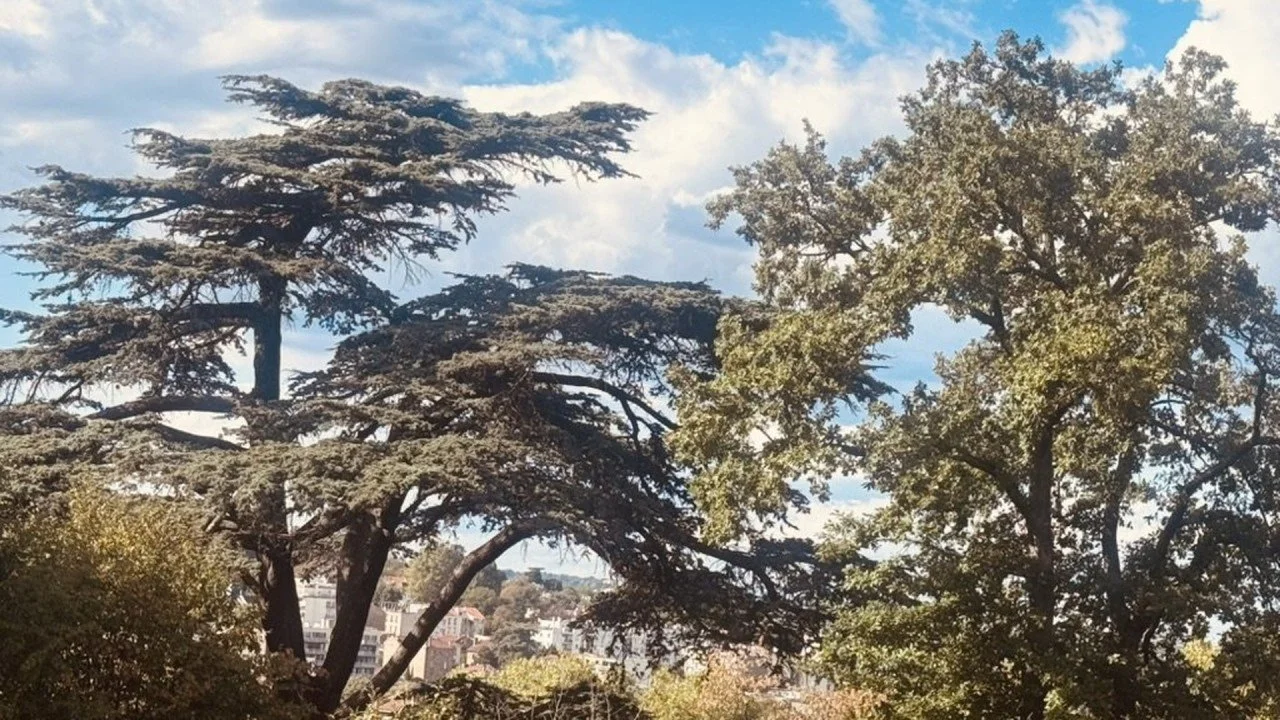
What plays out under a street tree, and can be checked on a leek
Two plane trees planted on the same day, in the same street, with the same trunk girth. Five years later, one carries a full crown, the other has lost half its main limbs and the technical department is already talking about replacing it. Same pit, same watering, same contractor, same nursery. The usual culprits are compaction, salt, dogs, the volume of soil. We are right to name them, and we stop too soon. They do not only kill the tree, they first kill what works beneath it, and that death leaves no trace above ground. The real difference is underground, and it cannot be seen on a tree.
It can be seen on a leek.
Pull one up in October and look at its roots before you shake them. You will see a few white cords, thick as string, stiff, almost bare. No root hairs, no down, none of the fine beard other plants are so proud of. A leek explores the soil with a beginner’s kit.
Now pull up the carrot growing in the next row. Same surprise. A smooth taproot, a few rootlets, and so few root hairs that you wonder how the plant finds anything to eat. Here are two vegetables that have always been grown together, officially so that one keeps the other’s fly away. The underlying reason lies elsewhere and nobody says it: they subscribe to the same network, they deal with the same fungus, and neither can do without it. The carrot is so reliable in this partnership that it serves as the reference host plant for growing mycorrhizal fungi in the laboratory.
Finally, pull up the cabbage growing three steps away. You are holding the exact opposite. A bush of fine roots, branched down to the last division, covered in root hairs so numerous that the soil stays stuck to them and will not come off. The cabbage has built its own exploration network itself, centimetre by centimetre, and it has cost it a considerable share of its sugar.
Three plants, the same soil, the same rain, and two opposite strategies. The leek and the carrot have no fine roots because they do not need them. They subcontract. They rent the fine roots of a fungus, a hundred times finer than the finest of their rootlets, able to enter pores no root will ever pass through. The cabbage subcontracts nothing, because nobody wants to work with it.
Back to the street. The plane tree works exactly like the leek and the carrot, with the same family of fungi, and in all likelihood it depends on them just as much. What you hold in your hand explains the tree you cannot dig up. The leek, the carrot and the plane tree have the same supplier. Only the scale changes. A failed bed of leeks is resown in spring. A failed tree is replaced, and replaced again, and the shade never comes.
The whole art of combining plants starts here. There are those that are plugged into the network and those that never will be. The gardener who ignores this makes plants live side by side. The designer who ignores it juxtaposes systems. The one who knows it makes plants work together. It is not the same harvest, nor the same crown at fifteen years old.
What follows therefore holds for a bed of vegetables as for a row of street trees, for an orchard as for a green roof. The mechanisms are the same, only the means change. And that is not yet enough, because the network is not a kindly cooperative, it is a market where some pay for others.
How to use this article
This text is not a treatise on mycology. It is a decision manual, and it reads differently depending on what you are planting. Here is how I suggest you go in. If you simply garden, read it in order, this text is written for you, and “A garden plan in a few lines” awaits you at the end of the second part. The article is indeed published in two instalments. This one stops at “The band of soil that decides everything”. The second picks up at “The water we pour” and ends with the garden plan and with what my garden proves or does not prove. In the advice that follows, chapters in the second part are flagged.
If you manage urban green spaces. Your problem is not the choice of species, it is the soil and the building site. Read “The network does not take everyone”, then “Three networks that do not talk to each other”, which tells you in five minutes who plugs into what and without which the rest does not hold. Go through “Winter drowns more often than it freezes” and “The band of soil that decides everything”. It is site compaction followed by a saturated winter, far more than the heatwave, that separates the two plane trees, and it can be seen with a spade: one hole in February, another in May. Then go to “Designing a green space that lasts” (second part), which turns everything else into written clauses. A permanent living cover over the root zone, apart from the mulched square metre at the foot of a young tree for its first three years; permeable surfaces; a ban on soluble phosphorus, the phosphorus in fertilisers that dissolves at once, throughout the establishment period; the production method of the plants required from the nursery; a three-year establishment phase written into the contract. One figure will settle your trade-offs. Across fifty-four field studies, reducing tillage and sowing a winter cover each increase mycorrhizal colonisation of the following crop by about thirty per cent. Colonisation is the share of the root actually occupied by the fungus. No planting delivered will make up, within its one-year guarantee, what two seasons of bare soil have destroyed. And know that the city does not destroy your partners, it replaces them with species that tolerate disturbance: the aim is not to bring the forest back into town, it is to give these urban generalists something to work with. The end of “The water we pour” (second part) deals with salt and green walls, and “The nitrogen nobody decided on” (second part) with the single line of analysis to add to the contract.
If you have an estate, an orchard, a large garden. You have what the city does not, continuity and time. Your main lever is the relay plant and the hedge. Read “The relay plant” (second part), “Three networks that do not talk to each other” and “A garden plan in a few lines” at the end of the second part. Your first decision is not to buy something, it is to stop two things, bare soil and soluble phosphorus. Your second is to spot, on your own property, the old hedge or woodland edge that will serve as your bank, and to protect it. Before any purchase, dig the two holes from “The band of soil that decides everything”, and read “The water we pour” (second part), because on a rich soil chlorinated mains water costs more than you think. “The nitrogen nobody decided on” (second part) will then tell you why a borehole loaded with nitrate holds back cover crops you thought were free.
If you farm, market gardening or field crops. Go in through “The network does not take everyone”, which will tell you why your brassicas and your beets do not behave like the rest, then through “What breaks the network” (second part). And do not skip “The relay plant” (second part), whose passage on long fallow disorder describes a situation you may already have seen without naming it, a stunted crop in properly supplied soil. And read “The network is a market, not a cooperative” (second part) carefully, because it explains why the companion planting tables copied from one book to the next work for one grower and not for another. Have your irrigation water analysed, “The nitrogen nobody decided on” (second part) puts a figure on the undeclared fertilisation it brings. And “The band of soil that decides everything” explains why the spring recolonisation window closes earlier than it used to.
If you are reforesting or restoring. “Three networks, one soil”, “The north mines, the south prospects” and “Designing a green space that lasts” (second part) concern you first. The first of the three sets the rule that governs everything else: a newcomer is introduced in contact with a resident host, never alone in a bare field. And if the newcomer carries only one circuit, the host must carry the same one. Read also “The soil remembers”: a soil is inhabited or poorly inhabited, not young or old, but podzolisation cannot be undone. And if the band described further on does not exist, no species will save the planting.
Six things to know before you start, whatever your way in.
The first. The soil decides before the species list. A magnificent planting palette set on a soil whose network has been chopped up will give plants dependent on watering and fertiliser. The reverse is also true, and that is the good news: a soil whose network is intact makes up for many palette mistakes.
The second. Nothing works without a living root. The fungus lives only on a living plant, it does not keep in the soil like a seed. Every period of bare soil is a loss of capital, and that loss cannot be bought back, it is rebuilt over seasons.
The third. Do not buy what you can take thirty metres away. Across two hundred and fifty trials of commercial mycorrhizal products, eighty-four per cent of the trials produced no colonisation or almost none, while field soil colonised in every trial where it served as the reference. With one reservation I maintain: soil transfer is reasoned according to texture and origin, it is not sprinkled.
The fourth. Count on three years, not one spring. The network rebuilds itself in two to three seasons, and the effects of an inoculation, that is the deliberate addition of living organisms, cannot be read in the first year. A project that promises an immediate result is lying, including to itself.
The fifth, and the most unsettling. There is no companion planting table that holds everywhere. What you will read in the second part about flax and sorghum shows that the sharing between two connected plants depends on the species of fungus present in your soil, and that it can reverse from one partner to another. So you are not looking for the right recipe, you are looking for the right conditions.
The sixth. The soil is read in February, not in July. Two holes, one in February, the other in May, before any species list. What remains between the standing water and the already dry soil is the only band where the network can work all year round.
And a warning about what this article is not. It is not a fertilisation method. Nothing that follows is bought in a bag and spread. The rhizobium inoculant for legumes, which goes on the seed and not in the soil, is not concerned. In the second part a single exception will appear that goes into the ground, and it is a partial one: biochar, that porous plant charcoal. It is a habitat rather than a fertiliser, but it still has to be charged before it is buried. It is first left to fill with water, nutrients and life, otherwise it takes them from the soil. This charging is a site adjustment that I will not reduce to a recipe, and a local authority can produce biochar from its own green waste instead of buying it. These are rules of conduct, things to do and above all to stop doing. Their main cost is a change of habit, and their benefit is measured in years. If you are looking for a product, you will waste your time. If you are looking to spend less while standing up better to drought, you are in the right place.
The network does not take everyone
Mycorrhiza is the association between a root and a soil fungus that dates back to life leaving the water. The first land plants had no true roots. They already had fungi. In the Rhynie chert, in Scotland, fossilised arbuscules have been found, intact, identical to those we stain today in a clover root. These are the exchange organs between plant and fungus, and we will meet them again. The root came after the fungus, not the other way round.
The count has been done seriously. By bringing together a hundred and thirty-five years of publications and recent phylogenies, Brundrett and Tedersoo established in 2018 that 72 per cent of vascular plant species form arbuscular mycorrhizas, 2 per cent ectomycorrhizas, 1.5 per cent ericoid mycorrhizas and 10 per cent orchid mycorrhizas. Only 8 per cent are entirely non-mycorrhizal, and 7 per cent are so inconsistently. The figures are rounded, they do not add up exactly to a hundred. These are still only four names and an order of magnitude. What each one covers will come a little further on, with the three networks that do not talk to each other.
These 8 per cent are not a scattering of botanical exceptions. It is a list every gardener knows by heart, without knowing that it makes up a family of behaviour.
The brassicas first, that is cabbages in all their forms, turnip, radish, rocket, mustard, oilseed rape, camelina. Then the goosefoots in the broad sense, beetroot, spinach, chard, quinoa. Then the knotweed family, buckwheat, sorrel, rhubarb. The pink family, including the carnation and chickweed. Rushes and some of the sedges. And, in the poorest soils in the world, the Australian proteas and our own lupin, which have invented something else.
These plants are not disabled. They have chosen another path. The cabbage makes a massive mass of fine roots and pays the bill itself. The lupin does better still, it produces proteoid roots, clusters of rootlets packed together like a brush, which pour out organic acids locally and wrest from the soil the phosphorus the others cannot take.
And the brassica does not merely refuse the fungus, it hinders it. Its tissues contain glucosinolates which, as they break down, release isothiocyanates, the bite in mustard and horseradish, which are hostile to soil fungi. Schreiner and Koide showed in 1993 that living roots and root extracts of brassicas inhibit the germination of mycorrhizal spores. Add molecules that trap isothiocyanates to the medium and the inhibition disappears, which points to them as the likely culprits. The demonstration was made under controlled conditions and it is still debated, since plants rich in glucosinolates such as nasturtium or papaya form mycorrhizas normally. This is the principle called biofumigation when it is used against a pest.
Here I must correct an idea I used to repeat myself. The question is simple: does a bed of cabbages left in place over winter damage the network of the leeks that will follow? I checked the figures at the source, and the effect is more modest and more ambiguous than the campaigning version going round. I give the answer straight away, the figures follow: it is not the mustard that breaks the network, it is the plough and bare soil.
In the most often cited Italian trial, colonisation of the following crop at the juvenile stage reached 35.0 per cent after hairy vetch and 29.4 per cent after a seven-species mix, against 20.9 per cent after Indian mustard. But the control under spontaneous vegetation stood at 21.3 per cent, that is at the same level as the mustard. So the mustard did no worse than what grew naturally, it was the vetch and the mix that did better. The mycorrhizal inoculum potential of the soil, that is its capacity to colonise a test plant, fell much further after the mustard, by 56.5 per cent, against 34 to 47 per cent after the other covers. A four-year Japanese trial found weaker mycorrhization of soya after oilseed rape, a non-host, than after wheat, a host, with the gap only appearing from the second year of the rotation. And the non-mycorrhizal status of brassicas, curiously, is still not fully explained at the level of mechanisms.
Meanwhile, two independent studies say the same thing about the real culprit. A Lithuanian trial published in 2026 took care to sample before the cover was destroyed, so as not to confuse the effect of the plant with the release of isothiocyanates. On volunteer barley, the intensity of colonisation was determined first and foremost by tillage, clearly higher under direct drilling, with no tillage at all, than under ploughing. A Japanese sequencing study reaches the same ranking on another criterion, the composition of maize mycorrhizal communities being changed by tillage and not appreciably by the preceding cover.
A meta-analysis is the statistical synthesis of all published trials that lend themselves to comparison. The reference one gives the order of magnitude of the two useful levers. Across fifty-four field studies on five continents and two hundred and seventy-eight comparisons, reducing tillage and sowing a winter cover each increase colonisation of the following summer crop by about thirty per cent. Under reduced tillage, fungal species richness gains 11 per cent, and the best combinations pair direct drilling with a legume cover.
So the practical conclusion changes shape. The brassica is a secondary lever. The plough and bare soil are the main levers. A mustard cover under direct drilling is worth more than a perfect cover followed by ploughing.
All plugged in, but not at the same rate
Among the plants that are admitted, dependence is not equal, and it can be read with the naked eye on the root, exactly as on the leek at the start.
Thick roots, little branching, few short root hairs: the plant cannot do without the fungus. This is the case of all the alliums, leek, onion, shallot, garlic. It is the case of the vine, of the olive, whose response to the fungus nevertheless varies a great deal with the cultivar, of citrus, sorghum, squash, melon, flax, sunflower, cotton. The carrot, met at the outset, belongs to the same group, and its almost bare taproot says the same thing as the leek’s cord. So does the kiwi, which you only have to clear around one plant to see its fleshy, little-branched roots. In my garden it is the first to give up when water runs short, for that reason as much as for its leaf area.
Fine roots, dense mass of fine roots, many root hairs: the plant manages much better on its own. Lawn grasses are in this case, and a good share of the straw cereals. They remain mycorrhizal, they gain from it, but they do not collapse if the network is missing.
In a system, you serve first those who cannot serve themselves.
Three networks that do not talk to each other
Another rule, less well known and just as decisive. There is not one soil network, there are several, which I will call circuits, and they do not connect to one another.
Arbuscular mycorrhiza is the most widespread. The fungus, a Glomeromycete, enters the root cell and spreads a tiny tree-like structure there, the arbuscule, on which the exchange takes place. Sugars and lipids from the plant against water, phosphorus, nitrogen, zinc, copper. These fungi bear no fruiting bodies, make no caps, cannot be picked into a basket. We never see them, and that is why they are so little loved. This is the circuit of the apple, the pear, the plum, the walnut, the maple, the plane, the cypress, the yew, the vine, the olive, citrus, and almost the whole vegetable garden.
Ectotrophic mycorrhiza, also called ectomycorrhiza, is the second. Here the fungus does not enter the cells. It wraps the tip of the root in a sheath and works its way between the cells of the cortex. These are the fungi of the autumn basket, cep, chanterelle, amanita, milk cap, and the truffle that grows underground. This circuit is that of the oak, the beech, the sweet chestnut, the hornbeam, the birch, the hazel, the pine, the spruce, the larch, the cedar, the lime, the rockrose.
One figure surprises everyone. Ectomycorrhizas concern only 2 per cent of plant species, but those 2 per cent are the trees that make up our temperate and boreal forests. A handful of species, a considerable mass of vegetation. That is why almost all the literature on forest networks talks about this circuit, and why it does not transfer as it stands to the orchard or the vegetable garden.
Ericoid mycorrhiza is the third circuit, reserved for heather, ling, bilberry, cowberry, rhododendron. It works in acid, poor soils rich in poorly decomposed organic matter, and it knows how to release there the organic nitrogen that nobody else touches.
Last comes orchid mycorrhiza, the most astonishing, since the orchid seed, which has no reserves, germinates only by letting itself be colonised and by feeding, during its first months, at the fungus’s expense.
Two plants from different circuits can be neighbours. They do not connect. Planting a hazel near an oak brings together two subscribers to the same network. Sowing a carpet of heathers at the foot of an apple tree puts side by side two systems that politely ignore each other.
A category must be added at once that was long taken for a curiosity, that of plants with a double subscription, able to carry both arbuscular and ectotrophic mycorrhizas at the same time. Willow and poplar are the classic examples, and this explains part of their robustness on disturbed ground. But the most serious census, that of Teste, Jones and Dickie in 2019, retains eighty-nine confirmed genera in thirty-two families and two hundred and thirty-eight documented species, after setting aside the poorly established cases among two hundred and eleven candidate genera. The ash, long classed as strictly arbuscular, is among them, as are acacia, eucalyptus and some oaks. So it is not an exception, it is a widespread strategy.
Three networks, one soil
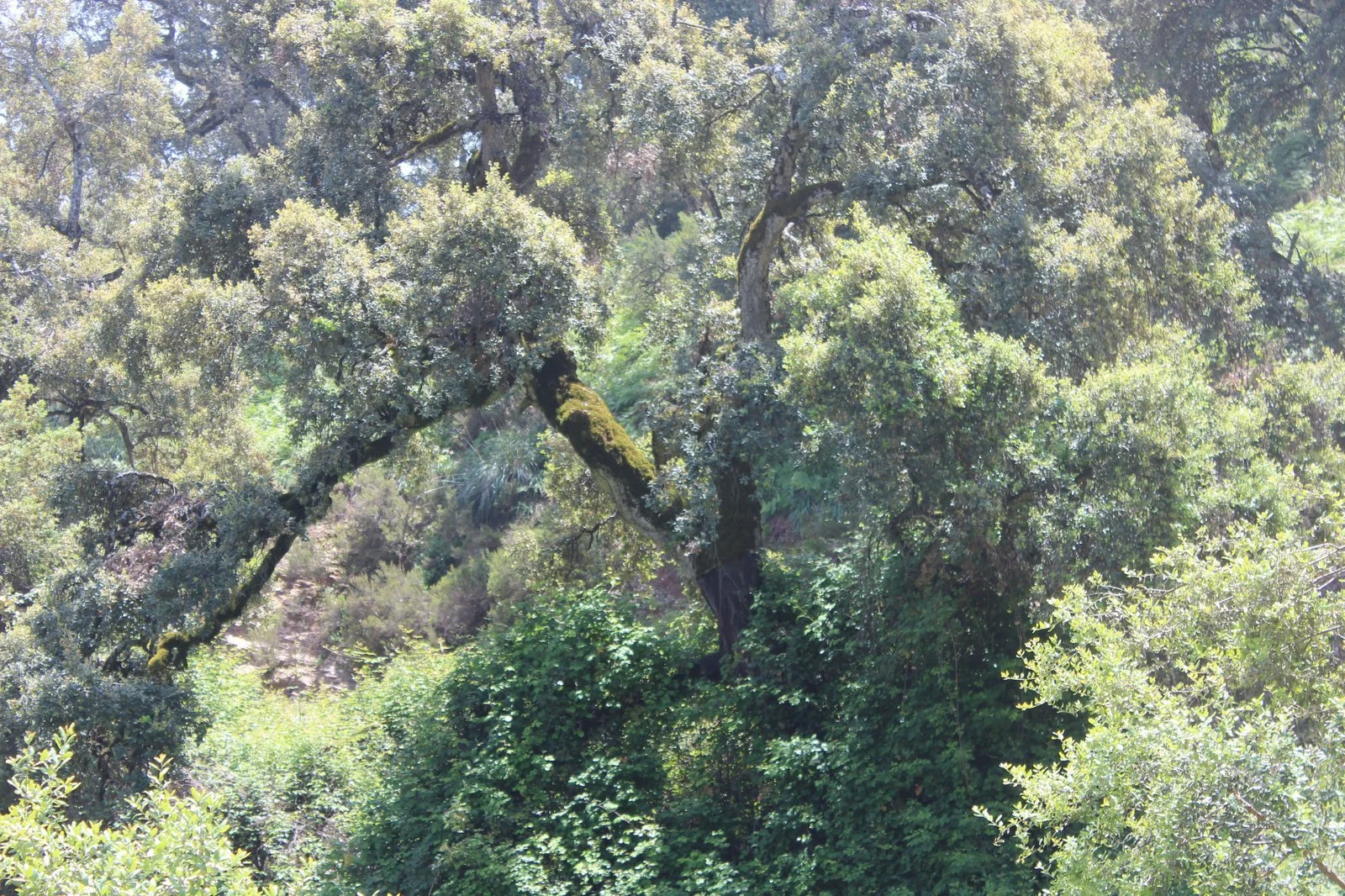
Middle Atlas. An old holm oak, its ivy and the dwarf palm on the slope. The oak deals with mushroom-forming fungi, the ivy with others, invisible ones. Two circuits in the same earth, and nobody is the worse for it.
Saying that the circuits do not connect does not mean they avoid each other. In nature they almost always overlap, and that is even the ordinary situation.
Walk into an oak wood in April. The trees above you work in ectomycorrhizas. The wild garlic, the wood anemone, the ivy, the bramble, the bluebell covering the ground work in arbuscular mycorrhizas. Two whole networks occupy the same cubic decimetre of soil, draw on the same water, compete for the same nitrogen, and never connect. Add ling or bilberry under pines and you have three stacked up.
This overlap is not disorder, it is a division of labour. The ericoid circuit goes after the organic nitrogen locked up in acid humus that nobody else can open. The ectotrophic one attacks litter and proteins. The arbuscular one prospects for mineral phosphorus in pores nothing else enters. Three trades on three different resources. The woodland floor is not a jumble, it is a sharing of tasks, and that is why the three systems hold side by side instead of excluding one another.
Cohabitation also happens on a single plant. Willow and poplar carry both circuits at once, rather arbuscular when young, more and more ectotrophic with age. The alder, also a double subscriber, adds its Frankia nodules on top. These are coral-shaped root outgrowths, sometimes as big as a fist, housing a bacterium that fixes nitrogen from the air, like that of legumes. Three partners on a single root. On these species, the word association takes on its literal meaning: the same root houses several trades.
In them, the balance between the two circuits is not fixed once and for all, it follows conditions. The young plant often starts out arbuscular, cheaper and available sooner, then switches to ectotrophic as it grows. Drought and excess water both push towards arbuscular, because the ectotrophic fungus copes poorly with a badly aerated soil. And above all, the presence of a partner decides. Red oak acorns sown at the foot of red maples, which are arbuscular hosts, gave seedlings widely colonised by arbuscular fungi, while the same acorns sown near oak suckers remained clearly ectotrophic. The double subscription therefore works as an insurance, it takes the circuit the neighbourhood offers. The authors add an honest reservation, they measured no growth gain linked to the arbuscular route. It is one more argument for backing a planting onto a resident host rather than setting it down alone on bare ground.
And it happens right down inside the root itself. A single clover root commonly hosts several species of Glomeromycetes at once. A single oak can carry dozens of different ectotrophic species depending on the age and position of its root tips. The hyphae, the filaments that make up the body of the fungus, cross constantly in the soil, but they only fuse between compatible individuals of the same species. Crossing is not connecting. The whole nuance lies there, and it is what must be remembered before drawing a planting plan.
There remain the true bridges, which are the finest cases. The strawberry tree and bearberry have a particular mycorrhiza, called arbutoid, which plugs them into ectotrophic fungi, that is into the network of neighbouring trees. Yellow bird’s-nest in pine woods does the same, but as a parasite, without a single green leaf. And many of the orchids in our forests, helleborines of the genera Cephalanthera and Epipactis, are only half green in the metabolic sense: they draw part of their carbon from the trees’ ectotrophic network, what is called mixotrophy, a field largely opened up in France by Marc-André Selosse. There, two circuits really do communicate.
So the rule is better put this way. Circuits do not connect with each other, except in a few hinge species that have learnt to plug into two systems. And this lack of connection does not prevent cohabitation, it organises it.
For the designer, the consequence is good news. A garden that deliberately stacks circuits, trees of one trade, low layer of another, exploits more compartments of the soil than a uniform planting. It is not decorative biodiversity, it is coverage of resources.
The north mines, the south prospects
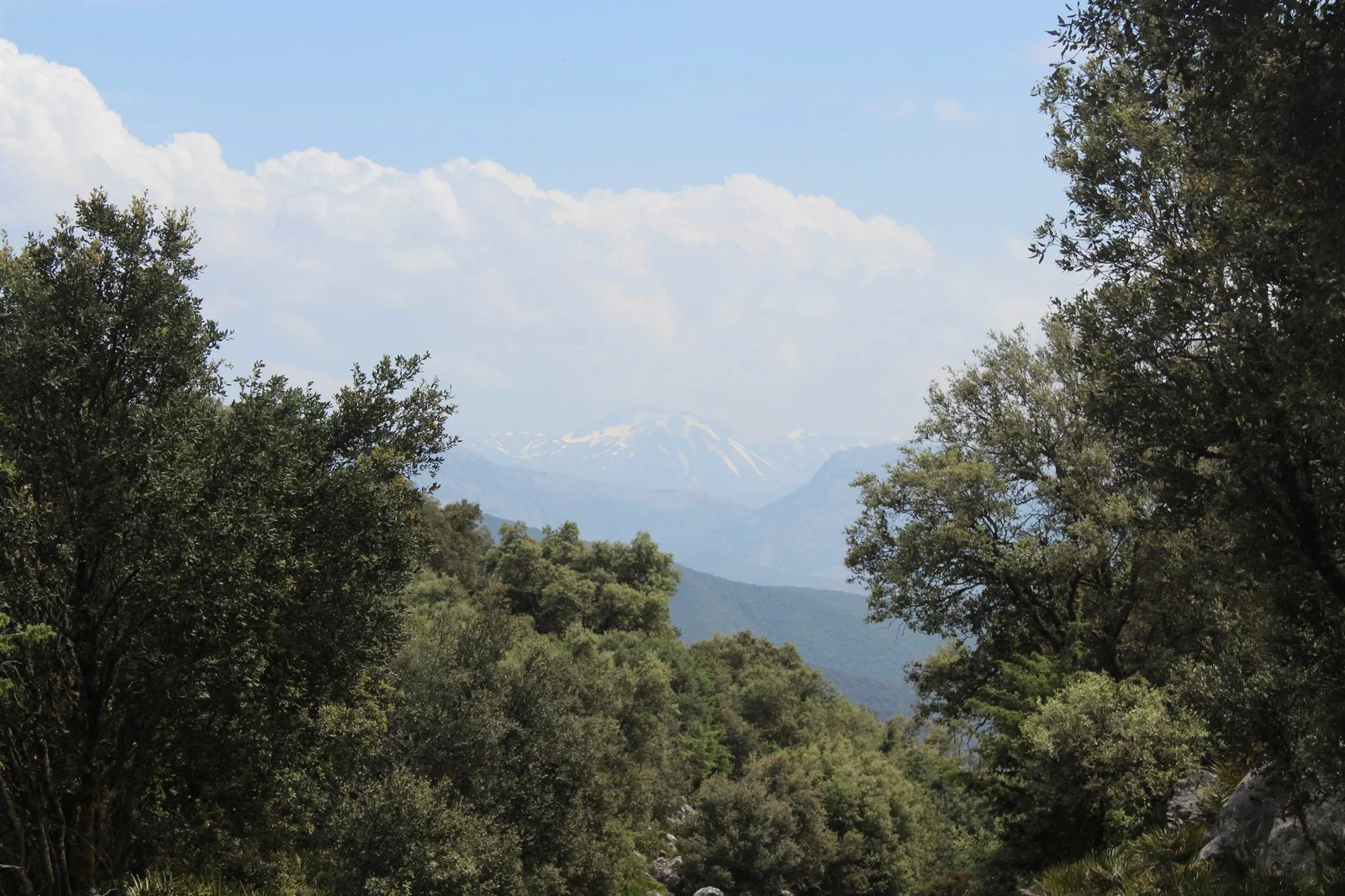
Middle Atlas. Mountain holm oak woodland, snowfields in the background. Here it is not cold that commands the underground circuit, it is the dry summer.
Why three circuits rather than one, and why this one rather than that one. The answer exists, it is global, and it is far more useful than people think.
A study published in Nature in 2019, covering the planet’s three trillion or so trees, mapped the division. Ectotrophic trees, which represent only 2 per cent of plant species, make up about 60 per cent of the Earth’s trunks. They dominate wherever a seasonally cold or dry climate slows decomposition, that is at high latitudes and at altitude. Arbuscular trees dominate the hot tropical forests without a marked season, and cohabit with ectotrophic ones in our temperate zones, where the warm, wet season speeds up decomposition. The transitions between the two are abrupt rather than gradual, and for a simple reason: the litter of an ectotrophic tree decomposes poorly, which maintains precisely the conditions that favour the ectotrophic circuit. The system makes the soil that confirms it.
The underlying chemistry is simple. In the north, in young soils often reworked by glaciers, nitrogen is in command, and it is locked in organic matter that the cold prevents from mineralising, that is from breaking down into the elements the root can drink. Now, ectotrophic and ericoid fungi descend from decomposer ancestors and have kept part of their enzyme toolkit. They go after organic nitrogen directly, without waiting for mineralisation. It is a miner’s work. In the south, in old, deeply weathered soils, nitrogen circulates quickly but phosphorus is locked onto iron and aluminium oxides. The arbuscular fungus, which has little or no enzyme capacity, is on the other hand an unrivalled explorer for mineral phosphorus. It is a prospector’s work.
Two strategies for two locks. The north mines, the south prospects.
Now, the rule is not a rule of latitude, and this must be said clearly, otherwise it will lead you astray. The factor is not heat, it is the blocking of decomposition, and drought has the same effect as cold. That is why the whole Mediterranean rim, well to the south, remains ectotrophic country: holm oak, cork oak, kermes oak, Atlas cedar, pines, rockroses, with the truffle as its signature. Conversely, the tropics have their ectotrophic exceptions, the dipterocarps of South-East Asia and certain African caesalpinioid legumes, often settled on the poorest sands, where they form almost pure stands.
The same study gives one last result, and it is the one I keep for my own work. Symbiotic nitrogen fixers escape this climatic control of decomposition, and they peak in arid biomes with alkaline soils and high maximum temperatures. The nitrogen-fixing lever is therefore a lever of the dry, chalky south. Where cold blocks nothing, where litter disappears in a season, where phosphorus is locked up, nature itself bets on the nodule.
Let us translate this for two terrains I know.
In temperate France, we work in a mixing zone. Forest trees are ectotrophic, almost everything else is arbuscular, and the historically limiting factor, nitrogen, has been drowned under inputs for a century while soluble phosphorus accumulated. The main lever there is not to add, it is to stop switching off the symbiosis with fertiliser and ploughing.
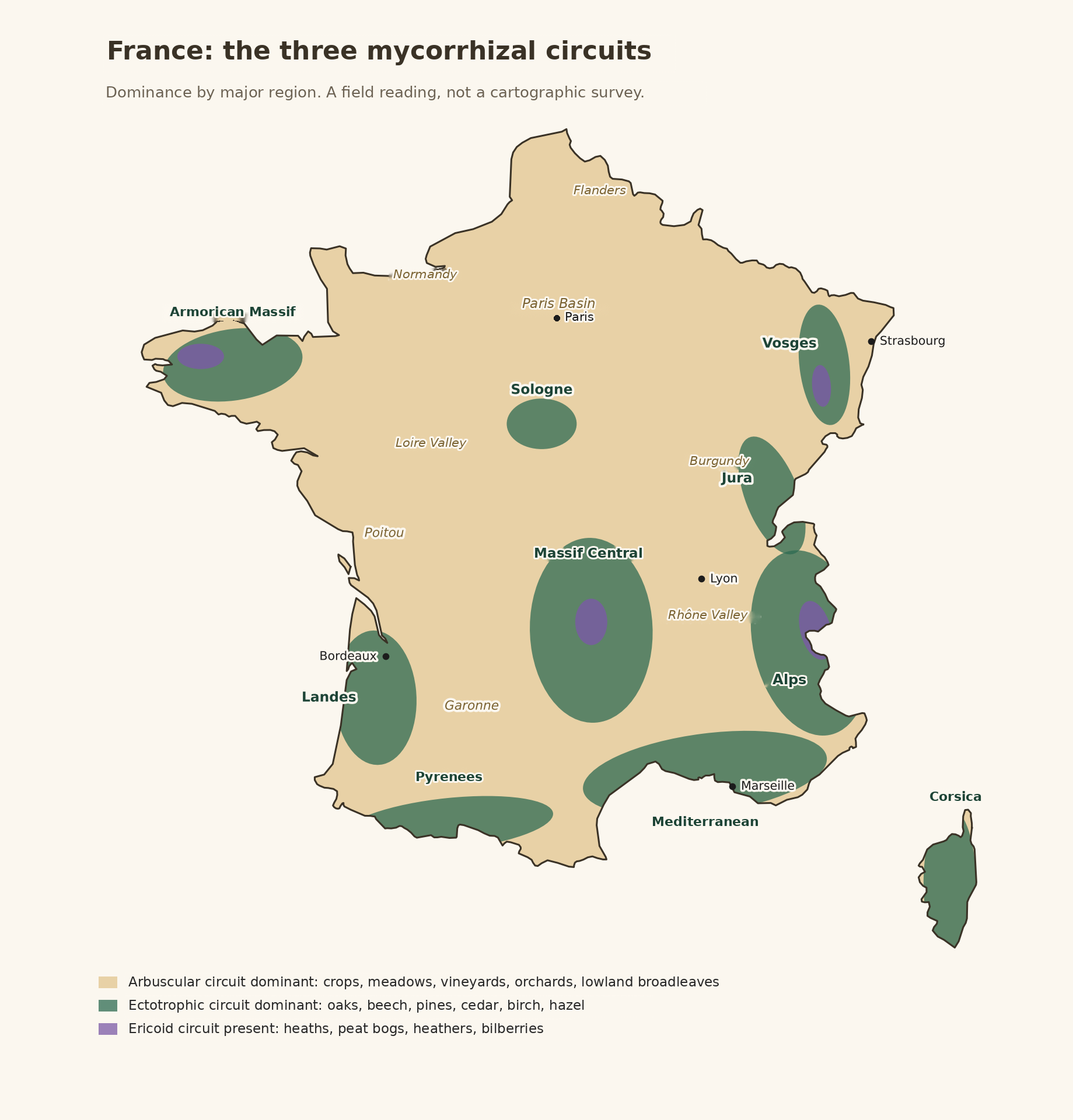
France. In sand colour, the arbuscular background of crops, meadows, vineyards and orchards. In green, the ectotrophic massifs. In purple, the ericoid circuit.
In Morocco, the chemistry is not that of the tropics, even if the heat looks similar. Phosphorus is not locked there by iron and aluminium but by calcium, at high pH, in carbonate soils. Same lock, different key. The arbuscular circuit remains the key to the vegetable garden and to crops, the ectotrophic one the key to the oak and cedar forests, and the nitrogen-fixing legume has a value there that French companion planting tables seriously underestimate. Add two things. The fungus’s contribution to water transport weighs all the more as the soil dries out. And the stock of propagules is in all likelihood exhausted faster in bare, hot soil than in bare, cool soil. Propagules are the spores, fungal fragments and colonised roots capable of starting again, and what I say about them here I take from observation and not from measurement. The relay plant, to which I devote a chapter of the second part, is a host plant left in place to keep the network alive between two crops. In France it is good practice. In Morocco it is a condition for the network’s survival.
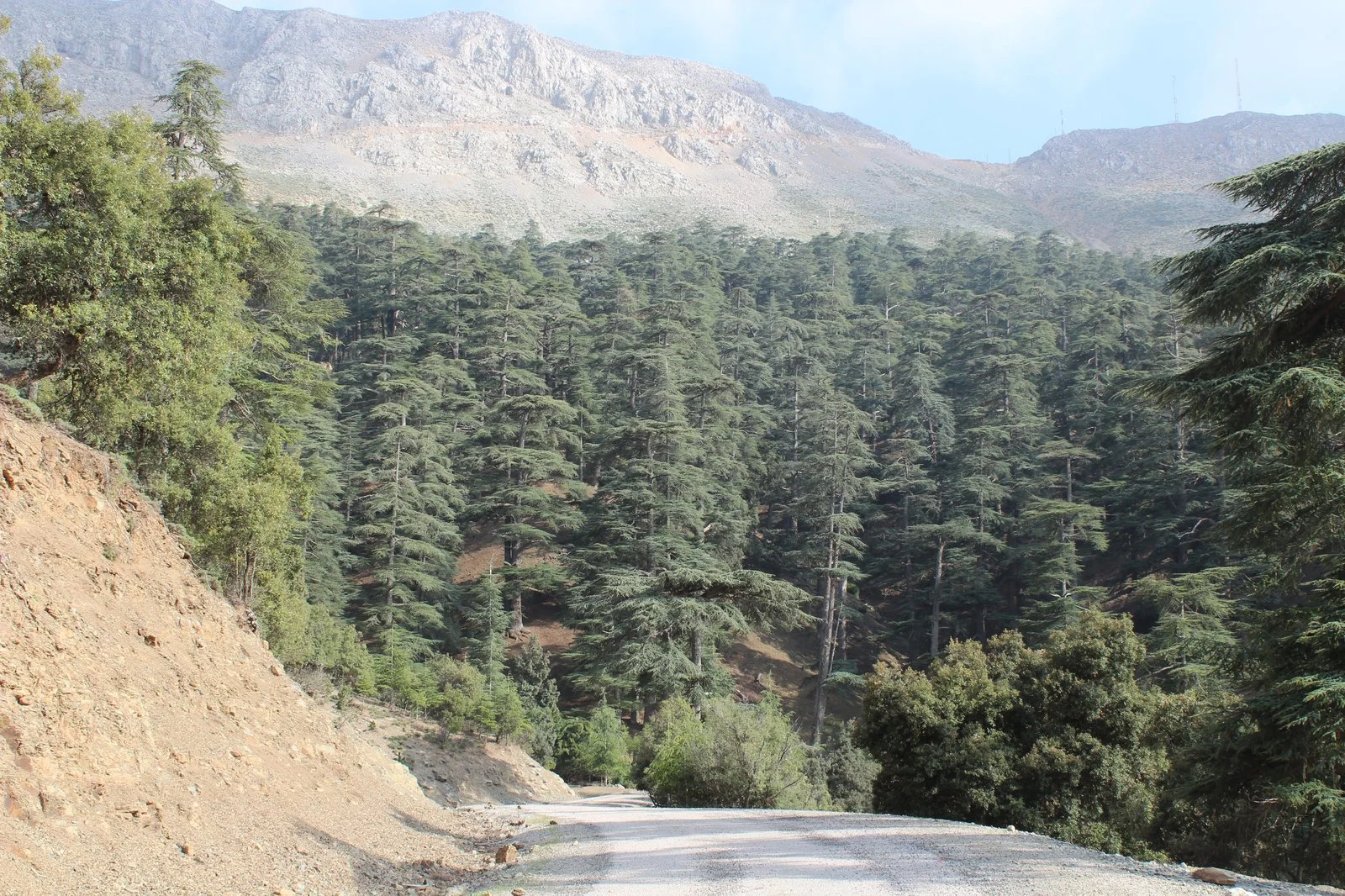
Middle Atlas. On the right, cedar and holm oak plugged into the same fungi for centuries. On the left, a track bank without a single root. The same species will not have the same fate depending on which side it is planted.
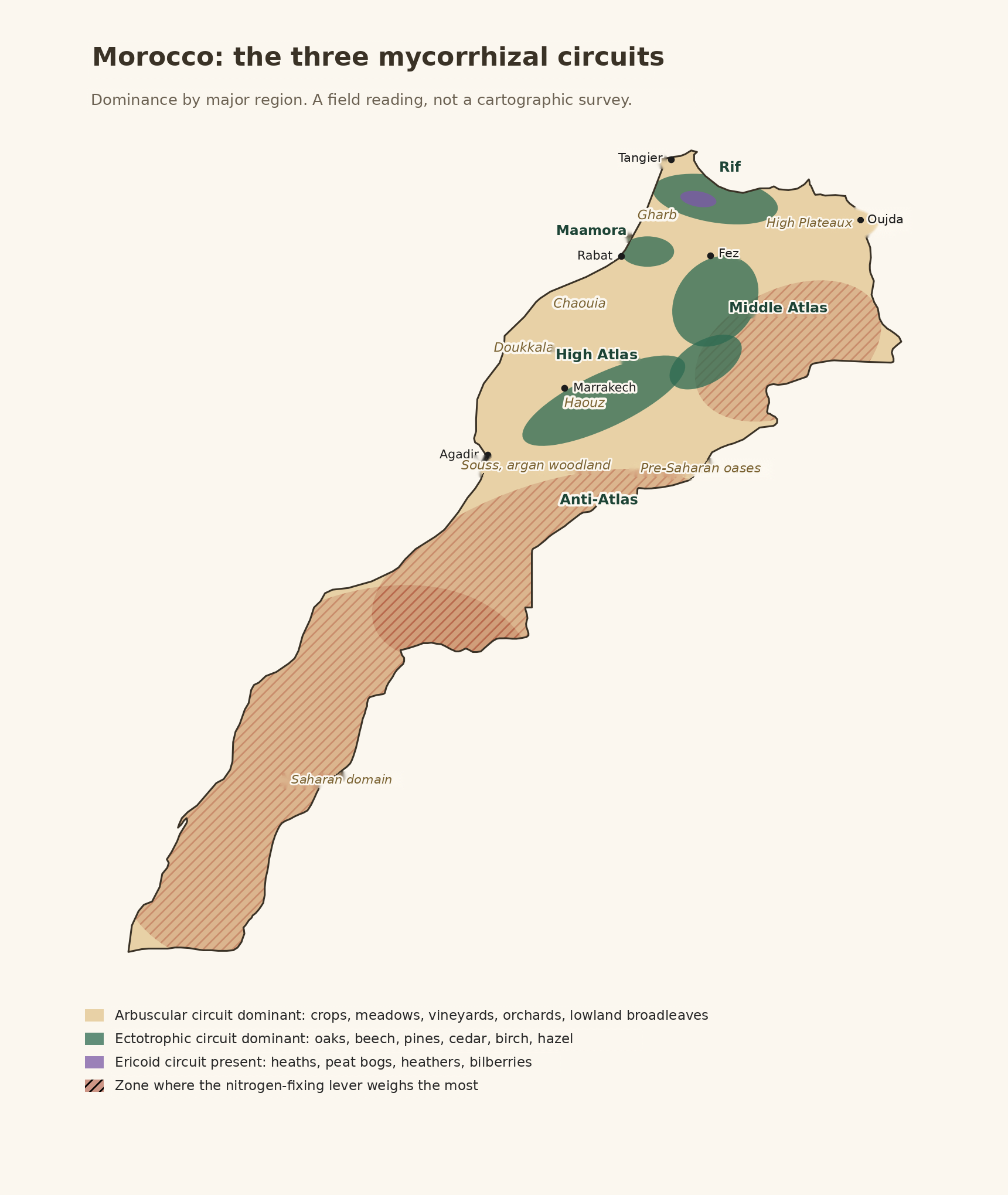
Morocco. Same colours, plus a hatched pattern: where nitrogen fixation weighs the most. The ectotrophic circuit shrinks to a ribbon, Rif, Maamora, Middle and High Atlas. Everything else belongs to the arbuscular circuit and the fixers.
Placed side by side, the two maps say the essentials in a second. I drew them on the outlines of the Natural Earth database, with no administrative boundary added, and the zones of dominance are a field reading, not a cartographic survey. France is an agricultural background pierced by massifs. Morocco is an arid background edged with a forest border. This contrast of proportions is worth all the speeches on adapting planting palettes.
One last result deserves to be set down here, because it governs the choice of species for the decades ahead. By comparing more than four hundred tree genera worldwide, Rog and his co-authors showed in 2025 that species with a double subscription occupy a wider geographical and climatic range than strictly arbuscular and strictly ectotrophic ones. This holds regardless of their relatedness, with a marked advantage towards dry climates. They are the ones that cross borders best.
A clarification is needed before transposing, because the result is measured on dry conditions and our winters will not be dry. In our latitudes, what must be remembered is not aridity, it is amplitude. Winter waters and drowns, summer dries, and these two extremes drive out the ectotrophic circuit for the same underlying reason: it needs an aerated soil, which excess water denies it as much as drying out does. The plant with a double subscription therefore keeps an option open at both ends of the year, on the waterlogged soil of February as on the baked soil of August. That is what makes it a serious candidate for a shifting climate, and not the fact that it would tolerate drought.
So the north and the south are not two worlds. They are two ways of being poor, and two ways of buying what is lacking.
The soil remembers, and it does not remember everything
We readily picture the soil as a fixed stage on which vegetation parades. It is the reverse. The soil is largely the product of what grows on it, it records every switch, and it keeps some of them for good.
The most complete demonstration appeared in 2025 in Science Advances. A sediment core taken from Lake Lama, in central Siberia, at the foot of a basalt plateau, covers twenty-three thousand years. The authors sequenced the ancient DNA of everything deposited in it, plants, fungi and bacteria together, checking on the reads the chemical alterations that prove they are ancient and not modern. It is the first time the making of a soil has been followed like a film, instead of being deduced by comparing soils of different ages.
The film tells a story of partners. In the Late Glacial, a tundra, lichens in abundance, a brutal weathering of the basalt by the acids they secrete, and bacteria busy oxidising the arsenic released by the rock. The carbon cycle is in command. Then the Holocene arrives, larch settles in, lichens retreat, mycorrhizas take over for a finer weathering, and it is the nitrogen cycle that is in command.
Then comes spruce, and the soil changes nature. Litter that is hard to digest, acidification, iron and aluminium migrating downwards, iron bacteria on the rise. The podzol forms, that leached soil, grey and acid at the top, rusty below, where the iron has gone down. When larch returns in the late Holocene, it does not find the soil it had left. It returns on a podzol, this time accompanied by bilberry, which was not there the first time.
The fungal detail is the most telling. The Suillineae, ectotrophic fungi associated with larch, appear with it at the start of the Holocene, disappear throughout the spruce phase, and return with the second larch. The Hyaloscypha, on the ericoid side, rise at the same time as bilberry. The partner follows the tree in the core, over millennia, exactly as it follows it in a planting pit.
The first lesson is encouraging. By analysing what explains the composition of underground communities, the authors find that vegetation weighs the most, temperature next, and that the time elapsed since deglaciation weighs almost nothing. A soil is therefore not old or young, it is inhabited or poorly inhabited. Change the cover and the community follows, which is precisely what we are trying to do on damaged ground.
The second is severe, and it pulls the other way. Podzolisation did not reverse when the vegetation changed. It went one way and did not come back. The same sequence, forest then heath then podzol, is the classic scenario of the acid soils of north-western Europe, and it sometimes produces an iron pan that nothing undoes. The soil follows the cover for everything biological, and no longer follows it for what has become chemical and mineral.
This memory is read in lake sediments, through pollen and ancient DNA, which is laboratory work. In herbaria, through nitrogen isotopes. Nitrogen exists in two versions of slightly different weight, and each transfer route leaves its own proportion in the leaf, like a fingerprint. The result is troubling: across four hundred and ninety-three samples from Minnesota collected between 1871 and 2016, the characteristic isotopic gap that separates the leaf of an ectotrophic tree from the leaf of an arbuscular tree has shrunk by more than half in a century and a half. The circuit’s signature is fading, which means that nitrogen transfer by the fungus no longer works as before. This signature is no anecdote: worldwide, it ranks plants in a clear order, non-mycorrhizal at the top, then arbuscular, ectotrophic, and ericoid at the very bottom. The authors also specify that the decline in nitrogen affects everyone, both circuits and the fungi themselves, and that it is not explained by the type of mycorrhiza. It is not a divergence, it is a general impoverishment.
Only one reading fits in a rucksack, and it is the one I practise. The soil keeps the record of its winters in its colour. Rust mottles on a grey background, a bluish-grey horizon at depth, and above all the depth at which these marks appear. In France this reading is standardised by order and legally binding, the ministerial guide to identifying wetland soils gives its classes. A soil auger, that hand-held screw that brings up a core of earth, one morning, and you know whether water has always stood there, since the works, or only in wet years. Almost nobody does it before drawing up a planting palette.
The climate switches fast, vegetation follows more slowly, and the soil keeps the trace of the previous regime for a long time. We never plant in the forecast climate, we plant in a soil that still belongs to the climate before.
The network carries water, and it has been measured
The network carries water, and this point long lacked direct evidence. We knew that mycorrhizal plants withstood drought better. We did not know whether the fungus really brought them water or acted by indirect routes, better nutrition, regulation of the stomata, those pores of the leaf, soil structure.
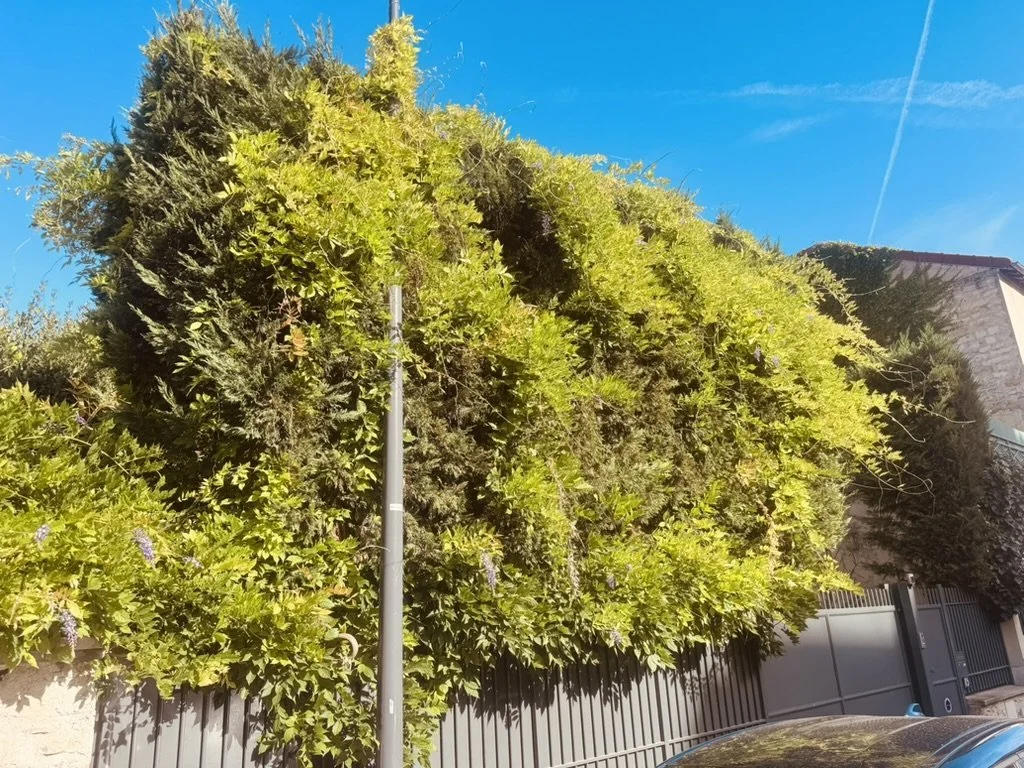
Meudon. A wisteria in flower in the middle of an August heatwave, along a street. A plant short of water gives up its flowers first. This one has not given up. Between two sealed soils, something is still watering it.
The demonstration came in 2022. Kakouridis and her team grew a wild oat in a two-compartment set-up separated by an air gap of three millimetres, impassable for roots, passable for hyphae. They then injected into the plant-free compartment water labelled with oxygen-18, together with a fluorescent dye unable to cross a cell membrane. The connected plants transpired nearly twice as much as the control plants, the labelled water turned up in their transpiration, and the dye was observed on the hyphae right into the roots. The fungus’s contribution was estimated at 34.6 per cent, plus or minus 10.5, of the transpired flow. Part of the transport therefore takes place outside the hyphal membrane, along the walls, driven by the pull of the leaves.
Let us be honest about the order of magnitude. Earlier comparable set-ups estimated the contribution at between 4 and 20 per cent, and a study using deuterated water published in 2020 concluded that the volumes were small compared with the plants’ demand. The authors of the 2022 study write themselves that their figure is probably at the high end of what happens in the field. What is established is that the transport exists, that it persists when the soil dries out, and that the hyphae cross air-filled gaps to maintain hydraulic continuity. What is not established is the figure.
The physical reason, on the other hand, is solid and worth remembering. Roots and root hairs work in pores a few tens of micrometres across, the ones that empty first when the soil dries. Hyphae, two to ten micrometres thick, enter pores of a few micrometres, the ones that stay full of water longest. The fungus does not go further, it goes finer.
For the practitioner, that is more than enough. These hyphae form in the soil a tangle of filaments invisible to the naked eye, the mycelium. A soil whose mycelium is intact puts the plant in touch with water its roots will never touch. A soil ploughed every year does not.
Winter drowns more often than it freezes
Everything above talks about drought. It is the reflex of the trade, and it is its blind spot. In our latitudes, what kills the network does not arrive in August. It arrives in November, and it lasts until April.
An ectotrophic fungus is an aerobic organism. Its useful part, the mycelium running through the soil far from the root, needs oxygen all the time. A week of water does not kill it. A whole season without air does. Surface frost, brief in our climates, costs it far less. Work on plants with a double subscription shows this indirectly: wherever the soil is waterlogged, in poplar, in willow, in swamp oak, colonisation switches to arbuscular, and it switches there too in soil that is too dry. The two extremes produce the same result for the same underlying reason, a soil that no longer breathes or water that is lacking.
Above ground, on the other hand, frost does more damage than ever, and it does it through what comes before it. A week at eighteen degrees in February deacclimates the tree, that is makes it lose the cold resistance it had gained, and sets its growth going. An ordinary minus three in March then destroys tissues that should never have come out. The number of frosts is falling and the plants’ exposure is rising, which is what I see on my own fruit trees. A season that no longer plays its role as a season, as in the soil, except that here it plays out in the buds.
The worst part is the calendar. Under an oceanic climate, the roots of broadleaved trees keep growing as long as the soil stays above five degrees, slowly it is true, and they only return to full speed above ten. A mild winter should therefore be a useful season underground. Waterlogging removes it. The dry summer removes the other one. That leaves spring and early autumn. In other words, warming does not shift the biological window upwards, it pinches it at both ends.
Compaction makes all the difference between a soil that drains slowly and a soil that suffocates. A soil packed down by site machinery and then saturated for six months becomes anoxic, that is deprived of oxygen. The arbuscular fungus takes waterlogging better than the ectotrophic one, but not without limit, and the fine root of the plane tree cannot stand six months without air. The network dies without anything showing at the surface. The tree declines three or five years later, and the heatwave of the previous summer is blamed. The two plane trees at the start of this article often part ways there, and not in August.
This also changes the choice of species, in a surprising way. A pedunculate oak copes very well with a sodden soil as a tree. Its ectotrophic partners, however, retreat. The tree can then switch partly to arbuscular, as do the red oak acorns sown at the foot of maples. This is not neutral: it loses access to the organic nitrogen that only the ectotrophic circuit can open. It survives, it no longer works the same way. On heavy land, the strictly arbuscular species loses less, since it never had the other circuit. The species with a double subscription loses the same thing as the oak, but it does not go through an unplugged phase, since its second circuit was already in service. It is this continuity that species tables never record.
So we learn to design winter aeration before summer watering, and not to plant in autumn on heavy land, which would condemn the young tree to spend its whole establishment phase in anoxia. The design chapter, in the second part, will draw the clauses from this. Go and look at the soil in February rather than in July: it is in February that it tells the truth.
The band of soil that decides everything
Start with two holes. A spade is enough, or the auger. Dig deeper than the root ball you intend to plant, and leave the hole open for a day. The first is dug in February, to see at what depth the water stands. If the day is dry, rust mottles on a grey background tell you just as well: they appear at the height the water rises to. The second is dug in May, one step from the first, which has been filled in meanwhile. It shows how far the soil has already dried, that is from what depth the earth stops moulding between your fingers. This reading holds on heavy land, and the two holes must be in the same texture.
What remains between the two is the band, and it governs everything else, well before the choice of species. Water at fifty centimetres in February, dry soil down to fifteen in May: the band runs from fifteen to fifty, it is thirty-five deep. It is read before drawing, and at least the February hole is dug again when the earthworks are handed over, because it is the soil as the site left it that will count.
Only one figure is useful here. The number of days on which the soil is dry gains twenty-four days a year by 2050, thirty-nine by 2100, which gives roughly one more month of drought in the north of the country and two in the south. At the same time, winter rainfall increases by fifteen to twenty per cent and summer rainfall falls by as much. The soil receives more water, and it lacks it for longer.
The important point is not that we have a wetter winter and a drier summer. It is that the two stresses follow each other, and that this sequence does more harm than either one alone.
Push your hand into a February soil on heavy land. The first twenty centimetres are cold and sodden, and that is where the mycelium is densest, even if part of its biomass lives much lower down. At the same moment, lift a mulch laid since autumn. The white felt that holds the twigs together and smells of the woodland floor is not the mycorrhizal network, which remains invisible, it is the decomposer fungi. But they are the signature of an aerated, moist and active soil, and it is in exactly that soil that the other works. Finding nothing under a mulch that has spent the winter is a bad sign for both. Come back in May, and the same layer is already dry and dusty. This layer, the most populated, is the one the year mistreats twice, and it is below it, in the spared band, that the network must be able to fall back. Winter destroys part of the network for lack of oxygen. Spring is the season when it should rebuild, since that is when root colonisation starts again. But if the surface dries from April instead of June, the rebuilding window no longer exists. The network is broken in February and never repaired.
That is why trees die of drought in soils that receive a lot of water over the year. Annual cumulative rainfall never meant anything, and it means even less today.
A planting is no longer designed against summer drought, it is designed around the band of soil that is neither drowned in February nor dry in May.
Everything falls in behind that. A mound on heavy land lifts the band above the winter water table. Decompaction recreates it where machinery had removed it. Living cover and mulch delay the drying of the surface and lengthen the spring rebuilding window. Light, permanent watering maintains the band instead of saturating it. No-till does not destroy it every year. And the choice of species is made on their ability to change trade when the band shifts, which puts species with a double subscription back in first place, not for their liking of drought but for their flexibility.
Two common pieces of advice become wrong along the way. Watering more in summer answers the wrong season, since the damage happened in February and the repair failed in April. And draining without doing anything else moves the problem, because a drained soil drives water out, dries earlier in spring and shortens the window still further. A mound does something else: it does not drive the water out, it puts the root above it. It is not the water that must be removed, it is the air that must be kept.
It remains to reread the two holes from the start. If the band is forty centimetres deep, the site can carry a tree. If it is ten centimetres, it will have to be built. If it does not exist, no species will save the planting and the earthworks must be redone before talking about a planting palette.
To be continued
So much for the soil we find. The second part will talk about what we bring to it, the water we pour and the nitrogen nobody decided on. It will say why the network is a market and not a cooperative. It will also talk about what works within it without showing itself, the bacteria the fungus carries along its hyphae. And it will end with what a designer does with all this, down to the garden plan.
Until then, only one thing to do. Note two holes in your diary, one in February, the other in May, one step from the first.
Short glossary
Words that deserve an explanation, in alphabetical order. Some also appear in the glossary of the other part, so that each can be read on its own.
Aerobic. Said of an organism that needs oxygen to live. Mycorrhizal fungi are aerobic. A waterlogged soil suffocates them, the ectotrophic ones first.
Ancient DNA. Fragments of DNA preserved in sediments or ancient remains, which can now be read to find out which living things were there thousands of years ago.
Anoxia, anoxic. Absence of oxygen. An anoxic soil is one from which air has been driven out by water, often because it is compacted and saturated.
Arbuscular (mycorrhiza). The most widespread association between roots and fungi, that of seven plant species out of ten. The fungus enters the cells of the root and is never visible to the naked eye. It is the circuit of almost the whole vegetable garden, of fruit trees, the vine, the olive, the plane tree.
Arbuscule. A small tree-like structure the fungus forms inside a root cell. It is the trading post where exchanges take place, sugars and lipids from the plant against water and minerals from the fungus.
Arbutoid (mycorrhiza). The association of the strawberry tree, bearberry and a few relatives. It is made with the ectomycorrhizal fungi of neighbouring trees, and the fungus partly enters the cells of the root.
Biochar. Plant charcoal obtained by heating wood or plant residues with almost no air. Porous, it shelters soil fungi and bacteria, provided it has been charged before being buried.
Biofumigation. A technique that consists of chopping and burying brassicas, mustard or radish, so that the pungent compounds they release hold back certain soil pests and diseases.
Biomass. The total mass of living matter of a group of organisms, for example of all the fungi in a soil.
Biome. A large group of environments with the same climate and vegetation on a global scale, boreal forest, savannah, desert.
Brassicas. The family of cabbages, turnip, radish, rocket, mustard and oilseed rape, now called Brassicaceae. Most do not form mycorrhizas.
Charge (a biochar). To let biochar fill with water, nutrients and life before burying it. Raw biochar, buried dry, starts by taking from the soil what it is expected to give.
Colonisation (mycorrhizal). The share of root length actually occupied by the fungus. It is measured under the microscope, after staining the roots.
Compaction. Crushing of the soil by machinery or repeated passages. Its pores close, and air and water no longer circulate.
Cortex (of the root). The layer of cells beneath the skin of the root, between the surface and the conducting core. That is where the fungi work.
Cover crop, plant cover. Plants sown or left to cover the soil between two crops or at the foot of trees. A catch cover occupies the soil, often in winter, between two crops.
Cultivar. A cultivated variety, selected by people.
Decomposer fungi. Fungi that live on dead matter, leaves, wood, mulch. Specialists call them saprotrophs. They are mostly the ones that form the white felt visible under a mulch. The arbuscular network itself remains invisible.
Decompaction. Work that loosens a soil compacted by machinery in depth, to bring air back into it.
Deacclimate. For a plant, to lose the cold resistance it had gained in autumn, often during a mild spell.
Deuterium, deuterated water. Water in which part of the hydrogen is replaced by a heavier form, deuterium. It is used as a tracer to follow the path of water.
Direct drilling. Sowing without ploughing or tillage, directly into the residues of the previous crop or cover.
Double subscription. The author’s expression for plants able to carry both arbuscular mycorrhiza and ectomycorrhiza, such as willow, poplar, alder or ash. Researchers speak of dual mycorrhization.
Ectomycorrhiza, ectotrophic mycorrhiza. An association in which the fungus wraps the tips of the roots in a sheath and works its way between the cells without entering them. It is the circuit of most trees of temperate and boreal forests, oak, beech, pine, and that of the mushrooms people gather, cep, chanterelle, truffle.
Establishment phase. The first years after planting, during which the tree sets up its roots and its network. It is generally counted as three years.
Ericoid (mycorrhiza). An association peculiar to heathers, ling, bilberries and rhododendrons. Its fungi can draw nitrogen from acid, poorly decomposed organic matter, which other mycorrhizas exploit poorly.
Fertilisation. All the inputs of fertilisers or soil improvers made to a crop. A fertilisation plan sets the quantities.
Fine roots, mass of fine roots. All the finest roots of a plant, the ones that explore the soil and absorb.
Frankia. A filamentous bacterium that fixes nitrogen from the air in the nodules of alder and some other trees and shrubs that are not legumes.
Generalists (fungi). Fungi that are not demanding about their partner and tolerate disturbance, compaction, heat, salt. They are the ones that dominate under street trees.
Glomeromycetes. The group of fungi that forms arbuscular mycorrhiza. They bear no fruiting bodies and live only in association with a root.
Glucosinolates. Sulphur compounds found mainly in brassicas, but also in nasturtium or papaya. As they break down, they release isothiocyanates, the bite in mustard and horseradish.
Goosefoots. The family of beetroot, spinach, chard and quinoa, now classed among the Amaranthaceae. Most do not form mycorrhizas.
Heavy land. Soil rich in clay or fine silt, which holds water and compacts easily.
Holocene. The present geological period, which began about eleven thousand seven hundred years ago, at the end of the last glaciation.
Horizon (soil). A layer of soil that differs from its neighbours in colour, texture or structure, and that can be seen on the wall of a hole.
Host plant, non-host. A host plant can house a mycorrhizal fungus. A non-host, such as cabbage, cannot.
Humus. The organic matter of the soil transformed by living things, dark and stable. Several forms of humus are distinguished according to the activity of the soil.
Hypha. A microscopic filament that makes up the body of a fungus, two to ten thousandths of a millimetre thick.
Inoculation, inoculum. Inoculation is the deliberate addition of living organisms, fungi or bacteria, to the soil, to a plant or to a carrier such as biochar. The inoculum is what is added, a commercial product or soil taken from under a healthy plant.
Iron pan. A layer hardened by iron accumulated at depth in a podzol. Roots and water pass through it poorly.
Isothiocyanates. Pungent compounds released by brassicas when their tissues break down. They hinder the germination of fungal spores.
Isotope. A version of the same chemical element that differs only in its weight. Nitrogen thus exists in a light and a heavy version, and their proportion in a leaf keeps a trace of the path the nitrogen has taken.
Late Glacial. The end of the last glaciation, between about fifteen thousand and eleven thousand seven hundred years before today.
Legumes. The family of pea, bean, broad bean, clover, lucerne, vetch and false acacia. Most house in their nodules bacteria that fix nitrogen from the air.
Litter. The layer of dead leaves, needles and plant debris that covers the soil, especially in forest.
Long fallow (disorder). A disorder of a crop that remains stunted and deficient after a long period without a host plant, although the soil is properly supplied. The fungal network has died out during the fallow.
Main limbs. The large branches that leave the trunk and carry the crown of a tree. Underground, one also speaks of structural roots, the large roots that anchor the tree.
Meta-analysis. A statistical synthesis of all the published trials on a question, when they lend themselves to comparison. It gives a more solid order of magnitude than a single trial.
Mineralise. To break down organic matter into simple elements, nitrogen, phosphorus, that the root can absorb.
Mixotrophy, mixotrophic. Said of a green plant that makes part of its sugar and takes the rest from the fungal network.
Mound. A slight hump of earth on which one plants in heavy soil, to put the roots above the winter water.
Mulch. A layer of organic matter, wood chips, leaves, straw, spread on the soil surface to cover and protect it.
Mycelium. All the filaments of a fungus, a tangle that runs through the soil. That of arbuscular fungi is invisible to the naked eye.
Mycorrhiza. An association between a root and a soil fungus. The plant gives sugars, and lipids in the arbuscular case. The fungus brings back water and minerals it fetches from where the root does not go.
Mycorrhizal inoculum potential. The capacity of a soil to colonise the roots of a test plant, in other words the quantity of fungi still able to start again.
Nitrate. A soluble form of nitrogen that plants absorb directly. It is one of the forms of nitrogen fertilisers, and the one found in groundwater.
Nitrogen fixation. The ability of certain bacteria to capture nitrogen from the air and turn it into ammonia, which the host plant uses. In legumes and alder, they do it in root nodules.
Nodule. An outgrowth of the roots that houses nitrogen-fixing bacteria. A small ball in legumes, a coral-shaped cluster in alder. Nodulation is the formation of these nodules.
Orchid (mycorrhiza). An association in which the fungus feeds the orchid seed, which has no reserves, during germination. Without it, the seed does not germinate.
Phylogeny. A family tree of species, reconstructed from their DNA.
Podzol, podzolisation. A leached soil, grey and acid at the surface, rusty below where the iron has gone down. Podzolisation, which forms it, is very slow and cannot be undone.
Propagules. Everything that allows the fungus to start again, spores, fragments of filaments and pieces of root already colonised.
Proteoid roots. Clusters of rootlets packed together like a brush, formed by white lupin or the proteas to release phosphorus from the soil without the help of a fungus.
Relay plant. A host plant left in place between two crops, clover, lucerne, a grass, so that the fungal network does not die out for lack of a living root.
Rhizobium. A soil bacterium that settles in the nodules of legumes and fixes nitrogen from the air there.
Root hairs. Microscopic outgrowths of the skin of young roots, which multiply their contact surface with the soil.
Rootlets. Small fine roots that come from the main roots.
Rust mottles. Orange or red marks on a grey background in a soil, left by iron when water stagnates and then withdraws. They show how high the water rises in winter, even on a dry day.
Soil auger. A large hand-held screw driven into the soil to bring up a core of earth and read its layers.
Soluble phosphorus. The phosphorus in fertilisers that dissolves at once in the soil water. Served in abundance, it frees the plant from feeding its fungus, which it sends away.
Spore. A reproductive cell of a fungus, which can wait in the soil before germinating on contact with a root.
Stomata. Small openings in the leaf through which carbon dioxide enters and water vapour leaves.
Symbiosis, symbiont. A lasting association between two different living things, in which each one gets something out of it. Symbionts are the partners in this association.
Texture (soil). The proportion of sand, silt and clay in a soil. It governs how it holds water and air.
Transpiration. Water the plant loses through its leaves and replaces by drawing from the soil.
Vascular plants. Plants that have vessels to conduct sap, ferns, conifers and flowering plants. Mosses are not among them.
Waterlogging. The state of a soil whose pores are all full of water, so that air no longer circulates.
Weathering. The slow transformation of rocks and soil minerals by water, air and living things. An old soil is a highly weathered soil.
Drain off (of a soil). For a soil, to get rid of its excess water after heavy rain.
Further reading
Brundrett M. and Tedersoo L., 2018, New Phytologist 220: 1108-1115, global distribution of mycorrhizal types.
Steidinger B. et al., 2019, Nature 569: 404-408, climatic control of decomposition and global biogeography of forest symbioses.
Teste F., Jones M. and Dickie I., 2019, New Phytologist 225: 1835-1851, dual-mycorrhizal plants, census, ecology and switching between circuits.
Rog I., Lerner D., Bender S. and van der Heijden M., 2025, Ecology Letters 28: e70132, wider environmental range of dual-mycorrhizal woody plants.
Read D. and Perez-Moreno J., 2003, New Phytologist 157: 475-492, mycorrhizas and nutrient cycling across ecosystems.
Von Hippel B. et al., 2025, Science Advances 11: eadj5527, palaeometagenomics of Lake Lama, weathering, cycles and podzolisation over twenty-three thousand years.
Michaud T. et al., 2024, New Phytologist 242: 1717-1724, Minnesota herbaria 1871-2016, decline in nitrogen status and fading of the ectotrophic signature.
Chen Q. et al., 2025, Journal of Ecology 113: 1150-1163, mycorrhizal status controls foliar δ15N worldwide.
Guide d’identification et de délimitation des sols des zones humides, French ministry for ecology, April 2013, reading redoximorphic features and hydromorphy classes.
Météo-France, DRIAS and DRIAS-Eau portals, projections of seasonal rainfall, river flows and dry soil days for 2050 and 2100.
Bowles T. et al., 2017, Journal of Applied Ecology 54: 1785-1793, meta-analysis of tillage and cover crops, 54 trials.
Njeru E. et al., 2014, Agronomy for Sustainable Development 34, effect of cover crops on mycorrhization of the following crop.
Shamshitov A. et al., 2026, Mycorrhiza 36: 42, white mustard, tillage and colonisation.
Schreiner R. and Koide R., 1993, New Phytologist 123: 107-113, mustards, mustard oils and mycorrhizas, and 123: 99-105, antifungal compounds of roots.
Vierheilig H. et al., 2000, New Phytologist 146: 343-352, glucosinolates and mycorrhizal status, the limits of the isothiocyanate explanation.
Isobe K. et al., 2014, Plant Production Science 17: 260-267, effect of winter cover on mycorrhization and yield of soya.
Higo M. et al., 2020, Scientific Reports 10: 6039, sequencing of maize mycorrhizal communities according to cover and tillage.
Dickie I., Koide R. and Fayish A., 2001, New Phytologist 151: 257-264, arbuscular colonisation of Quercus rubra seedlings, and Dickie I., Koide R. and Steiner K., 2002, Ecological Monographs 72: 505-521, influence of established trees.
Püschel D. et al., 2020, Mycorrhiza 30: 299-313, hyphal water transport measured with deuterated water, small contribution relative to demand.
Khalvati M. et al., 2005, Plant Biology 7: 706-712, and Ruth B. et al., 2011, Plant and Soil 342: 459-468, quantification of water uptake by hyphae.
Kakouridis A. et al., 2022, New Phytologist 236: 210-221, direct evidence of water transport by mycorrhizal fungi.
Boeraeve M., Honnay O. and Jacquemyn H., 2019, Science of the Total Environment 666: 703-712, black alder, a dual-mycorrhizal tree, its arbuscular and ectotrophic fungi.
Lodge D., 1989, Plant and Soil 117: 243-253, soil moisture and arbuscular or ectotrophic colonisation in poplar and willow.
Schenker G., Lenz A., Körner C. and Hoch G., 2014, Tree Physiology 34: 302-313, minimum temperatures for root growth in seven European broadleaved trees.
Sosa-Hernández M. et al., 2019, Frontiers in Microbiology 10: 744, subsoil arbuscular fungi, biomass and communities at depth.
Koziol L., McKenna T. and Bever J., 2025, New Phytologist 246: 821-827, meta-analysis of commercial inoculants.
Yves Nicolas, Expert Consultant in Functional Ecology, yvesnicolas.com