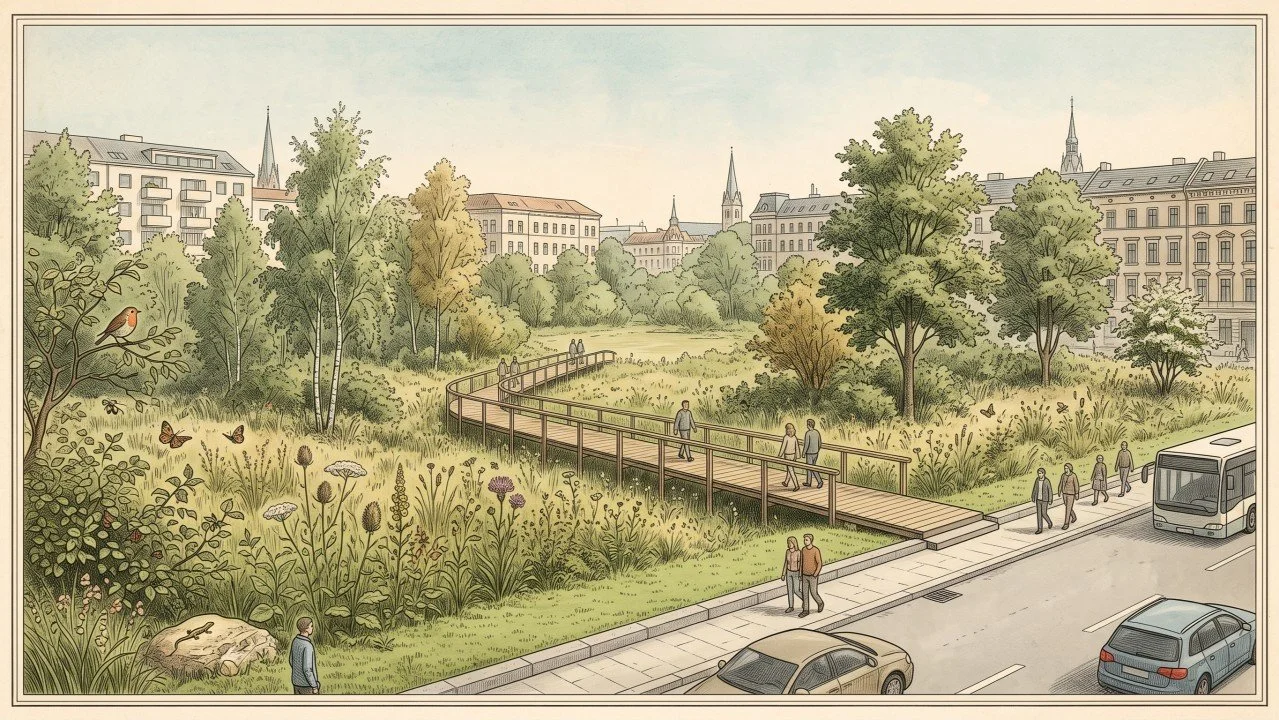
What if we started rethinking how cities are laid out? Wild spaces in the city, with no showpiece and almost no maintenance
Third instalment of the Pacts series, after “The soil pacts” and “The air pact”, in three episodes. “Oasis” newsletter. Yves Nicolas, functional ecology consultant, yvesnicolas.com.
The essentials for decision-makers
You manage hectares of green space that cost a lot and give back little. This article proposes handing part of them over to nature, not by abandoning it, but by giving it a direction once, and giving it well.
Leaving free does not mean abandoning. It is the opposite. You choose the site and protect the soil from all trampling, so that the pacts that keep it alive, between roots, fungi and bacteria, can form and last. You plant the framework: the trees and shrubs of the main grid, nitrogen fixers first, chosen consistently with the soil and the water available on the spot. Then you fill the gaps with well-chosen sowings, perennials, ground covers, small shrubs, the most beautiful local flowers, also selected for what they offer the eye. You draw a clean edge, a boardwalk, a few clearings. Then you step back, and nature evolves within this frame at its own pace. It will not necessarily follow the direction you gave it: it will keep some of our species, drop others, and bring in some nobody had planned. That is intended. The design gives a starting direction, nature then chooses its own, and its own is the one that will last. All the work lies in this initial design: it is what then allows you to do almost nothing.
The principle is not new. It is the one Francis Hallé set out for his 70,000-hectare primary forest: core zones where no one sets foot, transition zones where people live and visitors are received, and a legible boundary between the two. Here it is applied to the city, with three rules and a single intervention, and you can start small: a 400 m² module at the foot of a building or on a parking bay, repeated in clusters near homes, before the hectare.
A clean frame. You mark the boundary neatly, with a mown edge, a border, a sign, a marked entrance. The public accepts wildness when it sees that someone is looking after it. This has been established since Nassauer in 1995 and confirmed in France by the 2021 survey of the Observatoire des villes vertes: 79% of French people see value in spontaneous vegetation, but 66% want it to be managed and 41% still see it as a sign of neglect.
Nobody on the soil. People move along wooden boardwalks on piles. Compaction, by machinery as by repeated trampling, reduces soil infiltration by 70 to 99%; in a park in Brno, a single informal path halved the earthworm population. A boardwalk in local oak or black locust costs in the order of 250 to 650 euros per linear metre excluding tax on recent French projects, for twenty years or more without treatment.
Clearings to rest in. A few open rooms, mown once a year, where people can sit, play and picnic. They offer the edge, the richest habitat, and act as firebreaks in the south of France.
A single intervention inside the frame. Removing invasive species, two passes a year, by hand and at the right stage, in a mulch of ramial chipped wood that makes pulling easy.
One application of wood chips every year. It is the only input the site receives, and it matters a great deal: it feeds the soil fungi, keeps the ground covered and loose, it is the only guarantee of having fewer weeds, and it is what makes pulling easy. Ramial chipped wood preferably, but any chipped prunings from the municipality will do, a resource that is currently paid for to be carted away.
Results within a term of office. Decision-makers are elected for a short time and want results their constituents can see quickly. This is built in: the planted framework gives the site its shape from day one, the sowings flower in the first year, by the second year the space is in bloom, and in the third year the irrigation is switched off. The result is visible well before the end of the term.
What it costs and what it returns. In Rennes, cost accounting gives 2,800 hours per hectare per year for a highly flowered garden, 800 for an amenity garden, 90 for a nature area. The ratio is one to thirty. A mown meadow takes three times less time than a mown lawn (Plante & Cité 2019). Wastelands host, in most cases, more species than other urban green spaces (Bonthoux et al. 2014); in Marseille, a 7,900 m² wasteland opened to the public in 2023 already has 51 recorded plant species. The plan of this episode. Chapter 1 sets the showpiece against the wasteland. Chapter 2 explains why the showpiece is expensive, chapter 3 what wildness gives back. Chapter 4 explains how a space is designed before being left free: plants, seeds, nitrogen fixers, ground covers and the public’s eye. Chapters 5, 6 and 7 give the three rules, chapter 8 the single intervention, chapter 9 the objections. Chapter 10 presents three cities that already do it, then takes a world tour of approaches, from the Chinese standard to the Miyawaki method. The second episode will assemble everything at two scales, a 400 m² module repeated as a grid and a typical hectare, with plant palettes, costs, the decision grid and specification clauses. The third episode, in “Water: Reality and Solutions”, will turn the park itself upside down: the sunken park, which stores water for the summer, regulates heavy rain, purifies street water, and what it can do for the clay under houses. Each figure carries its level of certainty: established, debated, hypothesis, or my own calculation when I made it.
1. Two plots, one city
In almost every city I pass through, there are two plots that face each other without looking at each other.
The first is a showpiece. You recognise it from afar: close-cropped lawn, watered at nightfall by sprinklers that leave puddles on the pavement, begonia beds replaced twice a year, edges cut to the line, tree bases scraped down to bare earth. It is tidy. It is also empty. Go there at noon in July and bend down: not an insect, not a seed sprouting, the soil as hard as tiles underfoot. This plot costs a lot every week and gives back nothing of what we expect from a living soil, neither water, nor coolness, nor wildlife.
The second is a wasteland. It grew behind a hoarding, on a former car park, along a railway line. Nobody waters it, nobody mows it, nobody sowed it. It manages on its own. You find great mullein and viper’s bugloss, wild carrot, sweet clover, mugwort, willows that came by themselves, a fig tree in the south. Come close in June: it is humming. A solitary bee digs its burrow in a corner of beaten earth, a grasshopper jumps ahead of your steps, the dew still lingers in the shade of the tall stems. Beneath it, the soil has not been compacted for years, and storm water disappears into it without leaving a puddle.
Between the two, people hesitate. The showpiece costs, but it reassures. The wasteland gives back, but it worries. The purpose of this article is to show that you can have the wasteland with the peace of mind of the showpiece, provided you design it before leaving it free, and that cities are already doing so.
The oldest proof I know of in France stands on a concrete plinth at the foot of Lille-Europe station. In the Parc Matisse, designed by Gilles Clément between 1990 and 1995 over eight hectares, a platform seven metres high carries a piece of land inaccessible to the public. It was named Derborence Island, after a Swiss valley where the forest grew back on its own after a landslide. For thirty years, nobody has gone up there. The plants growing on it came by wind and by birds. It is a wasteland in a shop window, framed by a well-kept park, and the city presents it as such: a perched island where nature does its work without us.
Established: the city of Lille describes the island as inaccessible and perched seven metres high. Hypothesis: the commonly cited area of 3,500 m² comes from secondary works, and I have found no published results from the biodiversity monitoring carried out there. So I stick to the principle, which is verified, and leave the figures to whoever publishes them.
There is another proof, at the other end of the scale, and it bears the name of a botanist I admire. Francis Hallé, the man of the canopy raft, founded an association in 2019 to bring a primary forest back to life in Western Europe: about 70,000 hectares in a single block, straddling a border, in the Franco-Belgian Ardennes or in the Northern Vosges and the Palatinate, left to evolve freely for several centuries, seven hundred years say some, eight hundred say others, the time it takes for a forest to become again what it was before us. Why 70,000 hectares? Because that is the area needed, the association replies, for Europe’s large forest fauna to live there with its predators, the wolf included. Hallé died on 31 December 2025, and the project goes on.
What interests me here is how he framed the question of the public. Will the forest be closed to humans? “Certainly not,” the association replies: no bell jar, but core zones under strict protection, with organic outlines, and around them transition zones where people will go on living, cutting wood and receiving visitors in very carefully managed nature tourism. Established for these principles, which are the association’s; the exact form of the access points remains to be drawn, and I do not attribute it to them.
That is the thesis of this article, give or take the scale. Hallé asks for 70,000 hectares and seven centuries for the primary forest; I ask for one hectare and twenty years for an urban wasteland. But the rule is the same: design first, then step back. A core where no one sets foot, an edge where people live, and between the two a boundary everyone can see. What Hallé does for the wolf, we can do for the ground beetle.
2. Why the showpiece is expensive
A showpiece is a system that has to be restarted constantly, because it is forbidden from doing by itself what a soil does naturally.
You mow, so the grass never flowers and never sets seed; you resow it. You water, so the roots stay near the surface and you have to water again. You weed the tree bases, so the bare soil compacts and crusts under the rain, and the water runs off instead of soaking in. You plant annuals, so you pull them out six months later. Each action calls for the next, like a clock that has to be wound every morning.
The French figures exist, and they are clear. The City of Rennes keeps cost accounts by management code, whose averages have been published by Plante & Cité. A highly flowered structured garden, known as code 1, requires on average 2,800 hours of work per hectare per year, with peaks at 4,600. A structured garden, code 2, requires 1,200. An amenity garden, code 3, the kind around buildings, 800. A rustic garden, code 4, 250. A nature garden, code 5, 90 hours, within a range of 70 to 200. The ratio between the most groomed showpiece and the nature area is one to thirty. And labour accounts, in these same accounts, for 80 to 99% of the maintenance cost. Established: the source is official and covers more than 1,300 sites. What it does not give is the hourly cost; each local authority will apply its own.
Plante & Cité’s national survey on irrigation, carried out in 2013 among 57 municipalities, put the average management cost of a green space at 1.85 euros per square metre per year, i.e. 18,500 euros per hectare, all uses combined, and irrigation alone at 0.18 euros per square metre per year. Irrigated areas consumed on average 2,500 m³ of water per hectare per year, 2,880 in the south. Established, but old: these values date from 2013 and need updating.
On mowing, Plante & Cité published in 2019 an observatory covering 219 sites monitored by 45 managers. The result picked up by the trade press is simple: a meadow takes three times less work than a mown lawn. A meadow mulched or mown without collection is managed in 0.2 to 0.5 minutes per square metre per year, i.e. 33 to 83 hours per hectare. Grass covers account for 15 to 25% of the total activity of a green space department, and finishing with strimmers and leaf blowers can absorb up to 60% of it on difficult sites. Established.
One cost remains that none of the institutional sources I consulted puts a proper figure on: replacing annual bedding, in euros per square metre per year. I will not invent it. Managers know it; let them set it beside the 90 hours of code 5.
Finally there is the cost that does not appear on invoices: compacted soil. A park lawn, trampled, machine-mown, watered on the surface, becomes a crust over the years. Water no longer enters, air no longer circulates, life becomes scarce. We come back to this in chapter 6, because it is the heart of the second rule.
3. What wildness gives back
In “The soil pacts”, I followed sugar from the leaf to the fungus and nitrate from the fungus to the leaf. In “The air pact”, I followed water from the root to the cloud and back. This third instalment is where the two pacts meet: a soil that is neither compacted nor scraped is the only place in the city where they can hold.
Water gets in. This is the first service, and the most measured. On urban soils in Florida, Gregory and colleagues measured in 2006 infiltration rates of 377 to 634 mm per hour under uncompacted natural forest, and 8 to 175 mm per hour once the soil was compacted. Compaction reduced infiltration by 70 to 99%. A compacted soil, they write, behaves almost like an impervious surface. Established for the principle; debated for the absolute values, since Florida sands are not our loams. In North Carolina, Bergeson and colleagues found in 2022 a ratio of one to fourteen between a forest soil with its litter and a dense residential soil. I recall the figure from the previous instalment: a bare soil loses in the order of 15 tonnes of earth per hectare per year, a covered soil less than one. The soil of a wasteland is covered all year round.
Soil cools, provided it has water. Apur measured in 2017, in the laboratory, a lawn at 40 °C on the surface after eight hours of simulated sunshine, against more than 60 °C for asphalt, a difference of more than 20 °C. Armson and colleagues, in Manchester in 2012, found that grass reduces surface temperature by up to 24 °C compared with concrete, but has little effect on the temperature felt by a pedestrian, unlike the shade of a tree. And Cerema showed in 2021 that when the soil lacks water, evapotranspiration falls by 50 to 80% and cooling collapses. Established, and it has to be put this way to elected officials: coolness is not in the plant, it is in the water the soil has kept. A compacted soil keeps nothing. Does a tall meadow cool more than a short lawn? A 2023 review reports it for one study, without figures. Hypothesis.
Dew. I am often asked what it amounts to. On a meadow in the Netherlands, Jacobs and colleagues measured in 2006 an average dew of 0.12 mm per night, and an annual total in the order of 37 mm, i.e. 4.5% of precipitation. In Vancouver, Richards found in 2005 0.10 mm per night on grass in rural areas against 0.07 in the city. It is little. Established, and not to be oversold. What is precious about dew is not the volume, it is the timing: it falls at dawn, on the leaf, when the plant needs it most, and it feeds the mosses and algae that cover the soil. That tall vegetation captures more than a short lawn, I observe on my hands every summer morning when I walk through tall grass, but I have found no measurement. Hypothesis.
Pollinators. Here the figures are numerous and converge. In Germany, Wastian and colleagues compared in 2016 lawns mown twelve times a year with meadows mown twice: 43 species of wild bees caught in all, and significantly higher richness under reduced mowing. In Saxony, Nuss and colleagues measured in 2021, on nine meadows mown at most three times a year and nine intensive lawns, an arthropod biomass of 1.26 to 4.51 grams per sample against 0.01 to 0.33. A meta-analysis by Proske, Lokatis and Rolff in 2022, covering 46 abundance datasets and 23 richness datasets, concludes that frequent mowing has a strong negative effect on many groups, the most affected being true bugs and hymenopterans. Established.
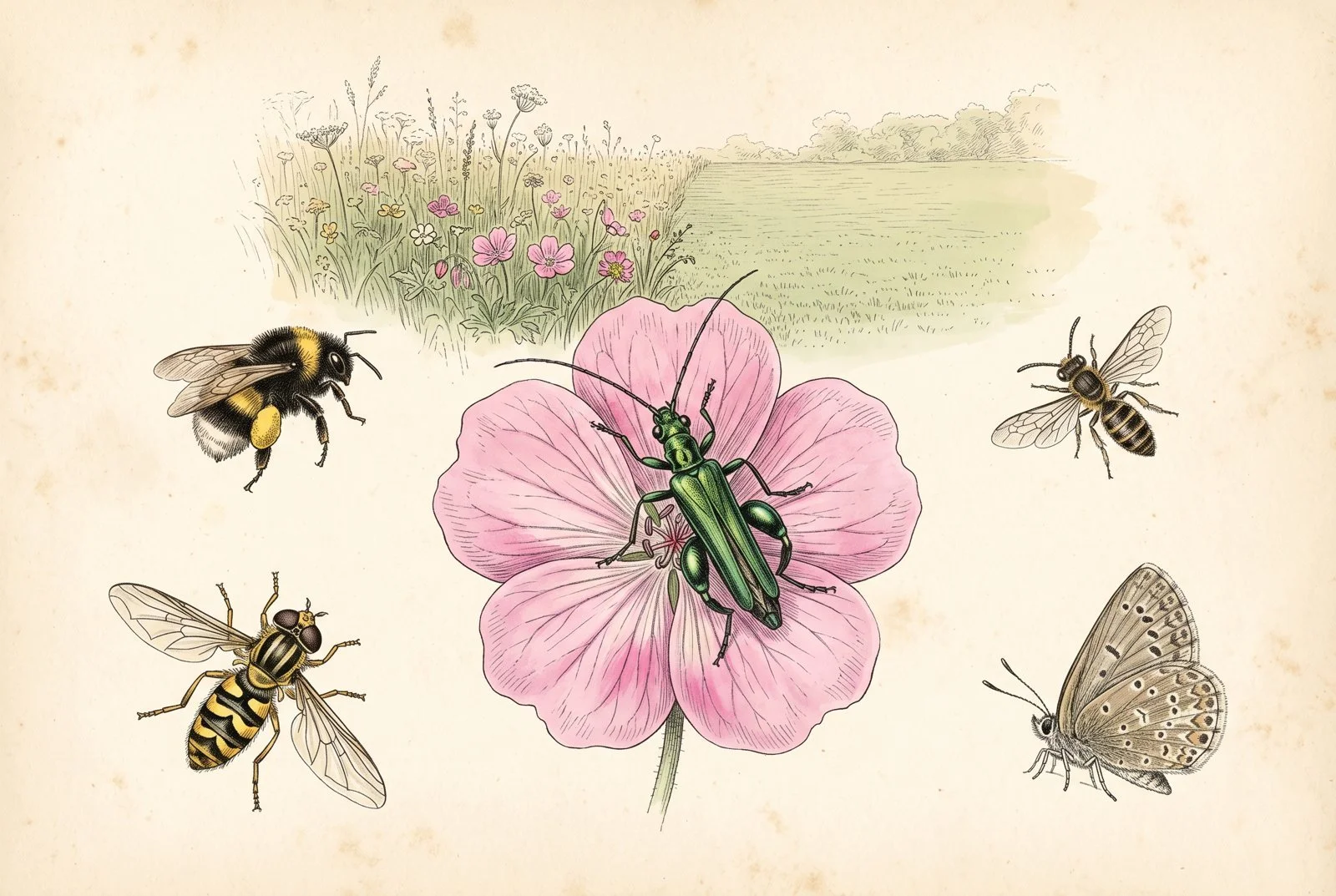
Thick-legged flower beetle, bumblebee, wild bee, hoverfly, butterfly: everything that lives off a flower that is not mown.
The seeds of clouds. In “The air pact”, I described how rain deposits millions of bacteria per square metre per day, and how the leaf sends some of them back to the sky. A wasteland is a far larger surface of living leaves than a short lawn, open to the wind, never washed by a treatment. I also recalled that the spores of mycorrhizal fungi travel little by air: the underground network is not to be expected from the sky, it has to be kept. And it is kept only by not compacting it. That is why the pacts hold together.
4. Designing before leaving free
A spontaneous wasteland takes years to form, and it forms with whatever passes by: the wind brings buddleia as readily as wild carrot. In the city, there is neither the time to wait nor the luxury of letting tree of heaven take over. So a direction has to be given. Once, at the start, and given well. This chapter is what makes the difference between a space left free and an abandoned plot.
But you have to understand what this direction is. It is not a plan that nature will have to carry out, it is a proposal made to it. The designer holds two parameters at once. The first is the direction he gives: the soil he protects, the species he plants and sows, the shape he draws. The second is the direction nature will take of its own accord, which he does not control. A good design is one that leaves this second parameter all the room it needs.
The direction starts with the soil. Before planting anything, you protect it: no machinery on the surface to be left free, no site storage, no stripping. Machines stay on the route of the future boardwalk, and the boardwalk goes in first. This is the condition for the soil pacts, between roots, fungi and bacteria, to form from the first season instead of having to repair a crushed soil. And it is the living soil that sets the pace. In a living soil, wild plants establish at incredible speed, because they find everything they need there, in a very balanced way: the water the structure retains, the nitrogen the pacts fix, the minerals the fungi go and fetch. This is an observation from my whole life in the field, and it is what justifies the promises of the timetable: protect the soil, and the vegetation will not keep you waiting.
Planting and sowing. The framework is planted. The trees and shrubs that shape the space, the main grid, arrive as plants, and this grid is not improvised: it is decided consistently, for the soil and the water available on the spot, and it is what carries the direction. It gives the site its shape from the first year, and this condition is not negotiable: no town hall will accept a vacant lot for five years while waiting for a sowing to agree to become a wood, and the decision-maker is elected for a short time: he legitimately needs a result his constituents can see before the end of the term. Seed comes next, to fill the gaps and prepare the next generations, and it does what no nursery plant can do. A tree sown in place has never known a pot: its taproot goes straight down, without the coil roots form when they circle against the wall of a container, and it learns the soil and the drought of the place from germination. These trees do not make today’s structure, they make tomorrow’s succession.
I must be honest on one point, because foresters know it. The review by Grossnickle and Ivetić in 2017 on direct seeding in reforestation recalls that on average only about twenty seeds out of a hundred produce an established seedling, and that in the first years the potted plant survives better and grows faster. Established. That is precisely why the framework is planted, and why you sow densely and at the right time, in autumn for most woody species. But what seed loses in numbers it gains in selection: the young trees that remain have been chosen by the place itself, and this is what I see in the field, where a well-placed seedling often catches up within a few years with the nursery plant set beside it. Hypothesis for the general rule, observation for what I have seen. And a seed costs a fraction of the price of a plant.
Sowing together. Above all, a seed does not grow alone. In the gaps between the plants, sow perennials, ground covers and a share of locally sourced tree and shrub seed together, and they grow up together: their roots cross in the same first few centimetres of soil, the soil fungi pass from one to the other, and what I described in “The soil pacts” forms from the first spring instead of having to be rebuilt around plants already formed elsewhere, in a nursery compost that has nothing to do with the soil they are planted in. A caveat, which I owe to my scientific readers: the idea of shared mycorrhizal networks through which trees exchange resources is now disputed, and Karst and colleagues showed in 2023 that many field results had been over-interpreted. Debated for exchanges between plants; what I assert is the observation that a mixed sowing establishes as a community, and does so better than plants set side by side.
The choice of seed matters as much as the mix. For wild trees and shrubs, the collective label Végétal local, created in 2015 by the national botanical conservatories, Réseau Haies France and Plante & Cité, and owned by the French Biodiversity Agency (OFB), guarantees plants and seeds collected from wild populations of the same biogeographical region, eleven in mainland France, with their genetic diversity. Established. It is the tool a local authority can write into a contract.
A space being born. There is a benefit elected officials underestimate. A planted bed arrives finished, and the public sees only one more showpiece. Here, the planted framework gives the shape from day one, and between its trees the space is born before the residents’ eyes. In the first year, a flush of young shoots among the perennial flowers; in the third, shrubs at a child’s height; in the tenth, a continuous wood between the planted trees. Schools can follow it from season to season, the entrance sign can date it, and the species count rising every year becomes the best answer to those who saw it as an abandoned plot. You are not showing people a garden, you are showing them a birth.

Poppy, cornflower, corncockle: the sown meadow flowers in its first year. The corncockle, which is toxic, stays in the core.
Nitrogen fixers first. Among the plants, I always include a few nitrogen fixers, chosen with care. They lead the way. Their roots host bacteria that draw nitrogen from the air, the ones whose story I told in my series on nitrogenase, and their fallen leaves enrich a soil that is often poor in the city. Their shade protects the young seedlings through the first summers: ecologists speak of nurse plants, and Padilla and Pugnaire showed in 2006 that the survival and growth of young plants are better at their feet in harsh environments, Mediterranean drylands first among them. Established for the nurse effect; what the fixed nitrogen adds on top depends on the site.
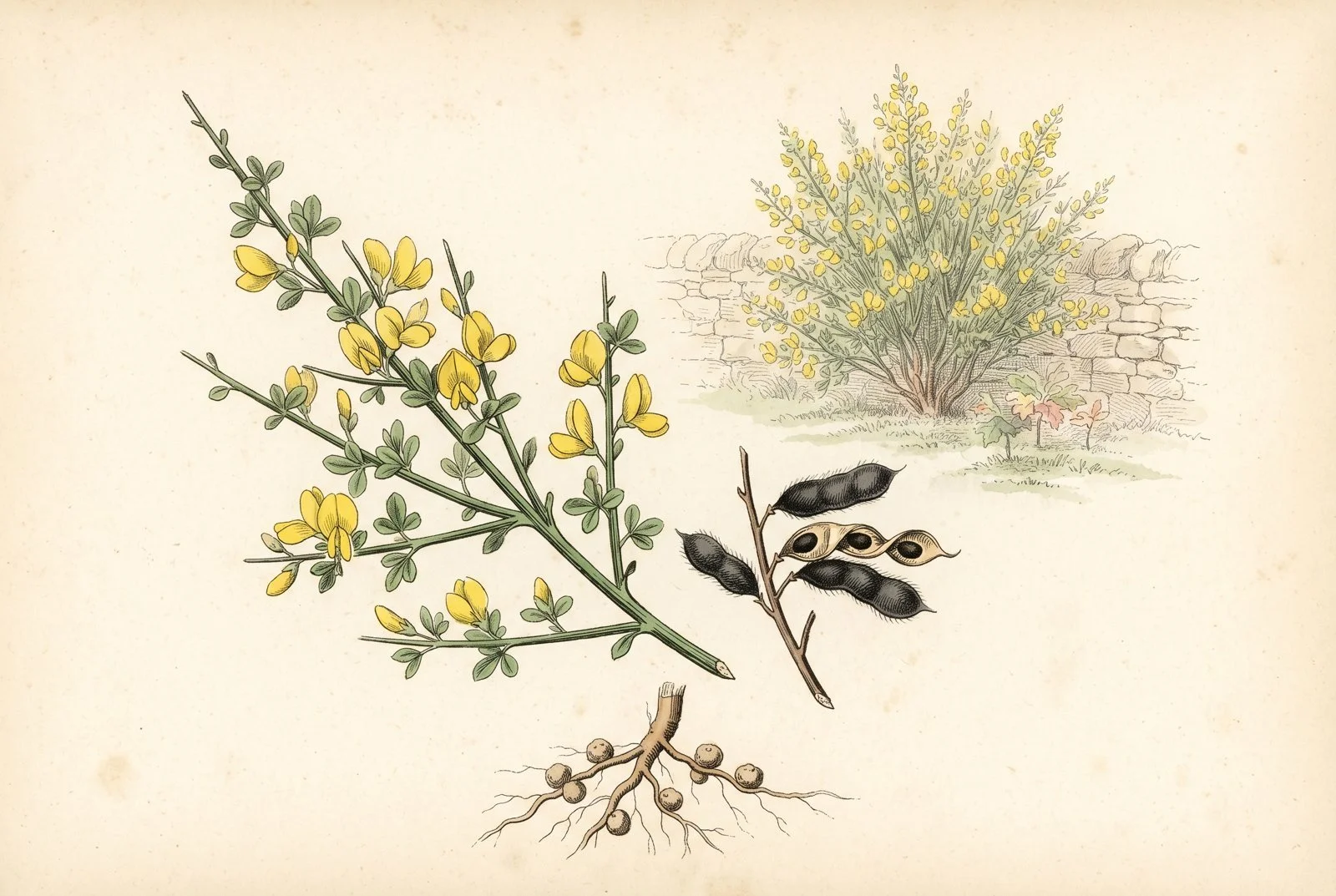
Common broom and the nodules on its roots, where bacteria fix nitrogen from the air.
The choice is not improvised. Black locust, Russian olive and mimosa fix nitrogen, but they are among the invasives fought in chapter 8, or escape from hedges in the south of France. I prefer native species, and I choose them by a criterion that is always forgotten: their lifespan.
Fixers that hand over. The best pioneers are the ones that do not stay. Common broom, which botanists class among the brooms of the genus Cytisus as Cytisus scoparius, gorse and Spanish broom live ten or fifteen years, then decline. In the meantime they have done their work: they have enriched the soil with nitrogen, covered the young seedlings with their light shade, and drawn bees by the thousand in spring. As they age they thin out, their dead branches fall and decompose on the spot, returning to the soil the nitrogen they drew from the air. And the light they let through goes back to the young oaks, maples and wild cherries that grew up in their shelter. Ecologists have a name for this mechanism: facilitation, one of the three drivers of succession described by Connell and Slatyer as early as 1977, in which a pioneer species prepares the ground for those that will replace it. Established for the principle; how much nitrogen each broom leaves to its successors depends on the soil, and I have not put a figure on it. Alder, sea buckthorn and bladder senna stay longer: they form the lasting framework, while the brooms are only the scaffolding.
So I compose the fixers in three generations, so that nitrogen reaches the soil without interruption while nature makes its choices. Herbaceous perennials first, which fix from the first season and retreat within a few years as the shade spreads: bird’s-foot trefoil, red clover, kidney vetch, sainfoin on calcareous soil, with sweet clover, a biennial, for the first flush. Then the pioneer shrubs, which last about ten years and fade away: common broom on acid soil, gorse on the Atlantic coast, Spanish broom and Genista scorpius on the dry, calcareous soils of the south. Finally the lasting companions: common alder on moist soil, sea buckthorn on poor or sandy soil, bladder senna and scorpion senna on dry soil, and laburnum on calcareous soil, in the core only, like all toxic plants. On laburnum I take a position against an official opinion: the Conservatoire botanique du Bassin parisien lists it, in the Île-de-France region, among horticultural plants not to be planted, because it escapes onto calcareous slopes. I keep it anyway, and I say why. It does not live very long, twenty to thirty years, and that is why it self-seeds easily: that is the behaviour of a pioneer, not an invader; it fixes nitrogen and does the soil good; its May racemes do insects good, bumblebees first; and it is no more toxic than yew or oleander, which are on the same list and which nobody thinks of banning. In the core, more than three metres from any path, it has its place, in Île-de-France as elsewhere. The table below brings them together.
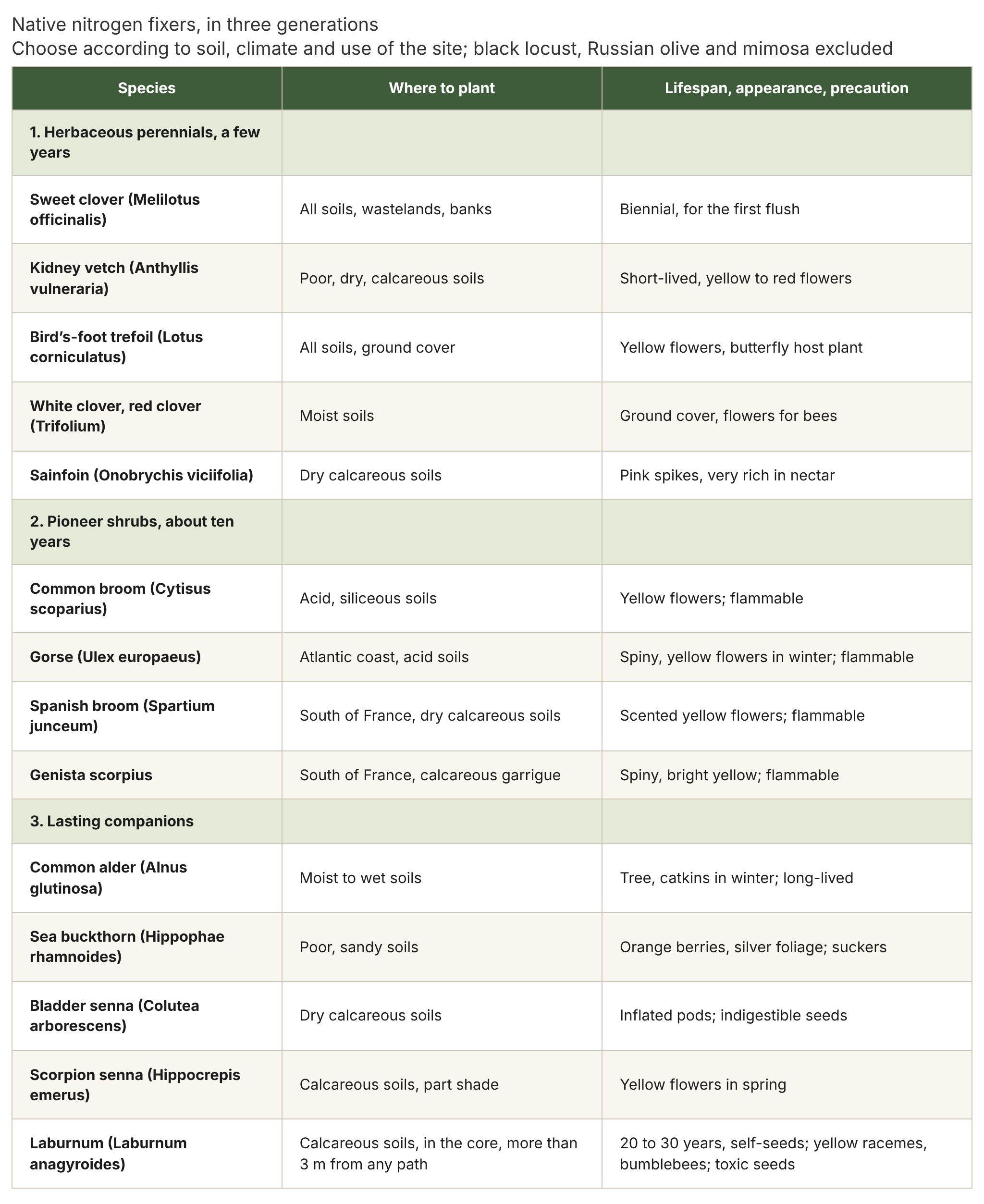

Bladder senna: it fixes nitrogen, holds on dry soil, and its pods pop under children's fingers.
Two precautions, which I do not write for form’s sake. The seeds of most woody legumes, brooms and bladder senna included, are indigestible and irritating if swallowed: they are kept away from paths, clearings and play areas. Laburnum seeds, for their part, are a real poison, no more and no less than yew or oleander: if laburnum is part of the mix, it is only in the core of the space, far from any path; I return to this below. And brooms and gorse burn well: in the south of France they are kept away from building façades and out of the firebreak strips of chapter 7. Sea buckthorn suckers vigorously on light soil; that is an asset on a bank that needs holding, something to watch elsewhere.
The public’s eye. Every choice, potted or seeded, also goes through the eye. This is not a concession: it is a condition of success. A space left free that local residents find ugly will be mown at the first council meeting; one they find beautiful, they will defend. Hoyle and colleagues found that a planting looks most attractive from 27% floral cover onwards, and the French Acceptaflore programme says the same thing: what people like are flowers and colour. We return to this in chapter 5.
So I choose species for what they do to the soil, but also for what they offer the eye throughout the year. The fixers lend themselves to this well: Spanish broom and scorpion senna cover the spring in yellow and scent, sea buckthorn carries orange berries on silver foliage, alder keeps its catkins all winter, and the inflated pods of bladder senna, which pop under the fingers, delight children. In the sowings, I mix with the tree seeds perennials that flower early and for a long time, viper’s bugloss, wild carrot, great mullein, mallow, so that in the first year, before the trees can be seen, the space is already in flower. This gives the public a reason to love the place even before it understands what is happening there.
Never bare soil. Between the plants and the sowings, the soil is never left uncovered. I cover it from the start with low plants sown at the same time as the trees. They keep moisture around the seeds, soften the July sun and the January frost, hold the soil in storms and hide the seeds from birds. But a badly chosen ground cover smothers what it was meant to protect. So I avoid invasives, the Hottentot fig of chapter 8, greater periwinkle which escapes from gardens, and ivy wherever seed is sown, because it smothers the seedlings, which I keep for shady corners where nothing is sown; and I choose low, light species that let the young shoot through. The best do three things at once: bird’s-foot trefoil and white clover cover the ground, fix nitrogen and flower for bees; wild thyme carpets the dry soils of the south and gives off its scent underfoot; bugle turns shady corners blue in spring. When the trees have grown, their shade will push back these light-loving plants, and the litter, together with the annual input of ramial chipped wood, will take over. Ground cover is not there to last, it is there to get through the first years.
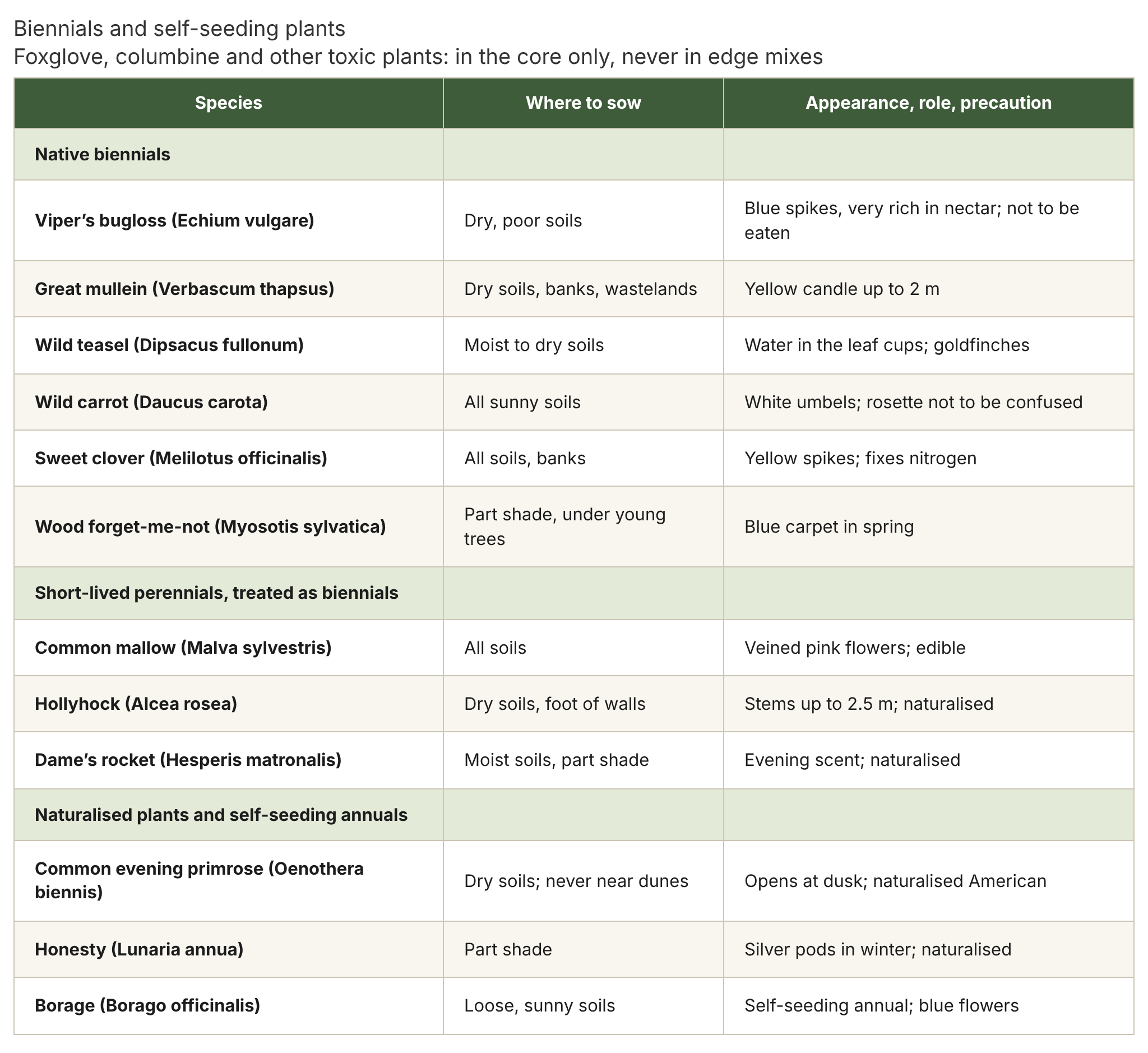
Biennials, the clocks of the place. Between the grass of one summer and the tree of a century, there is a family of plants that gardeners underestimate and that I love above all others: the biennials. Their life comes in two stages. In the first year they make only a rosette of leaves pressed against the ground, which covers the soil all winter like one more ground cover. In the second they bolt, flower, set seed and die. This cycle is uncommonly ingenious for a space left free. The rosette protects the soil in the season when it is most exposed. The flowering stem of the second year gives the public the height and colour it expects. And the death of the plant opens a gap of light where its own seeds, and those of others, will try their luck. Where the soil suits them, they return; where it does not, they give way. It is nature that chooses, every year, where they will flower the following year.
Some are sold as perennials, yet I treat them as biennials, because that is how they behave on a soil that is not fed: musk mallow, hollyhock and dame’s rocket flower for two or three years then wear themselves out, and last only through their seedlings. I add annuals that self-seed with the same constancy, such as borage, whose blue flowers draw bumblebees from spring until the frosts.
Each species has its own knack. Common evening primrose, Oenothera biennis, opens its yellow flowers at dusk, so fast you can watch them unfold within minutes, and hawk-moths come to feed on them at nightfall; it is an American plant naturalised in France since the 17th century, which I keep for dry soils and away from dunes, where it spreads. Wild teasel, Dipsacus fullonum, holds rainwater in the cup of its leaves joined around the stem, where insects drown, and its dry heads feed goldfinches all winter. Great mullein raises its yellow candle two metres high. Viper’s bugloss is covered in a blue that bees visit from morning to evening. Wild carrot spreads its lacy umbels, with at their centre a small purple flower whose purpose is still debated. Honesty, Lunaria annua, leaves its translucent silver pods through the winter. Wood forget-me-not turns the shade of young trees blue in spring. The table below gives the list.
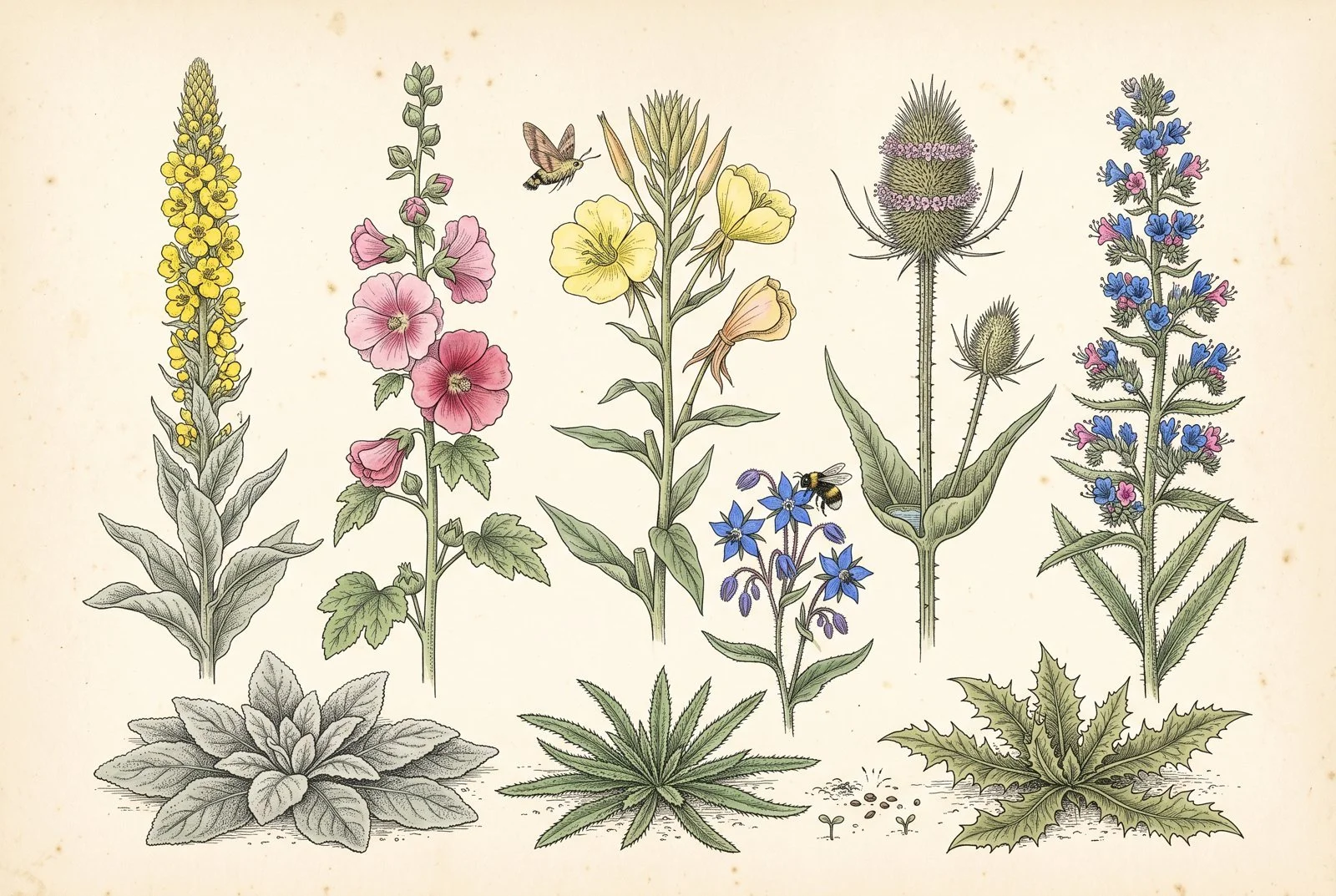
Biennials: a rosette in the first year, flowers and seeds in the second.
Posts for climbers. The design can also raise a few verticals. An oak or black locust post set in the wasteland, alone or in small groups, gives climbers what the trees will not offer them for twenty years: a support, straight away. Wisteria is superb on it, like the one covering the old wall of my garden in Meudon, and its mauve racemes in spring are in themselves a sign of care visible from the street. But it is an Asian plant of formidable vigour: it needs a post of its own, sturdy, at least twenty centimetres in diameter, never a tree it would end up strangling, and its pods are toxic, which puts it under the rule that follows. Beside it, native climbers have their place: hop, which climbs four or five metres every summer and dies back to the ground in winter, wild honeysuckle with its evening scent, field rose. The post performs a second service, well known to restoration ecologists: birds perch on it, and what they drop at its foot, seeds of wild cherry, hawthorn, elder and dogwood, is sown by nature. Holl measured it in 1998: perches clearly increase the seed rain at their foot. Established for the seed rain; debated for what follows, since not all these seeds germinate, as Holl also showed. At the foot of the post, then, you see the direction you gave mixing with the one nature chooses.
The post must not burden the budget, though. Oak and black locust are the most durable, but an untreated pine or fir post costs much less, and it has its place here. Set as it is in the ground, it will last only a few years; its life is extended by charring its base, as farmers used to do for their stakes, or by setting it on a metal foot that keeps it off the ground. And when it eventually rots, that will not be a failure: its wood will return to the soil, like that of the brooms, and the climbers will meanwhile have found other supports in the young trees. For hop, which dies back every winter, a pine post is more than enough. For wisteria, which is heavy and long-lived, I keep oak, black locust, or a large-diameter pine on a metal foot. Pressure-treated pine is also a reasonable option for posts. Today’s treatments have nothing to do with yesterday’s: since 2004, Europe has banned arsenic in treated wood intended for public uses, and current products rely on copper combined with organic fungicides, which are far less toxic. A pine post treated for ground contact lasts more than ten years for a modest price. Debated for the lifespans, which depend on soil and climate.
Toxic plants, away from paths. A space opened to schools and families must offer within reach no plant of which a few berries, seeds or leaves put in a child’s mouth are enough to endanger them. I never sow them in edge mixes, and I do not plant them where people pass. Wisteria, whose pods and seeds are toxic, therefore goes in the core of the space, away from paths. Foxglove, the biennial par excellence, is toxic in all its parts; columbine, so beautiful that one forgets it, is more modestly so, enough to be kept out of reach of hands; laburnum, yew, oleander, monkshood, autumn crocus, datura, castor oil plant and deadly nightshade are too. The references of the French poison control centres and the lists of toxic plants in France classify them this way; established. What matters, more than the list, is distance. Rule 2 helps here more than one might think: since nobody walks in the core of the space, a toxic plant there is a danger to nobody. The danger is at the edge, along the boardwalk, around the clearings, at the entrance, wherever a child’s hand can reach. So I keep a three-metre strip, beyond arm’s reach from the decking, where no toxic plant is tolerated, whether planted or arrived by itself. And because a space left free makes its own choices, the two annual passes on invasives also serve to pull out of this strip any that have arrived there. In the core, they are left to live their lives. Wild carrot calls for extra vigilance: its young rosette looks like those of poisonous umbellifers of the same family, such as Conium maculatum, which can find their way into a wasteland; the entrance sign says so, and nothing is picked.
Water in the first years. A space left free is not watered. But a space that has just been sown and planted is, until the roots go down. The whole art is to water without making a showpiece: no sprinklers, no surface water, no lazy roots that stay at the surface. I propose two methods, depending on the site and the budget, both buried.
The first is a grid of buried drip line, laid in fifty-centimetre squares before sowing, so that every seed and every plant has an emitter within root reach. The water arrives below the surface, nothing evaporates, nothing runs off, and the topsoil stays dry, which hinders the emergence of weeds without hindering seedlings that dive towards moisture. Subsurface drip irrigation is a proven agricultural technique that reduces evaporation losses; established.
The second is older than our pipes. These are ollas, porous terracotta jars buried up to the neck, which I choose large, fifty litres. The water passes slowly through the wall, and it is the soil itself that draws it out, at the rate at which the roots dry it: when the soil is moist, the jar gives almost nothing; when it dries, the jar empties. The roots come of their own accord to wrap around the cool wall. Bainbridge, who in 2001 brought together the known experience with these buried jars, counts them among the most water-efficient irrigation methods; established. I bury them completely, closed with a cork stopper that stops evaporation, leaves and mosquitoes, and I have them filled automatically, through a small network and a timer, at a fixed time, at night or at dawn, and always in advance, before the soil is thirsty. On a roundabout, where nobody should be crossing the road with a watering can, this is the solution I prefer.
In both cases, irrigation is scaffolding, like the brooms and the pine posts. It is set to force the roots downwards, by spacing out the waterings from the second year, and it is switched off at the end of the establishment phase. The network stays in the ground, ready to be used again in an exceptional drought on the most valuable plantings, but the space itself must learn to live on rain. Hypothesis for the exact irrigation period, which depends on climate and soil: three years as a rule, a little more in the south, sometimes less in the north.
Then step back, and let nature choose. Once the boardwalk is in, the plants established, the sowing done and the frame drawn, the design is finished. No more planting, no more sowing, the irrigation is switched off. Only the ramial chipped wood keeps arriving, every year. And above all, the choices of the place are not corrected. Of the twenty species sown, the soil may keep eight; sea buckthorn will thrive where alder was expected; an oak will come from an acorn hidden by a jay, a wild cherry from a stone dropped by a bird, and neither will have been sown. What has come up will self-seed, what has not will leave its place to what the wind and the birds bring. Missing plants are not replaced, gaps are not refilled: each failure says something about the soil, the water, the exposure, that the designer did not know. Ecological succession has always done this sorting, and it does it better than we do, because it tries everything and keeps only what holds.
The designer does not disappear for all that. He changes jobs: he stops directing and starts reading. The annual survey, the sign and the species count are there for that, to follow the direction nature has chosen and to learn from it what to sow elsewhere. The only remaining intervention is on invasives, because they are not a choice of the place but an accident of our trade. The starting direction is given; the final direction belongs to the place.
My garden in Meudon is not a wasteland, and I do not present it as one. What gives it its shape was planted: an old pear tree, a mirabelle plum, a maple and a second mirabelle at the foot of an old wall, a wisteria and a honeysuckle on that wall, a kiwi, and a summer bed of bananas, bamboos and perennials so dense that not a centimetre of bare soil can be seen. But for at least fifty years it has received no product of any kind, no fertiliser, no treatment, no purchased soil improver. The mirabelle, which has never been fed or watered, is laden with fruit every summer, and the kiwi produces, except in years of severe drought: this year it suffered badly and its fruits will stay very small. It taught me what I say later about the school playground: a kiwi without irrigation depends on the sky. The rest of the garden is in profusion. This is exactly the method of this chapter, at the scale of a plot: a shape given at the start, a soil never bare and never fed, then half a century of free evolution, during which the garden made its own choices. That is the most important point about this plot: a continuous observation over fifty years.
5. Rule 1, the frame: cues to care
In 1995, Joan Nassauer, landscape architect and researcher at the University of Michigan, published in Landscape Journal an article whose title says it all: “Messy Ecosystems, Orderly Frames”. Her thesis: the ecological value of a landscape is invisible to anyone not trained to read it, and it conflicts with a deep cultural preference for order. An ecological design will be neither appreciated nor maintained, she writes, unless it speaks a recognisable landscape language that shows human intention. She calls this language cues to care: a mown strip along the path, an edging, a low fence, a straight walk, a sign, a few showy flowers at the edge. A 2020 systematic review by Li and Nassauer identified 212 studies that have since tested and confirmed the principle. Established.
French surveys say the same thing with percentages. In May 2021, the Observatoire des villes vertes had YouGov survey 1,010 French people over 18. 79% see value in spontaneous vegetation in the city, 69% see it as good news for biodiversity, 55% would like it to be more visible. But 66% believe it should be managed by the local authority, and 41% say it gives a feeling of neglect. Established, in the sense of an opinion poll. Plante & Cité’s Acceptaflore programme, carried out with 420 people in seven municipalities, puts it differently: what people like are flowers and colour; what they dislike most is the lack of human intervention. Established.
That is the whole of rule 1. People do not reject wildness. They reject abandonment. And they tell the two apart by precise cues, which you only have to give them.
In practice, I propose four cues, and not one more. A two-metre mown edge all around, cut four to six times a year, which draws the shape of the space and says: this is intended. A low edging, wood or stone, or a one-metre open-slatted fence, which marks the boundary without hiding what lies behind it. A marked entrance, with the start of the boardwalk and a sign that names the place, explains what is done there and what is not, dates the birth of the space and lists the species seen this year. And a flowering strip at the edge, sown with showy local species, because the study by Hoyle, Hitchmough and Jorgensen, carried out in 2017 with 1,411 people, found that a planting is judged most attractive from 27% floral cover onwards, while green, restrained plantings are the most restful. Established in the United Kingdom; debated for transposition, but Acceptaflore points the same way.
What I do not propose: a showpiece inside. Once past the edge, things are left to happen. The frame is made to be seen from outside, like the frame of a painting.
And this painting has a property no flower bed will ever have: it repaints itself. In properties where I have left spaces free, I have seen multitudes of foxgloves appear one year, and in other places poppies, bellflowers, ox-eye daisies. Every year the scene moves, it lives, it is never fixed. The frame does not change, and that is its whole role: the edge stays clean, the sign stays in place, and the painting changes inside. Hence a little game I suggest to municipalities, which costs only a photograph. Every year, at the end of May or the beginning of June, the space is photographed from the same spot, and the year’s picture is displayed on the sign beside the previous year’s. Residents then see the painting evolve: one year’s foxgloves give way to the next year’s daisies, and nobody has touched anything. Every year it is a surprise.
6. Rule 2, never walk on the soil
This is the rule that annoys people, and it is the most important.
What a foot does. David Cole, of the US Forest Service, carried out the reference experiment in 1995: lanes 0.5 by 1.5 metres, walkers weighing 70 kilos in lug-soled boots, and 25 to 500 passes over eighteen vegetation types. The result is a factor of thirty. In the most resistant type, an alpine sedge turf, Carex nigricans, about 600 passes were needed to lose half the cover. In the most fragile, a forest understorey of the fern Dryopteris campyloptera, 25 passes were enough to fall to a third and 500 left only 2%. Established: it is the study everyone has drawn on since.
In urban forest in Helsinki, Hamberg and colleagues showed in 2010 that after only 35 passes the cover of the most abundant species fell by 10 to 30%, and by more than half after 70 to 270 passes. On 155 sites in the same city, Malmivaara-Lämsä and colleagues had found in 2008 an understorey cover half that of the reference areas, and wear that tracks the number of inhabitants around the wood. Established. In urban-fringe woods in England, Littlemore and Barker measured in 2001 that 500 passes in one season were enough to leave the soil more compact two years later, and to reduce the flowering of bluebell, Hyacinthoides non-scripta, to 4% of that of intact plots. Hypothesis for the values, a single study; but it says what every gardener knows: the soil remembers.
What a foot does to the soil itself. The only direct measurement in an urban park I have found is that of Pižl and Schlaghamerský, in Brno, in 2007. On three pairs of plots, intact lawn against informal footpath, earthworm density fell from 256 to 121 individuals per square metre, their biomass from 111 to 51 grams, and the density of enchytraeids, the small white worms that do the fine work on the litter, from 9,935 to 2,516. Hypothesis, in the sense that it is a single study on three pairs. But it is consistent with everything else: in oak forest, Shang and colleagues measured in 2024 a drop of 46 to 57% in bacterial markers and 36 to 61% in fungal markers under moderate to severe trampling, with soil density rising and porosity falling. Debated, because another study finds a peak in microbial diversity at low intensities before the decline. On porosity, Korkanç measured in 2014, in Turkey, surface porosity falling from 52 to 41% after 500 passes, and penetration resistance rising from 3.8 to 6.1 kilos per square centimetre. Hypothesis for the values, established for the direction.
And for water, I refer back to chapter 3: a compacted soil loses 70 to 99% of its infiltration capacity. In the paths studied by Nir and colleagues in 2022, the large pores had disappeared in the top three centimetres, water stood on the surface and ran off. It is the slow death of a soil: first the pores, then the air, then the worms, then the fungi, then the water that no longer gets in.
I sum it up for an elected official: a footpath in a wasteland is a strip of dead soil that widens every year, because people walk around the puddles. The review by Ballantyne and Pickering, covering 59 studies, finds the effects of a path measurable from one to twenty metres from its edge. Established. The only way not to kill the soil is not to touch it.
The boardwalk. Hence the second rule: people move along a wooden boardwalk on piles, and nowhere else. It is not a luxury, it is a common structure in French natural areas, and it has known prices.
At the Lac de Save, in the Isère département, the Department had about 220 linear metres of boardwalk on piles in local oak installed in 2018, 24 m³ of timber, with four benches, for 59,987 euros excluding tax, i.e. in the order of 270 euros per metre. In the Ain, on the sensitive natural area of the former Rhône meanders, 17 metres of oak decking on chestnut piles, with 25 metres of stabilised path, cost 11,145 euros excluding tax the same year; the metre comes out expensive on such a short length. At the Marais du Vigueirat, in the Camargue, 1,700 metres of trails, more than half of them raised decking in black locust and oak, had cost 355,000 euros in 2000. Debated: prices vary by a factor of two depending on length, height, guardrails and site access. As a working order of magnitude I retain 250 to 650 euros per linear metre excluding tax, at 2018 values, excluding design fees, to be updated.
For lifespan, the timber species decides everything. Black locust, Robinia pseudoacacia, with its sapwood removed, is classed as very durable; the French technical institute FCBA generally gives it more than twenty years in ground contact, and vine stakes fifty-five years old are known. There is a happy reversal here: in the south of France, where black locust is pulled out as an invasive, felled trees of the right diameter can provide the timber for the boardwalk crossing the very space they were removed from. Oak and sweet chestnut are classed as durable; the oak boardwalks of the Hautes-Fagnes in Belgium are expected to last fifteen to twenty years depending on the species, and chestnut stakes last fifteen to twenty-five years. Douglas fir and larch, moderately durable, must have their sapwood removed and be kept off the ground. Pressure-treated pine lasts twelve to twenty years; current copper-based treatments, without arsenic or chromium, are far less toxic than the old ones, and it is a defensible economy solution, even if the 2012 technical guide by Aten (the French natural areas workshop) on accessibility of natural areas recommends untreated local species. Debated for the lifespans, which come from professional sources and not from published trials; established for the classification of species under standard EN 350, with one caveat: secondary sources do not always agree on the exact rank, and sapwood is never durable, whatever the species.
On form, the same Aten guide gives the essentials: a width of 1.40 metres with widenings for passing, a gradient not exceeding 5%, guardrails above 40 centimetres in height, ventilation under the decking, stainless steel fixings near the sea. The French order of 20 April 2017 on the accessibility of establishments and installations open to the public sets, for outdoor paths, a clear width of 1.40 metres, a gradient of at most 5%, tolerated at 8% over two metres and 10% over fifty centimetres, a cross-fall of at most 2%, steps of at most 2 centimetres, and gaps in the walking surface of at most 2 centimetres, which directly sets the spacing of the boards. Side protection is required as soon as a drop of more than 40 centimetres borders the path within 90 centimetres; below that, from 25 centimetres, a simple tactile warning on the ground is enough. Established.
Hence a design tip that weighs on the budget: wherever the ground allows, I keep the decking less than 25 centimetres above the soil. It stays high enough never to touch the earth and to let air pass underneath, and it stays well below the 40-centimetre drop threshold beyond which side protection is required. Where it has to rise higher, across a hollow or a ditch, the guardrail is costed separately. A nature trail is not always an installation open to the public in the sense of the order, but a boardwalk in a city park almost always will be, and it is simpler to build it compliant from the start.
A boardwalk has two virtues that are often forgotten. The first: it is the most legible cue to care there is. A wooden path crossing a wasteland says, better than a sign, that someone wanted this. The second: it shades the soil, and beneath it, in the damp, dark strip, mosses, liverworts, slugs and ground beetles settle that are found nowhere else in a park. Lift a board one September morning, if you get the chance: a whole people flees the light.
A word on maintenance, because I am always asked. A boardwalk in untreated local hardwood is not treated. It is swept, a board is replaced when it breaks, the fixings are checked once a year. The Aten guide insists: do not neglect maintenance of the path. It is the only regular expense item in the whole scheme, and it is counted in hours, not days.
7. Rule 3, clearings
A wild space where you can never stop is only a corridor. People want to settle somewhere. They need rooms.
A clearing, in my vocabulary, is an open space of 200 to 1,000 square metres, served by the boardwalk, mown once a year at the end of winter, with a soil we accept will be trodden. Yes, people walk on it. It is the only place. Two benches go in, a table perhaps, and nothing else. It is bounded by the same mown edge as the outer frame, so the eye knows where the room ends and the wild begins.
Why clearings and not lawns? Because the richness of a habitat is not at its centre, it is at its edge. The edge between a tall wasteland and a short clearing is the most populated line in the whole space. Sit on the bench on a May afternoon and watch it: the lizard hunts there in the sun, the robin lies in wait, solitary bees nest in the soil the mowing has exposed, butterflies find the flowers of the wasteland and the warmth of the clearing a metre apart. Nuss and colleagues showed it in Saxony in 2021: it is the partly mown meadows, those that always keep a tall strip next to a short one, that carry the most insects. Established.
In Meudon I have my clearing: the spot where grass grows at the foot of the mirabelle, and I love the feeling of safety it gives, this open room from which you see everything. This year, given the drought, I let everything grow around it, brambles and perennials alike, and the clearing dried out, but not completely: the tall grass lay flat. Then the dew came back, with the first timid rains, and while I was still picking the last mirabelles I saw a tender young green lawn push through the flattened grass. Around it, dahlias were pushing through the brambles, the ‘Papa Meilland’ rose was perfuming the air, ‘Rozanne’ geraniums were mingling with nettles and evening primroses. Life was there despite the drought, whereas if I had not let things be, everything would have scorched. I see in it the work of the bramble, whose deep root fetches water and lifts it at night towards the surface, where the others help themselves: physiologists call this hydraulic redistribution, and it is documented in many deep-rooted plants. Hypothesis for my bramble, observation for the grass that greened again beneath it.
In the south of France, the clearing is also a firebreak. This has to be said clearly to Mediterranean cities, because it is their first objection. A herbaceous wasteland that is dry in August is fine fuel. The fire physics course of the French national fire research group recalls that a grass fire can exceed ten kilometres an hour in very strong wind, with low intensity but very fast spread, while under a closed forest canopy the understorey stays more than ten degrees below the open air in a heatwave and keeps its moisture. Established for the orders of magnitude, debated for what is drawn from them, since the joint note by IUCN France and the Société botanique de France in 2023 recalls that systematic, unreasoned brush clearance can be counter-productive and asks for it to be selective or limited in space.
The figures for the wildland-urban interface, however, are not open to debate. Nine fires out of ten in France are caused by humans. In the Bouches-du-Rhône, the interfaces between housing and forest cover 15% of the département’s area but concentrate 47% of fire starts, according to work by Ganteaume at Irstea in 2016. The law requires brush clearance over fifty metres around buildings, a hundred by mayoral order, and the order of 29 March 2024 specifies that this includes cutting or mulching herbaceous and low woody vegetation. Established.
An urban wasteland in the south is therefore designed with its clearings placed as firebreaks: a short strip ten to twenty metres wide along every façade and every road, mown and mulched before 15 June, and inner clearings that break the tall surface into cells of less than 2,000 square metres. That is also why, in chapter 4, I keep the brooms away from façades. The French fuel break network, which worked on the question for twenty years, concluded that only combinations of techniques achieve a degree of effectiveness, and that grazing allows mechanical mulching to be spaced out to every four or five years instead of every two or three. Established. A flock of ewes in June on the clearings of a Marseille wasteland is not a postcard cliché: it is what the city already does on one of its sites, as we will see in chapter 10.
8. The single intervention: removing invasives
Leaving free does not mean doing nothing. There is one thing nature will not do on its own in the city, and that is defend itself against the few species we have imported and which have no enemy here.
The list is short, and it is not the same in Lille and in Marseille. Tree of heaven, Ailanthus altissima, has been on the list of invasive alien species of Union concern since 2019 under Regulation 1143/2014: introduction, transport and sale are banned, and it must be managed. Japanese knotweed, Reynoutria japonica, buddleia, Buddleja davidii, giant reed, Arundo donax, pampas grass, Cortaderia selloana, Hottentot fig, Carpobrotus, mimosa, Acacia dealbata, and black locust itself are not on this European list, but the botanical conservatories have classed them as major invasives in Provence-Alpes-Côte d’Azur since 2014 and, for most of them, in Occitanie since 2021, with nuances from region to region: buddleia, pampas grass and black locust are major in PACA, moderate in Occitanie. Established for the lists; debated for the fine status, which depends on the local climate.
Each has its method, and none is dealt with by cutting alone. Tree of heaven produces up to 300,000 seeds per female tree per year, grows a metre and a half a season, and suckers over a ten-metre radius in three years. Cutting it stimulates it: the fact sheet of the INVMED network of Mediterranean conservatories says that simple cutting is counter-indicated. What works is pulling plants under 60 centimetres by hand, root included, and two to three passes a year on bare soil, for years; in a mulch, two are enough. Feedback from Occitanie gives an average cost of 660 euros per site per year. Debated for the cost; established for the method.
Knotweed requires, according to Cerema’s 2020 synthesis, six to eight mowings a year to contain it, two a month from April to November to exhaust it, at 0.12 to 2 euros per square metre per mowing, or sheeting at 4 to 12 euros per square metre left for several years. Established. The practical rule: never take a fragment of rhizome off site, never disturb the soil where it grows, and mow before it reaches a metre.
Pampas grass produces millions of seeds per clump, which travel for kilometres, and it burns well. It is pulled young, and the plumes are cut before they ripen if it cannot be pulled. Buddleia is treacherous: it feeds adult butterflies, and is loved for that, but it feeds no caterpillar. It is pulled before it seeds, and host plants take its place: nettle, bird’s-foot trefoil, wild carrot, the true butterfly plants. Established for the fact sheets; hypothesis for the replacement palette, which comes from my own experience.
Wood chips are the key to this scheme. Ramial chipped wood preferably, made from young branches rich in living bark, but any chipped prunings from the municipality will do: what counts is the layer, not the fineness of the specification. Spread thickly over the whole surface from establishment, held in by a rim slightly higher than the layer, it keeps the soil covered between seasons, retains moisture, feeds the soil fungi, and it is the only guarantee of having less grass and keeping certain weeds in check. It does two more things that are measured less often. The first: it makes pulling easy. In a loose mulch, a young tree of heaven, a ragweed, a buddleia seedling come out with one hand, root included, without tools and without turning the soil. Two passes a year are then enough, on foot along the boardwalk and in the clearings, to remove invasives, toxic plants that have arrived along the paths, and in the first years whatever would smother the young seedlings. Knotweed remains the exception: its rhizomes cannot be pulled, and it keeps the treatment described above. Everything else is left. The second thing is owed to the layer itself: in this loose, cool bed, many shrubs do what they do not do on bare soil. Low branches touching the chips root into them, suckers travel through them with ease, and the thicket thickens on its own, by layering and by suckers: snowberry, sea buckthorn, raspberry and dogwood run through it. This is leaving free at ground level. And every year, without exception, fresh ramial chipped wood is brought in from the municipality’s prunings, a resource currently paid for to be carted away. I insist on this point, because it is the first to be dropped when budgets tighten: this annual input is very important. It is the only food the place receives, food for the soil fungi that are at the heart of the pacts; it is what keeps the layer loose so that pulling stays easy; and it is what keeps the soil covered. Without it, the mulch breaks down in a few seasons, the soil closes up again, and you are back to weeding. One reservation: on sown areas, wait until the seedlings are up before mulching, because a layer of chipped wood would smother small seeds.
This chapter fits in one sentence for the specification: two passes a year in a mulch of ramial chipped wood, on foot along the boardwalk and in the clearings, with a botanist or a trained operative, to spot and pull young, and one input of ramial chipped wood every year. Everything else is left.
9. Objections and answers
Ticks. This is the first question at every public meeting, and it deserves an honest answer. The meta-analysis by Proske, Lokatis and Rolff in 2022 on mowing in cities concludes that the fear of ticks and pest insects in tall grass is probably unfounded. Debated, because the risk depends on the presence of large mammals, and a city-centre wasteland has no roe deer. But the structural answer lies in rule 2: people do not walk in tall grass, they walk on a wooden boardwalk. A tick waits on a stem, it does not jump. And in the clearings, the grass is short.
Pollen. Mugwort and ragweed are the two allergens of wastelands. Ragweed, Ambrosia artemisiifolia, is one more invasive, to be pulled before it flowers in July: it joins the list in chapter 8. Common mugwort, Artemisia vulgaris, is native and is not got rid of; it is mown in the clearings and left elsewhere. That a wasteland produces less allergenic pollen than a street planted with birches or male cypresses I consider likely, but I have found no figured comparison: hypothesis.
Insecurity. It comes down to two things: visibility and use. A wasteland crossed by a boardwalk is used, and therefore watched over by its users. The mown edge and the clearings open up views. And the boardwalk is kept away from façades and hidden corners. On the Berlin wastelands studied by Meffert and Dziock in 2012, the presence of people and dogs had no measurable effect on birds: people and the wild coexist. Established for the study, hypothesis for what is inferred about safety, which is a matter for the municipal police, not for ecology.
Litter. A wasteland without a frame attracts dumping. A framed wasteland attracts less, because the frame says that someone is watching. The rest is a matter of bins at the entrance and a weekly walk along the boardwalk. That walk already exists: it is the one the operative makes to check the boards.
The image of abandonment. This is the fundamental objection, and it has been answered twice: in chapter 4, by a design that cares for the eye, and in chapter 5, by cues to care. 41% of French people still associate spontaneous vegetation with neglect, and 66% want it managed. They will not be convinced by speeches. They will be convinced by a clean edge, an oak boardwalk, a dated sign, a space they have watched being born and a species count that rises every year. The Muséum’s citizen science programme Sauvages de ma rue (“Wild plants of my street”) gathered in ten years more than 100,000 records and 2,400 taxa in 470 municipalities, with thousands of participants; residents are glad to count plants when they are given a guide. Established. Get them counting in your wasteland, and abandonment becomes an inventory.
10. Three cities that do it, and a world tour
Lille, Derborence Island. I mentioned it at the opening. It is the extreme case of rule 2: nobody goes up, ever. The frame is an eight-hectare well-kept park, the boardwalk is replaced by a seven-metre wall, and the single intervention is periodic monitoring. Established for the scheme; the monitoring results are not published online, and I do not invent them.
Berlin, the Natur-Park Südgelände. A former marshalling yard, colonised for decades, of which Deutsche Bahn handed eighteen hectares to the Berlin Senate in 1995. The park opened to the public in 2000. The Senate’s official brochure, updated in 2023, lists more than 350 plant species, 49 large fungi, some thirty breeding birds, about sixty spiders, 16 grasshoppers and crickets and 130 species of wild bees, out of the roughly 310 found in Berlin. Established. A strict 3.6-hectare nature reserve occupies its core. And the point that matters for this article: in this reserve, people move on a raised metal walkway, and nowhere else. It is rule 2 applied over eighteen hectares for a quarter of a century, in a capital city, with rails, rusting locomotives and sculptures as cues to care. I note that the figures circulating elsewhere, 366 plants, 49 birds, 95 bees, come from secondary sources; I stick to the Senate brochure.
Marseille, the natural urban wastelands. This is the Mediterranean example I was looking for, and it is in France. Since its 2021 local biodiversity strategy, the City of Marseille has inventoried more than 300 natural urban wastelands, which it calls FUN (friches urbaines naturelles), totalling 250 hectares, and has opened 19 of them to the public with educational signs. Its definition fits in one sentence: plots where nature has reclaimed its rights, with no or very little human interaction. The city manages invasives, safety and legal compliance; the rest it leaves. Maintenance is described as rustic and minimal. On rue Auguste-Marin, in the 8th arrondissement, a 7,900 m² municipal wasteland was inaugurated in May 2023 with 51 recorded plant species; the footpaths are maintained and everything else is preserved. At the Collet des Comtes, in the 12th, an association mows, monitors and removes invasives, and a flock grazes there. On Traverse Paul, in February 2025, a new wasteland was entrusted to five associations including the LPO (the French bird protection league), with an educational vocation. Monitoring is carried out with Aix-Marseille University, which reports a sometimes exceptional diversity, higher than that of conventional parks. Established for all this, which comes from the pages of the City, the district town hall, the regional agency and the French Biodiversity Agency. Not documented: costs and acceptance surveys, which the city has not published.
Marseille therefore applies rule 1, with its signs, and the single intervention, with the removal of invasives; it applies rule 3 through grazing. It lacks rule 2, the boardwalk, and its ground-level paths are the weak point of its wastelands. It also lacks the initial design of chapter 4: its FUN are inherited wastelands, not sown and directed spaces. That is precisely where a specification can help it.
Elsewhere in the Mediterranean. Since 2018, Barcelona has managed its herbaceous areas in three classes: ornamental meadows mown six to seven times a year, natural meadows one to three times, wastelands once every two years, and its Nature Plan 2030 aims for a hundred more naturalised hectares. Lisbon has a management plan for the 1,045 hectares of the Monsanto forest, with a programme to remove acacias and tree of heaven and a fire register. Established. Neither city has, to my knowledge, published a space designed then left free with a boardwalk.
A world tour of approaches
Before assembling the ideal garden, I wanted to look at how other countries go about it. The tour is worth it: each tackles the same question from a different angle, and none from ours.
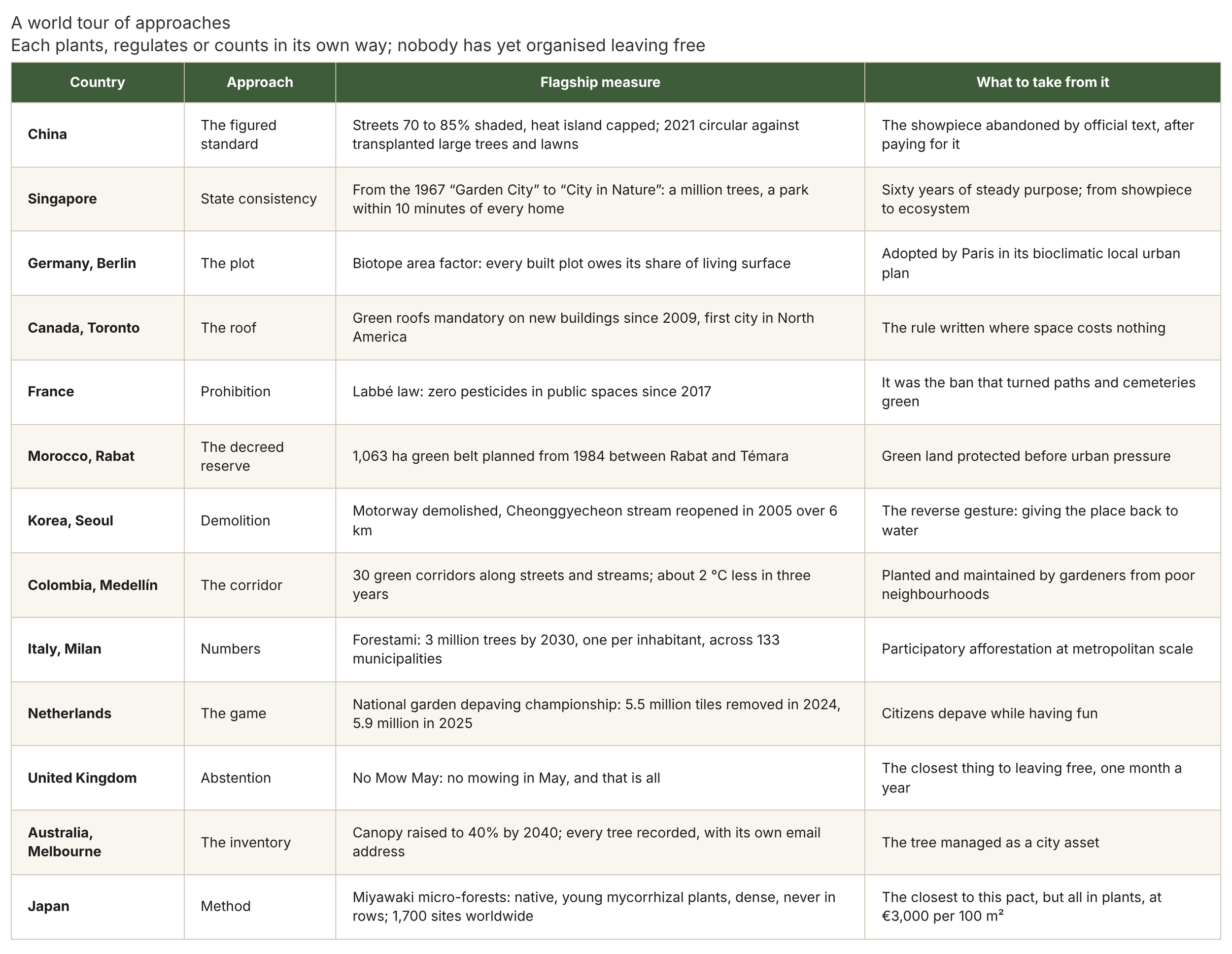
China tackles it through standards. Its 2022 “garden city” standard requires shaded streets over 70 to 85% of the pedestrian network and caps the heat island at 3 or 2.5 degrees depending on the level; its “forest city” label, launched in 2004, covered 219 cities at the end of 2022, for an estimated gain of about three fewer days a year above 35 °C. But the most interesting text for an ecologist is the 2021 State Council circular on “scientific greening”: a ban on transplanting large trees into cities, young plants with full crowns, local species in mixtures, planting “according to the water available”, and a crackdown on thirsty lawns. A country of one billion four hundred million people renounced the showpiece by circular, after paying to find out: old trees uprooted in the countryside that died in the city, Chengdu’s planted towers abandoned to mosquitoes, and forty-five pilot “sponge cities” with no measurable cooling of the air, except Xiamen. Established for the texts and assessments; the measurements are mostly surface temperatures, and the effect, though real, remains modest: vegetation does not replace the climate, it corrects it.
Singapore tackles it through consistency. From the “Garden City” declared in 1967 to today’s “City in Nature”, sixty years of steady purpose have raised vegetation cover above 40% of the territory, placed a park within ten minutes’ walk of every household, and committed to a million new trees by 2030, more than 830,000 of them already in the ground, planted in part by 150,000 residents. And the city-state tells its own story in the terms of this article: it says it has moved from the idea of decorating the city to that of reintegrating real ecosystems into it.
Others tackle it through rules. Berlin, through the plot: its biotope area factor requires every built plot to have its share of living surface, weighted by quality, and Paris has adopted it in its bioclimatic local urban plan. Toronto, through the roof: the first city in North America to make green roofs mandatory on new buildings, in 2009. France, through prohibition: it was the Labbé law and the 2017 zero-pesticide rule that turned our paths and cemeteries green, by making weeding too costly to cling to. Rabat, through a reserve decreed early: the 1,063-hectare green belt planned as early as 1984 between Rabat and Témara still holds the Moroccan capital together.
Others again through a bold gesture. Seoul demolished an elevated motorway to reopen, in 2005, six kilometres of the Cheonggyecheon stream in the city centre. Medellín planted thirty green corridors along its streets and watercourses, measured about two degrees less in three years, and entrusted planting and maintenance to gardeners trained in poor neighbourhoods. Milan plants by numbers, three million trees by 2030, one per inhabitant, across the hundred and thirty-three municipalities of its metropolitan area. Melbourne counts: 40% canopy targeted for 2040, every tree inventoried, with an email address residents write to. The Netherlands plays: its national championship for removing garden paving, born during Covid, took up five and a half million tiles in 2024. And England abstains: No Mow May, no mowing in May, and that is all.
Japan, finally, tackles it through method, and it is the closest to mine. Miyawaki micro-forests plant native species, young, mycorrhizal from the nursery, dense, distributed at random and never in rows: more than seventeen hundred sites worldwide. Almost all my principles are there, and two differences remain. Miyawaki plants everything, three to five plants per square metre, around three thousand euros per hundred square metres; the pact plants the framework and sows the rest, for a fraction of that price, leaving the sorting to the place rather than to density. And the Sardinian trial of the method, published in 2011, recalls the honesty required: 61 to 84% of the plants dead at twelve years, for a final community that is nonetheless rich and self-sustaining. Density sorts, like my sowing; but it sorts at the price of the plant, and sowing at the price of the seed.
What this world tour says fits in one sentence: the whole world plants, regulates, counts or depaves, and nobody has yet organised the right to do nothing. A legible frame, three rules, a single intervention, a specification: that gap is precisely the place of the pact left free.
11. Assessment of this episode: established, debated, hypothesis
What I hold as established. Compaction, by machinery as by repeated trampling, reduces soil infiltration by 70 to 99% and makes soil life collapse, with effects measurable after a few dozen passes and up to twenty metres from a path. Urban wastelands host, in most cases, more species than other green spaces, and reduced mowing multiplies pollinators. Residents accept wildness that is framed and in flower and reject wildness that is abandoned, and the cues that make the difference have been known for thirty years. Nurse plants improve the survival of young plants in harsh environments, and facilitation is one of the recognised drivers of succession. A nature area takes thirty times fewer hours than a highly flowered garden. Wooden boardwalks on piles in local hardwoods exist, can be costed and last.
What I hold as debated. The exact cost per metre of a boardwalk, which varies by a factor of two depending on the project. The lifespan of timber species, which comes from professional sources. The exact rank of each species in the durability standard. The extent of the fire risk specific to a herbaceous wasteland compared with woodland, on which the experts themselves disagree. The invasive status of several species, which changes from one region to another. The transposition to France of infiltration figures measured in America. Exchanges between plants through mycorrhizal networks.
What I hold as hypothesis, and would like to see measured. That short-lived pioneer fixers, brooms and gorse, leave as they decline a richer soil and a clear place for the species that grew up in their shelter. That the direction taken by nature after establishment gives a more stable and richer space than one imposed on it. That a mixed sowing of trees, shrubs and perennials establishes better as a community than plants set side by side, and that a well-placed seedling catches up with a nursery plant. That tall vegetation captures more dew than a short lawn. That a tall meadow cools more than a mown lawn. That the strip of shade under a boardwalk is a particular refuge. And that my garden in Meudon, fifty years without anything, can be reproduced on a hectare of city. I believe it, because I have seen it elsewhere. I have not yet counted it. That is the next step, and it will be done with a municipality willing to keep the count.
To be continued in the second episode: the 400 square metre module, the palettes space by space, the typical hectare from year zero to year twenty, the costs and the clauses. Then in the third: the sunken park.
Glossary
The technical terms of this episode, in the sense in which I use them.
Wood chips, RCW. Chipped branches spread on the soil. RCW, ramial chipped wood (BRF in French), uses only twigs less than 7 cm in diameter, chipped fresh: it feeds the soil fungi and holds back grass.
Cerema. The French Centre for Studies and Expertise on Risks, the Environment, Mobility and Planning. The State’s public technical expertise body, author of many of the monitoring studies cited here.
Framework. The trees and shrubs planted at the start, which give the place its structure. The rest will come through sowing and through nature.
Clearing. An open space of 200 to 1,000 square metres, served by the boardwalk, mown once a year, with two benches. The only place where the public walks on the soil.
Compaction. The crushing of the soil by feet or machinery. Air and water are driven out, fine roots and soil life die.
Ground cover. A low, spreading plant that covers bare earth and protects it from sun, driving rain and unwanted weeds.
Sucker, layering. A sucker is a stem that emerges from a root, at a distance from the parent plant. Layering is when a branch touches the soil and takes root there.
Evapotranspiration. The water returned to the air by the soil, which evaporates, and by leaves, which transpire. It is what cools the air under a tree.
Mowing (meadow). Cutting tall grass once or twice a year and removing the hay, instead of mowing it short every week.
Nitrogen fixer. A plant that hosts in its roots bacteria able to take nitrogen from the air and return it to the soil: legumes such as black locust or laburnum, alders, sea buckthorn.
Wasteland. A plot left unused, where vegetation establishes on its own.
Urban heat island. The overheating of a city compared with the surrounding countryside, especially at night, because stone and asphalt store the day’s heat.
Infiltration, runoff. Rainwater that enters the soil infiltrates; water that flows over the surface runs off. The more the soil is covered in asphalt or compacted, the more it runs off.
Invasive. An invasive alien species: introduced by humans, it spreads at the expense of local species. European and French lists name them, such as Japanese knotweed or tree of heaven.
Edge. The transition strip between woodland and open space. It is often the richest in species.
MACH. A Cerema experiment, from 2016 to 2020, on a cracked house in Mer, in the Loir-et-Cher. The clay soil was kept moist by buried irrigation controlled by sensors.
Miyawaki method. Very dense planting of young native species, mixed at random, to obtain a small wood quickly. It is named after the Japanese botanist Akira Miyawaki.
Mycorrhiza. The association between a plant’s roots and a soil fungus. The fungus brings water and minerals, the plant gives it sugars.
Swale. A wide, shallow ditch, grassed or planted, that collects rainwater and lets it infiltrate.
Boardwalk on piles. A wooden walkway set on posts, above the ground, to cross it without trampling.
Pioneer. A species that is first to establish on bare or disturbed soil. It grows fast, lives briefly, and prepares the ground for those that follow.
Clay shrink-swell (RGA). Clay swells when wet and shrinks when it dries; houses built on it crack. RGA is the French acronym (retrait-gonflement des argiles).
Sowing. Here, the seeds sown in the gaps between the framework plants.
Cues to care. The visible signs that a place is intended and looked after: clean edging, mown strip, boardwalk, sign. A concept from landscape architect Joan Nassauer.
Succession. The gradual replacement of species on a plot left free: grasses, then shrubs, then trees.
References, chapter by chapter
Chapter 1. Ville de Lille, Parc Matisse page, lille.fr/Nos-equipements/Parc-Matisse. Villes et Pays d’art et d’histoire Hauts-de-France, “Le parc Matisse”, vpah-hauts-de-france.fr. The 3,500 m² area of Derborence Island is cited from Vercelloni et al., Inventing the Garden, 2010, via Wikipedia, and has not been confirmed by a primary source. Association Francis Hallé pour la forêt primaire, pages “Le projet” and “Questions fréquentes”, foretprimaire-francishalle.org (70,000 hectares, several centuries, strictly protected core zones and transition zones, “Certainement pas” closed to humans). Société nationale d’horticulture de France, “La renaissance d’une forêt primaire en Europe de l’Ouest”, snhf.org. La Relève et la Peste, “Francis Hallé est mort, mais son rêve continue”, 12 January 2026 (association founded in 2019, death on 31 December 2025, about 700 years). Chapter 2. Plante & Cité, Baromètres, “Parcs et jardins : temps de travaux pour l’entretien”, after Ville de Rennes, maintenance costs, 2012, barometres.plante-et-cite.fr. Plante & Cité, Étude sur la gestion raisonnée de l’arrosage en espaces verts, 2013, 57 municipalities, plante-et-cite.fr/files/ressource/file:83. Plante & Cité, Optimisation des pratiques de tonte et de fauche, 2019, reported by Cité Verte (Unep), “Comment optimiser la tonte et la fauche”, 6 February 2020, citeverte.com, and by CGconcept, 26 February 2020. Chapter 3. Gregory J.H., Dukes M.D., Jones P.H., Miller G.L., “Effect of urban soil compaction on infiltration rate”, Journal of Soil and Water Conservation, 61(3), 117-124, 2006. Bergeson C.B., Martin K.L., Doll B., Cutts B.B., “Soil infiltration rates are underestimated by models in an urban watershed in central North Carolina, USA”, Journal of Environmental Management, 313, 115004, 2022. Apur, Les îlots de chaleur urbains à Paris, cahier 4, influence climatique des revêtements de sol, July 2017. Armson D., Stringer P., Ennos A.R., “The effect of tree shade and grass on surface and globe temperatures in an urban area”, Urban Forestry & Urban Greening, 11(3), 245-255, 2012. Cerema, “Quels leviers pour favoriser l’évapotranspiration et rafraîchir le climat urbain ?”, 15 October 2021, cerema.fr. Paudel S., States S.L., “Urban green spaces and sustainability: exploring the ecosystem services and disservices of grassy lawns versus floral meadows”, Urban Forestry & Urban Greening, 84, 127932, 2023. Jacobs A.F.G., Heusinkveld B.G., Berkowicz S.M., “Passive dew collection in a grassland area, The Netherlands”, Atmospheric Research, 87, 377-385, 2008. Richards K., “Urban and rural dewfall, surface moisture, and associated canopy-level air temperature and humidity measurements for Vancouver, Canada”, Boundary-Layer Meteorology, 114, 143-163, 2005. Wastian L., Unterweger P.A., Betz O., “Influence of the reduction of urban lawn mowing on wild bee diversity”, Journal of Hymenoptera Research, 49, 51-63, 2016. Nuss M. et al., “Partial mowing of urban lawns supports higher abundances and diversities of insects”, Journal of Insect Conservation, 25, 797-808, 2021. Proske A., Lokatis S., Rolff J., “Impact of mowing frequency on arthropod abundance and diversity in urban habitats: a meta-analysis”, Urban Forestry & Urban Greening, 76, 127714, 2022. For the figures on erosion, rain bacteria and mycorrhizal spores: see “The air pact”, instalment 2 of this series, and its references. Chapter 4. Grossnickle S.C., Ivetić V., “Direct seeding in reforestation: a field performance review”, Reforesta, 4, 94-142, 2017. Karst J., Jones M.D., Hoeksema J.D., “Positive citation bias and overinterpreted results lead to misinformation on common mycorrhizal networks in forests”, Nature Ecology & Evolution, 7, 501-511, 2023. Commission Directive 2003/2/EC of 6 January 2003 relating to restrictions on the marketing and use of arsenic. Bainbridge D.A., “Buried clay pot irrigation: a little known but very efficient traditional method of irrigation”, Agricultural Water Management, 48(2), 79-88, 2001. Holl K.D., “Do bird perching structures elevate seed rain and seedling establishment in abandoned tropical pasture?”, Restoration Ecology, 6(3), 253-261, 1998. Padilla F.M., Pugnaire F.I., “The role of nurse plants in the restoration of degraded environments”, Frontiers in Ecology and the Environment, 4(4), 196-202, 2006. Connell J.H., Slatyer R.O., “Mechanisms of succession in natural communities and their role in community stability and organization”, The American Naturalist, 111(982), 1119-1144, 1977. Office français de la biodiversité, “Végétal local”, ofb.gouv.fr/vegetal-local (collective label created in 2015, eleven biogeographical regions in mainland France). Hoyle H. et al., 2017, and Plante & Cité, Acceptaflore, see chapter 5. Chapter 5. Nassauer J.I., “Messy Ecosystems, Orderly Frames”, Landscape Journal, 14(2), 161-170, 1995. Nassauer J.I., “Care and stewardship: from home to planet”, Landscape and Urban Planning, 100(4), 321-323, 2011. Li J., Nassauer J.I., “Cues to care: a systematic analytical review”, Landscape and Urban Planning, 201, 103821, 2020. Observatoire des villes vertes, “Végétation spontanée en ville : des politiques récentes qui méritent d’être cadrées”, YouGov survey of 6 and 7 May 2021 of 1,010 people, July 2021, observatoirevillesvertes.fr. Plante & Cité, Acceptaflore programme, 2009-2012, coordinated by D. Provendier and M. Guérin, and Gutleben C., “La végétation spontanée en ville : l’étudier, la faire accepter, la gérer”, Jardins de France. Menozzi M.-J., Marco A., Léonard S., Les plantes spontanées en ville, literature review, Plante & Cité, 2011. Hoyle H., Hitchmough J., Jorgensen A., “All about the wow factor?”, Landscape and Urban Planning, 164, 109-123, 2017. Fischer L.K. et al., “Beyond green: broad support for biodiversity in multicultural European cities”, Global Environmental Change, 49, 35-45, 2018. Kühn N., “Intentions for the unintentional: spontaneous vegetation as the basis for innovative planting design in urban areas”, Journal of Landscape Architecture, 1(2), 46-53, 2006. Chapter 6. Cole D.N., “Experimental trampling of vegetation. I. Relationship between trampling intensity and vegetation response”, Journal of Applied Ecology, 32, 203-214, 1995. Hamberg L., Malmivaara-Lämsä M., Lehvävirta S., O’Hara R.B., Kotze D.J., “Quantifying the effects of trampling and habitat edges on forest understory vegetation”, Journal of Environmental Management, 91, 1811-1820, 2010. Malmivaara-Lämsä M. et al., “Trampling tolerance of understorey vegetation in different hemiboreal urban forest site types in Finland”, Urban Ecosystems, 11, 1-16, 2008. Littlemore J., Barker S., “The ecological response of forest ground flora and soils to experimental trampling in British urban woodlands”, Urban Ecosystems, 5, 257-276, 2001. Pižl V., Schlaghamerský J., “The impact of pedestrian activity on soil annelids in urban greens”, European Journal of Soil Biology, 43, S68-S71, 2007. Shang Q., Li C., Liu Y., “The negative effects of tourist trampling on the soil physical properties and microbial community composition in a natural oak forest”, Forests, 15(8), 1419, 2024. Yasar Korkanç S., “Impacts of recreational human trampling on selected soil and vegetation properties of Aladag Natural Park, Turkey”, Catena, 113, 219-225, 2014. Nir N. et al., “Footpaths: pedogenic and geomorphological long-term effects of human trampling”, Catena, 215, 106312, 2022. Ballantyne M., Pickering C.M., “The impacts of trail infrastructure on vegetation and soils”, Journal of Environmental Management, 164, 53-64, 2015. Kissling M., Hegetschweiler K.T., Rusterholz H.-P., Baur B., “Short-term and long-term effects of human trampling on above-ground vegetation, soil density, soil organic matter and soil microbial processes in suburban beech forests”, Applied Soil Ecology, 42, 303-314, 2009. Dynamique Environnement, project sheets “Cheminement en caillebotis en bois sur pilotis, Isère” and “Platelage bois pilotis sur l’ENS des anciens méandres du Rhône”, 2018, dynamique-environnement.com. Aten, technical guide 85, Guide pour l’accessibilité dans les espaces naturels, outils d’accueil et d’interprétation, 2012 (figures for the Marais du Vigueirat). Alternabois, black locust FAQ citing FCBA, 2023. Saintonge Bois, “Durée de vie piquet bois”, 2026. Vedia, “Botrange : la Province aux petits soins pour les caillebotis”, 14 November 2023. Woodup, “Durabilité et classes d’emploi du bois”, 2026, and ID Environnement, “Quelles sont les différentes classes d’emploi du bois ?”, 2024, for standards NF EN 335 and EN 350. French order of 20 April 2017 on accessibility for disabled people of establishments open to the public at construction and of installations open to the public at fitting-out, article 2, read via accessibilite-batiment.fr and the copy published by the Drôme prefecture. Chapter 7. Nuss M. et al., 2021, see chapter 3. Santoni P.-A., Porterie B., Morvan D., “Incendies de végétation”, École du GDR Feux, 2018, docs.gdrfeux.univ-lorraine.fr. Comité français de l’UICN and Société botanique de France, Prévention du risque incendie et biodiversité dans les forêts françaises, 2023. CGDD/SDES, Chiffres clés des risques naturels, 2023 edition, “Feux de forêt et végétation”. Ganteaume A., Le risque incendie dans les interfaces habitat-forêt : évaluer l’inflammabilité de la végétation ornementale, Irstea, 2016. Géorisques, “Obligations légales de débroussaillement”, georisques.gouv.fr. Order of 29 March 2024 on legal brush clearance obligations, read via AIDA. Rigolot E., Lambert B., Étienne M., “Les enseignements du Réseau coupures de combustible”, Forêt Méditerranéenne, XLI(3), 233-238, 2020. Thavaud P. et al., Mesures agroenvironnementales appliquées à la prévention des incendies, Réseau coupures de combustible no. 11, 2006. Chapter 8. Centre de ressources espèces exotiques envahissantes (IUCN France, OFB), “Règlement européen relatif aux EEE : 17 nouvelles espèces inscrites”, 19 August 2019. Brussels Environment, list of invasive alien species of Union concern, 20 March 2023. INVMED, fact sheets Ailanthus altissima and Cortaderia selloana, invmed.fr. Cottaz C., Dao J., Hamon M., Liste de référence des plantes exotiques envahissantes de la région Occitanie, CBNMed and CBNPMP, 2021. Terrin É., Diadema K., Fort N., Liste des espèces végétales exotiques envahissantes et potentiellement envahissantes de PACA, and Stratégie régionale relative aux EVEE en PACA, CBNA and CBNMed, 2014. Cerema Centre-Est, La problématique des renouées asiatiques, analyse bibliographique et recommandations, 2020. CBN Pyrénées et Midi-Pyrénées, feedback on Ailanthus altissima, cbnpmp.fr. Chapter 9. Proske A., Lokatis S., Rolff J., 2022, see chapter 3. Meffert P.J., Dziock F., “What determines occurrence of threatened bird species on urban wastelands?”, Biological Conservation, 153, 87-96, 2012. Muséum national d’histoire naturelle, press release “Le programme de sciences participatives Sauvages de ma rue fête ses 10 ans”, 3 May 2022. Observatoire des villes vertes, 2021, see chapter 5. Chapter 10. Ville de Lille, see chapter 1. Berlin Senate, environment department, brochure Natur Park Südgelände, as of June 2023, and exhibition page “Artenreichtum auf engem Raum”, berlin.de. Ville de Marseille, “Les FUN, friches urbaines naturelles”, marseille.fr. Town hall of the 6th and 8th arrondissements of Marseille, “Les friches urbaines naturelles dans les 6 et 8”, 19 March 2025, “Lancement d’une FUN rue Auguste Marin”, 2023, and “Une nouvelle FUN Traverse Paul”, 2025. ARBE Région Sud, “Marseille et ses FUN”. Office français de la biodiversité, “Marseille, territoire engagé pour la nature”. Ajuntament de Barcelona, Pla Natura Barcelona 2021-2030, and Borja Martín J., Solucions basades en la natura: actuacions en zones herbàcies, 2018. Câmara Municipal de Lisboa, Plano de gestão florestal do Parque Florestal de Monsanto. Bonthoux S., Brun M., Di Pietro F., Greulich S., Bouché-Pillon S., “How can wastelands promote biodiversity in cities? A review”, Landscape and Urban Planning, 132, 79-88, 2014. Muratet A., Machon N., Jiguet F., Moret J., Porcher E., “The role of urban structures in the distribution of wasteland flora in the greater Paris area”, Ecosystems, 10, 661-671, 2007. For the world tour: State Council of the People’s Republic of China, circular no. 19 on scientific greening, 2021. Ma, Geng, Zhong, “Urban Forest Development and Extreme Heat Mitigation”, Forests, 2026. Ou et al., “Impacts of China’s Sponge City projects on urban thermal environments”, City and Environment Interactions, 2026. NParks, Singapore Green Plan 2030 and City in Nature. UN, UNRIC, “Medellín crée des couloirs verts”, 2019. City of Toronto, Green Roof Bylaw, 2009. Euronews, “NK Tegelwippen”, 2025. Plantlife, No Mow May. Forestami, Milan. City of Melbourne, Urban Forest Strategy 2012-2032. Schirone, Salis, Vessella, “Effectiveness of the Miyawaki method in Mediterranean forest restoration programs”, Landscape and Ecological Engineering, 2011.