10 November 2026 · Yves Nicolas, Functional Ecology Consultant, yvesnicolas.com
© Yves Nicolas, 2026. All rights reserved for the text and original illustrations.
What did the men of water know that we have forgotten?
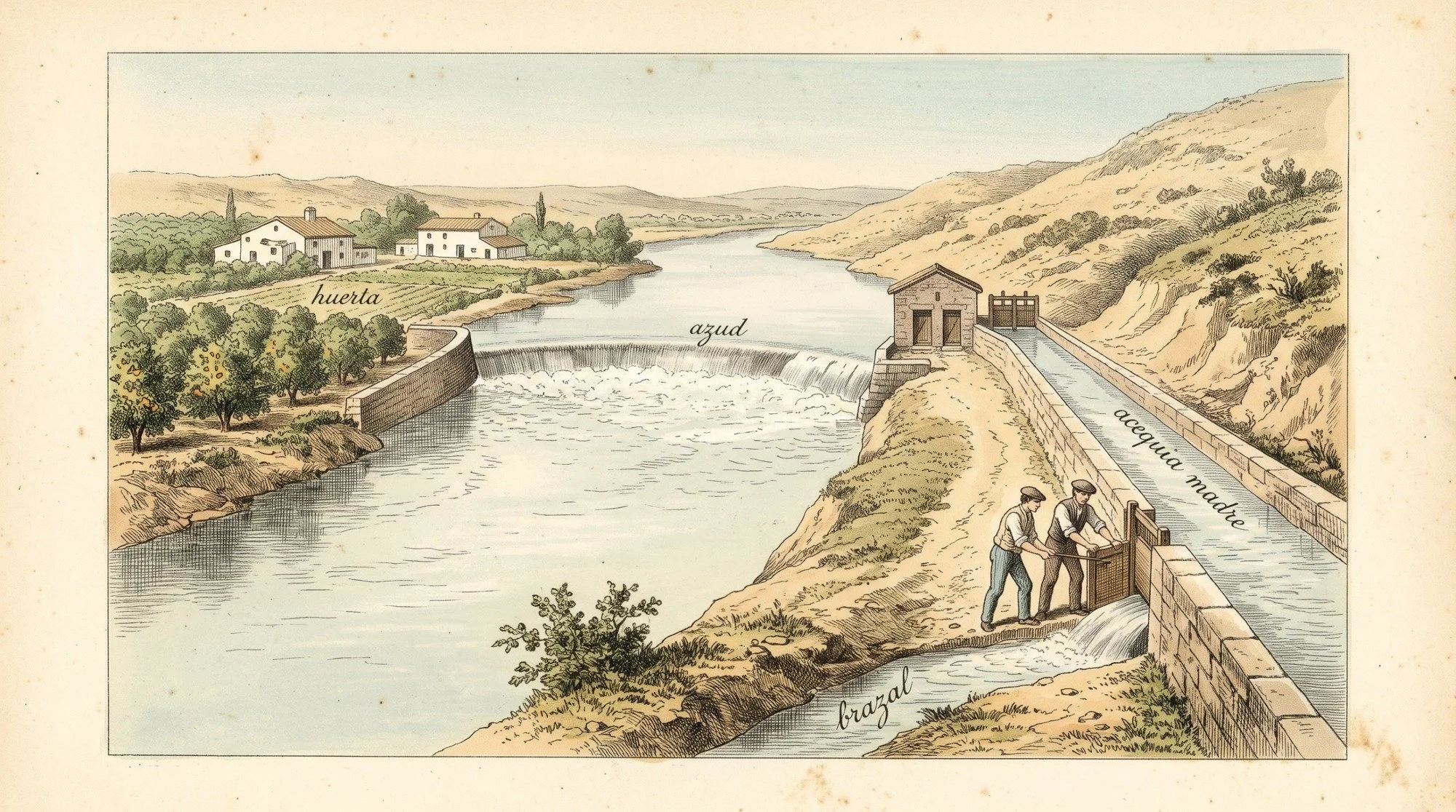
The azud raises the water level of the río; at its end, the intake and its gates send part of the flow into the acequia madre, which stays high along the slope while the río descends, then divides into brazales that carry the water to the plots. AI engraving.
On the other side of the strait, the ougoug is called azud and the seguia acequia. Both words come from Arabic: as-sudd, the dam, and as-sāqiya, the one that gives water. The principle is the same as in Morocco: a weir across the río raises the water level, an intake sends part of the flow into a gently sloping canal, and this canal, which descends more slowly than the río, divides from branch to branch down to the plot.
What changes is the length of observation and the scale: here, observation has gone on for centuries and the rule covers a whole plain. In Valencia, the Real Acequia de Moncada and the acequias of the Tribunal share the Turia according to a proportional rule, and every Thursday a court of farmers judges water disputes in front of the cathedral. In Murcia, the azud of the Contraparada commands most of a network of about 310 km of acequias [1].
Spain also offers Morocco twenty years of hindsight on irrigation modernisation, that is, on replacing earthen canals with pressurised networks and drip irrigation. More than 7 billion euros have been programmed for it [2], and the measurements tell us what was gained and what was lost.
We will first follow the river and the plain it built, then the water from the azud to the plot and the institutions that govern it. Then come what becomes of canal losses, the history of the system, the threats it faces, and what the acequia teaches Morocco, Spain and France. Two ideas will return from one end of the text to the other: we only preserve the water whose flow we know, and oases, like huertas, survive only if we ban the boreholes that ruin existing works.
1. Geology and hydrology: a plain built by an irregular river
A fan built by the river
An alluvial fan is what a river leaves behind as it leaves the hills: it drops its gravel there in a fan shape, and the fan slowly spreads. The huerta of Valencia rests on the alluvial fan of the Turia, built mostly in the Upper Pleistocene, at a time when sea level was lower. Its apex, the tip of the fan, leans against a tectonic fault running northeast-southwest, linked to the subsidence of the coastal margin. In the Holocene, fine silts covered the middle and lower parts of the fan and shaped a plain with a very gentle slope [3].
It is this gentle, even slope that makes the acequia possible: an intake a little way upstream is enough to command the whole plain, and the water flows down on its own from canal to canal to the sea or to the Albufera lagoon.
A Mediterranean river
The Turia, like the Segura in Murcia, has a very irregular regime: long low-water periods in summer, that is, very low levels, then sudden floods in autumn. They arise when cold air at altitude meets a still-warm sea, what the Spanish call gota fría, and meteorologists DANA, an isolated drop of cold air at altitude.
The chronicles keep the memory of the floods of 1321, 1328 and 1358, the last of which destroyed more than a thousand houses. After 1358, the city created an institution in charge of its walls and ditches; after the great flood of 1589, another, the Fàbrica Nova del Riu, spent two centuries raising the stone parapets that hem in the river [3].
1957 and the new riverbed
Then came 14 October 1957, and a flood that killed at least 81 people in Valencia [4]. To measure its size, we must compare two flows, that is, volumes of water passing per second. The old riverbed could carry about 2,300 m³/s, and experts estimate the 1957 flow at between 2,400 and 3,800 m³/s depending on the author [5].
The answer was the Plan Sur: a new riverbed 12 km long and 175 m wide, dug from 1964 to 1973 south of the city [4]. It is designed for 5,000 m³/s, although a 2014 report puts its real capacity at about 3,700 m³/s [5]. It protected the city, but it cut the southern huertas off from the rest of the plain [6].
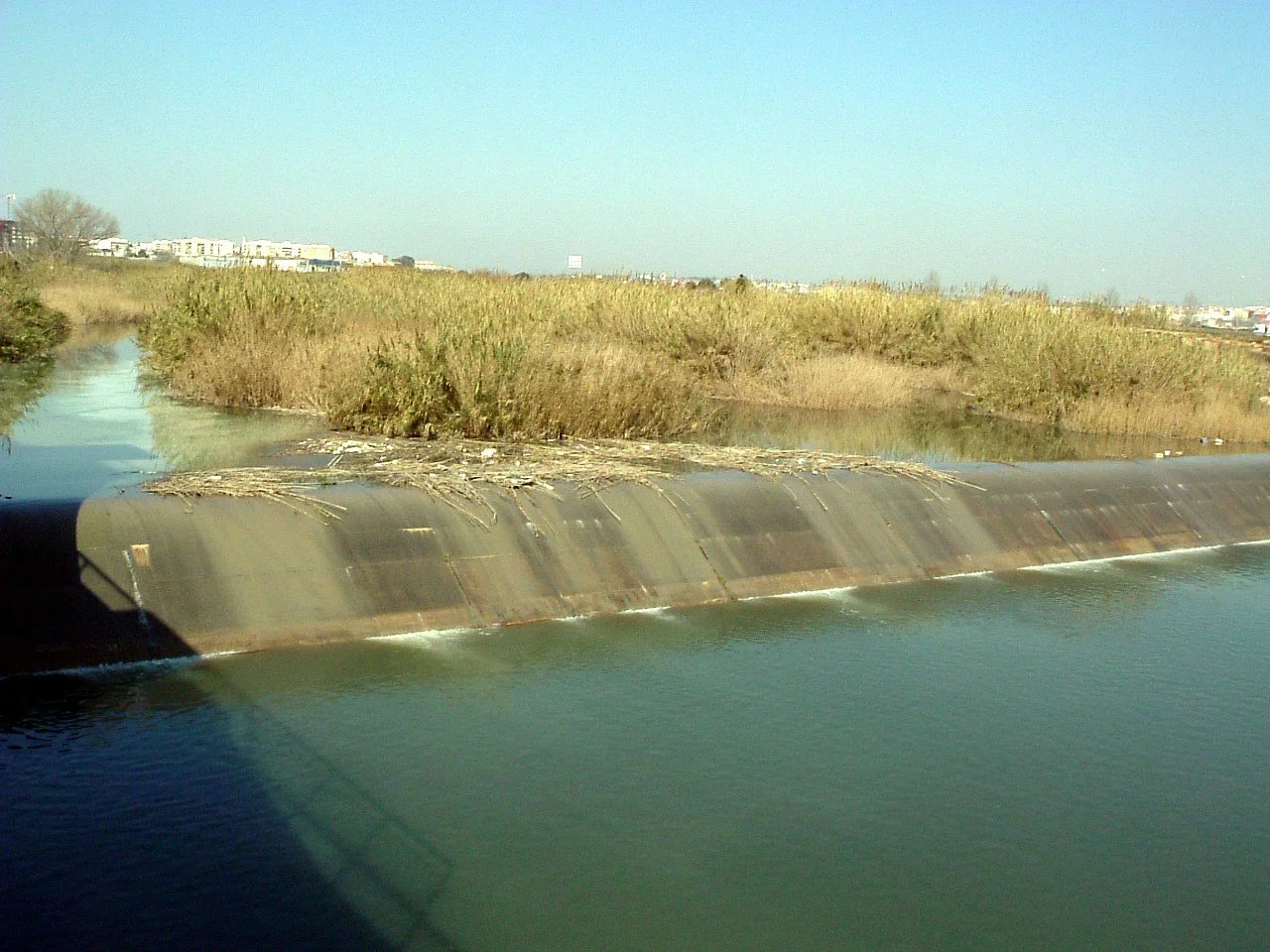
The azud del Repartiment, in the new bed of the Turia dug after 1957: today it feeds Rascanya, Rovella, Favara and the acequia de l’Or [7]. Photo Talayuelo, CC BY-SA 4.0, via Wikimedia Commons.
29 October 2024
The DANA of 29 October 2024 was a reminder that danger does not come only from the main river. At Turís, the Spanish meteorological agency’s station measured 185 mm in one hour and 621 mm in six hours, two national records [8]. The Poyo ravine, whose channel was designed for 800 m³/s, carried more than 2,000 at the measuring station alone, probably close to 3,000 at Paiporta and Catarroja [9], and the province counted more than 200 dead [9]. The new bed of the Turia, for its part, carried two peaks of about 2,000 m³/s [5].
Further south, the Albufera, Valencia’s coastal lagoon, received more than 120 million m³ in eleven hours; its level rose by nearly a metre and about 700,000 tonnes of sediment settled in it, the equivalent of some thirty years [10]. The acequias paid their share: the State funded repairs for seven of the nine irrigators’ communities of the Tribunal, gates, azuds, walls and dredging [11]. In the Horta Sud, the systems of Quart-Benàger-Faitanar, Mislata-Xirivella, Favara and the Séquia de l’Or were damaged, networks and plots, to the extent of about 40% [12].
The aquifer beneath the huerta
Beneath the plain lies the Plana de Valencia aquifer, a porous layer saturated with water, which the Geological and Mining Institute divides into two units, of about 333 km² in the north and 795 km² in the south [13]. It is a multi-layer system: an unconfined aquifer in the Quaternary gravels, sands and silts, a semi-confined aquifer in the Miocene, and an impermeable base of marls [13].
The Quaternary aquifer is the one that feeds the ullals, the springs of the Albufera; it is also the most loaded with nitrates from fertilisers and irrigation [13]. In the south, 78% of what enters the aquifer comes from surface infiltration, rain and irrigation water combined, and its first outlet is the drainage network of the Albufera marsh [14].
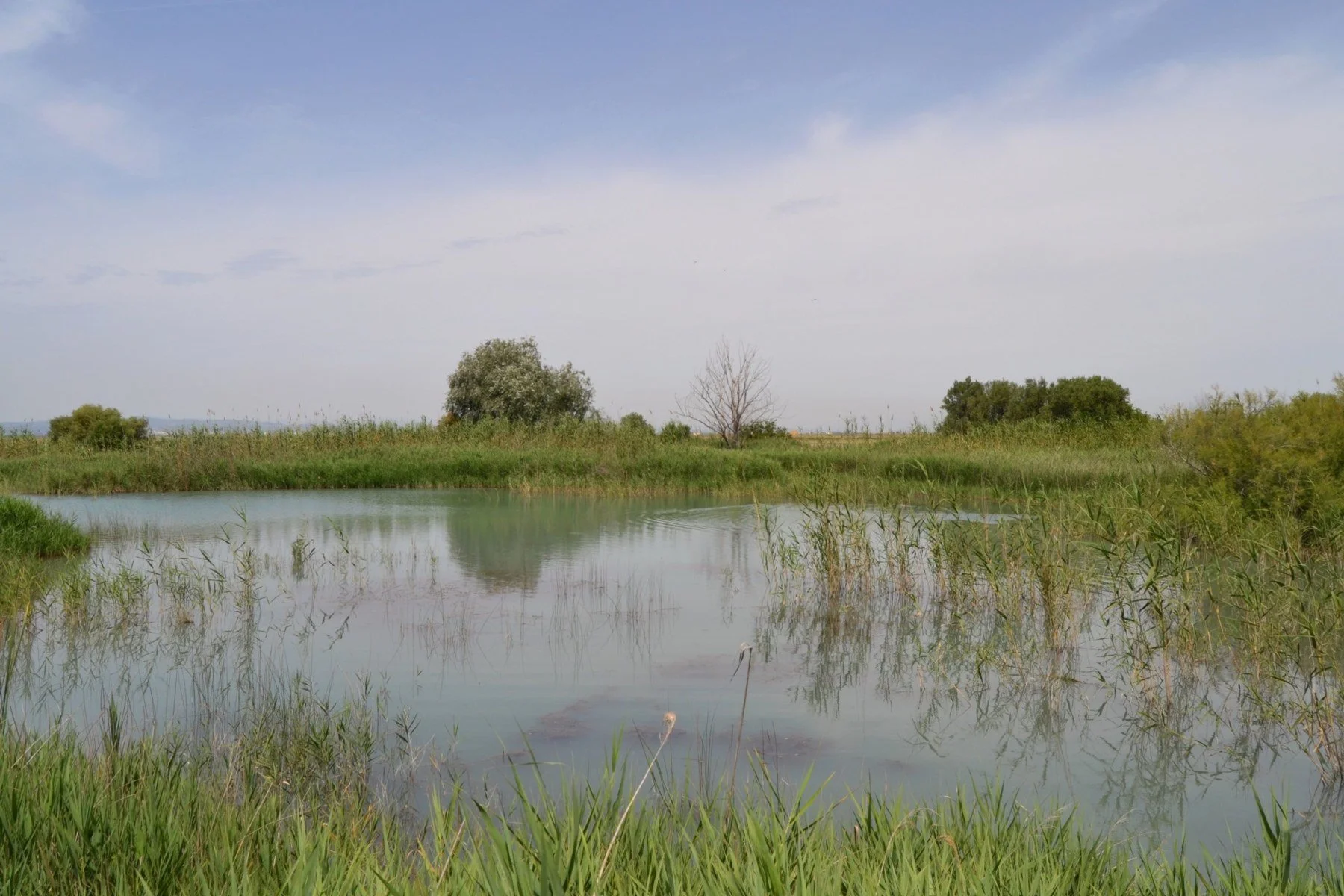
The ullal de Baldoví, in the Albufera natural park: a spring where the aquifer reaches the surface, fed in part by the water the huerta let slip away further up. Photo Joanbanjo, CC BY-SA 4.0, via Wikimedia Commons.
The huerta, the acequia, the aquifer and the lagoon therefore form a single system: what the acequia loses on the way and what the plot lets slip away comes back up, a little further on, in an ullal or a drainage canal.
2. Workings: from the azud to the plot
The system comes down to five parts, the same as in Morocco under other names: the azud, the acequia madre, the partidor, the brazal, and the canals that bring the surplus back to the river. We meet them here in the order in which the water passes through them.
The azud, a weir that raises the river
The azud is a weir laid across the riverbed. It raises the water level up to the intake, the opening that draws water from the bank, and it lets the flood pass over the top.
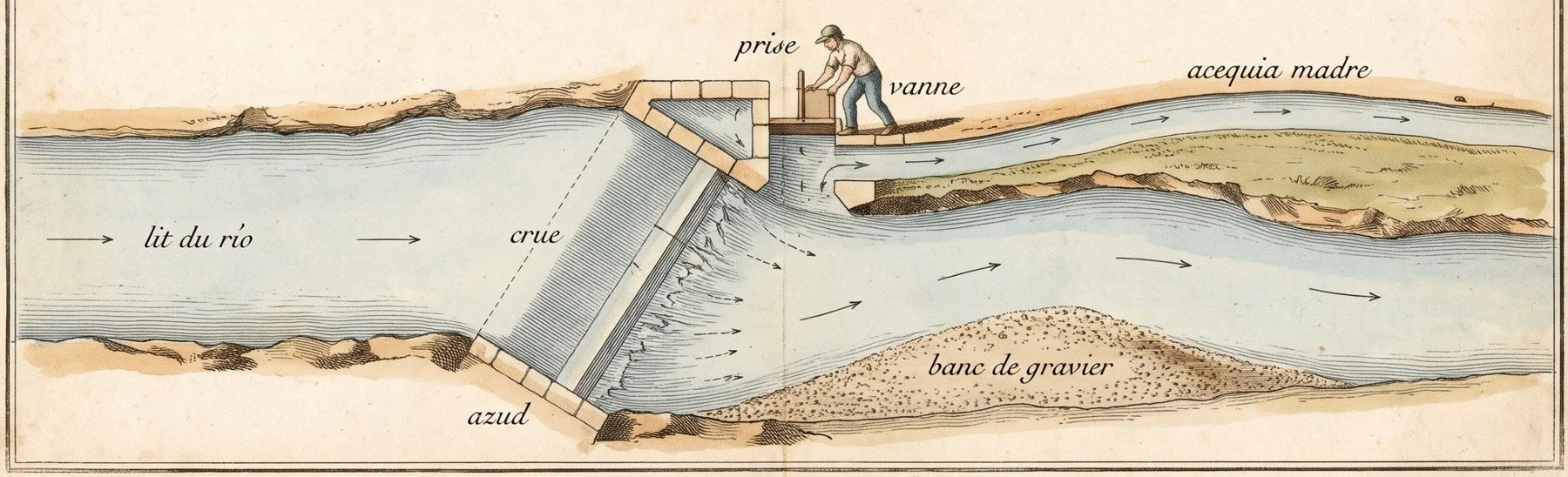
Plan of an azud: the weir, set at an angle in the riverbed, raises the water and guides it towards the intake, on the bank, at the downstream end of the angle, where the raised water comes to rest; the gate regulates what enters the acequia madre, and the flood passes over the weir. Downstream, the current deposits a gravel bar. AI engraving.
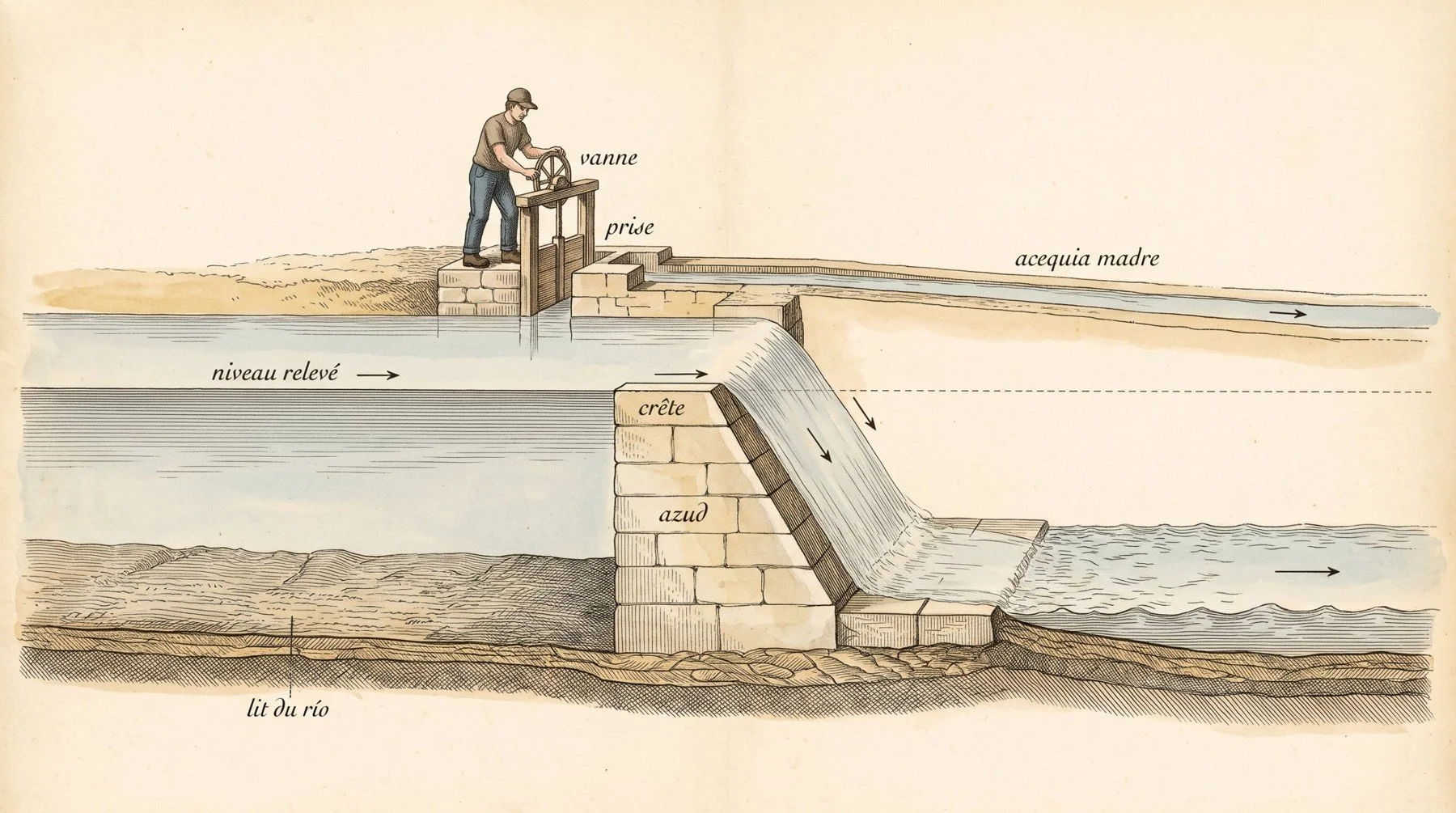
Cross-section of an azud: the weir raises the level of the río upstream; the intake, placed upstream of the weir, takes the water at this high level, and the acequia madre sets off with a gentler slope than the río, so that it stays above the river downstream and can command the plain. AI engraving.
On the Turia, the vega of Valencia, its irrigated plain, had nine of them, from upstream to downstream: Moncada, Quart, Tormos, Mislata, Mestalla, Favara, Rascanya, Rovella and the Oro [15]. Since the new riverbed was dug after 1957, the azud del Repartiment alone feeds Rascanya, Rovella, Favara and the Oro [7].
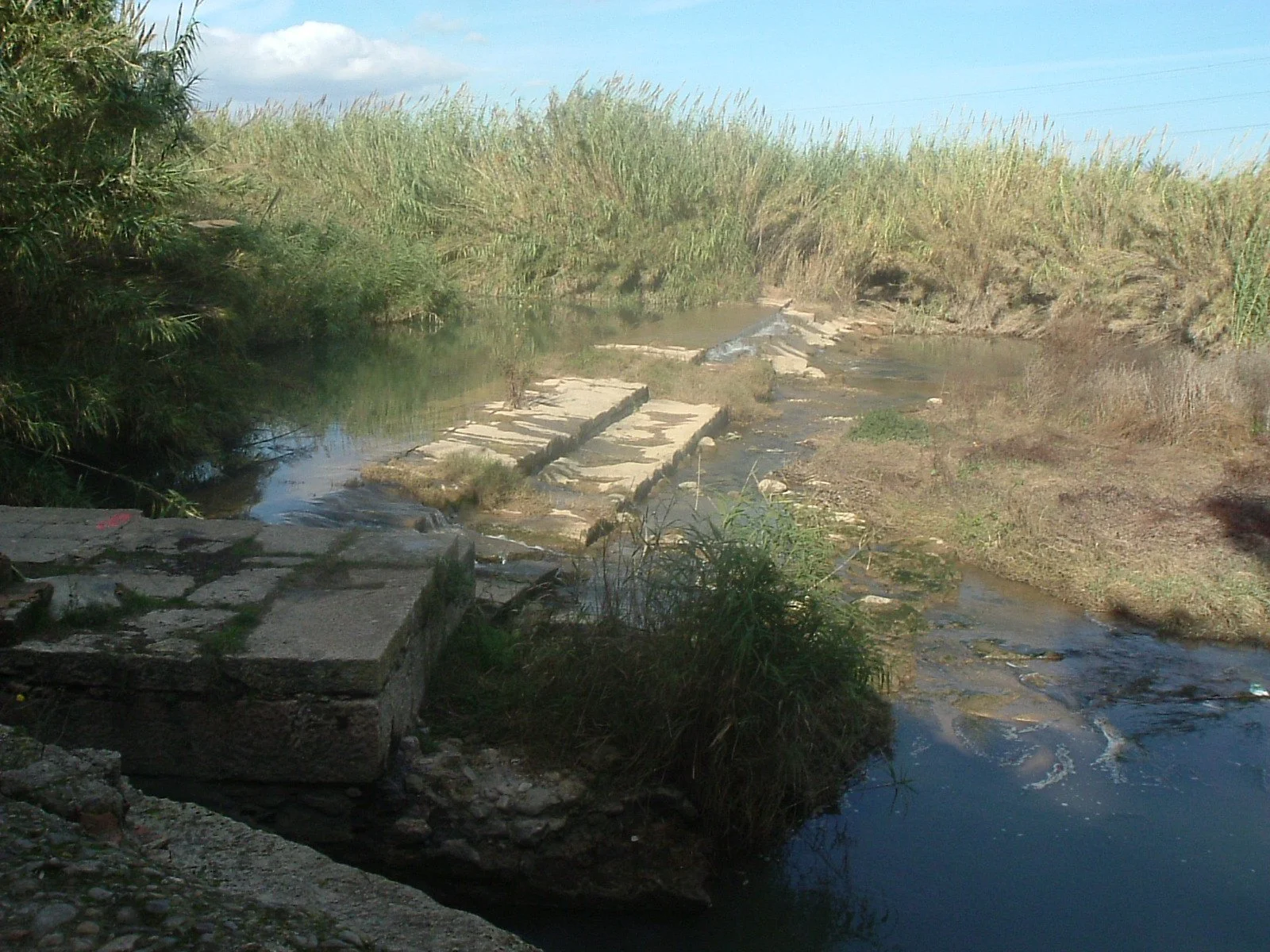
The azud of the acequia de Mislata, on the Turia: a stone weir across the river, the Valencian cousin of the ougoug. Photo Talayuelo, CC BY-SA 4.0, via Wikimedia Commons.
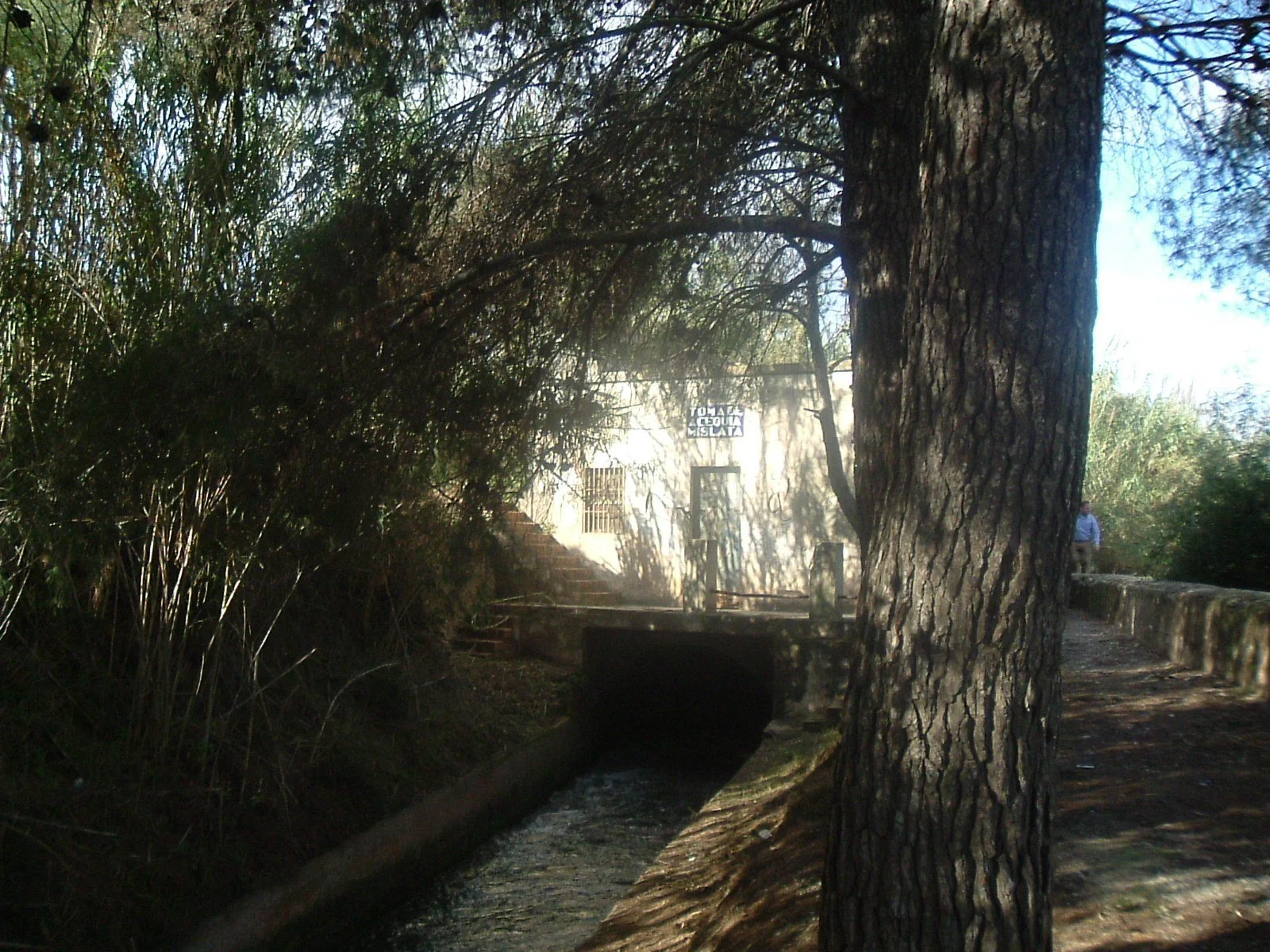
The intake of the acequia de Mislata, beside its azud: the water enters beneath the intake house and sets off down the canal. Photo Talayuelo, CC BY-SA 4.0, via Wikimedia Commons.
The Moncada azud, between Manises and Paterna, is of Islamic origin; its present masonry dates from the 16th century and its gates were rebuilt after 1957 [16]. In Murcia, the Contraparada, built in the 9th and 10th centuries, is made of dressed limestone with dovetail joints, cut like a swallow’s tail to lock the blocks together; the flood of September 2019 shifted about 150 of its blocks [17].
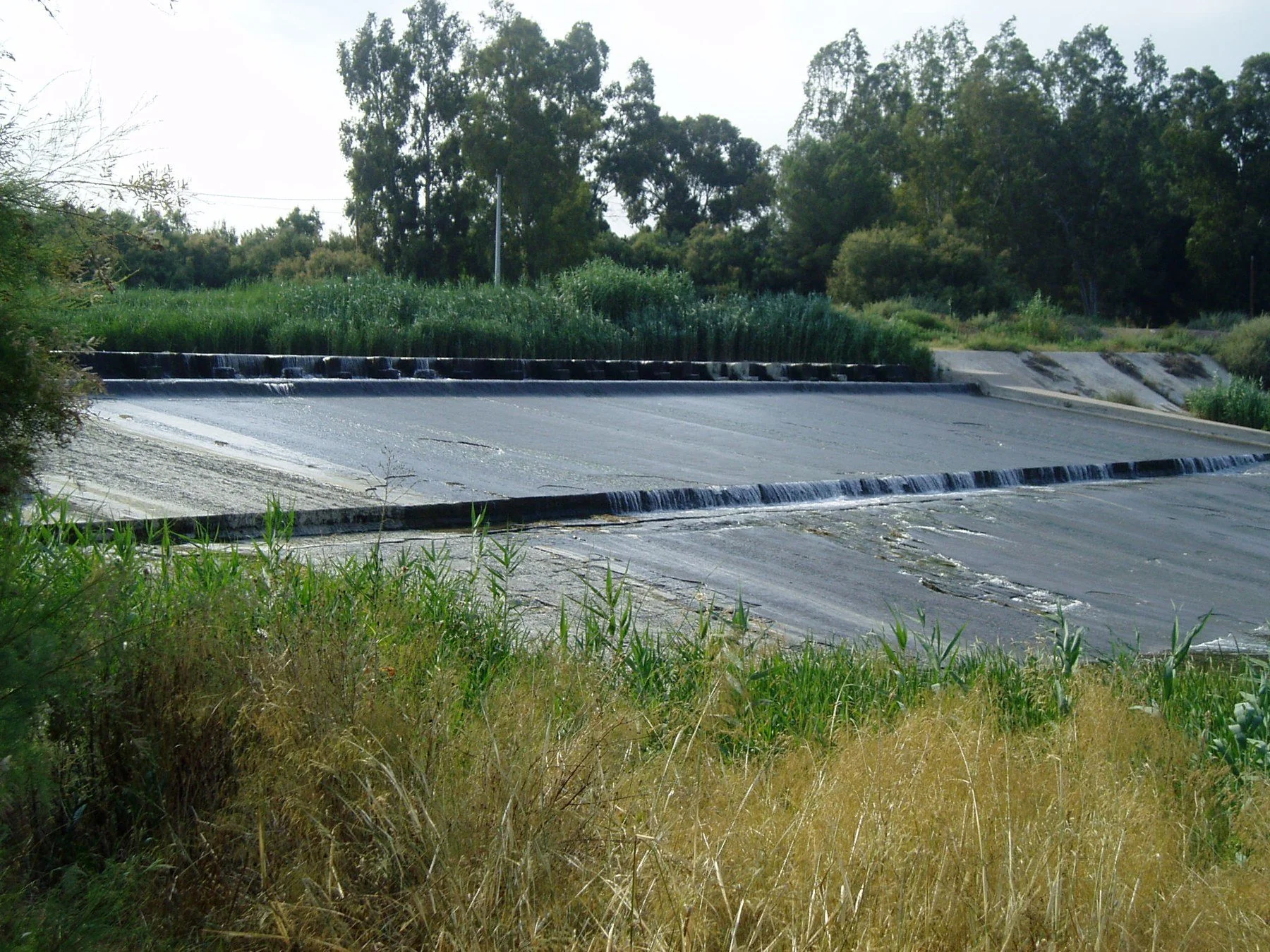
The Contraparada, on the Segura, at Javalí Nuevo: the azud that feeds the two acequias mayores of the huerta of Murcia. Photo Quezaltepeque, CC BY 3.0, via Wikimedia Commons.
Where the ougoug is made of whatever is found on the spot and rebuilt after each flood, the azud of the great huertas has become a stone structure, maintained over centuries. Chapter 5 tells how this came about.
The acequia madre, a canal that holds its level
The main canal, the acequia madre, follows the contour line with a slope just sufficient for the water to flow without eroding. The río descends faster than it does: the further one moves from the intake, the higher the canal stands above the river, and this is what allows it to water the whole plain.
In Murcia, two acequias mayores leave the Contraparada: the Aljufía to the north, “the northern one” in Arabic, 27 km long, and the Alquibla or Barreras to the south, about 22 km long [18, 19, 20]. A third, Churra la Nueva, takes its water a little upstream of the Aljufía [21]. In Valencia, Faitanar is nearly 10 km long [22].
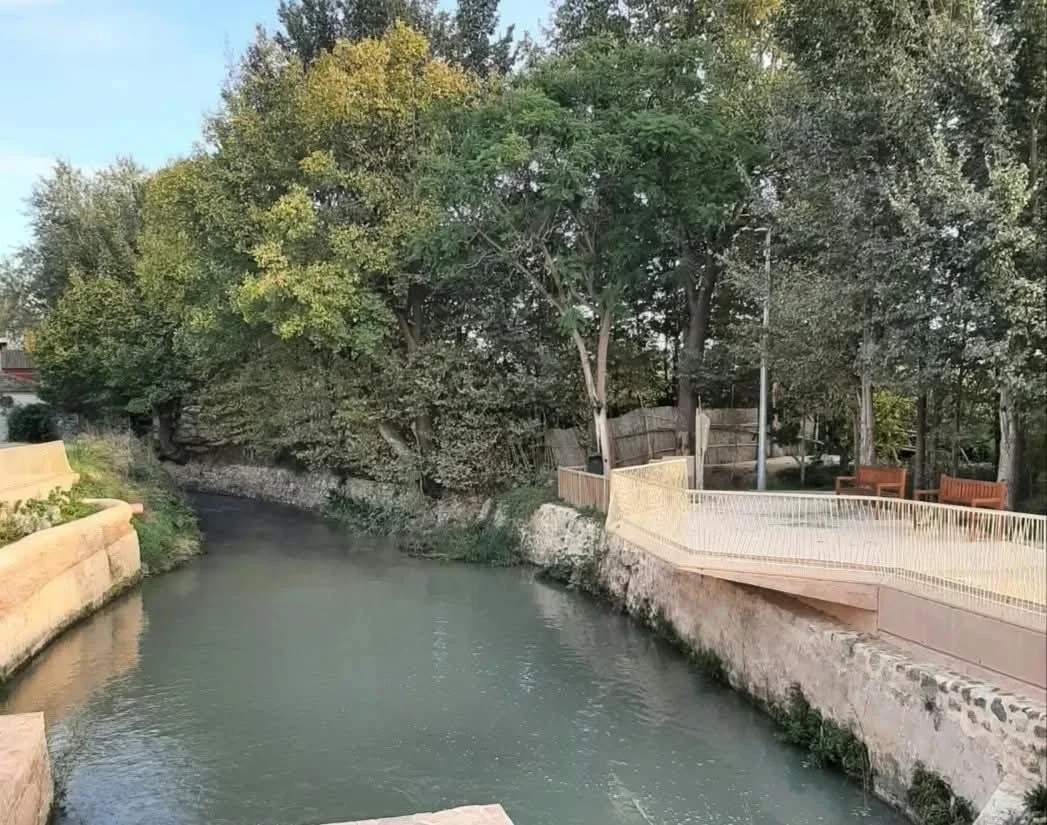
The acequia mayor Aljufía, in Murcia: starting from the Contraparada, it runs for 27 km across the north of the huerta [19]. Photo Gregorico, CC0, via Wikimedia Commons.
From the partidor to the azarbe
Further down, the canal meets a partidor, the divider that splits the water between two or more canals. The gates of the partidores are lifted with the ganxo, the guard’s hook [7]. From there run the brazales, the secondary arms that carry the water to the plots; the acequia de Mestalla, for example, divides into three or four arms depending on the source [23].
What the plot has not drunk is not lost: drainage canals, the escorredor and the azarbe, collect the surplus. In Murcia, a distinction is made between aguas vivas, taken from the river, and aguas muertas, collected by the escorredores, azarbetas and azarbes, which return to the Segura [18, 19]. Water taken upstream therefore returns to the river or the lagoon downstream: the acequia forms a circuit.
The fila, a share and not a volume
The partidor does not divide water in litres, it divides it in shares. The drawing below shows the principle: a stone basin, a slab pierced with equal openings, and brazales that each take a fixed number of openings. This model with openings is not the only one: other Valencian partidors share the water in the open, by means of a stone spur, the tajamar, which splits the current; it is then the width left to each branch that sets its share [24].
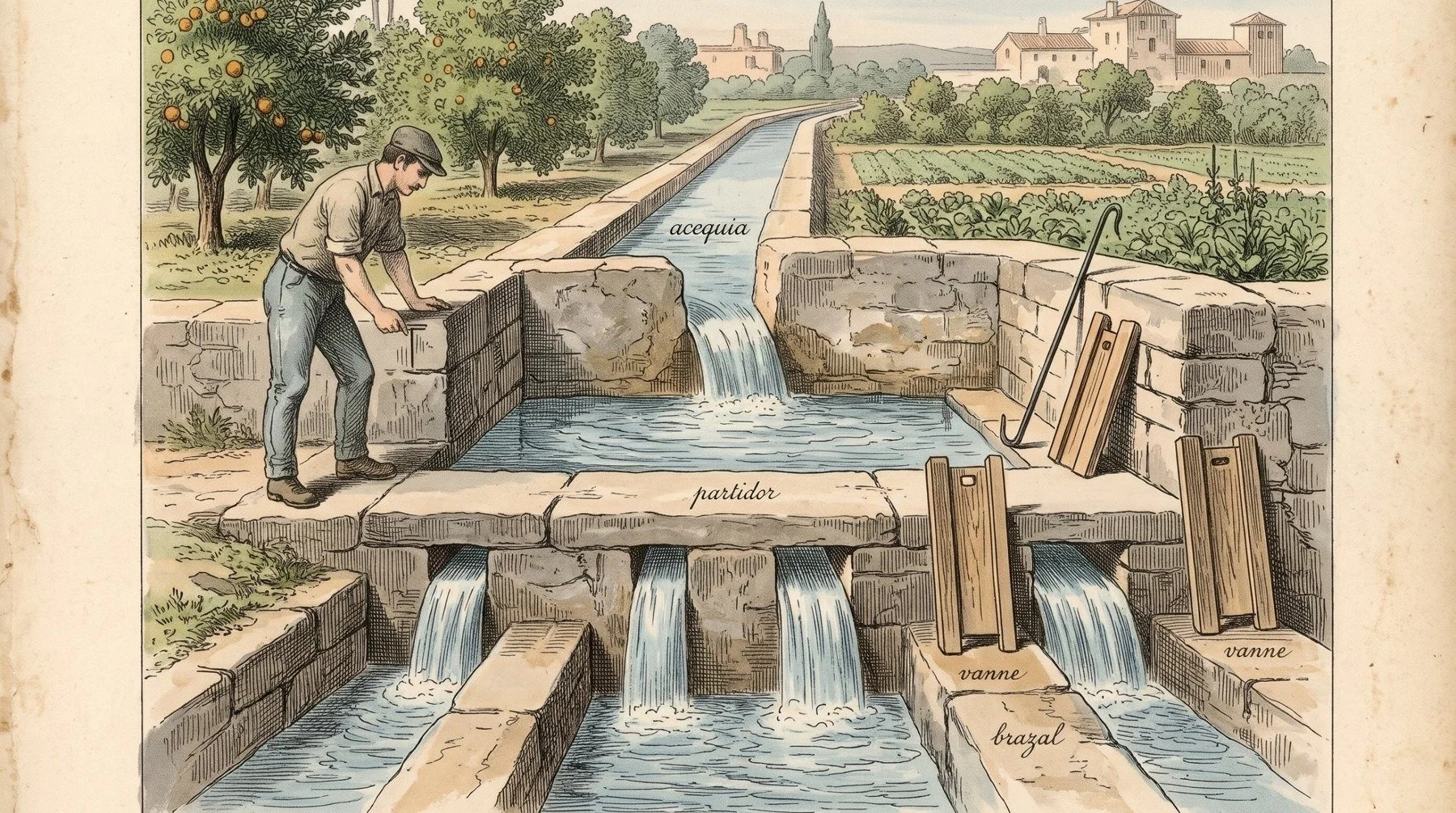
A partidor: the acequia pours into a stone basin, then passes under a slab through openings of the same size, each one a fixed share. The middle brazal, which receives two openings, takes two shares; those at the sides take one. When the water drops, each loses in the same proportion. The gate boards and the guard’s hook wait against the wall. AI engraving.
This idea of the share governs the whole division of the Turia, which is divided among its acequias into 138 filas. The fila, a measure of Andalusian heritage, had a threefold nature depending on the water available: in normal times, the flow passing through an orifice of a given size; when the level drops, a proportional share of all the available water; in severe shortage, a period during which one has all the water [25]. It thus combines volume, proportion and time.
The 138 filas are counted on the river’s flow at the Quart intake, the first of the Tribunal’s acequias, so that the last is not penalised by its position [26]. Take a Turia of around 15 m³/s. On the left bank, the Real Acequia de Moncada holds 48 filas, Tormos 10, Mestalla 14 and Rascanya 14. On the right bank, Quart holds 14, Mislata 10, Favara 14 and Rovella 14 [27]. Moncada, designed for a flow of 6 m³/s, irrigates some 6,343 ha [28, 29], and the huerta irrigated by the Turia covers about 17,000 ha in all [26, 22].
When the river drops, each acequia in principle receives less in the same proportion. In severe drought, the board of syndics also sets up a water rotation between acequias and can ask upstream for water of grace [30]. Moncada, at the head of the river, was long in conflict with downstream [16]: in 1321, privileges granted by James II set water rotations between the huerta and the upstream villages, and obliged Moncada, when needed, to open one of the four gates of its almenara to let a quarter of its water pass to the downstream canals [31, 16].
The tandas, time in each canal
Within each acequia, the water passes from plot to plot according to a rotation set by the ordinances, the tanda, supervised by the guard [7]. The rotation is generally weekly and lengthens in times of shortage [32].
Proportion is therefore decided first between acequias, at the river; time is decided between irrigators, at the canal, and between acequias when water runs short. The two rules complement each other, as in a Moroccan oasis where water is first shared in proportion between the seguias, then by time within each one.
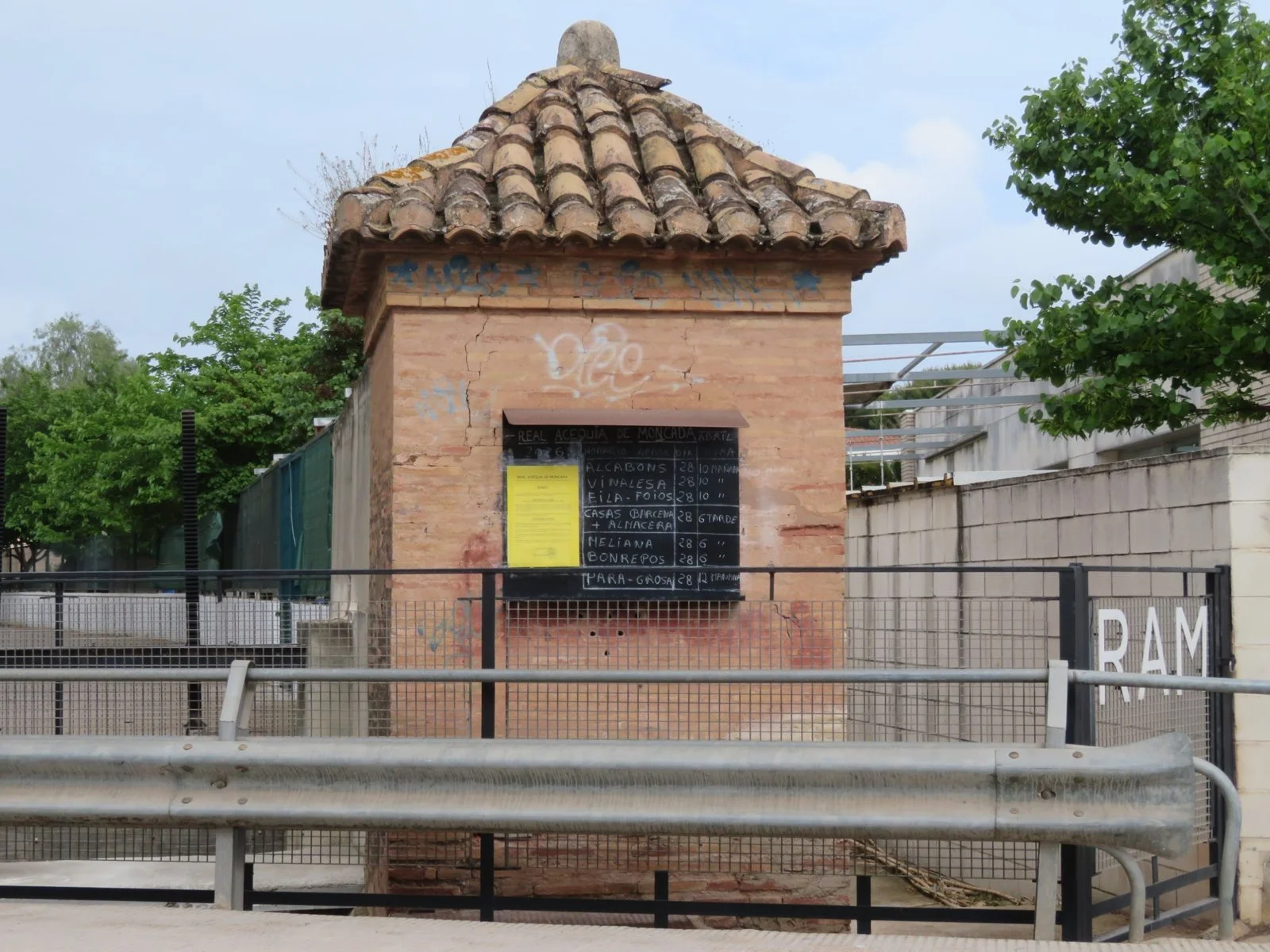
The partidor of the acequia de la Fila, on the Real Acequia de Moncada, at Vinalesa: on the board, the day and hour set for each village of the huerta. Photo Juan Emilio Prades Bel, CC BY 4.0, via Wikimedia Commons.
Eight acequias, nine communities, a plain in Murcia
The eight acequias of the Tribunal of Valencia are Quart, Benàger-Faitanar, Mislata, Favara and Rovella on the right bank, and Tormos, Mestalla and Rascanya on the left bank [33, 26]. For a long time there were only seven, until Benàger-Faitanar split off from Quart. Xirivella, an arm of Mislata, now forms a ninth community that does not sit on the Tribunal; hence the seven, eight or nine acequias one reads about depending on the source [26].
The Real Acequia de Moncada, the first intake, has had its own jurisdiction since the 13th century; sources trace it back to a privilege of James I of 1239 or date it to 1268 [33, 30].
In Murcia, the scale is different: the network has about 310 km of acequias, and the Junta de Hacendados records some 8,000 ha for about 24,000 owners [1].
3. Governance: irrigators who judge themselves
The Tribunal de las Aguas of Valencia
Every Thursday, at noon, the bell of the Micalet rings and the syndics of the acequias go and sit in front of the Apostles’ Door of the cathedral [30]. There are eight of them, one per acequia, each elected by the assembly of irrigators of his canal [30]; the syndic of the ninth community, Xirivella, sits on the board but not on the Tribunal [26, 30].
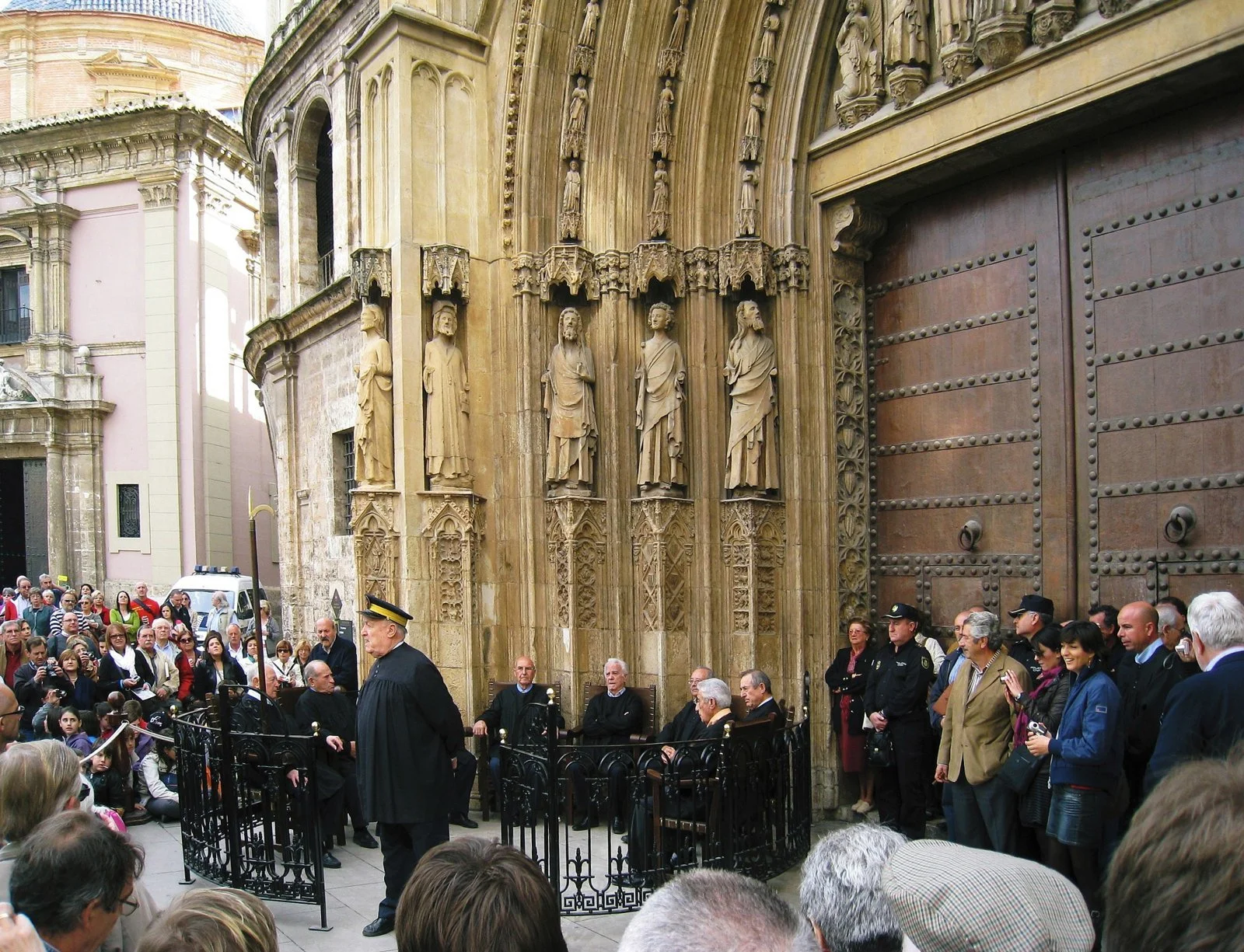
A session of the Water Tribunal of Valencia, in front of the Apostles’ Door of the cathedral. Photo Martinvl, CC BY-SA 3.0, via Wikimedia Commons.
The bailiff calls the accused acequia by acequia, in the order in which they take water from the river; the plaintiff is most often the canal guard; the syndic of the accused’s acequia does not vote, and the fine is paid on the spot [33]. The procedure is oral, in Valencian, with Castilian allowed, and without appeal [30]. When the hearing ends, the board of syndics meets to share out costs, declare drought and set the rotations [30].
The tribunal judges quickly, on the spot, among people who know the canals, and the fine stays in proportion to the offence. Its age, on the other hand, is less certain than is often said, and chapter 5 reopens the case.
The Consejo de Hombres Buenos of Murcia
Murcia has its equivalent. It descends from the medieval council of the water heirs, has borne several names, and took back that of “Good Men” in 1821 [34]. It applies the ordinances of the huerta of Murcia approved in 1849 and adapted to the water law in 1991 [34]. Each acequia and each azarbe elects a procurator and two veedores, the inspectors who record offences [34].
A justice recognised by the State
These tribunals are not tolerated survivals: the State has recognised them step by step. The 1978 Constitution opens to citizens participation in “customary and traditional courts” (article 125) [35]. The 1985 Organic Law of the Judiciary recognised the Tribunal of Valencia (article 19) [30], and an organic law of 1999 added the Consejo of Murcia [36].
In 2004, the Constitutional Court ruled that the Consejo of Murcia was a judicial body, and not a mere administration [37]. In 2009, UNESCO inscribed both tribunals on the list of intangible cultural heritage; the nomination file counted 11,691 members for Valencia and 23,313 for Murcia [38]. In 2019, FAO recognised the historic irrigation network of the Horta as a Globally Important Agricultural Heritage System [39].
The comunidad de regantes, a general rule
Spanish law made this organisation the rule for the whole country. The water laws of 1866 and 1879 both cite the Tribunal of Valencia as an example [30]. The 1879 law makes the community compulsory above a certain number of irrigators and area, and lets it write its own ordinances, approved by the State [40].
Today, the consolidated text of the 2001 Water Act requires users of the same intake to form a community; the irrigators’ community is a public-law corporation attached to the basin authority, with a general assembly, a governing board and an irrigation jury [41]. Their national federation, FENACORE, founded in 1955, claims more than 700,000 irrigators and more than 2 million hectares [42].
The contrast with Morocco
In Spain, sharing, surveillance and sanction remain in the hands of those who know the canal, within a framework where the State recognises their decisions and attaches them to the basin. The jmaa of a Moroccan seguia also judges, but without recognised jurisdiction. Water Law 36-15 does provide for a public inquiry before a borehole is authorised, and protects acquired water rights [43]; the jmaa is just one riparian among others, and boreholes dug without authorisation escape this procedure.
4. Losses, recharge and modernisation: twenty years of hindsight
What the huerta gives back to the lagoon
The earthen acequia “loses” water, and that is what it is blamed for. But this water goes somewhere. It seeps through the bed of the canals and the plots down to the water table, which flows towards the coast and springs up again as an ullal in the Albufera; the rest is taken up by the escorredor and the azarbe, which carry the irrigation return flows back to the lagoon.
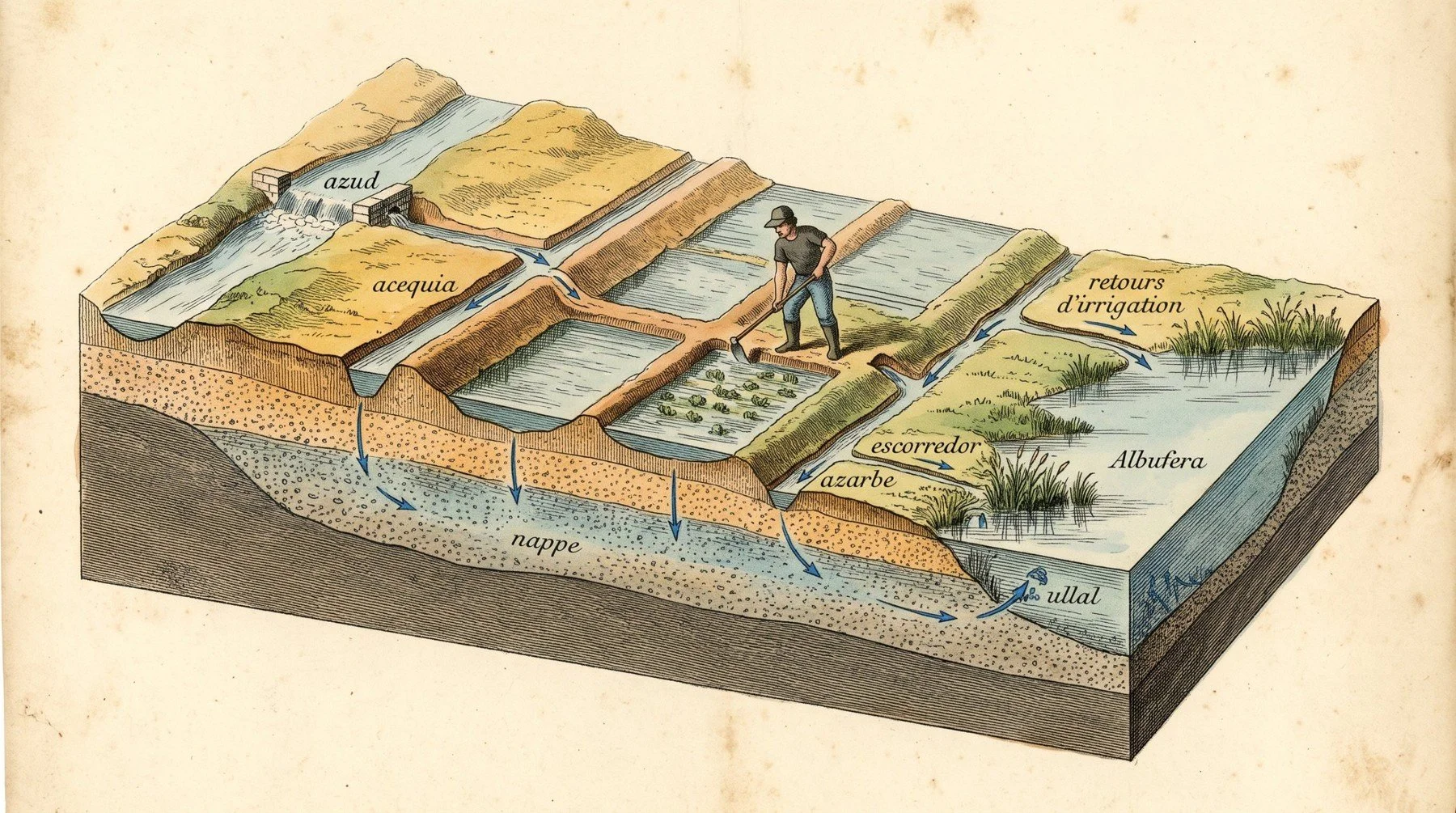
The water cycle in the huerta: the azud sends the water into the acequia, which floods the beds; part of it seeps through the bed of the canals and plots down to the water table, which flows towards the coast and springs up again as an ullal in the Albufera; the rest is taken up by the escorredor and the azarbe, which carry the irrigation return flows back to the lagoon. AI engraving.
The Albufera lagoon, south of Valencia, is the best witness to what the acequia gives back to the landscape. Take a normal year, 1988. The authors estimated the annual inflows to the natural park at 484 million m³, of which 324, or 67%, was irrigation water diverted from the Júcar and the Turia. For the lake alone, irrigation surpluses accounted for 120 million m³, or 43% of the inflows [44].
They considered insufficient the minimum of 100 million m³ per year set by the basin plan: in their view the lake needed at least 260 million m³ per year, and those 100 million had to be guaranteed whatever the irrigation surpluses, which were bound to decline [44].
Over a longer period, from 1970 to 2002, irrigation return flows supplied on average 178 million m³ per year out of the 292 entering the lake; if only the years 1980 to 2002 are kept, the average falls to 116 out of 227 [45]. This decline precedes the great modernisation, and the source attributes it to no single cause.
The proof came later, from the administration itself. The Acequia Real del Júcar, which has taken water from the river since 1258 and today irrigates 19,000 ha, switched to drip irrigation. In 2015, the basin plan recognised for the first time that the water thus “saved” was missing from the aquifers and neighbouring wetlands, and it withdrew up to 30 million m³ per year from its concession to return them to the Albufera [46]. Since 2017, it is the natural park’s technicians who request this water when the marsh needs it, mainly in autumn and late winter; in 2022, 14.5 million m³ were delivered to it through the acequia’s own canals [46].
Spanish modernisation: what it promised
In Spain, to modernise most often means replacing the canal with the pressurised pipe. From 2002 to 2015, the country modernised nearly 1.8 million irrigated hectares [47]. On paper, the gain is clear: according to the Ministry of the Environment, water diverted to agriculture fell from 17.8 km³ in 2004 to 14.9 in 2015 (one km³ equals one billion m³), and withdrawals in modernised schemes fell by about a third, by 40 to 60% in a sample of sixty Valencian irrigators’ communities [47].
The trap has a name: the rebound effect. The water that drip irrigation saves on the plot is used to irrigate new hectares, often thanks to a new borehole; the canal no longer recharges the water table, the spring dries up, the well drops and the lagoon shrinks.
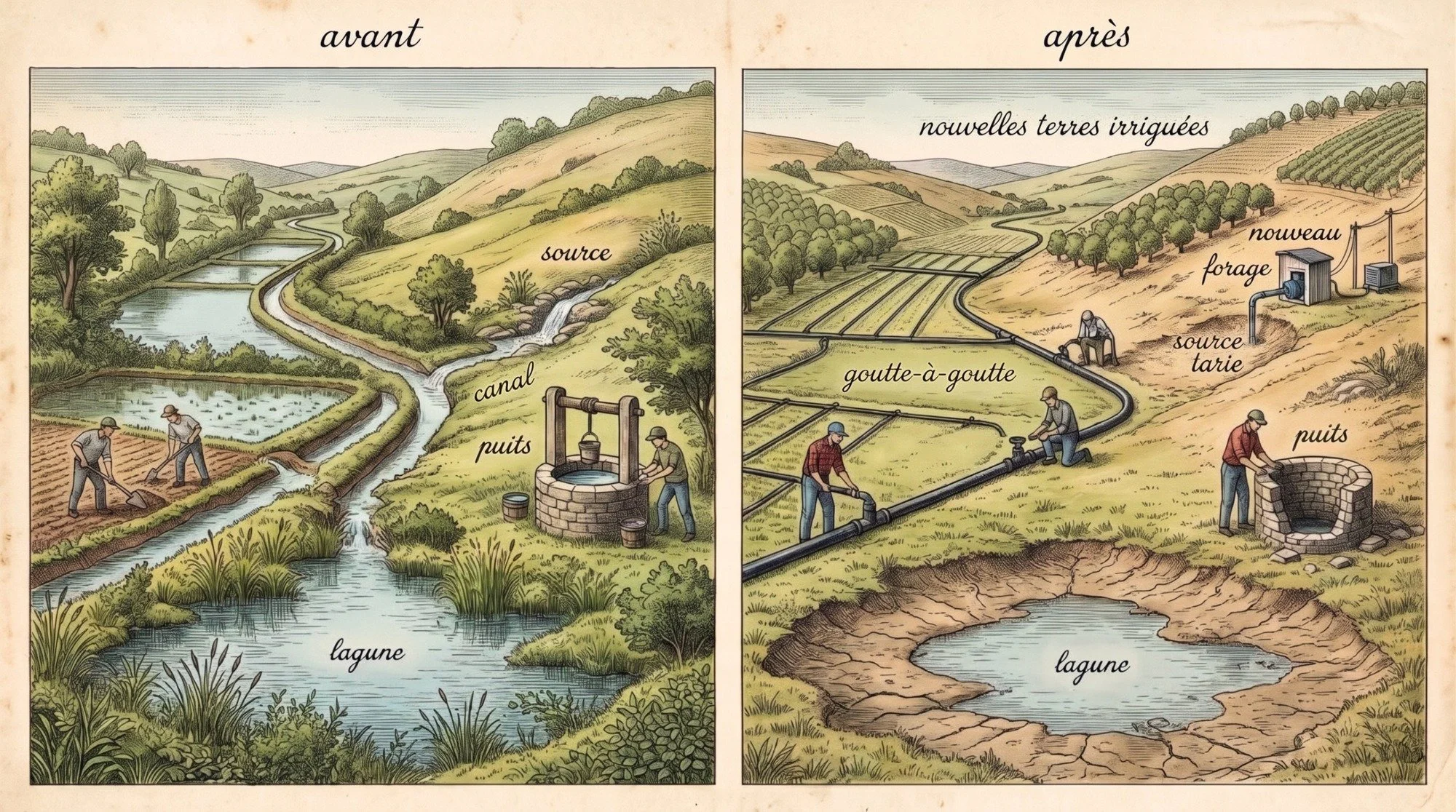
The rebound effect. Before: the earthen canal irrigates the valley, recharges the water table, and the spring, the well and the lagoon have water. After: drip irrigation replaces the canal, the “saved” water and a new borehole are used to irrigate the slopes, the spring dries up, the well drops and the lagoon shrinks. AI engraving.
Spanish modernisation: what the measurements say
The plants’ actual consumption can increase when the saved water is used to extend the irrigated area, and return flows decrease [47]. The energy bill, for its part, goes up: 0.02 to 0.15 kWh per m³ are needed for gravity irrigation, against 0.28 to 0.68 under pressure [47, 48].
The national irrigation plan and the 2006 shock plan together represented more than 7 billion euros of programmed investment, or about 5.5 million euros per million m³ that was expected to be saved [2]. In the Segura basin, the official evaluation counted 65 million m³ saved, without this necessarily translating into lower withdrawals, because the calculation was made at plot level and ignored the extension of crops; in Alicante, 5 million m³ were saved out of the 20 planned [2].
The irrigated area did indeed grow. According to WWF, Spain’s irrigated area went from 3.37 million hectares in 2002 to 3.61 million in 2014, about 7% more, and the official figure of 2,863 million m³ saved does not take lost return flows into account [49]. In 2022, Spain irrigated 3.77 million hectares, 55.8% of it by drip and only 21% by gravity [50]. For modernisation to genuinely reduce the water consumed in a basin, allocations would have had to be cut by about 40 to 50% at the same time [51].
The Cànyoles, twenty-five years later
In this basin in the province of Valencia, twenty-five years after the switch from gravity irrigation to drip, researchers found more boreholes and a falling water table, irrigation extended to former dry lands, thirstier fruit monocultures, more electricity consumed and the abandonment of the medieval hydraulic heritage [52].
What the measurements show
The earthen acequia loses water, but this water recharges the water table, feeds the springs and the lagoon, and returns to the river through the azarbes. The pipe loses nothing on the way, and it gives nothing back either; without a cap on area and volume, the water gained goes into new hectares. What the basin must count is the water that leaves it through evaporation and plant transpiration, not the water the plot saves [47, 51]. Yet this recharge has its downside: as we saw in chapter 1, the Quaternary aquifer of the huerta is also the one most loaded with nitrates [13]. The water that descends from the beds carries away what has been put on the land; a canal only recharges a healthy water table if fertilisers and pesticides are kept in moderation on the area it waters.
Valencian researchers note that the paradigm linking drip irrigation and water saving has collapsed in recent decades, but that the notion of the rebound effect is passing too slowly from research to institutions and irrigators [46]. It must also be said why so many irrigators wanted the pipe. It was not first of all to save water, but to stop getting up at three in the morning when their turn came, and to control watering at the push of a button. There is surely room to automate certain tasks without giving up the canal: a gate that opens and closes by itself at the entrance to the plot does not prevent the acequia from recharging the water table. But we are talking about water. A gate left open, a breach in a bank, a canal blocked by a flood do not show up on a screen; there will always be a need for the eye of a man who knows his canal and walks along the water. A disaster would cost far more than a few hours sacrificed at night.
5. History: an inquiry into the origin of the huertas
No one knows exactly who dug the first canals of Valencia, nor when the sharing rule was written down. Historians and archaeologists have been investigating since at least 1831; here is who said what, on what evidence, and what can be held as certain.
What the words say
Acequia comes from the Arabic as-sāqiya, formed on the verb saqā, to give to drink [53]; it is the same word as the Moroccan seguia. Azud also comes from Arabic, as-sudd, the dam [54]. The names tell where the vocabulary comes from; they do not tell who dug the first canals.
First case: the age of the Tribunal
The inquiry begins with the most famous institution. A tradition dates the Tribunal back to the year 960. This date was put forward by Borrull in 1831, following Escolano, and Borrull at the same time rejected a Roman origin for the Tribunal [55]. It has no proof: the first reliable document is a privilege of James I from 1251 that mentions a court of sequiers [55], and sources from the 14th and 15th centuries speak of a Cort dels Sequiers [30].
Older evidence comes from a chronicler. At the beginning of the 11th century, Ibn Hayyan already shows two freedmen, Mubarak and Muzaffar, in charge of Valencia’s irrigation before becoming its masters around 1010: the function existed, but nothing says it took the form of a tribunal [27]. The Tribunal’s millennium, celebrated in 1963, therefore rested on no document [56].
Romans or Andalusis: the case of the huertas
There remains the plain itself. Do the canals come from the Romans or from the Andalusis, that is, the Muslims of al-Andalus? Several researchers have, in turn, put forward different answers.
Glick, 1970: a model from the East. Thomas Glick revived the debate in 1970 in his study of irrigation in medieval Valencia. He attributed the organisation of the huerta to the Islamic period and looked for its models among the two great groups of settlers who came from the East. To the Syrian type, where water follows the land and is shared in proportion to the river’s flow, as on the Barada, the river of Damascus, whose division of 742-743 he published, he linked the sharing of the Turia. To the Yemeni type, where water is detached from the land and measured by time, with the clepsydra, he linked the lands of wells and springs [31, 57].
Bazzana and Guichard, 1981: a field lead. André Bazzana and Pierre Guichard proposed, as a line of inquiry, linking the irrigation networks of the East to rural communities born of the settlement of Berber and Arab groups: small, local networks, the great canals, such as the acequia real of the Júcar, being in their view the work of Christian power [58].
Butzer, 1985: a network that already existed. Karl Butzer reopened the case in the opposite direction. Butzer and his colleagues argued that the great works of eastern Spain, canals, diversion dams and tunnels, already existed before 711, and that the Andalusis mainly restored a network in decline, with differences “of degree rather than of kind” [59]. They nonetheless credited the Islamic period with decisive contributions: the geared noria, the qanat, the unit of sharing, the clepsydra for measuring water time, and new crops, rice (Oryza sativa), sugar cane (Saccharum officinarum) and citrus (genus Citrus). The silkworm, for its part, was reared on the mulberry trees already present in the peninsula, and the white mulberry (Morus alba) only took over much later [59].
Barceló and his school: proof from the field. Butzer’s thesis was hotly debated. Miquel Barceló and his team put Bazzana and Guichard’s lead to the test of the field, in the Sierra de Cazorla: there the Andalusi hamlet is always built above the irrigated area, so as to take nothing from it, and this layout survived almost intact through the Castilian conquest, whereas the hamlets themselves were abandoned [60]. His students drew a general rule from it: the Andalusi network is designed in a single stroke by the peasant group, to the measure of what it must produce to live, and the line of the main canal makes it rigid, so that its design can still be read today beneath the additions [61].
Barceló himself considered the quarrel over the origin of the huertas, Roman or Arab, a sterile one: even if certain, a Roman origin would say nothing about the state in which the Andalusis found the networks, what they added to them or what they expected of them [62]. He also held it unthinkable that sophisticated irrigation, which presupposes very intensive cultivation, could have survived through the centuries of demographic depression of Late Antiquity and the Visigothic period, as Butzer supposed [62]. He preferred to read in the small peasant networks a properly Andalusi hydraulics, and it was by this route that his school called into question the Roman origin of the huertas [62, 63].
Butzer and Mateu, then Glick: the positions draw closer. Butzer and Mateu then proposed distinguishing the large networks, of Roman origin, from the small and medium ones, of Andalusi origin, an idea that Glick examined when revisiting his first thesis [64]. At first convinced that the huerta was Syrian, because of its resemblance to the Ghouta of Damascus, he came round to the idea, defended by Guichard, of a “Berberisation” rather than an “Arabisation” of Valencia’s irrigated lands [65]. He himself later described the shift from irrigation systems held by tribal groups to irrigators’ communes after the conquest [66].
And Rome, and Morocco?
That Rome irrigated Spain is not in doubt: the bronze of Agón, from the time of Hadrian, found in 1993 near Zaragoza, sets out the regulations of an irrigators’ community that shared a canal from the Ebro, a document without equivalent in the whole Empire [67]. The question is whether the huertas of Valencia and Murcia descend from it, and hydraulic archaeology answers rather no [68, 63, 60].
Morocco does not settle the matter: Rome held only the north of Tingitana, around Volubilis, whose aqueduct was built between 60 and 80 and which the Roman army abandoned in 285; the oases of the South, where the khettaras were born, were never Roman [69]. The FAO presents the whole as a Muslim heritage [32]. On the origin of the great works, the question remains open.
What the Andalusis wrote about water
The agronomists of al-Andalus wrote about irrigation water. Ibn Baṣṣāl, born in Toledo in the 11th century and later settled in Seville, classifies waters by origin, rain, river, spring, well, and advises digging wells around August, when the water table is at its lowest [70]. The Kitab al-Felaha of Ibn al-Awwam, written in Seville at the end of the 12th century, takes up and extends this tradition [71].
What is certain: continuity after 1238
What is certain is that the Christian conquest did not break the system. Valencia capitulated to James I on 28 September 1238 [72]. As early as December 1239, a royal privilege gave the irrigators all the acequias of the city, except the royal acequia, that of Moncada, to be held according to the ancient custom; around 1261, the Furs, the kingdom’s code, took up the rule: the acequias of the Horta are the common property of the irrigators, to be governed “as it was established and customary in the time of the Saracens” [73].
The new power kept the rule because it worked, and wrote it down; as late as 1244, the Christian settlers of the huerta of Gandia brought in a Muslim ṣāḥib al-sāqiya to explain to them how water was shared between the canals [56]. This was not a foregone conclusion: in Majorca, after the conquest of 1229, the Catalan conquerors kept the Andalusi networks with almost no change to their layout, but they changed the rule, moving from equal sharing, based on the pacts of the founding clans, to a management that gave priority to mills and made irrigated land a source of rent [74, 75].
A recent historian, Ferran Esquilache, adds a nuance by distinguishing measurement from sharing. The fila, as a measure of flow, is an Andalusi legacy [25]; but the division of the Turia into 138 filas between the Real Acequia de Moncada and the seven intakes of the Tribunal was, in his view, fixed shortly after the Christian conquest, in the 13th century, and not in the Andalusi period as Glick thought [68].
The works changed hands faster than the rule. The azuds of the Turia, made in the Middle Ages of trunks, brushwood, reeds (the giant cane, Arundo donax) and stones often swept away by floods, were rebuilt in stone and mortar from the end of the 16th century [54]: the medieval azud looked very much like today’s ougoug.
The institution, for its part, did not stand still. The communities brought together landowners of every rank, not only peasants: at Mislata in 1415, one of the three elected deputies was a knight, and at Favara in 1493 all three were knights and lords of villages on the network. Their regulations were rewritten, and from 1597 those of Favara had to be approved by the governor of the kingdom [56]. What has come down through the centuries is the layout of the networks and the principle of sharing, more than the make-up of the communities.
Murcia
The Contraparada, which is dated back to the 9th-10th centuries, perhaps on Roman remains, was thoroughly restored in 1748 and listed in 2002 [17]. The Consejo de Hombres Buenos cites a book of water from the first half of the 14th century among its antecedents [34].
6. The threats: concrete, sewers, boreholes, drought
The city eats the huerta
In Valencia, the municipality’s built-up area grew from 2,007 ha in 1956 to 4,385 ha in 2006, from about 15% to 33% of its territory, largely on the best agricultural soils [76]. The traditional huerta covered about 20,000 ha in 1960 according to Romero and Melo [77]; in 2009, land-cover mapping classified only 7,000 ha of the comarca as market-garden huerta, against 33,250 ha of artificial land [6]. The two figures do not cover the same area, but the trend is clear.
The regional government itself estimates the losses at 2,914 ha between 2000 and 2018, then at more than 2,186 ha between 2018 and 2023, or about 437 ha per year [78], against 162 ha per year before the 2018 protection law: nearly three times as much. It was this figure that it put forward to abolish, in early 2025, the council created by that law. Every hectare built on is one plot fewer for the acequia, and an acequia that no longer irrigates becomes a ditch that will be piped or filled in.
Protection laws, made and unmade
A popular initiative, Per l’Horta, gathered some 118,000 signatures in two months in 2001 [79, 80]. Law 5/2018 on the Huerta of Valencia finally acknowledged that its area had been “significantly reduced” and created a Consell de l’Horta [81]; the territorial action plan adopted the same year classifies the land into three degrees of protection [82]. In early 2025, a decree-law of the Valencian government, validated by the Corts on 20 February, abolished this Consell [81, 78], and more than fifty deputies referred the matter to the Constitutional Court [83].
The acequia turned into a sewer
In wet weather, the city’s sewer mains overflow into the acequias, then into the Albufera, which is already too rich in nutrients; some acequias serve both as irrigation canal and as sewer, and wastewater mixes with the water of Favara, to the cost of the irrigators downstream [84]. A programme of 62.9 million euros planned seven retention basins holding about 121,000 m³ [84].
The Albufera has been paying the price for fifty years: in the mid-1970s, within a few years, its waters went from a nutrient-poor state to a hypereutrophic one, the lagoon serving as a treatment plant for the neighbouring urban growth; the first peripheral sewer main only came into service in the early 1990s, and chlorophyll, at 800 µg/l in the 1980s, is now below 100 µg/l [85]. After the 2024 DANA, the team of the Cavanilles Institute at the University of Valencia still found, in the acequias that reach the north of the lake, medicines, caffeine and a great deal of ammonium, some of it brought by the flood, some of it already there before [10].
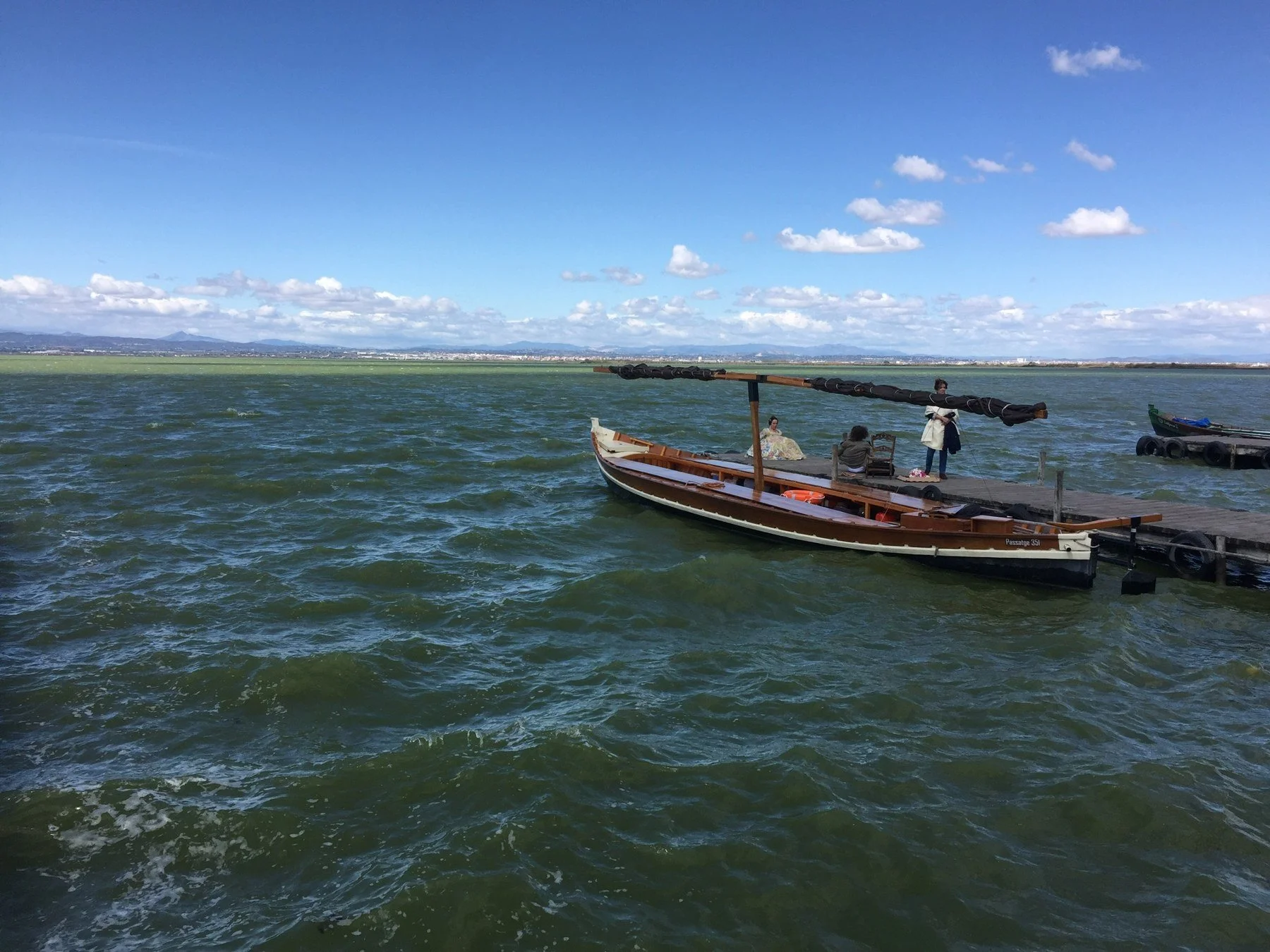
The Albufera lagoon, with a traditional lateen-sailed boat; in the background, the irrigated plain that feeds it. Photo Punteador, CC BY-SA 4.0, via Wikimedia Commons.
The boreholes of the Segura
The Segura basin shows where unlimited pumping leads. In 2021, out of 63 groundwater bodies, 38 were in poor quantitative status and 43, or 68%, in poor overall status [86]. In the Campo de Cartagena, on the shore of the Mar Menor lagoon, satellites identified in 2019 some 8,460 ha suspected of being irrigated without water rights; since 2018, the administration has opened 393 proceedings and sealed 191 illegal brackish water desalination units, and the aquifer is threatened by nitrates [87]. The Mar Menor, saturated with nutrients of agricultural origin, suffered mass die-offs of fish and crustaceans in 2019 and 2021 [88].
Where the huerta of Murcia still lives on river water, shared by custom, the new irrigated lands live on the aquifer, with no tribunal to share it.
Drought
In September 2023, 14.6% of Spanish territory was in a water scarcity emergency and 27.4% on alert, with reservoirs at 37% of their capacity [89]. Winter cereals fell by about 40% compared with 2022 [89]. In Catalonia, 2023 was the driest year in the series begun in 1920, with about 430 mm [90], and the Generalitat declared a drought emergency at the start of 2024.
In such years, the fila shares the shortage among the acequias instead of leaving it to those who pump the deepest [30].
7. In Morocco and Spain: what the acequia teaches us, and what must change
The seguia and the acequia are the same work, born of the same world, and Spain has kept it alive long enough for us to see what held and what gave way. It has kept three practices that Morocco can take up, and it has made one mistake that Morocco can avoid.
Three practices Morocco can take up
Proportional sharing. In Valencia, sharing by filas settles the upstream and downstream problem where it arises, at the river: each acequia in principle receives its share of the day’s flow, whatever its position [26, 27], and the board of syndics organises turns between acequias when water is short [30]. The water turn, the tanda, only comes afterwards, within each canal.
Morocco has known both rules. At Aghmat, where the Ourika leaves the mountains, the great canals were laid out between the 9th and the early 12th century, each group with its own intake, and al-Idrisi reports that in the 12th century the town took the water of the main canal from Thursday to Sunday, and the fields on the other days [91].
Then came the Tassoultant seguia, dug by the Almohads in the mid-12th century for the Agdal of Marrakech, which was only accepted by force [91, 92]. At first it ranked seventh among the eight great seguias of the Ourika, and those upstream had to close their intakes one week a month, from May to September, to let its water through; its intake was only moved up above the tribal seguias in the colonial period [93].
The 1934 decree, which still governs the sharing, gives it half the water at low flow, that is, when the river is at its lowest, the downstream seguias being served only once upstream needs are met [92]. Today, the flows of these seguias are no longer measured, and when water is short, the downstream rights holders end up giving up [92]. A proportional sharing between intakes, built into the structures and checked by measurement, would protect the downstream villages better than this priority given to upstream.
The written rule. In Valencia, the Furs of the 13th century set custom down in writing, and the ordinances of the acequias, long passed on by word of mouth, were written down in the early 18th century [73, 26]; in Murcia, the ordinances of the huerta go back to the 14th century and were recast in 1849 [94, 34]. A written rule outlives the elders who knew it and can be invoked against the administration.
The structure suited to the wadi. The azuds of the Turia were rebuilt in stone and mortar from the late 16th century onwards [54], and the Contraparada, in dressed stone, lost more blocks in 2016, then in 2019 [17]. On a wadi in southern Morocco with violent floods, the fusible ougoug, made of local materials and rebuilt after the flood, often remains the best solution: it gives way without carrying off the bank, and the community knows how to rebuild it on its own. The question is who rebuilds it. Collective work, the touiza, has weakened, and rural exodus is readily blamed. There is another cause, which I see on the ground: not enough value has been placed on the knowledge behind these techniques, nor on the savings they bring, since a weir of pebbles and branches, rebuilt by those who live from it, costs very little compared with a concrete structure. I am not opposed, for all that, to the gabion, that wire cage filled with stones: it no doubt holds better over time and is easy to lay. But it remains to be measured how to anchor it in the bed and in the banks so that it withstands the push of floods, and that measurement must be made on the ground, wadi by wadi, before its use is generalised.
What must change in Morocco
A justice with the force of law. We saw in chapter 3 that the Tribunal of Valencia and the Consejo of Murcia judge quickly, on the spot, and that the State recognises their rulings [30, 36, 37]. The jmaa of a seguia does the same work, but, unless it has formed an agricultural water users’ association [95], its opinion carries little weight against a borehole permit issued by the basin agency [43]. Recognising it as an irrigators’ community in the Spanish sense, with written ordinances and a right to be consulted on any new abstraction from its aquifer, would be the most direct way of protecting the oases. Recognition is not a blank cheque. A local assembly can, like any institution, fall under the sway of a few powerful families; transparency and real fairness must therefore go with it, and flows recorded and published at each intake are the best guarantee of that. But these safeguards must start from the customs and traditions of each valley, which have governed the sharing for centuries. It is above all not for Europe to decide, nor for a model imported from Valencia: it is for the local committees, rooted in tradition, to set their rules, with the State giving them the power to enforce them.
The modernisation mistake. The measurements in chapter 4 are clear: water saved at the plot has often been used to extend irrigated areas, while return flows to aquifers and springs declined, despite the billions committed [47, 2, 52, 49]. Yet in 2007 Morocco launched a national programme for water saving in irrigation, which aims to convert 550,000 ha to drip irrigation and promises to save 826 million m³ a year [96].
The Agricultural Development Fund subsidises localised irrigation at 100% for collective projects and small farmers, at 75% from 5 to 20 ha and at 60% above that. Within a drip irrigation project, and subject to an abstraction permit, these grants also cover wells, boreholes and pumps [97]. The State therefore finances both water saving and the pumps that make it possible to draw more.
The Spanish experience leads to tying every subsidy to a cap on area and volume at basin scale, and to never lining a seguia with concrete or putting it into pipes without first measuring what it recharges.
Return channels. The azarbe and the escorredor give back to the river what the plots have not drunk [18]. In the oases, the water that runs off at the foot of the beds rejoins the aquifer or the next seguia: this path must stay open, and village wastewater must not be discharged into it, as happened in the acequias of Valencia [84].
What must change in Spain
The new lands without a tribunal. Around the Mar Menor, thousands of hectares are suspected of being irrigated without water rights and live on the aquifer [87]. What the huerta has practised for centuries should be extended to these abstractions: a flow measured at the intake, a cap, and a community that answers for its use before its neighbours [41].
Modernisation judged at the basin. A water saving at the plot only counts if the basin’s allocations fall at the same time, by about 40 to 50% according to the calculations cited in chapter 4 [51]. The official assessment should therefore be made at basin scale, irrigation return flows included [2, 49]. The Júcar plan did so in 2015, taking from the Acequia Real del Júcar the water that drip irrigation had gained it and returning it to the Albufera [46]: this is the example to extend.
The huerta and its law. The 2018 law acknowledged the loss of huerta land and created the Consell de l’Horta; in early 2025, a decree-law abolished it [81, 78], while the losses continue at the rate already cited [78]. Restoring a body responsible for monitoring these areas, and classifying the lands served by an azud as a protected zone, would be in keeping with what Spain already recognises in its water tribunals [36, 38, 35].
Acequias are not sewers. In Valencia, the sewer mains overflow into the acequias in wet weather, and a programme of 62.9 million euros, studied as early as 2007, planned to separate these waters [84]. It must be carried through to the end, for otherwise the downstream irrigator receives the city’s wastewater [84].
8. In France: what the acequia teaches us, and what must change
What France can take up
France has its gravity canals, in Provence, in Languedoc, in the Pyrénées-Orientales, and its landowners’ syndical associations, whose status was set by the law of 21 June 1865, replaced by Order no. 2004-632 of 1 July 2004 [98]. Many of these canals had been managed in common for centuries, and not all of them come under a syndical association.
What the acequia teaches France comes down to three features: a proportional sharing of the flow, a users’ justice recognised by the State, and a canal that recharges what it crosses [30, 41, 44].
What must change in France
Irrigators’ associations and drought. In Spain, the irrigators’ community is a public-law corporation attached to the basin authority, with its own jury [41]. In France, the syndical association maintains the canal, but in a drought it is the prefect who, by order, reduces the canals’ abstractions in stages, by 25, then 50 and finally 80% in the Pyrénées-Orientales in 2023 [99]. The reduction is already proportional; what is missing is a decision taken with the associations, and a sharing between intakes in proportion to the river’s actual flow, like the fila, which would make crises more predictable and fairer.
What the canals give back. The Albufera shows that a gravity network can supply most of a wetland’s water [44, 45]. France has its own example: in the Crau, the water of the Durance, spread by gravity over the hay meadows, provides nearly 70% of the recharge of the aquifer, which supplies nearly 300,000 people [100]. Before lining a French canal with concrete, piping it or putting it under pressure, one must measure what it recharges and what it feeds downstream, and write this role into the water development and management plans. Spanish modernisation has shown that a saving at the plot can be a loss for the basin [47, 49].
Canals and the city’s waters. Valencia had to set aside more than 60 million euros to separate its wastewater from its acequias [84]. In France too, irrigation canals receive stormwater, and sometimes discharges, from the districts they cross. These waters must be separated before they reach the plots and the aquifers.
Irrigated land in planning documents. The huerta of Valencia has lost a large part of its area in sixty years, and the protection laws came late, then were weakened [76, 81, 78, 77]. Land served by a gravity canal carries a collective infrastructure several centuries old: it belongs in a protected agricultural zone, and once built over, it cannot be rebuilt.
The flood and the canal. After the 2024 DANA, the State had to fund repairs for seven of the Tribunal’s nine irrigators’ communities [11]. Irrigation canals cut across natural drainage and can worsen or relieve a flood depending on how their spillways are designed [12]. In prevention plans, they must be treated as hydraulic structures in their own right.
9. The lessons
First lesson: we can only preserve the water whose flow we know
The Valencia system rests on one idea: we share what the river brings today, not what it brought yesterday. The fila shares what flows past without any need to measure it. But a community that knows the river’s flow and what each intake diverts from it knows when to declare drought, as the board of syndics does [26, 30, 27], and sees at once whether a new abstraction, upstream or from the aquifer, is taking its water.
Without measurement at the basin, Spanish modernisation announced nearly 3 billion m³ saved, without counting the lost return flows or the new hectares [2, 49]. The seguias of the Ourika, whose flows are no longer measured, show the other side of it [92]. A staff gauge at each intake, read and published, is the first instrument of this knowledge.
Second lesson: preserving huertas and oases means banning the boreholes that ruin existing works
The Segura, seen in chapter 6, shows what happens when the aquifer becomes the resource of whoever digs deepest: two thirds of groundwater bodies in poor status, thousands of hectares irrigated without rights, an aquifer threatened by nitrates and a eutrophic lagoon [88, 86, 87]. In the Cànyoles, modernisation went hand in hand with new boreholes and a falling water table [52]. The huerta of the Albufera, for its part, depends on a balance in which the aquifer is recharged by surface irrigation and returns its water to the springs [13, 14, 44].
The rule is not new: Maliki law protects each well with a reserved zone, the ḥarīm, and beyond it forbids digging another if it disturbs the supply of existing wells; a new khettara must reduce neither the flow nor the safety of the galleries already in place [91]. In the Haouz, motorised wells, which became widespread in the 1990s, themselves depend, far from the wadi, on recharge from gravity irrigation [92].
Any borehole pumping from the aquifer of a huerta or an oasis takes water from those who live from the canal. It must be banned until its effect on the flow of springs and intakes has been measured, and submitted to the opinion of the irrigators’ community concerned.
Third lesson: a common rule is worth more than a structure
The azud has changed its material, the city has changed its masters, but the sharing rule has come down through the centuries, even if the communities and the tribunal that enforce it have changed in membership and status [30, 73, 55, 56]. The canals, the basins and the mills have been repaired and rebuilt a hundred times; what endures is each one’s place in the layout of the network [61]. In Morocco as in France, it is therefore the rule, written, recognised and enforceable, that must be put in place before the structures are renovated.
Glossary
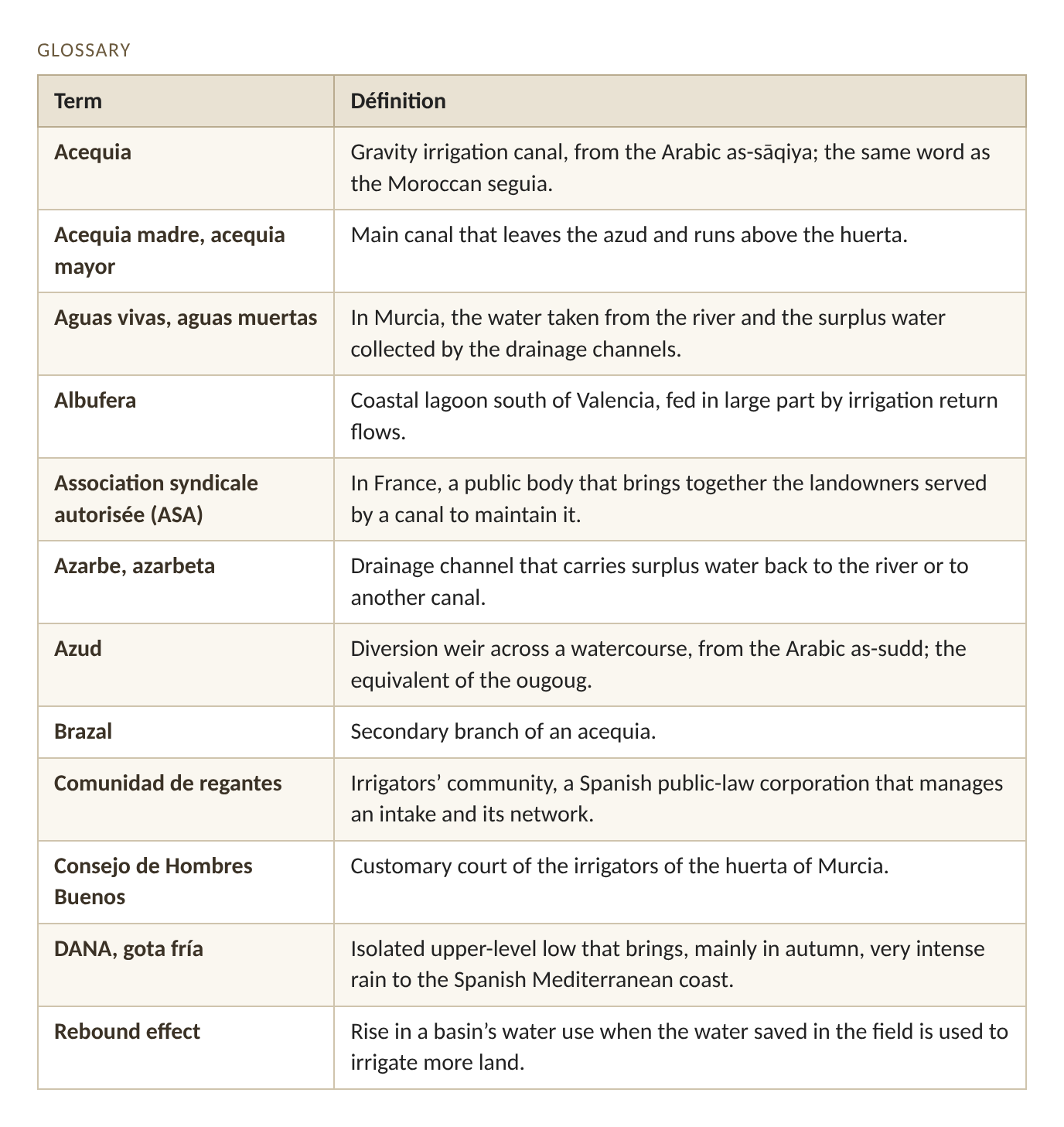
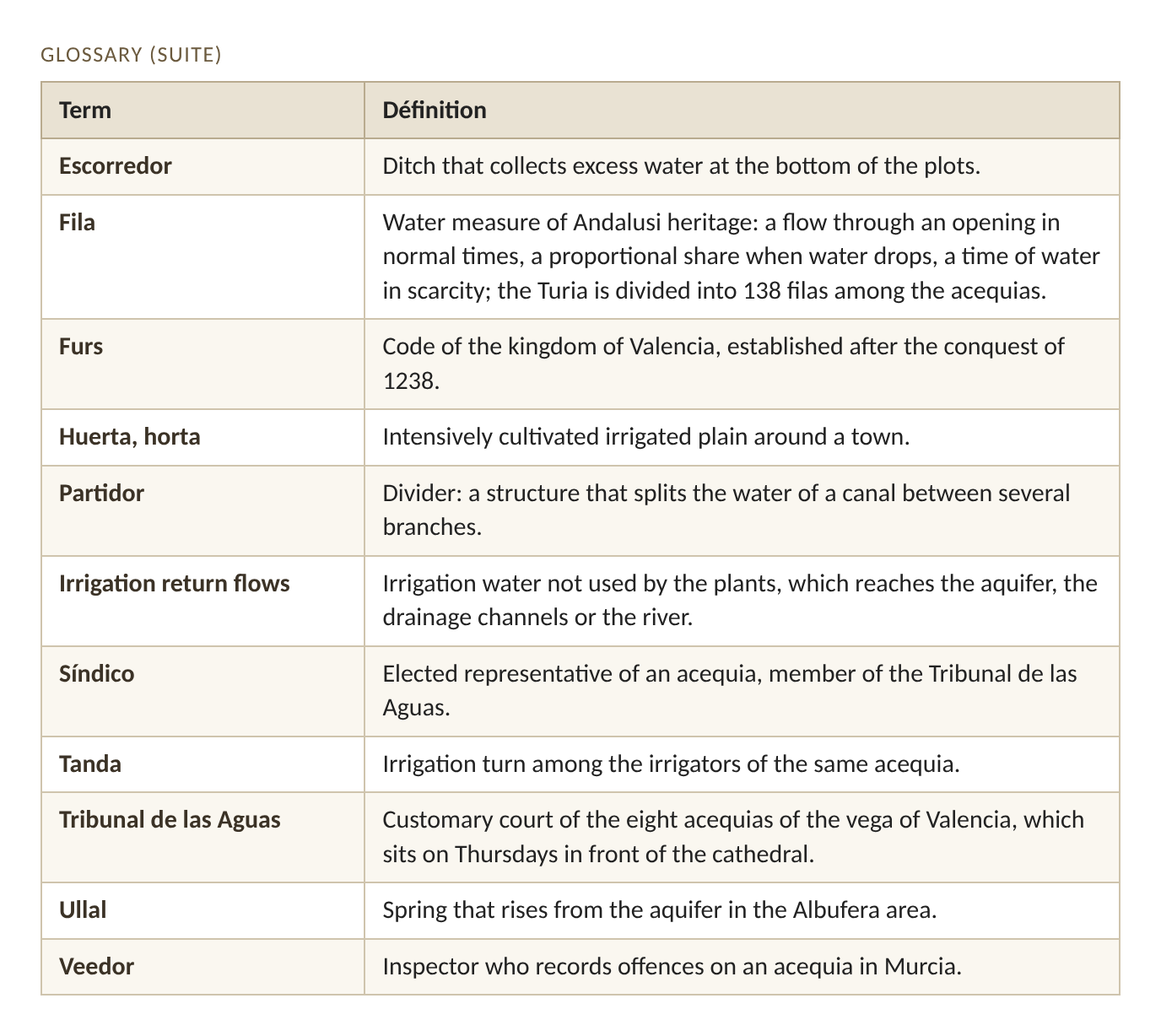
References
Conway A., 12/04/2025. Pugna legal por las acequias de la huerta de Murcia. elDiario.es.
López-Gunn E., Mayor B., Dumont A., 2012. Implications of the modernization of irrigation systems. In Water, Agriculture and the Environment in Spain, Fundación Botín, ch. 19.
Carmona González P., 1997. La dinámica fluvial del Turia en la construcción de la ciudad de Valencia. Documents d’Anàlisi Geogràfica 31, 85-102.
1957 Valencia flood. Wikipedia (en).
Maldita.es, 11/12/2024. El desvío del Turia tras la riada de 1957.
Cátedra L’Horta de València, Universitat de València. City vs crops.
Tribunal de las Aguas de Valencia, 2026. Official brochure.
Agencia Estatal de Meteorología (AEMET), 2024. Informe sobre el episodio de precipitaciones de la DANA del 29 de octubre de 2024. Madrid.
Bonet Zapater F., 26/12/2024. DANA 29 de octubre de 2024 en la Comunidad Valenciana. iAgua.
Bartual L., 17/06/2026. Ni arrasada ni recuperada : qué revelan los estudios sobre la Albufera tras la dana. El Salto Diario.
Ministerio de Agricultura, Pesca y Alimentación, 17/02/2026. Press release on the repair of the acequias of the Tribunal de las Aguas after the DANA.
Hermosilla Pla J., García Patón J., Aparicio Vayà J. V., Berenguer Sala J., 2025. Análisis territorial de la afección de la DANA 29-O en los sistemas de regadío tradicionales de l’Horta Sud. Cuadernos de Geografía de la Universitat de València 114-15, 279-302, doi 10.7203/CGUV.114-15.32300.
Pérez Gago M., Ballesteros Navarro B., García Menéndez O., Grima Olmedo J., López Gutiérrez J. (IGME), n.d. Contenido en nitratos de las aguas subterráneas en la Plana de Valencia.
Ballesteros Navarro B. J., Navarro Odriozola J. O., 2022. Numerical modeling of a multilayer coastal aquifer in extreme drought (Plana de Valencia Sur). Boletín Geológico y Minero 133(1), 155-179, doi 10.21701/bolgeomin/133.1/010.
Montañana Palacios M., Tormo Esteve S., n.d. Los azudes del Turia en la Vega de Valencia. GE-IIC.
Navarro Caballero T. M., 25/05/2017. Gobernanza tradicional de recursos en cuencas deficitarias. iAgua.
Acequia Mayor Aljufía. Wikipedia (es).
Región de Murcia, Patrimonio cultural. Acequia Mayor Alquibla. Record no. 35.
Navarro Caballero T. M., n.d. Gobernanza tradicional de recursos en cuencas deficitarias. iAgua, blog.
Perales Ferrer A. et al., 2013. Tribunal de las Aguas y Acequia de Benacher y Faitanar. Revista Jurídica Valenciana 30, 145-149.
Tribunal de las Aguas de Valencia. Pages on the acequias Favara, Mestalla, Tormos.
Esquilache Martí F., 2015. La cuestión de la proporcionalidad en la distribución del agua de riego. El caso de la acequia de Favara (huerta de Valencia). In Sanchis Ibor C. et al. (coord.), Irrigation, Society and Landscape. Tribute to Thomas F. Glick, Valencia, Universitat Politècnica de València, 50-69, doi 10.4995/ISL2014.2014.151.
Esquilache Martí F., 2021. La « fila » de agua valenciana y otras medidas de aforo. La verdadera naturaleza de un sistema de medición de caudales de origen andalusí. Espacio, Tiempo y Forma, Série III, Historia Medieval 34, doi 10.5944/etfiii.34.2021.28668.
Tribunal de las Aguas de Valencia. History.
Gran Enciclopèdia Catalana. Tribunal de les Aigües de València.
Ayuntamiento de València. Catálogo de Bienes y Espacios Protegidos de Naturaleza Rural, fiche AH_01, Real Acequia de Moncada.
Acequia Real de Moncada. Wikipedia (es), accessed 4 November 2026.
Generalitat Valenciana, 2005. Resolución de 30 de marzo de 2005 (opening of the intangible heritage listing procedure for the Tribunal de las Aguas). BOE no. 114, 13/05/2005, 16338-16340.
Glick T. F., 1970. Irrigation and Society in Medieval Valencia. Cambridge (Mass.), Belknap Press of Harvard University Press, ch. XI, « Proportional Distribution and the Measuring of Water », from p. 207 (the khaiṭ, p. 227); appendix 8, « Division of the Barada River in 125 H. (742/743 A.D.) », p. 264 ; on 1321, p. 66 and 119.
FAO. Valencia historical irrigation system. GIAHS.
Cátedra L’Horta de València, Universitat de València. Tribunal de las Aguas : organización y funcionamiento.
Faldzinska K. K., n.d. Resolución de los conflictos del agua a través de los tribunales consuetudinarios. El Consejo de los Hombres Buenos de la Huerta de Murcia. Cátedra del Agua y la Sostenibilidad, Universidad de Murcia.
Constitución Española de 1978, art. 125. BOE.
Ley Orgánica 13/1999, de 14 de mayo. BOE, 15/05/1999.
Carpi Abad M. V., 2005. De los tribunales consuetudinarios de aguas (comentario de la STC 113/2004). Revista de Administración Pública 168.
UNESCO, 2009. Irrigators’ tribunals of the Spanish Mediterranean coast. Décision 4.COM 13.70.
Ministerio de Agricultura, Pesca y Alimentación, 2019. La FAO declara el regadío histórico de l’Horta de València como SIPAM.
Pérez Pérez E., n.d. Disposiciones decimonónicas sobre aguas. Ley de 1879. MAPA.
Real Decreto Legislativo 1/2001, de 20 de julio, texto refundido de la Ley de Aguas, arts. 81 and 82. BOE.
iAgua. FENACORE.
Kingdom of Morocco, 2016. Law no. 36-15 on water, promulgated by dahir no. 1-16-113 of 10 August 2016, Bulletin officiel no. 6506.
Soria J. M., Vicente E., 2002. Estudio de los aportes hídricos al parque natural de la Albufera de Valencia. Limnetica 21(1-2), 105-115.
Confederación Hidrográfica del Júcar, 2003. Aportaciones hídricas a l’Albufera, informe complementario.
Sanchis-Ibor C., Manzano-Juárez J., García-Mollá M., 2024. Towards a new efficiency paradigm for drip irrigation ? Changes in water allocation and management in irrigation and wetland systems. Agricultural Systems 216, 103910, doi 10.1016/j.agsy.2024.103910.
Berbel J., Expósito A., Gutiérrez-Martín C., Mateos L., 2019. Effects of the Irrigation Modernization in Spain 2002-2015. Water Resources Management 33, 1835-1849, doi 10.1007/s11269-019-02215-w.
Hardy L., Garrido A., 2012. Challenges and opportunities related to the Spanish water-energy nexus. In De Stefano L., Llamas M. R. (dir.), Water, Agriculture and the Environment in Spain : can we square the circle ?, Fundación Botín, chap. 14, p. 179.
Fernández Lop A. (WWF España), 2022. Falsas expectativas de uso sostenible del agua en las cuencas mediante la modernización del regadío en España.
Ministerio de Agricultura, Pesca y Alimentación, 05/07/2023. Los sistemas de riego eficiente alcanzan el 79 % de la superficie regada total (ESYRCE 2022).
Fernández Lop A., 17/01/2023. La modernización de regadíos no impide la sequía en las cuencas. iAgua.
Sese-Minguez S., Boesveld H., Asins-Velis S., van der Kooij S., Maroulis J., 2017. Transformations accompanying a shift from surface to drip irrigation in the Cànyoles Watershed, Valencia, Spain. Water Alternatives 10(1), 81-99.
American Heritage Dictionary. Acequia.
Cátedra L’Horta de València, Universitat de València. Azudes.
Càtedra L’Horta de València, Universitat de València. Tribunal de les Aigües : història.
Guinot E., Esquilache F., 2017. Not only peasants : the myth of continuity in the irrigation communities of Valencia, Spain, in the medieval and early modern periods. Continuity and Change 32(2), 129-156, doi 10.1017/S0268416017000194 (abstract and notes 10, 31, 42, 50 and 52).
Burke E. III, 1974. Compte rendu de Glick T. F., Irrigation and Society in Medieval Valencia (Harvard University Press, 1970). International Journal of Middle East Studies 5(4), 501-503, doi 10.1017/S0020743800025605.
Bazzana A., Guichard P., 1981. Irrigation et société dans l’Espagne orientale au Moyen Âge. In L’homme et l’eau en Méditerranée et au Proche-Orient. I. Séminaire de recherche 1979-1980, Lyon, Maison de l’Orient, p. 115-140 (Travaux de la Maison de l’Orient, 2). Persée, mom_0766-0510_1981_sem_2_1_1155.
Butzer K. W., Mateu J. F., Butzer E. K., Kraus P., 1985. Irrigation agrosystems in eastern Spain : Roman or Islamic origins ? Annals of the Association of American Geographers 75(4), 479-509.
Barceló M., Kirchner H., Martí R., Torres J. M., 1989. Sistema de regadío y asentamientos andalusíes en la estribación sur de la Sierra de Cazorla. In Cara Barrionuevo L. (ed.), El agua en zonas áridas : arqueología e historia. I Coloquio de Historia y Medio Físico, Almería, Instituto de Estudios Almerienses, p. 169-178.
Poveda Sánchez A., 1997. Estudio de dos casos de hidraulismo andalusí localizados en el Alto Maestrazgo (Castellón). In Pérez Picazo M. T. (dir.), El agua en los regadíos mediterráneos. Nuevos enfoques y problemas, Áreas. Revista Internacional de Ciencias Sociales 17, Université de Murcie, p. 13-29.
Barceló M., 1986. La qüestió de l’hidraulisme andalusí. In Barceló M., Carbonero M. A., Martí R., Rosselló-Bordoy G., Les aigües cercades (Els qanat(s) de l’illa de Mallorca), Palma, Institut d’Estudis Baleàrics, p. 9-36 ; reprinted in Spanish: La cuestión del hidraulismo andalusí, in Barceló M., Kirchner H., Navarro C., El agua que no duerme. Fundamentos de la arqueología hidráulica andalusí, Granada, El Legado Andalusí, 1996, p. 13-47 (passages used p. 16-17; see also p. 76 of the same volume).
Kirchner H., 2024. The archaeology of field systems in al-Andalus. Agronomy 14(1), 196 ; version abrégée : Irrigation in al-Andalus, Encyclopedia (MDPI), entrée 54452.
Glick T. F., 1996. Irrigation and Hydraulic Technology : Medieval Spain and its Legacy. Aldershot, Variorum.
Guichard P., 1998. Compte rendu de Glick T. F., Irrigation and Hydraulic Technology : Medieval Spain and its Legacy (Aldershot, Variorum, 1996). Technology and Culture 39(3), 564-566, doi 10.1353/tech.1998.0018 (extrait public).
Glick T. F., 1995. From Muslim fortress to Christian castle : social and cultural change in medieval Spain. Manchester, Manchester University Press, p. 64-91 (cited by Guinot and Esquilache 2017, notes 11 and 29).
Beltrán Lloris F., 2006. An irrigation decree from Roman Spain : the Lex rivi Hiberiensis. Journal of Roman Studies 96, 147-197.
Esquilache F., 2021. La distribución tradicional del agua del río Turia entre las acequias de la Huerta de Valencia : un sistema de origen bajomedieval. Historia Agraria 85, 71-97, doi 10.26882/histagrar.085e05e.
Volubilis. Archaeological Mission and Conservation of the site of Volubilis, « L’histoire de Volubilis » (volubilis.lparchaeology.com), accessed 4 November 2026.
Clément-Mullet J.-J. (transl.), 1864-1867. Le livre de l’agriculture d’Ibn-al-Awam (Kitab al-Felahah). Paris, A. Franck, 2 tomes en 3 volumes.
Llibre del Repartiment (Valencia). Wikipedia, via Wikiwand.
Generalitat Valenciana. Llibret del Tribunal de les Aigües.
Kirchner H., 1997. Observaciones a propósito de la hidráulica andalusí. In Morilla Critz J., Gómez-Pantoja J., Cressier P. (ed.), Impactos exteriores sobre el mundo rural mediterráneo. Del Imperio Romano a nuestros días, Madrid, Ministry of Agriculture, Fisheries and Food, Serie Estudios 137, p. 139-162.
Kirchner H., 1995. Colonització de lo Regne de Mallorques qui és dins la mar : la subversió feudal dels espais agraris andalusins a Mallorca. In Sénac Ph. (ed.), Histoire et archéologie des terres catalanes au Moyen Âge, Perpignan, p. 279-316 ; cited in Kirchner H., Oliver J., Vela S., 2002, Aigua prohibida. Arqueologia hidràulica del feudalisme a la Cerdanya, Bellaterra, Universitat Autònoma de Barcelona, note 35.
Valera Lozano A., Añó Vidal C., Sánchez Díaz J., 2011. Anales de Geografía de la Universidad Complutense 31(2), 177-191, doi 10.5209/rev_AGUC.2011.v31.n2.37016.
Romero J., Melo C., 2015. Spanish Mediterranean Huertas : theory and reality in the planning and management of peri-urban agriculture and cultural landscapes. WIT Transactions on Ecology and the Environment 193, 585-595, doi 10.2495/SDP150501.
Valencia Plaza, 18/02/2025. La Generalitat asegura que ninguna zona agrícola va a dejar de serlo tras la disolución del Consell de l’Horta.
Observatorio del Patrimonio Histórico Español, Universidad de Granada, n.d. Iniciativa legislativa popular per l’Horta.
El Temps, juillet 2001. La Iniciativa Legislativa Popular per l’Horta, n° 890, 34-35.
Ley 5/2018, de 6 de marzo, de la Huerta de València. BOE no. 96, 20/04/2018, consolidated text.
Tribunal Constitucional, 2025. Recurso de inconstitucionalidad n.º 3276-2025 contra el Decreto-ley 4/2025 de la Generalitat Valenciana. Boletín Oficial del Estado, 5 June 2025, BOE-A-2025-11199.
ACUAMED, 2007. Informe de viabilidad, actuación 3.2.h : reordenación de la infraestructura hidráulica de la Huerta y red de saneamiento del área metropolitana de Valencia. MITECO.
Martín M., Hernández-Crespo C., Andrés-Doménech I., Benedito-Durá V., 2020. Fifty years of eutrophication in the Albufera lake (Valencia, Spain) : causes, evolution and remediation strategies. Ecological Engineering 155, 105932, doi 10.1016/j.ecoleng.2020.105932.
MITECO, 15/07/2021. Presentación del Plan hidrológico del Segura 2022-2027.
MITECO, 15/04/2021. Actualización de actuaciones en el Mar Menor.
Ministerio para la Transición Ecológica y el Reto Demográfico. Mar Menor : problemática actual.
MITECO, MAPA, 12/09/2023. Informe de seguimiento de la sequía.
Téllez B., Ripoll O., Pascual R. (AEMET), 10/08/2024. 2021-2023 : análisis de la sequía en Cataluña. Aemetblog.
Cressier P., 2006. Géométrie des réseaux et marqueurs des territoires : l’image du partage de l’eau dans le paysage médiéval (Espagne et Maroc). Mélanges de la Casa de Velázquez 36(2), Le partage de l’eau (Espagne, Portugal, Maroc), 39-59, doi 10.4000/mcv.1957.
Héritier-Salama V., 2019. Canaux anciens et puits récents : usages de l’eau d’irrigation, identité et territoire dans le Haouz (Maroc). Développement durable et territoires 10(3), doi 10.4000/developpementdurable.15758.
Navarro Palazón J., Garrido Carretero F., Torres Carbonell J. M., 2013. El Agdal de Marrakech. Hidráulica y producción de una finca real (ss. XII-XX). In II Encuentros Internacionales del Mediterráneo, Murcie, 19-21 avril 2013, p. 62-69.
Martínez Martínez M., 2017. En defensa de la huerta de Murcia : las primeras « Ordenanzas » en el siglo XIV. Estudios sobre patrimonio, cultura y ciencias medievales 19(2), 875-926.
Kingdom of Morocco, 1990. Law no. 02-84 on agricultural water user associations, promulgated by dahir no. 1-87-12 of 21 December 1990, Bulletin officiel no. 4081 of 16 January 1991.
Benouniche M., Kuper M., Hammani A., 2014. Mener le goutte à goutte à l’économie d’eau : ambition réaliste ou poursuite d’une chimère ? Alternatives Rurales 2, doi 10.60569/2-a4, novembre 2014.
Ministry of Agriculture, Maritime Fisheries, Rural Development, Water and Forests (Morocco), 2023. Fonds de développement agricole : les aides financières de l’État pour la promotion des investissements agricoles, 2023 edition, p. 8-10 (joint order no. 1323.22 of 18 May 2022, B.O. no. 7107 of 11/07/2022).
Ordinance no. 2004-632 of 1 July 2004 on landowners’ associations (associations syndicales). Journal officiel de la République française.
Prefecture of Pyrénées-Orientales, 2023. Water use restriction orders of 23 February and 10 May 2023.
SYMCRAU, 2025. Stakeholder paper no. 31, Fos Berre Provence public debate. Commission nationale du débat public, July 2025.