Argania spinosa, relic of a refuge and companion of humankind since prehistory
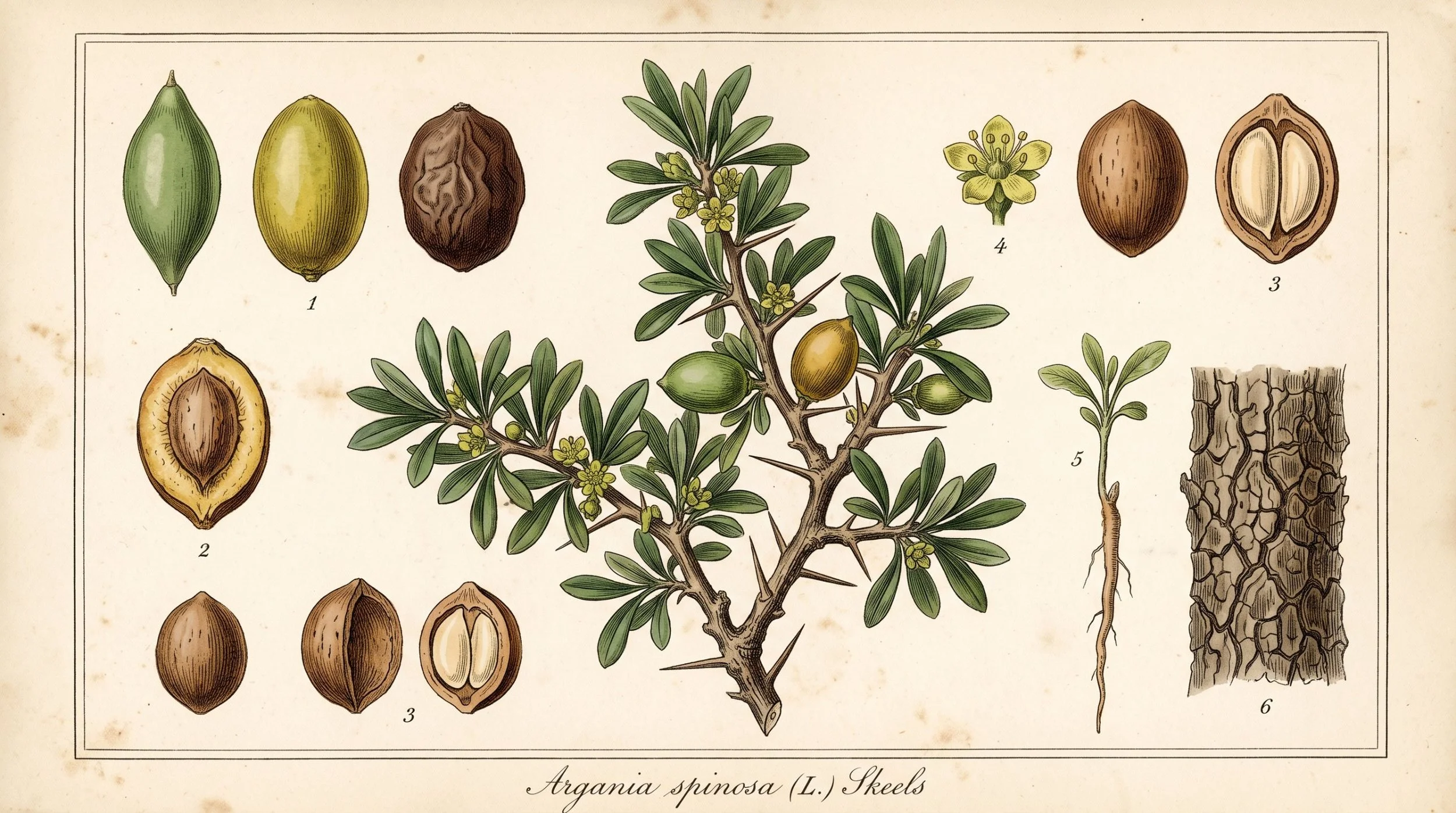
Plate generated by AI (Gemini, October 2026), in the style of a nineteenth-century naturalist engraving.
Millions of years ago, the lineage of this tree grew on the shores of the Mediterranean. Today it holds on in a single corner of Morocco. And it is still waiting.
Argania spinosa (L.) Skeels belongs to the Sapotaceae, a family of pantropical affinity whose living members are concentrated in sub-Saharan Africa, tropical America and South-East Asia. Since a phylogenetic study published in 2014 merged the genus Argania into the genus Sideroxylon, the Royal Botanic Gardens, Kew, have used the name Sideroxylon spinosum L., the very name Linnaeus gave it in 1753: the tree has taken a long detour through nomenclature only to return to where it started. The presence of this isolated species in the Maghreb, the only member of the Sapotaceae in Morocco, is a remarkable biogeographical anomaly, which palaeobotany sheds light on without yet fully resolving.
A legacy of the Tertiary
The fossil record does not tell everything, but it tells the essentials. Fossil seeds of Sideroxylon, cousins of the argan tree, have been identified in late Miocene and Pliocene deposits in Italy, between six and three million years old. These plants grew under the humid climates of the Neogene, and they closely resemble Sideroxylon mascatense, a small tree of the dry mountains of western Asia that botanists regard as the sister species of the argan. The lineage therefore once occupied a far wider area than today, at a time when the Mediterranean rim carried dry forests of tropical affinity.
For the argan tree itself, one must be more cautious than popular texts often are. Its pollen appears sporadically in Quaternary sediments, and data from the late Pliocene even suggest that it then occupied a smaller area than it does today. Researchers read this as an ancient endemism, established before the Quaternary, rather than as the trace of a great argan forest covering the whole of the Maghreb.
The gradual drying linked to the expansion of the Sahara, then the cold phases of the Quaternary, probably got the better of the lineage across almost all of its European and Mediterranean range; this is a plausible scenario rather than a demonstrated mechanism, and it concerns the genus more than the species. The argan is thus what biogeographers call a relict taxon: the geographically confined survivor of a lineage whose past extent was incomparably greater.
Geography of a refuge
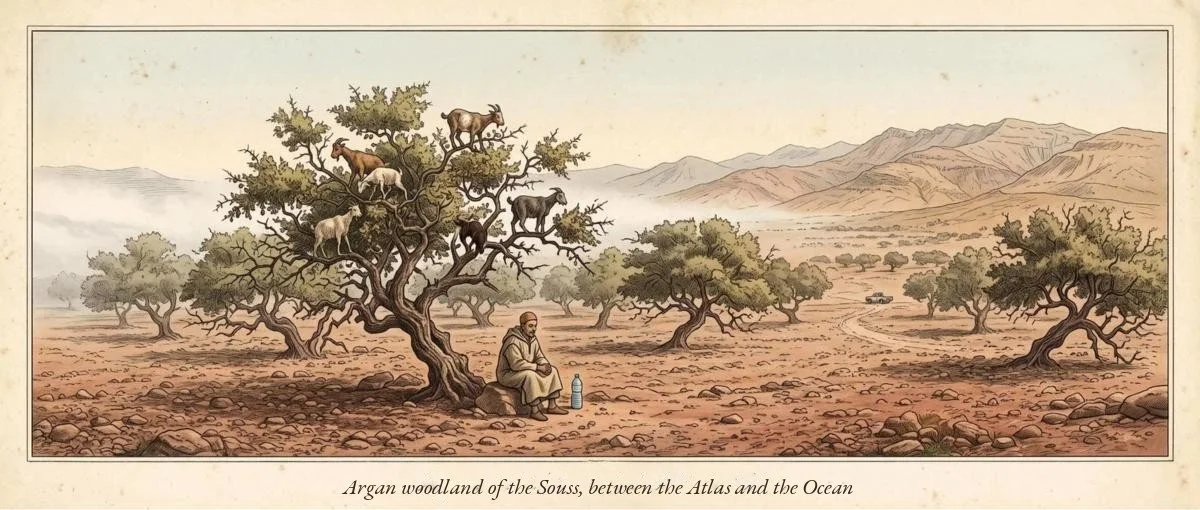
The present main range of Argania spinosa covers, according to estimates, between 800,000 and 950,000 hectares in south-western Morocco, from Safi in the north to the Draa river in the south, from sea level up to 1,300 or 1,500 metres, mainly in the Souss-Massa, Marrakech-Safi and Guelmim-Oued Noun regions. This distribution can be read as the effect of a mountain-ocean pairing: the High Atlas and the Anti-Atlas block part of the hot, dry Saharan air flows, while the Atlantic seaboard maintains a coastal humidity made of frequent fogs and low rainfall, between 150 and 400 millimetres a year. This pairing draws a climatic refuge unlike any other in the Maghreb.
This refuge is thinning out. One often reads that the argan woodland lost half of its area in a century, but I have found no measurement that establishes it. What has been measured is above all a fall in density: on a site in the Souss, Yann le Polain de Waroux and Eric Lambin counted 27 trees per hectare in 1970 and 15 in 2007, a loss of 44 per cent, due to firewood, grazing and cultivation. A 2022 study covering thirty sites finds, on the contrary, recruitment and mortality almost in balance between 1972 and 2018. The diagnosis therefore depends on the place, and it deserves better than a single figure.
Outside Morocco, the tree survives naturally only in Algeria, where its presence has been established since the work of René Maire in 1939. The largest population occupies the hamada of Tindouf, in the heart of the western Sahara, where Algerian foresters describe it as an exceptional botanical heritage, threatened by grazing and by cutting for charcoal. A few trees are also reported at Stidia, near Mostaganem, on the Oran coast. These populations are probably the witnesses of a former, more easterly distribution, and Algeria has in recent years committed to planting programmes.
Did the argan tree grow further north, in the coastal plains of the Loukkos and the Rharb? It has often been assumed, and the idea is appealing. It must nevertheless be said honestly: to my knowledge, no published pollen data attest to it in these plains. The hypothesis remains open, and it lies at the heart of a mythological question we will come back to.
The architecture of symbioses
Faced with the aridity of its sanctuary, Argania spinosa has not only developed its own morphological adaptations. It relies on a network of biological relationships that multiply its ability to acquire resources in poor, stony soils.
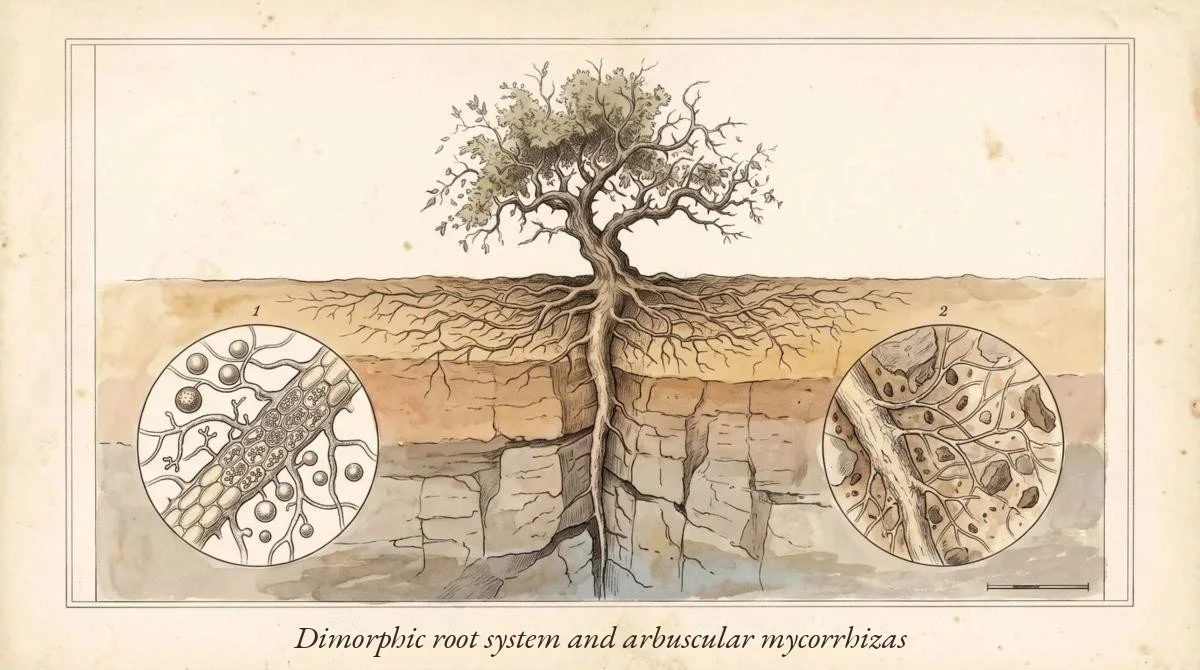
Mycorrhizal symbiosis is the first of these alliances. The roots of the argan associate with Glomeromycete fungi, forming arbuscular mycorrhizas: a Moroccan study from 2022 recorded 39 morphotypes, dominated by the genus Glomus. Their filaments, a few micrometres across, extend the roots a few centimetres into the soil and fetch phosphorus, which the alkaline pH and low organic matter make scarce. In the nursery, the dependence of young plants is clear, and an inoculum taken from the local argan woodland gives better results than a foreign one; in the field, measurements are still lacking.
The argan tree is often associated with desert truffles, and here what is established must be separated from what remains a lead. Truffles of the genus Terfezia live in association with small annual rockroses, including the spotted rockrose, now named Tuberaria guttata, and this association, closer to an endomycorrhiza than to a classic ectomycorrhiza, has been obtained experimentally. But I have found no study documenting this trio under the argan; Tuberaria guttata also prefers acid sands, whereas argan woodland soils are often alkaline, and Morocco's main desert truffle areas lie outside the argan woodland. Conversely, an experiment published in 2022 showed in the greenhouse that argan seedlings could be colonised by another desert truffle, Tirmania nivea. What is certain is that the shade and moisture maintained under the canopy help establish plants that would not survive in full sun: ecologists speak of a facilitation effect, or nurse effect. The precise link with truffles remains to be observed in the field.
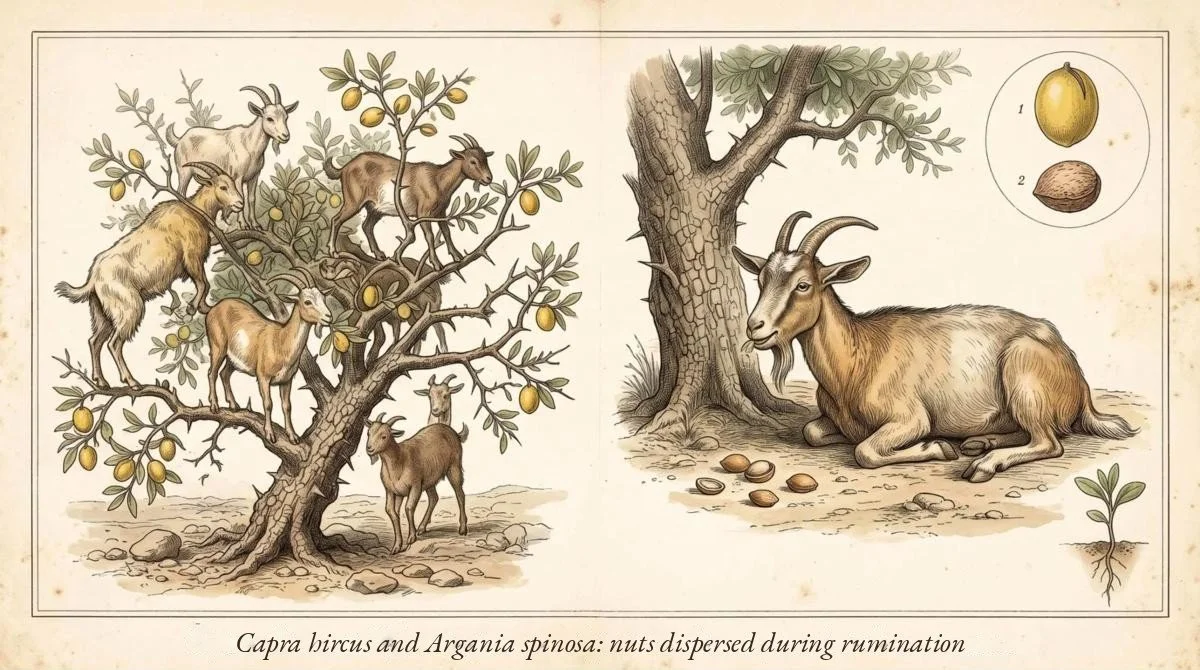
The relationship between the argan tree and the goat is more complex, and more instructive still, than popular accounts usually present it. In 2017, Miguel Delibes, Irene Castañeda and José Fedriani, of the Doñana Biological Station, published in Frontiers in Ecology and the Environment a natural history note showing that goats do not disperse the argan as was believed, through their droppings, because they pass large seeds poorly. They disperse it by spitting out the clean nuts while chewing the cud, often far from the tree where they fed. This mode of dispersal had been largely overlooked by ecologists. Herders, for their part, had known the gesture for a long time, as we will see with a twelfth-century geographer.
To call this interaction a symbiosis, however, would be inaccurate. In autumn, when the rest of the vegetation is scarce, goats spend about three quarters of their grazing time in the canopies, and browsing is one of the main causes of poor regeneration in argan woodlands, along with the near-total gathering of nuts for oil, cutting for firewood, land clearing and drought. What was, at low animal densities, an interaction favourable to dispersal becomes, under heavy grazing pressure, a brake on all young regrowth. The argan reminds us that ecological balances are not permanent states: they are temporarily stabilised power relations, which human and animal density can tip over.
The root system itself can finally be read as an alliance with the geology of the place. Botanists describe it as dimorphic: a taproot that goes down for deep water, combined with a network of spreading roots that captures rain at the surface. One reads everywhere that this taproot reaches fifteen, even thirty metres, based on roots seen when wells were dug; I have found no published measurement to confirm it, and these figures should be kept as anecdotal reports. What has been measured, on the other hand, is that in summer the tree draws on deep water, out of reach of neighbouring plants. In severe drought it sheds much of its foliage, thereby reducing its transpiration, and turns green again with the first autumn rains. What the untrained observer takes for a dead tree is simply a tree that is waiting.
One hundred and forty thousand years alongside humans
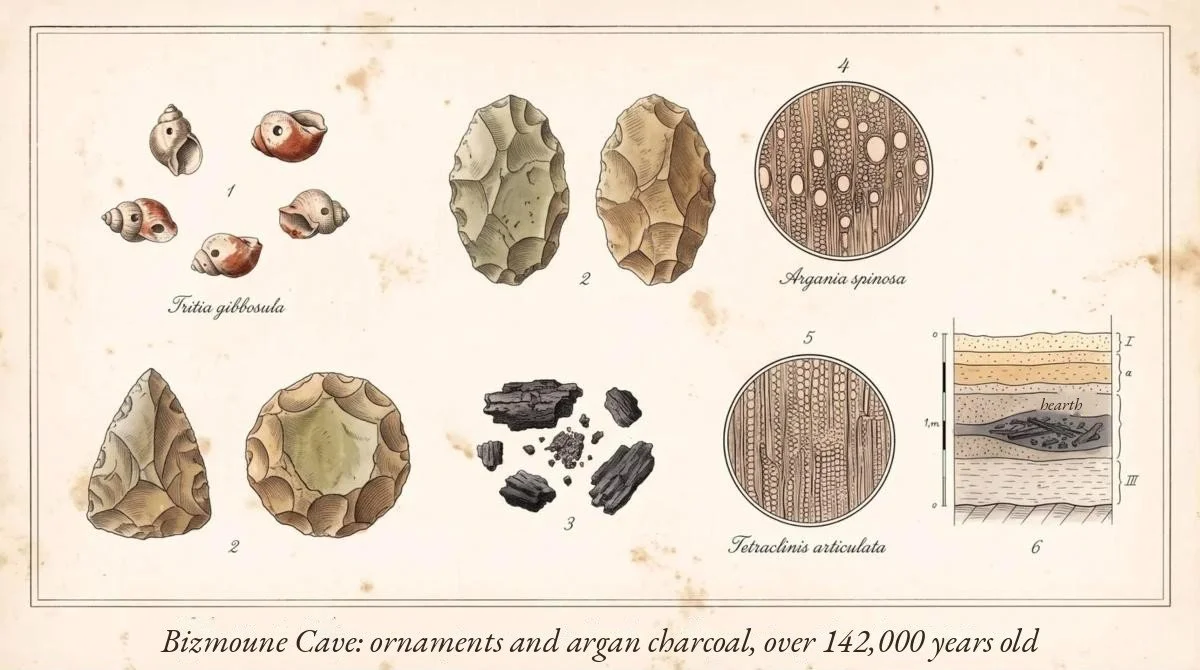
The argan tree did not wait alone. In 2021, a team from Morocco's National Institute of Archaeological Sciences and Heritage, the CNRS and the University of Arizona published the results of excavations at Bizmoune Cave, near Essaouira: pierced shells worn as ornaments, at least 142,000 years old, among the oldest known ornaments of humankind. According to the CNRS, throughout much of the sequence the charcoal in the hearths comes from argan and thuya, two trees that still grow around the cave. The occupants of the site were therefore already burning argan wood.
In November 2025, at Bayt Dakira in Essaouira, members of the same team announced that the argan tree had been constantly present in the local landscape since that time, and that it was used from prehistory onwards for food and cosmetic purposes. For now these are statements made at a conference, without a scientific publication: they should be welcomed with interest and awaited with firm expectations.
Marine sediment cores taken off Cape Ghir tell another part of the story. Between 650 and 850 CE, they record a sharp rise in soil eroded from the slopes, an increase in pollen from open, grazed habitats, and a decline in deciduous oak. The authors link this degradation to the rise of pastoralism, contemporary with the Islamisation of southern Morocco, hence the title of their article: "Vegetation change, goats, and religion". The same record shows, over the last hundred and fifty years, the joint spread of olive and argan cultivation, at the same time as the arrival of Australian eucalyptus.
The botanists who have studied these archives conclude that the present dominance of argan woodland in the landscape of south-western Morocco is largely of human origin. The species itself is far older than humanity; but its place in the landscape, its density and its form have become a human affair. The argan is a tree neither wild nor domestic, the pivot of a production system shaped by generations of farmers. I have often written about other plants: we think we have domesticated a species, and it is often the species that has used us to last and spread. The argan is a fine example.
A question then arises: how could such a precious product pass through Antiquity without leaving a single written record? Several reasons converge. Rome never held the argan country: Mauretania Tingitana stopped around Sala and Volubilis, and the Souss, the Haha and the Anti-Atlas remained outside the empire; the Phoenicians and later Juba had only an island trading post to the south, Mogador. The oil itself travelled badly: extracted from a paste mixed with water, it quickly went rancid, and it took considerable labour for small quantities, in a Mediterranean overflowing with olive oil. The know-how belonged to Amazigh women and was passed on from hand to hand, without writing. Even later, when Leo Africanus and then European travellers had described it, argan oil remained very little traded outside Morocco until the 1990s. This silence makes an ancient use plausible, but it does not prove it. The proof, if it exists, lies in the ground: cracked, charred nutshells in hearths, which would point to the extraction of the kernel, and oil residues in lamps.
What the Arab geographers tell us
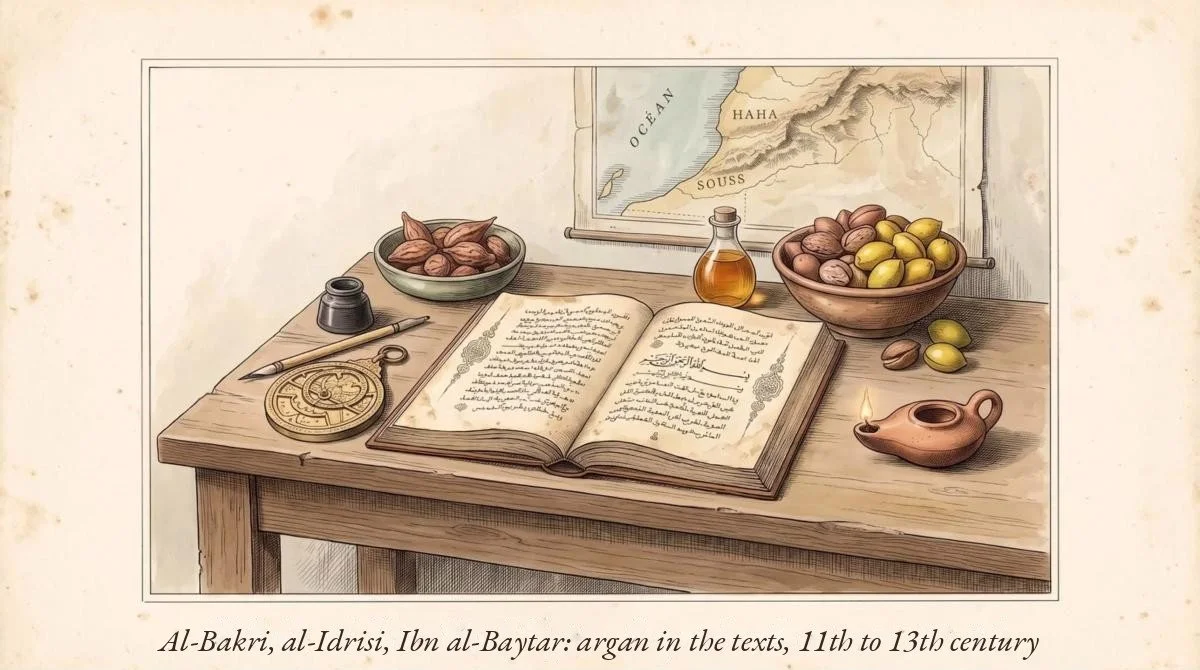
The first texts to speak of argan oil are Arabic, and they are precise. Around 1068, the Andalusian geographer al-Bakri, who never left al-Andalus and worked from the accounts of travellers and merchants, mentions argan oil and its extraction. In the twelfth century, al-Idrisi, geographer to the Norman court of Sicily, names the tree arqân and describes the harvest: the ripe fruits fallen to the ground are gathered in September, then given to the goats, which eat the pulp, and the stones are then collected from their troughs. The text does not say clearly whether the stones are spat out, but the herder's gesture is there, eight centuries before ecologists established its role in dispersal. Al-Idrisi notes that the oil gives the hair a glossy black; it is also used for lighting, according to him as to his successors. His contemporary al-Zuhri, who names the tree ardjân, makes the Souss the great centre of production, from where the oil goes to Aghmat and Marrakesh.
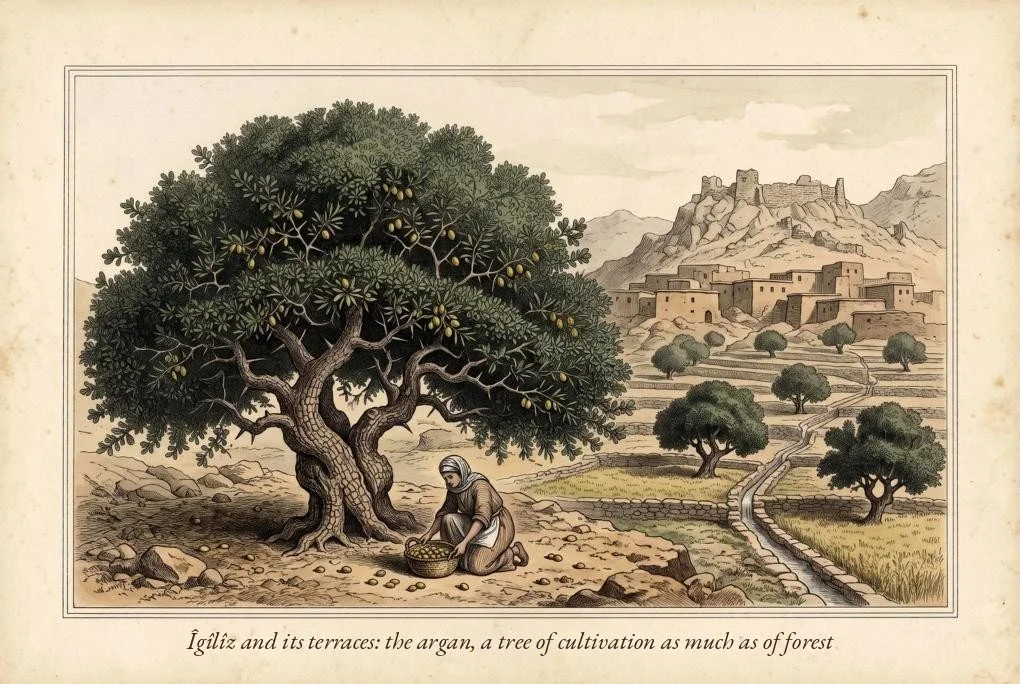
Archaeology confirms these texts. On the mountain of Îgîlîz, in the Anti-Atlas, at an altitude of 1,354 metres, the Moroccan-French archaeological mission that has been excavating the cradle of the Almohad movement since 2009 has yielded the oldest medieval argan remains identified in Morocco. Charred wood and seed shells dominate the deposits from the tenth to the thirteenth century: argan alone accounts for 82 per cent of the identified charcoal. An anatomical analysis of twenty of these charcoals, published in 2021 and presented by its authors as preliminary, suggests that fifteen come from trees managed in gardens or cultivated, manured terraces, rather than from wild trees. Eight centuries ago, the argan was therefore probably already, at least in part, a cultivated tree as much as a forest tree.
In the thirteenth century came the first botanist. Ibn al-Baytar, born in Málaga, trained by al-Nabati and dead in Damascus in 1248, devotes several entries of his Compendium of Simples to the tree he names ardjân, to its fruit, called the Berber almond, and to its oil. He places it in the country of the Haha and the Regraga, describes a fruit like a small yellow acorn, reports the method of extracting the oil and credits it with a virtue against long-standing deafness and earache. This text was translated into German by Joseph Sontheimer as early as 1840-1842, then into French by Lucien Leclerc between 1877 and 1883: what is sometimes presented as discovery had been in writing for six centuries.
Islamic law, too, turned its attention to the tree. A reported tradition holds that in the fifteenth century jurists of southern Morocco accepted that argan kernels could be paid as zakat, the legal alms, in place of barley; other ulama, on the contrary, exempted argan oil from zakat. The disagreement itself shows that the question arose, and that the argan counted in the economy of families.
Europe's gaze
In 1526, Hassan al-Wazzan, whom Europe would call Leo Africanus, completed his Description of Africa in Rome. Born in Granada and raised in Fez, he had travelled through the Haha country, near present-day Essaouira, a harsh region of rocky mountains, forests and small streams. There he describes thorny trees whose fruit, the size of Spanish olives, is called argan, and an evil-smelling oil used for cooking and lighting. The remark about the smell is not a traveller's fancy: traditional extraction, which mixes water into the paste, gave an oil that kept poorly. It would take until the end of the twentieth century and the mechanical screw press to obtain a stable oil of consistent quality.
Linnaeus described the species in 1753 under the name Sideroxylon spinosum, the thorny ironwood. According to the American botanist Homer Skeels, it had first been described from a plant grown in the garden of George Clifford, in the Netherlands, which was then thought to come from India. Between 1791 and 1793, the Danish botanist Peder Schousboe, who would later become Denmark's consul general in Tangier, travelled through Morocco to describe its flora and studied the tree on the spot; his observations, published in Copenhagen in 1800, are the first systematic description of the Moroccan flora. In 1809, the English merchant James Grey Jackson mentioned the argan in his account of the empire of Morocco and the Souss.
The name that prevailed in the twentieth century has a more unexpected origin. On 17 September 1910, the plant introduction service of the United States Department of Agriculture received argan seeds sent from Tangier by the American consul. It was in the inventory of these imported seeds, published on 27 November 1911, that Homer Skeels created the combination Argania spinosa. The tree's scientific name was born in a seed catalogue.
From forest to law, from oil to heritage
On 4 March 1925, a dahir enshrined the legal singularity of the argan woodland. Its preamble notes that the rights of use traditionally exercised by local people over argan trees do not allow the ordinary rules of the 1917 forestry dahir to be applied to these forests, and expressly proclaims that those rights are maintained. Whereas in other Moroccan forests local residents may only gather dead wood and graze, the right-holders of the argan woodland keep extensive uses of the trees, their fruit and the soil. The system rests on three pillars, the argan, the goat and barley, and on old local rules: in the Haha country, the agdal is a forest placed under protection, closed to herds for part of the year so that the fruit can ripen and fall.
The oil's second birth began in 1972, when the first description of its chemical composition appeared. From 1985, a vast project brought together chemists, agronomists, ecologists and economists around argan oil. The chemist Zoubida Charrouf, of Mohammed V University in Rabat, played a decisive role: from 1996 she helped set up the first women's cooperatives, the women having always been the guardians of this know-how. According to the Belgian development agency Enabel, the Tighanimine cooperative became in 2011 the first group of argan oil producers to be certified fair trade.
International recognition followed. UNESCO listed the argan woodland as a biosphere reserve in 1998, then the practices and know-how linked to the argan tree on the list of the Intangible Cultural Heritage of Humanity in 2014. In 2018, the FAO recognised the argan-based agro-sylvo-pastoral system of Ait Souab and Ait Mansour, in the province of Chtouka Ait Baha, as a Globally Important Agricultural Heritage System. On 3 March 2021, on Morocco's initiative, the United Nations General Assembly proclaimed 10 May International Day of Argania.
There is nevertheless a paradox in this success. Economists have shown that the wealth brought by the oil boom allowed some households to buy more goats, and the growth of herds in turn weighs on the regeneration of the trees. The value of the oil does not protect the tree by itself; it is the rules of use that can protect it.
The oil: what it contains, what it does, what we still do not know
After the history of the tree, the bottle must be opened. Argan oil is today one of the most expensive vegetable oils in the world, and one of the most surrounded by promises. Some are demonstrated, others plausible, many are sales talk. This chapter sticks to what laboratories measure and what trials in humans have tested.
Two oils, one kernel
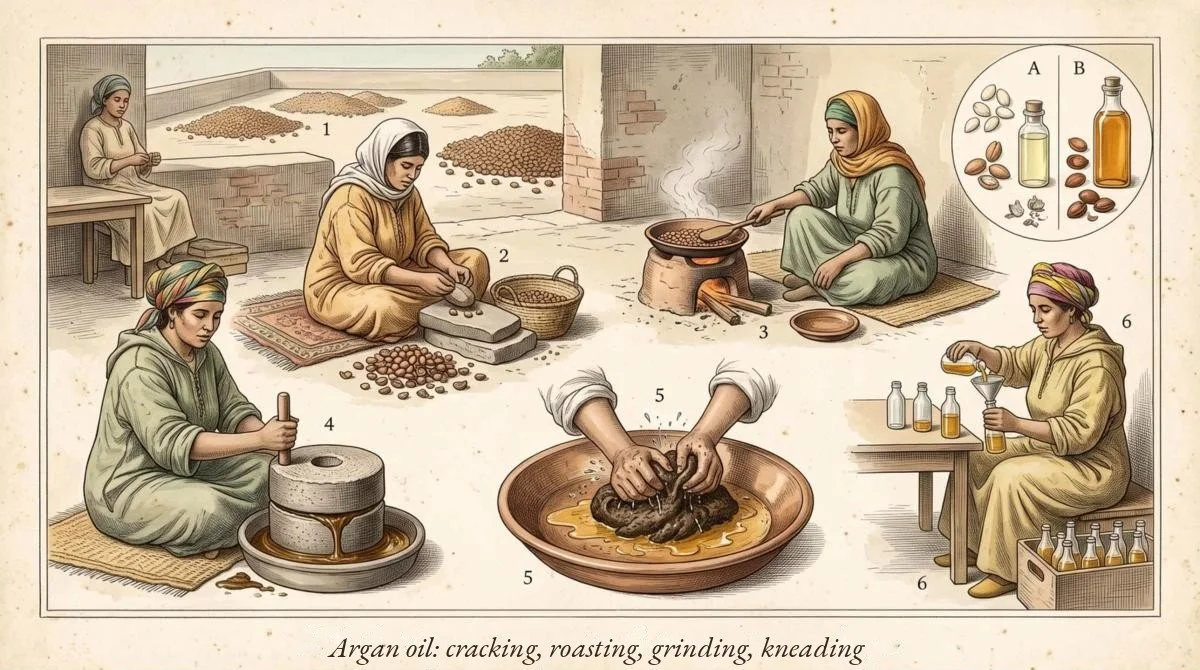
Two different oils are obtained from the kernel. Culinary oil is pressed after the kernels have been roasted, which gives it its amber colour and nutty taste; cosmetic oil is pressed raw. The traditional process, still practised in homes, is extraordinarily slow: from gathering the fruit to the oil, estimates range from twenty to nearly thirty hours of work for one litre, and a litre of oil represents only 2 to 3 per cent of the weight of the dried fruit. The water mixed into the paste limits its shelf life to a few weeks. The mechanical screw press, made widespread by the cooperatives, has made it possible to obtain a stable oil of consistent quality. A decree of 20 November 2009, in force from January 2010, created the protected geographical indication "Argane", reserved for oils produced in south-western Morocco under defined specifications, and the Moroccan standard NM 08.5.090 sets the quality criteria, including free acidity below 0.8 per cent for extra virgin oil and a peroxide value of no more than 15 milliequivalents of oxygen per kilo.
A composition like no other
In its fatty acids, argan oil sits between olive oil and seed oils. The Moroccan standard credits it with 43 to 49 per cent oleic acid, the dominant fatty acid of olive oil, but also 29 to 36 per cent linoleic acid, an essential omega-6 that olive oil usually contains at less than 10 per cent. Saturated fatty acids, palmitic and stearic, make up 16 to 20 per cent. Comparative analyses of forest argan trees, at Essaouira and Taroudant, and of a plantation in Casablanca, show that these proportions vary with the origin of the trees, by about five points for oleic acid.
Its real originality lies in its unsaponifiable fraction, which weighs only about 1 per cent of the oil but carries its signature. Tocopherols, that is vitamin E in its various forms, reach 600 to 900 milligrams per kilo, about twice as much as olive oil. Above all, more than four fifths of these tocopherols are gamma-tocopherol, whereas olive oil is dominated by alpha-tocopherol. They are two forms of the same vitamin: the gamma form traps certain reactive nitrogen species better, but the body preferentially retains the alpha form, and the benefit of gamma-tocopherol for human health has not been demonstrated.
The plant sterols are more unusual still. Olive oil and sunflower oil are dominated by beta-sitosterol; argan oil, by contrast, is dominated by two rare sterols, schottenol, which accounts for 40 to 49 per cent of its sterols depending on the analysis, and spinasterol, 33 to 44 per cent. This signature is so distinctive that it is now used to authenticate argan oil and to detect fraud by blending with cheaper oils. It is this same signature that would make it possible to recognise traces of argan oil in ancient lamps.
Two widespread ideas must also be corrected. Argan oil contains squalene, about 313 milligrams per 100 grams, but less than extra virgin olive oil, which contains nearly 500. And it is much poorer in polyphenols than olive oil: less than 5 milligrams per kilo in the reference analysis, against nearly 800 for an extra virgin olive oil. Its strengths lie elsewhere, in the gamma form of vitamin E and in its sterols.
What studies in humans show
On blood lipids, several Moroccan and Algerian studies point the same way. In 2004, a comparison of 96 healthy Moroccan adults showed that regular consumers of argan oil had LDL cholesterol 12.7 per cent lower, lipoprotein (a) 25 per cent lower and plasma lipoperoxides 58 per cent lower than non-consumers. This is an observational study: it finds an association, without proving the cause.
In 2012, in Tlemcen, 20 healthy adults consumed 15 grams of argan oil a day for four weeks, compared with 20 matched controls. Triglycerides fell by 21 per cent, total cholesterol by 15 per cent, LDL cholesterol by 16 per cent, and plasma vitamin E rose by 43 per cent. In 2013, in Rabat, 39 dyslipidaemic patients were randomly assigned to 25 millilitres of argan oil a day or to butter for three weeks. In the argan group, LDL cholesterol fell by 25.6 per cent against 10.4 per cent in the controls, HDL cholesterol rose by 26 per cent against 6.6 per cent, and platelet aggregation decreased.
The only trial that directly compares argan oil with extra virgin olive oil qualifies this picture. In 2005, 60 healthy men were randomly given 25 grams a day of one or the other for three weeks. With argan, HDL cholesterol rose by 8.4 per cent and triglycerides fell by 17.5 per cent, but LDL cholesterol did not fall significantly; with olive oil, it was LDL that fell, by 13.8 per cent. A meta-analysis published in 2020 by a team in Shiraz, Iran, pooled five trials: it concludes that apolipoprotein A, the protein of good cholesterol, rises and apolipoprotein B, that of bad cholesterol, falls, but these two results rest on only two studies, and the authors judge the trials included to be of low quality overall.
On the skin, a trial published in 2015 followed 60 post-menopausal women for 60 days: half consumed argan oil, the other half olive oil, and all applied cosmetic argan oil to the left forearm. Skin elasticity improved significantly, both through consumption and through application. It is one of the few controlled trials of a cosmetic effect.
Finally, on knee osteoarthritis, a Moroccan trial from 2017 involving 100 patients compared 30 millilitres of culinary argan oil a day for eight weeks with no treatment. Pain and joint function improved in the argan group, but the trial was open, without placebo, and its criteria, perceived pain and discomfort, are subjective: an expectation effect cannot be ruled out.
The antioxidant and anti-inflammatory effects often put forward rest mainly on laboratory and animal studies. A review published in 2025 in the journal Antioxidants judges them solid at this preclinical stage, and links them to the regulation of two major cellular pathways, Nrf2 and NF-κB, while acknowledging that direct evidence in humans remains limited.
The limits that must be stated
These results are encouraging, but they must be read with the same caution as the rest of this article. The trials are small, a few dozen people. They are short, three to eight weeks. They are generally not blinded, because the taste of argan oil is easy to recognise. The control is often butter, the usual diet or no treatment, which mechanically favours any good-quality vegetable oil. They measure markers, cholesterol or skin elasticity, not health events such as heart attacks. Finally, they come from a small number of Moroccan and Algerian research teams, often linked to one another, and none was registered in advance as good practice now requires. I have found no large trial or more robust meta-analysis published since 2020. No study therefore allows us to say that argan oil protects the heart better than olive oil, whose evidence rests on far larger trials.
Finally, argan oil is not harmless for everyone. Cases of contact eczema after skin application have been published, including one in an infant, as well as a case of anaphylactic shock. These reactions are rare, a repeated patch test on 54 volunteers having shown no irritation, but they exist, and argan oil should be avoided by people who have already reacted to it.
What can be stated is that argan oil is an excellent culinary oil, with an original composition, richer than olive oil in vitamin E and essential fatty acids, and whose consumption improves certain lipid markers in most of the available trials, without doing better than olive oil in the only trial that compares them directly. As for the rest, science is gradually confirming part of what the women of the Souss knew from use, without yet proving them entirely right or wrong.
A golden apple in the garden of the Hesperides
There is a hypothesis that deserves examination, not as a certainty but as an intuition, and it requires taking the myth from the beginning. Around 700 BCE, Hesiod, in his Theogony, places beyond the river Ocean, at the edges of the sunset, the Hesperides, daughters of Night, guardians of golden fruit and of the trees that bear them. Atlas stands before them and holds up the sky. Pherecydes, quoted by Hyginus, gives the origin of these fruits: Earth offered them to Hera for her wedding to Zeus, and Hera planted their branches near Mount Atlas, guarded by an immortal serpent, whom later poets call Ladon and whom sculptors showed coiled around the trunk. The theft of these fruits is one of the labours of Heracles, the eleventh or the twelfth depending on the list.
Where was the garden?
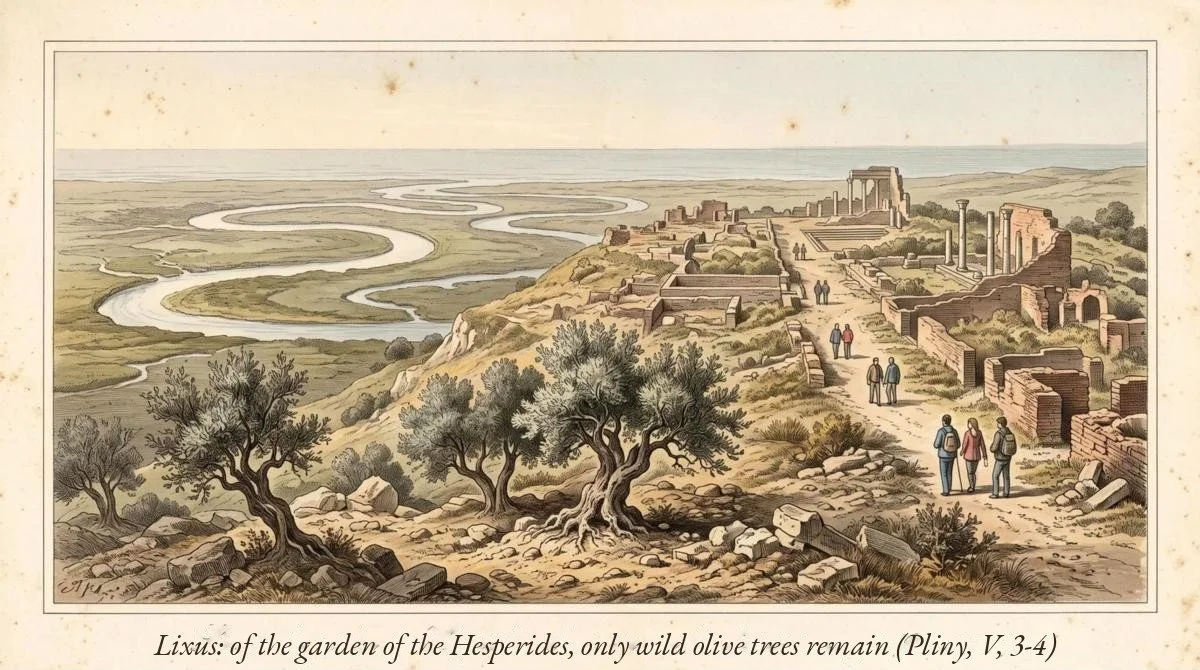
The Ancients never agreed. Euripides places it on the shore of Ocean, where Atlas carries the sky. Apollonius of Rhodes places it in Libya, near Lake Triton. The Greeks of Cyrene had fixed it near their city of Euhesperides, present-day Benghazi. Strabo reports that some poets located it in Iberia, and Apollodorus among the Hyperboreans. Pliny the Elder places it at Lixus, in the estuary of the Loukkos; elsewhere, reporting the navigator Statius Sebosus, he places islands of the Hesperides forty days' sailing along the Atlas, beyond the Gorgades, before concluding that none of this is certain. In a nearby passage, he mentions the islands that Juba had covered with purple-dye workshops opposite the Autololes, which are identified with Mogador, the island of Essaouira.
A trap must be avoided here. In Hesiod, Atlas is a Titan who carries the sky at the edge of the world, and not yet a mountain: only from Herodotus, in the fifth century BCE, does his name become attached to the mountains of north-west Africa. The garden of the oldest versions is therefore a cosmic place, that of the setting sun, rather than a geographical one. But when geography caught up with the myth, it led it towards Morocco, and it is at the foot of those mountains, between them and the Ocean, that the argan grows.
Pliny adds a detail about Lixus that is rarely quoted. On an island in the estuary stands an altar of Hercules, and of the famous grove that bore the golden apples, he says, nothing remains but wild olive trees. The Roman naturalist, who openly mocks the Greek fables about this place, therefore saw or heard described very real trees on the site of the garden, and they were oleasters, not argans. Lixus is, moreover, north of the argan's present range.
What was the fruit? Weighing the candidates
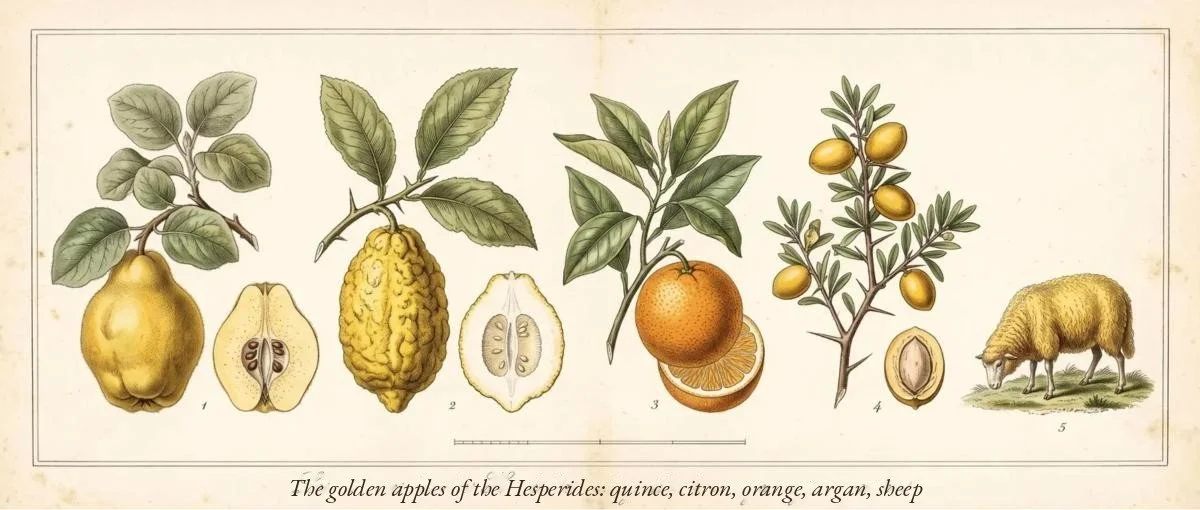
A false problem must first be set aside. The Greek word mêlon, translated as apple, referred to any round, fleshy tree fruit: a fruit's modest size does not therefore rule it out. Five candidates have been put forward over the centuries, and each deserves to be weighed.
The quince (Cydonia oblonga) is the classicists' candidate, and it has a strong argument in its favour. The golden apples were a wedding gift, and in Greece the quince was the fruit of marriage: Plutarch reports that a law of Solon required the young bride to eat one before entering the bridal chamber. It is golden when ripe, fragrant, and the Greeks knew it very early as the Cydonian apple, from Crete. Its weakness is geographical: it is a tree of the East, from the Caucasus and Iran, which nothing links to the sunset or to the Atlas.
The citron (Citrus medica) has a prestigious sponsor. According to Athenaeus, Juba II, king of Mauretania, reported that the Libyans called the citron the Hesperian apple, and identified it with the apples of the Hesperides. The testimony of a king of the argan country carries great weight. But Juba was writing around the turn of the era, some seven centuries after Hesiod, at a time when the citron had become the exotic luxury fruit of the Mediterranean. Yet this citrus, native to the foothills of the Himalaya, is attested in the eastern Mediterranean only in the Persian period, in the fifth and fourth centuries BCE, in a royal garden near Jerusalem. It cannot have founded a myth already established in Hesiod's time. Juba did what every age does: he recognised in the myth the precious fruit of his own time.
The sweet orange is later still, since it only became established in Europe at the end of the Middle Ages. But the Renaissance associated it so closely with the mythical garden that botany has kept the trace: the fruit of citrus is still called a hesperidium. It is proof that each century repainted the golden apples in the colours of its own treasure.
Sheep offer the strangest reading. Diodorus Siculus reports an interpretation according to which mêla meant not fruit but sheep, the same Greek word meaning both apple and sheep: the golden apples would have been flocks with golden fleeces, and the dragon a shepherd named Drakon. The myth would then speak of pastoral wealth. One cannot help thinking that, in the argan country, flocks and golden fruit are literally found in the same tree.
The argan tree, finally, has several features that make it appealing. It grows at the foot of the geographers' Atlas, on the shore of the Ocean, at the end of the world known to the Greeks. Its fruit, oval, green then yellow when ripe, is a mêlon in the Greek sense. It is a thorny tree, defended by its thorns as the garden was by its dragon, and its twisted trunk bears a bark that the archaeobotanists of Îgîlîz themselves compare to a snakeskin; the image is tempting, but the serpent guarding the tree is a very widespread motif in the ancient Near East, and a bark could at best only have reinforced it. The tree lives for several centuries and turns green again after droughts that leave it for dead. Its fruit yields a precious oil, liquid gold in the literal sense. And this fruit has never left its country: a fruit one must go to the end of the world to fetch, as in the myth.
A layered hypothesis
The most likely explanation is that no single fruit is the key, and that the myth formed in layers. The oldest layer is cosmic and Greek: the golden light of the sunset, the daughters of Night, Hera's wedding, nourished by the image of the quince, the wedding fruit. One can imagine a western layer, and this is where pure hypothesis begins, with no source to support it: that of the stories Phoenician navigators, settled at Lixus since at least the eighth century BCE, might have brought back from a land at the foot of the mountains, where a thorny tree bore golden fruit from which a precious oil was drawn, among the flocks. The following layers were added by each age with the luxury fruit it knew: Juba's citron, the Renaissance orange. If this western layer existed, the argan could be its fruit.
The limits of this intuition must be set out before they are raised against it. Looking for the real fruit behind a myth is doing what Diodorus already did with his sheep, and many classicists would see in it too literal a reading of a story that is first of all cosmological. No ancient text describes the argan or its oil. It is often repeated that the Phoenicians knew argan oil, but I have found no archaeological proof of it. No published pollen attests the argan in the plains of the Loukkos, and Pliny speaks of wild olives, not argans. Should these oleasters be seen as an argan misnamed by a Roman eye, the tree having a narrow leaf and a habit reminiscent of the olive? Nothing allows us to say so.
The hypothesis nevertheless has one merit: it can be tested. A pollen core in the Loukkos estuary would tell whether the argan grew at the foot of Lixus in Hesiod's time. Chemical analysis of lamps and ceramics from Lixus and Mogador, looking for schottenol and spinasterol, markers specific to argan oil, would tell whether the Phoenicians burned or transported it. It is up to palynologists and chemists to decide.
What the argan tree teaches us
The story of Argania spinosa illustrates a principle of landscape ecology: the long-term resilience of a species rarely depends on isolated adaptations, and almost always on a web of relationships. Glomeromycete mycorrhizas, facilitation of the plants under its canopy, a dimorphic root system and a refuge between mountain and ocean form a whole in which each component conditions the others. And when an outside pressure, grazing density, total gathering of the nuts, ploughing that severs the fungal networks, exceeds the resilience threshold of one of these links, the whole can tip over, often lastingly on a human timescale.
History adds a second lesson, which botany alone did not provide. Where the argan woodland has lasted, the people living beneath it managed it through rules: seasonal closure, recognised rights of use, trees managed in gardens and terraces. The evidence is mostly qualitative, but it converges: where the rule fades, the tree retreats, whatever the value of its oil.
For the designer of gardens in Mediterranean or arid settings, this is a whole work programme. Inoculate substrates before planting, but with a local inoculum, taken from the soil of an argan woodland or a healthy neighbouring habitat, rather than with a standard product: the viability of commercial inoculants varies greatly, and introducing foreign strains is not without risk, whereas trials on the argan show the advantage of native strains. Accept summer leaf drop as a survival strategy rather than an aesthetic failing. Treat the soil as a living network whose destruction cannot be repaired in a season. And plan management with those who live from the place, because a tree is protected first by the use made of it. The argan has come through the Tertiary, survived the drying of the world, burned in the hearths of Bizmoune, perhaps fed the oldest Western myth of abundance, and fed whole civilisations with its golden oil. It offers us the result of millions of years of free engineering. It is up to us to learn to read it.
Yves Nicolas, Expert Consultant in Functional Ecology, yvesnicolas.com, France / Morocco
#ArganTree #ArganiaSpinosa #FunctionalEcology #Morocco #Palaeobotany #PlantEngineering #Mycorrhizae #Souss #Lixus #HesperidesMyth #AridLandscape #PlantConservation #Agroecology #MoroccoNature #LandscapeEcology #MoroccanBotany #HistoryOfMorocco #YvesNicolas
Sources
Ros J., Terral J.-F., Ruas M.-P. et al. (2021). Understanding anatomical plasticity of Argan wood features at local geographical scale in ecological and archaeobotanical perspectives. Scientific Reports 11: 10830.
Ruas M.-P., Ros J., Terral J.-F. et al. (2016). History and archaeology of the emblematic argan tree in the medieval Anti-Atlas Mountains (Morocco). Quaternary International 404: 114-136.
Ruas M.-P., Tengberg M., Ettahiri A. S., Fili A., Van Staevel J.-P. (2011). Archaeobotanical research at the medieval fortified site of Îgîlîz (Anti-Atlas, Morocco) with particular reference to the exploitation of the argan tree. Vegetation History and Archaeobotany.
McGregor H. V., Dupont L. M., Stuut J.-B. W., Kuhlmann H. (2009). Vegetation change, goats, and religion: a 2000-year history of land use in southern Morocco. Quaternary Science Reviews 28: 1434-1448.
Delibes M., Castañeda I., Fedriani J. M. (2017). Tree-climbing goats disperse seeds during rumination. Frontiers in Ecology and the Environment 15 (4): 222-223.
Martinetto E., Manchester S. R., Barone Tosco R., Swenson U. (2025). Fossil seeds of Sideroxylon L. (Sapotaceae) from the Neogene of Europe and their relationships to extant species in Macaronesia and West Asia. Earth History and Biodiversity 4: 100028.
Sehasseh E. M., Fernandez P., Kuhn S., Bouzouggar A. et al. (2021). Early Middle Stone Age personal ornaments from Bizmoune Cave, Essaouira, Morocco. Science Advances 7 (39): eabi8620. CNRS INEE note on Bizmoune (argan and thuya charcoal); reports of the INSAP conference at Bayt Dakira, Essaouira, 23 November 2025 (Le Matin, Bladi).
Ibn al-Baytar, Traité des simples, French translation by Lucien Leclerc, Paris, Imprimerie nationale, 1877-1883; German translation by J. Sontheimer, Stuttgart, 1840-1842.
Leo Africanus, Description de l'Afrique (1526), translated by Épaulard, 1956.
Arganier et huile d'argan, Le Journal de botanique no. 27, 2004, pp. 3-8 (Persée).
Dahir of 4 March 1925 on the protection and delimitation of argan forests, Bulletin officiel of 17 March 1925 (FAOLEX).
Bejbouji J. et al. (2015). La connaissance des stratégies des Ihahan : une des principales portes d'entrée à la conservation de l'arganeraie. CIHEAM, Options méditerranéennes B 72.
Charrouf Z., Dubé S., Guillaume D. (2011). L'arganier et l'huile d'argane, d'Ibn Al-Baytar à nos jours. Glyphe.
Guillaume D., Charrouf Z. et al. (2018). The argan oil project: going from utopia to reality in 20 years. OCL 25 (2).
Skeels H. C. (1911). Argania spinosa (L.) Skeels, Bulletin of the Bureau of Plant Industry, USDA, 223 (Inventory 24): 50 (IPNI).
FAO, Argan-based agro-sylvo-pastoral system of Ait Souab and Ait Mansour (GIAHS, 2018); United Nations General Assembly, resolution A/RES/75/262 of 3 March 2021; Order no. 2816-09 of 20 November 2009 on the "Argane" PGI (FAOLEX, WIPO Lex).
Work published in Algerian university journals (Revue des BioRessources, 2012; 2013): the Tindouf argan woodland and the Stidia trees (Mostaganem).
Hesiod, Theogony, 215-216, 517; Apollodorus, Library, II, 5, 11; Hyginus, Astronomica, II, 3 (after Pherecydes).
Diodorus Siculus, Library of History, IV, 26; Athenaeus, Deipnosophistae, III, 83 (Juba's testimony on the citron); Plutarch, Life of Solon, 20.
Pliny the Elder, Natural History, V, 3-4 and 14; VI, 36-37; XIII, 29; XV, 7 (Littré translation, remacle.org).
Theoi Project, Hesperides, collection of ancient sources (theoi.com).
Rabbaa S., Bouchab H., Laaziouez Y. et al. (2025). Argan Oil: A Natural Bioactive Lipid Modulating Oxidative Stress and Inflammation. Antioxidants 14 (5): 515.
Sabiri M. et al. (2023). Nutritional Assessment and Comparison of the Composition of Oil Extracted from Argan Nuts Collected from a Plantation and Two Natural Forest Stands of Argan Trees. Forests 14 (2): 180.
Khallouki F. et al. (2003). Consumption of argan oil (Morocco) with its unique profile of fatty acids, tocopherols, squalene, sterols and phenolic compounds should confer valuable cancer chemopreventive effects. European Journal of Cancer Prevention 12 (1): 67-75.
El Maouardi M., Kharbach M. et al. (2023). Quality Control and Authentication of Argan Oils: Application of Advanced Analytical Techniques. Molecules.
Drissi A. et al. (2004). Evidence of hypolipemiant and antioxidant properties of argan oil derived from the argan tree (Argania spinosa). Clinical Nutrition 23 (5): 1159-1166.
Sour S., Belarbi M. et al. (2012). Argan oil improves surrogate markers of CVD in humans. British Journal of Nutrition 107 (12): 1800-1805.
Haimeur A., Messaouri H. et al. (2013). Argan oil prevents prothrombotic complications by lowering lipid levels and platelet aggregation, enhancing oxidative status in dyslipidemic patients from the area of Rabat (Morocco). Lipids in Health and Disease 12: 107.
Ghaseminasab Parizi M., Eftekhari M. H., Tabibzadeh S. M., Shafeei M., Mazloomi S. M. (2020). The Effect of Argan Oil on Surrogate Markers in Cardiovascular Diseases: A Systematic Review and Meta-Analysis. International Journal of Nutrition Sciences 5 (4): 159-166.
Boucetta K. Q., Charrouf Z., Aguenaou H., Derouiche A., Bensouda Y. (2015). The effect of dietary and/or cosmetic argan oil on postmenopausal skin elasticity. Clinical Interventions in Aging 10: 339-349.
Essouiri J., Harzy T. et al. (2017). Effectiveness of Argan oil consumption on knee osteoarthritis symptoms: a randomized controlled clinical trial. Current Rheumatology Reviews 13 (3): 231-235.
Astier C. et al. (2010). Anaphylaxis to argan oil. Allergy; Foti C. et al. (2014) and Barrientos N. et al. (2014), cases of contact eczema, Contact Dermatitis.
Stride G., Nylinder S., Swenson U. (2014). Revisiting the biogeography of Sideroxylon (Sapotaceae) and an evaluation of the taxonomic status of Argania and Spiniluma. Australian Systematic Botany 27: 104-118; Plants of the World Online (Kew), Sideroxylon spinosum L.
Le Polain de Waroux Y., Lambin E. F. Monitoring degradation in arid and semi-arid forests and woodlands: the case of the argan woodlands (Morocco). Applied Geography; Kirchhoff et al. (2022). Frontiers in Environmental Science (dynamics of 30 argan woodland sites, 1972-2018).
Sellal Z. et al. (2022). Arbuscular mycorrhizas of the argan tree, IntechOpen; Ouallal I. et al. (2018). Effects of native arbuscular mycorrhizae inoculation on the growth of Argania spinosa seedlings. Tree Planters' Notes 61 (1).
Khrizi H. et al. (2022). Mycorrhization of Argania spinosa seedlings by the desert truffle Tirmania nivea. PeerJ 10: e13769; Fortas Z., Chevalier G. (1992), mycorrhization of Helianthemum by Terfezia; World Flora Online, Tuberaria guttata (L.) Fourr.
Chakhchar A. et al. (2019). A review on the root system of Argania spinosa. Current Agriculture Research Journal 8 (1); Zunzunegui M. et al. (2018). Deep water use by the argan tree. Tree Physiology.
Derouiche A. et al. (2005). Nutritional intervention study with argan oil in man: effects on lipids and apolipoproteins. Annals of Nutrition and Metabolism 49 (3): 196-201.
Lybbert T. J., Aboudrare A., Chaloud D., Magnan N., Nash M. (2011). Booming markets for Moroccan argan oil appear to benefit some rural households while threatening the endemic argan forest. PNAS 108 (34): 13963-13968.
Enabel (Trade for Development Centre), profile of the Ibn Al Baytar project and the Tighanimine cooperative; Stroomer H., work on Amazigh texts relating to argan (Leiden University).
Jackson J. G. (1809). An Account of the Empire of Marocco and the District of Suse.