Or how a molecule four billion years old invented life, poisoned the planet, created the ozone layer, split animals from plants, and still works in silence beneath our feet
In the black water
First, close your eyes. Forget the blue sky, the grass, the birdsong. Forget the air we breathe. None of it exists yet. We are more than three billion years in the past, and the Earth looks like nothing we know.
Picture a vast ocean, with no shore, no beach, not a single shell on the seabed. Lukewarm water, almost warm, a dark green verging on black. Above it, a low sky, orange and brown, heavy with carbon dioxide, methane and water vapour. Not one white cloud, not one patch of blue. The sun barely pierces this thick haze, and when it does, its ultraviolet rays strike the surface unhindered, because there is no ozone layer to filter them. No ozone, because there is no oxygen. No oxygen, because nobody is making it yet.
In this dark water there are no fish, no seaweed, no jellyfish. Nothing visible to the naked eye. But if we could dip a microscope into this primordial soup, we would find something. Cells. Billions of cells, no bigger than a thousandth of a millimetre, membrane sacs with no nucleus, no organs, almost nothing. The first forms of life. They float, they divide, they die, they start again. And they are hungry.
Hungry for what? For everything, but above all for one element without which none of their essential molecules can exist. An element that makes up four fifths of the atmosphere above their heads, yet floats up there in a form as useless as treasure locked in a safe to which nobody holds the key.

Nitrogen.
Two atoms bound to each other by a bond so strong it could be compared to three steel cables braided together. In chemistry this is called a triple bond. In everyday language, it is a padlock that cannot be forced. And without nitrogen in a usable form, it is impossible to build the smallest protein, the smallest strand of DNA, the smallest enzyme. No nitrogen, no life. The baker has no flour. The oven is there, the water is there, the leaven is there, the salt is there, but without flour, there is no bread.
The invention of the key
And then, in one of these tiny cells, in the warm darkness of the Archaean ocean, something extraordinary appears.
A molecular mechanism of unheard-of daring. Two proteins bristling with iron and sulphur, fitted together like the two jaws of a vice, able to seize the molecule of atmospheric nitrogen, hold it still in their metal claws, twist its three steel bonds one by one, and turn it into ammonia, the simple form of nitrogen the cell can at last use to build its proteins, its DNA, its enzymes, its offspring.
Scientists call this little molecular forge nitrogenase. And it runs only on iron. Pure iron, dissolved in the black water of the primitive ocean, where it is abundant because nothing has rusted it yet. For iron to rust, you need oxygen. And there is no oxygen.
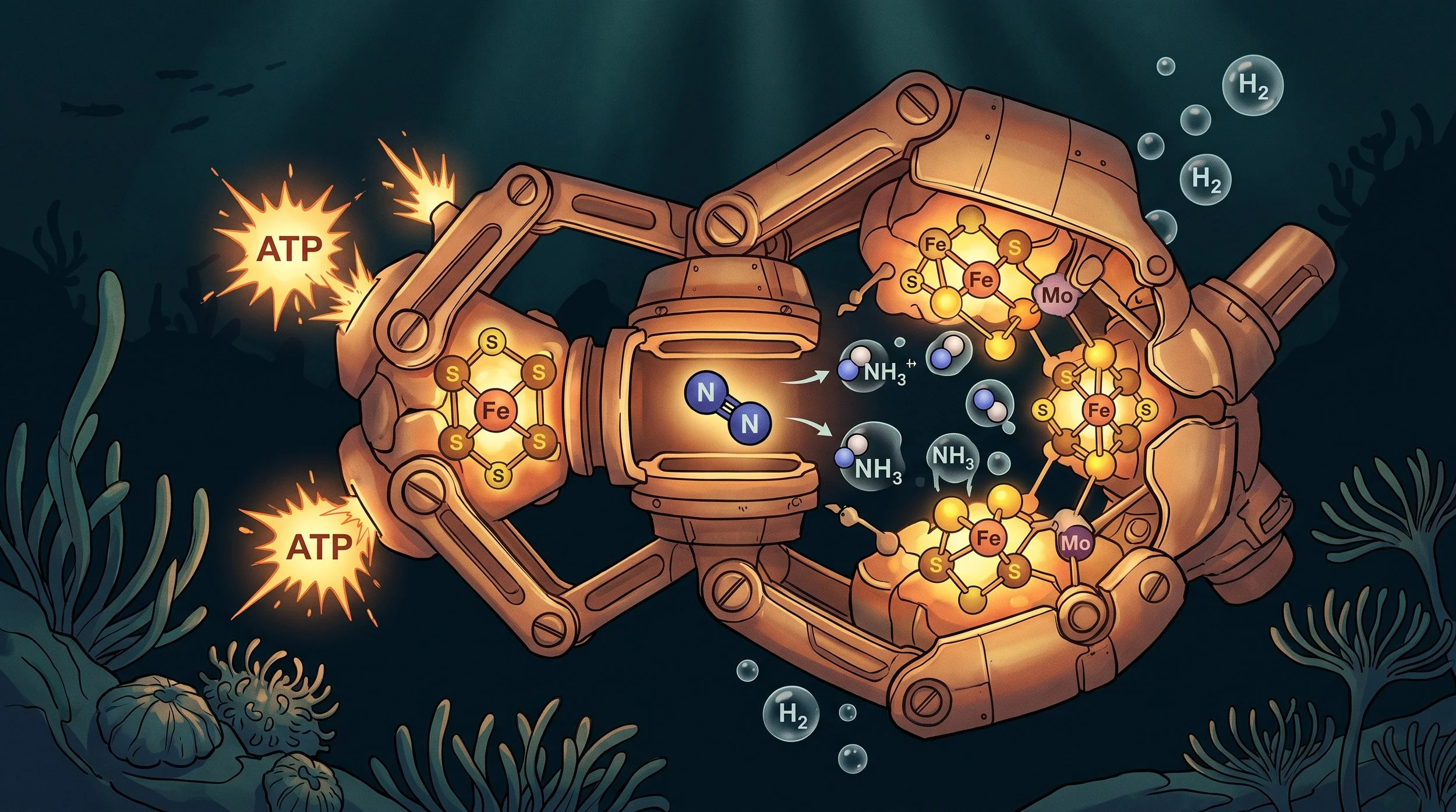
This is the key to the padlock. And the day it appears, everything changes.
Cells that hold this key have an immense advantage over all the others. They can make their own nitrogen building blocks from the gas floating above the ocean. They multiply. They colonise the warm waters. Molecule by molecule, generation after generation, they lay the nitrogen foundation of all life's chemistry on Earth. Every amino acid, every nitrogenous base, every protein that will ever exist on this planet descends from the nitrogen they tore out of the atmosphere with their little forge of iron and sulphur.
Without nitrogenase, the story ends there. No first protein. No first gene. No evolution. Nothing but water, salt and inert minerals for all eternity.
The price to pay
But this key does not come free. Far from it.
To break a single molecule of atmospheric nitrogen, nitrogenase uses a considerable amount of energy. Imagine having to strike sixteen matches to light one candle. That is roughly the ratio: sixteen molecules of ATP burned for a single molecule of N2 fixed. The forge works, but it is expensive in fuel. And as if that were not enough, every time it runs, the flame necessarily gives off a molecule of hydrogen, a by-product that some bacteria know how to recycle and others let escape into the water. We will see later that this apparently trivial detail has immense consequences.
The other weakness of nitrogenase is that it cannot tolerate oxygen. Not at all. Expose the forge to open air and it destroys itself within seconds. Irreversibly. Like the movement of a fine watch plunged into seawater.
In the primitive ocean, this was no problem. There was not one molecule of free oxygen on the whole planet. The forge could work in peace in its oxygen-free bath, safe from any risk.
But it was not going to last. And what followed is perhaps the greatest drama in the history of the Earth.
The rain of rust
About 2.7 billion years ago, a newcomer enters the stage in that same ocean. An ordinary-looking microbe, a cyanobacterium, discovers an unprecedented photochemical feat: using sunlight to split the water molecule and strip from it the electrons it needs to build its organic matter. This is the invention of photosynthesis as we know it, the kind every green plant practises today, from the moss on the woodland floor to the Californian redwood.
The trouble is that this reaction produces a waste product. A gas. Oxygen.
And oxygen is a poison. A violent, corrosive poison, able to oxidise everything it touches. The first living organisms, born in a world without oxygen, have no defence against it. And nitrogenase, the forge of iron and sulphur that made life possible, is one of its first victims.
For a long time, though, nothing happens. Or rather, something happens, but under water, in the dark, and nobody is there to see it.
The oxygen the cyanobacteria release does not rise into the atmosphere. It meets iron first. The primitive ocean is loaded with dissolved iron, ferrous iron, soluble, invisible, which has bathed in the black water for billions of years. Oxygen attacks this iron. It oxidises it. Ferrous iron becomes ferric iron, which is insoluble. It precipitates. It sinks to the ocean floor as fine particles of iron oxide.
Rust. An underwater rain of rust, slow, silent, unbroken.
Layer after layer, for hundreds of millions of years, this rust piles up on the ocean floor. It is compressed, it hardens, it turns into rock. These are the banded iron formations, alternating strata of red and black that are found today in the oldest rocks of Western Australia, South Africa, Brazil and Canada. Some of these formations are hundreds of metres thick. Each red layer bears witness to a season when the cyanobacteria photosynthesised more actively. Each black layer bears witness to a quieter season. It is the calendar of a planetary poisoning written in stone, as legible as the rings of a tree trunk.
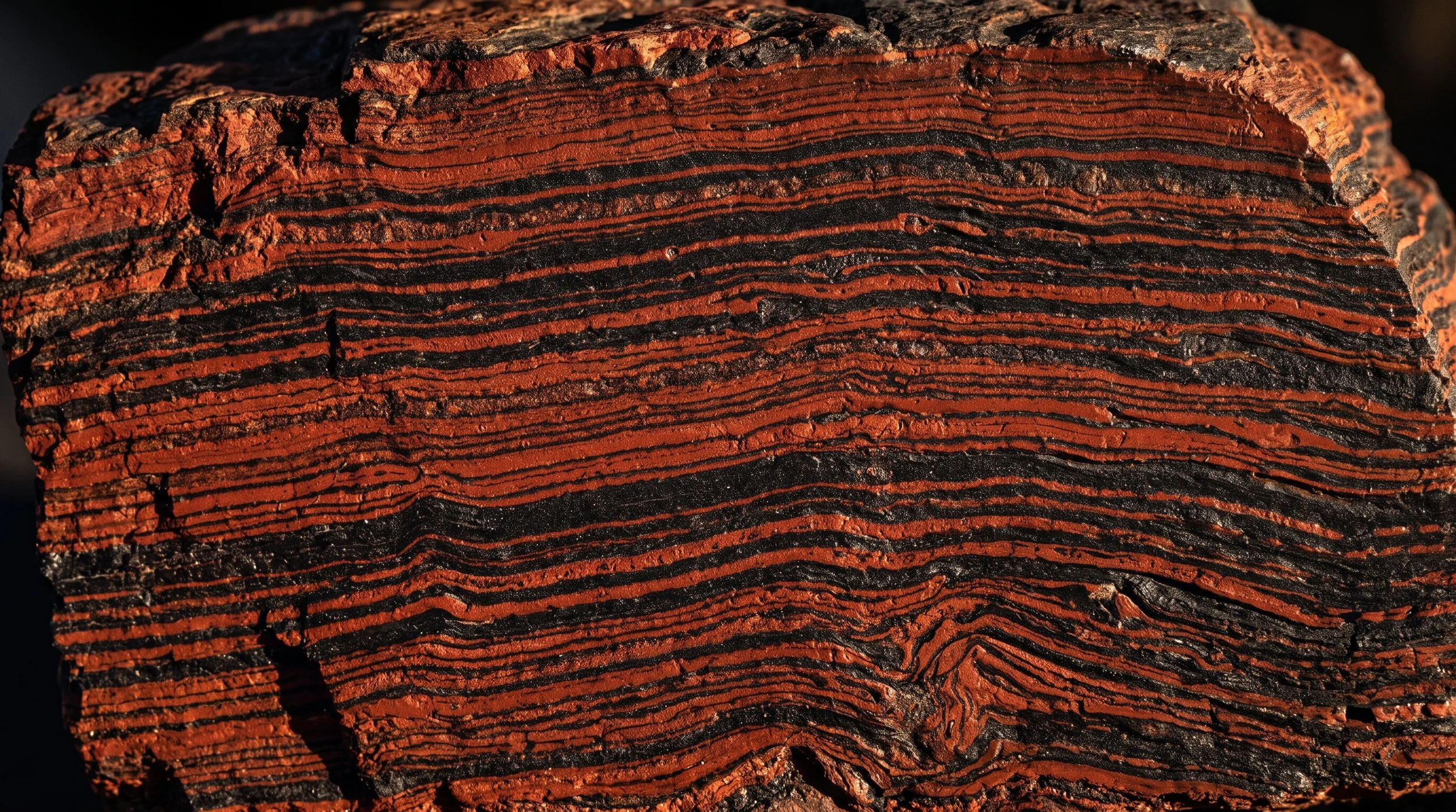
And all that iron rusting and sinking to the bottom is also the iron nitrogenase will soon lack to forge new keys. The forge needed iron. Oxygen takes it away.
The tipping point
Then, one day, the iron runs out. The ocean has absorbed all it can absorb. There is no dissolved ferrous iron left to capture oxygen. And the cyanobacteria have not stopped photosynthesising. They keep producing their gaseous waste, imperturbably, as they have for hundreds of millions of years.
Oxygen has no trap left. It begins to escape from the ocean. It rises. It reaches the atmosphere. Slowly at first, then faster and faster. This is what geologists call the Great Oxidation Event, about 2.4 billion years ago.
The atmosphere changes colour. The orange sky gradually turns blue. Methane, the gas that warmed the primitive planet like a blanket, is oxidised and breaks down. The Earth cools abruptly. The first massive glaciations cover the continents in ice, perhaps as far as the equator. This period is called Snowball Earth. It is the first planetary winter, and it is caused by a microbe less than a hundredth of a millimetre long.
But oxygen does not stop there. High in the atmosphere, under the sun's ultraviolet rays, oxygen molecules recombine into ozone. Three oxygen atoms instead of two. This ozone layer, thin as a veil, will change the planet's destiny. Ozone filters out the most destructive ultraviolet rays, the ones that break DNA, the ones that until then had stopped every form of life from venturing out of the water. As long as there was no ozone, the surface of the continents was sterilised by UV. No organism could survive there. Life was a prisoner of the ocean.
The ozone layer opens the prison. For the first time, dry land becomes habitable. In a few hundred million years, marine organisms will be able to colonise the continents. Mosses, ferns, forests, insects, amphibians, reptiles, mammals, ourselves: all of this is possible only because a cyanobacterium made enough oxygen to build an anti-UV shield in the upper atmosphere.
And it all begins with nitrogenase. Without nitrogenase, the cyanobacteria would not have had the nitrogen needed to build the proteins of their photosynthetic machinery. No nitrogenase, no efficient photosynthesis. No photosynthesis, no oxygen. No oxygen, no ozone. No ozone, no life on land. The key to nitrogen is also, indirectly, the key to the blue sky and to the shield that protects us from the sun.

The blacksmith's paradox
But here is the most extraordinary paradox of this whole story.
By inventing photosynthesis, the cyanobacterium produced the very poison that destroys nitrogenase. Yet nitrogenase is the tool it needs to feed itself on nitrogen. It is as if a blacksmith invented a new bellows so powerful that it melted his own tools. Progress threatens its creator.
How to get out of it?
Filamentous cyanobacteria find a solution of singular boldness. They invent specialisation. Within a single string of cells, some stop photosynthesising, thicken their walls the way you would brick up the windows of a workshop to shut it off from the outside, and devote themselves entirely to fixing nitrogen, in the dark, sheltered from oxygen. These cells are called heterocysts. Meanwhile, their neighbours go on capturing light and producing sugar.
Some make the bread, others make the flour, and everyone shares.
It is one of the oldest examples of division of labour in the history of life. A cyanobacterial filament is already, in its modest way, a collective organism, in which each cell gives up part of its abilities to serve the whole. Biological complexity was born of the need to protect an old enzyme from the new world its own family had created.
The great divide
But the story then takes a turn nobody could have foreseen.
About one and a half billion years ago, in an ocean now partly oxygenated, a cell larger and more complex than ordinary bacteria, a so-called eukaryotic cell, swallows a cyanobacterium. The way you would swallow an olive. But instead of digesting it, it keeps it alive inside itself. The captive cyanobacterium goes on photosynthesising, and the host cell benefits from the light energy its prisoner turns into sugars.
It is a forced partnership, but it will last. For billions of years. The captive cyanobacterium gradually loses its independence, hands part of its genes over to the host cell, and becomes what biologists call a chloroplast. The little green grain you see under the microscope in every cell of a leaf, a blade of grass or a seaweed is the great-great-granddaughter of that cyanobacterium swallowed in the black water of a vanished ocean.
And this is where the world splits in two.
The cells that captured a cyanobacterium become plants. They can make their food from water, carbon dioxide and light. They need to eat no one. They are self-sufficient. From them will come seaweeds, mosses, ferns, oaks, palms, wheat and wisteria.
The cells that did not capture a cyanobacterium stay in the dark. They cannot photosynthesise. They are condemned to eat in order to live. From them will come animals, fungi, amoebae. From them will come us.
The cyanobacterium is the crossroads. The roundabout of life. Those who took it on board became plants. Those who carried on alone became beasts. And ever since, the two worlds have never stopped talking to each other: one side makes organic matter and oxygen, the other consumes them and gives back carbon dioxide. The great cycle is closed.
The debt we never repaid
And nitrogenase in all this? It is still there. Faithful at its post. Unchanged in principle since the Archaean.
But here is the most astonishing fact of this long story: in four billion years of evolution, no plant, no animal, no fungus has ever managed to make its own nitrogenase. The enzyme has remained the exclusive preserve of bacteria. The safe holding atmospheric nitrogen still opens only with the same key, and that key belongs to prokaryotes alone. At least until very recently, for we will see later that this four-billion-year-old rule may be falling before our eyes, in the ocean, right now.
The plants that fix nitrogen, the clover in our meadows, the alder along the streams, the acacia of the savannah, the wisteria in the garden, never do it alone. They strike a deal with soil bacteria. They offer them lodging in a small swelling on the root, the nodule, and board in the form of sugars. In return, the bacterium runs the old forge and supplies the ammonia. And to protect nitrogenase from oxygen, the plant lines the inside of the nodule with a pink protein, leghaemoglobin, a cousin of the haemoglobin in our blood, which keeps around the forge an atmosphere ten thousand times poorer in oxygen than open air.
The pink nodule of a clover plant is the cyanobacterium's heterocyst reinvented by the plant world. The same constraint, the same solution, two billion years apart.
From the depths of time to the bottom of the garden
When I sow clover between rows of maize, when I let wisteria take over a pergola, when I combine alders with willows in a phytoremediation system, I am doing nothing other than drawing on this four-billion-year-old alliance. The nitrogenase of the Rhizobium bacterium working in the nodule of a white clover in my garden is the direct descendant of the primitive forge that ran in the Archaean ocean, before there was oxygen in the air, before there were plants on the continents, before there were continents at all.
Every molecule of ammonia it produces in the silence of a root links us to the very origin of life.
But this quiet miracle, this forge that has been running silently beneath our feet for four billion years, we have found a way to break. And not once. Twice.
The first blow: the fertiliser that puts out the forge
In 1909, the German chemist Fritz Haber found a way to break the triple bond of atmospheric nitrogen in a factory, at 500 degrees and 200 atmospheres of pressure. His partner Carl Bosch industrialised the process. Synthetic ammonia flowed freely. Modern agriculture was born.
What happens in the soil when mineral nitrogen fertiliser is spread?
Remember the contract between the plant and the bacterium: the plant feeds the bacterium sugars, and the bacterium runs the forge to supply it with ammonia. But this contract has an automatic termination clause. The plant is not generous by vocation. It feeds the bacterium only if it is short of nitrogen. The day nitrogen arrives free through the soil, as mineral fertiliser, the plant stops feeding its bacteria. Why pay a baker when someone delivers bread to your door?
The root nodules empty. The fixing bacteria die or stop working. Nitrogenase shuts down. The forge goes out.
Let us stop for a second on what this means. What we put out with a sack of white granules is not just one mechanism among others. It is the mechanism. The oldest. The most fundamental. The one without which life on Earth would simply never have existed.
Remember the story we have just walked through. More than three billion years ago, nitrogenase made the nitrogen in the air available to the first cells. Without it, no first protein, no first gene, no first organism. It fed the cyanobacteria that invented photosynthesis. Thanks to the nitrogen it supplied, those cyanobacteria could build the proteins of their photosynthetic machinery, produce oxygen, transform the atmosphere, and make the appearance of animals possible. Nitrogenase lies at the origin of the entire food chain. Plants grow because they have nitrogen. Herbivores eat plants. Carnivores eat herbivores. Fungi break down both. At every link, nitrogen is there, indispensable, and at the origin of every atom of biological nitrogen there was, at one time or another, a nitrogenase that tore it out of the atmosphere.
When a farmer spreads synthetic nitrogen fertiliser on a field, he is not merely feeding his crops. In the soil that carries them, he is putting out the mechanism that founded life on land. It is an act of dizzying scope, carried out in complete ignorance, repeated billions of times every year across the surface of the globe.
And the forge did not produce only ammonia. Every time it ran, it necessarily released a molecule of hydrogen. That hydrogen gas, diffusing through the earth around the roots, was not useless waste. It was a survival shield for the whole ecosystem.
Molecular hydrogen is one of the most powerful and smallest antioxidants in nature. It enters plant cells and instantly neutralises free radicals, the aggressive molecules that damage DNA and membranes. In soil polluted by heavy metals, in salty soil, in soil under drought, it is this continuous flow of hydrogen, produced by the nitrogenase of fixing bacteria, that lets pioneer plants survive where all others die. Alder colonises mine spoil heaps, elaeagnus grows by the sea, legumes cover bare ground after a fire: this is because their associated bacteria run the forge, and the forge produces the shield. And this shield does not protect only the fixing plant. Hydrogen diffuses into the surrounding soil, feeds neighbouring hydrogen-eating bacteria, stimulates the microbial community, and strengthens the resilience of every plant nearby, nitrogen fixers or not. The forge supplies the whole community, as it has always supplied the whole community of life since the Archaean.
When synthetic fertiliser puts out the forge, it also puts out the shield. And it cuts the link between the plant and the whole underground network around it. The plant receives its nitrogen by chemical drip, it no longer needs its bacterial allies, it stops feeding them, and the whole procession that depended on this alliance collapses in a cascade. The fixing bacteria. The hydrogen-eating bacteria that lived on the hydrogen. The mycorrhizal fungi that passed fixed nitrogen on to neighbouring plants. The soil microorganisms that thrived on the activity of the whole. The entire underground food chain, built patiently on the foundation of nitrogenase over millennia, collapses because the first link has been cut.
It is as if you switched off the sun and replaced it with a desk lamp. The lamp lights the sheet of paper just below it. But the forest, the field, the ocean, all the rest of the living world that depended on sunlight, is plunged into darkness.
And here is the cruellest, most visible consequence, the one every farmer sees without understanding its cause: a plant deprived of its hydrogen shield loses much of its ability to withstand drought. In living soil, where nitrogenase is running in the nodules of legumes, hydrogen diffuses constantly through the rhizosphere. This tiny gas enters root cells and neutralises the free radicals that water stress generates. When water runs short, plant cells suffer, their membranes oxidise, their metabolism breaks down. Hydrogen repairs this damage in real time. The plant bends, but does not break. It holds on for one more week, two more weeks, long enough for rain to come or for a morning dew to be enough to revive it.
Cut off the hydrogen supply, and the same plant, in the same soil, under the same drought, collapses. Its root cells oxidise with no defence. Its stomata slam shut. Its growth stops. It scorches where it stands while its neighbour, connected to a network of fixers, is still upright.
The proof is before our eyes, and it is so obvious that nobody looks at it.
Look at wisteria. Walk through any town in France at the height of summer, when the lawns turn yellow, when the roses droop, when the hydrangeas hang their heads and the gardeners bring out their hoses. Look at the wisteria. It is there, on the facades, on the pergolas, on the railings of public gardens. And it is magnificent. Its foliage is green, dense, lush. It is not thirsty. Nobody waters it. Nobody feeds it. It grows, it climbs, it takes over walls, lifts gutters, twists wrought-iron railings, and the heatwave does nothing to it.
Wisteria is a legume. Its roots bear nodules packed with Rhizobium bacteria that run nitrogenase at full throttle. For every molecule of nitrogen fixed, a molecule of hydrogen is released into the rhizosphere. The antioxidant shield works all the time. And this shield works in synergy with a root system of phenomenal mechanical power: wisteria can break through foundations, lift paving slabs, push into cracks in the rock to find water where other plants give up. Drilling roots and a hydrogen shield: it is the combination of the two that makes wisteria so defiant in a heatwave.
In Morocco it is even more striking. Wisteria grows in Rabat, in Meknes, in Marrakesh, in heat that would kill half the ornamental plants of Europe. It does not care. No watering, no fertiliser, no upkeep. You plant it, you forget it, and it thrives. Why? Because its inner forge runs non-stop, because its hydrogen shield never goes out, and because nobody has thought of giving it nitrogen fertiliser that would have shut the machine down.
And let no one say it is only a matter of roots. Other shrubs with deep roots and thick cuticles scorch where they stand in the first dry summer. Oleander, a badly established ornamental olive, photinia: they have strong roots, they have leathery leaves, and they suffer all the same. Wisteria does not. What makes the difference is not only root mechanics. It is the continuous synergy: drilling roots that go after water, a steady nitrogen supply that keeps the metabolism going, and a hydrogen shield that prevents cell oxidation in real time. Take away any one of these three, and wisteria would suffer like the others. But nobody takes them away, because nobody gives it nitrogen fertiliser.
Next time you see wisteria in a heatwave, green and vigorous next to a lilac that is scorching, remember what you have just read. It is not a question of a resistant variety. It is not a question of genetics. It is a question of nitrogenase and hydrogen. Wisteria has the forge. Lilac does not.
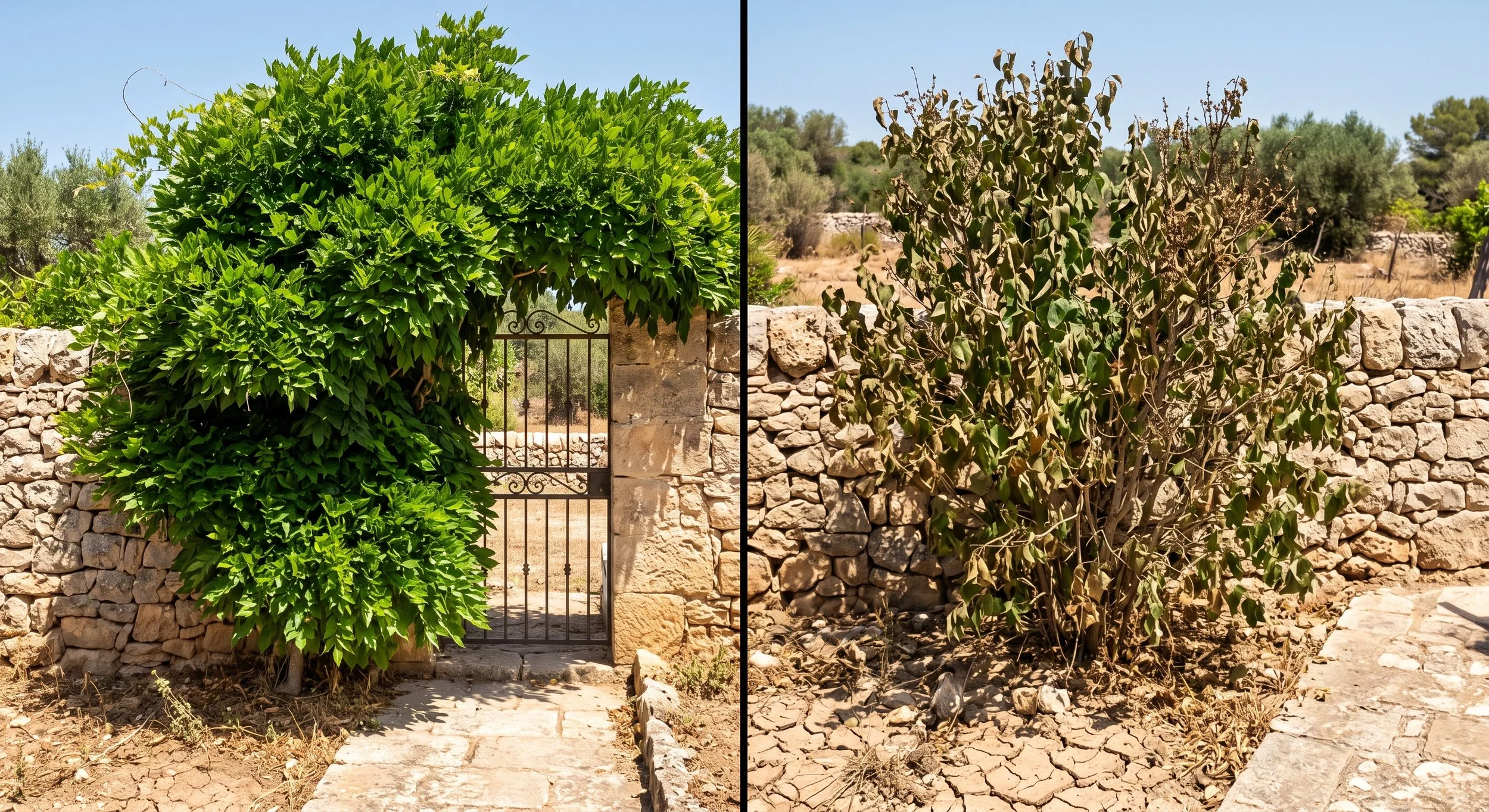
Today we search for drought-resistant varieties, we invest billions in genetics, in precision irrigation, in water-retaining polymers. And meanwhile, the oldest and most proven resilience mechanism on the planet, the hydrogen shield produced by nitrogenase, is methodically put out with every spreading of nitrogen fertiliser. It is looking for the key everywhere except in the lock where it sits.
And fertiliser cannot regulate itself. It does not know when to stop once the soil has had enough. It cannot pass nitrogen on, through the underground fungal networks, to neighbouring plants that are short of it. It floods groundwater with nitrates and loads the atmosphere with nitrous oxide, a greenhouse gas three hundred times more powerful than CO2. The industrial version of nitrogen fixation is a tap with no valve. The biological version was a thermostat.
The second blow: the plough that opens the grave
But industrial agriculture did not stop at putting out the forge. It also demolished the workshop.
Remember: nitrogenase works only when sheltered from oxygen. Mind the nuance, because it matters: it is not always the bacterium that fears oxygen, it is its enzyme. Rhizobium breathes oxygen as we do. So does Azotobacter. So does Frankia. But all of them must protect their nitrogenase in micro-environments low in oxygen: the nodule lined with leghaemoglobin, accelerated respiration that uses up oxygen faster than it diffuses in, or the oxygen-free microsites of the soil. Only a few species, such as Clostridium, are strict anaerobes that avoid oxygen altogether. In natural, undisturbed soil, all these bacteria find what their enzyme needs: at the heart of soil aggregates, inside root nodules, in the deep crevices of the soil where little air gets in. The forge is sheltered, as the Archaean cyanobacterium was sheltered in its oxygen-free ocean, as the heterocyst's nitrogenase is sheltered behind its thickened wall.
And then comes the plough.
The plough turns the earth over. It opens the soil the way you would open a body at a post-mortem. It exposes to open air, to light and to oxygen, layers that had lived in darkness for years. Within hours, the oxygen-free microsites are destroyed. The anaerobic bacteria suddenly find themselves plunged into a bath of oxygen. It is exactly the drama of the Great Oxidation Event, replayed on the scale of a field, with every pass of the plough.
The fixing bacteria die. Their nitrogenases are destroyed by oxygen. The mycorrhizal fungi, which had woven their networks through the intact structure of the soil to pass fixed nitrogen on to the whole plant community, are chopped to pieces. The living web of the soil is torn apart.
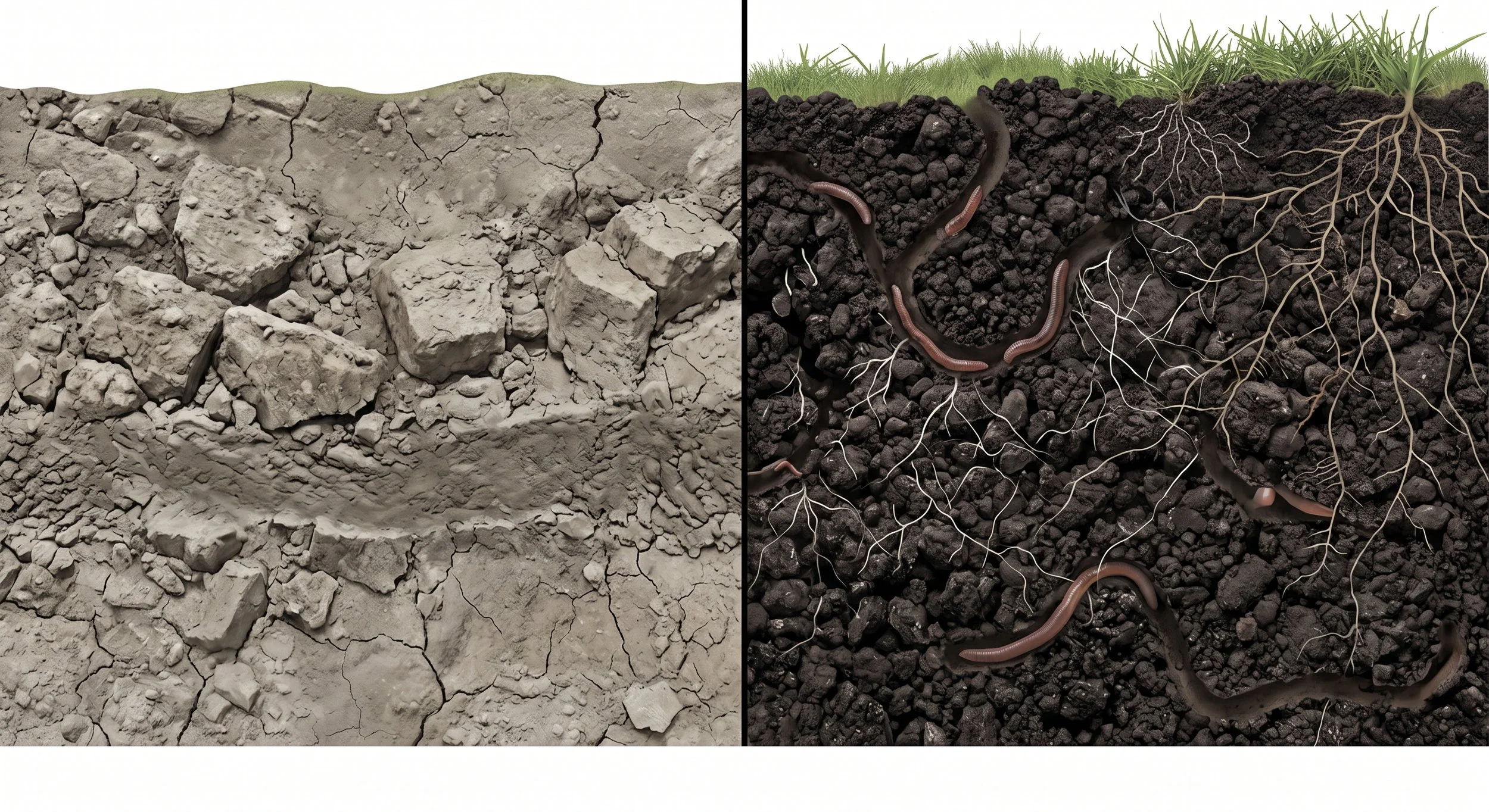
First blow: fertiliser puts out the forge. Second blow: the plough destroys the workshop. The soil, deprived both of its biological engine and of its physical structure, becomes an inert substrate, unable to fix nitrogen from the air, unable to produce the hydrogen shield that protected the plants, unable to regulate itself. It survives only on its chemical drip. It is a patient on a ventilator whose ribs have been broken as well.
The black refuge: biochar and the rebirth of the forge
How do we repair this disaster? How do we relight the forge when the workshop is in ruins?
There is an answer, and it fits in one word. Biochar.
Biochar is charcoal made by pyrolysis, that is, by burning plant biomass with almost no oxygen. It is not a modern invention. Amazonian peoples used it thousands of years ago to create terra preta, the black earth of exceptional fertility still found today in the soils of the Brazilian Amazon, intact after centuries of abandonment.
Look at a piece of biochar under a magnifying glass and you will understand why it is the key to restoration. Its structure is that of the wood it came from, but emptied of all volatile organic matter. What remains is a skeleton of pure carbon, riddled with countless micropores, tunnels, microscopic caves. One gram of biochar can offer an internal surface of 200 to 300 square metres. It is a block of flats for bacteria.
And this is where the genius of the material shows: the inside of these micropores is naturally free of oxygen. Oxygen does not reach the bottom of these tiny tunnels. Grain by grain, biochar rebuilds the anaerobic microsites the plough destroyed. It is an artificial heterocyst, if you like. A shelter where nitrogen-fixing bacteria can settle, deploy their nitrogenase, and run the forge away from oxygen, as they did in natural, undisturbed soil.
But burying biochar offers a double advantage, and this is where the system shows its full scope.
The first advantage we have just seen: the absence of oxygen. Burying biochar places it in an environment where oxygen diffusion is already limited. The pores of the charcoal, themselves lying in deep, poorly aerated soil, become remarkably stable oxygen-free refuges. The bacteria that settle there are doubly protected: by the structure of the biochar and by the depth of the soil. The forge can run without interruption.
The second advantage is heat. Deep soil is a thermal buffer. Thirty centimetres below the surface, the temperature barely changes between day and night, between summer and winter. Yet nitrogen-fixing bacteria, like most enzymes, are sensitive to thermal shocks. Bare, ploughed soil exposed to the sun can reach fifty degrees at the surface in summer and freeze in winter. Deep soil enriched with biochar keeps its tiny inhabitants in a constant comfort zone. The forge never stops, neither for cold nor for heatwave.
And when the fixing bacteria start working again in these black refuges, they start fixing atmospheric nitrogen again. And they start producing hydrogen again. The antioxidant shield re-forms. The soil regains its resilience to heavy metals, salinity and drought. The mycorrhizal fungi recolonise the pores of the biochar, anchor themselves there, and reweave their distribution networks. The cycle starts up again.
You do not repair a soil with fertiliser. You repair a soil by giving it back its inhabitants. Biochar gives them housing. Burial gives them safety. And nitrogenase, the forge whose principle has not changed in four billion years, starts turning again in the silence of the soil, as if nothing had happened.
Loading the weapon before planting it: inoculating biochar
But there is a mistake many people make, and it ruins the benefit of the whole operation: burying virgin biochar.
Biochar fresh from the pyrolysis kiln is a new building, spotless, with hundreds of square metres of living space per gram. But it is empty. No bacteria, no fungi, no trace of life. And an empty building, in soil already impoverished by years of fertiliser and ploughing, may stay empty for a long time. Worse: in the first weeks after burial, virgin biochar will even draw nutrients and microorganisms out of the surrounding soil to begin colonising its own pores. It takes before it gives. It is a sunk investment for the whole start-up phase.
The solution is simple, and the peoples of the Amazon were already practising it without knowing it when they mixed their charcoal with organic waste, excrement and kitchen scraps before working it into the soil. Biochar must be inoculated before it is buried. Fill the building with tenants before closing the door.
Here are the recipes. They are simple, they cost almost nothing, and anyone can carry them out in a garden, a field or a farmyard.
Recipe 1: the compost bath. This is the easiest. In a tub, a wheelbarrow or a recycled drum, mix one volume of crushed biochar (pieces of 5 to 15 millimetres) with half a volume of mature, well-rotted compost. Add rainwater until the mixture is moist but not soaked, roughly the consistency of a wrung-out sponge. Cover with a tarpaulin or cardboard to keep it dark and limit evaporation. Leave to rest for two to three weeks, stirring once a week. The bacteria and fungi in the compost colonise the pores of the charcoal, settle there and begin to multiply. After three weeks, the biochar smells of forest soil. It is ready.
Recipe 2: wormery juice. If you have a wormery, you have a liquid inoculant of uncommon microbial richness. Collect the liquid that drains from the base of the wormery. Dilute it at one volume of juice to five volumes of rainwater only, never tap water. Steep the biochar in this bath for a week, out of the sun and direct heat. The liquid is drawn by capillarity into the smallest pores of the charcoal and deposits billions of bacteria, protozoa and micro-fungi there. Drain, and the biochar is loaded.
Recipe 3: the nourishing plant tea. Make a comfrey or nettle tea by the classic method: one kilogram of fresh leaves to ten litres of rainwater, left to ferment for ten to fifteen days, stirring daily, until the liquid goes quiet and bubbles stop rising. Strain. Dilute at one volume of tea to five volumes of rainwater. Immerse the biochar for a week. The tea brings both a varied bacterial flora and soluble nutrients (potassium, boron and silica from comfrey, nitrogen and iron from nettle) that feed the first colonisers and speed up the start.
Recipe 4: targeted mycorrhizal inoculation. For those who want to go further, mycorrhizal inoculants are sold as powder or granules, containing spores of endomycorrhizal fungi (Rhizophagus irregularis, Glomus mosseae, Funneliformis mosseae). Moisten the biochar with rainwater, then sprinkle on the inoculant at the rate recommended by the manufacturer (usually 5 to 10 grams per litre of biochar). Mix thoroughly. The spores lodge in the pores and will wait for contact with a living root to germinate. A word of caution, though: mycorrhizal fungi are aerobic organisms, they need oxygen to breathe. This mycorrhizal biochar must not be buried at the bottom of a deep borehole, but placed in the top ten to twenty centimetres of soil, where air still circulates. Down deep, anaerobic bacteria rule. Near the surface, fungi do. Living soil is a building with storeys, and each storey has its tenants.
Recipe 5: the forge's anvil, basalt rock dust. An essential detail is often forgotten. Nitrogenase is not only a forge of iron and sulphur. It has a secret heart, where the hardest work is done, where the triple bond of nitrogen is actually broken. This heart, which chemists call the FeMo cofactor, contains an atom of molybdenum. Without molybdenum, the forge runs empty. The iron is there, the sulphur is there, the ATP is there, but the reaction does not happen, because the anvil is missing. In many soils exhausted by decades of intensive cropping, molybdenum has been leached out. The fixing bacteria have the blueprint of the enzyme but not the rare metal to build it.
The solution exists, and it is as simple as can be. Look at volcanic land. In Hawaii, in Java, in the Canaries, in the Auvergne, in Iceland, wherever lava has flowed, the soils are legendary for their fertility. Farmers on volcanic islands have known it for millennia: the black earth of the volcano gives prodigious harvests. Why? Because basalt, rock that melted and then cooled, naturally contains the seventy trace elements of the Earth's crust. Molybdenum, cobalt (essential for making the vitamin B12 that fixing bacteria need), iron, zinc, manganese, boron. It is all there, in tiny traces, but that is all life needs.
The recipe is simple: add a handful of basalt rock dust to your inoculated biochar mix, alongside the natural phosphate, before burying it. Twenty to thirty grams per litre of biochar. No more. The aim is not to change the composition of the soil but to supply the micro-traces of metals the bacteria can no longer find. The basalt will dissolve slowly, attacked by the same organic acids from roots and fungi that dissolve natural phosphate. And it will release its molybdenum, grain by grain, as life calls for it. The forge will get its anvil.
The complete recipe, the one I recommend, works in two separate preparations. The first, meant for deep burial, is made in a 200-litre drum or a large bin: pour in 100 litres of crushed biochar. Add 50 litres of mature compost. Water with 20 litres of diluted wormery juice (4 litres of pure juice in 16 litres of rainwater). Add 10 litres of comfrey tea diluted one in ten. Mix everything with a fork. The mixture should be damp like a forest after rain, not like a pond. Cover. Leave to mature for three weeks in the shade, stirring every five days. This bacterial biochar is the one you will bury deep, where the anaerobic nitrogen-fixing bacteria will run the forge.
The second preparation, meant for the surface layers, is simpler: take part of the mature bacterial biochar and mix in the mycorrhizal inoculant just before planting. This mycorrhizal biochar will be placed in the top ten centimetres of the borehole and in the soil that closes it, where oxygen still circulates and where the fungal spores can germinate on contact with the first roots. Bacteria work deep down, in oxygen-free darkness. Fungi work near the surface, where they can breathe. Each on its own storey. That is the logic of the living building.
Bury the bacterial biochar twenty to thirty centimetres deep, in the planting trench of a hedge, at the bottom of a fruit-tree planting hole, or in a line in the soil of a vegetable garden. At that depth it finds the two conditions it lacked at the surface: the absence of oxygen and thermal stability. The fixing bacteria start up nitrogenase within days. Hydrogen begins to diffuse. Then fill the top ten centimetres with the mycorrhizal biochar mixed with soil. The fungal spores are where they need to be: near the surface, in contact with the air and with the first roots. Within weeks the hyphae germinate, spread towards the nearest roots, and begin to move down into the intermediate layers of biochar, naturally creating the gradient found in all living soil: aerobic fungi above, anaerobic bacteria below, and between them a transition zone where exchanges take place. Within months the building is full, the deep storeys occupied by fixing bacteria, the upper storeys colonised by mycorrhizal hyphae, and the whole works like a giant nodule, stable and durable, that will go on fixing nitrogen and producing hydrogen for centuries, because biochar itself hardly breaks down at all.
One last, essential point: never use tap water for inoculation. The chlorine in the drinking water supply is a biocide; it kills the bacteria you are trying to establish. Rainwater, always. Failing that, well water, pond water, river water. Only as a last resort, tap water left to stand for twenty-four hours in an open bucket so the chlorine evaporates. But rainwater remains the first choice, the only one with no risk at all. It is a detail, but it is the detail that makes the difference between living biochar and dead biochar.
Biochar boreholes: the living cistern
One problem remains to be solved, and it is perhaps the most crucial of all in times of drought. We have the biochar. We have inoculated it. We know it must be buried deep to give it the absence of oxygen and thermal stability. But once it is buried, how do we make sure this refuge stays moist? Fixing bacteria, however robust, need water to live and to run nitrogenase. Dry biochar is dead biochar. The building is up, the tenants have moved in, but if you cut off the running water, everyone leaves.
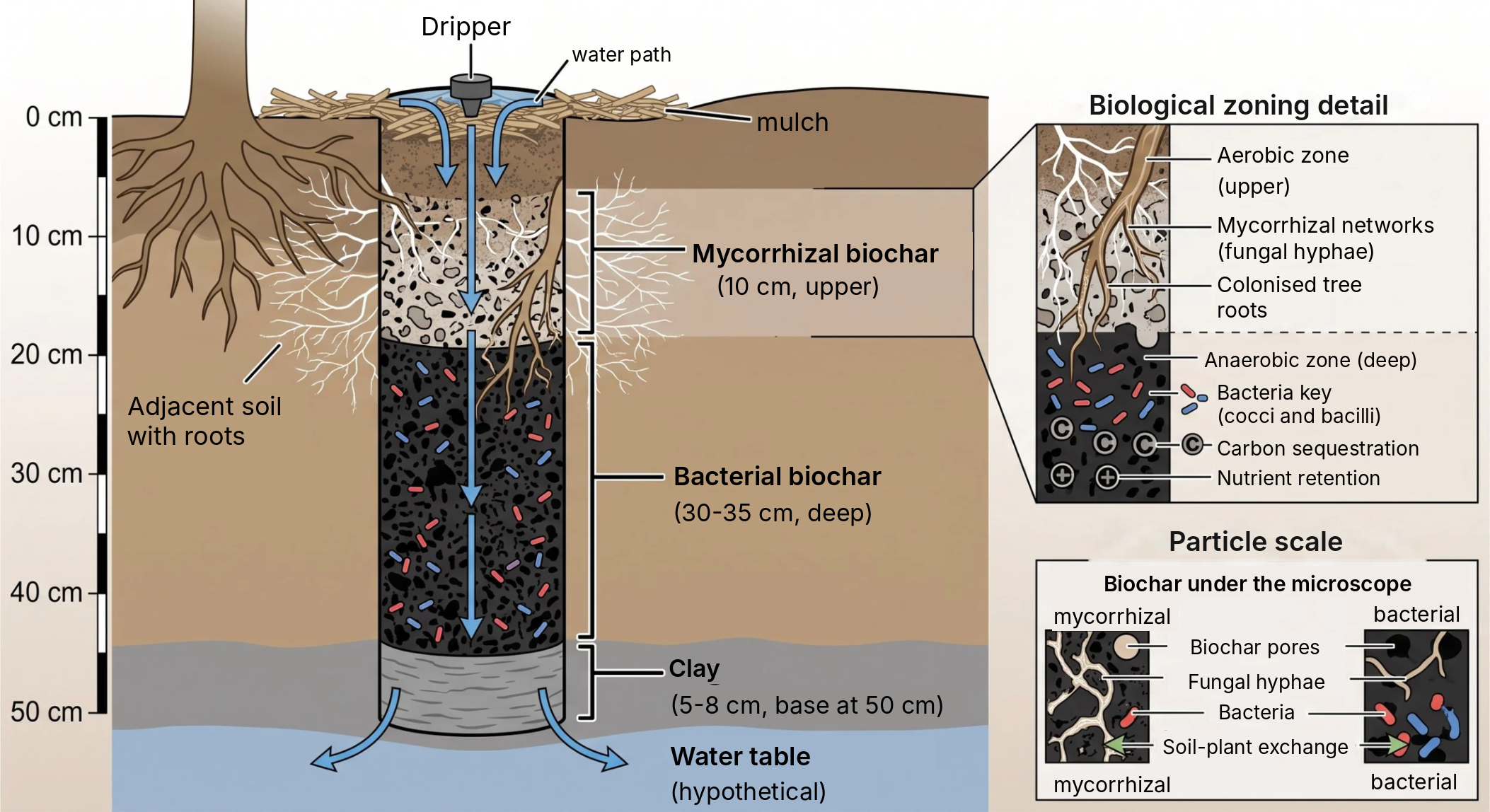
I have developed a field technique that answers this problem. I call it the biochar borehole. The principle is that of a miniature biological well, a living cistern buried fifty centimetres deep, designed to keep the biochar constantly moist even in high summer, even in the most free-draining soils, even in climates where it does not rain for four or five months.
Here is how it is done.
Bore a hole fifty centimetres deep and about twenty to thirty centimetres across. With an auger, a spade or a mattock, the tool does not matter as long as the hole is clean and vertical. Fifty centimetres is the depth at which soil temperature hardly varies any more and oxygen diffuses very little. It is the ideal zone for the forge.
At the bottom of the hole, lay a first layer of clay. Five to eight centimetres of clay, tamped, moistened and compacted the way you would compact the bottom of a pond. This clay layer is the keystone of the system. Clay is naturally almost watertight. It forms a plug at the bottom of the borehole that stops irrigation water seeping into the deep layers and being lost out of reach of the roots. The water stays where you put it, in contact with the biochar, instead of running off into the subsoil. In sandy or stony soil, this clay layer makes the difference between a system that works and a system that leaks.
On top of the clay, pour in the bacteria-inoculated biochar. Thirty to thirty-five centimetres of biochar loaded with the compost, the wormery juice and the plant tea, with no mycorrhizal inoculant. This is the oxygen-free zone, the territory of the fixing bacteria. Tamp it lightly, without compacting it so much that the pores close. The biochar must stay airy within its internal structure while being dense as a mass, to maximise contact between the grains.
Close the borehole with ten centimetres of a mix of topsoil and mycorrhizal biochar, the batch to which the mycorrhizal inoculant was added just before planting. This is the aerobic zone, the territory of the fungi. The spores of Rhizophagus and Glomus are where they need to be: near the surface, where oxygen diffuses, where the first roots will come to find them. This surface layer also acts as a natural lid. It limits direct evaporation from the deep biochar, blocks out light, and provides a first level of filtration for the irrigation water. You can mulch over it to strengthen the protection further.
That leaves the element that gives the system its full power in a dry climate: the dripper.
Install a dripper at surface level, just above the borehole, set to between five and ten litres per hour. No more. It is a low flow, deliberately low. The aim is not to water the borehole the way you would water a flower bed. The aim is to keep the biochar constantly moist, like a sponge that never dries out. Five to ten litres per hour is enough for the water to percolate slowly through the ten centimetres of soil, reach the biochar, soak it gradually, and stop at the bottom on the clay layer instead of being lost in the subsoil. The biochar then behaves like a biological cistern: it absorbs water into its micropores, holds it by capillarity, and makes it available to the bacteria and roots around it.
At this flow rate, one hour of irrigation a day is enough in summer to keep the borehole in its ideal moisture range. That is five to ten litres of water per day per borehole. Compare that with the fifty to a hundred litres a day that conventional surface watering needs for an equivalent area, three quarters of which evaporates before it even reaches the roots. The biochar borehole is a system of astonishing water thrift. The water does not evaporate because it is under ten centimetres of soil. It does not leak because the clay holds it. It does not stagnate because the biochar spreads it through its pores. It stays where life needs it: in contact with the fixing bacteria, with the mycorrhizal hyphae, with the roots.
And the bacteria, in this stable moisture, do what they have known how to do for four billion years. They fix nitrogen. They produce hydrogen. The antioxidant shield spreads around the borehole. The roots of nearby trees and shrubs colonise the edges of the borehole, drawn by the nitrogen, the hydrogen, the constant moisture. The mycorrhizal hyphae weave their web between the borehole and the roots, carrying phosphorus one way and sugars the other. Each borehole becomes a hot spot of fertility, an island of resilience in dry soil.
Boreholes can be multiplied around a tree, along a hedge, in a line through an orchard. Three or four boreholes around a young fruit tree, fifty centimetres from the trunk, connected to the same drip line, and the tree has an underground network of living cisterns that feed it nitrogen, protect it with hydrogen, and water it with a fraction of what conventional watering would require. In a drought, that is the difference between a tree that survives and a tree that dies.
Fertiliser is rent, biochar is an inheritance
And there is one last thing biochar offers that synthetic fertiliser never can: time.
A sack of nitrogen fertiliser feeds one harvest. Just one. The following spring you have to buy another. And another the year after. And another again. It is rent paid every year, without ever becoming the owner. The farmer who spreads fertiliser is a tenant of the fertility of his own soil.
Biochar, on the other hand, is a title deed.
A gram of biochar buried in the soil will stay there for centuries. Archaeologists prove it: in the Brazilian Amazon, the peoples who made terra preta two thousand, three thousand, sometimes seven thousand years ago left charcoal in the soil that is still there. Still black. Still porous. Still colonised by bacteria. Still fertile. Seven thousand years. That is older than the pyramids of Egypt, older than writing, older than agriculture itself in most regions of the world.
When you bury inoculated biochar in your garden, your field, your orchard, you are not acting for this season. You are acting for your children, your grandchildren, your grandchildren's children. The refuge you build today for the fixing bacteria will still be standing when nobody remembers your name. The forge you relight today will still be running in two thousand years.
Fertiliser is rent. Biochar is an inheritance.
And this inheritance does not benefit only your soil. It benefits the whole planet. Every kilogram of biochar you bury contains about 800 grams of pure carbon, carbon that without your action would have been released into the atmosphere as CO2 through the natural decay of the wood. Every kilogram of carbon, when it oxidises, produces about 3.6 kilograms of CO2. Do the sum: a single kilogram of biochar buried in your garden means nearly three kilograms of CO2 that will never reach the atmosphere. And will not reach it for centuries, perhaps millennia, because biochar hardly breaks down at all.
By burying biochar, you are not only doing a gardener's job. You are sequestering carbon. Every borehole, every planting trench, every handful of inoculated charcoal going down into the soil is a permanent carbon sink, verifiable and useful: unlike other storage methods, this one improves the soil at the same time as it protects the climate. The tree whose wood you used captured CO2 as it grew. Pyrolysis turned that carbon into a stable form. Burial takes it out of the atmospheric cycle for generations. You close the loop.
But biochar is only the visible part of the storage. When nitrogenase is running, when nitrogen and hydrogen irrigate the soil together, the whole underground ecosystem starts making stable carbon.
Fixed nitrogen lets plants grow more, photosynthesise more, capture more CO2 in their leaves, stems and roots. Hydrogen feeds the hydrogen-eating bacteria, stimulates the whole microbial community, and keeps the mycorrhizal fungi active, whose hyphal networks and glomalin secretions are among the most stable forms of carbon known in soil. It is the complete circuit, nitrogen and hydrogen together, that turns a soil into a carbon sink. Take away either one, and storage collapses.
To measure the difference, you only have to look at what lives beneath our feet.
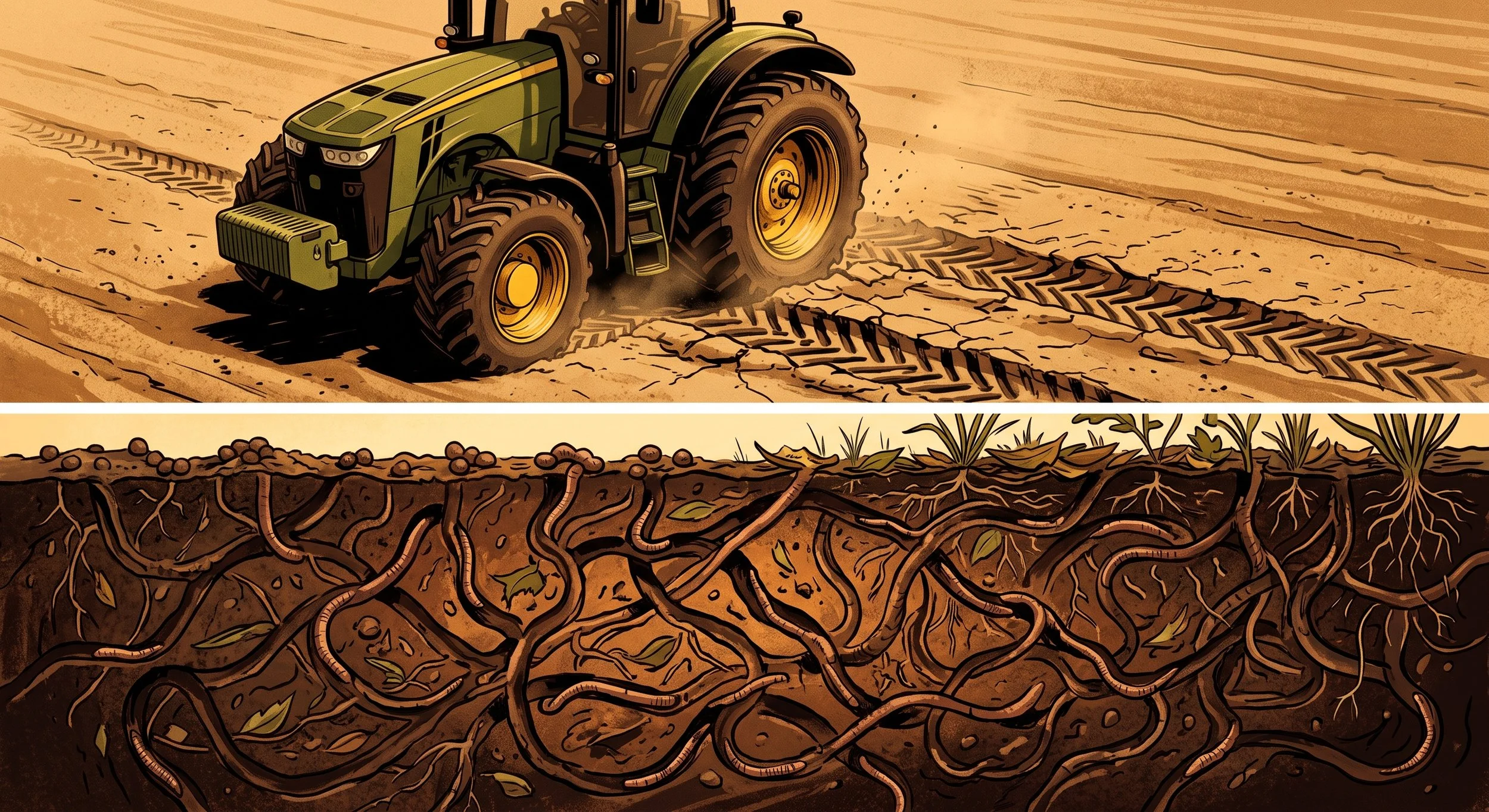
Take a hectare of soil ploughed every year and fed with synthetic fertiliser. Weigh its earthworms: you will find between 100 and 300 kilograms. That is all. The soil is grey, compact, it smells of dust. Its organic matter is around 1 to 1.5 per cent. It is a dying soil.
Now take a hectare of living, unploughed soil, where nitrogenase runs in the nodules of legumes, where hydrogen diffuses through the rhizosphere, where mycorrhizal fungi weave their web, where cover crops protect the surface. Weigh its earthworms: 1,000 to 3,000 kilograms. Up to 4,000 kilograms in the best conditions. Ten to fifteen times more. The soil is black, crumbly, it smells of forest after rain. Its organic matter reaches 4, 5, sometimes 6 per cent.
And these worms are not just there. They work. A healthy earthworm population, about two tonnes per hectare, brings between 40 and 100 tonnes of soil to the surface every year as casts, the little coils you see on lawns early in the morning. It is natural vertical tillage, free and permanent, that creates no compaction pan and mixes surface carbon intimately with minerals from below. Worms do gently, from the inside, what the plough claims to do by brutalising the soil from the outside.
And here is the detail that sums it all up. A farm tractor weighs three tonnes and compacts the soil. Nature had planned the same weight, to the kilogram, three tonnes of earthworms per hectare, to loosen it from within. The tractor crushes. The worms aerate. The tractor passes once and leaves. The worms work day and night, all year round, with no fuel, no maintenance, no bill. But they work only in living soil. In dead soil, only the tractor is left.
The difference between these two soils is carbon. Each extra percentage point of organic matter, over a hectare and thirty centimetres of depth, represents about 20 to 25 tonnes of carbon locked in the soil (organic matter is about 58 per cent carbon). A living soil at 5 per cent organic matter stores 70 to 80 tonnes more carbon per hectare than a dead soil at 1.5 per cent. That is the equivalent of 260 to 290 tonnes of CO2 removed from the atmosphere. Per hectare. With no factory. No technology. No patent. Just by letting nitrogenase do its work and giving it the conditions to do it.
And those 100 to 300 kilograms of earthworms in the dead soil, against 2 to 3 tonnes in the living soil, are not just an indicator. Earthworms mix the soil, work in organic matter, and dig burrows that help water soak in and air circulate. Their casts are among the most stable and carbon-rich aggregates the soil can produce. The more worms, the more stable carbon. And worms thrive only in soil where microbial life is active, where fresh organic matter keeps arriving, where nobody turns the earth over with a plough. The earthworm is the witness of the complete circuit: nitrogenase, hydrogen, mycorrhizae, organic matter, carbon. When the worms come back, the forge is running.
No factory in the world, no industrial capture technology, no geoengineering process will ever be able to store as much carbon as the earth beneath our feet. The planet's soils already hold more organic carbon than the atmosphere and land vegetation combined. It is the largest active carbon reservoir in the biosphere. And this carbon is not a mere inert stock, piled up in a warehouse. It is alive. It feeds a community of organisms whose extent we do not even suspect.
Beneath the thin film of topsoil we know, where roots plunge and worms dig, life does not stop. It carries on. Bacteria live in rocks hundreds of metres, sometimes kilometres, down. They have been found in South African gold mines 3.5 kilometres below the surface, in ocean basalts, in the deep aquifers beneath the continents. These deep-dwelling bacteria, most of them still unknown to science, form the invisible world researchers have named the deep biosphere. It is estimated that it may hold as much biomass as all life on the surface. And these deep organisms feed, to a large extent, on the organic carbon that seeps slowly down from the surface, dissolved in water, carried grain by grain through the micropores of the rock over millennia.
A living soil at the surface, rich in organic matter, in stable carbon, in root exudates, is a soil that feeds life in the depths. A dead soil, stripped of organic matter by decades of fertiliser and ploughing, is a soil that cuts off supplies to this invisible biosphere. We do not yet know the exact role of these deep bacteria in the planet's great biogeochemical cycles. But we know they exist, that they are countless, and that they depend on the carbon coming down from above. Every gram of organic matter that nitrogenase helps to lock into the soil is a gram of carbon that may one day, in a century or a millennium, feed a microbial community nobody has yet named, at a depth nobody has yet explored.
The earth is not a substrate. It is a world.
The missing link: without phosphorus, the forge falls silent
But one piece of the puzzle is still missing, and it is perhaps the most important of all. Without it, everything we have just built remains a dead letter. The biochar is in place, the bacteria have settled in, moisture is guaranteed by the borehole, the roots are colonising its edges. And yet the forge does not start. Nitrogenase stays inert. Why?
Let us go back to our image of the sixteen matches. To break a single molecule of nitrogen, nitrogenase burns sixteen molecules of ATP. ATP is the energy currency of all life, from bacterium to whale, from clover to redwood. Every contraction of our muscles, every cell division, every biochemical reaction is paid for in ATP. And nitrogenase is one of the biggest spenders in the living world. Sixteen molecules in one go. That is enormous. It is an energy sinkhole.
Yet to make a single molecule of ATP, the cell needs phosphorus. Not just any element: phosphorus, and nothing else. The name says it: adenosine triphosphate, three phosphate groups linked in a chain. Phosphorus stores the energy in its chemical bonds, and releases it when the bond breaks. No phosphorus, no ATP. No ATP, and nitrogenase has no fuel. The forge is there, intact, ready to work, but there are no matches left.
Picture a beautifully built water mill, with its wheel, its gears, its millstones. Everything is in place. But the millrace is dry. Not a drop of water in the channel. The mill does not turn. Phosphorus is the water of the mill. It is the flow of energy without which the nitrogenase wheel cannot turn.
And here is the drama: nitrogen-fixing bacteria are among the greatest consumers of phosphorus in the microbial world. Sixteen ATP per molecule of N2, millions of molecules of N2 per hour, billions of bacteria per hectare. The demand is colossal. Within a few seasons of active fixation, the bacteria exhaust the phosphorus available in their immediate surroundings. The ore still exists, in the soil, in the rock, in the clays, but it is stuck out of reach. Bound to iron oxides. Trapped in the micropores of the parent rock. Locked away in the recesses of the biochar itself. The bacteria, immobile in their nodules or their charcoal refuges, have neither legs nor hyphae to go and fetch it.
The forge stops. Not for lack of nitrogen, not for lack of protection, not for lack of water, but for lack of fuel. And with it stops the production of hydrogen, and the antioxidant shield fades away, and the whole chain we have patiently rebuilt falls silent again.
The phosphorus motorways: the fungus enters the stage
This is where the third partner of the alliance comes in, perhaps the most discreet, the most underestimated, the most indispensable: the mycorrhizal fungus.
Mycorrhizae are soil fungi whose microscopic filaments, the hyphae, stretch for metres, sometimes tens of metres, from each colonised root. These filaments are infinitely finer than a root hair, and they reach into spaces no root could venture into: the micropores of biochar, the gaps between grains of sand, the cracks in the parent rock. And they have a speciality: extracting the phosphorus stuck in these inaccessible recesses, carrying it along their hyphae the way goods travel along a motorway, and delivering it straight to the root of the host plant.
The plant receives the phosphorus. It passes it on to its fixing bacteria. The bacteria make ATP. ATP powers nitrogenase. The forge turns. Nitrogen is fixed. Hydrogen is produced. The shield spreads. And in exchange, the plant supplies the fungus with the sugars it needs to live, since it cannot photosynthesise. Everyone pays, everyone receives, and nobody is in charge.
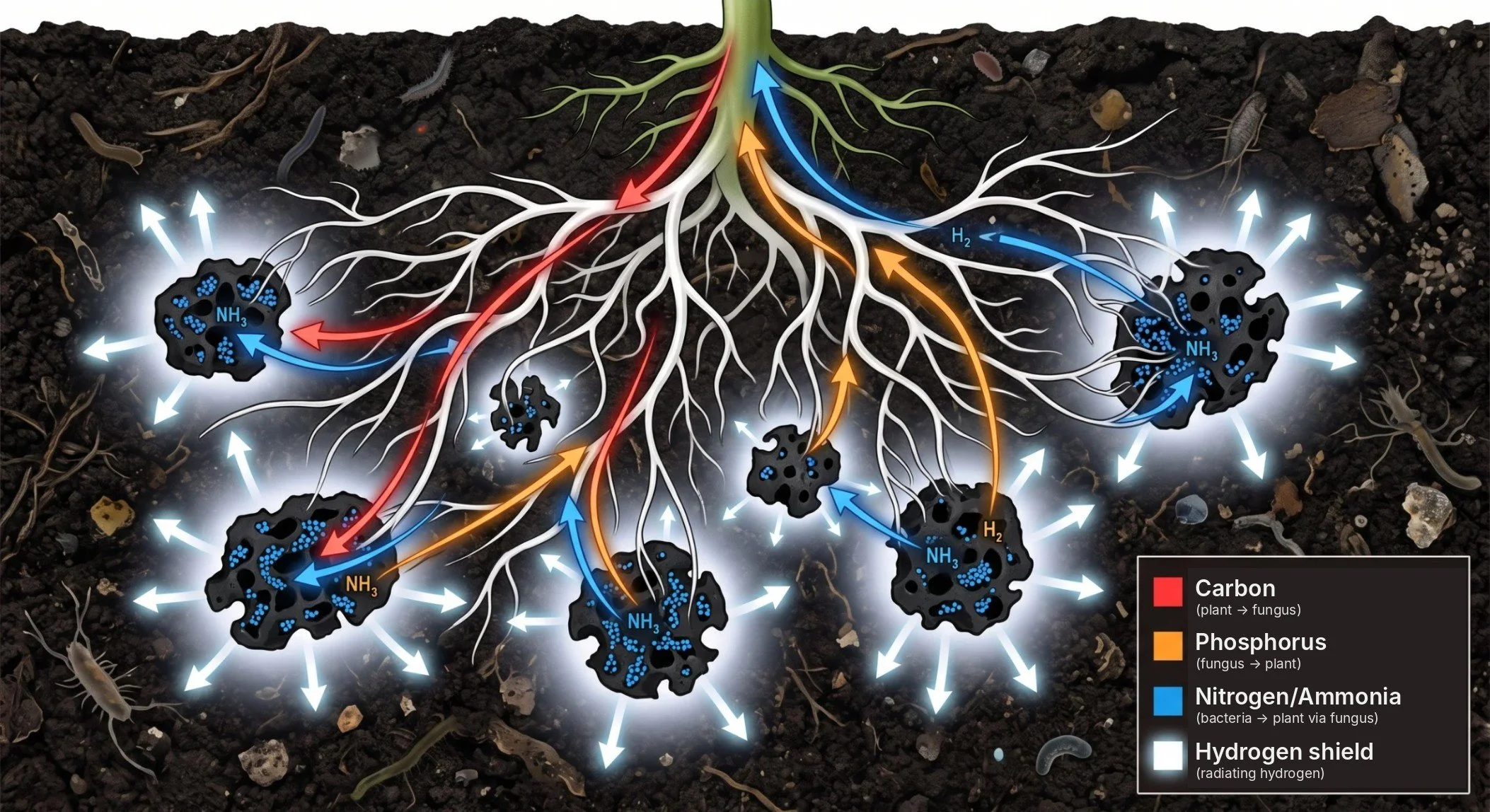
It is a three-way circuit: the plant, the bacterium and the fungus. The fungus brings the phosphorus the bacterium lacks. The bacterium brings the nitrogen the plant lacks. The plant brings the carbon the fungus lacks. And biochar, by offering both an oxygen-free refuge for the bacterium and a network of micropores where the fungus can mine phosphorus, plays the part of the market square where the three partners meet.
Without phosphorus, the forge stalls. Without the fungus, the phosphorus stays stuck. Without biochar, the fungus has no network of micropores to explore and the bacterium has no shelter. Each piece depends on the others. Take one away, and the system stops. Give them all back, and it starts again.
Moroccan phosphate: the slow-release battery
But the restart can be given a decisive push. In soil exhausted by years of synthetic fertiliser and ploughing, available phosphorus is often so low that even mycorrhizal fungi struggle to find enough to launch the cycle. The hyphae spread, explore, but the larder is empty. The forge stays cold for lack of fuel.
This is where a simple, inexpensive and remarkably effective step comes in: adding a tiny dose of natural phosphate.
Not industrial superphosphate, not phosphate treated with sulphuric acid. Raw rock phosphate, phosphorite, as it comes out of sedimentary deposits. And when we talk about rock phosphate, we are talking above all about Morocco.
Morocco alone holds about 70 per cent of the world's phosphate reserves. The deposits of Khouribga, Youssoufia and Benguerir hold a geological treasure of exceptional quality, formed tens of millions of years ago by the build-up of the skeletons of marine organisms on the floor of a vanished ocean. Moroccan phosphate is the keystone of world agriculture. Without it, half the planet's phosphate fertilisers would not exist. But the chemical industry attacks it with sulphuric acid to make it soluble, and that is precisely where the system goes off the rails.
Raw phosphate, the grey powder taken straight from the rock with no chemical treatment, is completely insoluble in water. It is a stone, in the literal sense. Put it in a glass of water, come back in a year, and it will still be there, intact. And in chalky soils, so common in arid and Mediterranean areas, it is locked twice over: calcium in the soil combines with phosphorus to form compounds that are even more insoluble. Raw phosphate, in an alkaline soil in the Souss-Massa or on the Meknes plateau, stays chemically mute.
Industry found its solution: sulphuric acid. It dissolves the phosphate by force, in a factory, at great cost in energy and pollution, to make soluble superphosphate.
But life found its own solution, and it beats the factory's on every count.
Legumes, the same plants whose nodules shelter nitrogenase, secrete powerful organic acids through their roots: citric acid, malic acid, oxalic acid. These acids ooze into the soil right next to the root and dissolve the phosphate rock locally. Not in a factory, not at 200 degrees, not with sulphuric acid. At ambient temperature, in the silence of the soil, molecule by molecule. The legume itself attacks the rock to extract the phosphorus its nitrogenase needs. Living acid against industrial acid.
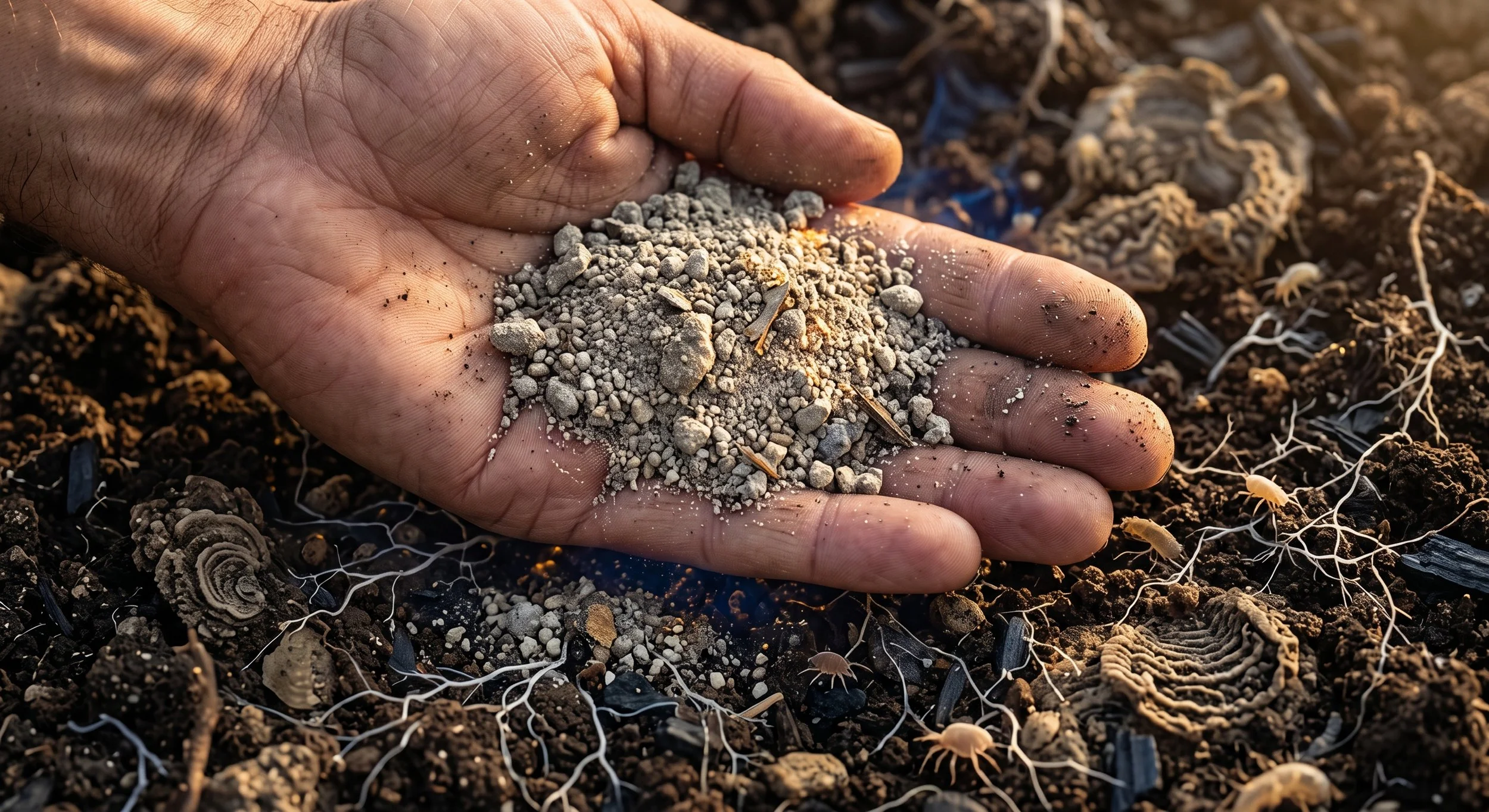
And mycorrhizal fungi do even better. Their hyphae secrete specific enzymes, phosphatases, which break the bonds between phosphorus and calcium, between phosphorus and iron, between phosphorus and aluminium. The fungus is a miner at the coalface. It digs into the rock, grain by grain, with surgical precision, and brings pure phosphorus back to the root. In the micropores of biochar into which a few grams of raw Moroccan phosphate have been mixed, the mycorrhizal hyphae find a deposit on their own scale: micro-grains of phosphate rock, accessible, workable, inexhaustible on the scale of a plant.
The whole beauty of the system lies in this: raw phosphate never leaches. It does not escape into groundwater like soluble phosphate. It does not bind uselessly to clays, because it is never in solution. It stays where it was put, stable, patient, and is released only at the exact demand of life, when a root or a hypha comes to attack it with its acids. It is a slow-release battery. A capital fund that pays out over decades, not over days.
The dose must stay small. A handful of natural phosphate powder per biochar borehole, mixed into the inoculated biochar before burial, is enough to supply the starter fuel the fixing bacteria need to restart ATP production. Ten to twenty grams per planting hole, worked into the loaded biochar. No more. The aim is not to saturate the soil with phosphorus but to prime the pump. Once the cycle is running, the fungus will fetch phosphorus wherever it is, in the rock, in the fossil reserves, in the grains of raw phosphate buried with the biochar. The initial dose is the match that relights the forge. After that, the forge feeds itself.
By combining raw Moroccan phosphate, an abundant, unprocessed resource, with biochar engineering and plant symbiosis, an inert mineral becomes an engine of self-sufficiency. Phosphorus powers ATP. ATP powers nitrogenase. Nitrogenase fixes nitrogen and produces hydrogen. Hydrogen protects the soil. The fungus recycles phosphorus. The plant supplies carbon. And biochar holds it all together, in the damp, warm darkness of a borehole fifty centimetres deep.
Four billion years of co-evolution. A handful of rock dust. And the forge starts again.
Planting the forge: the alliances that work
All this molecular machinery, however beautiful, is useless if we do not know how to deploy it in a field, a garden, a bank or a hedge. The practical question arises: which plants should we enlist to get the forge running again?
The answer rests on a simple principle: pair plants that fix nitrogen with plants that benefit from it, and let the soil fungi make the connection between the two. This is the principle of the plant guild, an assembly in which each species plays a role and the whole produces more than the sum of its parts.
The oldest of these guilds is also the most famous. In Central America, Mesoamerican peoples practised it long before the Europeans arrived. It is called the milpa, or the three sisters: maize, beans and squash. Maize grows tall and straight and acts as a stake. The bean climbs the maize stalk, and its root nodules fix nitrogen from the air thanks to their Rhizobium bacteria. The squash spreads its broad leaves over the ground, limits evaporation and smothers weeds. The maize receives the nitrogen fixed by the bean. The bean receives physical support from the maize. The squash benefits from the nitrogen and carbon the other two add to the soil. And underground, mycorrhizal fungi connect the three root systems and share out nutrients according to each one's needs. Three plants, three functions, one system.
This model can be varied endlessly.
In a vegetable garden, peas or broad beans go with tomatoes, cabbages or peppers. The legumes fix nitrogen, the nightshades and brassicas benefit from it. Rows of crimson clover or lucerne can be slipped between the beds: these living covers fix nitrogen continuously and, when cut, return to the soil the nitrogen and hydrogen their nodules had built up.
On the scale of a field, legume cover crops turn the gap between seasons into a season of restoration. A mix of white clover, hairy vetch, sainfoin and field beans, sown after the wheat or maize harvest, covers the bare soil, protects it from erosion, and above all runs billions of miniature forges in its root nodules all winter long. In spring, when the cover is mown or rolled before the next sowing, the fixed nitrogen is released into the soil and feeds the main crop. And the hydrogen produced all winter has recharged the soil's antioxidant shield, strengthened the mycorrhizal network and stimulated the microbial community. The field starts the season with soil that is alive, protected and fed by the oldest system on the planet.
But it is in the hedge that the alliance perhaps finds its most lasting form.
A hedge made of nitrogen-fixing shrubs is a permanent forge set up at the edge of a field. Common alder, paired with its Frankia bacterium, fixes nitrogen and produces hydrogen twelve months a year. Elaeagnus, the modest bush with silvery berries you pass by the roadside without a glance, is also a formidable fixer, paired with Frankia, able to grow in sand, gravel and the poorest soils. False acacia, for all its invasive nature, is a tree legume whose roots house Rhizobium of rare efficiency. Broom, laburnum, caragana, the Judas tree: so many fixers that can go into a nurturing hedge.
Plant a hedge of this kind along a field or an orchard and you set up a permanent source of nitrogen and hydrogen that feeds the neighbouring soil by sideways diffusion and through the mycorrhizal network. The fruit trees or crops nearby benefit from the fixed nitrogen without a single gram of fertiliser being spread. The soil fungi connect the roots of the fixers with those of the non-fixers and carry nitrogen from one to the other, just as they carry phosphorus from the micropores of biochar. The hedge is not a fence. It is a biological filling station.
And when the hedge is cut, the prunings can be turned into ramial chipped wood and returned to the soil as food for the fungi. Or pyrolysed into biochar and buried to create new bacterial refuges. The cycle closes. Matter circulates. Nothing is lost.
This is nature's logic, and the oldest logic of life: specialised partners, linked by underground networks, exchanging nitrogen, phosphorus, carbon and hydrogen according to each one's needs, with no boss, no central plan, no factory. A system that has worked for four billion years, and still works, wherever it is given room to work.
From the milpa to the wheat field: the forge at scale
Some will object that all this is very fine, but it is a gardener's solution. That the biochar borehole, hand inoculation, the dripper at the foot of the tree are craftsmanship for market gardeners or landscapers. That the arable farmer managing two hundred hectares of wheat cannot drill holes every metre. That faced with the world food problem, we need solutions on the scale of the tractor, not the wheelbarrow.
The objection is fair. And the answer is simple: you do not drill holes in a wheat field. You change the design of the field.
The first tool is direct drilling into a living cover. Instead of ploughing the soil in autumn, leaving it bare all winter, and sowing into dust in spring, wheat or maize is sown directly into a carpet of living legumes. A cover of clover, lucerne or vetch, sown the year before, is flattened with a roller crimper just before the cereal is drilled. The cover dies on the surface and forms a natural mulch that protects the soil from erosion and evaporation. But its roots stay in place, intact, with their nodules packed with fixing bacteria. Nitrogenase keeps running under the mulch. Nitrogen is fixed. Hydrogen is produced. The shield spreads. And the mycorrhizal network that connected the legumes to the soil plugs into the roots of the germinating cereal. The cereal inherits the network. It grows in soil that is alive, protected and fed, without a single gram of fertiliser having been spread.
The second tool is strip alternation. The field is divided into strips ten to fifteen metres wide. A strip of cereal, a strip of legume. Wheat grows in its strip, lucerne or sainfoin in the next. Underground, mycorrhizal fungi know no borders. Their hyphae cross the invisible line between the two strips and carry the nitrogen fixed by the legume to the wheat roots. In this system, biochar does not need to be buried in deep boreholes. It is worked into the surface of the legume strips, ten to twenty centimetres down, where the fixing nodules work. Biochar offers the bacteria shelter, the cover supplies the carbon, the fungus makes the link, and the cereal receives nitrogen and the hydrogen shield without the farmer having changed tractor.
And for rice, the cereal that feeds half of humanity, the solution has existed for fifteen centuries. It is called Azolla.
Azolla is a tiny aquatic fern, the size of a thumbnail, that floats on the surface of still water. And it hides a secret in its leaves: microscopic cavities where a nitrogen-fixing cyanobacterium, Anabaena azollae, lives permanently. The fern provides housing and protection. The cyanobacterium runs nitrogenase in its heterocysts and supplies the nitrogen. It is the aquatic milpa: two organisms, one system, and a prodigious fixing capacity, among the highest in the plant world.
Chinese and Vietnamese rice growers have used it for at least fifteen hundred years. Azolla is left to cover the surface of the paddy before transplanting. The carpet of ferns fixes nitrogen from the air for weeks. Then the carpet is worked into the mud at transplanting time, and the accumulated nitrogen is released to feed the rice throughout its growth. Not a gram of synthetic fertiliser. A fern, a cyanobacterium, and fifteen centuries of experience.
And Azolla has an even bigger story. Forty-nine million years ago, this little fern invaded the Arctic Ocean, which was then warm and enclosed like an inland sea. For hundreds of thousands of years, generations of Azolla grew, fixed nitrogen, captured CO2, then sank to the bottom, taking their carbon into the sediments. Geologists call this the Azolla event, and some believe it helped tip the planet's climate from the hothouse of the Eocene towards the cooler world that followed. A one-centimetre fern, armed with a cyanobacterium and its nitrogenase, helped to cool the Earth. When you are told the forge regulates the climate, it is not a metaphor.
And if we are told these methods do not produce enough to feed the world, let us recall the work of Masanobu Fukuoka. This Japanese farmer, an agronomist by training, showed for forty years that living soil, intelligently managed, with no ploughing and no chemical inputs, produced rice and wheat yields equivalent to those of Japanese industrial farms. And he did it on soil that grew more fertile every year, instead of poorer.
But we can go further than Fukuoka. We can send the forge along with the seed.
Seed coating: every seed takes its own forge with it. This is the ultimate answer to the problem of scale. Instead of treating the whole soil, each seed is treated individually before sowing, by coating it in a thin shell that contains everything it needs to start the symbiosis from germination.
Here is the recipe. In a bucket, make a slurry of fine clay (bentonite, or failing that the local clay) diluted in rainwater to the consistency of thick cream. Add to this slurry: a handful of very fine biochar powder (sieved, under 2 millimetres), a tablespoon of powdered natural phosphate, a pinch of basalt dust, a dose of mycorrhizal inoculant (spores of Glomus or Rhizophagus), and a dose of Rhizobium inoculant if you are sowing legumes. For cereals, choose a general-purpose bacterial inoculant, available from the same suppliers. Mix. Pour your seeds into this slurry, stir so that each seed is evenly coated, then spread them on a tarpaulin in the shade to dry for two to three hours. The seeds are ready.
When the drill places them in the soil, each seed will arrive in the earth with its micro-forge: clay to hold moisture around the germ, biochar to house the first bacteria, phosphate for fuel, basalt for trace elements, fungal spores to launch the network, and fixing bacteria to start nitrogenase. The seed needs nothing else. It is self-sufficient. And the operation costs a few cents per hectare.
The trap of variety selection. But here a question arises that nobody wants to ask. Which varieties are we sowing?
Since the Green Revolution of the 1960s, seed companies around the world have bred varieties of wheat, maize, rice and barley optimised for a single goal: producing the most grain on a drip of synthetic nitrogen fertiliser. These modern varieties have short stems so they do not fall over under the weight of the ear, shallow roots because they have no need to look for nitrogen deep down (it is given to them at the surface), and a weakened capacity for mycorrhizal colonisation because breeding programmes were carried out in soil saturated with soluble phosphate, where the fungus was useless.
We have bred plants unable to feed themselves. Plants that no longer know how to work with fixing bacteria, that no longer know how to feed fungi, that no longer know how to produce the root exudates that attract and sustain the microbial community. We have done the exact opposite, point for point, of what four billion years of evolution had built. We have made junkie varieties, dependent on the chemical drip, unable to survive without it.
Old farmers' varieties, the ones farmers selected themselves in their fields for millennia, have kept these abilities. Their roots are deep, vigorous, richly colonised by mycorrhizae. They produce abundant exudates. They know how to talk to the soil. They may produce less grain per ear on a chemical drip, but in living, connected soil, where nitrogenase runs and the mycorrhizal network works, they produce as much, or even more, because they know how to use what the soil offers them.
The future of agriculture is not to breed plants that respond better to fertiliser. It is to breed plants that work better with the forge. Varieties that produce more exudates, that host mycorrhizae better, that feed fixing bacteria better. It is a complete reversal of the breeding paradigm. And it has already begun, in farmers' seed networks, in participatory breeding programmes, on farms that have understood that the seed is only half the system, and that the other half is underground.
In-field agroforestry: the montado model. In Portugal, in the hills of the Alentejo, there is an agro-silvo-pastoral system several centuries old called the montado. Cork oaks spaced fifteen to twenty metres apart grow in the middle of meadows where black Iberian pigs, sheep and cattle graze. The trees anchor the landscape. Their deep roots act as a hydraulic lift, like the argan tree of the Souss. Their canopy filters the sun and creates a cooler, damper microclimate beneath. Their leaf litter feeds the soil with carbon. And mycorrhizal fungi connect the roots of the trees with those of the meadow grasses, carrying nitrogen and phosphorus from one to the other.
Adapted, this model works everywhere. Rows of alders or false acacias spaced twenty-five metres apart in a cereal field, with biochar buried at the foot of each tree, turn a field into an agroforestry system. The tree fixers supply nitrogen and hydrogen continuously through the mycorrhizal network. The cereals grow between the rows of trees, connected to the network. And when the trees are pruned, the prunings are pyrolysed into biochar or chipped into ramial wood and returned to the soil. The cycle closes.
The transition strategy: weaning. An arable farmer who has farmed conventionally for twenty years cannot stop everything overnight. His soil is dead, his fixing bacteria are at their lowest, his mycorrhizal networks are in tatters. Cut fertiliser all at once and the harvest collapses. The soil has to be weaned, not cut off.
Year 1: cut synthetic nitrogen by 30 per cent. Introduce a legume cover between crops. Stop deep ploughing. The legume nodules begin to form bacteria, nitrogenase restarts at low speed, the first traces of hydrogen diffuse. The soil wakes up.
Year 2: cut by 50 per cent. Work inoculated biochar into the surface of the legume strips. Coat the seeds. The mycorrhizae begin to reweave their network. The earthworms come back. Organic matter rises by half a point.
Year 3: stop synthetic nitrogen. The soil now fixes enough nitrogen on its own to keep yields up. The hydrogen shield is in place. The mycorrhizae carry phosphorus. The farmer no longer buys nitrogen fertiliser. His production cost falls. His margin rises. And his soil, instead of getting poorer every year, gets richer.
Three years. That is how long it takes to wean a soil and relight the forge. Not ten years, not twenty. Three years of gradual, measured, secure transition.
The yield of the Haber-Bosch model is an accounting illusion. We measure the tonnes harvested, but we do not subtract the tonnes of fertiliser, pesticides, fuel, water and lost soil it took to produce them. And we do not count the third of the harvest that ends up in the bin for reasons of grading, appearance or sell-by dates. If yield is calculated as calories actually eaten relative to the total energy invested, the symbiotic model is far superior. It is not about producing less. It is about no longer mistaking cosmetic volume for food resilience.
And there is one last argument, which recent events have made impossible to ignore. The Haber-Bosch process uses between one and two per cent of all the world's energy, and it depends heavily on natural gas, both as an energy source and as raw material for the hydrogen in the reaction. When the price of gas soars, the price of fertiliser soars with it, and entire farming systems are brought to their knees, as the world found out abruptly in 2022. A soil that fixes its own nitrogen is a sovereign soil. It depends neither on the price of gas, nor on shipping routes, nor on pipeline geopolitics. The biological forge knows neither embargo nor shortage. It runs on sunlight, sugar and rainwater, and nobody can turn off its tap.
But all these solutions, from the biochar borehole to the Portuguese montado, from direct drilling into cover to the seed coated with life, assume the starting soil is not entirely dead. That something remains. A foothold. A first tenant. And in the most arid regions of the planet, that first tenant, the humblest, the oldest, the most often invisible, is the one that opens the way for everything else.
Desert crusts: cyanobacteria on the ground
Before talking about the argan tree, we must talk about what comes before the argan tree. About what comes before any tree, any plant, any root. The first coloniser of bare ground.
Remember: in the Archaean ocean, it was cyanobacteria that invented photosynthesis and triggered the Great Oxidation. These same cyanobacteria, or their descendants, have not vanished from dry land. Today they live on the surface of arid soils all over the world, in deserts, in steppes, in the semi-arid zones of the Sahel, the Souss and central Australia. They form what ecologists call biological soil crusts: thin dark films, sometimes barely visible, made of intertwined cyanobacteria, lichens and mosses, stuck to the surface of bare earth.
These crusts fix nitrogen. Directly. With no legume, no nodule, no Rhizobium. The crust's cyanobacteria carry their own nitrogenase and protect it in heterocysts, as their ancestors did two billion years ago. They fix nitrogen from the air and deposit it in the top centimetre of soil. They produce hydrogen. And they stabilise the soil surface against wind and water erosion, like a living cement.
Ploughing destroys them. Overgrazing crushes them. Repeated passes of machinery pulverise them. And once destroyed, they take years, sometimes decades, to rebuild.
How can they be restored? The first step is the simplest: stop destroying them. Stop ploughing. Limit trampling by livestock. Protect the areas where they still survive. On bare, degraded soil, recolonisation can be sped up by collecting fragments of crust from a healthy site (a few square centimetres are enough), grinding them in rainwater to make a cyanobacterial slurry, and spraying this slurry onto the soil to be restored. It is surface inoculation, the same principle as inoculating biochar, but in the open air, for organisms that have no fear of oxygen since they invented the heterocyst solution two billion years ago.
In the Moroccan Souss, in the Sahel, in degraded steppes, restoring biological crusts is the first storey of reconstruction. The crusts fix nitrogen and stabilise the soil. Grasses settle on the stabilised soil. Fixing shrubs follow. Then trees. This is natural ecological succession, and it always begins with the cyanobacterium. Always with nitrogenase.
The desert forge: the argan tree, a living fossil
We have talked about the soil, the field, the garden. But to measure the true power of nitrogenase, we must go where life is barely allowed to exist any more. We must go into the desert.
In south-western Morocco, between Essaouira, Agadir and Taroudant, grows a tree found nowhere else on the planet. The argan tree. Argania spinosa. A tree with twisted branches, a gnarled trunk and sharp thorns, whose crown goats climb into to browse the leaves, and from which Berber women have for centuries extracted a golden oil that smells of roasted hazelnut. The argan tree is a living fossil. Its lineage goes back more than 80 million years, to a time when dinosaurs still roamed the Earth. It has survived every extinction, every drought, every shift in the North African climate, from humid tropical to the semi-arid we know today.
How? How does a tree survive in soil where it sometimes does not rain for six months, where the surface temperature of the ground exceeds fifty degrees, where sand and rock hold almost nothing?
The answer fits in one word: alliance. The same alliance as clover and its bacterium, the same as alder and Frankia, the same as bean and maize in the milpa. But taken to a degree of sophistication evolution has reached nowhere else.
The argan tree has a double root system. A huge taproot that goes straight down twenty-five or thirty metres, to reach the water table or the residual moisture of deep geological layers. It is a driller. It goes after water where no one else can go. And a network of lateral roots, spread horizontally in the top few metres of soil, where air still circulates and mycorrhizal fungi can breathe.
Then the marvel happens. At night, when the sun goes down and the tree closes the pores of its leaves, the deep root keeps pumping groundwater. But instead of sending this water up to the leaves, the tree deliberately releases it through its surface roots. It irrigates its own soil. It waters its own fungi. This mechanism is called hydraulic lift, or hydraulic redistribution. The argan tree is a giant pump that brings water up from the depths to keep alive, at the surface, the mycorrhizal network it needs.
If you think about it, it is exactly the principle of the biochar borehole with its dripper. The argan tree invented the system millions of years ago. We are only copying it.
But that is not all. The argan tree has no root nodules. It is not a legume. It does not house Rhizobium or Frankia in its roots. So where does its nitrogen come from?
The answer may lie in one of the most fascinating hypotheses of recent microbiology. Thirty metres down, where there is no oxygen, the argan tree's taproot secretes sugars into the groundwater. Some studies suggest these exudates could attract free-living anaerobic bacteria, such as Clostridium, which live in this total darkness. Since these bacteria carry nitrogenase, they could run the forge there in complete safety, fix the nitrogen dissolved in the groundwater, and supply ammonia to the deep root. The argan tree would thus use the geology of the desert as a giant nodule.
At the surface, the hypothesis is bolder still. Inside the very filaments of the mycorrhizal fungi that colonise the lateral roots, researchers have discovered tiny bacteria called endobacteria. Their existence is proven, and the presence of nitrogenase genes in some of them is documented. The most elegant hypothesis today is that the fungus may be able to lower the oxygen level in its own cells, creating an oxygen-free micro-zone at the heart of its hyphae. The endobacteria carrying nitrogenase could settle there, fix nitrogen and supply it to the fungus, which would pass it on to the tree. The fungus would then become a heterocyst. The same solution as the Archaean cyanobacterium, reinvented by a desert fungus four billion years later.
Although this complete symbiotic chain is still being demonstrated by science, its logic is relentless: the argan tree gives water and sugar to the fungus. The fungus would house the fixing bacterium in its own cells and gives phosphorus to the tree. The bacterium would fix nitrogen and produce hydrogen. Hydrogen would protect the tree's root cells against the oxidative stress of the desert. And when all this is no longer enough, when drought exceeds even the capacity of this prodigious system, the argan tree has one last card, and this one is fully documented: it drops all its leaves at once, goes dormant, and plays dead for months. Then, at the first rain, it starts again.
When you look at an argan tree in the arid landscape of the Souss, you see only ten per cent of the system. The other ninety per cent is underground: an underground chemical works orchestrating the same three-way alliance as our biochar borehole, but 80 million years ahead of us.
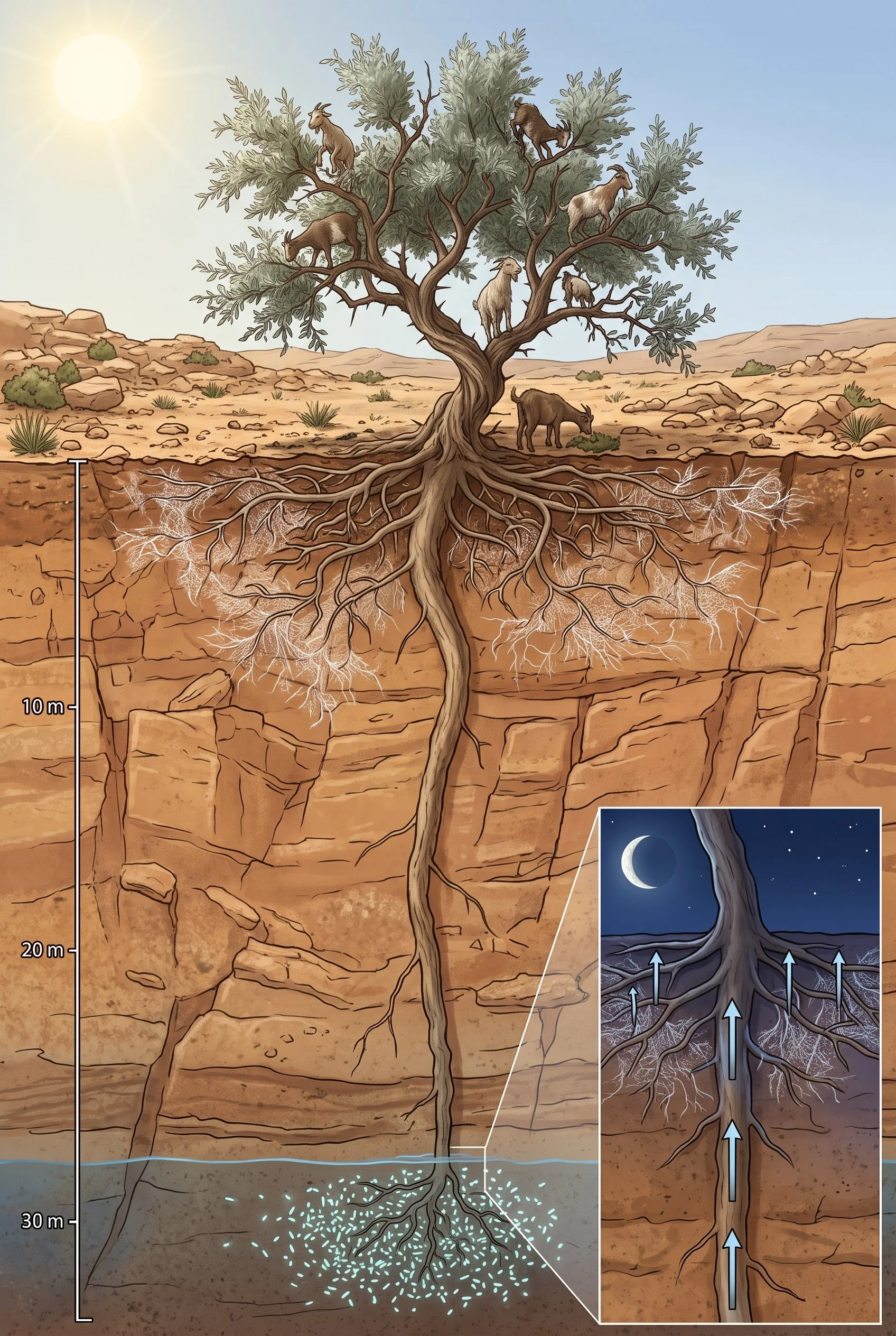
The ocean forge: nitrogenase beneath the waves
We began this story in the ocean. It is time to go back.
Nitrogenase did not vanish from the sea when life conquered the continents. It is still working there, today, at this very moment, in every litre of tropical water, in every filament of marine cyanobacterium, in every flake of marine snow drifting slowly down to the abyss.
In the vast liquid deserts of the tropical ocean, where the water is warm, clear and poor in nutrients, the phytoplankton, the micro-algae invisible to the naked eye that form the base of the entire marine food chain, are short of nitrogen. Like plants in an exhausted soil, these microscopic algae do not have enough usable nitrogen to build their proteins and multiply. The ocean ought to be a biological desert.
But it is not. Because Trichodesmium is there.
Trichodesmium is a marine cyanobacterium, filamentous and colonial, that sometimes forms blooms so vast they can be seen from space. Large reddish-brown patches on the surface of tropical seas, which sailors call sea sawdust. Trichodesmium is the direct descendant of the cyanobacteria that invented photosynthesis 2.7 billion years ago. And it still carries nitrogenase. In the surface ocean, saturated with oxygen and bathed in light, it must protect its forge as its ancestors did: by separating photosynthesis (by day) and nitrogen fixation (by night) in time, or by creating oxygen-free zones inside its colonies.
Alongside Trichodesmium, other marine fixers work in the shadows. Richelia, a cyanobacterium that lives in symbiosis inside diatoms, the siliceous algae that build tiny glass cathedrals. UCYN-A, a single-celled cyanobacterium discovered recently, so small and so abundant that its contribution to global ocean nitrogen fixation was long underestimated. And billions of non-cyanobacterial bacteria, in sediments, in aggregates of marine snow, in oxygen-free depths, that fix nitrogen with the same enzyme, the same forge of iron and sulphur, unchanged since the Archaean.
And this is where the story springs its most extraordinary surprise.
Remember the great divide. One and a half billion years ago, a eukaryotic cell swallows a photosynthetic cyanobacterium and turns it, over millions of years, into a chloroplast. That is how plants were born. And remember what we said earlier: in four billion years, no eukaryote has ever managed to acquire nitrogenase.
Well, that is changing. Before our eyes. Right now.
In 2024, a team of researchers showed that UCYN-A, this small nitrogen-fixing cyanobacterium, is no longer merely a symbiont of the marine alga that hosts it, a tiny alga called Braarudosphaera bigelowii. It is becoming an organelle. UCYN-A has lost its photosynthesis, lost a large part of its genes, and now divides in perfect step with the host cell, which supplies it with everything and even imports proteins into it. The researchers gave it a name: the nitroplast. The first nitrogen-fixing organelle in the history of life.
Let us measure what this means. Evolution is replaying, today, in the ocean, exactly the scenario that gave birth to plants one and a half billion years ago. The same capture. The same domestication. The same gradual integration. But this time, it is not photosynthesis being integrated. It is nitrogenase. A line of algae is acquiring, by way of symbiosis, what no eukaryote had ever possessed: its own internal forge.
Meanwhile, for forty years genetic engineering has been trying to transfer the nif genes of nitrogenase into cereals, without success, so complex is the machinery: some twenty genes, a metal cofactor of extreme sophistication, an oxygen protection system to be rebuilt from scratch. Where our laboratories have failed for four decades, nature has just succeeded, by its own method, the only one that has ever worked: alliance. You do not transfer the forge. You adopt the blacksmith.
All this marine fixation feeds the ocean food chain. Nitrogen fixed by diazotrophs feeds the phytoplankton. Phytoplankton feeds the zooplankton. Zooplankton feeds the fish. Fish feed birds, marine mammals, and us. And when phytoplankton dies and sinks towards the depths, it takes with it the carbon it absorbed from the atmosphere. This is the biological carbon pump, the mechanism by which the ocean locks atmospheric CO2 away in the abyss for centuries. Nitrogenase, by supplying the nitrogen that lets phytoplankton grow, is one of the regulators of the world's climate. Put out the marine forge, and the carbon pump slows down.
The third blow: poisoning the oceans
And at sea we are doing all over again exactly what we do on land.
The synthetic nitrogen that agriculture spreads on fields does not stay in the fields. Nitrates, soluble in water, seep into groundwater, run off into ditches, reach streams, then rivers, then great rivers, and end up in the sea. Millions of tonnes of reactive nitrogen every year, poured into estuaries and onto continental shelves.
When this nitrogen reaches the sea, it reproduces, point for point, the same short circuit as in the soil. Opportunistic algae, the ones that cannot fix nitrogen but absorb it very fast when it is already available, multiply explosively. These are the green tides of Brittany, the toxic algal blooms of the Gulf of Mexico, the greenish waters of the Baltic. The marine diazotrophs, for their part, stop fixing. Why spend sixteen ATP to break a molecule of N2 when agricultural nitrates are right there, free, in the water? The marine forge goes out, exactly as the soil forge goes out under fertiliser.
And with the forge goes the production of hydrogen. In aggregates of marine snow, in coastal sediments, the hydrogen produced by the fixers fed a whole invisible microbial ecosystem: methane-producing bacteria, sulphate reducers, acetogens, entire communities that depended on this flow of hydrogen for their metabolism. When the flow stops, these communities collapse. Microbial syntrophy, the web of energy exchanges woven over billions of years, comes apart.
Then comes the final catastrophe. The algae that proliferated on agricultural nitrogen die en masse. They sink to the bottom. And the bacteria that break them down use up all the oxygen dissolved in the water. The seabed becomes oxygen-free. Fish flee or suffocate. Crustaceans, shellfish, worms, everything that cannot swim fast enough to escape, perishes. These are the dead zones. The Gulf of Mexico, at the mouth of the Mississippi, holds a dead zone of more than 15,000 square kilometres in some years, an area larger than the whole Paris region. The Baltic, the Black Sea, the Gulf of Thailand, the estuaries of China: wherever rivers carry nitrogen from the fields, the sea dies.
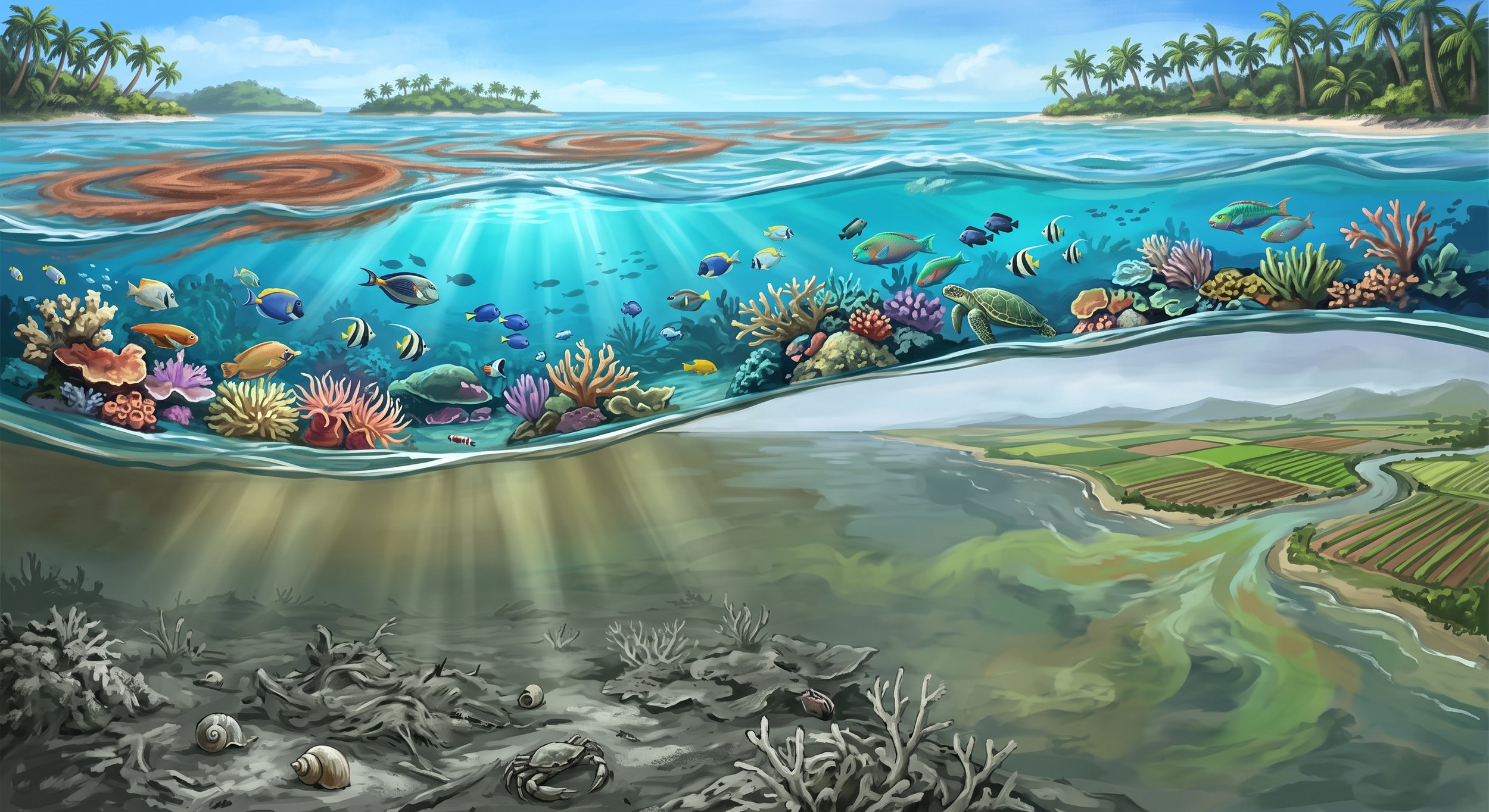
And nitrous oxide rises into the atmosphere. This gas, produced by marine bacteria as they try to process the surplus nitrogen in poorly oxygenated conditions, has three hundred times the warming effect of CO2 and destroys the ozone layer, the very layer the cyanobacteria took hundreds of millions of years to build. Synthetic fertiliser, by way of nitrous oxide, is undoing what nitrogenase did: the shield that protects life from ultraviolet rays.
The hidden poison: fluorinated phosphate
But synthetic nitrogen is not the only poison industrial agriculture pours into soils and waters. There is another, more insidious and less well known, directly linked to phosphate.
When the chemical industry attacks phosphate rock with sulphuric acid to make soluble superphosphate, it does not merely transform the phosphorus. It releases two toxic by-products: fluorine and cadmium. Moroccan natural phosphate, like all the sedimentary phosphates in the world, naturally contains fluorine and traces of cadmium, trapped in the crystal structure of apatite for tens of millions of years. As long as the phosphate stays in the form of raw rock, these poisons are imprisoned, inert, harmless. The mycorrhizal fungus that attacks a grain of natural phosphate with its phosphatases does release a tiny share of fluorine and cadmium into the soil's micro-solution. But the fundamental difference is a matter of flow. Biological acid releases these elements so slowly that they are immediately diluted and bound by the clays without ever reaching the toxicity threshold that harms bacteria. It is a trickle against a torrent.
And the fungus does better than simply slowing the flow. It acts like a customs post. When its hyphae dissolve phosphate rock, they extract pure phosphorus and carry it to the root. But cadmium and fluorine are intercepted. The fungus locks them away in its own cell walls, in the chitin of its hyphae, or binds them to the surfaces of the biochar, which adsorbs them like an activated charcoal filter. Symbiosis sorts what chemistry mixes. Industry makes cadmium soluble and the plant absorbs it. The fungus extracts the phosphorus and keeps the cadmium for itself. It is the same rock, the same ore, the same elements: but the biological route filters out the poison the industrial route releases.
And for those who would object that raw phosphate does not work in chalky soil, here is the answer. In alkaline soils, common in Mediterranean and semi-arid areas, rock phosphate is indeed locked up by the calcium in the soil. But this is where biochar changes everything. Inside the micropores of the charcoal, exudates from bacteria and fungi create acidic microsites. The pH drops locally, in these tiny caves, even if the surrounding soil is chalky at pH 8. Biochar isolates the reaction. It creates thousands of little acid reactors in an alkaline ocean. The rock phosphate dissolves in these microsites, and the fungus carries the released phosphorus to the root. The unlocking takes place inside the biochar, sheltered from the chemistry of the soil outside. It is natural micro-engineering.
The factory's sulphuric acid does no sorting. It dissolves everything at once, and releases fluorine and cadmium along with the phosphorus. The superphosphate leaving the factory takes its poisons with it: into the soil, where fluorine inhibits the enzymes of fixing bacteria and sterilises the microsites where they try to keep working; into run-off water, groundwater and streams, and finally into the sea, where it adds to the nitrates in degrading the chemical environment of marine diazotrophs that have already been short-circuited. It is a third, silent blow, on top of nitrogen fertiliser and the plough: not only do we put out the forge by supplying ready-made nitrogen, not only do we destroy the workshop by turning the earth over, but we poison the workers with the residues of industrial phosphate.
The solution, as we have seen, has something ironic about it. Raw, untreated natural phosphate, whose fluorine stays imprisoned in the rock, is precisely what the soil needs. The mycorrhizal fungus extracts the phosphorus and leaves the fluorine alone. The living acid of roots and hyphae does the work sulphuric acid does in the factory, but without releasing the poison. Nature had designed a selective sorting system at the molecular scale. Industry replaced it with a grinder that mixes everything.
The accelerator: pruning, grazing and the carbon pump
One lever is still missing from our inventory, and it is perhaps the most counter-intuitive of all. How can the forge be speeded up? How can nitrogenase be pushed into overdrive?
The answer is a paradox: by stressing the plant. Not just any stress. A positive, controlled stress, as old as grass itself.
When an animal grazes a plant cover, when secateurs trim a hedge, when a scythe lays down a carpet of clover, the plant takes a shock. It loses part of its foliage. It suddenly needs a great deal of nitrogen to rebuild its leaves, its stems, its photosynthetic capacity. And to get that nitrogen, it does the only thing it knows how to do: it pushes out large quantities of sugars through its roots. Liquid carbon, pumped straight from photosynthesis into the soil, to pay the fixing bacteria and restart nitrogenase at full throttle.
The passing of the animal or the secateurs is not destruction. It is the switch that puts the forge into overdrive.
This is the principle of rotational grazing, developed by Allan Savory: large herds that pass briefly over a plot, graze intensively, leave their dung, trample organic matter into the soil, then move on and do not return for weeks, until the grass has grown back. Each pass triggers a peak of root exudation. Each peak restarts the forge.
It is also the principle of cutting hedges for ramial chipped wood. When the alders, elaeagnus and false acacias of the fixing hedge are cut, the cut branches become ramial chipped wood or biochar. But the tree that remains, stressed by the cutting, pushes its sugars into the soil to restart nitrogen fixation and rebuild its canopy. The cut wood feeds the soil from above. The cut tree feeds the soil from below. Pruning is an act of production, not destruction.
How to tell whether the forge is restarting: four field tests
We have described the mechanisms. We have given the recipes. We have set out solutions at every scale. But how can you tell, without a laboratory, whether the forge is starting up again in your soil?
First test: earthworms. Dig out a block of soil thirty centimetres square and thirty centimetres deep. Count the worms. In dead soil you will find two or three. In living soil, twenty, thirty, fifty. If the worms are coming back, the forge is running.
Second test: water infiltration. Place a metal ring on the soil surface and pour in a litre of water. Time it. Living soil absorbs the litre in a few seconds. Dead soil lets the water pool and run off. If the water soaks in, the worm burrows, the fungal hyphae and the crumbly structure of the soil are doing their job.
Third test: the smell of the soil. Take a handful of earth and smell it. Living soil smells of forest after rain. That smell is geosmin, a molecule produced by actinobacteria. Dead soil smells of dust, of nothing, of inertness.
Fourth test: pink nodules. Carefully pull up a clover or lucerne plant. Look at the roots. You should see small swellings, the nodules. Split one in two with your fingernail. If it is pink inside, that is leghaemoglobin, the protein that protects nitrogenase from oxygen. Pink means the forge is active, nitrogen is being fixed, hydrogen is being produced. If the nodule is green or brown, the forge is out.
Coral, or the soil that shows itself
Take a handful of earth from a meadow. It smells of mushrooms, it crumbles cleanly, it holds between your fingers without sticking or falling to powder. Now take the same handful from a wheat field fertilised for twenty years. It sticks or crumbles depending on the moisture, it smells of almost nothing, and if you look for an earthworm you can look for a long time. What you hold in your hand is the same earth. It is no longer the same soil. The difference has no colour. It has no date. It made no noise as it happened. A meadow that loses its mycorrhizae stays green. A field that has lost its nitrogen fixers still yields wheat. A nodule that shuts down warns no one. The soil dies in silence, beneath our feet, and it would take decades of patient measurement to notice. Nobody has that time. So nobody notices.
Coral does not know how to die in silence. It bleaches. In three weeks, before the eyes of the whole world, it shows exactly what the soil hides from us. And if I am telling you about reefs in an article about the earth, it is for this reason alone: coral is a soil that shows itself. The same enzyme works there, the same balance holds there, the same human hand pours the same poison there, and the result is visible in colour instead of invisible underground.
An organism that lives on little
First, look at what a reef is. It grows in the poorest waters on the planet. Not the coldest, not the roughest: the emptiest. The tropical seas where corals live are chemical deserts, so lacking in nitrogen that biologists have given them a library name, oligotrophic, fed on nothing, blue as glass because there is almost nothing to scatter the light. Dive fifteen metres down in the central Pacific and you will see a blue with no bottom, clean and sterile as distilled water. It is in this blue that coral builds the largest living structure on Earth. How?
By frugality. Coral houses algae in its tissues, the zooxanthellae, which give it its sugar and its colour. It also houses bacteria that run nitrogenase, the enzyme I have been telling you about since the beginning, able to pull nitrogen out of the air dissolved in water. In summer these bacteria supply it with about eleven per cent of the nitrogen its algae need. It is not much. That is deliberate. Coral keeps its algae on a diet. It measures out their nitrogen the way a gardener measures water for an olive tree, just enough to live, never enough to proliferate. As long as they are hungry, they stay in their place, they work for the host, and the whole has held for hundreds of millions of years.
This is exactly what a plant does with its nodules. It feeds them sugar, it lets them fix what is needed, and as soon as nitrogen is plentiful in the soil it sacrifices them, because a nodule running for nothing costs a fortune. Frugality is not poverty endured. It is regulation. And any regulation can be broken.
What happens when you overfeed
On the east coast of Australia, the rivers that run down from the sugar cane plantations carry fertiliser nitrogen all the way to the Great Barrier Reef. In Florida, the same thing has been happening in the Keys for forty years. What does coral do when nitrogen arrives free?
Its algae stop being hungry. They multiply. They then demand phosphorus to build their membranes, and phosphorus did not arrive with the fertiliser. So they make makeshift membranes, with sulphur instead of phosphorus, and these makeshift membranes hold at normal temperature but melt as soon as the water warms by a degree. When they melt, the light captured can no longer be converted, it turns into free radicals, and these radicals poison the host from within. The coral expels its algae. It bleaches.
The measurements speak for themselves. On the reefs of the Great Barrier Reef exposed to agricultural plumes, the bleaching threshold is lowered by one to one and a half degrees compared with reefs the currents have spared. At Looe Key, in Florida, thirty years of sampling show that the nitrogen to phosphorus ratio more than doubled between 1984 and 2014, and that the three great bleaching events of that period follow the nitrogen peaks the way a shadow follows a man. The heat is real, it is rising, it kills. But wherever we have poured nitrogen, we have brought the hour of death forward by a degree and a half. A degree and a half, in the coming century, is the border between a reef that holds and a reef that falls.
Satellite mapping confirms this mechanism across the whole Great Barrier Reef. Over ten consecutive wet seasons, agricultural plumes covered on average eleven per cent of the lagoon, or thirty-eight thousand square kilometres, and doubled during exceptional floods. Sediment and chlorophyll concentrations exceed ecological thresholds in every type of plume except the waters furthest offshore. At regional scale, the proportion of macroalgae on the reefs, a direct indicator of coral degradation, rises with the risk score with a coefficient of determination of zero point nine six. The reefs of the Fitzroy basin, downstream of intensive cattle farming, show the highest risk scores and the densest macroalgae. The map below shows the spatial distribution of risk along two thousand kilometres of coast (Petus et al., 2016, Remote Sensing 8, 210, doi:10.3390/rs8030210, CC-BY licence).
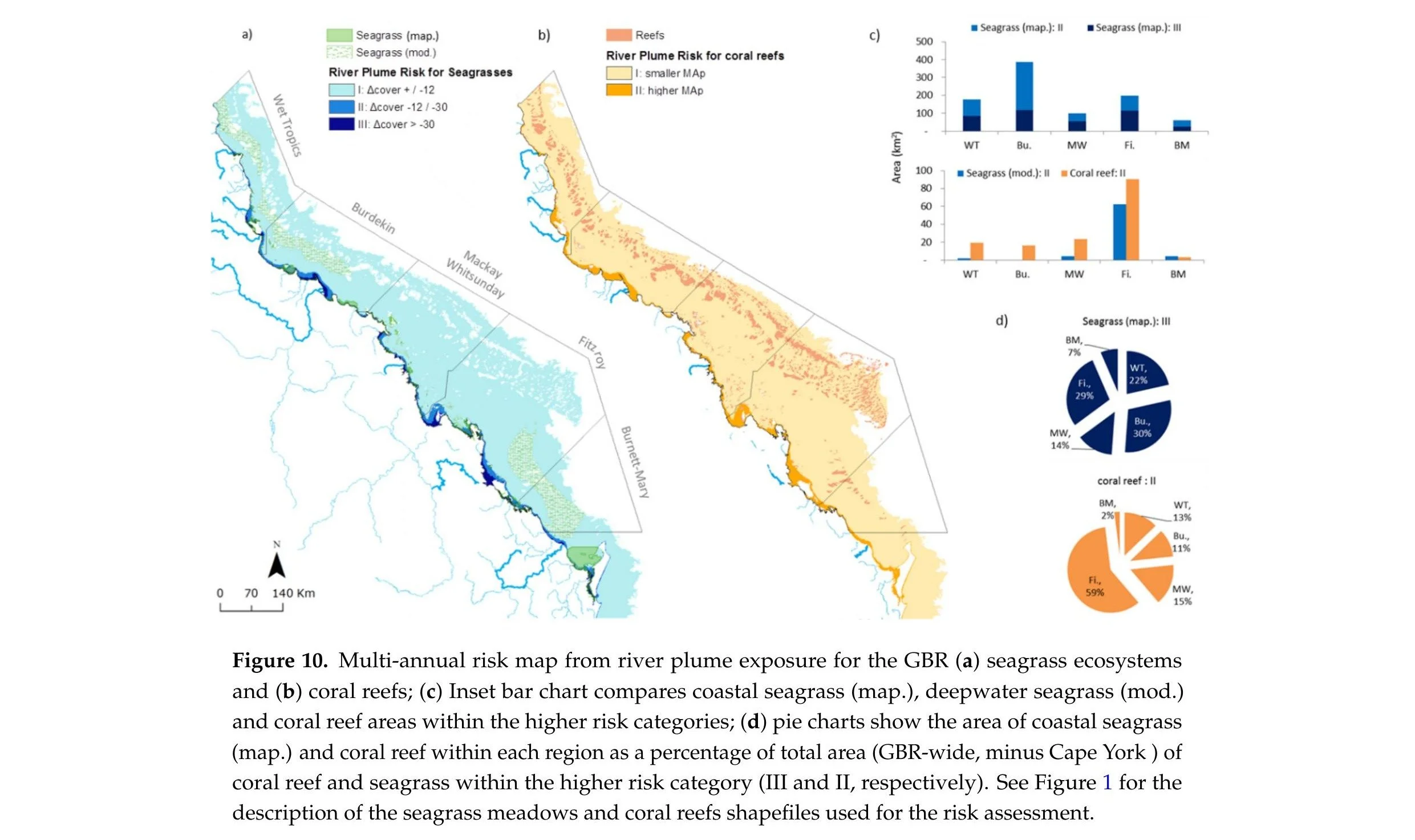
Multi-year risk map (2005-2014) of river plumes for seagrass meadows (a) and coral reefs (b) of the Great Barrier Reef, Australia. Dark areas mark the sectors where agricultural nitrogen exceeds ecological thresholds and where macroalgae compete with coral. Source: Petus et al. (2016), Remote Sensing 8(3), 210. CC-BY.
When coral starts to expel its algae, the fixing bacteria living in it run wild. Their activity is multiplied by four. Nitrogenase, the same enzyme that measured out nitrogen with a watchmaker's thrift, starts flooding the tissue. So it is not the enzyme that saves or kills. It is the hand that holds it. A healthy coral is one that commands its nitrogenase. A sick coral is one that no longer commands it, smothered from above when fertiliser makes it useless, overwhelmed from below when fever sends it off the rails.
Now look at the soil
Everything I have just described, do it again underground.
Living soil is oligotrophic too. It keeps its nitrogen fixers and its mycorrhizal fungi on a diet, it gives them sugar drop by drop, and it gets from them the nitrogen and phosphorus they fetch from places roots cannot reach. When fertiliser arrives, the plant stops feeding its partners. The nodules abort. The mycorrhizae retreat, by fifteen per cent on average in field trials, far more in forests. Free-living fixation, which could supply ten to thirty kilos of nitrogen per hectare per year in a living meadow, dies out in fertilised cereals. The soil loses its partners exactly as coral loses its algae, for the same reason, through the same breakdown of regulation. But the soil does not bleach. It goes on bearing wheat, wheat on a drip, in earth where no one works for free any more.
And what the soil no longer holds goes away. More than half the nitrogen spread in the world is never taken up by crops. It leaves for groundwater, for rivers, for the air. Tropical rivers physically export three quarters of it to the open ocean before any denitrification on the shelf, some seventeen million tonnes a year, a flow comparable to what the atmosphere deposits there. What the plough let escape reaches the reef. Life has left the soil by the same door as the nitrogen, and the nitrogen has gone to destroy life elsewhere.
Life on farmland is collapsing at a speed nobody had measured before the 2020s. Europe's farmland birds have lost fifty-seven per cent of their numbers since 1980, and the study that shows it, covering thirty-seven years and twenty-eight countries, names fertilisers and pesticides as the main cause, ahead of climate, ahead of towns. Coral shows us in colour what the birds tell us through their silence.
What coral teaches us
If I wanted this detour by sea, it is because the reef brings together, in a single visible organism, everything the soil hides from us. See what it teaches us. Life holds through frugality, not abundance. Nitrogenase is a precision instrument, not a tap. Fertiliser does not feed, it disrupts. Heat kills faster the organisms we have disarmed. And this disarming is the only lever in our hands in the coming ten years, because we will not cool the ocean, but we can stop pouring nitrogen into it.
One last thing, which I put as a question and not as a fact. Every time nitrogenase fixes a molecule of nitrogen, it releases a molecule of hydrogen. It is not a choice, it is its chemistry. In soil, we have known for twenty-five years that this hydrogen feeds a ring of bacteria around each nodule and stimulates the following crop. In plants, we know hydrogen protects against oxidative stress. In coral, nobody has measured it. When fertiliser shuts down the enzyme, this flow shuts down with it. I do not know what it was protecting. I am asking for someone to look.
Coral dies in colour. Soil dies in silence. It is the same death.
The same key, everywhere
We began this story in the black water of an ocean without oxygen, more than three billion years ago. We followed it through the rain of rust, the Great Oxidation, the birth of the ozone layer, the split of life into plants and animals. We found it again in the nodule of a clover plant, in a field hedge, in a garden biochar borehole. We saw it at work in the roots of the argan tree, thirty metres beneath the sand of the Souss, and in the filaments of Trichodesmium, on the surface of tropical seas.
Everywhere, the same enzyme. The same forge of iron and sulphur. The same mechanism: break the triple bond of nitrogen, release ammonia and hydrogen, feed life and protect it. On land, in the desert, in the ocean. In the nodule, in the heterocyst, in the fungus's endobacterium, in the geological depths of the desert, and now in the nitroplast of a marine alga. Nitrogenase is the universal key of life.
And nature's logic is fractal: what happens around the roots of a tree is replayed identically in our own bodies. In our colon, our microbiota ferments fibre and produces large amounts of hydrogen, just as nodules do in the rhizosphere. This hydrogen diffuses through our gut wall, passes into our blood, and plays the same antioxidant role there as it plays in the root cells of a wisteria in a heatwave. Our gut is our rhizosphere. Without knowing it, we carry within us a miniature version of the system this article describes. When you eat pulses, fibre, plants grown in living soil, you feed your inner forge as clover feeds its own.
And everywhere, the same poison. Synthetic nitrogen fertiliser putting out the forge in the soil. Agricultural nitrates putting it out in the ocean. The plough destroying the workshop. Fluorinated phosphate poisoning the workers. A century of industrial agriculture has set about dismantling, piece by piece, the oldest and most fundamental mechanism in the biosphere.
You do not replace four billion years of fine-tuning with a sack of white granules.
The good news is that the key is not lost. Nitrogenase still exists. The bacteria that carry it are still there, in every pinch of living soil, every clover nodule, every cyanobacterial heterocyst, every filament of Trichodesmium, every argan root, every grain of sand in the Souss and every drop of Atlantic water. We only have to give them back what they need: an oxygen-free shelter, a source of carbon, accessible phosphorus, and peace.
Biochar gives them refuge. The borehole gives them moisture. Natural phosphate gives them fuel. Mycorrhizal fungi bring them phosphorus without releasing fluorine. Fixing plants supply them with carbon. The hedge, the cover crop, the guild, the milpa, clover with maize, the alder at the edge of the field, the argan tree at the edge of the desert: so many forms of the same alliance, so many ways of restarting the oldest machine in the living world.
The rest, they know how to do. They have been doing it since the Earth was the Earth.
Author's note
This text is, to my knowledge, the first synthesis written in French to bring together in a single account the evolutionary history of nitrogenase, the role of hydrogen as a resilience shield, the engineering of inoculated biochar, natural phosphate and its biological unlocking, plant guilds, large-scale cereal solutions, the argan tree, biological soil crusts, marine nitrogenase and the nitroplast. It is the fruit of long work in the field, of synthesis and of writing.
This text is shared freely because this knowledge needs to circulate. Publishing on a free medium is a deliberate choice: to give access to as many people as possible, first. This knowledge can help a gardener in Meudon, an arable farmer in the Beauce, a fruit grower in the Souss, a rice farmer in Vietnam. Take it, use it, apply it, pass it on.
A book is being written that will go deeper into these subjects and complete them with detailed field protocols, case studies and the lessons learned from project after project.
Only one thing is asked of you in return: if you quote, reproduce or draw on passages from this text, mention its source. Yves Nicolas, yvesnicolas.com. That is how the work of synthesis stays traceable, how dialogue stays possible, and how the forge of ideas, like the nitrogen forge, keeps running for everyone.
Yves Nicolas yvesnicolas.com
References
Edwards, C.A. & Bohlen, P.J. (1996). Biology and Ecology of Earthworms. 3rd edition. Chapman & Hall, London. 426 pp. (Reissued by Springer). The world reference work on earthworm biology. Biomass data: 1,000 to 3,000 kg/ha in permanent grassland, 100 to 300 kg/ha in ploughed soils. Cast production: 40 to 100 tonnes of soil per hectare per year.
Bouché, M.B. (1972). Lombriciens de France : écologie et systématique. INRA, Paris. 671 pp. The first comprehensive survey of earthworm populations in France. Biomasses documented up to 3,000 kg/ha in the permanent grasslands of western France.
Peoples, M.B., Herridge, D.F. & Ladha, J.K. (1995). "Biological nitrogen fixation: an efficient source of nitrogen for sustainable agricultural production?" Plant and Soil, 174, 3-28. Review of biological nitrogen fixation rates by legumes and plant associations.
Lehmann, J. & Joseph, S. (eds) (2015). Biochar for Environmental Management: Science, Technology and Implementation. 2nd edition. Routledge, London. 944 pp. Reference work on the stability of biochar in soils (half-life of 500 to 5,000 years), its carbon sequestration capacity and its effects on soil biology.
Glaser, B. & Birk, J.J. (2012). "State of the scientific knowledge on properties and genesis of Anthropogenic Dark Earths in Central Amazonia (terra preta de Indio)". Geochimica et Cosmochimica Acta, 82, 39-51. Radiocarbon dating of terra preta biochars (2,000 to 7,000 years) and documentation of their lasting function.
Zeng, H., Xu, L. et al. (2013). "Molecular hydrogen (H2) as an emerging protective gas against oxidative stress in plants". Critical Reviews in Plant Sciences, 32(6), 371-381. Review of the role of molecular hydrogen as a plant antioxidant under abiotic stress (drought, salinity, heavy metals).
Soper, F.M. et al. (2021). "Biological nitrogen fixation: a review of key processes and challenges in Earth system models". Global Biogeochemical Cycles, 35. Review of global biological nitrogen fixation fluxes and their coupling with the carbon cycle.
Magnani, G.S. et al. (2010). "Diversity of endophytic bacteria in Brazilian sugarcane". Genetics and Molecular Research, 9(1), 250-258. Early work on nitrogen-fixing endobacteria housed inside mycorrhizal hyphae.
Bar-On, Y.M., Phillips, R. & Milo, R. (2018). "The biomass distribution on Earth". Proceedings of the National Academy of Sciences, 115(25), 6506-6511. Estimate of the biomass of the deep biosphere and of underground microbial life.
Coale, T.H. et al. (2024). "Nitrogen-fixing organelle in a marine alga". Science, 384(6692), 217-222. Demonstration that the cyanobacterium UCYN-A has become a nitrogen-fixing organelle (nitroplast) within the alga Braarudosphaera bigelowii. The first nitrogen endosymbiosis documented in the course of integration.
Brinkhuis, H. et al. (2006). "Episodic fresh surface waters in the Eocene Arctic Ocean". Nature, 441, 606-609. Documentation of the Azolla event in the Eocene Arctic Ocean and its role in massive carbon sequestration.
Wagner, G.M. (1997). "Azolla: a review of its biology and utilization". The Botanical Review, 63, 1-26. Review of the Azolla-Anabaena symbiosis and its centuries-old use in Asian rice growing.
Bonfante, P. & Anca, I.A. (2009). "Plants, mycorrhizal fungi, and bacteria: a network of interactions". Annual Review of Microbiology, 63, 363-383. Review of the endobacteria housed in the hyphae of mycorrhizal fungi, including Candidatus Glomeribacter and the presence of nif genes.
Petus, C., Devlin, M., Thompson, A., McKenzie, L., Teixeira da Silva, E., Collier, C., Tracey, D. & Martin, K. (2016). "Estimating the Exposure of Coral Reefs and Seagrass Meadows to Land-Sourced Contaminants in River Flood Plumes of the Great Barrier Reef". Remote Sensing, 8(3), 210. doi:10.3390/rs8030210. CC-BY licence. Ten wet seasons (2005-2014) of satellite mapping of river plumes and of the risk to seagrass meadows and coral reefs of the Great Barrier Reef.
Author's note: the references above were compiled with digital assistance. Readers are invited to check the exact citations before any academic use.
Glossary
Nitrogenase: a bacterial enzyme that turns nitrogen gas from the air into ammonia that plants can use. The only biological key able to open the safe of atmospheric nitrogen.
Nitrogen (N): a chemical element essential to every form of life (proteins, DNA). Makes up 78% of the air, but in a gaseous form that is unusable without nitrogenase.
Biological nitrogen fixation: the process by which certain bacteria turn nitrogen from the air into ammonia, thanks to nitrogenase. The natural alternative to synthetic fertilisers.
Biochar: charcoal obtained by pyrolysis (burning without oxygen). Buried in the soil, it offers millions of micropores where nitrogen-fixing bacteria settle.
Mycorrhizae: soil fungi whose filaments (hyphae) connect to plant roots. They carry phosphorus, water and nitrogen between plants, forming an underground network.
Root nodule: a swelling on the roots of legumes where Rhizobium bacteria live. It is the workshop where nitrogenase fixes nitrogen, sheltered from oxygen.
Heterocyst: a specialised cell of filamentous cyanobacteria, with thickened walls, that isolates nitrogenase from oxygen. The first invention for protecting the forge.
Leghaemoglobin: a pink protein found in root nodules. A cousin of our haemoglobin, it regulates oxygen around nitrogenase to protect it.
Hydrogen (H2): an unavoidable by-product of nitrogenase. Far from being waste, it acts as an antioxidant shield that protects plant cells against water and heat stress.
Haber-Bosch: an industrial process (1909) that makes ammonia from natural gas. Uses 1 to 2% of the world's energy and makes agriculture dependent on hydrocarbons.
Phosphorus (P): an element essential for making ATP, the fuel of nitrogenase. Without phosphorus available in the soil, the biological forge falls silent.
ATP (adenosine triphosphate): the universal energy molecule of life. Nitrogenase uses sixteen of them to fix a single molecule of nitrogen.
Terra preta: the black soils of the Amazon, enriched with biochar by pre-Columbian peoples 2,000 to 7,000 years ago. Still fertile today.
Glomalose: a secretion of mycorrhizal fungi that cements soil aggregates and stores carbon in a stable form. Formerly called glomalin (reclassified in 2026).
Rhizosphere: the zone of soil directly influenced by a plant's roots. This is where exchanges between the plant, bacteria and fungi are concentrated.
Diazotrophs: the general name for microorganisms able to fix atmospheric nitrogen thanks to nitrogenase. Includes free-living and symbiotic bacteria and cyanobacteria.
Zero phyto: a legal obligation in France (Labbé law, 2017) banning the use of synthetic pesticides in public spaces. It requires local authorities to find biological alternatives for looking after their soils.
Differentiated management: a method of maintaining green spaces that adapts the work to each zone (less mowing, plant covers, no chemical inputs). The operational framework of zero phyto for municipal technical departments.
Nitroplast: a nitrogen-fixing organelle discovered in 2024 in the marine alga Braarudosphaera bigelowii. The first nitrogen endosymbiosis in the course of integration, in which a cyanobacterium (UCYN-A) is becoming an organ of the host cell.
Pyrolysis: heating wood to a high temperature without oxygen. It produces biochar, a stable charcoal that keeps the porous structure of the original wood.
FeMo-co (iron-molybdenum cofactor): the active heart of nitrogenase, where the triple bond of nitrogen is broken. It contains iron, sulphur and one essential atom of molybdenum.