Plants, fungi and bacteria, from the vegetable plot to the street tree. Water, nitrogen, bacteria, and what a designer does with them.
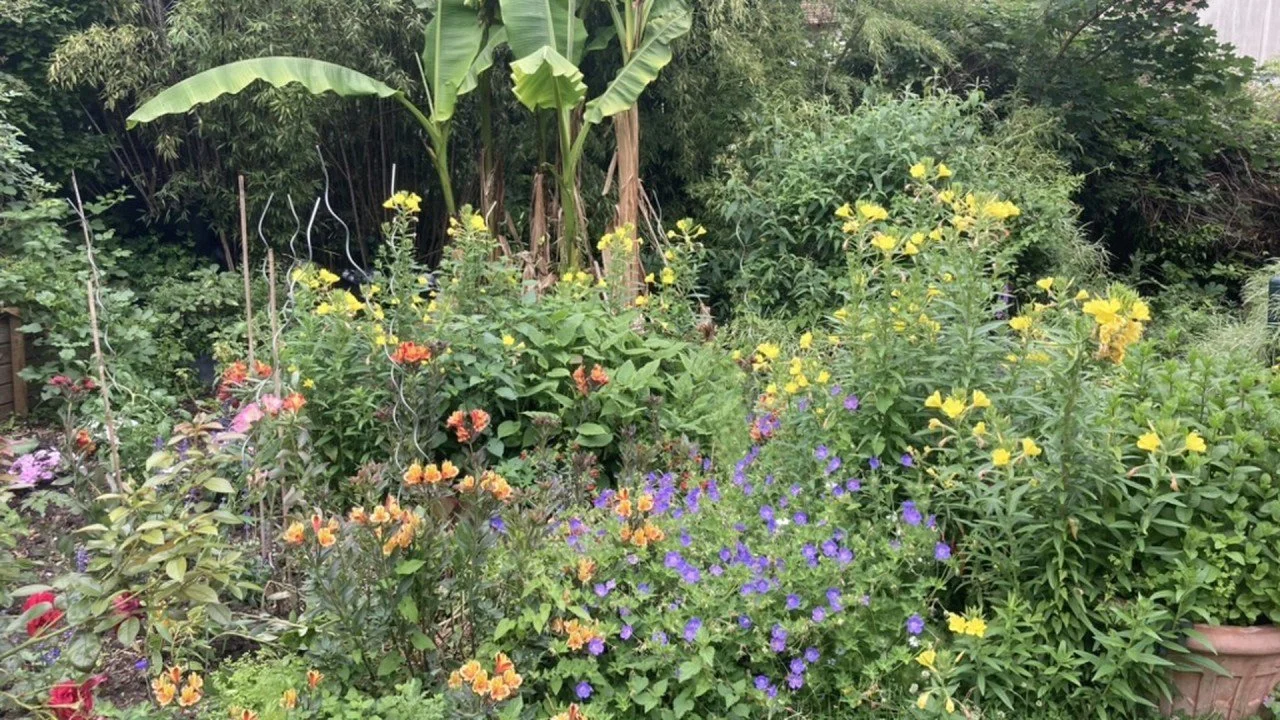
Where we left off
Two plane trees planted on the same day, in the same street. Five years later, one holds, the other dries out. The first part looked for the difference underground. There we saw a leek that rents a fungus’s fine roots instead of making them, a cabbage that deals with nobody, and three networks that share the same soil without talking to each other. We also saw that cold and drought, by blocking decomposition, decide the circuit, that the soil keeps the memory of its winters, and that the fungus carries water to the root.
All of this came back to a band of soil, neither drowned in February nor dry in May. That is where the network falls back when winter breaks it at the surface and spring dries too early for it to rebuild there. Site compaction followed by a saturated winter does more damage there than the heatwave, and two holes dug with a spade are enough to read it.
This is where we start again, with what we pour into that soil and what lives in it without showing itself, before drawing clauses and a plan from it. If you are looking for where to go in depending on what you plant, the guide is at the start of the first part.
The water we pour, and what it carries
Watering is reasoned in litres and frequency. Almost never in quality. Yet the water we pour is not neutral for the underground world, and the dangers are not the ones people think. It falls first on the twenty centimetres where the mycelium is densest, the very ones winter drowns and spring dries out.
Let us start with the most widespread accusation, that chlorine sterilises the soil. It does not hold. A team irrigated a soil and plant set-up continuously for fourteen days with lightly chlorinated water, then sequenced the whole microbial community, in the rhizosphere, that thin layer of soil in contact with the roots, and outside it. No lasting effect on diversity or composition. Metabolic functions shifted slightly, then returned to their initial state. Soil is a buffering medium, it absorbs what is poured into it, and its organic matter consumes a weak oxidant almost instantly.
The real danger lies elsewhere, and it is more devious. Chlorine does not kill biology, it reacts with organic matter. An Italian study followed lettuces grown in pots on two different soils, irrigated with more or less chlorinated water. Molecules form in which chlorine attaches to organic matter, and they are then found everywhere the plant has grown, soil, roots, leaves, in proportion to the chlorine poured. In the sandy soil, the accumulation remains insignificant. In the silty clay soil, the load in the soil reaches up to three hundred per cent of that of the control soil. The authors explicitly link the phenomenon to the soil’s organic matter content. And there is a memory effect: once these compounds have accumulated, they go on passing into the following crops even when watered with ordinary water. With only zero point two milligrams of residual chlorine per litre, the leaves carried four hundred to seven hundred micrograms of organic chlorine per kilo, against nothing detectable in the control leaves. Chloramines, those stable forms of combined chlorine, produce effects comparable to free chlorine.
The richer the soil is in organic matter, the more of these compounds it makes from the chlorine we pour. In other words, the better you look after your soil, the more chlorinated water costs. It is exactly the opposite of intuition, and it is the kind of result that should give pause before watering a vegetable garden with the hose. What these compounds do to the plant and to whoever eats it is not established; there is simply no reason to want to make them.
It should also be known that the soil chlorinates its own organic matter, on its own, all the time. Measurements on six temperate French soils, using an isotopic tracer, show that the highest chlorination rates are found in forest humus layers, and among humus forms, in mull, that is the one with the most intense biological activity. Cultivated soils are the lowest. And the rates follow soil moisture. Organic chlorine is therefore not an exotic pollutant, it is a product of underground metabolism, and what we add through water is grafted onto a cycle that is already turning.
On doses, a few benchmarks. Mains water commonly carries between zero point two and one milligram of free chlorine per litre. Recommendations for treating an irrigation network aim at one to two milligrams at the last dripper, with an initial injection of five to six, and annual maintenance shock doses exceed fifty. Two instructions come out of this technical literature and deserve to be known. Never inject chlorine at the same time as a fertiliser, because chlorine reacts with ammonium and forms chloramines. And remember this, which can be checked at home: fill a watering can in the evening, in the open air, and water the next day, most of the free chlorine has gone on its own, and one more day finishes the job. If the local authority treats with chloramine, it is still there, and it will be there next week. Your water supplier will tell you which of the two it uses.
The case where the question becomes serious is that of soilless media. A nursery substrate, a closed-circuit green wall, a soilless crop do not have the buffering power of earth. The oxidant reaches the roots and biofilms intact. I put this forward as a deduction and not as a published result, because I have not found a study that has measured it properly: in these systems, mains water deserves to be treated as an input, not as a convenience.
One more confusion, between chlorine and chloride. The first is a disinfectant that disappears in a day or two in its free form, and persists in the form of chloramine. The second is a stable ion that builds up, season after season, wherever more is irrigated than is leached. It is the problem of the south and of irrigated land, not that of a garden in Normandy. It is also that of street trees, where de-icing salt measurably degrades the performance of trees planted in structural soil pits, those street pits filled with a mix of stones and earth that carries the roadway. Our two plane trees from the start are probably among them. And on this ground, the symbiosis is not only the victim, it is also the remedy: the literature on salt tolerance shows that mycorrhizal colonisation limits the accumulation of sodium in the aerial parts and improves the plant’s ionic balance. A well-mycorrhized street tree probably copes better with salt than an unplugged one.
In practice, it comes down to very little. On a soil rich in organic matter, prefer rainwater, or let mains water stand when it is chlorinated with free chlorine. Never mix chlorine and fertiliser. Treat media without buffering for what they are, roof substrate, planter, green wall, nursery. A street tree pit is a poorly buffered medium as long as it remains poor in organic matter, and it switches to the other problem, that of chlorinated compounds, as soon as it is enriched. And in the south, watch chloride and sodium, which accumulate, rather than chlorine, which passes.
The nitrogen nobody decided on, and the resistance we lose
Water does not carry only chlorine. It also carries nitrogen, and that nitrogen appears on no invoice.
Irrigation water is not neutral in nitrogen. A borehole, a well, mains water drawn in a farming area contain it, sometimes a lot. Let us work out the order of magnitude, it speaks for itself. With water at the regulatory limit of fifty milligrams of nitrate per litre, three hundred millimetres of irrigation over the season bring about thirty-four kilos of nitrogen per hectare, a little over three grams per square metre. Nobody decided on this fertilisation, nobody put it in the fertilisation plan, and it is delivered in small regular doses, directly in the root zone, that is in the most effective way there is to switch off a symbiosis. At this concentration, it is not enough to stop the nodulation of a legume, trials put that threshold clearly higher, but it is enough to slow it and to delay the setting up of a symbiosis that was thought to be free. A more heavily loaded borehole, and there are some, does the rest.
Nitrogen also arrives through the air, and at that scale the phenomenon is no longer debated. By crossing nitrogen deposition with the forest inventory of the United States, Averill and his co-authors showed in 2018 that nitrogen pollution goes together with a retreat of ectotrophic trees in favour of arbuscular trees. The effects on the demography of the two groups run in opposite directions, and the whole is correlated with lower soil carbon stocks. Fertilising on the scale of a continent therefore amounts to changing a forest’s dominant circuit, and making it lose carbon at the same time. It is the same movement as the one we cause in a tree pit with a bag of fertiliser, but on the scale where it becomes irreversible.
Now, what we lose, and this is the point most fertilisation advice ignores completely. When we replace the symbiosis with an input, we are not only replacing a nutrition service. We are dismantling an immune system.
A mycorrhized plant is a plant whose defences are primed. The phenomenon has a name, mycorrhiza-induced resistance. A mycorrhized plant does not defend itself better, it defends itself faster. Its defences are already armed when the attack comes, the signal leaves the root and rises to the leaves, and this holds against a pathogenic fungus as well as against a root-knot nematode or a chewing insect, less surely against an aphid. A plugged-in plant is not only better fed. It is forewarned.
Cameron and his co-authors suggest that this resistance is not the work of the fungus alone, but the combined effect of the fungus and the bacteria of the mycorrhizosphere, the soil surrounding the mycorrhized root and its hyphae. These bacteria for their part trigger induced systemic resistance, the bacterial equivalent of the same priming. In other words, the fungus builds a neighbourhood, and it is the whole neighbourhood that protects the plant. It cannot be bought in a bag.
From this a simple rule follows for inputs of any kind, soluble fertiliser, foliar feed, biostimulant. Anything that gives the plant free what it would have bought reduces its investment in the alliance. And the alliance carried not only nutrition, it carried defence. So we do not fertilise to make things grow, we correct a proven deficiency. The order of operations matters as much as the doses: restore the network, measure what is still lacking, and supply only that.
A single new line of analysis goes into the contract, and it costs almost nothing: analysing the irrigation water before sizing the irrigation, its nitrate content being read as undeclared fertilisation. The other clauses await in the design chapter.
One limit, to finish, because it is real. Mycorrhiza-induced resistance is documented mainly on herbaceous plants and under controlled conditions. Transposing it to a street tree is a line of reasoning, not a demonstration. But the reasoning points the same way as all the rest of this text, and it costs less to follow than to ignore.
The network is a market, not a cooperative
Here is the contribution I consider the most useful in all this literature, and the one heard least. It extends what the leek and the grass taught us in the first part: plants are not on the same rate, and we shall see that fungi are not either.
We readily imagine the fungus as a devoted servant and the network as a mutual aid fund. The measurements say something else. Kiers and her team showed in 2011 that the exchange is regulated by reciprocal rewards, the plant allocating more carbon to the fungi that deliver it the most phosphorus, and the fungus delivering more phosphorus to the roots that pay best. Whiteside and her colleagues went further in 2019, labelling phosphorus with fluorescent nanoparticles to follow it through the network. The fungus, placed between a rich zone and a poor zone, actively moves its phosphorus from the rich zone to the poor one. It does not share, it stores where the price is good and sells where demand is strong.
Walder and his team, in 2012, linked a flax plant and a sorghum plant through the same network, then traced the exchanges with isotopes. The sorghum supplied about 70 per cent of the carbon paid to the fungus. With one of the two fungal species tested, the flax received 80 to 94 per cent of the phosphorus and nitrogen distributed by the network. The big payer got the rest. With the other fungal species, the sharing became roughly fair.
Read that twice. In a plant association, it is not only the pair of plants that decides the result, it is the species of fungus present in your soil. The same pair, with another fungal partner, gives the opposite sharing.
A study published in October 2025 confirms it in another setting. Linking three green terrestrial orchids to pines through the same fungus, the authors found transfers of carbon and nitrogen in both directions, but with different net directions depending on the orchid species, three distinct configurations for nitrogen across three neighbouring species. The network has no policy. It has pairs.
This explains a good part of the associations that work next door and not at your place, and it should make anyone who publishes companion planting tables valid everywhere a little more modest. It also explains why the fungal diversity of the soil is worth more than a single strain bought in a bag.
The relay plant
Here now is the rule that costs most when it is forgotten. The mycorrhizal fungus is an obligate biotroph. It lives only on a living root. It feeds only on the living. A seed waits for spring in the earth, the fungus does not wait, it declines. Deprived of a host, it survives for a while as spores and fragments of hyphae, in decreasing numbers, and that reserve runs out.
Australian agronomists gave the consequence a name and documented it as early as 1987. They call it long fallow disorder. After one or two seasons of soil kept bare and clean, the following crop emerges poorly, stays stunted, and shows a double deficiency, in phosphorus and zinc, while the soil analysis reports adequate levels. The elements are there. The carrier has gone. On vertisol, a swelling clay, cotton sown in a soil from which the fungi had been removed remained extremely puny, while the same cotton, in untreated soil, had 48 per cent of its root system colonised. The same phenomenon has been described after long floods, for the same reason, the prolonged absence of a living host.
Hence the centrepiece of any well-reasoned association, the relay plant. A living host plant, present all year round, whose only job is to keep the network alive between two crops. A white clover, a lucerne, a strawberry plant, a tuft of grass, a phacelia in the mix. The meta-analysis cited in the first part is clear on this point, legume covers give the best colonisation.
In an orchard, the grassed strip is neither an ornament nor a mowing convenience, it is the power station of the system. In a vegetable garden, a row of clover left in place over winter is worth more than clean soil.
And there is a reservoir that is almost always forgotten, the hedge. An old hedge, never worked, never fertilised, holds beneath it a mycorrhizal population of a richness nothing can replace. It is the bank of the site. You draw from it, you put nothing in.
The nodule’s phosphorus, and the rhizobium’s taxi
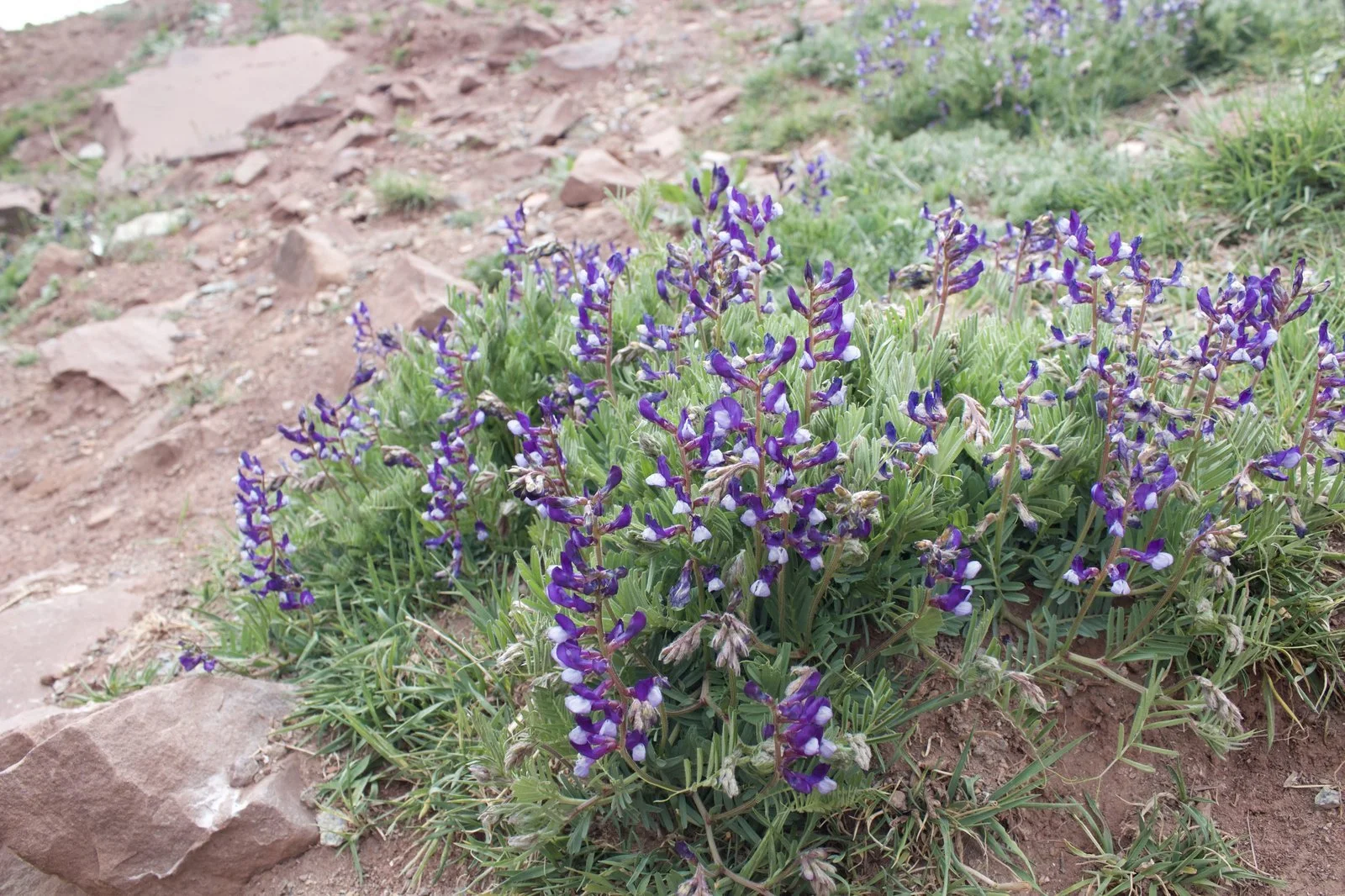
High Atlas. A cushion-forming legume settled on a scree slope, thirty centimetres from bare stone. It is there, in mineral, dry and alkaline soil, that symbiotic fixation weighs the most.
We saw in the first part that arid, alkaline soils bet on the fixers of their own accord. Let us understand what makes this nodule turn. A legume is paired with a hungry plant for the nitrogen it brings, and that is true, but it is incomplete.
Fixing atmospheric nitrogen is the most expensive operation in all of plant biology. Breaking the triple bond of the nitrogen molecule requires of nitrogenase, the enzyme that does this work, sixteen molecules of ATP per molecule of nitrogen reduced, a quarter of which goes into the hydrogen lost along the way. Now ATP, the currency that pays for every energy expense in the cell, contains phosphorus. A nodule, which runs through so much of it, must therefore hold a high stock: it is an organ with a very high concentration of phosphorus. A legume poorly supplied with phosphorus fixes poorly, whatever the quality of its rhizobium, the nodule bacterium. Experiment confirms it, mycorrhiza stimulates biological nitrogen fixation in lucerne and in Medicago truncatula precisely by improving phosphorus acquisition. With one condition that must be stated at the same time, the benefit exists only as long as phosphorus is limiting. Above eight to ten milligrams of water-extractable phosphorus per kilo, it disappears and the two symbioses start competing for the plant’s carbon.
There is better, and it is recent. The fungus was thought to be a mere supplier of minerals. It was shown in 2021 that its hyphae carry phosphate-solubilising bacteria to the pockets of organic phosphorus it cannot exploit on its own. Then, in 2024, that they do the same service for rhizobia. In a soil where the bacterium moves poorly, it travels along the hyphae and feeds on what they ooze along the way, their sugary exudates. It thus reaches distant legume roots and nodulates them. Better still, the presence of the bacterium stimulates the flow in the hypha and increases exudation, which keeps the traffic going.
So the fungus is not only the nodule’s phosphorus supplier. It is the taxi that brings the bacterium to the root. Pairing a legume with a hungry plant sets this whole chain in motion, not a simple exchange of nitrogen.
There is a sequel to this story, and I deliberately keep it separate from what precedes, because it does not have the same status of proof. It is a lead, not a result, and the rule of conduct that closes this chapter does not depend on it. If the chemical detail does not interest you, skip the paragraphs that follow and meet me at the last line.
The nodule releases hydrogen, and it cannot do otherwise: nitrogenase necessarily produces dihydrogen as it reduces nitrogen. The stoichiometry of the reaction, that is the exact count of what goes in and what comes out, imposes at least a quarter of the electrons. Measurement on whole plants gives far worse: in most symbionts, only forty to sixty per cent of the electron flow intended for nitrogen actually reaches it. The rest goes off as gas.
This gas is not exotic. Hydrogenases are spread across dozens of bacterial and archaeal phyla, and soils are the planet’s main sink for atmospheric hydrogen. The effect of nodule hydrogen on the growth of neighbouring plants has had a name in the literature since the early two thousands, hydrogen fertilisation. A 2003 study exposed soils that had not carried a legume to a flow of hydrogen imitating that of a nodule, then sowed wheat, oilseed rape, barley and a non-nodulating soya in them. Dry weights were fifteen to forty-eight per cent higher than in the same soils treated with air. And we know that this gas costs the plant five to six per cent of its net photosynthesis, which is a lot for a waste product.
The other side must be said at once. A 2025 study soaked a soil in hydrogen for two months before sowing vetch in it, with no further exposure during cropping. Not only did the expected gain in the aerial part fail to materialise, but root biomass decreased. The authors conclude that hydrogen fertilisation is not universal and that it depends on particular conditions that remain to be identified.
What I add to this is a working hypothesis and nothing more: the mycorrhizal mesh does not capture hydrogen, the fungus has no enzyme for that, but it houses, feeds, transports and positions the bacteria that capture it. Nobody has tested whether an intact network changes anything in this matter. I devote a whole article to this question, with its evidence, its precedents, its contrary results and its condition for abandonment.
Here is the promised last line. The rule of conduct I draw from this chapter can be published independently of the hypothesis, since it is already justified by everything that precedes it: continuous carbon, open structure, light and permanent water rather than copious and spaced out, low mineral nitrogen. It holds first of all because it makes things grow.
The fungus cannot do anything on its own either
So far we have described an exemplary supplier. This exemplary supplier is illiterate in chemistry.
The arbuscular fungus is a remarkable explorer and carrier. It is not a chemist. Sequencing of the genome of Rhizophagus irregularis, published in 2013, showed that it lacks the genes coding for the enzymes able to attack plant cell walls, which fits its obligate biotrophy, and that it does not secrete the phosphatases that would open up organic phosphorus. Translated into field language: it cannot break what is locked up. Faced with phytin, the form of phosphorus stored in seeds and very abundant in soils, it is as helpless as a leek in dry soil. Someone has to break the molecule for it.
That someone is a bacterium. And the fungus does not wait for it, it recruits it, pays it and transports it.
Hyphae exude sugar, notably fructose. It was shown in 2018 that this fructose does not act only as food. It triggers, in a phosphate-solubilising bacterium, the expression of phosphatase genes and modifies its protein secretion system, and therefore the amount of enzyme released into the medium. Phosphatase activity rises, phytin is mineralised, and the inorganic phosphorus thus released is captured by the fungus. Sugar, here, is not a wage, it is a work order.
The transport is demonstrated like this. Two compartments are separated by an air gap of seven and a half millimetres, impassable for a bacterium. The bacterium is placed on one side, a store of organic phosphorus on the other. Without the fungus, nothing ever happens. With hyphae stretched across the gap, the bacterium is on the other side within a week. The controls complete the proof. A nylon thread of the same diameter, stretched in the same place, does not do the job: it does not carry a thick enough film of water. Laid on the bottom, and therefore better wetted, it still does not work, unless it is coated with glucose. Finally, a bacterium lacking a flagellum, the whip that makes it swim, never reaches its destination, even with the hyphae in place.
So three things are needed at the same time, and that is the very definition of a pact. A road, the film of water surrounding the hypha. A fuel, the sugary exudates the fungus releases along the way. And a passenger who rows, the bacterium that has to swim by itself. Remove any one of the three and nothing happens.
In this set-up, the fungus alone mineralises nothing, the bacterium alone mineralises nothing, and the two together make 67 per cent of the phytin disappear. In real soil, under maize, the same experiment gives this: no detectable bacteria in the pocket of organic phosphorus when the fungus is absent, more than ten million bacteria per gram when it is present. And the loop closes on itself, since the recovered phosphorus finances more hyphae, therefore more exudates, therefore more bacteria, therefore more mineralisation.
None of this takes place in the bulk soil or in the rhizosphere, but in a zone that now has its own name, the hyphosphere. The bacterial communities that settle on hyphae away from roots are reproducible from one soil to another, with groups consistently enriched, and they set up within fourteen days. Two species of fungus placed in the same soil do not recruit the same bacterial team, each makes its own selection. Here we find again, at the bacterial level, what we saw with flax and sorghum. The fungal partner present in your soil decides not only the sharing between plants, it also decides the staff recruited in the soil.
For nitrogen, a third kingdom is even needed. The fungus cannot open chitin either, the nitrogen-rich molecule that makes up insect shells and the walls of other fungi, and which represents a considerable store of nitrogen. A study published in 2022 reconstructed the complete chain under controlled conditions, with labelled chitin. The fungus obtains a lot of nitrogen when a Paenibacillus is present in its hyphosphere, but part of this nitrogen remains locked inside the bacteria themselves. A protist is then needed, a social amoeba, to come and graze the bacteria and release the nitrogen into the medium. Three kingdoms of life, plants aside, to move one atom of nitrogen to a root.
And there are bacteria inside the fungus. It is the last level of the nesting, and the most spectacular. Some species of Gigaspora host in their cytoplasm an obligate bacterium, Candidatus Glomeribacter gigasporarum, whose genome is reduced to about two million base pairs, unable to live anywhere else. When the fungus is rid of its tenant, it loses vigour and bioenergetic potential. The bacterium also improves the fungus’s antioxidant responses and, step by step, those of the host plant. A bacterium in a fungus in a root, with the bacteria of the hyphosphere around it. The pact is played by four.
In ectotrophic trees, the same story plays out with other actors. It was discovered as early as the nineteen-nineties, as Frey-Klett summarised in 2007, that some soil bacteria favour the very formation of ectomycorrhiza. They have since been called mycorrhiza helper bacteria. A strain of Pseudomonas fluorescens thus increases the number of mycorrhizas formed between Douglas fir and the fungus Laccaria bicolor. The mechanism is not trivial: mutants deprived of their type three secretion system, that is of the molecular apparatus that injects proteins into a neighbouring cell, lose all ability to favour the symbiosis. So there is active molecular dialogue, not mere neighbourliness. Exchanges of vitamins, thiamine in particular, complete the picture.
These cooperations are triggered only under constraint. When soluble phosphorus is plentiful, they have no reason to exist and one simply observes organisms tolerating each other. It is the same prohibition as above, found one notch lower: a richly fertilised soil is not a fed soil, it is a soil where nobody has any reason to deal with anybody any more.
Three practical consequences follow for those who design and plant.
First, an asymmetry to know before buying anything. Bacteria can be cultured, packaged and reintroduced: inoculating legumes with rhizobia has a century of agronomic experience behind it and it works. The mycorrhizal fungus, on the other hand, cannot be grown away from a living root, and eighty-four per cent of trials of commercial products colonise nothing or almost nothing. So bacteria can be reintroduced. A network cannot be made in a bottle, it can only be transplanted with its soil or given back the conditions for its return.
Next, a bacterium without a habitat does not last long. It needs the film of water, the porosity and the continuous carbon that the plant and the fungus produce. That is exactly the function of biochar, that porous plant charcoal, charged before burial: it does not bring a strain, it brings housing.
Finally, the formula that sums it all up and that I will keep for my reports. The plant pays the fungus in sugar, the fungus pays the bacterium in sugar, and the bacterium opens the chemical lock that neither of the two can open alone. If the nitrogen stays stuck in the bacterium, a protist will even be needed to come and eat it. In this chain, nobody works for free, nor alone.
That is why the title of this article speaks of pacts in the plural. There is not one alliance between a plant and its fungus, there is a cascade of them, nested, negotiated at each level, and the way the soil is managed decides whether it is set up or not.
What breaks the network
The question can be turned round to ask what unplugs a plant that was asking to be plugged in.
Excess soluble phosphorus. It is the first of all. The plant maintains the symbiosis only if it needs it. Serve it ready-made phosphorus and it reduces the colonisation of its roots, then sends the fungus away. You pay twice, for the fertiliser and for the loss of the network. The threshold has been measured on legumes, as we saw with the nodule: eight to ten milligrams of water-extractable phosphorus per kilo of substrate, beyond which the fungus and the rhizobium compete for the plant’s carbon. A non-legume has only one symbiont to lose, and it loses it by the same mechanism, at a threshold these trials did not measure. This water-extractable phosphorus is not the one on the usual analysis reports, Olsen or Joret-Hébert, whose values are much higher for the same soil. So the figure does not transfer as it stands to your report.
Excess mineral nitrogen produces a similar effect, and it also switches off fixation in the nodules.
Tillage. The extraradical network is a tangle of hyphae that crosses the soil from root to root. The plough chops it up. The fungus rebuilds, but it starts again from a lower level, and if you start again every year it never climbs back. It is, as we saw in the first part, the first factor measured.
Bare soil, which we have discussed.
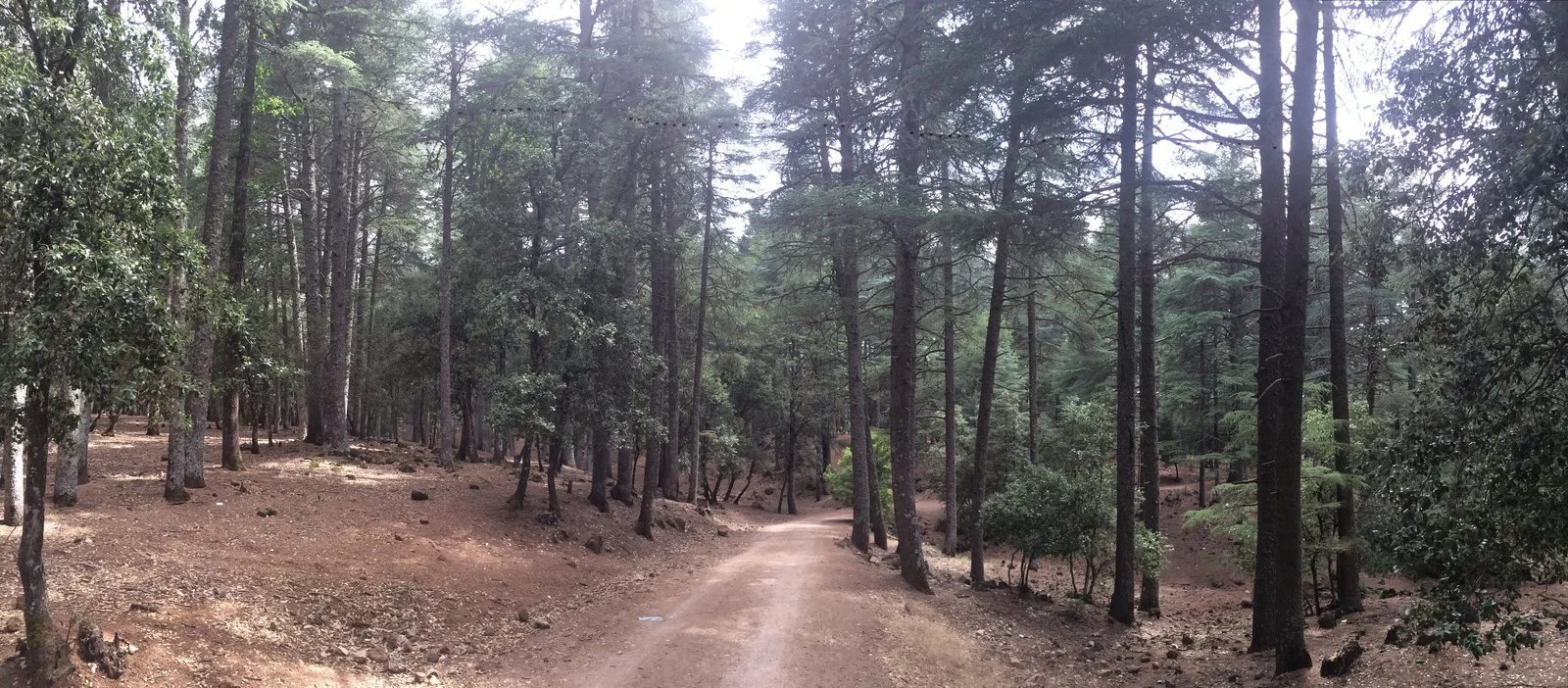
Middle Atlas. The stand still holds, the soil no longer does. Here, the tree is protected, the soil is not.
Pure brassica covers before a highly dependent crop, with the reservation set out in the first part about the real size of the effect. One more nuance, because buckwheat is often put to me as a counter-example. Buckwheat is not mycorrhizal, which does not stop it being useful for other reasons, notably its ability to mobilise soil phosphorus through its exudates. It is not forbidden, it is simply useless as a relay plant. It must be accompanied and not sown alone.
Finally, certain fungicides, whose effects on mycorrhizas are rarely shown on the label.
What can honestly be said about the network that feeds the neighbours
We must now talk about the image that has gone round the world, that of the caring forest where the big trees feed their young through an underground network. I will not take it up as it stands.
What is solidly established comes down to a few points. The hyphae of a single fungus do colonise the roots of several neighbouring plants, including different species. Labelled molecules pass from one plant to another by this route, as was shown as early as the nineteen-nineties between birch and Douglas fir. Signals pass too: in broad beans attacked by aphids, the neighbouring plants connected by the mycelium, and they alone, triggered their defences and released the volatile compounds that repel the aphid and attract its parasitoid. Finally, there are plants entirely without chlorophyll, yellow bird’s-nest in pine woods, which the first part came across, and the bird’s-nest orchid of our beech woods, which live plugged into a tree’s network without ever making a gram of sugar. They are living proof that carbon circulates and can feed a whole organism.
What is not established is the generous interpretation that has been drawn from it. In 2023, Karst, Jones and Hoeksema examined the literature on these common networks in forests in Nature Ecology and Evolution. Their conclusion is clear: the idea that the networks are ubiquitous in forests and that the transfers improve seedling survival is not sufficiently supported, field results varying too much or admitting other explanations. And the idea that adult trees preferentially send resources and signals to their offspring rests on no peer-reviewed publication. They also showed a citation bias, positive results being cited far more often than null results.
The debate is alive and that must be said too. Simard and her colleagues published a reply in 2025, other teams proposed in 2024 to clarify the very definition of these networks, distinguishing the mere sharing of a fungus from real continuity of hyphae between two plants.
As for quantities, they are beginning to be measured. The 2025 study on orchids and pines puts the transfers at 1 to 3.7 per cent of assimilated carbon and 0.2 to 12.2 per cent of acquired nitrogen, enough to count, not enough to feed a small fir tree on its own.
My position is simple and I hold it for the whole of functional ecology. No mechanism is established on its own, each depends on context, and yet the whole works in the field in a reproducible way. Describing the whole while staying cautious about each piece is the exercise. I do not need trees to love each other to know that a soil whose network is intact grows better, for longer and with less water than a soil whose network has been chopped up. That I see every season.
The network also builds the soil
One last fact, often forgotten in debates about who feeds whom. The carbon that goes down into the network does not only feed the fungus. Part of it goes out into the soil.
By isolating hyphae from any root with an air gap and labelling the carbon, Kakouridis’s team, the one that had measured water transport in the first part, measured in 2024 that the fungus had transferred 0.77 milligrams of carbon per gram of soil. A third of it ended up in the occluded or mineral-associated fractions, that is in the stable forms of organic matter. Around the hyphae lives the hyphosphere described in the bacterial chapter, a population fed by their sugary exudates.
So a plugged-in plant does not merely eat better. Through its photosynthesis, it finances the making of stable soil and the upkeep of a microbial population at a distance from its roots. It is an argument I readily put to a technical department hesitating between a soil improver bought every year and a system that pays for itself.
In the field
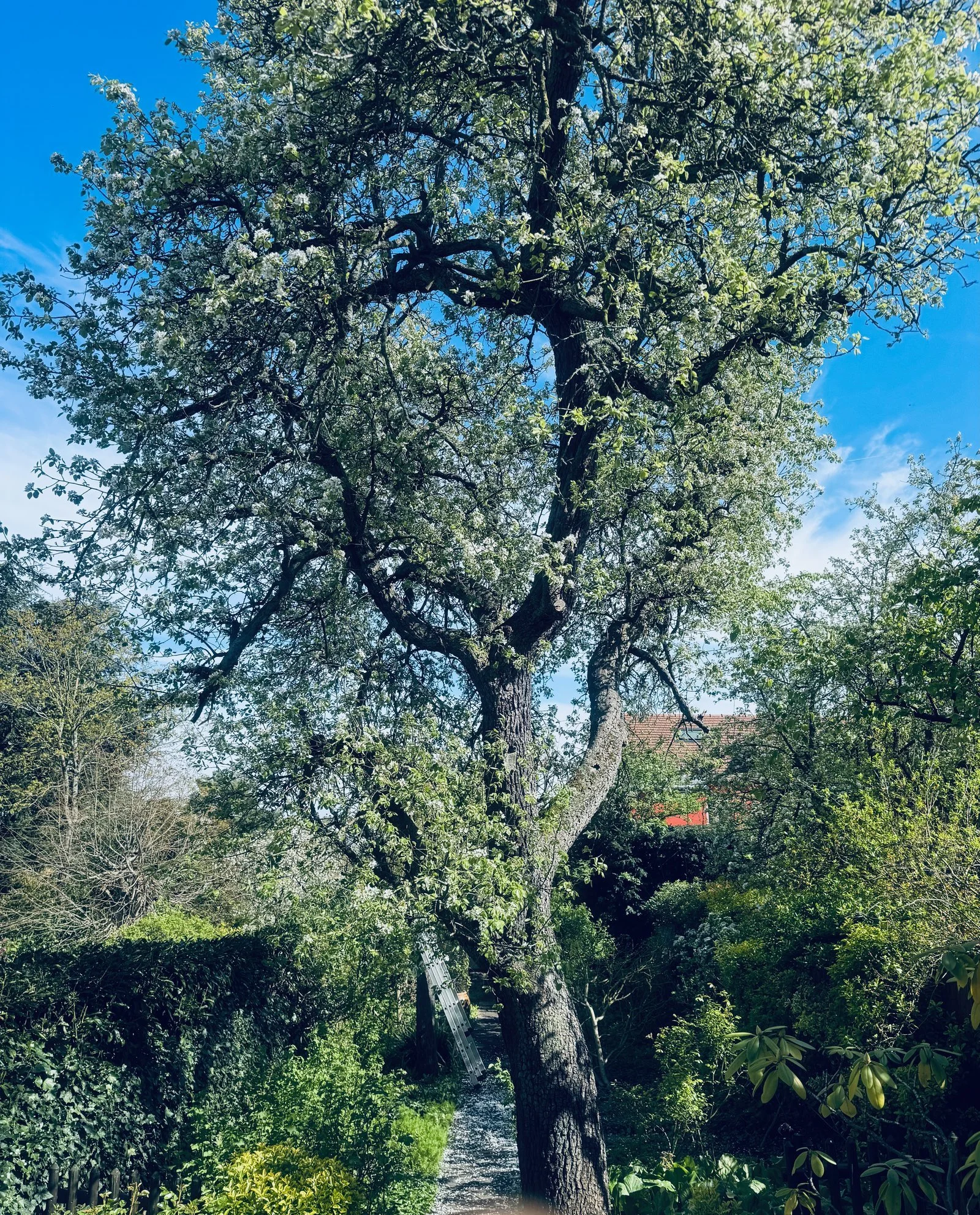
Meudon. An old pear tree in flower, arbuscular like the apple, the vine and almost the whole vegetable garden. A handful of earth taken from under a tree of this age carries the strain that has already proved itself here.
How do we set up this network, now, when it is no longer there?
First by ceasing to destroy it. The points listed above do, on their own, most of the work, and they cost nothing. Then by reintroducing the host, that is the permanent relay plant. The fungus comes back of its own accord in most soils of our regions, provided it finds a living root and is given two or three seasons.
And commercial inoculum, I will be asked. Here one must be direct, because the subject costs people money. A meta-analysis published in New Phytologist in 2025 brought together 302 trials of inocula, including 250 trials of commercial products, on seven crop species. Commercial products gave on average less than 9 per cent colonisation by hyphae, against 39 per cent for field soil and 41 per cent for inocula produced in a research laboratory. Eighty-four per cent of the trials of commercial products produced no colonisation or negligible colonisation, and 81 per cent no arbuscules, that is no exchange organ. About 6 per cent killed the crop. The pathogen Olpidium was found eleven times in commercial products. Only one trial in eight, twelve and a half per cent, combined a real growth gain with sufficient colonisation.
The most instructive detail lies elsewhere. Nearly half the commercial products improved growth without colonising at all, which means the benefit came from the fertiliser contained in the sachet and not from the fungus. And the number of propagules announced on the label was correlated neither with colonisation nor with the plant’s response. It is not a question of quantity, it is a question of viability on arrival. Two points in fairness: there are therefore good products, those in that eighth of trials where the fungus was alive and beneficial, and the lead author of this study herself declares that she runs an inoculum company, which does not invalidate published and peer-reviewed figures, but is worth knowing.
One figure above all, which nobody highlights: field soil worked in every trial where it served as the reference. The best inoculum is rarely the one you buy. It is often thirty metres away, under a healthy plant of the same circuit. A clod taken from under an old hedge, under an old leek gone to seed, under a hazel by a path, contains the three forms of propagules: spores, fragments of hyphae and colonised roots. It also contains the local strain, the one that has already proved it can stand this soil, this limestone, this drought. A few litres are taken from the top twenty centimetres, on the very day of planting. Do not sieve it, since the colonised roots are part of it, and place this soil in contact with the root, not on the surface.
Biochar comes into the arrangement here, and for precise reasons that have nothing magic about them. Its porosity offers a protected habitat where hyphae and spores settle, and hyphae reach micropores no root will enter, including to take phosphorus from them. A recent global synthesis, covering 85 studies and 663 comparisons, concludes to an average increase in root colonisation of about 26 per cent with biochars made from plant residues. The effect is more marked in coarse soils well supplied with carbon, and on fruit and tuber crops. Older studies that reported the opposite, notably with wood biochars, attributed it to a sudden rise in available phosphorus, which brings us back to the first point on the list of network breakers. Dose and preparation are everything. Raw biochar, not inoculated, added alone and in excess, starts by capturing whatever passes. Charged beforehand and properly dosed, it does the opposite. That is why I always prepare it before burying it.
The principle of the pit filled with porous material is not new, it is found in the Stockholm planting system as in far older Sahelian practices. What I carry out with the biochar borehole around trees already in place is the adjustment of this assembly site by site: the composition of the charge, the low-flow water supply, the way of drilling without injuring the tree. You start with a small-diameter pilot hole, to check that you pass between the structural roots and the utility networks, moving over if need be, and then you widen it. This adjustment is mission work, not a recipe.
Designing a green space that lasts
All of the above comes together in a design doctrine, and it does not look like the one in current use. I give it as I apply it, with what the urban literature confirms, and with what it refuses to confirm. This chapter is addressed first to those who write contracts. The gardener will also find something in it, and his summary awaits him just after.
Let us first say that the subject is coming out of the shadows. A review published in 2026 in Ecological Restoration, entitled “Designing the Fungal City”, notes that mycorrhizal fungi are one of the fundamental actors missing from ecological design and landscape architecture. That is exactly the gap in which we work.
We design with circuits, not with species lists. The unit of the project is no longer the plant, it is the nutritional economy it belongs to. An oak and a hazel form one unit. An oak and a carpet of heathers form two, which ignore each other. This single shift reorganises all existing planting palettes, and it can be checked when the species are chosen, not three years later.
Species with a double subscription are a wild card, and you need to know you have it. Willow, poplar, alder, ash, eucalyptus, acacia and a few oaks carry both circuits at once. On a site whose biological state is unknown, on fill, on stripped wasteland, they settle with what they find instead of waiting for the missing partner. Symbiotic flexibility does not, however, exempt them from the tree’s physiology. Riverside willows and poplars, like black alder, are phreatophytes: they live with their feet on an accessible water table. Dry fill puts them into hydraulic failure well before their double subscription can serve them. Their advantage plays out on soils with extreme regimes, waterlogged then dry, provided the water is there. On dry fill, the pioneers are goat willow and aspen, which is a poplar, and it is they who benefit from this flexibility. The ash and the oaks on this list are less demanding. And since species with a double subscription occupy a wider climatic range than those with a single circuit, they cope better with a shifting climate: they keep an option open on the drowned soil of February as on the baked soil of August. It is not a reason to make a whole palette of them, it is a reason to put some in every difficult project.
Resilience is redundancy of acquisition routes, not redundancy of species. Planting fifteen species that all prospect for mineral phosphorus by the same route diversifies nothing from the soil’s point of view. Stacking three circuits on the same footprint, as an oak wood does spontaneously, puts three trades on three resources. If one drops out during a heatwave, the others hold. This is functional biodiversity, and it can be defended before a technical department that has no use for an aesthetic argument.
Winter air is designed before summer water. On heavy land, planting is done on a slight mound, after decompaction if machinery has passed, and never in autumn, which would deliver the young tree to six months without air. A drainage-only solution is refused, since it brings the spring drought forward. The height of the mound is read in the two holes: it is what the band is missing. And a soil is accepted in February, not in July, with the water hole dug as for reading the band. The May hole will come later, during establishment monitoring.
Bare soil is the only absolute prohibition. The fungus dies without a living root. This is not settled during maintenance, it is written into the contract documents: a permanent living cover over the root zone, a grassed strip maintained, no blanket weeding between two plantings, the cover re-established in the weeks following earthworks. The lawn would survive the loss of the network, the tree would not: the cover is there for the tree. The fifty-four field studies cited in the first part apply here, with legumes in the lead. The meta-analysis concerns catch covers, and extending it to permanent cover is reasoning on my part, not a measured result. No planting delivered will make up, within its one-year guarantee, what two seasons of bare soil have destroyed.
A nuance, which does not weaken the rule. On a young planting, the thirst of the grass often weighs more heavily than the absence of fungi, and it plays out in the twenty centimetres everyone is fighting over. So a square metre mulched with chipped branches is kept at the foot of the tree for the three years of establishment, mulched and not scraped bare, until it has put down enough roots no longer to depend on that layer alone. The permanent cover begins beyond. This is a classic result of young planting management, and it does not contradict the ban on bare soil, since a mulch is not bare soil.
The surface is chosen on this criterion too. An Italian study of 2023 compared, under city trees, bare soil, a permeable surface and an impermeable one. Fungal diversity did not collapse in any of the three cases, but the communities under the permeable surface remained close to those of open soil, while those of sealed soils diverged. In other words, the permeable surface preserves the procession of the living soil, the impermeable one makes another. It is a line to write into the specification, the technical clauses document of a public contract.
The city damages less than it replaces, and that changes the strategy. A study carried out in Amsterdam on the elm, the city’s most planted tree, compared an urban forest, a park and a street. Against all expectations, the diversity of arbuscular fungi was highest in the street and lowest in the urban forest, with clearly distinct communities according to the degree of soil sealing. It is not that partners are lacking, it is that partners change, in favour of generalist species tolerant of disturbance. A nuance that still counts: about a fifth of the elm rootlets sampled carried no fungus at all. So design should not aim to bring the forest back into town, but to give urban generalists something to work with. Our two plane trees from the start probably did not lack partners. They had different ones, and the loser was the one that had nothing to make them work, neither living roots around it nor air in February.
What happens above is read below. A survey carried out in Virginia on urban and peri-urban forests crossed a forest quality index, calculated on tree health, soil sealing and invasive species, with the biological state of the soil. The share of ectotrophic fungi and the rate of arbuscular root colonisation fell as surface quality deteriorated. The soil follows the stand, and vice versa. This result does not contradict the previous one, it completes it: the city lengthens the list of species present and shortens the intensity of the connection. A serious design diagnosis therefore looks at both.
The green roof is the textbook case, and it is instructive in both directions. A roof substrate delivered new contains practically no propagules. A two-year experiment in Chicago inoculated half the trays with soil taken from under a prairie restored thirty-two years earlier, deliberately choosing the dry, rocky, shallow areas to catch strains able to hold out on a roof. The result was a clearly richer and distinct community from four months, reinforced at two years, whereas colonisation by air brought only a handful of small-spored species, of the opportunistic type. So much for the good side. The bad side, which must be said, is that this inoculation produced no measurable effect on plant survival or on the services expected from the roof during the trial. The soil changed, the vegetation has not yet responded.
The plant is a vehicle for inoculation, and nobody treats it as such. In the same experiment, it was the trees planted mature with their root ball that carried the richest fungal community, quite simply because they had brought their own soil. A plant raised in sterile, over-fertilised peat arrives unplugged on site. A plant raised in open ground arrives with its procession. It is a criterion for selecting a supplier, and it appears in no specification I have read. The line fits in one sentence: plants raised in open ground, delivered with their root ball, not in sterile peat-based substrate and without finishing fertilisation.
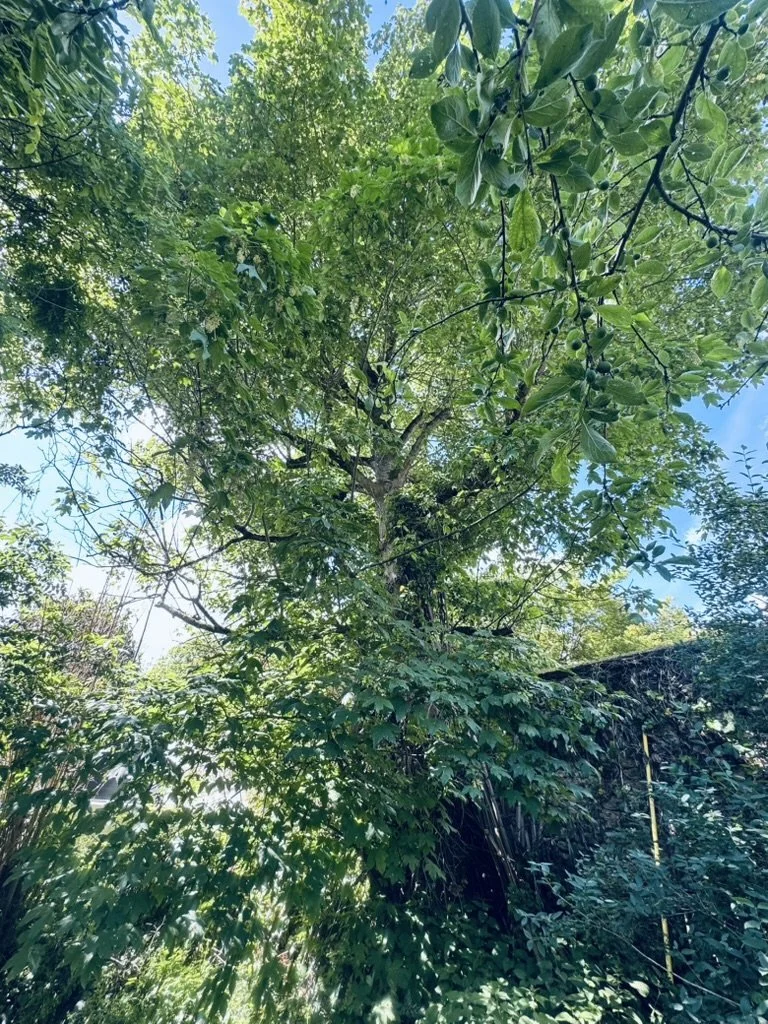
Meudon, back of the garden. A maple and a mirabelle plum intertwined at the foot of an old wall, both able to plug into the same fungi. A corner you would call badly kept, and which is the site’s reserve, because it has never been dug.
Inoculum is designed on site, but not just anyhow. Commercial products fail in the vast majority of cases, as we have seen, while field soil colonises every time. The consequence for design is clear: a source of living soil is identified on the site or nearby, an old hedge, a woodland edge, a patch of wasteland, it is protected during the works, it is marked on the plan as a sampling zone, and the inoculum line is deleted from the budget.
In a dense city, this clause does not apply as it stands. On a town centre redevelopment there is no woodland edge thirty metres away, and if there were one its procession would not be the right one, since the street selects the disturbance-tolerant generalists we saw on the Amsterdam elms. The donor is then the pit of an old, healthy street tree in the same district, whose fungi, I assume without having measured it, already hold out under the constraints of the place. Three conditions apply, and they are not negotiable. The agreement of the highway authority, since the soil is taken from public land. A contamination analysis, since tree pit soil often carries hydrocarbons, lead, zinc and accumulated chloride. And a plant health opinion, since soil also moves root pathogens, and canker stain of plane is a regulated organism for which soil and tools are recognised vectors. The soil is taken from the edge of the pit, under a tree of the same circuit as the recipient, without injuring any root, and placed as described above, in contact with the roots of the planted tree. The donor tree is protected as much as the recipient.
There is a real limit, which also holds from one pit to another. Soil transfer is not beneficial in principle. A peri-urban restoration experiment carried out on a former golf course, with five-year monitoring, showed that adding forest soil held back tree growth, but only in clay loams. The effect also depended on the precise spot where the donor soil had been taken. Texture and origin decide. A soil transfer is reasoned, it is not sprinkled.
The donor soil chooses the vegetation that arrives. This is the most useful result in all this literature for a designer. A six-year Dutch field trial on former arable land showed that adding soil taken from under grassland or heathland steered the vegetation that established itself towards that of the donor site, the effect being clearest when the topsoil had been stripped. So soil is not only a medium to be repaired, it is a lever of composition. The donor is chosen according to the vegetation you want to see establish itself, between the planted trees, in ten years’ time.
Long standing on site is a design criterion, above ground as below. Late frost depends on three things, the species’ flowering date, the choice of variety and the size of the tree. The serviceberry gets through nights that destroy an apricot, first of all because it flowers later. Within the same species, it is the old local varieties that disappoint least, having been selected over generations under the local climate, and that is what I observe without having measured it. Finally, a large tree with an uneven crown opens its flowers over several days, which spreads the risk within the same tree. The principle is that of inoculum taken on site, and it holds for the plant as for the soil. You take what has already held out here.
De-icing salt may have its biological answer. Ectotrophic fungi isolated from urban sites improved the salt tolerance of young pines, by reducing the accumulation of sodium in the aerial parts. This remains work on seedlings, not on a row of street trees, but it points in a direction: for a street tree, the relevant strain probably comes from a constrained urban soil, not from an intact forest.
The network is a hydraulic infrastructure. Hyphae, two to ten micrometres thick, enter pores of a few micrometres, the ones that stay full when all the others have emptied. A green space with intact mycelium has access to a reserve its roots will never touch. In management, this means light and permanent water rather than copious and spaced out, and a porous substrate loaded with biology rather than an inert one. It will be objected that spaced-out watering forces the root to go down. But it is not the root we are looking after here, it is the band where the fungus works, and the fungus does not go further, it goes finer.
Inputs are justified, they are not prescribed. No soluble phosphorus during the establishment phase, no starter fertiliser at the bottom of the hole, and any biostimulant treated as an input to be justified by a measured deficiency. The irrigation water is analysed before the irrigation is sized, its nitrate content being read as undeclared fertilisation, and on a rich soil rainwater is preferred.
Finally, time goes into the contract. The network is not restored in one spring, and the effects of inoculation are often seen after several years, not in the first. An honest project provides for a three-year establishment phase with three simple indicators. The root colonisation rate on samples, in the second and third spring, compared with that of the site’s donor tree. The white felt of decomposer fungi under the mulch, sign of a soil that breathes. Behaviour in the first heatwave, foliage held or scorched, flowers kept or dropped, and the following year, main limbs dry or not. This is what turns a planting handed over into a monitored system.
A limit to set oneself. None of this rests on the idea that trees feed one another. This doctrine stands on measured mechanisms: water transport, access to phosphorus, transport of bacteria, soil structure, stabilised carbon. Put this way, it does not belong on the shelf of stories about the caring forest.
A garden plan in a few lines
First stop ploughing and bare soil. That is where most of it is decided, more than in the choice of species.
Keep a living root everywhere, in every season, and prefer the legume when you have the choice of cover. The only reservation is the mulched square metre at the foot of a young tree for its first three years.
Group the brassicas and goosefoots together, in a single bed, and rotate that bed. They bother nobody when they are among themselves.
Place the most dependent ones, leek, onion, carrot, squash, melon, behind or with a legume.
With woody plants, keep the circuit consistent. Oak, beech, sweet chestnut, hazel, birch, pine on one side. Fruit trees, maples, vine and olives on the other, with the ash playing on both sides and getting along with both neighbourhoods. Heathers and bilberries together, in acid soil.
Before anything else, dig two holes, one in February, one in May. What remains between the two is your margin. Ten centimetres, mound up or decompact. Nothing, do not plant yet.
Do not plant in autumn on heavy land, and go and look at your soil in February.
Have your irrigation water analysed for nitrate. On a rich soil, prefer rainwater, or let mains water stand overnight, which works only if the local authority does not treat with chloramine. And never mix chlorine and fertiliser.
Do not count on a sachet to repair what good management repairs for free.
And let go of soluble phosphorus. It is the most profitable measure of all, since it consists of not spending.
This garden, and what it proves or does not prove
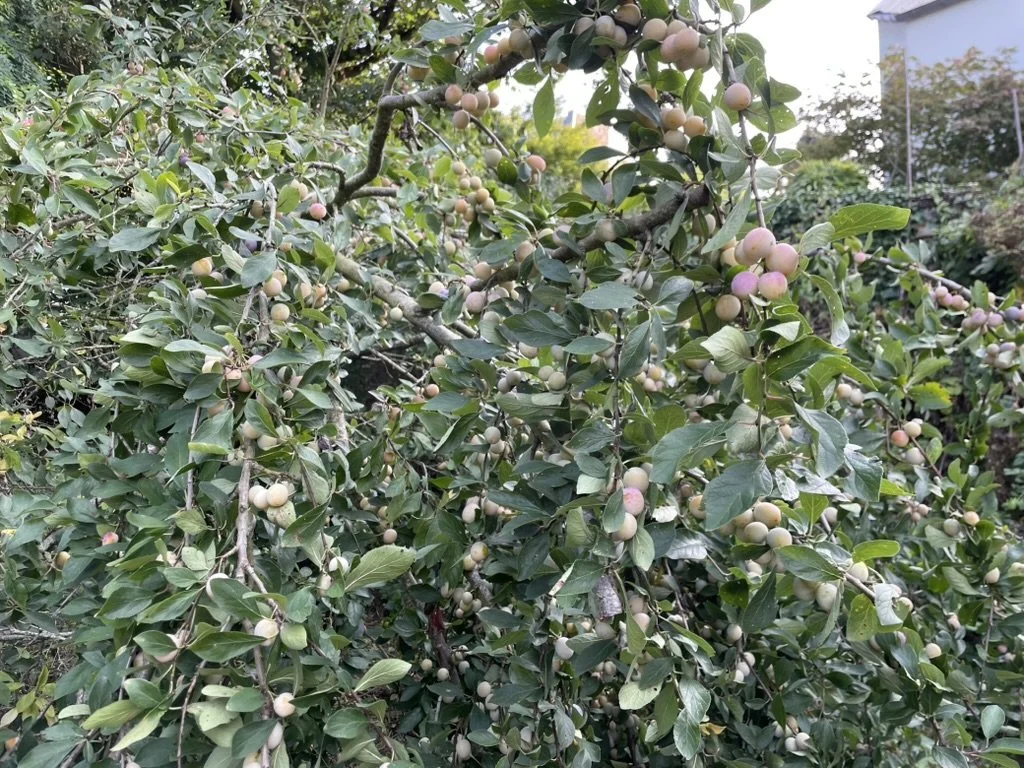
The same mirabelle plum, late summer. Soil never turned under the crown, permanent cover, no fertiliser and no watering. What the soil gave that year is on the branches, and it is the only measure this garden yields.
A word about the garden photographs in this text. The pear tree, the maple and the mirabelle plum at the back come from the same plot, in Meudon. The wisteria, photographed in the first part, grows a little further away in the same town, near the Observatory. This plot in Meudon has received no product for at least fifty years, no fertiliser, no treatment, no bought soil improver, and what that gives is profusion.
I do not draw a proof from it, and that must be said clearly. A garden is not a trial. There is no control, no replication, no measurement, and I do not know what this plot would have given with inputs. Most of the studies cited in this text are counted in seasons, a few in years, and the longest, the Lake Lama core and the Minnesota herbaria of the first part, are not trials but archives, which say nothing about a garden. What this plot shows is of another order, duration under constant management, and that is all I draw from it.
Nor does it show that everything succeeds. A soil that works shelters those whose demand stays within what it can supply, and not the others. The year the mirabelle bent under its fruit, the kiwi in the same garden gave up, because it asked for more than the band of soil had to give that summer.
What I do with all this
On a plot, an orchard, a municipal green space or an estate garden, this work takes the form of a site reading, the choice of species and covers according to the circuits present, management of the soil season by season and monitoring over several years, since the network is not restored in one spring. That is the job.
Of the two plane trees at the start, the one that holds is almost always the one whose soil was breathing in February. What you hold in your hand when you pull up a leek, you can hold in a plan.
Short glossary
Words that deserve an explanation, in alphabetical order. Some also appear in the glossary of the other part, so that each can be read on its own.
Ammonium. A mineral form of nitrogen, present in many fertilisers. With chlorine, it forms chloramines.
Arbuscular (mycorrhiza). The most widespread association between roots and fungi, that of seven plant species out of ten. The fungus enters the cells of the root and is never visible to the naked eye. It is the circuit of almost the whole vegetable garden, of fruit trees, the vine, the olive, the plane tree.
Arbuscule. A small tree-like structure the fungus forms inside a root cell. It is the trading post where exchanges take place, sugars and lipids from the plant against water and minerals from the fungus.
Archaea. Microorganisms without a nucleus, long confused with bacteria, which in fact form a separate branch of life.
ATP. A small molecule that serves as the energy currency in all living cells. It contains phosphorus, which explains why a nodule demands so much of it.
Biochar. Plant charcoal obtained by heating wood or plant residues with almost no air. Porous, it shelters soil fungi and bacteria, provided it has been charged before being buried.
Biofilm. A thin living layer, made of microorganisms stuck together in a jelly they produce, lining a damp surface.
Biomass. The total mass of living matter of a group of organisms, for example of all the fungi in a soil.
Biostimulant. A product sold to stimulate the growth or resistance of plants, based on microorganisms, seaweed extracts or various molecules. Its effectiveness varies a great deal from one product to another.
Brassicas. The family of cabbages, turnip, radish, rocket, mustard and oilseed rape, now called Brassicaceae. Most do not form mycorrhizas.
Buffering medium. A medium that absorbs what is poured into it. A soil rich in organic matter consumes chlorine almost immediately, a substrate planter or a green wall much less so.
Canker stain of plane. A fatal disease of the plane tree, caused by a regulated fungus. Soil and tools spread it.
CCTP. Cahier des clauses techniques particulières, the technical specification. It is the document of a French public contract that describes what the contractor must do and how.
Charge (a biochar). To let biochar fill with water, nutrients and life before burying it. Raw biochar, buried dry, starts by taking from the soil what it is expected to give.
Chipped wood. Branches and twigs passed through a chipper, spread as a mulch.
Chitin. A nitrogen-rich molecule that forms the shells of insects and the walls of fungi. It represents a large store of nitrogen in the soil, hard to open.
Chloramine. A form of chlorine combined with nitrogen, used by some local authorities to disinfect mains water. Unlike free chlorine, it does not evaporate when the water is left to stand.
Chloride. A stable ion that is no disinfectant at all, that of table salt. It does not evaporate and builds up in the soil when more is irrigated than rain leaches.
Colonisation (mycorrhizal). The share of root length actually occupied by the fungus. It is measured under the microscope, after staining the roots.
Common mycorrhizal network. A network of fungi linking the roots of several neighbouring plants, sometimes of different species.
Compaction. Crushing of the soil by machinery or repeated passages. Its pores close, and air and water no longer circulate.
Cover crop, plant cover. Plants sown or left to cover the soil between two crops or at the foot of trees. A catch cover occupies the soil, often in winter, between two crops.
Cytoplasm. The inside of a cell, the medium in which its organs bathe.
Decomposer fungi. Fungi that live on dead matter, leaves, wood, mulch. Specialists call them saprotrophs. They are mostly the ones that form the white felt visible under a mulch. The arbuscular network itself remains invisible.
Decompaction. Work that loosens a soil compacted by machinery in depth, to bring air back into it.
Diazotroph. See nitrogen fixation.
Dihydrogen. Hydrogen gas, made of two hydrogen atoms. Legume nodules give it off as they fix nitrogen.
Double subscription. The author’s expression for plants able to carry both arbuscular mycorrhiza and ectomycorrhiza, such as willow, poplar, alder or ash. Researchers speak of dual mycorrhization.
Ectomycorrhiza, ectotrophic mycorrhiza. An association in which the fungus wraps the tips of the roots in a sheath and works its way between the cells without entering them. It is the circuit of most trees of temperate and boreal forests, oak, beech, pine, and that of the mushrooms people gather, cep, chanterelle, truffle.
Establishment phase. The first years after planting, during which the tree sets up its roots and its network. It is generally counted as three years.
Exudates. Substances, often sugars, that roots or fungal filaments let ooze into the soil around them.
Extraradical network. The part of the fungus that leaves the root and runs through the soil, sometimes from one root to another.
Fertilisation. All the inputs of fertilisers or soil improvers made to a crop. A fertilisation plan sets the quantities.
Fine roots, mass of fine roots. All the finest roots of a plant, the ones that explore the soil and absorb.
Flagellum. A long filament a bacterium turns to move through water.
Free chlorine. The chlorine added to mains water to disinfect it, in its active form. Most of it evaporates overnight in a watering can left in the open air.
Generalists (fungi). Fungi that are not demanding about their partner and tolerate disturbance, compaction, heat, salt. They are the ones that dominate under street trees.
Genome. All the genetic information of a living thing.
Gigaspora. A genus of arbuscular fungus, some species of which host a bacterium inside their cells.
Goosefoots. The family of beetroot, spinach, chard and quinoa, now classed among the Amaranthaceae. Most do not form mycorrhizas.
Heavy land. Soil rich in clay or fine silt, which holds water and compacts easily.
Host plant, non-host. A host plant can house a mycorrhizal fungus. A non-host, such as cabbage, cannot.
Humus. The organic matter of the soil transformed by living things, dark and stable. Several forms of humus are distinguished according to the activity of the soil.
Hydraulic failure. The breakdown of a tree’s water supply, when sap no longer rises because air bubbles block its vessels.
Hydrogen fertilisation. The supposed effect of the hydrogen given off by nodules on the growth of neighbouring plants, through the soil bacteria. Results are contradictory.
Hydrogenase. An enzyme that allows a microorganism to use or produce hydrogen.
Hypha. A microscopic filament that makes up the body of a fungus, two to ten thousandths of a millimetre thick.
Hyphosphere. The thin layer of soil surrounding the fungal filaments, where a population of bacteria lives, fed by what they ooze.
Induced resistance. A state of alert in a plant’s defences, triggered at root level by a mycorrhizal fungus or by certain bacteria. Its defences are primed. They go off faster, and often more strongly, when the attack comes.
Inoculation, inoculum. Inoculation is the deliberate addition of living organisms, fungi or bacteria, to the soil, to a plant or to a carrier such as biochar. The inoculum is what is added, a commercial product or soil taken from under a healthy plant.
Isotope. A version of the same chemical element that differs only in its weight. Nitrogen thus exists in a light and a heavy version, and their proportion in a leaf keeps a trace of the path the nitrogen has taken.
Legumes. The family of pea, bean, broad bean, clover, lucerne, vetch and false acacia. Most house in their nodules bacteria that fix nitrogen from the air.
Long fallow (disorder). A disorder of a crop that remains stunted and deficient after a long period without a host plant, although the soil is properly supplied. The fungal network has died out during the fallow.
Main limbs. The large branches that leave the trunk and carry the crown of a tree. Underground, one also speaks of structural roots, the large roots that anchor the tree.
Meta-analysis. A statistical synthesis of all the published trials on a question, when they lend themselves to comparison. It gives a more solid order of magnitude than a single trial.
Mineral nitrogen. Nitrogen in the form of nitrate or ammonium, directly absorbable by roots.
Mineralise. To break down organic matter into simple elements, nitrogen, phosphorus, that the root can absorb.
Mound. A slight hump of earth on which one plants in heavy soil, to put the roots above the winter water.
Mulch. A layer of organic matter, wood chips, leaves, straw, spread on the soil surface to cover and protect it.
Mull. A form of humus of very active soils, where litter disappears quickly, mixed into the earth by worms and microorganisms.
Mycelium. All the filaments of a fungus, a tangle that runs through the soil. That of arbuscular fungi is invisible to the naked eye.
Mycorrhiza. An association between a root and a soil fungus. The plant gives sugars, and lipids in the arbuscular case. The fungus brings back water and minerals it fetches from where the root does not go.
Mycorrhiza helper bacteria. Soil bacteria that favour the setting up of a mycorrhiza between a tree and its fungus.
Mycorrhizosphere. The soil surrounding a mycorrhized root and the filaments of its fungus.
Nitrate. A soluble form of nitrogen that plants absorb directly. It is one of the forms of nitrogen fertilisers, and the one found in groundwater.
Nitrogen fixation. The ability of certain bacteria to capture nitrogen from the air and turn it into ammonia, which the host plant uses. In legumes and alder, they do it in root nodules. Microorganisms able to do this are called diazotrophs, whether free-living, symbiotic or cyanobacteria.
Nitrogenase. The enzyme of nitrogen-fixing bacteria that breaks the nitrogen molecule of the air to make ammonia. It is one of the most energy-costly reactions in living things.
Nodule. An outgrowth of the roots that houses nitrogen-fixing bacteria. A small ball in legumes, a coral-shaped cluster in alder. Nodulation is the formation of these nodules.
Obligate biotroph. Said of an organism that can live only in contact with a living host. The arbuscular fungus cannot be grown without a living root.
Occluded fractions. The share of organic matter enclosed within soil aggregates, sheltered from decomposers. With the matter bound to minerals, more stable still, it forms the soil’s lasting carbon.
Olpidium. A microscopic fungus that parasitises roots, found several times in commercial inocula.
Olsen, Joret-Hébert. Methods of analysing phosphorus used on the usual laboratory reports in France. They give values much higher than water-extractable phosphorus.
Open ground. Growing in natural soil, as opposed to growing in pots or containers.
Orchid (mycorrhiza). An association in which the fungus feeds the orchid seed, which has no reserves, during germination. Without it, the seed does not germinate.
Organic chlorine. Molecules in which chlorine has attached to the soil’s organic matter. The soil makes them naturally. Watering with chlorinated water adds more, all the more so as the soil is rich in humus, and they build up in it.
Parasitoid. An insect, often a small wasp, that lays its eggs in another insect, an aphid for instance, whose larva kills it as it develops.
Peat-based substrate. A peat compost used in nurseries, often fertilised. It contains practically no mycorrhizal fungi, and the plant grown in it arrives without a partner.
Phosphatase. An enzyme that detaches phosphorus from organic molecules to make it absorbable.
Phosphate-solubilising bacteria. Soil bacteria that release locked phosphorus, organic or mineral, by making it soluble.
Photosynthesis. The making of sugar by the plant from light, water and carbon dioxide from the air.
Phreatophyte. A plant whose roots fetch water from a water table or just above it. White willow, black poplar and black alder by rivers are examples.
Phylum. A major division in the classification of living things, just below the kingdom.
Phytin. A form of phosphorus stored in seeds and plant debris, which the plant cannot absorb as it is.
Propagules. Everything that allows the fungus to start again, spores, fragments of filaments and pieces of root already colonised.
Protist. A living thing, most often made of a single cell with a nucleus, neither animal, plant nor fungus, such as amoebae.
Relay plant. A host plant left in place between two crops, clover, lucerne, a grass, so that the fungal network does not die out for lack of a living root.
Rhizobium. A soil bacterium that settles in the nodules of legumes and fixes nitrogen from the air there.
Rhizosphere. The thin layer of soil in contact with the roots, the most alive in the whole soil.
Riparian vegetation. The vegetation lining a watercourse, willows, poplars, alders.
Root-knot nematode. A tiny microscopic worm that attacks roots and causes swellings on them, the galls.
Rootlets. Small fine roots that come from the main roots.
Silty clay. Said of a soil composed mainly of silt, fine particles, with a share of clay. It is fertile land but compacts easily.
Soil sealing. Covering the soil with a surface that lets neither water nor air through, tarmac, concrete, jointed paving.
Soilless growing. Growing on a substrate or artificial support, without natural soil.
Soluble phosphorus. The phosphorus in fertilisers that dissolves at once in the soil water. Served in abundance, it frees the plant from feeding its fungus, which it sends away.
Spore. A reproductive cell of a fungus, which can wait in the soil before germinating on contact with a root.
Stockholm system. A method of planting street trees in which the pits are filled with stones and a porous material, often biochar, under the roadway.
Stoichiometry. The exact count of what goes in and what comes out in a chemical reaction.
Structural soil pit. A planting pit for a street tree filled with a mix of stones and earth, designed to carry the roadway while leaving room for the roots.
Symbiosis, symbiont. A lasting association between two different living things, in which each one gets something out of it. Symbionts are the partners in this association.
Texture (soil). The proportion of sand, silt and clay in a soil. It governs how it holds water and air.
Thiamine. Vitamin B1.
Type three secretion system. A syringe-shaped molecular apparatus through which a bacterium injects proteins into a neighbouring cell.
Vertisol. A very clayey soil that swells when wet and splits into wide cracks when it dries.
Waterlogging. The state of a soil whose pores are all full of water, so that air no longer circulates.
Water-extractable phosphorus. The phosphorus that a simple wash with water removes from a soil sample, that is the immediately available share. This laboratory measurement is not the one on the usual analysis reports.
Yellow bird’s-nest, bird’s-nest orchid. Plants without chlorophyll, the first small and white in pine woods, the second a brown orchid of beech woods, which live entirely on the fungal network of the trees.
Further reading
Harden V. and Moreno-Mateos D., 2026, Ecological Restoration 44: 23, Designing the Fungal City, review of mycorrhizal networks in the built environment.
Verbeek C., Gomes S. and Merckx V., 2026, Plants People Planet, Amsterdam elms along an urbanisation gradient.
Grassi A. et al., 2023, Urban Forestry and Urban Greening, effects of permeable and impermeable surfaces on the symbionts of urban trees.
Gaimaro L. et al., 2025, npj Urban Sustainability, urban forest quality and mycorrhizal colonisation.
Metzler P., Ksiazek-Mikenas K. and Chaudhary V., 2024, New Phytologist 242: 1814-1824, active inoculation and passive dispersal on green roofs.
Bashian-Victoroff C. et al., 2026, Restoration Ecology 34, inoculation with forest soil and with a commercial product in a peri-urban restoration.
Wubs E. et al., 2016, Nature Plants 2: 16107, the donor soil steers the vegetation that establishes.
Zwiazek J. et al., 2019, Mycorrhiza, urban ectotrophic fungi and salt tolerance.
Zhang L., Feng G. and Declerck S., 2018, The ISME Journal 12: 2339-2351, fructose exuded by the fungus triggers phytin mineralisation by a bacterium.
Jiang F. et al., 2021, New Phytologist 230: 304-315, bacteria carried along hyphae to pockets of organic phosphorus.
Emmett B. et al., 2021, The ISME Journal 15, conserved bacterial communities on extraradical hyphae.
Rozmoš M. et al., 2022, The ISME Journal 16, organic nitrogen made available by a specific bacterium and a protist.
Ghignone S. et al., 2012, The ISME Journal 6, and Salvioli A. et al., 2016, The ISME Journal 10, the endosymbiotic bacterium of Gigaspora and its effect on the fungus’s vigour.
Frey-Klett P., Garbaye J. and Tarkka M., 2007, New Phytologist 176: 22-36, mycorrhiza helper bacteria.
Bonfante P. and Anca I., 2009, Annual Review of Microbiology 63, plants, mycorrhizal fungi and bacteria, a network of interactions.
Teste F., Jones M. and Dickie I., 2019, New Phytologist 225: 1835-1851, dual-mycorrhizal plants, census, ecology and switching between circuits.
Rog I., Lerner D., Bender S. and van der Heijden M., 2025, Ecology Letters 28: e70132, wider environmental range of dual-mycorrhizal woody plants.
Von Hippel B. et al., 2025, Science Advances 11: eadj5527, palaeometagenomics of Lake Lama, weathering, cycles and podzolisation over twenty-three thousand years.
Michaud T. et al., 2024, New Phytologist 242: 1717-1724, Minnesota herbaria 1871-2016, decline in nitrogen status and fading of the ectotrophic signature.
Yu Y. et al., 2022, Soil Ecology Letters 5: 66-78, metagenomics of the soil microbial community under continuous chlorinated irrigation.
Lonigro A., Montemurro N. and Laera G., 2017, Science of the Total Environment 584-585: 595-602, organohalogen compounds in soil and crop under chlorinated water.
Svensson T. et al., 2022, Science of the Total Environment 806: 150478, natural chlorination of organic matter according to humus type and land use.
Ordóñez-Barona C. et al., 2018, Environmental Pollution 234: 562-571, de-icing salt and the performance of urban trees in structural soil pits.
Evelin H., Devi T., Gupta S. and Kapoor R., 2019, Frontiers in Plant Science 10: 470, mitigation of salt stress by arbuscular mycorrhizal symbiosis.
Averill C., Dietze M. and Bhatnagar J., 2018, Global Change Biology 24: 4544-4553, nitrogen pollution shifts forest mycorrhizal associations and soil carbon stocks.
Cameron D., Neal A., van Wees S. and Ton J., 2013, Trends in Plant Science 18: 539-545, mycorrhiza-induced resistance, more than the sum of its parts.
Bowles T. et al., 2017, Journal of Applied Ecology 54: 1785-1793, meta-analysis of tillage and cover crops, 54 trials.
Thompson J., 1987, Australian Journal of Agricultural Research 38: 847-867, long fallow disorder.
Walder F. et al., 2012, Plant Physiology 159: 789-797, unequal terms of trade in a common network.
Kiers E. T. et al., 2011, Science 333: 880-882, reciprocal rewards.
Whiteside M. et al., 2019, Current Biology 29: 2043-2050, phosphorus moved from rich to poor zones.
Babikova Z. et al., 2013, Ecology Letters 16: 835-843, alarm signal between broad beans.
Kakouridis A. et al., 2022, New Phytologist 236: 210-221, direct evidence of water transport by mycorrhizal fungi.
Püschel D. et al., 2017, Frontiers in Plant Science 8: 390, mycorrhiza stimulates nitrogen fixation in two Medicago species through phosphorus acquisition, and the phosphorus switch threshold.
Tisserant E. et al., 2013, PNAS 110: 20117-20122, genome of Rhizophagus irregularis and obligate biotrophy.
Dong Z. et al., 2003, Plant, Cell and Environment 26: 1875-1879, hydrogen fertilisation of soils, and a cost of five to six per cent of net photosynthesis.
Dip D. and Constant P., 2025, PeerJ 13: e20019, residual effect of hydrogen on vetch, a negative result.
Simard S. et al., 1997, Nature 388: 579-582, net carbon transfer between birch and Douglas fir in the field.
Rillig M. et al., 2024, Functional Ecology 39: 1411-1417, clarifying the definition of common mycorrhizal networks.
Murray J., Liu C., Chen Y. and Miller A., 2017, Journal of Experimental Botany 68: 1919-1926, nitrate and nodulation, inhibition thresholds.
Schubert K. and Evans H., 1976, PNAS 73: 1207-1211, hydrogen evolved by nodules and relative efficiency of nitrogenase in many legumes.
Greening C. et al., 2016, The ISME Journal 10: 761-777, distribution of hydrogenases across fifty-one bacterial and archaeal phyla.
Reji L. et al., 2025, Nature Communications 17: 515, soils as the main sink for atmospheric hydrogen.
Cusano A. et al., 2011, Environmental Microbiology Reports 3: 203-210, the type III secretion system of a mycorrhiza helper bacterium.
Kakouridis A. et al., 2024, New Phytologist, carbon transferred to the soil and to the hyphal microbiome.
He J. et al., 2024, The ISME Journal 18, dispersal of rhizobia along hyphae.
Karst J., Jones M. and Hoeksema J., 2023, Nature Ecology and Evolution 7: 501-511, citation bias on forest networks.
Simard S., Ryan T. and Perry D., 2025, Frontiers in Forests and Global Change, reply.
Chen J. et al., 2025, Frontiers in Plant Science 16, bidirectional transfers between orchids and pines.
Koziol L., McKenna T. and Bever J., 2025, New Phytologist 246: 821-827, meta-analysis of commercial inoculants.
Salomon M. et al., 2022, iScience, quality of commercial mycorrhizal inoculants.
Han H., Wang H., Yang Z., Cheng M. and Yang Q., 2026, Agronomy 16: 263, response of arbuscular colonisation to biochar, compost and manure, meta-analysis of 85 studies and 663 comparisons.
Yves Nicolas, Expert Consultant in Functional Ecology, yvesnicolas.com