Roots, marshes and bacteria, from the leaf to the cloud.
The pacts of the soil followed sugar downwards. This one follows water upwards, from the root to the cloud, and looks at what rises with it: gases, spores, bacteria, fragments of dead leaves. Every link in this journey has been published. The whole chain never has, and at each step I will say where we stand on solid ground and where we are walking on ice.
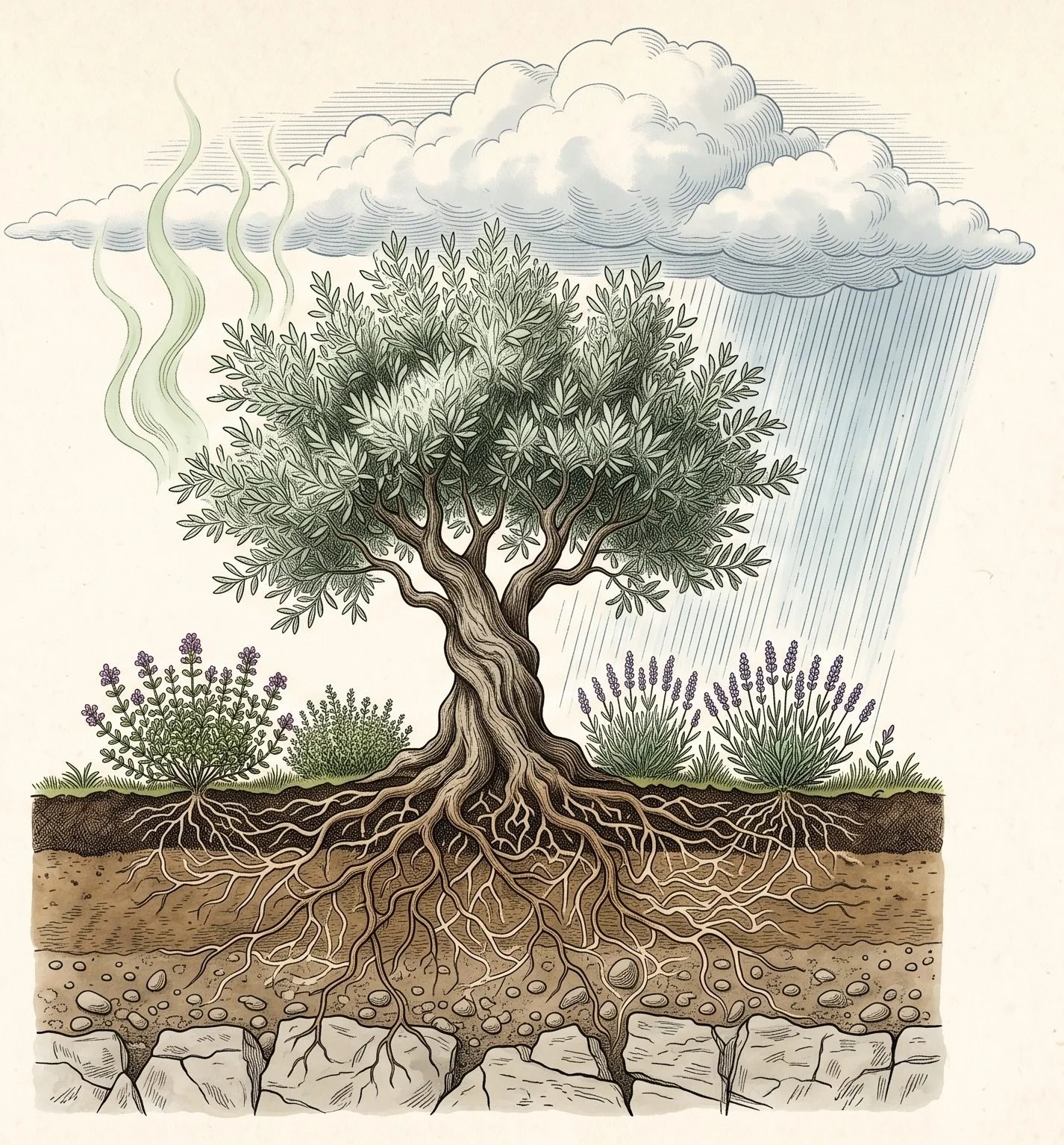
Illustration. Water rises through the leaf, comes back down as rain, and the soil decides what goes up again.
The mist of the Anti-Atlas
On Mount Boutmezguida, in the Aït Baamrane, 1,225 metres above the Atlantic, nets stretched between poles wait for the mist. It rises from the ocean one day in three, from September to June. When it passes, the mesh becomes covered in droplets; the droplets swell, merge, slide into a gutter, and several thousand litres of water a day run down a pipe to villages that had none. A square metre of net yields on average seven to ten and a half litres per day of mist, depending on the series of measurements, and up to twenty in some spring months. In July, nothing: the mist no longer comes.
On the lower slopes, the argan tree stands in the same mist. One would like to write that it drinks it. That would be beautiful, and it would be false. Botanists followed for two years the signature of the water in the wood of two argan populations, one near the coast, the other ten kilometres inland, by measuring the oxygen isotopes of the sap. Their conclusion is clear: the argan tree depends on deep soil water all year round, and no trace of water from the air was found in its wood.
Here, then, are two answers to the same mist. The net catches the water passing by. The tree does not catch it: it calls it up from below, from several metres down, and sends it back to the sky through its leaves.
Yet this water does not rise alone. With it go gases that the leaves breathe out, spores that fungi shoot into the air, bacteria torn from the leaves by wind and rain, and even proteins from soil fungi clinging to dust. These passengers are not accidents of the journey. Some become the seeds of drops. Others become the seeds of ice, without which the rain from our winter clouds would hardly fall. And the rain, as it falls back, returns to the leaf its multiplied bacteria and to the soil its revived fungi.
This is the contract I call the pact of the air. The plant gives the water and the seeds; the air gives it back rain. Like all pacts, it is negotiated, it comes undone, and it can be repaired.
How to use this article
This article is long because the road is long. It follows water from the root to the cloud, then from the cloud back to the soil, in nineteen stages, and each part says what it is about and can be read on its own.
The road begins underground, with the root that holds water before calling it up (1), then the plant that pumps it and knows how to turn off the tap (2). It passes through the question of where rain comes back from, and in particular Morocco's rain (3). It then rises with what the leaf puts into the air (4), and with what the air carries besides water: orders that trigger plants, and the pollen that allowed plants to reproduce on dry land (5). It enters the two workshops of the cloud, the drop factory (6) and the ice factory (7), and it looks at what happens when sea meets land there (8). It lingers at the edge of the marshes, which give back to the air what the soil gave them (9), and on what we lose when we drain them, in France, in Spain and in Morocco (10). It looks at what nitrogen pollution does to all this, mirroring the chapter on nitrate in The pacts of the soil (11), then at what remains of acid rain (12). It then watches the pact break: when drought closes the doors of the leaves and rain changes its face (13), then in the mountains, where the earth slips away once nothing holds it any more (14). It comes back down with the rain, what it tears from the soil and what it gives back (15), and the water that returns without rain, dew and mist (16). It ends in the city, facing the storm (17), with an account of what can honestly be claimed (18) and what I do with it in the field (19). A box at the end of chapter 13 also looks at the hydrogen that soils exchange with the air.
If you garden, read first the root (1), the orders carried by the air (5), drought (13), what rain gives back to the soil (15) and water without rain (16): you will find there why a covered, living soil keeps water when it runs short, what dew can be worth, and why your plants talk to one another. If you are an elected official or a technician, go to the marshes (9 and 10), the mountains (14), the city (17) and the final chapter (19): you will find there what a restored wetland or a stabilised slope can promise, and what they cannot. If you farm, read about pollen and its carriers (5), nitrogen (11), acid (12), drought (13) and the ice factory (7). If you live in Morocco, the road passes through your country at every stage: the mist of the Anti-Atlas, the meeting of the Atlantic and the Sahara, the dew of Mirleft, the merjas of the Gharb, Lake Iriki, the lakes and cedars of the Middle Atlas, the dams of the Rif.
A word on caution. This subject attracts easy promises: forests that make rain, trees that drink fog, marshes that bring back storms. Some are true, others half true, others not at all. So I use three words, and I stick to them. Established means measured and confirmed. Debated means measured but disputed by serious people. Hypothesis means plausible, argued, never demonstrated. The references are at the end of the article, chapter by chapter.
The essentials for decision makers
If you only have five minutes, here is what the article establishes, and where to find it.
Vegetation is a source of rain. More than half of the water that rises from the continents passes through leaves, and 40% of continental rain comes from evaporation over land (chapters 2 and 3).
The sea makes the drop, the land makes it fall. Leaf litter, living soils and certain leaf bacteria make cloud water freeze at temperatures where no dust works (chapters 7 and 8). And rain gives back to the soil what it lent: from a few million to several tens of millions of bacteria per square metre per day and, near Barcelona, nearly half of the calcium the forest needs each year (chapter 15).
A wetland does not make it rain on itself. It cools and moistens its surroundings and encourages dew. That is a promise that can be kept, and France lost nearly two thirds of its wetlands in the twentieth century (chapters 9 and 10).
Nitrogen from the air undoes the pact of the soil. Above 5.8 kilos of nitrogen per hectare per year, forest fungi change community, and rain alone already exceeds this threshold in the Pyrenees and northern Spain. In a street loaded with nitrogen oxides, some trees produce ozone: the answer is to diversify the planting palette, not to give up shade (chapter 11).
Pollution makes plants deaf. Ozone shrinks the range of messages between plants from 70 to 20 centimetres and, in open fields, ozone and diesel fumes cut pollinator visits by 83 to 90% (chapter 5).
A drought feeds itself. When leaves close their stomata, the air heats up, downwind rain falls by more than 15% per episode in dry regions, and by up to 30% in some months, and ozone is no longer absorbed. Keeping water deep in the soil slows the loop (chapter 13).
In the mountains, hold the earth before planting the tree. Bare soil loses around fifteen tonnes per hectare per year, and at best one tonne forms. Moroccan dams lose 58.3 million cubic metres of capacity every year to silting (chapter 14).
What must not be promised. That reforestation will bring back winter rain in Morocco, that a wetland makes it rain on itself, that the argan tree drinks the mist (chapter 18).
What remains to be measured, and what local authorities or universities can fund. The chemistry of rain and mist in Morocco, the share of rain lost to soil drought, the effect of watershed programmes on erosion (chapters 8, 13 and 14).
1. The root holds before it calls
Everything begins within a millimetre and a half.
Around every living root lies a sheath of soil a millimetre and a half thick that does not behave like the rest of the soil. Physicists looked at it through the pot, using neutron radiography, on lupins they left to dry out. When the soil dries, this sheath stays wetter than the neighbouring earth. When watering resumes, it first stays drier, then, after sixty hours, becomes the wettest of all. It has its own memory of water.
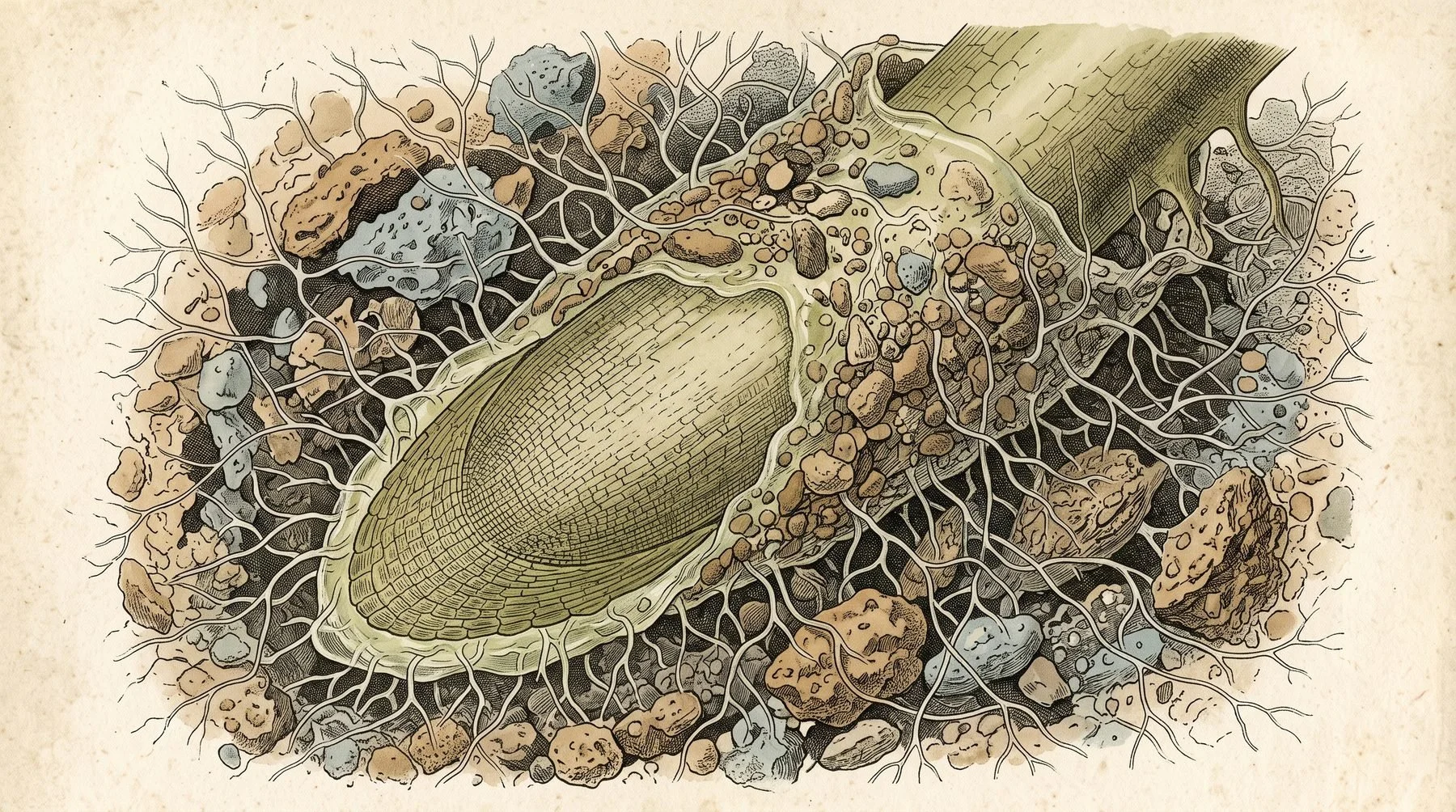
Illustration. Around the root, a sheath of soil held together by mucilage, extended by the filaments of fungi.
The cause is mucilage, the jelly that the root tip exudes ceaselessly. Another team put it to the test on an artificial root planted in almost dry soil: coated with mucilage, it kept the nearby soil wet and conductive, and water kept reaching its surface. So the plant does not merely suck. It prepares the ground for its suction, as one moistens a wick before lighting the lamp.
In the evening, the movement reverses. When the leaves close and transpiration stops, the deep roots, still in contact with moist earth, let water leak out through the surface roots into the dried-out soil. This is called hydraulic lift. By the late nineteen-nineties it had already been described in twenty-seven species, trees, shrubs and grasses, mostly in dry climates.
This night-time water does not benefit the tree alone. In a Californian oak grown in compartments, tracers injected at dusk had marked the hyphae and spores of its mycorrhizal fungi by dawn; injected in broad daylight, they marked nothing. Thanks to this nocturnal water, the hyphae stayed alive after seventy to eighty days of drought, in soil at minus twenty megapascals, that is, earth where nothing else can drink. The megapascal here measures the suction with which the soil holds on to its water: most crop plants wilt for good at around minus one and a half. The network I told you about in The pacts of the soil, the one that carried water towards the root, is itself watered by the tree at night. Water flows through it in both directions.
We must keep a sense of proportion, and this is where the exercise I will propose throughout this article begins. In the same oaks, labelled water does pass from one tree to another linked only by the fungus, but the authors themselves write that only a small fraction of the hyphae takes part. And when an adult cork oak was followed in Portugal, root by root, for a whole year, hydraulic lift accounted for only 0.9% of its annual flow. On the other hand, the tree did the reverse in winter: it conducted rainwater downwards through its own roots, to four and a half metres, and this descent accounted for 37% of its flow for the year. A cork oak is first of all a cistern that fills itself in winter in order to drink in summer.
Let us return to the argan tree. If it does not drink the mist, it is because it does not need to: its water lies deep, all year round. The holm oaks and cork oaks of the Portuguese montado likewise draw more than 70% of their summer water from the water table. The Mediterranean tree does not live on humid air. It lives on the deep soil, and on the care it takes to keep its root in contact with it.
For the gardener, the consequence is simple. Anything that destroys fine roots and hyphae destroys this arrangement, and anything that spares them preserves it. The call of water towards the sky begins with a soil that knows how to hold it.
2. The plant pumps, and it knows how to turn off the tap
Once inside the root, water rises. The leaf draws it up through the tension of the water evaporating in its cavities, and the column follows, from the soil to the crown, with neither pump nor engine. The question is what share of the water leaving the continents takes this route, rather than evaporating from bare soil, puddles and wet leaves.
The answer caused a stir. In 2013, a team announced in Nature, on the basis of water isotopes in the great lakes, that transpiration accounted for 80 to 90% of continental evaporation. Others redid the calculation, taking better account of the uncertainties, and obtained a range of 35 to 80%. A compilation of eighty-one field studies gives 61%, plus or minus 15, and 70% in tropical rainforests. I will keep to the cautious formula: more than half of the water rising from the land passes through a leaf, perhaps a good deal more.
To picture this flow, an orchard is enough. Near Marrakech, researchers measured for a year the water leaving a 275 hectare irrigated olive orchard: 824 millimetres. That is more than the annual rainfall of Paris, and it was trees reputed to be frugal that sent it back to the sky.
But the leaf is not a wick. It has doors, the stomata, and it closes them when the air becomes too dry. Physiologists measure this dryness of the air by the vapour pressure deficit, the gap between the water the air could hold and the water it does hold. In Zaragoza, under 298 millimetres of annual rain, the holm oak more than halves the opening of its stomata when this deficit rises from 2 to 4 kilopascals, even when it is generously watered. To give an idea, the kilopascal here measures the thirst of the air: less than 1 in humid weather, 4 and above on an afternoon of dry heatwave. The olive tree does the same. These trees waste nothing: they close before they are thirsty.
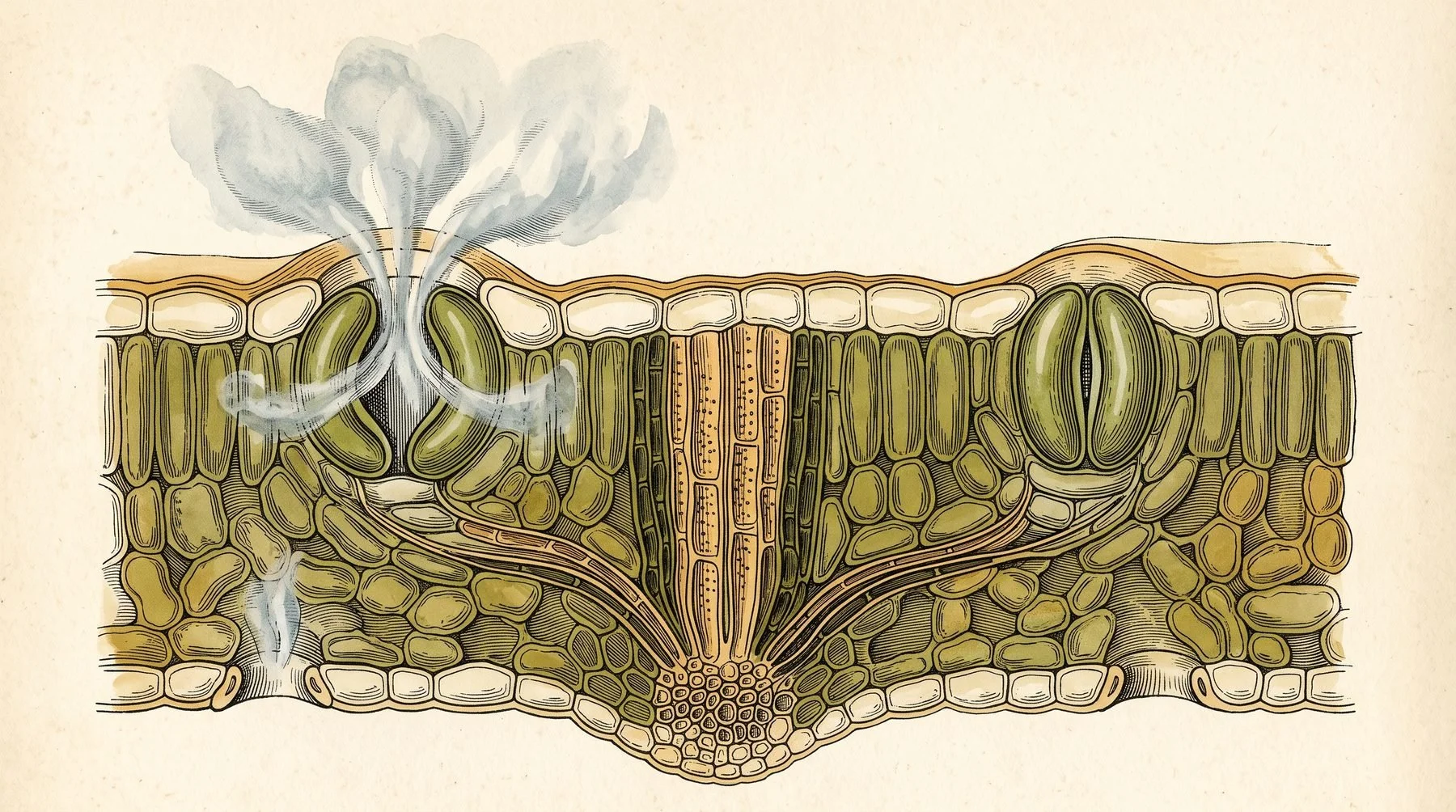
Illustration. The leaf in cross-section: the open stoma lets vapour escape, the closed stoma holds it back.
This is a virtue for the tree and a limit for the pact. Very dry air cuts the pump just when it is needed most. And this deficit climbs exponentially with warming; the most recent review on the subject ranks it among the leading causes of recent tree mortality. The drier the air becomes, the less water vegetation gives back to it, and the drier it gets. Remember this mechanism: we will meet it again in Spain, where it has been seen at work.
3. Where rain comes back from
Not all this vapour falls back where it rose. It travels with the wind, and the question that interests the gardener as much as the elected official is simple: what share of the rain falling on my land left from my land, or from my neighbours'?
On average across the planet, 40% of the rain that falls on the continents comes from evaporation from the continents themselves, and 57% of the water that evaporates from land falls back on land. The Río de la Plata basin, in Argentina, receives 70% of its rain from evaporation over the Amazon forest, thousands of kilometres away. Hydrologists have given this phenomenon a name, the precipitationshed, by analogy with the watershed. A town has a watershed from which its river water comes; it also has a precipitationshed from which its rain comes, and that may lie very far away, upwind.
In the tropics, this has been checked by following air masses by satellite: over more than 60% of tropical land, air that has just crossed dense vegetation produces at least twice as much rain as air that has crossed bare land. The dominant mechanism is nothing mysterious: it is the water that leaves gave back to the air along the way.
And on our side? None of the studies I have been able to read gives a quantified account of the sources of Moroccan rain, and I am not going to invent one. What we know is this. In the western Mediterranean basin, the North Atlantic supplies up to 65% of the moisture that falls in winter and autumn, the western Mediterranean comes second, and recycling over land only really counts in spring and summer. Morocco's rain arrives mainly with the depressions that mid-latitude blocking pushes southwards, and the North Atlantic Oscillation alone explains up to 30% of its variation from one decade to the next. In other words: the winter rain that fills Morocco's dams comes from the sea. Planting trees in the Gharb will not make it fall, and anyone who promises you otherwise is promising what nobody has measured.
Spring and summer rain is another matter, and on the other shore it has been measured how it slips away. In Spain, the share of summer rain coming from evaporation over the peninsula itself fell from 15% before 1997 to less than 12% afterwards. The authors describe the loop I announced in the previous chapter: drier soil evaporates less, the air receives less water from the land, summer rain decreases, and the soil dries further. The pact of the air comes undone along the same thread that held it together.
There is better still than moisture budgets: clouds have been seen forming above French forests. A Dutch, British and French team went through ten years of satellite images taken every fifteen minutes above two large lowland forests, the Landes and the Sologne, chosen precisely because no relief there blurs the reading. In summer, clouds form there more often than above the neighbouring crops, with a difference in frequency of 5 to 15 points. They appear earlier in the morning and last later into the evening. This difference exists only in summer, when harvested fields heat up while the forest goes on transpiring. And when there is wind, clouds gather on the downwind edge of the forest: this is the signature of a forest breeze, a small circulation that the forest makes itself.
Proof by absence came from a storm. On 24 January 2009, Klaus flattened a large part of the Landes forest. In the five years that followed, the cloud advantage of the worst-hit area collapsed: its seasonal cycle, with an amplitude of 0.114 before the storm, fell to 0.020, while the neighbouring areas did not move. Take away the forest and the clouds leave with it, and more than five years later they had not come back.
The limit must be stated at once, and the authors are the first to state it: more clouds does not mean more rain. In one isolated case they saw a storm break out above the forest, but the step from cloud to rain remains to be demonstrated. Among the possible causes, they cite the dark colour of the forest, which absorbs more sunlight, its roughness, which slows the air and makes it converge, the forest breeze, and also the volatiles of the next chapter, whose oxidation products make cloud seeds downwind. It is, to date, the link in this whole story that has been best measured in our part of the world, at the scale of an entire forest, with a full-scale experiment nobody would have dared to run.
You will sometimes read that one should go further, that forests literally suck humid air from the ocean towards the interior of the continents through the condensation of their vapour. This is the biotic pump theory, published in 2007 by two Russian physicists. It is appealing, and it is fiercely disputed by atmospheric scientists, who consider its driving force to have no physical basis. I mention it so that you will recognise it when it is put to you, not to lean on it. Moisture recycling does not need it in order to be true.
4. What the leaf puts into the air
Walk into a pine wood on a July afternoon. The smell of resin hits you before the shade does. Then walk into a poplar plantation, or under a large pedunculate oak: you smell almost nothing. Yet the oak and the poplar emit more than the pine. They breathe out isoprene, a small hydrocarbon that our nose barely detects.
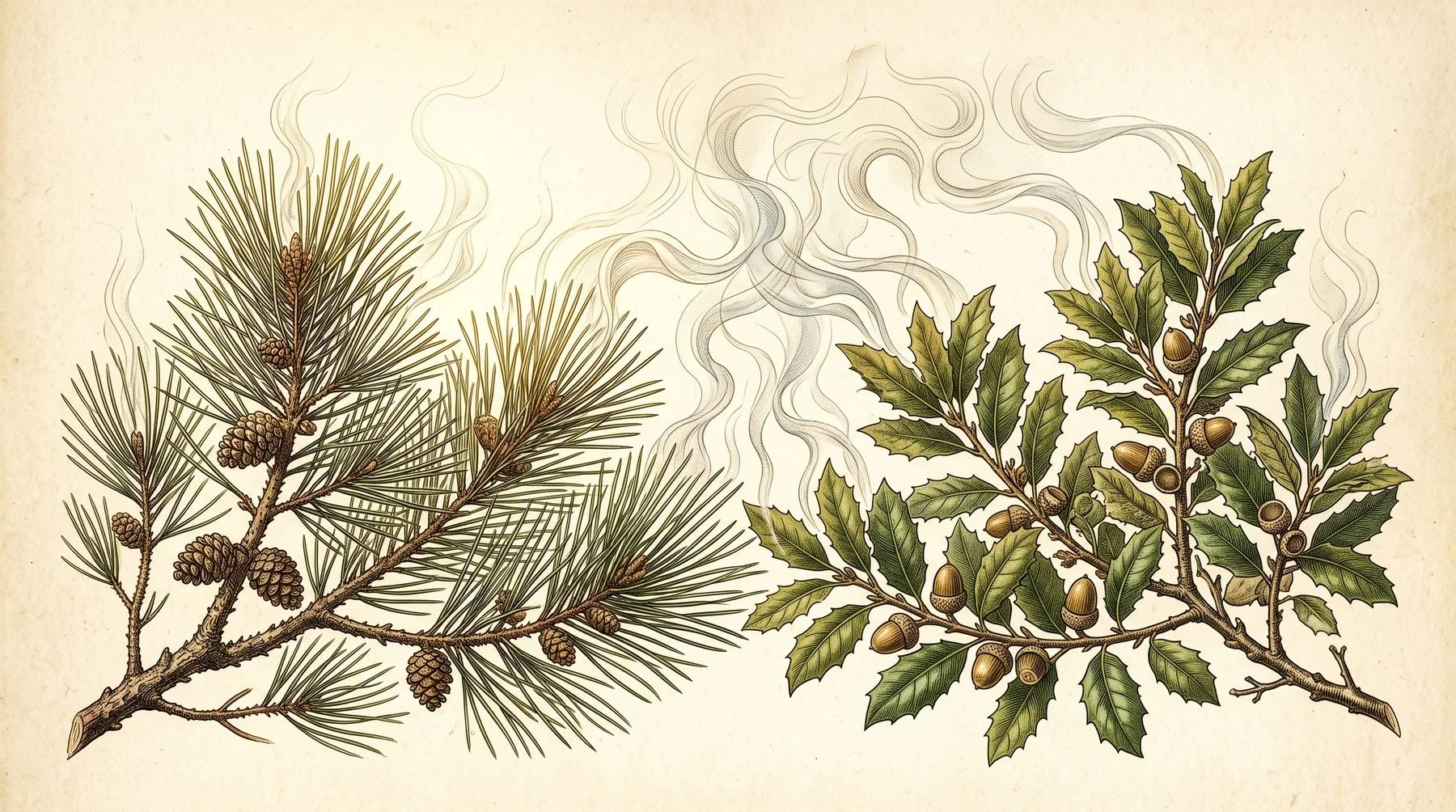
Illustration. The pine and the holm oak breathe out their volatiles, which will rise towards the cloud.
The world's plants send about a thousand million tonnes of these volatile organic compounds into the air each year. Isoprene makes up roughly half. Monoterpenes, the ones that smell of resin, lemon or lavender, make up 15%, sesquiterpenes 3%, and the rest is a procession of small molecules: methanol, acetone, acetaldehyde. Among European trees, the isoprene champions are poplars and the pedunculate oak, followed by eucalyptus, then willows and the plane tree. The alder, which grows in the same damp places, emits none at all. Why so much expenditure? Isoprene helps the leaf withstand heat spikes, and emission rises with temperature: in Haute-Provence, moderate drought imposed on downy oak first increased its emission per unit of leaf area, before the collapse described in chapter 13.
Not everything the leaf breathes out reaches the sky. Methanol leaves through the stomata as the leaf grows, and on the leaf itself live pink bacteria, Methylobacterium, which feed on it. Seedlings colonised by these bacteria emit fifty times less methanol than sterile seedlings, and they grow better: tomato, tobacco, strawberry, mustard, but not wheat, barley or carrot. On poplar leaves there also live bacteria that eat isoprene. And what escapes the leaf partly falls back onto a soil which, for its part, also consumes the methanol in the air. The leaf feeds a whole people with its breath, and part of what it breathes out never leaves the garden.
The rest speaks. Volatiles are not merely waste or heat shields; they are messages. Methyl salicylate, the notes of cut grass, ocimene signal an attack to anyone who can read them. And this is where the pact of the air joins the pact of the soil. In The pacts of the soil, I told you about those field beans linked by mycelium which, alone, triggered their defences when a neighbour was attacked by aphids, and emitted the volatiles that attract the aphids' enemies. An Austrian experiment goes further. A mycorrhizal bean attacked by red spider mite changes thirteen of the nineteen compounds in its bouquet: more ocimene and caryophyllene, less methyl salicylate. And the predatory mites that hunt the red spider mite prefer the smell of mycorrhizal plants. The authors stress one point: this is not the effect of a plant that is simply better fed, it is a fine reprogramming, which depends on the trio of fungus, plant and pest. The underground pact decides what the leaf says to the air.
The message then returns to the soil. In 2025, a team showed that the cut-grass smells emitted by an attacked cereal triggered in its neighbours a hormonal response that recruited beneficial bacteria into their rhizosphere; four years of field trials gave fewer pests and higher yields. The smell of a wounded leaf changes the soil of the plant next door. And underground, the network also speaks through gases: a mycorrhizal fungus of poplars, the bicoloured deceiver, makes its host's roots branch before it even touches them, through a sesquiterpene it releases into the soil pores; another fungus, which does not release it, cannot do so.
That is the first storey of the pact of the air. The leaf emits molecules of which one part feeds its own bacteria, one part carries messages that the soil fungus helped to write, and one part rises. It is this last part that we are going to follow.
5. The air that commands and the air that weds
Before following what rises towards the cloud, we must look at what the air carries besides water. It carries orders, molecules that make a plant flower, germinate or defend itself even though it did not make them. And it carries what allowed plants to leave the water: the means to reproduce on dry land. This is perhaps the oldest of the pacts of the air.
The first order is a gas, ethylene. It is a plant hormone, the only one that travels in gaseous form. It ripens fruit, and it brings on flowering. In 1874, in the Azores, it was discovered by chance that smoke made pineapples flower within six weeks. In Puerto Rico, planters lit smouldering fires under canvas. In 1932 it was shown that the ethylene in the smoke was enough, and today pineapple fields flower on a set date under a product that releases ethylene. For the mango tree, which is also smoked in the Philippines, researchers do not agree on what does the work. Ethylene also serves the drowned plant: under water it can no longer escape, it builds up in the tissues, and that is how the plant knows it is submerged and prepares to run short of oxygen.
The second order comes from fire. In 2004, an Australian team isolated in smoke a molecule, of the family now called karrikins, which makes seeds germinate as well as smoke itself. The seed waits in the soil and reads in the air that its competitors have just burned. Around the Mediterranean, heat counts for more than smoke: among thirty species of the Mediterranean basin, heat stimulated the germination of twenty-one, smoke of eight. In central Italy, smoke increased the germination of the grey-leaved cistus. The strangest thing lies elsewhere. The receptor that reads these molecules exists in all land plants, including those that never encounter fire. It serves first of all an internal hormone that has not yet been identified. The lock existed before fire brought a key that resembles its own.
The third order is the alarm, which chapter 4 began to describe. In 1990, two American researchers shut tomatoes in with sprigs of sagebrush, whose leaves carry methyl jasmonate: the tomatoes made the proteins that spoil caterpillars' appetite, without having been touched. In the American West, over three seasons, wild tobacco planted next to clipped sagebrush suffered far less damage from grasshoppers and caterpillars; a barrier cutting off the air removed the effect, a barrier in the soil changed nothing. Sagebrush even responds more strongly to the smell of its close relatives than to that of others. In a cereal, cut-grass smells do not trigger defence, they prepare it: the plant that has received them reacts faster when the attack comes. The range is short. In the lima bean, the message carries 70 centimetres. Under 80 parts per billion of ozone, it carries only 20. The pollution of chapter 11 makes plants deaf to one another.
Who speaks to whom? Plants of the same species, and also of different species. A plant first speaks to itself: in the lima bean, an attacked leaf warns the other leaves on the same plant through the air, since the sap links them poorly, and many researchers see this as the primary function of the signal, the neighbours merely eavesdropping. Tomatoes next to an attacked tomato absorb one of its volatiles and turn it into a poison for the caterpillar. Between species, sagebrush alerts tobacco, and cut-grass smells, common to many plants, prepare a cereal whatever their source. The air also serves to repel: the terpenes of certain aromatic shrubs stop grasses germinating around them, and work carried out near Montpellier suggests that plants living with thyme have adapted to the chemistry of their thyme neighbours. Lastly, it serves to call a third party: a cereal attacked by a caterpillar attracts the small wasp that lays its eggs in that caterpillar. Trigger, prepare, repel, call: these are the four verbs of the air between plants.
The soil also gives orders through the air. Certain bacteria of the genus Bacillus emit a gas, 2,3-butanediol, which makes the plant grow without any contact; two nanograms are enough, when the bacterium emits one to five micrograms a day. The same gases strengthen the plant's defences against a rot bacterium. And there are plants that hunt by smell. Dodder, a leafless parasite, is born with a few days' reserves to find a host. Placed between a tomato and nothing, it heads for the tomato eight times out of ten, in the dark as well as in the light, and towards an extract of tomato smell alone seven times out of ten. The smell of wheat repels it.
Lastly, the air gives orders through what it is. Carbon dioxide first: over two hundred years of herbarium leaves, eight tree species lost 40% of their stomata as carbon dioxide rose. The plant reads the composition of the air and adjusts its doors. Then the weather. European beeches have their mast years together, across whole regions, because they all read the same temperatures of previous summers; eight thousand observations from 1950 to 2014 show it. With warming, beeches produce more seed, but less in unison, and they lose the advantage of synchrony: less efficient pollination, more seed eaten. In the Mediterranean, it is summer drought that sets the acorn years of oaks, and in those years the acorn insects are overwhelmed. Bamboo is the exception, and deserves an aside. When madake flowered at the end of the 1960s in China, Japan and the United States at the same time, it was not the air that decided. These bamboos are pieces of the same individual, multiplied by division, and each carries the same countdown, about a hundred and twenty years. The beech reads the sky; the bamboo counts from within.
Let us come to the other half of the chapter, the oldest. To reproduce, a moss needs water. Its male cells swim to the egg in a continuous film of water, over less than thirty centimetres. Yet in 2012 an American team discovered that a common moss of pavements and roofs, Ceratodon purpureus, gives off scents as varied as those of flowers, different depending on whether it is male or female, and that these scents attract tiny soil arthropods, springtails and mites, which carry sperm from one plant to another. With them, fertilisation increases, even when the moss is watered. The moss had found its carriers before flowers existed, and it calls them through the air.
Plants left the water about 470 million years ago, and their oldest traces are precisely spores, protected by a wall that resists drying out and ultraviolet light. But fertilisation remained tied to water. The seed broke that tie at the end of the Devonian, about 365 million years ago. With the seed comes pollen, a male gamete packed in armour and entrusted to the wind. The ovule catches it in a drop that it exudes at its tip, the pollination drop, then reabsorbs it and swallows it. The ginkgo and the cycads have kept the memory of the time before. On 9 September 1896, in the Tokyo botanical garden, Sakugorô Hirase saw the male cells of a ginkgo swimming, and the same year Seiichirô Ikeno announced those of the cycads. Their pollen does not release a nucleus, it releases a swimmer, into a tiny liquid-filled chamber inside the ovule. The plant took the pond with it. In conifers and flowering plants, the pollen tube finished the job: the gamete no longer swims, it is delivered.
Volatiles entered the story long before flowers. In the Jurassic and early Cretaceous, insects related to our scorpionflies, equipped with a long proboscis, probably fed on the pollination drops of seed plants that have since disappeared; their discoverers themselves present this as a hypothesis. Even today an Australian cycad, Macrozamia lucida, shows how a cone can govern its pollinators by smell. The male cone heats up six degrees above the surrounding air and gives off myrcene, more than 90% of its bouquet. At a low dose, the smell attracts small thrips; at midday, when emission peaks, it drives them away, covered in pollen, towards the female cones, which smell less strongly. Push and pull through the air: this is already the logic of the flower. The flower arrives about 130 million years ago, and floral scent becomes the great language of fertilisation.
Then the wind returns. Flowering plants switched from insects to wind at least sixty-five times in the course of their history. The oak, the olive, grasses, the cypress and the pine, all the plants that make Mediterranean springs and our allergies, entrust their pollen to the air. And pollen travels far: in Finland, pine pollen still able to germinate arrives from the south before the local pines have even opened their sacs.
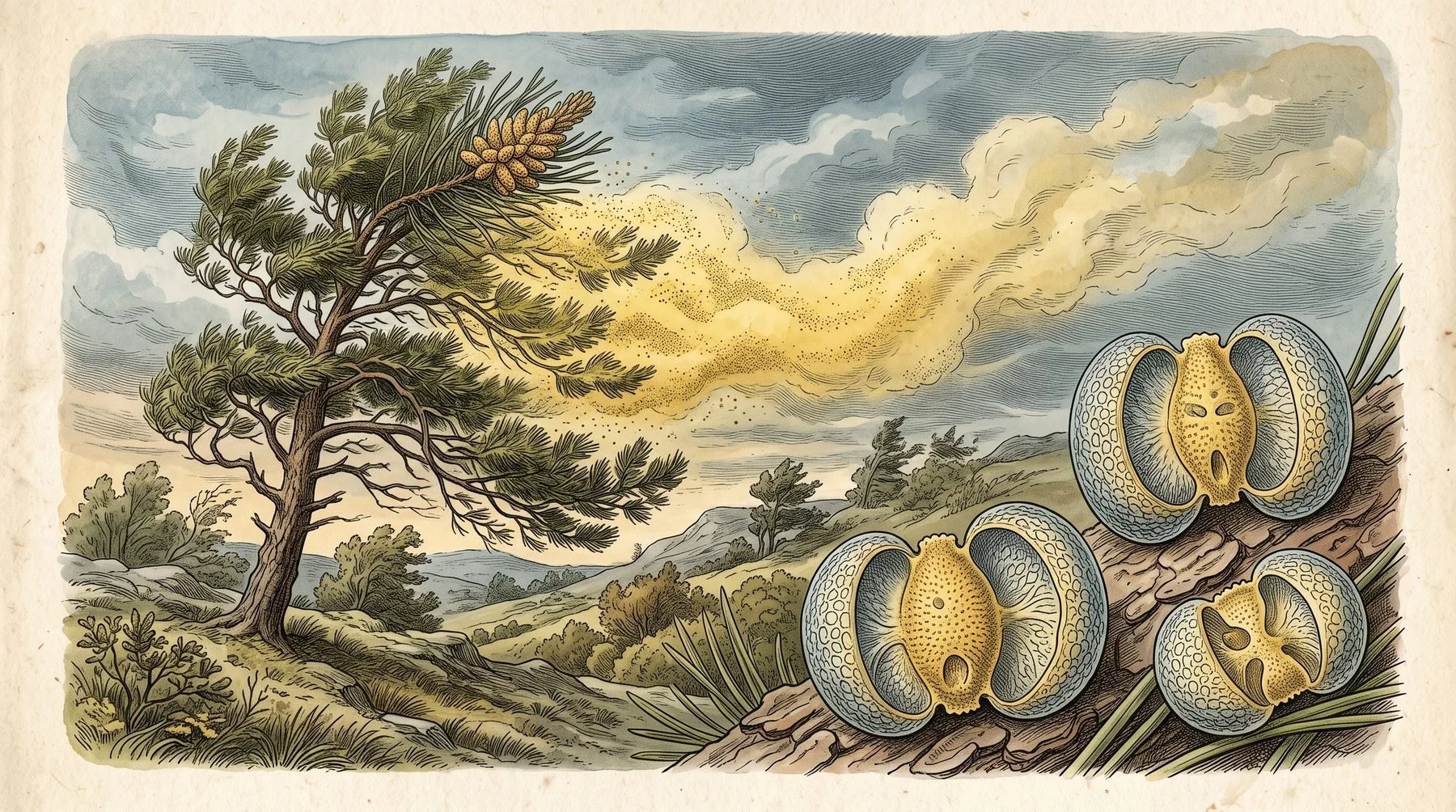
Illustration. The pine entrusts its pollen to the wind; each grain carries two small air sacs that help it travel.
Here too, pollution scrambles things. Above 60 parts per billion of ozone, floral scents break down on the way: the lifetime of caryophyllene drops from twelve minutes to two, and the insect takes longer to find the flower. In open fields in the United Kingdom, ozone and diesel exhaust at levels half the American legal limits reduced the number of pollinators by 62 to 70%, flower visits by 83 to 90%, and seed production of black mustard by 14 to 31%.
There remains the finest loop, which brings pollen back to rain. The pollen of birch, pine and juniper carries macromolecules that make water freeze between minus eighteen and minus thirty-three degrees, and water that has merely touched the pollen freezes as well as the grain itself. Wetted by humidity or rain, the grain bursts into tiny fragments: up to seventy-seven thousand per grain in an oak, which serve as seeds for drops. This same bursting explains thunderstorm asthma, as in Melbourne in November 2016. The invention that freed fertilisation from water thus helps to make water again. What share of rain is owed to them, nobody has measured.
Lastly, a word about words. Pollen is not a volatile: it is a particle, a solid grain. Volatiles are the scents that guide those who carry it. Fertilisation on dry land was built on both, the particle the air carries and the molecule that says where to take it.
6. The drop factory
A drop is not born from nothing. Cloud air is almost never supersaturated by more than one per cent, and at that level pure vapour would stay vapour indefinitely. It needs a seed, a tiny particle on which water agrees to settle: a grain of sea salt, a speck of dust, a droplet of sulphate, or an organic particle. This is where forest volatiles change their nature.
Rise with them. In the air, isoprene and terpenes meet ozone and the hydroxyl radical, which oxidise them. Monoterpenes in particular give, in a single step, molecules so loaded with oxygen that they can no longer remain gaseous. They condense, clump together, and make particles that grow until they become cloud seeds. At CERN, in the CLOUD chamber, it was shown in 2016 that oxidised pine vapours are enough to create particles without any sulphuric acid, that is, without any pollution. The forest knows how to make, on its own, the bluish haze that covers it in summer.
This is not a laboratory curiosity. Long-term measurements at continental sites in Europe show that this growth of plant origin produces roughly half of the particles that reach the size of cloud seeds, and that the seed load of the lower atmosphere grows exponentially with temperature. The hotter it is, the more the trees emit, the more seeds there are, the brighter the clouds. Some see in this a natural brake on warming, whose size remains debated in the models. In the intact Amazon, far from all pollution, 85% of cloud seeds are made of this organic matter derived from volatiles, and 80% of the large particles in the air are biological: spores, pollen, debris. The seeds of these particles are themselves often grains of potassium salts emitted by fungi and plants.
Not all volatiles are equal. In a growth chamber reproducing a forest, isoprene on the contrary held back the formation of new particles, because it uses up the hydroxyl radical the other molecules would have needed. A poplar stand and a pine stand therefore do not make the same clouds.
And here the fungi of The pacts of the soil return. When a bolete, a russula or a milk cap shoots its spores, each one leaves with a tiny drop, Buller's drop, loaded with mannitol and other sugars that attract water. In the air, the drop evaporates, but the sugary residue stays stuck to the spore. American mycologists showed in 2015 that these spores of Lactarius, Russula and Suillus condense water from 101% humidity, at the upper limit of cloud supersaturation, and form droplets of 13 microns around a single spore, 27 microns around a cluster. These are three ectomycorrhizal genera, three partners of tree roots that I described to you beneath the soil. The world's fungi send about fifty million tonnes of spores into the air each year, seventeen of them from gilled mushrooms alone, and the mannitol found in the atmosphere serves as a tracer of their passage. The russulas of the woodland floor make drops.
Yet an idea this chapter might leave must be corrected. More seeds does not mean more rain. Share the same water among more seeds and you get more numerous, smaller droplets, which fall more slowly and can delay rain. Seeds make the cloud; they do not decide the rain on their own. What decides it, in our winter clouds, is ice.
7. The ice factory
In a cloud, water does not freeze at zero degrees. A pure droplet can stay liquid down to minus thirty-seven. To freeze sooner, it needs an ice nucleus, a surface that arranges water molecules in the order of the crystal. Yet in our winter and between-season clouds, rain most often begins high up as ice, which grows at the expense of neighbouring droplets, falls, and melts on the way down. Without ice nuclei, many of these clouds would pass over without raining.
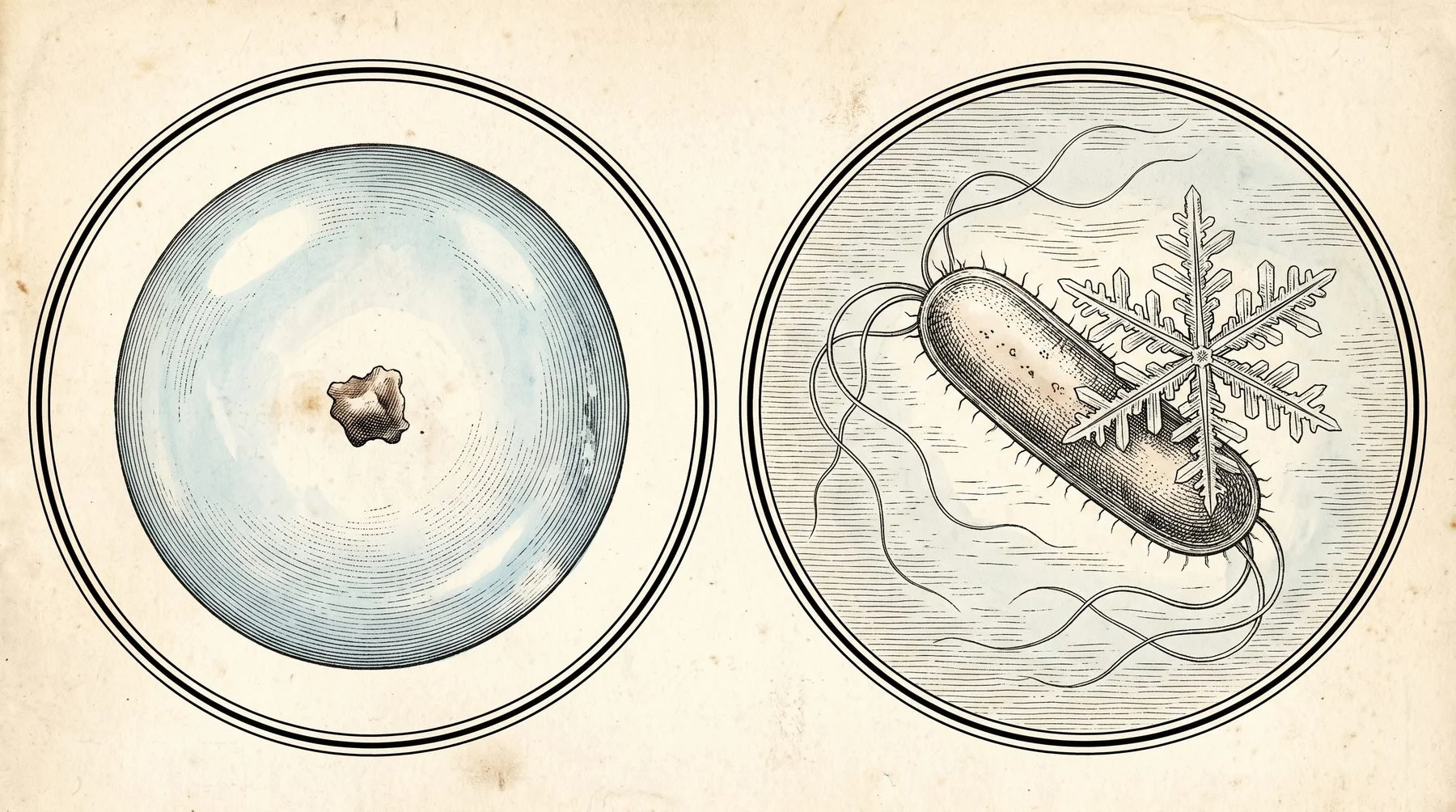
Illustration. On the left, a particle around which a droplet condenses. On the right, a bacterium on which ice begins to grow.
Mineral dusts make good nuclei, but only when it is very cold, below minus ten to minus twenty degrees; soot below minus twenty. Above these temperatures, in the decisive zone where the cloud hesitates, the best nuclei known are living, or once were.
The story begins with dead leaves. In 1970, in the forests of Wyoming, two atmospheric physicists, Schnell and Vali, collected leaves of aspen, alder, spruce and poplar every month, and measured their ability to make water freeze. Fallen leaves became active at around minus two degrees within a week. Litter that had already decomposed contained a billion active nuclei per gram at minus ten. The agent they isolated was a bacterium, Pseudomonas syringae. One of their samples, aspen litter collected in 1970 in Canada, was reopened forty-eight years later: it still made water freeze, and two Pantoea, one Pseudomonas syringae and a soil fungus, Mortierella alpina, were found in it. The litter you rake up every autumn is one of the oldest known sources of ice.
The soil then takes over. Dust from a fertile soil carries up to ten thousand times more freezing sites per gram than pure clay at minus twelve degrees, and this activity disappears if the sample is heated or its biological residues removed: it is not the minerals that freeze the water, it is the remains of the microbes that decomposed the plant debris. Above minus fifteen degrees, the biological share dominates. Soils in Colorado and Wyoming carry between one million and fifty million nuclei active at minus ten per gram, and an enzyme that destroys proteins removes three quarters of them: they are fungal proteins. Among these fungi, Mortierella alpina, a commonplace fungus of soils that receive fresh organic matter, makes water freeze from minus five or six degrees through proteins that come away from its mycelium with a simple rinse. Fusarium species do better still, from minus three or four degrees, with up to ten thousand billion nuclei per gram of mycelium, unaffected by ozone and by freezing cycles. Lichens, through their fungus, freeze water at minus two. When a wheat field is harvested, up to 922 nuclei per litre of air are lifted, 98% of them biological.
On the living leaf, the champion is Schnell and Vali's bacterium. Pseudomonas syringae carries on its membrane a protein that makes water freeze between minus three and minus eight degrees. This window is no trifle. It is precisely between minus three and minus eight that a process of ice multiplication occurs in clouds, known as Hallett-Mossop, in which each graupel pellet that captures droplets throws off splinters of ice that become so many new crystals. No mineral dust works in this window. Biological nuclei do.
What follows is a cycle, and this is the bioprecipitation hypothesis, put forward as early as 1982 by David Sands and taken up since by Cindy Morris, at INRAE in Avignon. Bacteria rise from leaves, freeze the cloud, come back down with the rain, and the rain multiplies them: after a downpour of more than twenty millimetres, populations of Pseudomonas syringae on leaves increase a thousandfold in forty-eight hours. One troubling clue supports the idea. In cloud water, less than 10% of strains of this bacterium freeze water. In rain, 60 to 100%. In snow, all of them. Precipitation sorts its passengers. In the south of France, out of 90 samples of rain and snow collected between 2005 and 2011, the bacterium was present in 25, and air masses coming from the Mediterranean carried it far more often than those from the north or east, 46% against 12%.
But how much rain do we owe it? Nobody knows. A first global model attributed less than 0.6% of ice nucleation to biological nuclei; another method, based on thousands of real strains, gives 3 to 6%. Cindy Morris and her co-authors write it themselves: the first study linking physics, biology and land use over the rainfall regime of a region is still missing. The mechanism is established; its share in rainfall is debated.
In the Mediterranean, the division is clear. When it is cold, below minus fifteen, Saharan dust dominates the ice nuclei. Above that, a local biological contribution appears, in Cyprus as on the Greek summits, and even in the Saharan air layer above Tenerife biological particles are more numerous among the nuclei than in ordinary air. In Cyprus, after rain, fungi account for more than 60% of the DNA in the air and the share of biological nuclei increases. In our winter clouds, ice is made of desert when it freezes hard, and of living things when it barely freezes.
8. When sea meets land
So far I have followed water from the land. But we saw in chapter 3 that Morocco's winter rain comes mainly from the Atlantic. It too arrives laden. We must look at what the sea puts into the air, and at what happens when its passengers meet those of the land.
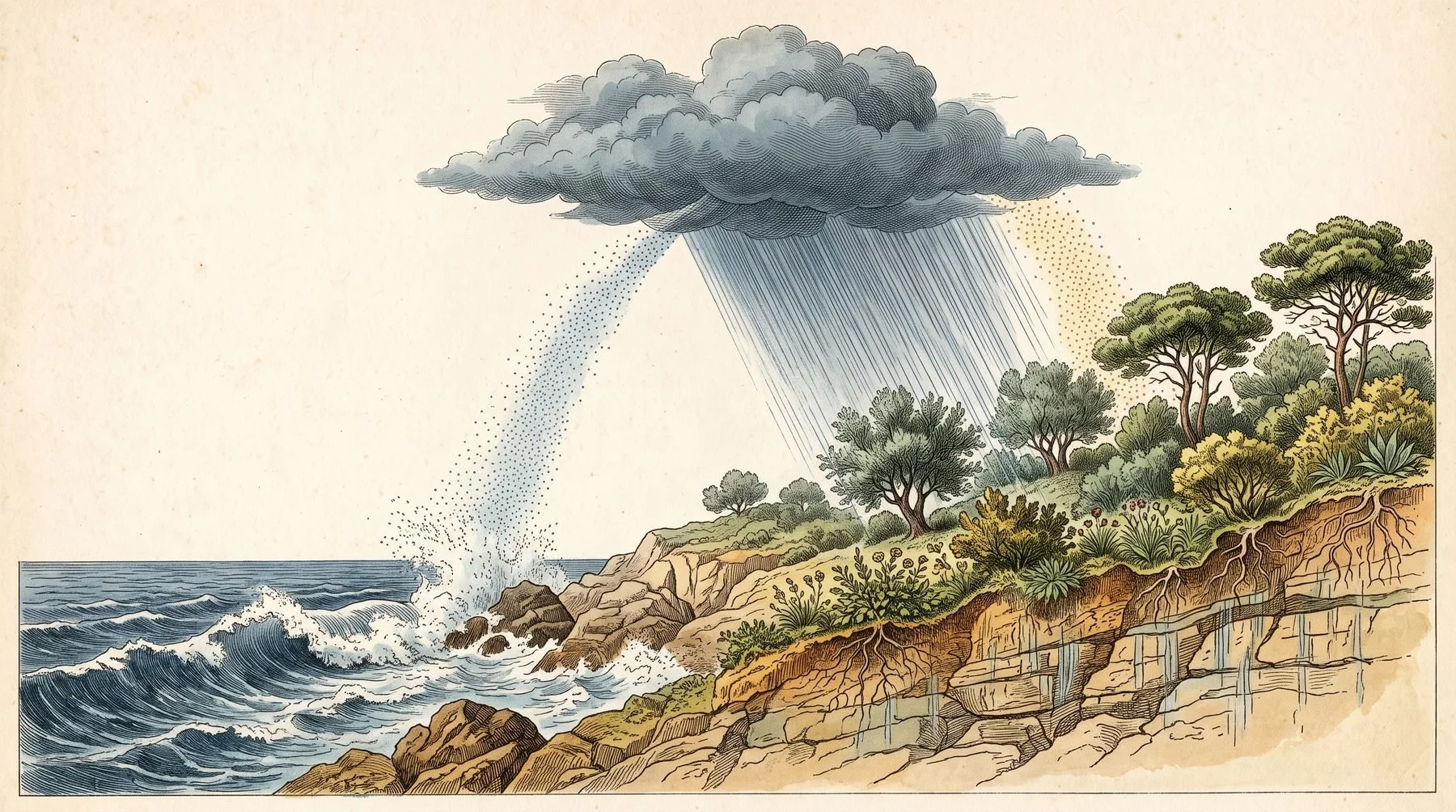
Illustration. The sea brings the salt that makes the drop; the land brings what makes it fall.
When a wave breaks, it traps bubbles that burst at the surface and throw out fine droplets of seawater. Once dried, they leave grains of salt, which are excellent cloud seeds, and with the salt the organic matter of the surface film. In the North Atlantic, during the spring plankton blooms, this organic matter makes up to 63% of the mass of fine marine particles, against 15% in winter, and the authors estimate that it can increase the number of cloud droplets by 15% to more than double. Phytoplankton does for the sea what the forest does for the land: it loads the air with living matter.
But the sea is poor in ice nuclei. It does produce some, and we know which: the ocean's surface film, rich in the exudates of diatoms, makes water freeze, and above the Southern Ocean, far from any land, it is these marine nuclei that make the ice in clouds. Only they are generally a hundred to a thousand times less numerous than those of continental air, and for the same surface area sea spray carries a thousand times fewer freezing sites than mineral dust. Even the gases are a matter for the land: the ocean emits less than one per cent of the isoprene emitted by land plants.
Hence a division of roles that I find striking. The sea brings the water and the salt that make the drop; the land brings the ice that makes the rain fall. An Atlantic depression reaching Morocco in winter arrives full of vapour and salt. For its cold clouds to rain, it still needs ice nuclei, and it is mainly the land that supplies them: desert dust when it freezes hard, litter, fungi and bacteria when it barely freezes. I offer this as a reading, because nobody has drawn up this balance for Morocco's rain.
The division also works the other way round. A cloud born above polluted land is loaded with a crowd of small seeds that share out the water and delay the rain. Above the sea, clouds just as polluted nevertheless rain, because the large grains of sea salt win out over the crowd: drops born on salt grow by swallowing the small ones and wash the air as they fall. Before the industrial era, continental air contained hardly more seeds than ocean air, at most twice as many; polluted air contains ten to a hundred times more. The sea repairs a little of what the land disrupts.
Above the Mediterranean, the meeting becomes more intimate still. Saharan dust on its way to Europe becomes coated with a film of sea salt, sulphate or nitrate. The resulting mixed grain becomes a good seed for drops while keeping its power to freeze water and, being heavier, falls back into the sea sooner. For a large share of this dust ends up in the sea. Nearly two thirds of the world's desert dust comes from North Africa. It carries iron, and the blue-green alga Trichodesmium, which fixes nitrogen from the air through its nitrogenase, needs five to ten times more iron when it fixes nitrogen than when it finds it ready made. It also carries phosphorus, which the acidity of the air makes soluble; we will come back to this. The desert feeds the sea, and the sea, through its blooms, sends organic matter back into the air.
Microbes travel in the same way. Above tropical and subtropical oceans, a third to two thirds of the microorganisms in the air are marine, the rest come from land; African dust brings them over the Atlantic in summer, and bacteria can travel thousands of kilometres there. On balance, the ocean receives more than it emits: it is the great sink for land microbes.
The mist of Boutmezguida is itself the product of this meeting. It is Atlantic air cooled as it passes over the cold waters of the Canary Current, pressed down under a temperature inversion and stopped by the relief. The water the nets collect contains 2.4 to 11 milligrams of nitrate per litre, whereas the neighbouring wells contain 80 to 280. What exactly the salts in this mist are, how much from the sea and how much from the desert, nobody has yet measured.
Lastly, water keeps the trace of its origin. The isotopes of Moroccan rain show extreme Atlantic rains strongly depleted in heavy isotopes, especially over the High Atlas, and a dry-season enrichment that hydrologists attribute to moisture recycled over land. What chapter 3 deduced from the winds, the chemistry of the drop confirms.
9. The wetland gives back to the air what the soil gave it
In The pacts of the soil, I left you at the edge of a marsh that holds water and then redistributes it. We must go back there, because the wetland is the only environment that gives the air, at the same time and in the same place, both water and seeds.
Sit at the edge of a reed bed on a July morning. The common reed is one of the big isoprene emitters of the plant world: a recent study measures peaks in it higher than in most trees, far ahead of bulrush and yellow flag. Behind it, the riverside woodland takes over with poplars and willows. The alder, as I said, emits nothing. In the bogs of the north, sedges and cotton grasses emit as much isoprene as broadleaved forests, nine times more than the models assumed, and their emission soars with heat, much faster than that of willows.
Sphagnum, for its part, holds a surprise that resembles everything we have seen underground. It makes isoprene, but the microbes living in its leaves consume it faster than it produces it, and almost nothing reaches the air. The border between the moss and the atmosphere is microbial, like the border between the root and the soil. In these bogs, it is the water level that commands: when the water table falls, emissions of volatiles and methane fall with it.
Open water speaks too. When lakes bloom with cyanobacteria, wind and waves throw up spray loaded with organic matter and biological fragments, and these lake particles have been found even in cloud water above Lake Michigan. On the foreshore, at low tide, the large brown seaweeds release iodine vapours that create bursts of new particles above the coast: the marine counterpart of the bursts over the pine wood. Salt marshes, which cover less than a thousandth of the globe's surface, are thought to supply nearly a tenth of the chloromethane and bromomethane in the atmosphere. It was long believed that plankton regulated the climate through the sulphur it emits; this fine hypothesis has been abandoned for the ocean, and there is no reason to transfer it to marshes.
The most direct link with the soil runs through rivers. They carry ice nuclei from the litter and soils of their whole catchment: in the Mississippi, nearly five thousand per millilitre active at minus ten degrees, 69 to 99% of them biological. In a river in Ohio, the signature of Mortierella alpina, the soil fungus of chapter 7, was recognised, and it was shown that turbulence in the water puts them back into suspension in the air, three times more than at neighbouring sites. In the Swiss Rhine, there are more of them in flood. Lakes, for their part, are reservoirs of Pseudomonas syringae. The water flowing down carries the seeds of the soil to the marsh, and the marsh gives them back to the air.
As for the water itself, a wetland does not evaporate like a lake. A bulrush marsh on the shore of Lake Ontario gave off 4.8 millimetres a day, as much as a shallow pond, but four to twelve times more than the large neighbouring lake, which stored heat in its depths instead of spending it as vapour. An English reed bed evaporated 15% more than a wet meadow. The Vaccarès lagoons in the Camargue evaporate 1,180 millimetres a year against 593 millimetres of rain, and survive only thanks to drainage water from the rice fields.
Then comes the most counter-intuitive result of this whole article. A wetland does not make it rain on itself. Fifteen years of satellite observations over sub-Saharan Africa show that afternoon rain is suppressed above wetlands, and that storms are born instead at their edges, where the cool, moist air of the marsh meets the hot air of dry land. The great Lake Chad of six thousand years ago received one to five millimetres of rain a day less than its eastern shores, and today's shrunken Lake Chad receives more afternoon rain than before. If the Sudd, the immense marsh of the Nile, were drained entirely, the regional water cycle would change little, since moisture recycling over the whole Nile basin is only 11%. But the local air would lose thirty to forty points of humidity and gain four to six degrees in the dry season.
That is where the true power of a wetland lies: beside it. In Spain, in the Mancha Húmeda, lagoons holding water lower the maximum temperatures of their shores by 1.5 to 4 degrees without affecting the minimums, and in winter they bring the air humidity close to saturation, with their fogs and hoar frosts. At Gallocanta, one March morning, the lagoon water was at 12 degrees when the neighbouring fields rose to 26; in November, even the dried-out bed stayed nine degrees cooler than the crops. In north-east China, a natural marsh receives 48 millimetres of dew a year, a field 35, a town 25. In China again, across 477 parks built around wetlands, the air is on average 2.5 degrees cooler over 240 metres in the hot season. This is an average, not a sharp-edged dome: the effect depends on the share of open water in the park, the size of the wetland and the sealing of its surroundings, and it does not protect a concreted district two hundred and fifty metres away.
A wetland is a source of water for the air, of seeds for the cloud, of coolness and dew for its neighbours. It does not make it rain on itself. Keep this sentence: it will serve you the day someone promises you the opposite.
10. What we lose when we drain
The figures are harsh, and they are sound.
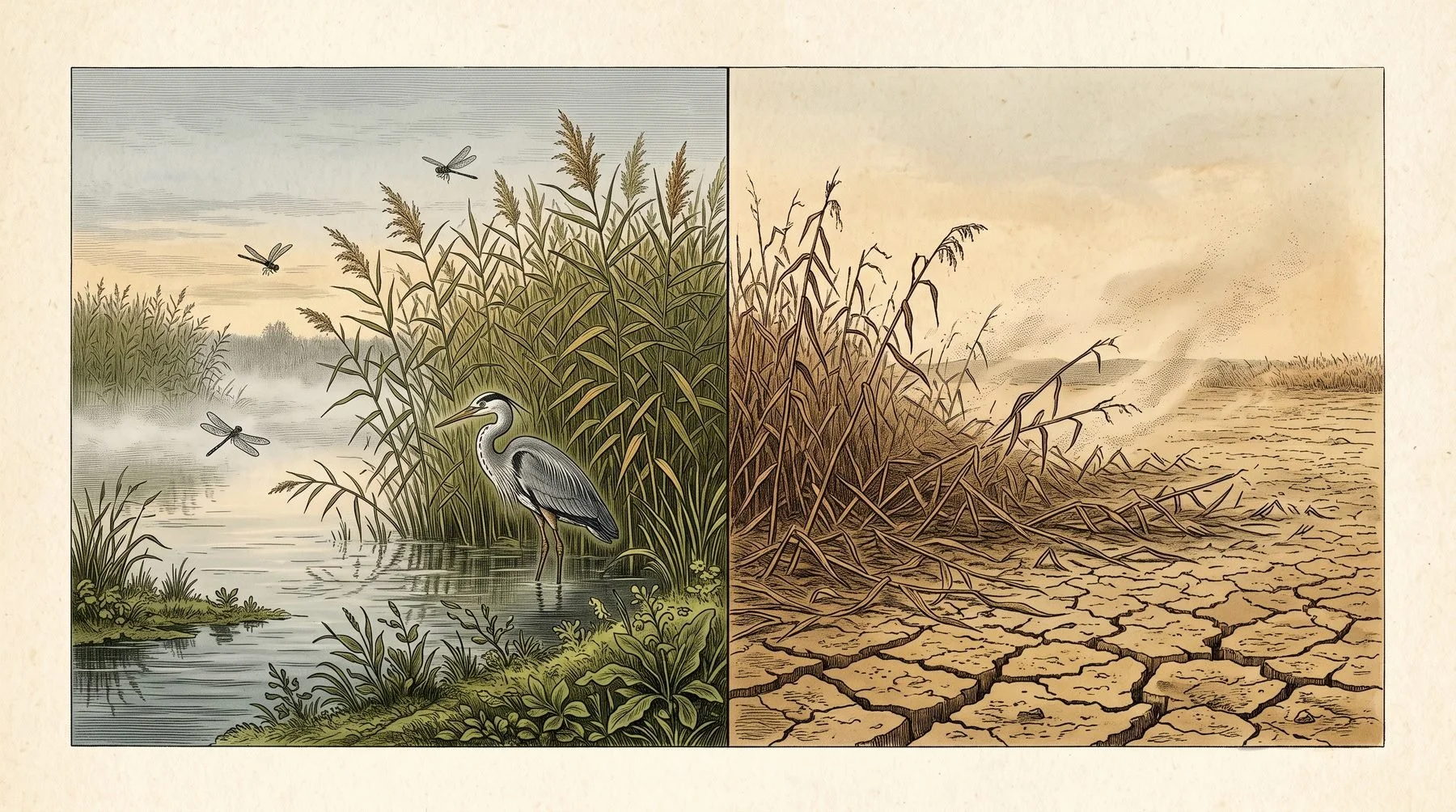
Illustration. The same wetland, holding water and then drained: with the water go the coolness, the dew and the seeds.
France lost nearly two thirds of its wetlands in the twentieth century, half of them between 1960 and 1990. Of the 189 emblematic wetland sites monitored by the State, 41% deteriorated further between 2010 and 2020. The Dombes had twenty thousand hectares of ponds in the middle of the nineteenth century; a law of 1856 had nearly half of them removed, and eleven thousand remain. Spain went from about 280,000 hectares of wetlands around 1800 to 114,000 in 1990, a loss of 59%, and 80% for its floodplains. The marismas of the Guadalquivir, around Doñana, covered more than 300,000 hectares; about 50,000 remain.
Morocco is no exception. The national strategy recognises that its natural wetlands, about 280,000 hectares, represent less than half of the floodable area of the early twentieth century. In the Gharb plain, drained since the 1920s for irrigation and rice growing, a recent mapping estimates the merjas of former times at more than 3,500 square kilometres, and what remains at less than 250. Lake Iriki, seven thousand hectares at the foot of the Sahara, stayed dry for fifty years after the Mansour Eddahbi dam was built, until the floods of September 2024 filled it at a stroke. In the Middle Atlas, six lakes dried up entirely between 2017 and 2024, including Ifrah, Aoua and Afennourir, and Aguelmam Sidi Ali went from more than 300 hectares in 1975 to 155 in 2007. Across the Mediterranean basin, natural wetlands have lost 48% of their area since 1970, against a world average of 35%.
Why were they drained? For health, and for land. The edict of 1599, the law of 1807 on draining marshes and the law of 1856 on the Dombes invoke fevers, miasmas, putrid air, and land to be won. In the Gharb, drainage was meant to drive off excess winter water and the salty water table, and to irrigate. None of the period texts analysed by historians claims that the rain or the fog would change. Marshes were drained without anyone asking what was being taken from the air.
What was taken from it? Here, three things must be distinguished.
What is established is the effect of a wetland holding water on the air around it: the coolness of the Mancha lagoons, the winter humidity, the dew of the marsh, which you saw in the previous chapter. What is deduced is the effect of its loss. At European scale, a 2020 study explicitly links the drying of wetlands in the north and north-east of the continent to an increase in sensible heat and to local summer warming. Around the dried-up Aral Sea, temperatures changed by up to six degrees near the former shoreline and by one degree up to two hundred kilometres away, and the gap between day and night widened by two to three degrees. The best model for Morocco comes from Tunisia: climatologists placed a virtual lake on the Chott el-Djerid and simulated twenty years of climate. The lake moderates temperatures, increases humidity and slightly increases winter rain, but its effects remain confined to its surface and to a fringe downwind. A wetland of a few thousand hectares makes a microclimate, not a rainfall regime.
What does not exist is direct proof. In none of the three countries, to my knowledge, is there a series of measurements before and after the drainage of a specific marsh. In Lyon, fog has receded since 1900, and the disappearance of nearby wetlands is cited as one of four possible causes, without being isolated. In the Po plain, fog has receded too, but along with sulphur in the air, without any loss of marshes: a counter-example to keep in your pocket. As for the idea that drainage made summer storms disappear, it is supported only by qualitative arguments, in Hungary as in Spain. It is a hypothesis, nothing more.
There is, on the other hand, a loss that is always forgotten, and it brings us back to ice. A dried-up lake bed becomes a source of dust. On the shores of Lake Urmia, in Iran, it has been shown that the ice-forming activity of this dust is dominated by its small share of biological matter, one to five per cent of its mass, and that abandoned agricultural lake beds make better nuclei than Saharan dust. In Morocco, the dried beds of the lower Drâa, including Lake Iriki, are active sources of dust, described as such by measurement campaigns. Nobody has yet measured what living matter this dust carries.
Hence the only promise that can be kept. Restoring a merja means giving back to its neighbours coolness, night-time humidity, dew, perhaps fog, and shutting off a source of dust. It does not mean bringing rain back to the Gharb. And since nobody has ever measured dew or fog at the edge of a Moroccan wetland, there is a gap here that field observation can fill: at Mirleft, a whole year's dew has been measured with one square metre condensers.
11. Nitrogen, which cuts nothing and scrambles everything
In The pacts of the soil, I made a simple calculation for you. Irrigation water at fifty milligrams of nitrate per litre, applied at three hundred millimetres over the season, brings about thirty-four kilos of nitrogen per hectare that nobody decided on, enough to slow down a symbiosis. We must now add what the rain brings of its own accord. In the Pyrenees, eight to fifteen kilos of nitrogen per hectare per year have been measured falling with rain and snow, two to three times more than the European reference model predicts. In northern Spain, deposition by rain alone reaches thirteen kilos. In the French countryside, nitrate in rain has remained stable, and has even increased in places, despite the fall in engine emissions. For Morocco, to my knowledge, there is no measurement. So rain already brings, without anyone having decided it, between a quarter and a half of the dose I held against irrigation water. Yet a large European survey, carried out in 137 forests in twenty countries, placed at 5.8 kilos of nitrogen per hectare per year, measured under the trees, the threshold beyond which communities of ectomycorrhizal fungi tip over, well below the critical loads accepted until then, of 10 to 20 kilos. In the Pyrenees, rain alone already exceeds this threshold. The air does not merely receive the pact of the soil: it can undo it by itself.
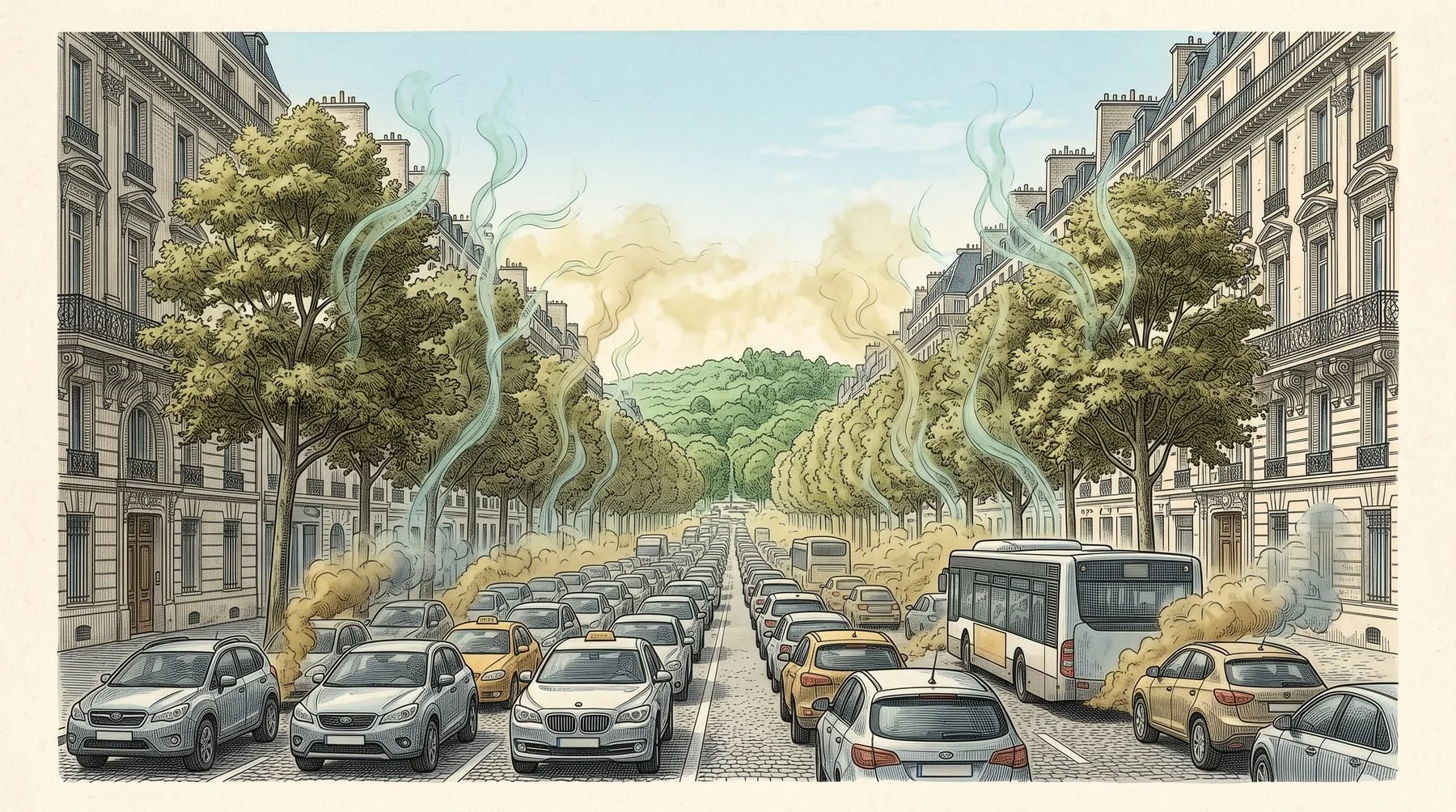
Illustration. In a street loaded with nitrogen oxides, the volatiles of trees turn into ozone.
This nitrogen is in the air before it is in the rain, and there it meets the volatiles of plants. What does it do to them? One would expect to find the soil scenario again, where nitrate makes the symbiosis useless and the plant stops investing in it. That is not what happens. In the air, nitrogen cuts nothing. It diverts, it replaces, and it scrambles.
First, it diverts. The nitrogen oxides coming out of engines and boilers change the fate of forest volatiles. In their presence, isoprene and terpenes make ozone. Over summer Europe, plant volatiles thus add about 2.5 parts per billion to ozone peaks, up to 15 in Portugal and around 5 in the Mediterranean, and this contribution doubled in places during the 2003 heatwave. Without nitrogen oxides, no ozone: it is not the tree that pollutes, it is the encounter. At the same time, these oxides stifle the birth of cloud seeds. Above about 23 parts per billion, the formation of new particles from monoterpenes collapses by several orders of magnitude, and ozone forms instead. In the CLOUD chamber, particle formation follows the ratio between terpenes and nitrogen oxides, and it is the smallest particles, those one to three billionths of a metre across, that suffer most. The city robs the pine wood of its ability to make cloud seeds and turns it into an ozone factory.
At night, the diversion continues. Nitrogen dioxide and ozone give a nitrate radical which becomes, wherever terpenes are plentiful, their main night-time oxidant: in Berlin, it accounted for nearly a third of the oxidation of organic compounds, and in a pine plantation it is devoured by terpenes in seven seconds. It turns them into organic nitrates, which make up as much as 40% of the mass of the newborn aerosol.
Next, nitrogen replaces. Ammonia, 94% of which comes from agriculture and above all from livestock, does the opposite of nitrogen oxides: it multiplies the birth of particles by a hundred to a thousand, and with the acids in the air it forms ammonium nitrate and sulphate, cloud seeds far more eager for water than the particles derived from terpenes. Halving ammonia would cut fine particles in north-west Europe by a quarter, Brittany and the Po plain foremost. A nitrogen-laden sky therefore has no fewer seeds. It has seeds from the cowshed in place of seeds from the forest.
And nitrogen scrambles messages. For me this is the strongest result of this chapter. At 80 parts per billion of ozone, a level found in nature, the distance at which two bean plants warn each other of an attack shrinks, because the alarm molecules are destroyed on the way. A diffusion model estimates that the most reactive floral scents, which carried more than a kilometre before the industrial era, now lose half their intensity within two hundred metres and three quarters within three hundred. In open fields in England, under realistic levels of diesel exhaust and ozone, pollinators fell by 62 to 70%, flower visits by 83 to 90%, and seed production by 14 to 31%. And at night, the nitrate radical destroys 84% of the pinene and 67% of the ocimene in the scent of an evening primrose; the hawkmoth that pollinates it can no longer find it. In populated regions, the distance at which an insect recognises a flower is thought to have lost at least three quarters since pre-industrial times.
Ice nuclei, for their part, hold out. Nitrogen dioxide and ozone have no effect, or a weak one, on most strains of Pseudomonas syringae, and none on Fusarium. What destroys them is acidity: an acid pH denatures the bacterium's protein, and sulphuric acid condensed on a dust grain destroys its freezing sites for ever, with no repair by ammonia.
On the plant itself, nitrogen does not do what one would expect. In species that emit isoprene, more nitrogen in the leaf gives more isoprene, up to a third more in a fertilised poplar; ozone, for its part, suppresses nearly 60% of it, and nitrogen compensates for nothing. A plant deprived of nitrogen loses its direct defences and a good part of its hormonal responses, but it goes on emitting the volatiles that call the enemies of its pests: in wild tobacco as in soya, the alarm bouquet withstands the deficiency, and the small wasp that parasitises its caterpillars still comes. In a Scottish bog sprinkled for eleven years with thirty-two kilos of nitrogen per hectare, nitrogen fixation by the microbes of the sphagnum did not flinch, whereas the same load makes the moss decline and speeds up the decomposition of the peat. Lastly, ozone reduces the colonisation of roots by mycorrhizal fungi, and yet it is mycorrhizal plants that tolerate it best.
The only real nitrogen switch in the air is the overfed plant. When it has received more nitrogen than it can use, it becomes a source of ammonia itself, with a peak in the days following the application: barley, wheat, oilseed rape and peas lose one to five kilos per hectare per season. Excess nitrogen cuts nothing; it leaks.
The parallel with the soil therefore fits into one sentence, provided it is said in full. In the soil, nitrogen makes the symbiosis useless. In the air, it makes the message inaudible. It does not switch it off: it oxidises it on the way. No study has yet tested in a single piece the chain running from nitrogen to the mycorrhiza, then from the mycorrhiza to the leaf's bouquet; each of its links is published separately, and I offer it for what it is, my reading.
For a town, the consequence is practical. Planting only heavy isoprene emitters along an avenue saturated with nitrogen oxides means making ozone. That is the chemical reason for the ozone column in my tree species tables. It does not mean banning these trees: the large, robust broadleaves are also those that give the best shade, and during a heatwave shade saves lives. The point is to weigh the ozone penalty against the shade bonus, and to diversify the palette instead of lining an avenue with a single emitter.
12. Acid, which the Mediterranean neutralises
In the 1980s, people talked about acid rain the way they talk about heatwaves today. Sulphur from power stations and factories fell back as sulphuric acid, lichens disappeared from tree trunks, and the death of central Europe's forests was announced, an announcement that forest inventories have since qualified. What remains of this story, and what does acidity do to the pact of the air?
Sulphur has been beaten, or nearly. In Europe, its concentrations and deposition have fallen by 70 to 90% since 1980, and in the French countryside the pH of rain rose by about 0.3 units between 1995 and 2007. The acidity that remains has changed in nature: it is now mainly nitric, and the thread of acid joins that of nitrogen in the previous chapter.
The Mediterranean, for its part, has a buffer. The south wind brings limestone from the Sahara, which neutralises the acid. In the south of France, the average pH of rain is around 5.8, whereas it drops to 4.9 in the north-east. At Montseny, near Barcelona, rain became alkaline in some twenty years, and the rare rains of African origin bring most of the calcium there. In Corsica, it had been shown as early as 1986: Saharan dust clearly raises the pH of rain. At Mirleft, dew and rain are close to neutral. In Morocco there is, to my knowledge, no network measuring rain chemistry, but nothing suggests that acid rain is an issue there.
There is an acidity that is forgotten: that of trees. By oxidising their terpenes, forests make formic acid, a hundred to a hundred and twenty million tonnes a year, 90% of it of plant origin, two to three times more than was thought. Above boreal forests, it lowers the pH of summer rain by a quarter to half a point. In Patras, in Greece, formic and acetic acids supply more than a third of the free acidity of rain. In rain that has become clean again, this natural acidity, a child of the pact of the air, weighs relatively more.
What does acid do to seeds? On dust, it works both ways. It makes the phosphorus in Saharan dust soluble, at least ten times more at Finokalia, in Crete, and iron along with it: acid fertilises the sea. But it irreversibly destroys the freezing sites of mineral dusts, in proportion to the sulphuric acid condensed on them. On living nuclei, it sorts. The protein of Pseudomonas syringae is sensitive to acidity, which denatures it; that of a Fusarium remains active from pH 1 to 13. In acid air, the ice nuclei of fungi would hold up better than those of bacteria; this is a laboratory deduction that nobody has verified in the sky.
Acid also changes the fate of volatiles. An acid sulphate particle swallows the oxidation products of isoprene: in a chamber, the aerosol yield rises from 1.3% on a neutral seed to 28.6% on an acid seed. In the United States, it is estimated that halving sulphur dioxide reduces aerosol derived from isoprene by about a third. By driving out sulphur, Europe has therefore probably reduced part of the haze that its oaks and poplars used to make; the calculation has not been done for Europe.
On leaves and in the soil, acid leaves long-lasting traces. An acid fog leaches calcium, magnesium and potassium from needles and disrupts the stomata. The lichens that sulphur had driven away are returning slowly, and in Sweden recolonisation remains weak twenty years after pollution fell, for lack of species to repopulate. In soils, natural recovery is counted in tenths of a pH point per decade, and the most acid forest soils in France are still acidifying. In bogs, sulphate held back methane production, by about 8% at world scale according to one model, and the sphagnum mosses that sulphur had wiped out in the English Pennines are coming back.
The lesson comes in two parts. Sulphuric acid was a parenthesis, largely closed in Europe and almost absent in the south, where the Sahara neutralises the rain. What remains of acid today is nitric, and that is once again the story of nitrogen.
13. When drought closes the doors
With every drought, in Morocco as in France, I see the same thing. The rain does not come back as before. It falls less often, elsewhere, in patches, and when it does fall it seems to hesitate. I am told that nobody talks about it. In reality, climatologists talk about it a great deal, under a name that almost never gets through the door of consultancy offices: soil-atmosphere feedbacks. And their starting point is that of chapter 2, the leaf closing its stomata.
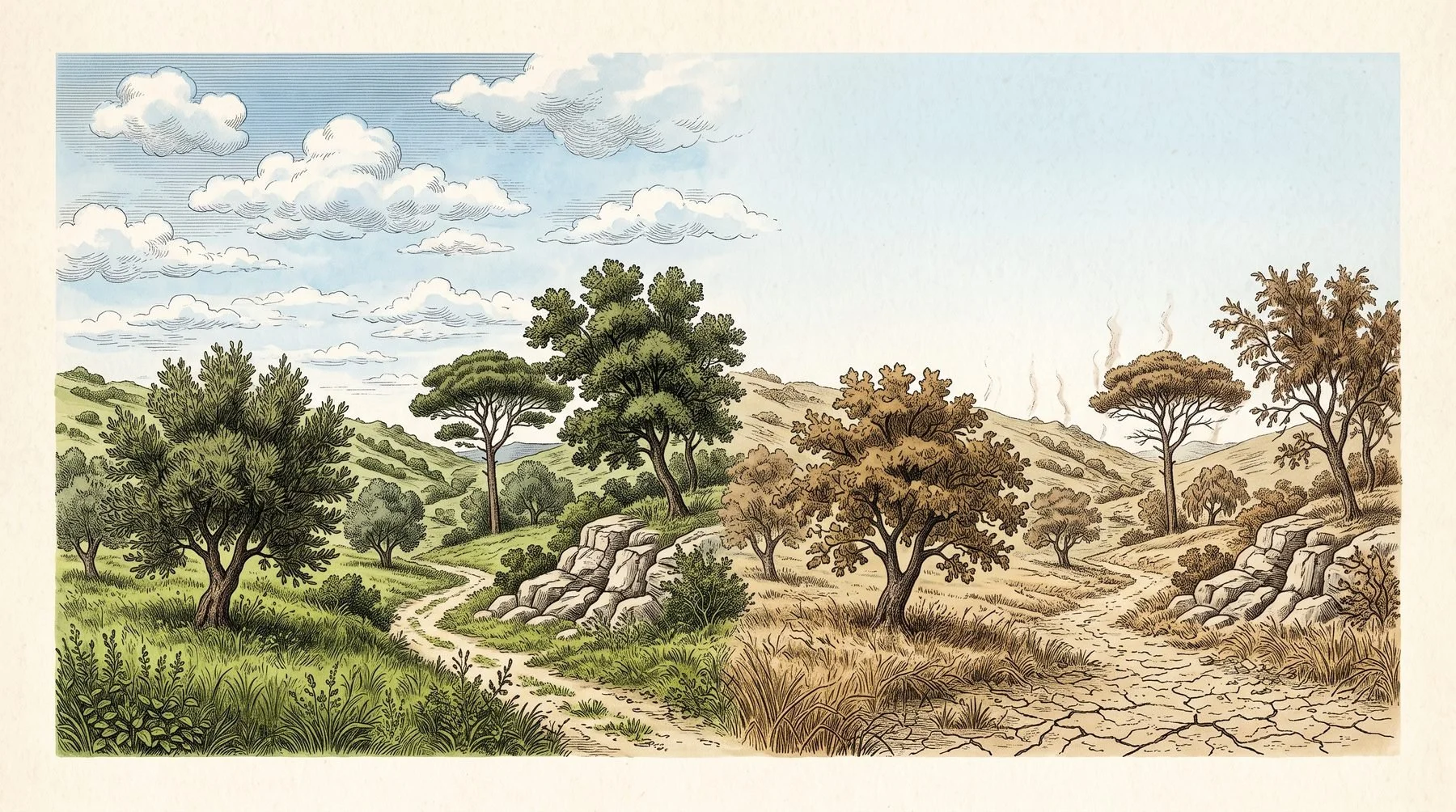
Illustration. The doors close, the air heats up and dries out, and clouds become scarce.
It is all a matter of energy. When the leaf transpires, a good part of the sunlight it receives goes into evaporating water, and this evaporation cools the air. When it closes its doors, the same sunlight no longer finds water to evaporate: it heats the air directly. The air warms, dries, its thirst rises, and the leaves close further. The loop is closed. For the summer of 2003, a Swiss team reran the European heatwave on computer with normally moist soils: in some regions, the heat anomaly would have been reduced by about 40%. Part of the heatwave came from soils and plants that no longer had anything to give back.
Less water rising means less water falling further on. By tracing backwards the humid air of the forty largest recent droughts, a team at Ghent University showed that in dry regions, upwind drought can reduce downwind rain by more than 15% in a single episode, and by up to 30% in some months. Drought spreads like fire, from one region to the next, on the wind. The same team went further in 2024: on about 40% of the land that has recently shifted from a humid to a dry climate, this self-propagation explains more than half of the observed aridification. And on our side, the route is known. French simulations have shown that heat and drought move up from the Mediterranean towards the north from late spring into summer: dry air from the south arrives with less convection and fewer clouds, then the dry soils of France and central Europe in turn amplify the warming. A dry Spain prepares a dry France.
There remains your impression, and mine, that rain behaves differently. It is correct, and the reason has been measured. In 2012, a British team looked by satellite at where afternoon storms are born on six continents: they start preferentially above soils drier than their neighbours, because dry soil heats the air more strongly and launches more vigorous updraughts, and the signal is clearest in semi-arid regions. A later study refined the picture: afternoon rain is more likely when a region's soils are moist overall, but it falls on the dry patches. During a drought, the moist patches disappear. Rain becomes rarer and more capricious in its geography: a shower here, nothing ten kilometres away. Lastly, under dry air, the cloud base rises, the drop crosses a thicker layer of thirsty air and partly evaporates before reaching the ground. These are the grey trails that hang beneath clouds without ever arriving. The isotopes of rain keep the trace of this loss on the way: it is negligible at 95% humidity and strong in hot, dry weather, as has been calculated for Madrid.
What drought does to volatiles follows a curve in two stages. At first, the leaf transpiring less heats up, and it emits a little more. Then everything collapses. At Puéchabon, near Montpellier, the terpene emissions of the holm oak fall exponentially when the suction of water in the leaf exceeds two megapascals, and the dry year of 2006 gave half the emissions of 2005. In Haute-Provence, depriving downy oaks of about 30% of their rain for three years reduced their emissions by 40 to 50% in spring and summer, mainly through closure of the stomata. Fewer volatiles means fewer cloud seeds made above forests, with a nuance still debated: stress also changes the bouquet, and some stress compounds make more particles than ordinary terpenes.
There is worse, and it brings us back to chapter 11. An open leaf swallows ozone. A closed leaf leaves it in the air. In August 2003, above a Mediterranean forest, the rate at which vegetation removed ozone from the air fell by 70% compared with the wet summer of 2004. By taking this closure into account, a model finally reproduces the ozone peaks observed in Europe, with three times as many days above 80 parts per billion. Drought does not merely deprive the air of water: it leaves in it the pollutant that the leaves would have drunk.
The living pact seizes up too. We saw in chapter 7 that rain multiplies leaf bacteria. It also sends puffs of spores and bacteria into the air: in a semi-arid pine wood in Colorado, biological particles in the air rise markedly during rain, and ice nuclei with them. In Australia, ice nuclei stay high for some twenty days after heavy rain, just when the next rain becomes more likely. Rain calls rain. Drought cuts this relay at its source: no rain, no puff. What dry land sends instead is dust, which still carries organic debris active at around minus fifteen degrees, but no study measures what is lost in the exchange. This is a hypothesis, but it fits what we see. Even dew is retreating: a dew atlas for the Mediterranean forecasts a fall of about 27% in summer dew by 2080, owing to hotter, drier air.
What holds? The deep root. In southern Portugal, at the height of drought, the cork oak lifts water at night from deep layers towards the surface, and this water supplies 17 to 81% of the next day's transpiration. This does not contradict the 0.9% of chapter 1: one counts the share of a single day at the peak of drought, the other a percentage of the whole year's flow. A tree whose roots reach a reserve keeps its doors ajar for longer, and the whole landscape goes on giving a little water back to the air. In Morocco, a study published this year on the Maghreb shows that droughts are closely linked to the depletion of soil water, especially in the semi-arid inland belt, and that an index which counts the thirst of the air detects more drought months than an index which counts only rain. Nobody has yet measured, for Morocco, the share of rain lost through this mechanism. What you observe is consistent with everything above. It remains to be counted.
The lesson fits into one sentence. A drought is not only a lack of rain; it is a regime that sustains itself: the doors close, water stops rising, volatiles collapse, ozone stays, and what rain remains becomes rarer and more capricious. Anything that keeps water in the soil, deep down and under cover, delays the closing of the doors and slows the loop.
Box. The soil that breathes hydrogen
There is a gas that nobody mentions in stories about rain, and yet I see it at work in my garden: hydrogen. Soils where nitrogenase is at work stay a little green after months without water, much more so than elsewhere. People reply that the quantities are small. That is true, and it is precisely what makes the question interesting.
Free hydrogen does end up as water. The hydrogen released by nodules stays largely in the soil, where bacteria burn it with oxygen to draw their energy from it: two molecules of hydrogen and one of oxygen give two molecules of water. What escapes joins the air, which holds about 555 parts per billion and where a molecule lives for nearly three years. Of the roughly 68 million tonnes that disappear each year, 73% are eaten by soil microbes, which capture it directly from the air. The rest is destroyed by the hydroxyl radical, and it too yields water at the end of the chain. The soil is therefore the planet's main hydrogen sink. By using up this radical, hydrogen leaves less of it to destroy methane, which gives it an indirect greenhouse effect of about eleven times that of carbon dioxide over a hundred years.
But this water does not count. The chemistry of nitrogenase releases at least 71 grams of hydrogen per kilo of nitrogen fixed, and up to three times more in strains that do not recycle their own. Burned, this makes 0.6 to 2 kilos of water. A very active legume fixing 200 kilos of nitrogen per hectare per year would thus give back 130 to 400 litres of water per hectare per year, one to four hundredths of a millimetre. The dew at Mirleft gives five hundred to fifteen hundred times as much. Hydrogen does not water.
It feeds. This is where the observation in the garden finds support. The bacteria that eat hydrogen from the air still work between minus seventy and minus one hundred megapascals, whereas a crop plant wilts at around minus one and a half: this is one of the most drought-resistant microbial activities known. When everything else stops, they are still breathing. In desert soils, their activity increases nearly a thousandfold as soon as water returns. A soil that receives hydrogen during drought keeps its biology on standby, ready to start again. That much is established.
Here is what is plausible. Around nodules, some of these bacteria slow down the plant's production of ethylene, the hormone that curbs root elongation. The roots lengthen, and a longer root goes looking for water further down. This is, in my view, the most credible link between hydrogen and a plant still green in August. It has been shown under controlled conditions, not yet in a field in drought.
And here is the hypothesis. The authors of the 2025 study suggest that the water born from burning hydrogen helps the bacterium itself to resist drying out. In volume, it is nothing. But this water is born inside the cell, where a single molecule counts. The other explanations must be kept in view: legumes often have deep roots, a soil rich in organic nitrogen is better structured and holds water better, and nitrogenase itself slows sharply when the plant is thirsty. To isolate hydrogen, one would have to compare, with the same legume, strains that release their hydrogen into the soil and strains that recycle it. That is a trial that can be run in the field.
14. The mountain, a crumbling water tower
The mountain is where the pact of the air plays out most strongly. Air that runs into a slope rises, cools and condenses: it rains, it mists, it snows. In arid and semi-arid regions, mountains supply 50 to 90% of river water, and sometimes more than 95%. In Morocco, dam water comes from the Atlas and the Rif. And the mountain forest captures more still: in the Canaries, half the water received by the laurel forest of Garajonay comes from mist combed out by the leaves, as chapter 16 details.
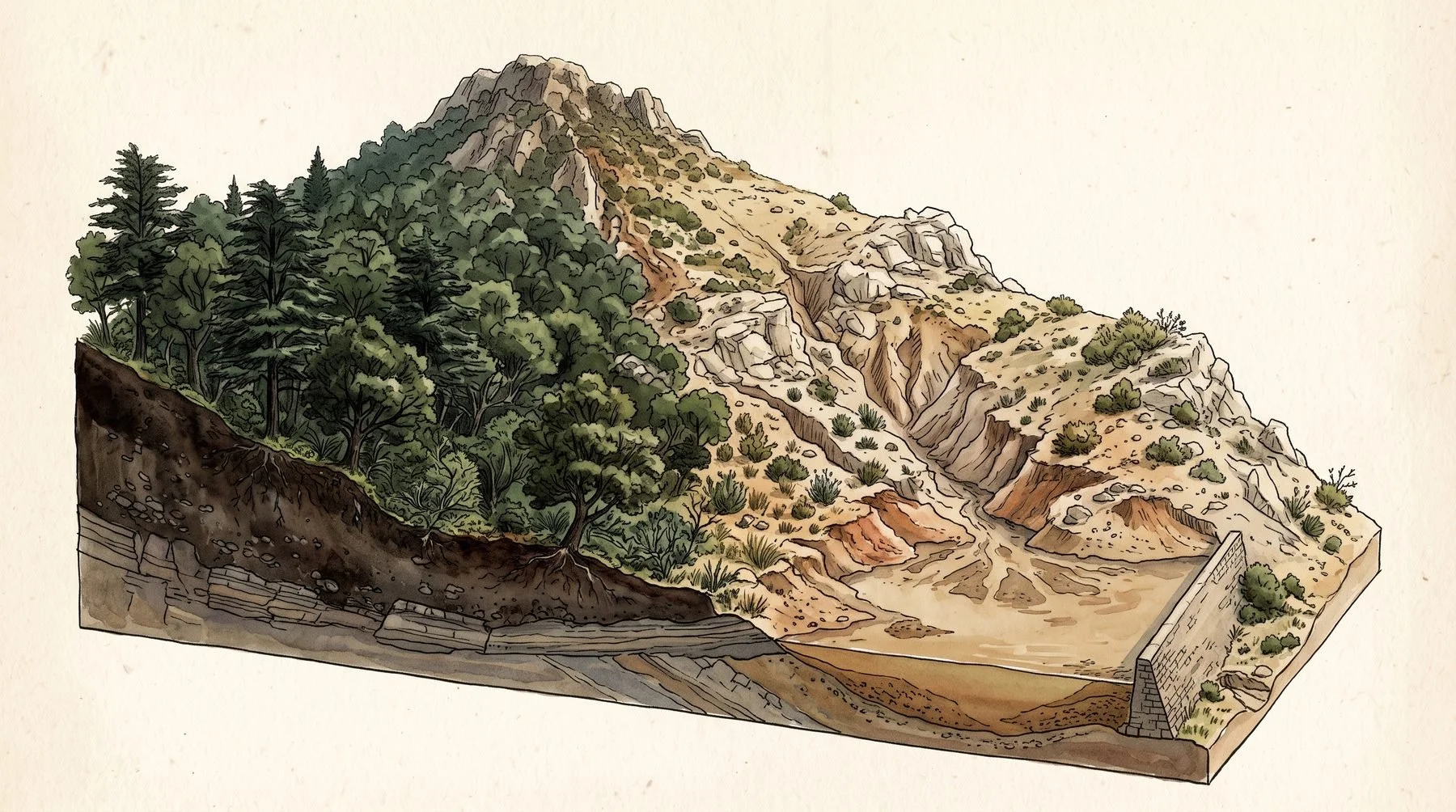
Illustration. The shaded slope keeps its soil and its forest; the sunny slope gullies, and the earth ends up in the reservoir.
Yet vegetation does not settle in the same way on both slopes. The north-facing slope, the ubac, receives less sun, evaporates less, keeps its water. The south-facing slope, the adret, heats up and dries out. An Israeli study measured this along a gradient running from a Mediterranean climate to desert. Under 620 millimetres of rain, vegetation covers 88% of the north slope and 64% of the south slope. Under 320 millimetres, the difference has almost disappeared, 22% against 20%. Under 260 millimetres, it reverses. The advantage of the shaded slope exists only as long as there is enough rain. In the Sierra Morena, in Andalusia, the north slope carries 29% more biomass, and its vegetation draws on deep water in the weathered rock; that of the south slope follows from day to day the soil moisture topped up by rain, and it is the first to suffer when rain fails. Anyone who has walked in the Rif or the Middle Atlas has seen the same division: the tree holds the shaded slope, the matorral takes the sunny one.
Mountain desertification follows this path. The Atlas cedar covers more than 130,000 hectares in Morocco and Algeria, 80% of it in the Middle Atlas. After the droughts of 1999 and 2000, 23% of a 15,000 hectare forest studied in the Middle Atlas showed signs of dieback, and cedar growth had already been declining everywhere since the early 1980s. A 2021 study summed up the harm in three words, drought, axe and goats: forest cover receded by about 18% in the High Atlas, and growth fell by 54% in the Middle Atlas. Felling and overgrazing had prepared the ground; drought dealt the blow. My hypothesis, which the Israeli gradient makes plausible without demonstrating it, is that desertification climbs the slopes in this order: the sunny slope first, then the shaded slope, whose advantage melts away as rainfall falls.
And when the vegetation goes, the earth goes with it. People often say that land has been washed out. Soil scientists speak rather of water erosion, since for them the word leaching refers to clays moving down within the soil, but the phenomenon everyone sees is the same: earth that is no longer held runs off with the water. Across 81 European sites, bare soil loses on average around fifteen tonnes per hectare per year, soil under shrubs, grassland or forest generally less than one tonne. Yet soil forms at best at a rate of about one tonne per hectare per year. A bare slope therefore loses in one year what it took fifteen years to make. What holds the earth is not only the leaves that cushion the drop, it is the roots: erosion decreases exponentially with root density, and for rills and gullies roots count at least as much as cover. The fine roots and hyphae of The pacts of the soil are also the seams of the mountain.
In the Rif, these seams have given way. Across fifteen dams in northern Morocco, the Rif catchments lose more than 1,500 tonnes per square kilometre per year, that is more than 15 tonnes per hectare, those of Tangier and the Loukkos about double that, and that of the Smir dam more than 5,300 tonnes per square kilometre per year, that is more than 53 tonnes per hectare. This earth ends up at the bottom of the reservoirs. According to the National Agency for Water and Forests, Moroccan dams lose 58.3 million cubic metres of capacity every year to silting, 2.58 billion in total, and the Sidi Driss dam has lost more than 92% of its capacity. On the other side of the sea, the Mediterranean countries of the European Union produce two thirds of European erosion, and Spain loses on average nearly four tonnes per hectare per year.
The link with the previous chapter is direct. A thinning soil is a shrinking reservoir. It empties earlier in the summer, the leaves close their doors earlier, the mountain gives back less vapour to the air, and we have seen what that costs downwind rain. Rain falling on stripped soil runs off instead of soaking in: flood first, dry wadi afterwards. And a pale slope reflects more sunlight. As early as 1975, Jule Charney suggested that the increase in this reflective power, when vegetation disappears, reduces rain on the margins of the desert. Each link in this chain has been measured separately. The whole chain, from the goat to the silted dam and from the dam to the lost rain, has never been measured in one piece.
And yet we know how to reverse it. France did it first, after the great floods of the nineteenth century, with the laws of 1860 and 1882 on the restoration of mountain land: foresters replanted and dammed the torrents of the southern Alps and the Pyrenees. Spain has replanted more than five million hectares since 1877, two thirds of them for protection. In the central Pyrenees, the Aísa plots show that runoff and erosion are lowest under dense scrub, not under cereal on the slopes. In the gullies of central Spain, a scheme in 1964 built 123 small check dams and planted 730 hectares of pines: fifty years later, 3.7 centimetres of litter and humus cover the planted soil, against nothing on the degraded soil, and sediment has decreased, but many soil properties have not yet shifted. The tree comes back in a few decades, the soil in many more. In Morocco, the watershed programme has treated 1.14 million hectares out of about eight million spread over 33 catchments, but to my knowledge no measurement of its effects on erosion or runoff has been published.
The lesson for anyone working in the mountains is simple. You do not start with the tree; you start by holding the earth: permanent cover, roots, small structures that break the slope, no bare soil. You do not plant the sunny slope like the shaded one: on the south slope, pioneers and shrubs first, which make the shade and soil the tree will need. And you shut the door on the goats while the roots take hold.
15. What rain gives back to the soil
The rain has fallen. Follow a single drop down to the soil.
When it strikes dry, porous earth, it does not sink in all at once. It traps tiny air bubbles beneath it, which swell as air escapes from the pores of the earth, rise through the drop and burst at its surface, throwing out fine jets that break into droplets. Two MIT engineers filmed this in 2015 and see in it one of the ways by which the smell of rain on warm earth rises to our nostrils. Two years later, they counted what rose with it: each drop sends into the air about one ten-thousandth of the bacteria on the soil surface, which stay alive for more than an hour. The effect is greatest on sandy clay soils, under light to moderate rain, when the earth is warm. On pure sand, which swallows the drop too quickly, nothing rises. At global scale, this mechanism is thought to supply between 1.6 and 25% of the bacteria that land sends into the air.
The smell itself has a history. It comes largely from geosmin, a molecule that soil Streptomyces make when they form their spores. It is not meant for us. It attracts springtails, those tiny jumping arthropods of the litter, which eat the colonies and disperse the spores in their droppings and stuck to their bodies. The smell of rain is the announcement of a microbial house move.
Meanwhile, the rain washes the leaves. On a bean leaflet, a shower can carry a hundred thousand bacteria down to the soil in a quarter of an hour. And as we have seen, after heavy rain those that remain multiply a thousandfold in two days. In forests, measuring instruments see bursts of biological particles of two to six microns rising during and after rain, aggregated bacteria and spores, and ice nuclei with them. In Cyprus, after rain, the air fills with fungi. Rain does not merely fall: it reseeds the air.
We must now look at the other half of the journey, the one least often told: what the sky gives back to the soil. And first at what happens up there, for the cloud is not a mere taxi. At the summit of the Puy de Dôme, at 1,465 metres, teams from Clermont-Ferrand have been collecting cloud water since the early 2000s. It contains a thousand to a hundred thousand cells per millilitre. Many are alive, and they are working: they read their genes, make sugars that protect them from cold and oxidation, and consume part of the cloud's organic compounds, at a rate these researchers consider comparable to that of chemistry. Among the most active are Methylobacterium, the pink bacteria that eat the methanol of leaves in chapter 4, and Pseudomonas. The cloud is an ecosystem, brief and cold, but alive.
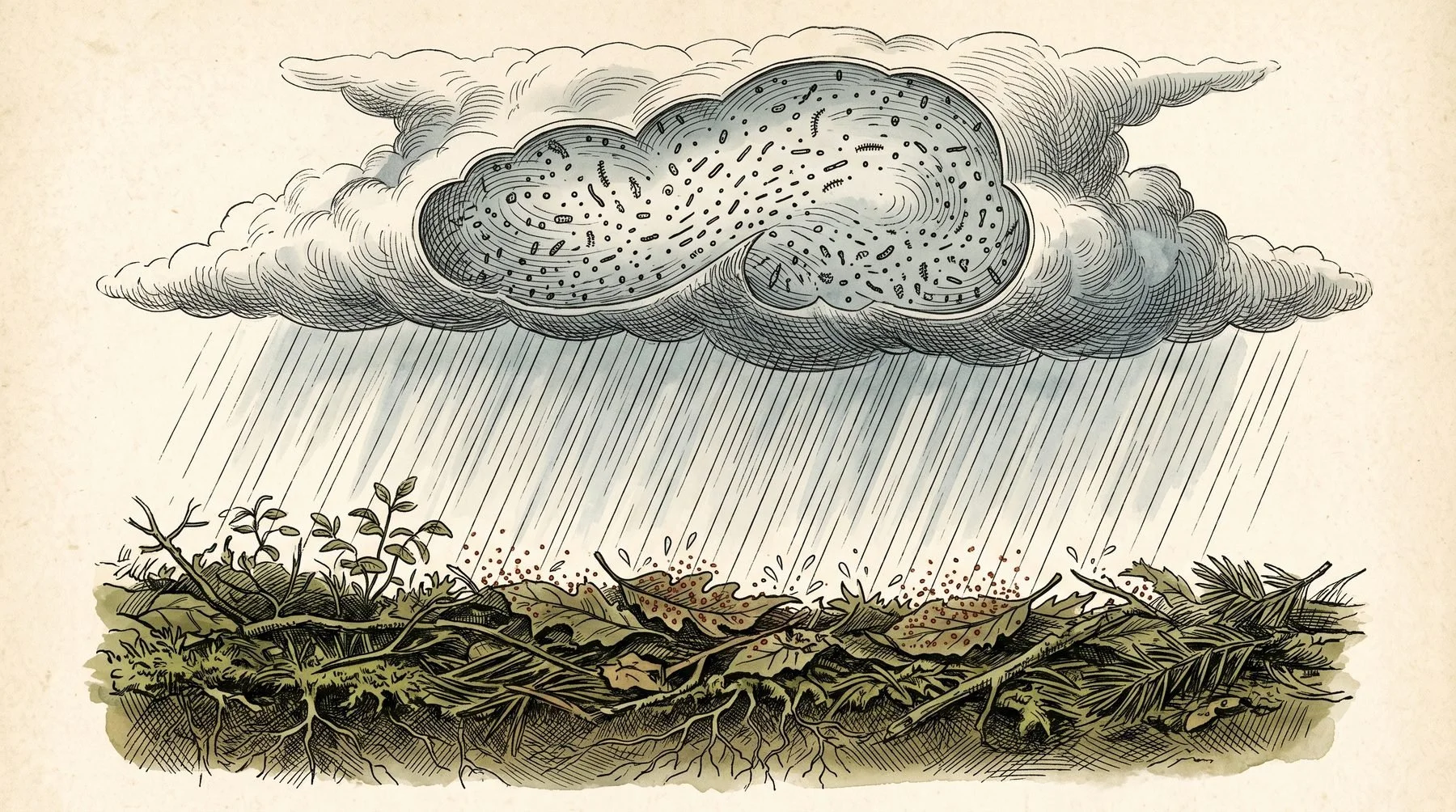
Illustration. The cloud is inhabited. Rain gives back to the soil living microbes, dust and salts.
The quantities involved are considerable. Land sends into the air each year something like thirty to fifty million tonnes of fungal spores, depending on the estimate, and a little under two million tonnes of bacteria, of the order of a million billion billion particles carrying bacteria. A bacterium stays in the air for three to seven days on average. What goes up therefore comes down within the week, often hundreds or thousands of kilometres away.
How much falls back? It has been measured in Spain, above the low clouds, at nearly three thousand metres in the Sierra Nevada. Every day, three million to more than eighty million bacteria fall on each square metre, and 260 million to more than seven billion viruses. Bacterial deposition is markedly higher during rain and during arrivals of Saharan dust. Let us compare this with what the soil already contains: a gram of good earth contains something like a billion bacteria. By my calculation, what the sky deposits on a hectare in a day is equivalent to a few tens or hundreds of grams of soil. This is not fertilisation, it is sowing: the sky does not feed the soil with microbes, it seeds it.
What takes root? On 19 February 2014, Saharan dust fell on the snow of the Dolomites. After the thaw, about a tenth of the bacteria and fungi it had brought were found in the alpine soil, all of them resistant to drying out and to ultraviolet light. The authors called them legal immigrants. Above the Iberian peninsula, aircraft found in the dusts of spring 2017 the same kind of travellers, including bacteria of the order to which rhizobia belong. We do not yet know what they do once they land. For mycorrhizal fungi, the answer is clearer, and it matters for anyone restoring a soil. The spores of the mycorrhizal fungi of crops and grasslands travel little through the air: they were found in only 83 air samples out of 622. Those of forest fungi rain down by billions of billions on each square kilometre around the trees, but their number drops very quickly with distance, and young trees planted far from a forest are less colonised and smaller. The sky sows bacteria far afield. The mycorrhizal network, for its part, stays local: you keep it, or you bring it in with litter, soil or plants; you do not wait for it from the sky.
Rain also gives back something to eat. At Montseny, near Barcelona, African dust deposits on average 5.3 grams per square metre per year. In the holm oak woodland, red rains bring 27% of the potassium, 45% of the calcium and 84% of the magnesium that the forest needs each year for its above-ground growth, on a soil poor in calcium. Two thirds of the particulate phosphorus falling on this massif comes from Africa. Added to this are the nitrogen of chapter 11 and the organic carbon dissolved in rain, which a model estimates at about 190 million tonnes a year over land. Dust from distant soils, washed down by rain, fertilises the soils here.
The loop is now complete. The soil feeds the litter; litter and leaf launch their spores, bacteria and proteins into the air. The cloud takes them in, feeds them a little, uses them to freeze its water, and sorts those that leave again: strains that freeze water are far more numerous in rain than in cloud. The rain deposits them on the leaves, where they multiply as we have seen, and on the soil, along with calcium, magnesium, phosphorus, nitrogen and carbon. Each stage has been measured. The whole loop, over a single region, never has. For microbes, the return counts mainly as seed; for minerals, it can count a great deal on poor soils, as at Montseny.
In The pacts of the soil, I told you about the strip of soil that decides everything, those few centimetres where water soaks in or runs off. It also decides what goes back up into the air. A covered, living, porous soil rich in litter receives the drop and gives back to the air its bacteria and spores. A compacted, crusted soil lets it run off. Bare sand swallows it without giving anything back. What becomes of the rain after it falls extends the pact, or breaks it.
16. The water that returns without rain
The air does not give back water only as rain. It also gives it back at night, silently, as mist and dew. The quantities are small, and for a plant in the dry season they sometimes make all the difference.
Mist first. On the Californian coast, redwoods comb the fog with their needles, and the water dripping from them makes up on average 34% of the forest's water input over the year; where the trees have been felled, it is only 17%. By combing the mist, the trees double the share of fog in their forest's water. In the Canaries, in the laurel forest of Garajonay, half of the 1,440 millimetres of water received each year on the ridges comes from mist, and under fog the transpiration of the trees drops to a thirtieth of its usual value: mist helps as much by suppressing thirst as by bringing water. In Morocco, on Boutmezguida, the nets from the beginning of this article have since been extended to nearly 1,700 square metres and supply sixteen villages, about 1,300 people. But remember the argan tree: catching mist is a talent not all plants have, and one that the argan tree, according to what has been measured, does not exercise.
Then dew. At Mirleft, on the Atlantic coast, forty metres above sea level, a team set out one square metre condensers and a small fog net for a whole year, from May 2007 to April 2008. Dew gave 18.85 millimetres over 178 nights, fog 1.41 millimetres, and rain 48.65. That year, dew was worth roughly 40% of the rain. In Ajaccio, a thirty square metre condenser collected on average 3.6 litres of dew a day, and there was dew one night in two. Physics sets a limit: never more than 0.8 millimetres a night. Let us be clear about the order of magnitude. The 18.85 millimetres of dew at Mirleft is what a Moroccan garden evaporates in two or three summer days. Dew does not replace watering and has no place in an irrigation calculation. It counts elsewhere: at dawn, at the hour when the leaf is most fragile, it wets it, cools it and suspends its thirst.
Can the leaf drink this dew? Some can. In Spain, two neighbouring Mediterranean shrubs were compared in the field: French lavender absorbs dew through its leaves, and six dew nights out of fifteen are enough to raise its water potential by half a megapascal; rosemary, next to it, absorbs nothing. Two plants from the same soil, two answers to the same night.
And when there is neither mist nor dew, the soil drinks the air directly. In arid zones, dry soil adsorbs water vapour at night without any drop forming, and this phenomenon can outweigh dew. In the dunes of Doñana, from 2021 to 2024, it dominated all year round; dew, rarer, almost disappeared in 2022, a hot, dry year, and fog was negligible.
Set these figures beside those of chapter 9: a natural marsh receives 48 millimetres of dew a year, a field 35, a town 25. Dew is made where the night air is humid and the surface cools, that is, in places that have been kept moist and covered. Every night, the air gives back a little of what it was given, provided it was given something.
17. The city and the storm
The city changes rain, and it does not need bacteria to do so. Its heat, its roughness and its fumes are enough. A review of eighty-five studies measures it: on average it rains 16% more above city centres, and 18% more twenty to fifty kilometres downwind. Summer storms like large conurbations.
Yet the city also has trees, and these trees carry a whole population. Above vegetation, the air contains two to ten times more microorganisms than neighbouring air without vegetation, and up to half the bacteria breathed in downwind of a woodland come from that woodland. In Montreal, the leaves of seven tree species were analysed along an urbanisation gradient: the first factor deciding a leaf's bacteria is the species of tree, well ahead of the neighbourhood. In Antwerp, across fifty-five plane trees, Pseudomonas, the family of our ice-forming bacteria, were more abundant in green neighbourhoods, and other bacteria took their place in the most polluted districts. Every street tree is therefore an emitter of bacteria chosen by whoever planted it.
What do these bacteria do to the storm? A Brazilian team put the question to computation. It simulated a real storm, that of 3 March 2003 over São Paulo, adding Pseudomonas syringae to the model at plausible concentrations. Result: three times more lightning, and 8% less rain. This is a single storm, a single model, never checked against observation. But it says something important: biological ice nuclei do not necessarily make it rain more, they change the way the storm builds.
It is in this context that Cindy Morris and her co-authors, among the leading specialists on the subject, wrote a sentence I find remarkable. The damage from hail and flooding over cities, they write, might perhaps be reduced by modifying the sources of biological ice nuclei, for example by planting trees that host and release enough ice-forming bacteria. This is speculation, published as such in an opinion article. But it shifts the gaze: street trees used to be chosen for their shade, their hardiness, their pollen; one day they might also be chosen for the bacteria they carry. The lever would not be the bacterium, which we do not know how to sow in the sky. It would be the species of tree.
Until that day, what vegetation does to the city is known and measured. In Marrakech, the best predictor of a neighbourhood's heat is the area of bare soil, and the Palmeraie, which has lost its layers of vegetation and now keeps only a storey of scattered palms, today leaves vast areas of bare earth in the sun. The irrigated vegetation of the centre, for its part, lowers surface temperatures by several degrees. In the oasis of Tolga, in Algeria, the palm grove stays cooler than the neighbouring desert by about two degrees at night and up to five during the day. And parks built around a wetland cool the air over their surroundings, 240 metres on average, all the better when they keep a lot of open water and few sealed surfaces around them.
One trap remains, which chapter 11 showed. In a street loaded with nitrogen oxides, a tree that emits a lot of isoprene makes ozone. The city tree is therefore not chosen only for its shade and its water, but for what it puts into the air, according to the air it will find. That is the whole point of the article "Heat in the city: the solution lies under your trees", which this chapter extends towards the sky.
18. What can honestly be said
At the beginning I promised to distinguish solid ground from ice. Here is the account, on the model of the chapter of The pacts of the soil devoted to the network that would feed the neighbours.
The following is established. The root holds water around itself through its mucilage, and redistributes it at night, to the benefit of its fungi. More than half of the water rising from the continents passes through leaves, and 40% of continental rain comes from the continents' own evaporation. Plants emit a billion tonnes of volatile compounds every year, which, once oxidised, make a large share of cloud seeds. The mycorrhiza changes the bouquet the leaf sends into the air. Litter, soil fungi, lichens and certain leaf bacteria freeze water at temperatures where no dust works. Russula and milk cap spores condense water at cloud humidity. Above the Landes and the Sologne, summer clouds are more frequent than over the neighbouring crops, and this difference disappeared where storm Klaus flattened the forest. The air carries orders: ethylene makes the pineapple flower, smoke makes seeds germinate, wounded plants alert their neighbours a few tens of centimetres away, soil bacteria make the plant grow through a gas, and ozone shortens the range of these messages. Pollen freed fertilisation from water, scents guide those who carry it, and certain pollens freeze water or serve as seeds for drops. Rivers carry the ice nuclei of the soil, and marshes give them back to the air. A wetland cools and moistens its surroundings, encourages dew, and shifts rain towards its edges instead of making it fall on itself. Nitrogen oxides divert volatiles towards ozone and destroy scents and messages on the way. The drop that strikes the soil sends its bacteria back into the air. Clouds shelter living, active microbes. Rain and dust deposit millions of bacteria per square metre every day and, on the poor soils of Catalonia, a large share of the calcium, magnesium and phosphorus the forest needs. The sea brings the salt that makes the drop, but a hundred to a thousand times fewer ice nuclei than the land. In Europe, sulphur has fallen by 70 to 90% since 1980, and the Sahara neutralises the acid in Mediterranean rain. Above 5.8 kilos of nitrogen per hectare per year, the ectomycorrhizal fungi of European forests change community. When drought closes the stomata, the air heats up more, emissions of volatiles collapse, ozone is no longer absorbed, and downwind rain falls in dry regions. Afternoon storms are born preferentially above patches of soil drier than their neighbours. On a slope, vegetation covers the shaded side more than the sunny side as long as rain is sufficient. Bare soil loses its earth ten to fifteen times faster than it makes it, roots hold it in place, and Moroccan dams lose tens of millions of cubic metres every year to silting.
The following is debated. The real share of biological ice nuclei in the world's rain, between less than one per cent and a few per cent depending on the method. The exact share of transpiration in continental evaporation. The net effect of volatiles on clouds in climate models. The step from cloud to rain above temperate forests, and the share of heat, roughness and volatiles in this phenomenon. The sign of the effect of dry soils on rain, negative at the scale of a storm, positive at the scale of a region, depending on the method chosen.
The following is hypothesis. That forests suck in humid air from the ocean, as the biotic pump would have it. That the drainage of marshes made summer storms disappear in Spain or Hungary. That planting trees carrying ice-forming bacteria changes a city's storms. That dust from Morocco's dried-up lakes carries living ice nuclei, like that of Urmia. That nitrogen, by reducing the mycorrhiza, impoverishes the leaf's message. That Morocco's winter rains, coming from the sea, owe their ice to the land. That in acid air, the ice nuclei of fungi hold up better than those of bacteria. That the fall in sulphur has reduced the haze made by oaks and poplars in Europe. That drought, by suppressing the puffs of seeds that rain launches, weakens the relay by which rain calls rain. That desertification climbs the slopes of the Atlas, taking the sunny slope before the shaded one. That mountain erosion, by reducing the soil's water reserve, brings forward the closing of the stomata each summer and deprives downwind rain of part of its vapour. That fertilisation by carriers summoned by smell, seen in a moss today, is as old as land plants. That pollen really weighs in spring rain. That the microbes sown by rain and dust play a notable role in the soils where they fall. That the hydrogen released by nodules, by feeding bacteria that lengthen roots, helps plants stay green in drought, and that the water born from burning it protects these bacteria from drying out.
And here is what must not be written, because it is false or has never been measured: that the argan tree drinks the mist; that a wetland makes it rain on itself; that reforestation will bring back winter rain in Morocco; that the alder emits isoprene; that marsh plankton regulates the climate.
There remains the whole chain, the one running from the root to the rain and from the rain back to the root. It has never been measured in one piece, and Cindy Morris says so herself: the first study linking physics, biology and the way soils are managed over the rainfall of a region is still missing. I do not claim to supply it. My profession, functional ecology, starts from an observation that is the reverse of the laboratory's. In the laboratory, you isolate a part and measure it. In the field, no part acts alone, each depends on the context, but the whole works, and it works reproducibly. Describing the whole while staying cautious about each part is the entire exercise. It is the one I have offered you here.
19. What I do with all this
This article is not a treatise. It is the map of what I look at when I am asked to design, restore or rescue a planted space, in France as in Morocco. Here is what it becomes on an assignment.
Reading the site first. Before planting or watering, I look at how a soil receives the drop, whether it holds it or lets it run off, whether it still has its fine roots, its litter and its fungi, and where the deep water lies on which the trees already there depend. This is chapter 1 applied to a plot.
Then the choice of species, taking into account what they put into the air and the air they will find. In a street loaded with nitrogen oxides, I limit the share of heavy isoprene emitters and combine them with species that emit little, without giving up the shade they provide; elsewhere, I accept them for what they bring. For towns, this translates into species grids and clauses your departments can copy.
Wetlands, with a promise that can be kept. Whether it is a village pond, a swale, a retention basin to be planted or a merja to be restored, I size it for what a wetland can do: cool its surroundings, moisten the night air, encourage dew, receive the seeds of its catchment, stop being a source of dust. I will not sell you rain.
Drought and slopes. On sloping ground, I first read the aspect and the depth of soil before choosing anything: you do not plant the sunny slope like the shaded one. I look for what keeps water deep down and what holds the earth, permanent cover, roots, small structures across the slope, and I favour species able to fetch water from far down, which keep their doors open when others close theirs. On a degraded slope, pioneer shrubs come before the tree, and fencing off before planting.
Nitrogen. I analyse irrigation water before sizing an irrigation system, and I bring into the balance the nitrogen that rain brings of its own accord, so as not to add a fertiliser nobody decided on to the one already falling from the sky.
Dew and mist in water budgets. In southern gardens, in Morocco above all, I measure what the air gives back at night, not to reduce watering, since it amounts to a few millimetres, but to know which plants benefit and where the morning coolness relieves them. A one square metre condenser is enough to measure it on site, and it is a figure missing at the edge of almost every Moroccan wetland.
Lastly, the work all this involves for a local authority or a client: drafting or reviewing technical specifications, analysing quotes, supervising works, training the staff who will maintain the site, and monitoring over several years, because nothing described in this article can be judged over a single season.
I sell neither plants, nor materials, nor equipment, and I am tied to no supplier. My only interest is that what you plant holds, and that the water you give it comes back.
Yves Nicolas, expert consultant in functional ecology, yvesnicolas.com
Short glossary
Albedo. The share of sunlight a surface sends back. A dark forest sends back little and absorbs a lot, but turns this energy into vapour as long as it transpires; bare, pale soil sends back more and yet heats the air, for lack of water to evaporate.
Biogenic volatile organic compounds. The gases plants emit, from isoprene to terpenes. They make the smell of a pine wood, and part of the cloud seeds.
Bioprecipitation. The hypothesis that leaf bacteria rise into the air, freeze clouds, come back down with the rain, and multiply thanks to it.
Cloud seed. A particle without which vapour does not condense. Also called a condensation nucleus. Sea salt, dust, soot, organic aerosol, spore.
Continental recycling. The share of rain falling on land that comes from evaporation over land itself, not from the sea. It averages 40% at global scale.
Dew. Water that the air deposits at night on surfaces cooled by radiation. Physics limits it to less than a millimetre a night.
Evapotranspiration. Everything a plant cover gives back to the air: water evaporated from the soil and from wet leaves, plus the water plants have passed through their stomata.
Forest breeze. A small air circulation made by a forest, because it heats and slows the wind differently from the neighbouring crops. It favours clouds on its downwind edge.
Hallett-Mossop. The process by which, between minus three and minus eight degrees, each graupel pellet that captures droplets throws off splinters of ice that become so many new crystals. This is the window in which biological nuclei work.
Hydroxyl radical and nitrate radical. The two great oxidants of the air, one by day, the other by night. They turn volatiles into particles, and destroy plants' messages on the way.
Ice nucleus. A particle on which cloud water freezes. Mineral dusts work only in severe cold; the proteins of litter, fungi and certain bacteria work from a few degrees below zero.
Isoprene. The volatile plants emit most. It protects the leaf from heat but, in the presence of nitrogen oxides, it makes ozone.
Karrikins. Molecules in smoke that make the seeds of many fire-adapted species germinate.
Megapascal and kilopascal. Units of pressure used here for two forces: the suction with which the soil holds its water, in megapascals, and the thirst of the air, in kilopascals.
Mycorrhiza. An association between a root and a fungus. Ectomycorrhizas sheathe the roots of forest trees; arbuscular mycorrhizas penetrate the cells of most grasses and crops.
Nitrogen oxides and ammonia. The former come from engines and boilers and divert volatiles towards ozone; the latter comes mainly from livestock farming and neutralises the acids in the air.
Occult precipitation. Water the air deposits without rain: mist intercepted by leaves, dew, rime.
Pollen. The male gamete of seed plants, packed in armour and entrusted to the wind or to insects. It is a solid particle, not a volatile: volatiles are the scents that guide its carriers.
Root mucilage. A jelly that the root tip exudes ceaselessly. It sticks soil grains together around the root and holds water in this sheath.
Sea spray. Fine droplets of seawater thrown up by waves. Once dried, they leave grains of salt, excellent seeds for drops.
Secondary organic aerosol. A particle that comes out of no chimney: it forms in flight, when plant volatiles oxidise in the air and stick to one another until they are large enough to carry a droplet.
Silting. The gradual filling of a reservoir with earth torn from its catchment. It reduces dam capacity every year.
Soil-atmosphere feedback. A loop by which the state of the soil alters the air, which in turn alters the soil. Self-sustaining drought is the clearest example.
Stoma. A pore in the leaf, bordered by two cells that open and close it. Through it vapour leaves, carbon dioxide enters, and ozone is absorbed.
Sunny slope and shaded slope (adret and ubac). The slope exposed to the sun and the slope in shade. In Mediterranean mountains, the shaded slope keeps its water and its forest, the sunny slope dries out and is stripped first.
Supercooling. The state of water that remains liquid below zero degrees. In a cloud, a pure droplet can hold out down to minus thirty-seven degrees if nothing helps it freeze.
Terpenes. A family of volatiles smelling of resin, lemon or lavender. Monoterpenes are the most abundant; sesquiterpenes, heavier, give more particles.
Tropospheric ozone. An irritant gas formed near the ground from volatiles and nitrogen oxides, under sunlight. Not to be confused with the ozone layer, which is high up.
Vapour pressure deficit. The thirst of the air, measured in kilopascals: the gap between the water the air could hold and the water it does hold. Between 2 and 4, many Mediterranean leaves already largely close their stomata.
Water erosion. Earth carried away by rainwater. This is what is commonly called the washing out of land, whereas soil scientists reserve the word leaching for the movement of clays down within the soil.
Wetland. Ground saturated with water for at least part of the year: pond, marsh, bog, reed bed, lagoon. In Morocco, a merja is a lowland wetland, often temporary.
To check for yourself
Opening and chapter 16, mist and dew. Marzol and Sánchez Megía 2008, Die Erde 139, Ifni fog. Dodson and Bargach 2015, Procedia Engineering, Boutmezguida nets. Marzol et al. 2010, FOGDEW, fog in Morocco and the Canaries. Zunzunegui et al. 2018, Tree Physiology 38: 678, deep water of the argan tree. Dawson 1998, Oecologia 117: 476, fog and redwoods. García-Santos et al. 2004, HESS 8: 1065, and Ritter et al. 2009, Tree Physiology 29: 517, Garajonay laurel forest. Lekouch et al. 2011, Energy, dew and fog at Mirleft. Muselli et al. 2002, Atmospheric Research, dew at Ajaccio. Munné-Bosch et al. 1999, New Phytologist 144: 109, lavender and dew. Agam and Berliner 2006, Journal of Arid Environments 65: 572, vapour adsorption. Kohfahl and Ruiz Bermudo 2026, Journal of Hydrology, Doñana dunes.
Chapters 1 and 2, root and transpiration. Carminati et al. 2010, Plant and Soil 332: 163, and Ahmed et al. 2014, Functional Plant Biology 41: 1129, mucilage. Caldwell, Dawson and Richards 1998, Oecologia 113: 151, hydraulic lift. Querejeta, Egerton-Warburton and Allen 2003, Oecologia 134: 55, night-time water and hyphae. Egerton-Warburton et al. 2007, Journal of Experimental Botany 58: 1473. David et al. 2007, Tree Physiology 27: 793, and David et al. 2013, Forest Ecology and Management 307: 136, montado oaks. Jasechko et al. 2013, Nature 496: 347; Coenders-Gerrits et al. 2014, Nature 506; Schlesinger and Jasechko 2014, Agricultural and Forest Meteorology 189: 115, share of transpiration. Ezzahar et al. 2009, Options Méditerranéennes A 88, Marrakech olive trees. Sancho-Knapik et al. 2022, Agricultural and Forest Meteorology 327, holm oak. Grossiord et al. 2020, New Phytologist 226: 1550, vapour pressure deficit.
Chapter 3, where rain comes from. Teuling et al. 2017, Nature Communications 8: 14065, clouds above the Landes and the Sologne and the effect of storm Klaus. van der Ent et al. 2010, Water Resources Research 46, continental recycling. Keys et al. 2012, Biogeosciences 9: 733, precipitationsheds. Spracklen, Arnold and Taylor 2012, Nature 489: 282. Batibeniz et al. 2020, Climate Dynamics 54: 4109, Mediterranean moisture sources. Hakam et al. 2025, Scientific Reports 15, Moroccan rain. Liu et al. 2022, HESS 26: 1925, Iberian summer recycling. Makarieva and Gorshkov 2007, HESS 11: 1013, and Meesters et al. 2009, HESS 13: 1299, the biotic pump and its critique.
Chapter 4, volatiles. Guenther et al. 2012, Geoscientific Model Development 5: 1471. Karl et al. 2009, Biogeosciences 6: 1059, European emission factors. Genard-Zielinski et al. 2018, Biogeosciences 15: 4711, downy oak and drought. Abanda-Nkpwatt et al. 2006, Journal of Experimental Botany 57: 4025, Methylobacterium. Crombie et al. 2018, PNAS, isoprene bacteria. Stacheter et al. 2013, ISME Journal, methanol and soil. Schausberger et al. 2012, Functional Ecology 26: 441, mycorrhiza and volatiles. Hu et al. 2025, Nature Plants, volatiles and the rhizosphere of neighbours. Ditengou et al. 2015, Nature Communications 6: 6279, deceiver and roots.
Chapter 5, orders and fertilisation. Purdue NewCROP, history of pineapple and smoke, and ISHS Acta Horticulturae 1042, floral induction of pineapple. Hartman et al. 2019, Nature Communications 10: 4020, ethylene and submergence. Flematti et al. 2004, Science 305: 977, the smoke molecule. Moreira et al. 2010, Annals of Botany 105: 627, and Crosti et al. 2006, Forest Ecology and Management, smoke and Mediterranean seeds. Journal of Experimental Botany 2024, 75: 1174, KAI2 receptor. Farmer and Ryan 1990, PNAS 87: 7713. Karban et al. 2000, Oecologia, sagebrush and tobacco; Karban et al. 2013, Proceedings of the Royal Society B, kinship. Engelberth et al. 2004, PNAS 101: 1781. Heil and Silva Bueno 2007, PNAS 104: 5467, signalling within a single plant. Sugimoto et al. 2014, PNAS 111: 7144, neighbouring tomatoes. Muller, Muller and Haines 1964, Science 143: 471, aromatic shrubs. Ehlers and Thompson 2004, Oecologia, thyme and neighbouring plants. Turlings, Tumlinson and Lewis 1990, Science 250: 1251, wasps called by the plant. Blande, Holopainen and Li 2010, Ecology Letters 13: 1172, ozone and message range. Ryu et al. 2003, PNAS 100: 4927, and Ryu et al. 2004, Plant Physiology 134: 1017, Bacillus gases. Runyon, Mescher and De Moraes 2006, Science 313: 1964, dodder. Woodward 1987, Nature 327: 617, stomata and carbon dioxide. Vacchiano et al. 2017, New Phytologist, and Bogdziewicz et al. 2020, Nature Plants, beeches. Espelta et al. 2008, Ecology 89, Mediterranean oaks. Janzen 1976, Annual Review of Ecology and Systematics 7: 347, and Yamada et al. 2023, PLOS One, bamboos. Rosenstiel et al. 2012, Nature 489: 431, moss and microarthropods. Rubinstein et al. 2010, New Phytologist, the first land plants. Rothwell, Scheckler and Gillespie 1989, Botanical Gazette 150, Elkinsia. Hirase 1896 and Ikeno 1896, Botanical Magazine Tokyo. Ren et al. 2009, Science 326: 840, pollination drop insects. Terry et al. 2007, Science 318: 70, cycad and thrips. Friedman and Barrett 2008, International Journal of Plant Sciences, origins of wind pollination. Varis et al. 2009, Silva Fennica, pine pollen. Fuentes et al. 2016, Atmospheric Environment 141: 361, and Ryalls et al. 2022, Environmental Pollution, pollution and pollination. Pummer et al. 2012, ACP 12: 2541, and Augustin et al. 2013, ACP 13: 10989, ice-forming pollen. Steiner et al. 2015, Geophysical Research Letters 42: 3596, and Matthews et al. 2023, ACS Earth and Space Chemistry, pollen fragments.
Chapter 6, drops. Ehn et al. 2014, Nature 506: 476. Kirkby et al. 2016, Nature 533: 521. Paasonen et al. 2013, Nature Geoscience 6: 438. Pöschl et al. 2010, Science 329: 1513. Pöhlker et al. 2012, Science 337: 1075. Kiendler-Scharr et al. 2009, Nature 461: 381. Hassett, Fischer and Money 2015, PLoS ONE 10: e0140407, spores and drops. Elbert et al. 2007, Atmospheric Chemistry and Physics 7: 4569, spores.
Chapter 7, ice. Schnell and Vali 1972, Nature 236: 163, litter. Vasebi et al. 2019, Biogeosciences 16: 1675. Conen et al. 2011, ACP 11: 9643; O'Sullivan et al. 2014, ACP 14: 1853; Hill et al. 2016, ACP 16: 7195, soil dusts. Fröhlich-Nowoisky et al. 2015, Biogeosciences 12: 1057, Mortierella. Kunert et al. 2019, Biogeosciences 16: 4647, Fusarium. Kieft 1988, Applied and Environmental Microbiology 54: 1678, lichens. Suski et al. 2018, ACP 18: 13755, harvests. Morris, Conen, Huffman, Phillips, Pöschl and Sands 2014, Global Change Biology 20: 341, bioprecipitation. Monteil, Bardin and Morris 2014, ISME Journal 8: 2290, rain in the south of France. Boose et al. 2016, ACP 16: 9067; Gong et al. 2019, ACP 19: 10883; Tang et al. 2022, Biogeosciences 19: 71; Gao et al. 2024, ACP 24: 9939, Mediterranean.
Chapter 8, sea and land. O'Dowd et al. 2004, Nature 431: 676, marine organic matter. Wilson et al. 2015, Nature 525: 234, marine ice nuclei. DeMott et al. 2016, PNAS 113: 5797, and McCluskey et al. 2018, Journal of Geophysical Research, sea spray and ice. Arnold et al. 2009, ACP 9: 1253, oceanic isoprene. Rosenfeld et al. 2002, Science 297: 1667, and Rosenfeld et al. 2008, Science 321: 1309, sea salt and rain. Solomos et al. 2011, ACP 11: 873, dust and salt in the Mediterranean. Jickells et al. 2005, Science 308: 67, desert iron and the ocean. Mayol et al. 2017, Nature Communications 8: 201, microbes in ocean air. Aït Brahim et al. 2016, Journal of Hydrology 543: 305, isotopes of rain in Morocco.
Chapter 9, wetlands. Chen et al. 2024, Atmosphere 15: 651, common reed. Crombie et al. 2025, Environmental Microbiology 27, sphagnum. Vettikkat et al. 2023, ACP 23: 2683, and Wang et al. 2024, Nature Communications 15: 6144, peatlands. May et al. 2018, Environmental Science and Technology 52: 397, lake spray. O'Dowd et al. 2002, Nature 417, seaweed and iodine. Rhew, Miller and Weiss 2000, Nature 403, salt marshes. Quinn and Bates 2011, Nature 480: 51. Moffett, Hill and DeMott 2018, Atmosphere 9: 307; Knackstedt et al. 2018, Environmental Science and Technology; Larsen, Conen and Alewell 2017, Royal Society Open Science, rivers. Price 1994, Aquatic Botany 48: 261; Acreman et al. 2003, HESS 7: 11, marsh evaporation. Heurteaux 1994, Annales de Limnologie 30: 131, Camargue. Taylor et al. 2018, Quarterly Journal of the Royal Meteorological Society 144: 2118; Contoux et al. 2013, Climate of the Past 9: 1417; Zhao, Cook and Vizy 2023, Climate Dynamics 61: 595; Mohamed et al. 2005, Water Resources Research 41, rain around wetlands. Pérez González and Sanz Donaire 1998, Anales de Geografía 18: 239, Mancha Húmeda. Xu et al. 2024, Water 16: 178, marsh dew. Deng, Yao and Zhang 2023, Ecological Indicators 156, wetland parks.
Chapter 10, losses. Bernard report 1994 and SDES 2023, emblematic wetland sites. Casado and Montes 1995, wetlands of Spain. Morocco's National Wetlands Strategy 2015-2024. Guelmami et al. 2023, Euro-Mediterranean Journal for Environmental Integration, Sebou basin. Aït Youssef et al. 2025, Land 14: 104, Lake Iriki. Geijzendorffer et al. 2019, Frontiers in Ecology and Evolution 7: 21, Mediterranean wetlands. Huang et al. 2020, Nature Communications 11, vegetation cover and temperature in Europe. Baidya Roy et al. 2014, Journal of Arid Environments 110: 79, Aral. Fathalli, Castel and Pohl 2020, Theoretical and Applied Climatology, Chott el-Djerid. Hamzehpour et al. 2022, ACP 22: 14905 and 14931, Urmia.
Chapter 11, nitrogen. Curci et al. 2009, Atmospheric Environment 43: 1444. Ng et al. 2017, ACP 17: 2103. Wildt et al. 2014, ACP 14: 2789; Lehtipalo et al. 2018 and Yan et al. 2020, Science Advances. Kirkby et al. 2011, Nature 476: 429. Backes et al. 2016, Atmospheric Environment 126: 153. Attard et al. 2012, ACP 12: 10667. Blande, Holopainen and Li 2010, Ecology Letters 13: 1172. McFrederick, Kathilankal and Fuentes 2008, Atmospheric Environment 42: 2336. Ryalls et al. 2022, Environmental Pollution 297. Chan et al. 2024, Science 383: 607. Boutin et al. 2015, Scientific Reports 5: 12942, and Pascaud et al. 2016, Atmospheric Environment 146: 28, nitrogen in rain. Litvak et al. 1996, Plant, Cell and Environment, and Fernández-Martínez et al. 2018, New Phytologist, nitrogen and isoprene. Lou and Baldwin 2004, Plant Physiology 135: 496. Schjoerring and Mattsson 2001, Plant and Soil, ammonia from crops. van der Linde et al. 2018, Nature 558: 243, nitrogen thresholds for ectomycorrhizas.
Chapter 12, acidity. Tørseth et al. 2012, ACP 12: 5447, thirty years of the EMEP network. Pascaud et al. 2016, Atmospheric Environment 146: 28. Loye-Pilot, Martin and Morelli 1986, Nature 321: 427, Saharan dust and rain in Corsica. Avila and Rodà 2002, Atmospheric Environment, Montseny. Stavrakou et al. 2012, Nature Geoscience 5: 26, formic acid from forests. Nenes et al. 2011, ACP 11: 6265, soluble phosphorus. Sullivan et al. 2010, ACP 10: 11471, acid and ice-forming dusts. Pouleur et al. 1992, Applied and Environmental Microbiology 58: 2960, Fusarium and pH. Surratt et al. 2010, PNAS 107: 6640, and Marais et al. 2016, ACP 16: 1603, sulphate and isoprene aerosol. Gauci et al. 2004, PNAS 101: 12583, sulphate and wetland methane.
Chapter 13, drought. Miralles et al. 2019, Annals of the New York Academy of Sciences 1436: 19, review of soil-atmosphere feedbacks. Fischer et al. 2007, Journal of Climate 20: 5081, the 2003 heatwave. Schumacher et al. 2022, Nature Geoscience 15: 262, self-propagation of droughts. Koppa et al. 2024, Science 385: 967, self-expansion of drylands. Zampieri et al. 2009, Journal of Climate 22: 4747, drought moving up from the Mediterranean. Taylor et al. 2012, Nature 489: 423, storms above dry soils. Guillod et al. 2015, Nature Communications 6: 6443. Salamalikis et al. 2016, Science of the Total Environment, evaporation of drops below the cloud. Lavoir et al. 2009, Biogeosciences 6: 1167, Puéchabon holm oak. Saunier et al. 2017, Frontiers in Plant Science, and Genard-Zielinski et al. 2017, ACP 17: 7555, Haute-Provence downy oak. Wu et al. 2015, Biogeosciences 12: 177. Mentel et al. 2013, ACP 13: 8755, stress volatiles and particles. Lin et al. 2020, Nature Climate Change 10: 444, ozone and drought. Huffman et al. 2013, ACP 13: 6151, biological bursts during rain. Bigg, Soubeyrand and Morris 2015, ACP 15: 2313, rain that calls rain. O'Sullivan et al. 2014, ACP 14: 1853, fertile soil dust. Tomaszkiewicz et al. 2016, Science of the Total Environment, Mediterranean dew atlas. Kurz-Besson et al. 2006, Plant and Soil, cork oak and hydraulic lift. Stojanovic et al. 2026, Journal of Hydrology: Regional Studies 67: 103785, droughts in the Maghreb. Hydrogen box: global hydrogen budget, Nature 2025; Reji et al. 2025, Nature Communications, moisture threshold of hydrogen bacteria; Jordaan et al. 2020, mSystems, desert soils; Greening et al. 2015, Applied and Environmental Microbiology, uptake of atmospheric hydrogen; Dong et al. 2003, Plant, Cell and Environment 26: 1875, soil fertilisation by hydrogen; Golding and Dong 2010, Environmental Chemistry Letters, hydrogen bacteria and ethylene.
Chapter 14, mountains. Viviroli and Weingartner 2004, HESS 8: 1017, and Viviroli et al. 2007, Water Resources Research 43, mountains as water towers. García-Santos et al. 2004, HESS 8: 1065, Garajonay. Kutiel, Lavee and Ackermann 1998, Geomorphology, north and south slopes. García-Gamero et al. 2021, Journal of Hydrology 598, Sierra Morena. Linares et al. 2011, Forests 2: 777, and Camarero et al. 2021, Science of the Total Environment 765: 142752, Atlas cedar. Cerdan et al. 2010, Geomorphology 122: 167, erosion in Europe. Verheijen et al. 2009, Earth-Science Reviews 94: 23, rate of soil formation. Gyssels et al. 2005, Progress in Physical Geography 29: 189, roots and erosion. Panagos et al. 2015, Environmental Science and Policy 54: 438. El Boukhari et al. 2019, silting of fifteen dams in northern Morocco. Médias24, 27 July 2026, based on ANEF figures, dam silting. Charney, Stone and Quirk 1975, Science 187: 434. Vadell, de-Miguel and Pemán 2016, Land Use Policy 55, reforestation in Spain. García-Ruiz et al. 1995, Aísa plots. Mongil-Manso et al. 2016, Ecological Engineering, gullies of central Spain.
Chapters 15 and 17, the drop and the city. Joung and Buie 2015, Nature Communications 6: 6083; Joung, Ge and Buie 2017, Nature Communications 8: 14668. Becher et al. 2020, Nature Microbiology 5, geosmin. Huffman et al. 2013, ACP 13: 6151. Hirano and Upper 2000, Microbiology and Molecular Biology Reviews 64: 624. Liu and Niyogi 2019, Scientific Reports 9: 7301, urban rain. Lymperopoulou et al. 2016, Applied and Environmental Microbiology 82. Laforest-Lapointe, Messier and Kembel 2017, mSystems 2. Gonçalves et al. 2012, ACP 12: 5677, São Paulo. Gourfi et al. 2022, Remote Sensing 14: 3935, Marrakech.
Chapter 15 continued, what rain gives back to the soil. Amato et al. 2007, FEMS Microbiology Ecology 59: 242, Amato et al. 2017, PLOS One, and Amato et al. 2019, Scientific Reports, cloud microbes at the Puy de Dôme. Vaïtilingom et al. 2013, PNAS, microbes and cloud chemistry. Elbert et al. 2007, ACP 7: 4569, and Heald and Spracklen 2009, Geophysical Research Letters, fungal spores. Burrows et al. 2009, ACP 9: 9281, emissions and residence time of bacteria. Reche et al. 2018, ISME Journal, deposition of viruses and bacteria in the Sierra Nevada. Weil et al. 2017, Microbiome, Saharan dust in the Dolomites. Scientific Reports 2020, dust above the Iberian peninsula. Egan et al. 2014, Fungal Ecology, and Chaudhary et al. 2020, New Phytologist, mycorrhizal fungi in the air. Peay et al. 2012, Molecular Ecology, spore rain of forest fungi. Avila et al. 1997, Journal of Geophysical Research, and Avila, Alarcón and Queralt 1998, Atmospheric Environment, African dust at Montseny. Atmospheric Environment 2012, phosphorus at Montseny. Safieddine and Heald 2017, Geophysical Research Letters, organic carbon in rain.