Jean-Marc Jancovici says we must adapt. He is right. But adapting does not mean inventing new solutions. Sometimes it means rediscovering very old ones. And sometimes it simply means observing what nature has already done.
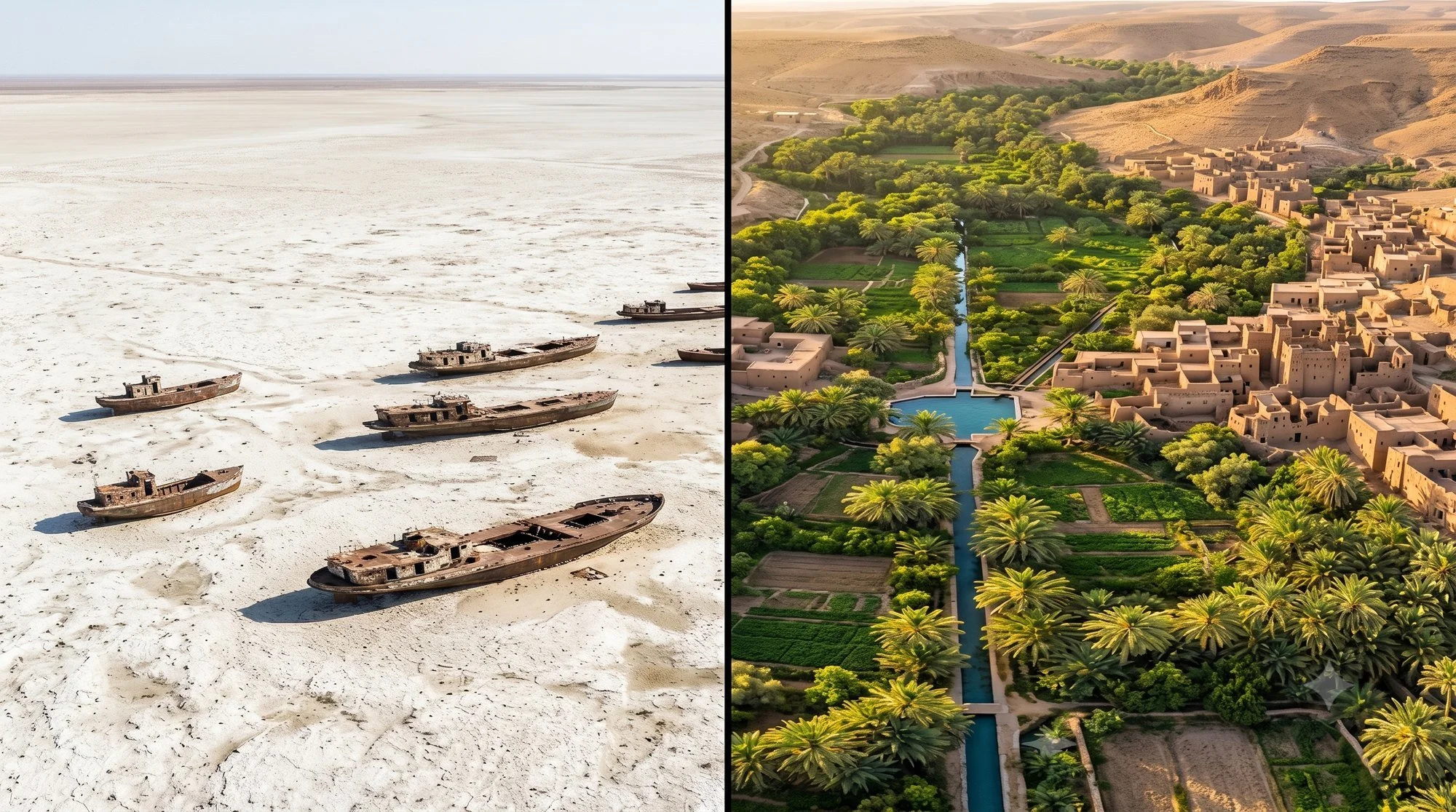
Six thousand years ago, the Sahara was not the Sahara. It was a green savannah, crossed by permanent rivers, home to a people who read the land better than any modern agronomist. Then the Earth’s axis shifted. Slowly. Imperceptibly. The African monsoon moved south. The lakes fell. The savannahs retreated inch by inch over four thousand years.
But the climate history of our planet is not only one of slowness. It also knows tipping points of a brutality that defies the imagination.
Sixty-six million years ago, an asteroid ten kilometres across struck the Earth at Chicxulub, in what is now Mexico. The impact threw billions of tonnes of dust and soot into the atmosphere, darkening the sun for months, perhaps years. Temperatures fell by ten to fifteen degrees within a few weeks. Seventy-five per cent of species disappeared. To this day, in geological layers all over the world, we find a thin line of iridium, the rare element characteristic of meteorites, marking that precise moment like a scar in the Earth’s memory.
And yet. Life survived. Ferns were the first to recolonise the devastated areas, within just a few years. Their spores, almost indestructible, had been waiting in the soil. Flowering plants rediversified the ecosystem. Mammals exploded in diversity to occupy every niche left vacant. It was not a miracle. It was resilience written into the genes by billions of years of evolution.
Nature has a memory we do not have. It has come through five mass extinctions. It carries in every living cell the trace of those catastrophes and of the responses it found to them. The mycorrhizal system that lines the top centimetre of our soils appeared four hundred million years ago. It has survived every extinction. It knows something we still do not.
Human civilisations have their lessons too.
Faced with the great drought of around 2200 BC, a sudden arid episode that lasted one to two centuries, the Akkadian Empire collapsed in Mesopotamia. It depended on a centralised granary and a single river. When the rain stopped, everything collapsed at once. In Peru, the Andean civilisations developed waru-waru, raised fields surrounded by canals that regulate moisture, night-time temperature and soil fertility all at once. They worked for millennia. Today they are being reintroduced in the Bolivian Andes with spectacular results. At Angkor, the Khmer civilisation built the largest pre-industrial hydraulic system in the world. Researchers at the University of Sydney showed in 2010 that its collapse in the fifteenth century was directly linked to the failure of this centralised system in the face of prolonged droughts. A single infrastructure. A single point of failure.
The Amazigh people did the opposite of all those who failed. Faced with the gradual drying of the Sahara, they multiplied local responses. Not one great dam. Thousands of small seguias. Not one central reservoir. Jessours scattered across every slope. Not one single oasis. A network of connected oases that allowed water to be redistributed when one point ran short.
This is what ecologists call resilience through redundancy. An ecosystem that has several ways of performing the same function survives when one of them disappears. An ecosystem that has only one collapses.
Some will object that these systems fed sparse populations, and that only industrial agriculture can feed eight billion people. This is the great argument of demographic blackmail. Let us look at the facts. Industrial agriculture today produces enough to feed twelve billion people. It throws away a third of it. At the same time it destroys the soils that will have to feed the generations to come. Meanwhile India feeds the largest population in the world with a network of hundreds of millions of small local farmers, decentralised, practising polycultures that enrich the soil rather than exhaust it. Decentralisation on a large scale does not feed fewer people. It feeds them better and for longer.
Some will also object that seguias and qanats were built at the cost of crushing human labour. That is true. But the conceptual intelligence of these systems, using gravity, filtering naturally, sharing collectively, remains timeless. The execution, however, is a different matter entirely. Solar pumps, low-power sensors and modern materials now make it possible to build these works without the human exhaustion of the past. It is not a step backwards. It is an update.
Let us now weigh the real ecological cost of each technological innovation before celebrating it. Desalination plants are presented as the miracle solution to water scarcity. Nobody talks about their discharges of concentrated brine that build up on the seabed, gradually destroying the most fragile marine habitats. Nobody asks how these discharges will be stored in the long term. And when that question is asked, the answer will be industrial, and therefore paid for, and therefore profitable to a few, and therefore imposed on all.
This is the mechanism the industrial system has perfected over two centuries. Create a problem. Offer a technical solution. Patent the solution. Centralise production. Extract the margin. At each step, everyone’s participation is reduced. At each step, dependence grows. At each step, wealth becomes more concentrated.
The Aral Sea, once the fourth largest lake in the world, was dried up in forty years by centralised Soviet industrial irrigation. Forty years to destroy what nature had built over millions of years. Agricultural waste carried by the Mississippi has created a dead zone of twenty-two thousand square kilometres in the Gulf of Mexico. Brine discharges from desalination plants in the Persian Gulf have reduced local marine biodiversity in a way that is documented and irreversible on a human timescale.
The Iranian qanats of Gonabad, built two thousand seven hundred years ago, still supply forty thousand people with drinking and irrigation water today. Two thousand seven hundred years of continuous operation, with no fossil energy and no imported spare parts. The oldest hydraulic infrastructure still in service on Earth. No industrial treatment plant built today will still be working in two thousand seven hundred years.
The subaks of Bali, collective irrigation systems run by temple councils since the ninth century, sustained intensive rice growing for more than a thousand years without depleting the soil. When the World Bank persuaded the Indonesian government in the 1970s to abandon the subak in favour of industrial agriculture, yields first rose and then collapsed within ten years. The government restored the subak. UNESCO added it to the World Heritage List in 2012.
The solution I advocate works the other way round from the industrial system. A seguia built by a village belongs to the village. A phytoremediation basin installed by a landowner produces water that belongs to him. A jessour built on a slope holds back water that feeds the family who dug it. Every local actor, anywhere in the world, at their own scale, with their own hands and resources, can take part in their own resilience without asking a multinational’s permission, without depending on central infrastructure, without paying a bill to a listed company.
This is not a pretty philosophy. It is the best vehicle for general prosperity there is. Not the enrichment of a few at the expense of all. The enrichment of each through control of their own resource.
Ibn al-Awwam did not sell his seeds. Fabre did not patent his observations. The Amazigh oasis engineers did not charge for khettara water by the cubic metre. They built systems that allowed everyone to produce, store and distribute locally. And their systems still work.
Nature has understood this for four hundred million years. It does not centralise photosynthesis in a single factory. It distributes it in every leaf of every plant in every ecosystem on the planet. Each leaf produces for itself and for the whole. That is the very definition of resilience.
Centralisation is fragile. Redundancy is resilient. That is the lesson of every extinction and of every civilisation that has survived its own predicted disappearance.
The qanats of Gonabad, the subaks of Bali and the oasis seguias still flow today. No centralised infrastructure has yet given the same proof of longevity.
Yves Nicolas, Expert Consultant in Functional Ecology, yvesnicolas.com