This morning, the French Office for Biodiversity published its monthly map of river flows. As of 1 August 2026, 1,373 small watercourses are affected by flow interruptions or have run dry. 554 more than in July. It is the most critical situation ever recorded since the ONDE network was created in 2012. Worse than 2022. More than twice as degraded as at the same point last year.
What this map does not say, but what hydrologists know: both sources of drinking water supply are directly connected to these small watercourses that are drying up. The 35% abstracted from surface water, rivers, lakes, dams, springs, depends directly on river flow. When the flow drops, the intake dries up. The 65% pumped from underground is no safer: a large share of this pumping takes place in alluvial aquifers fed directly by the river above them. Classified administratively as groundwater, they are depleted at the same time as the watercourse that recharges them. For hundreds of small French municipalities, it is not only ecosystems that are dying on this map. It is their water intakes.
There are moments when a civilisation must name what it still refuses to see. We are there.
The reinsurer Munich Re has published its figures for the first half of the year: 44 billion dollars of insured losses from natural disasters, with a protection gap reaching 60%. Actuaries underestimated the violence of climate disruption by a factor of two. In France and Germany, health authorities counted some 5,000 heat-related deaths.
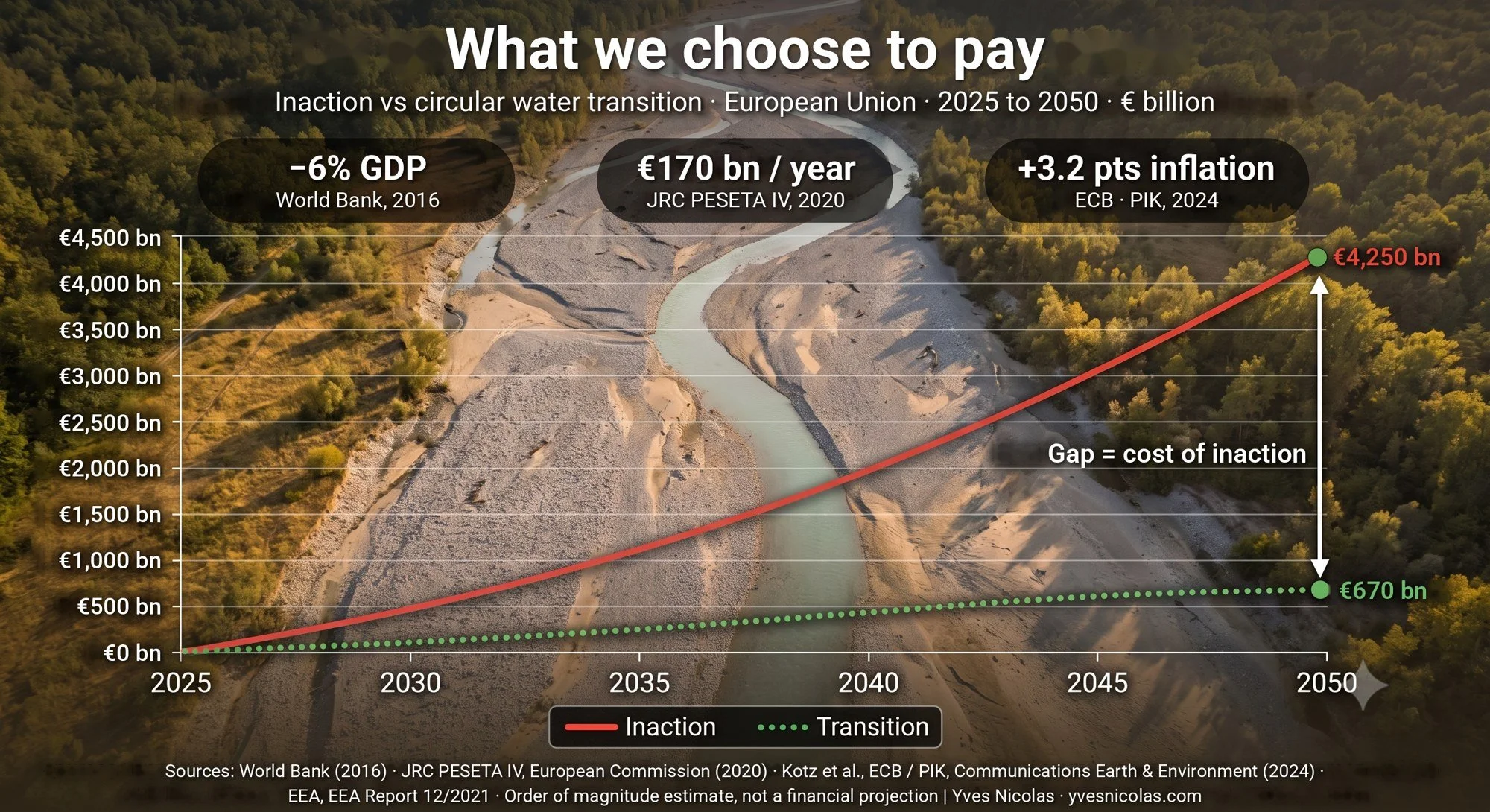
The European Commission's Joint Research Centre (PESETA IV, 2020) estimates climate losses at 170 billion euros a year without adaptation. The Potsdam Institute and the ECB (Kotz et al., 2024) put the additional food inflation at between 0.92 and 3.23 points a year by 2035.
The water crisis is not a future crisis. It is already printed in our prices, our yields, our bank balance sheets. And in the dry water intakes of our rural municipalities.
The broken metabolism of our cities
Every day, France abstracts around 15.6 million m3 to supply the public network. 20% disappears through leaks before reaching a tap. At the end of the chain, our cities discharge 11.5 million m3 of wastewater daily.
11.5 million m3. Every day.
That volume exceeds the entire water requirement of our agriculture. We are sitting on a resource of prodigious richness, and we call it "waste". We discharge it into rivers after partial treatment that does not remove emerging micropollutants, pharmaceutical residues or endocrine disruptors.
This is not water management. It is organised dissipation.
The World Bank puts the potential loss of GDP for the Mediterranean rim at 6% by 2050. The joint IGAS/IGEDD/CGAAER inspection report of May 2026, commissioned by four ministries, confirms: 4 billion euros of investment shortfall a year, plus 750 million for removing pesticides and PFAS. This 131-page report documents the impasse. It proposes no decentralised, nature-based solution. That is precisely where the thinking must open up.
Changing the paradigm: from dissipation to cycle
For twenty years, decision makers ran up against a false lock: separating blackwater from greywater costs too much. The systematic conclusion: decentralised biological treatment is impossible. Give up.
That conclusion was wrong. Separation is not the precondition we thought it was.
The solution does not lie in building a second network parallel to the existing one, a classic mistake that doubles costs and discourages decision makers before the first spade goes in. It lies in a logical inversion that the territory makes obvious once we agree to look at it squarely.
The new circuit goes deep. A deep underground network collects all wastewater, blackwater included, without prior separation, and carries it to decentralised mycorrhizal treatment units. A single civil engineering investment, a single route, a single political decision.
The old network returns to its natural vocation. The surface pipes, freed of their sanitary load, become exclusively stormwater pipes. For the first time in the history of our cities, the separation of flows is actually achieved, not by building a parallel network nobody can fund, but by reassigning the existing infrastructure to what it was best placed to do: receive the rain, slow it down, spread it out.
As for the leaks in the old network, long regarded as a costly defect to be fixed: they become an asset. Rainwater that seeps into the soil through a failed joint is no longer a loss, it is aquifer recharge. What the network operator used to correct at great expense becomes a diffuse, silent and free ecological function.
What the mountain does with snow, the urban territory could do with rain. Winter rainfall, abundant and today largely lost as rapid runoff, can be captured and stored in underground reserves or buffer wetlands, then released gradually in summer, precisely when low flows cut river levels and put rural water intakes under strain. This is no longer event-driven water management. It is the creation of a permanent territorial reserve that fills when it rains and empties when it is dry.
The transition happens without interruption of service. The deep network is built while the old one keeps working. Buildings switch over gradually, district by district. No city is placed in sanitary suspension.
A single project solves four problems at once: treating wastewater without prior separation, managing urban flooding, recharging aquifers by slow infiltration, and building seasonal reserves against summer low flows. This is not optimism. It is systems logic.
Living things as treatment and rehydration infrastructure
The key is not in the plant. Nor is it in the mycorrhiza alone, nor in the bacterium alone, nor in the soil alone. It lies in the close organisation between them. That is nature's fundamental lesson: none of these actors works without the others. The mycorrhiza without the plant dies out. The plant without the mycorrhiza weakens. Soil bacteria without this symbiotic network lose their enzymatic efficiency. And soil without the life that structures it is nothing but an inert substrate.
It is this inseparable organisation, mycorrhiza, bacteria, living soil, plant, that forms the real pre-treatment. A correctly sized mycorrhizal stage upstream of the filter bed does not work as an isolated filter. It activates a biological continuum in which each actor strengthens the capacities of the others. Blackwater pathogens, heavy organic loads, recalcitrant molecules: all of this becomes accessible to decentralised treatment as soon as this symbiosis is present, active and properly fed as a whole.
What we thought impossible at urban scale no longer is.
This organisation is of a complexity no industry will ever be able to reproduce at this cost, at this scale, with this resilience. Engineers took decades to design multi-layer treatment plants. Nature took four hundred and fifty million years to perfect what we are only beginning to understand. It has traced the path for us. All we need is the humility to follow it.
Let us return to the OFB map. These 1,373 watercourses with interrupted flow are not just ecological indicators. They are direct signals of the state of the shallow aquifers on which the water intakes of our rural municipalities depend. A decentralised network of mycorrhizal phyto-purification that returns treated water to the environment by slow infiltration does more than treat waste. It recharges shallow aquifers. It maintains a minimum flow in the watercourses that feed the intakes. It breaks the vicious circle: less water in the rivers, less possible abstraction, more pressure on deep aquifers, more dry riverbeds.
It actively rehydrates the territory.
The network of existing urban parks represents thousands of hectares in every large French city, already public, already planted. Integrating mycorrhizal filter beds into these spaces changes neither their appearance nor their use. It changes their biological function and their role in the water cycle at regional scale.
The design includes buffer zones, biological redundancy and an industrial UV stage at the outlet. Living things treat in depth, UV secures the outlet. The mycorrhizal recharge produces an exceptional organic soil improver, a living fertiliser, which local farming sectors can use directly.
What research on sequential biological systems is beginning to demonstrate, and what water engineers still struggle to take on board, is that a correctly sized fungal and plant ecosystem can reach, on certain parameters, levels that conventional surface water treatment does not systematically achieve. Treating raw wastewater with living things and obtaining at the outlet water whose quality exceeds that of some distributed fresh water: that is the stated aim of these systems, and the first pilot results show that it is achievable.
These results exist. What is missing is not proof of concept, it is funding for trials at scale. The IGAS report documents 6 to 11 billion euros a year for industrial solutions, some of which cost 25,000 € a year for a municipality of 230 inhabitants, without destroying the pollutants they capture. Europe funds reverse osmosis plants at a billion euros. It does not yet have a budget line for decentralised living systems. This is an anomaly of priorities that a few clear-sighted decision makers could correct quickly.
PFAS still resist every biological approach. The IGAS report acknowledges that the only known solution remains incineration at over 1,400°C, at 1,600 € a tonne. Neither living systems nor conventional chemistry offers a satisfactory solution. On this point, honesty is required.
On everything else, natural wetlands replenished by this system do exactly the opposite of drought: they rebuild carbon stocks, restore oxygen production and create cool islands. A natural wetland stores between 500 and 1,500 tonnes of carbon per hectare in its peaty soils and organic sediments, five to ten times more than a temperate forest. When it dries out, it does not stop storing. It emits.
What history has already taught us
This project belongs to no political camp. In the 1850s, faced with cholera, Paris responded in a technical, massive and cross-party way: 2,500 km of sewers in less than twenty years, funded by a conservative imperial power, built by republican engineers, saving lives in the working-class districts first.
A century later, rural drinking water supply was carried by mayors of every persuasion, from the communists of the Limousin to the Christian democrats of Alsace. What united them was not a programme. It was the obvious public health need.
The circular water transition threatens no political value. It serves them all. An elected official who opposed it would have nothing but inertia on their side.
What Europe has already voted
The Paris Agreement, signed by 196 nations in 2015 as the foundation of all global climate policy, does not mention water once. This is no trivial omission: it is the sign of a systemic blind spot. Douville et al., co-authors of the sixth IPCC report, denounced it publicly in PLOS Water in 2022: no COP document has ever mentioned water. All the mitigation strategies compatible with this agreement, reforestation, bioenergy, carbon storage, depend massively on water resources that nobody has yet counted in the feasibility equations. Water is not a by-product of the climate transition. It is its precondition.
The Water Framework Directive required good ecological status for water bodies by 2015. That deadline has been behind us for a decade. Regulation 2020/741 on water reuse has been binding since June 2023. France does not yet have the infrastructure to apply it at the scale where it would make a difference.
Europe is not an obstacle. It is the legal framework already voted, the funding through the cohesion funds, and the market that will absorb the pioneer's know-how. The question is whether France will let the Netherlands, Spain or Israel embody this ambition in its place.
Europe is watching. It is waiting for an example. It is ready to fund it.
A political decision, not a debate
The next great project is here. It is technical, living and green. It calls for civil engineers and functional ecologists, mycologists and nursery growers, hydrologists and climatologists. Above all it calls for a political decision that Munich Re's actuaries, the World Bank's economists, the IGAS inspectors, the OFB staff counting dry watercourses and the doctors counting heatwave deaths are all calling for, each in the vocabulary of their own profession.
Europe has written the score. History has shown that France knows how to build what nobody else dares to imagine. What remains is to find the orchestra that plays first.
If you have read this far, you know that this debate must go beyond expert circles. Every engineer, elected official, investor or local authority manager you know should have these figures on their desk. Share this article. Not for the algorithm, but so that someone's next budget meeting goes differently.
A call to scientists and investors
The pilot results exist. The biological model is documented. What is missing is the connection between those who have the questions and those who have begun to answer them in the field.
If you are a researcher in hydrology, applied mycology, wetland ecology or water engineering, and these leads interest you for scientific validation or publication: contact me.
If you are an investor, impact fund, family office or institutional funding manager, and you are looking for projects at the intersection of territorial resilience, water sovereignty and carbon sequestration: contact me.
If you are an elected official, local authority director, head of an inter-municipal body or water agency, and you are facing the investment wall documented by the IGAS report without a viable decentralised solution: contact me.
Yves Nicolas, Expert Consultant in Functional Ecology, yvesnicolas.com · France · Morocco
Sources: OFB / ONDE network, August 2026 · Munich Re, H1 2026 · JRC PESETA IV, 2020 · Kotz et al., ECB/PIK, Communications Earth & Environment, 2024 · EEA, EEA Report 12/2021 · World Bank, High and Dry, 2016 · IGAS/IGEDD/CGAAER report No. 016440-01, May 2026 · Douville et al., PLOS Water, 2022 · IPCC AR6, Chapter 8 Water Cycle Changes, 2021 · EU Regulation 2020/741 · Directive 2000/60/EC · Eaufrance / Water Information System (SIE), drinking water abstraction in metropolitan France · CIEAU, Water Information Centre