There are places we pass through without seeing them. We go round them, we drain them, we fill them in. We give them names that sound like nuisances: marsh, swamp, flood zone. And yet, in these spaces we have so methodically erased, some of the most powerful mechanisms the biosphere has ever produced are at work.
We must start by naming things correctly.
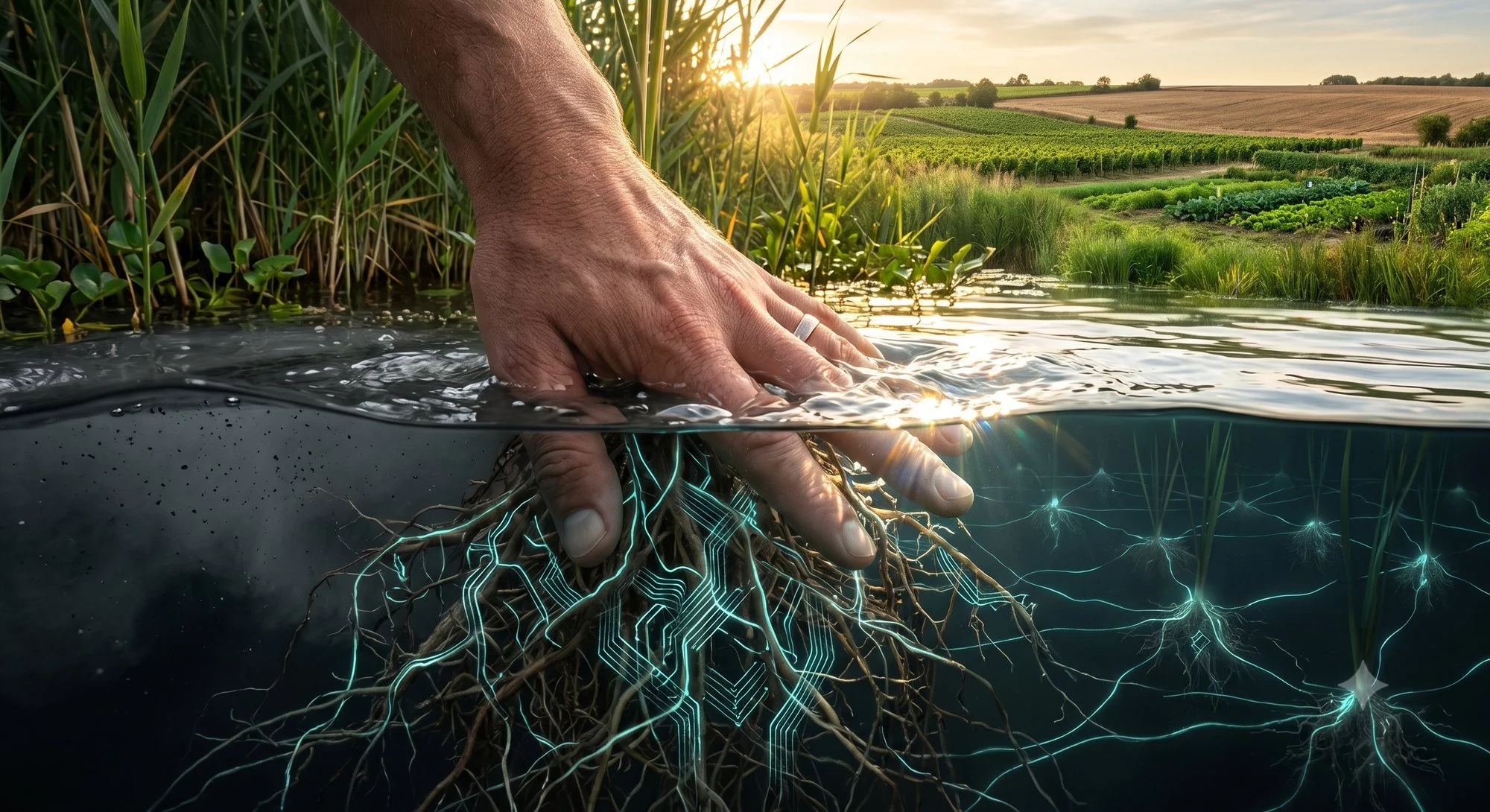
The architecture of slowness
A wetland is any space where water durably controls the soil and the forms of life that settle there. It may be permanent or temporary, fresh or brackish, coastal or inland. What defines it is not the visible presence of water at the surface but the saturation of the soil: a soil that holds water in its pores, deprives roots of oxygen, and imposes on plants and microorganisms a way of life radically different from that of ordinary dry land. Wet meadows, peat bogs, mangroves, reed beds and valley-floor riparian woodland are all wetlands. They share a common logic: water does not pass through, it settles.
A resurgence is the natural emergence of a water table at the surface of the ground. Groundwater, filtered for months or years through the geological layers, rises under hydrostatic pressure and creates a spring. It is not a topographical accident. It is the outlet of an underground hydrological system that can extend over tens of kilometres. A resurgence produces cold water, stable in temperature, laden with dissolved minerals and of remarkable microbiological quality. It feeds streams, moistens the soils downstream and maintains a base flow in rivers during the most severe low-water periods.
A pond is a shallow body of water, generally less than two metres deep, whose water regime varies with the seasons. It may be fed by rain, by runoff, by a resurgence, or simply by the impermeability of the underlying clay. Its small size is deceptive. A pond of fifty square metres can host more animal and plant species than a hectare of intensive arable farming. It is an irreplaceable node of ecological connectivity in fragmented farming landscapes.
These three environments are distinct. Yet they belong to the same functional network: that of water that lingers.
The paradox of buried carbon
It is precisely this slowness that makes these environments extraordinary.
In an ordinary soil, well drained and well oxygenated, dead organic matter is quickly broken down by bacteria and fungi. The carbon it contains is released into the atmosphere as CO2 within a few months. The cycle is fast and efficient, but it stores nothing.
In a waterlogged soil, oxygen is absent. This is called an anoxic environment. The usual decomposer microorganisms cannot breathe there. Dead plant matter, leaves, roots and stems, therefore builds up faster than it breaks down. Year after year, century after century, it forms layers of peat, dense organic sediments extraordinarily concentrated in carbon. A two-metre peat profile can represent five thousand years of unrecycled photosynthesis. Peatlands cover only 3% of the planet’s land surface. They store 30% of the world’s soil carbon, twice as much as all the world’s forests put together.
This figure deserves a pause. Not as a scientific curiosity, but as an engineering datum. This carbon, built up over millennia in conditions of stability that only anoxia can guarantee, is released within a few seasons if the soil is drained. Drained peatlands around the world now emit about 4% of global human-caused CO2 emissions. We have built a time bomb while believing we were reclaiming farmland.
The sponge and the natural filter
But carbon is only one chapter of this story.
Wetlands are also the greatest natural water purifiers we know. When water moves slowly through a reed bed or a marsh, the moisture-loving plants absorb dissolved nitrogen and phosphorus. Suspended sediments settle out. Anaerobic denitrifying bacteria turn nitrates into harmless nitrogen gas. This process happens spontaneously in every functioning wetland. A wet meadow on a valley floor filters agricultural runoff before it reaches the river. A coastal reed bed intercepts diffuse urban effluent before it contaminates coastal waters. This purifying capacity is all the more valuable because it is free: it uses no energy, needs no industrial maintenance and regulates itself, provided it is given the space to work.
Wetlands are also hydraulic sponges. They absorb excess water during floods, store it temporarily in their soils and vegetation, then release it gradually during dry periods. A hectare of wetland can store between 1,000 and 10,000 cubic metres of water depending on its type and depth. At the scale of a catchment, this buffering role is decisive: it lowers flood peaks downstream, reduces bank erosion and sustains low flows in rivers. In a climate where droughts and intense rainfall alternate ever more often, this function of hydraulic regulation takes on a strategic value that hydraulic engineers are only beginning to quantify seriously.
Biodiversity, finally, finds in these environments an intensity that few land ecosystems can match. The pond, the resurgence and the wet meadow are transition zones, what ecologists call ecotones, spaces where two environments meet and where the diversity of available ecological niches is at its greatest. Amphibians complete their breeding cycle there. Dragonflies hunt there. Wading birds find their food there. In intensified farming landscapes, where the monotony of large-scale arable farming has erased most refuges for wildlife, a simple pond of a few dozen square metres becomes once again an irreplaceable island of biological complexity.
The farm air conditioner
What is poorly understood, when people talk about restoring wetlands, is that the benefit does not stop at the edges of the restored area. It spills over. It spreads through space and time, to the neighbouring plots, to the local atmosphere, to the accounts of the farm that borders the area.
A wetland transpires. Its plants, constantly supplied with water, evapotranspire in massive quantities. This evaporation consumes thermal energy: it takes about 680 watt-hours to evaporate a single litre of water. That energy is drawn from the surrounding heat. The air above a wetland is consistently cooler than the air above bare farmland or a sealed surface. Field measurements show temperature differences of 2 to 5 degrees Celsius between a wet meadow and an adjacent cultivated field, in light wind and direct sunshine. This thermal difference does not stay put. It moves. The masses of cool, moist air generated by the wetland drift towards neighbouring plots on local breezes, reducing the heat stress of crops during heatwaves, lowering irrigation needs and limiting leaf evapotranspiration, which above a certain temperature threshold causes the stomata to close and photosynthesis to stop.
In other words: restoring a wetland of a few hectares gives the surrounding crops a natural air conditioning that no equipment can reproduce at that cost.
The relative humidity of the air also rises in the immediate vicinity. A 10% increase in relative humidity can reduce a crop’s irrigation water needs by 15 to 20% in the most favourable Mediterranean conditions. In Mediterranean or semi-arid settings, where water deficit is the first constraint on yield, this neighbourhood effect has a direct and measurable agronomic value. The wetland also influences local rainfall on a modest but real scale: the local increase in evapotranspiration helps feed the convective cells that produce summer convection rain, maintaining a local water cycle more stable than on drained, consolidated plains.
In the soil of the neighbouring plots, the benefit shows itself just as concretely. A functioning wetland keeps the water table higher in its immediate vicinity. This lateral capillary recharge effect can extend over several hundred metres depending on the geological substrate. Crops planted within this zone of influence benefit from a larger available water reserve at depth, which their roots can reach during surface droughts. This invisible water support is particularly valuable for perennial crops, orchards and vines, whose deep root systems actively explore the moist horizons of the soil.
Wetlands also export organic matter to their margins during episodes of temporary flooding. These inputs enrich the adjacent soils, stimulate microbial activity and improve the structure of the surface horizons. Farmers who border wet meadows often notice, without always being able to explain it, that their edge plots are more fertile than the central plots further from the water.
Beneficial insects are a third lever, less visible but just as concrete. Wetlands are reservoirs of predatory and parasitoid insects: ground beetles, rove beetles, ladybirds, lacewings and parasitoid wasps, whose populations are sustained by the diversity of plants and the permanence of wet habitats. These insects colonise the neighbouring crops and exert natural predation pressure on pests. Some studies document reductions in aphid pressure of around 30 to 50% at the immediate edge compared with an identical plot cut off from any natural habitat. This is free biological control, unplanned, that works without a specification and without human intervention.
It would be dishonest not to mention the other side of the coin. A badly positioned wetland, or one abandoned without any management, can also become a breeding ground for slugs that attack adjacent crops, a larval habitat for mosquitoes, or a source of excessive humidity unfavourable to crops prone to fungal diseases. These negative effects are not inevitable: they are the signal that a wetland, like any living system, is not managed by inaction but by observation. What functional ecology teaches is that a well-designed wetland, correctly located within the farm layout, with vegetation suited to its function, produces net benefits that far outweigh its constraints. Intelligent management makes all the difference between a marsh that creates problems and an ecological infrastructure that solves them.
The profitability of sacrificed land
Let us now come back to the farmer, and to the question every landowner ends up asking: what do I actually gain from it?
Two very different situations must be distinguished, depending on the kind of land concerned.
On land with high agronomic potential, drained long ago, with stable yields and controlled machinery costs, restoring a wetland does represent a loss of farm income. In this case, the value from carbon credits, between 800 and 1,000 euros per hectare per year at the current market price under the French Label Bas-Carbone, can partly offset the loss of margin, but rarely matches it on the best land.
On marginal land, on the other hand, the calculation is completely reversed. Flood-prone valley floors, clay hollows where water lies in spring, riverside strips farmed by force with unpredictable yields and high machinery costs: this land is a natural candidate for restoration. Its gross farm margin before subsidies rarely exceeds 150 to 300 euros per hectare. The carbon income makes it two to four times more profitable, with no inputs, no fuel and no workload.
And this income adds up. Payments for Environmental Services (PSE), funded by the water agencies and some regional councils, pay farmers directly for maintaining or restoring environments that favour water quality. The Agri-Environment-Climate Measures (MAEC) under the second pillar of the Common Agricultural Policy can fund the conversion of drained land into wet meadows. Some local authorities and public catchment bodies offer management agreements that guarantee the farmer a fixed income in return for a commitment not to drain for ten to twenty years. Combining these schemes can bring the net income of a restored wetland to 1,200 or 1,500 euros per hectare per year, with no production costs, on land that previously brought in less than 200 euros under arable crops.
It is no longer an ecological sacrifice made out of conviction. It is a rational management decision based on an economic balance that tips in favour of restoration once all the externalities and available schemes are taken into account.
One last benefit must be added, harder to put a figure on but just as real: resilience. A farm that restores wetlands within its layout has a buffer against climate hazards that its neighbours lack. It withstands droughts better thanks to the recharge of the water table. It withstands floods better thanks to the retention capacity of the wet environment. It withstands pest infestations better thanks to the populations of beneficial insects sustained by the natural habitats. These effects appear in no farm account. They reveal themselves in the difficult years, when the neighbours’ consolidated, drained plots take the full force of what the wetland had absorbed.
From observation to engineering: the change of scale
This is where this line of thought has been leading me for several years, and where the wetland stops being merely an object of study and becomes an engineering tool in its own right.
The United Nations has defined precise standards for the reuse of treated wastewater in agricultural irrigation. These thresholds, set by the joint WHO/FAO guidelines and taken up in the WHO recommendations of 2006, lay down strict microbiological and chemical parameters for vegetables eaten raw, the most demanding category of the guidelines: fewer than one intestinal nematode egg per litre, fewer than ten units of Escherichia coli per 100 millilitres, and a near absence of pathogens of faecal origin. These standards determine the ability of water-stressed regions to feed their populations by drawing on water resources that are today considered lost.
The problem is structural. Industrial processes capable of meeting these standards for category A agricultural reuse cost between 0.50 and 2 euros per cubic metre treated, depending on the level of treatment and the size of the plant. They require centralised infrastructure, energy, chemical reagents and maintenance engineering that most rural areas of the world can neither finance nor maintain. In sub-Saharan Africa, in the Maghreb, in the Middle East and in the peri-urban areas of South Asia, hundreds of millions of farmers already irrigate with untreated water for lack of an accessible alternative. The health consequences are documented and massive.
Phytoremediation has been known since the 1970s. It treats grey water and agricultural effluent effectively at low cost. What it could not yet do in a controlled, reproducible way was treat black water, laden with pathogens, faecal matter and complex organic residues, and reliably return it to the UN standards required for irrigation. The difficulty is not chemical. It is biological. It lies in the precise selection and sequencing of the plant species involved in the process: each species performs a distinct purifying function at a given stage of treatment, and it is the rigorous ordering of these functions that determines the final quality of the water produced and its compliance with international thresholds.
This is precisely the territory my research has explored and continues to refine.
But the real breakthrough is not in the performance of a single unit. It is in the deployment model. Where industrial systems concentrate treatment at a single point, use energy to bring water to it from sometimes considerable distances, and depend on central infrastructure whose failure paralyses the whole, a network of small phytoremediation units works on the opposite logic. Each unit treats the water where it is produced, as close as possible to where it is needed, with no transport, no pressurised network and no technician on call. It fits into the landscape as one wetland among others, discreet, self-maintaining and endlessly reproducible.
It is in this multiplication that the system structurally surpasses anything industrial engineering can produce. Not because one unit performs better than a treatment plant, but because a thousand units spread across a territory collectively treat volumes that no centralised plant could serve at that cost, with that resilience and in those conditions of access. The failure of one unit does not affect the others. Multiplying the units does not require multiplying local technical skills: living organisms do most of the regulating. And each new unit strengthens the hydrological network of the territory instead of short-circuiting it.
That is where the real change of scale lies: a system that grows more powerful as it spreads, where industrial systems grow more fragile as they grow larger.
This innovation is complete in its founding principles. It is entering a phase where the right partners matter more than the speed of deployment.
I am not looking to multiply contacts. I am looking for those who understand that breakthroughs in the field of water do not come from industrial chemistry laboratories, but from long and patient observation of living things. If you work in water, decentralised sanitation, food security or investment in nature-based solutions, or if you lead local projects facing the question of access to good quality treated water for farming, I am available for a discreet conversation.
Contact is made only through the website: yvesnicolas.com
Jean-Henri Fabre observed that nature does nothing in vain. The environments we judge worthless are precisely those we discover, too late, were providing everything. Wetlands have provided water quality for millennia. It remains for us to learn from them quickly enough.
Yves Nicolas, Expert Consultant in Functional Ecology, yvesnicolas.com · France · Morocco