Water and agriculture: a change of direction. What Spain took forty years to measure, and what France still refuses to read.
There is a tap in my kitchen. When I turn it on, water flows. When I turn it off, it stops. Nobody wonders where it comes from or where it goes afterwards.
That is exactly how France and Spain have thought about water for sixty years. You turn it on, you take it, you return it to the river, and you call that management.
What the figures say about this management is now published, measured, mapped. There is no longer any uncertainty about the diagnosis. Only one question remains: at what point do we read these data before signing the next building permit?
I. The Spanish mirror: forty years of management by concrete
What Spain built
Spain today irrigates 3.8 million hectares, 23% of its entire cultivated area. To water these fields, it takes 80% of the total volume of water available in the country. Between 2010 and 2019, while farmers were abandoning land because it no longer paid, the irrigated area grew by 14%.
These figures are not attacks. They are the official data of the Spanish State itself, published in the Estrategia Nacional de Lucha contra la Desertificación (ENLD), put out to public consultation in 2024.
Source: MITECO, ENLD, 2024, p. 92.
What Spain got
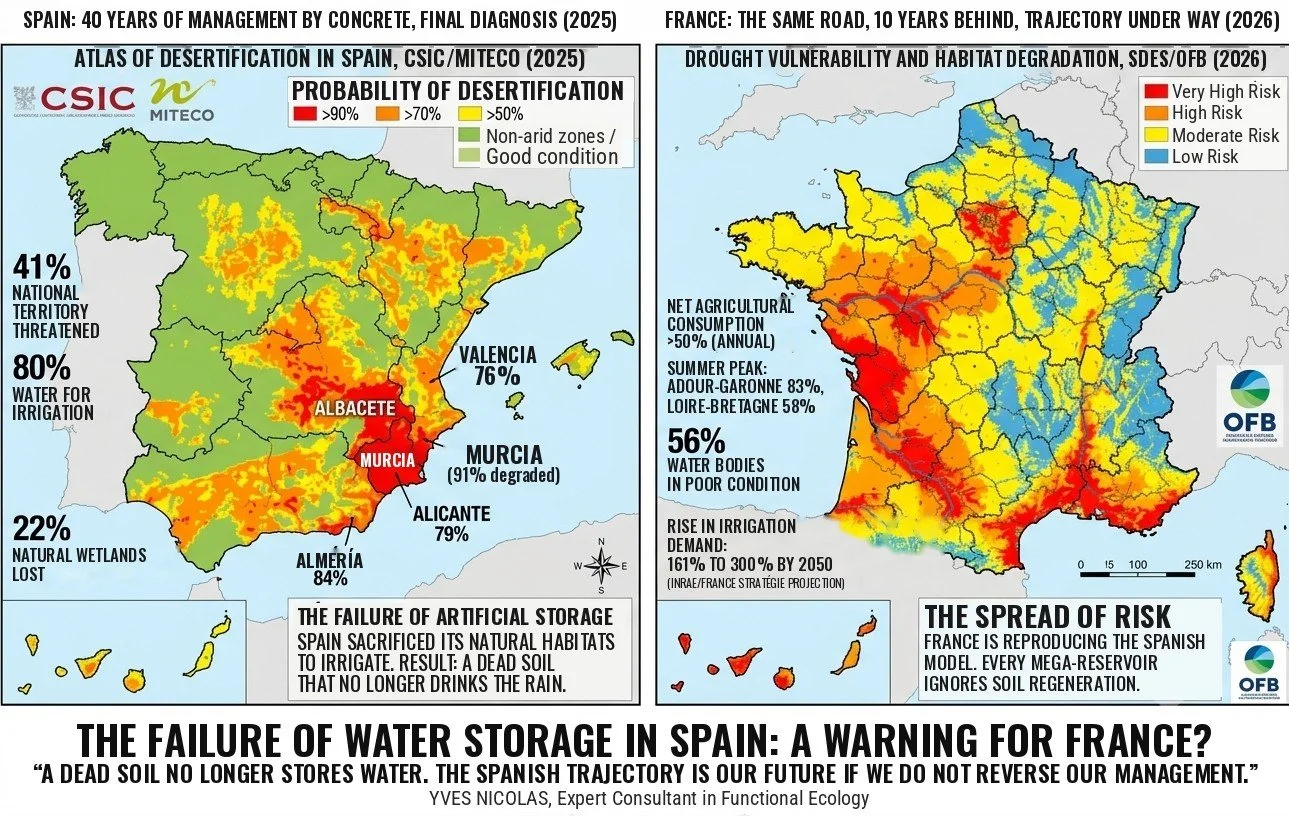
In November 2025, forty scientists from the University of Alicante published the Atlas de la Desertificación de España, 360 pages and 66 maps. What it shows is not a hypothesis. It is a measurement.
206,217 square kilometres threatened by desertification with a probability above 50%. That is 40.9% of the national territory and 60.9% of the country's arid zones.
Murcia: 91% degraded. Albacete, Almería: 84%. Las Palmas: 81%. Valladolid, Alicante: 79%. Valencia: 76%.
In the Guadiana basin, 86% of aquifers are in poor condition. Successive plans have not stopped the degradation. They have measured it.
Source: Atlas de la Desertificación de España, Universitat d'Alacant, November 2025.
Wetlands: the kidneys of the land
A temporary lagoon is not a decorative pond. It is an organ. It filters, it stores, it recharges deep aquifers by slow infiltration. When it disappears, nothing replaces it. Not a dam. Not a reservoir. Not a treatment plant.
Between 2000 and 2022, 22% of Spain's temporary lagoons disappeared. Direct cause: intensive farming practices and water abstraction.
Source: EBD-CSIC, Journal of Environmental Management, April 2026.
The paradox of over-irrigation
Between 2018 and 2024, 483,624 tonnes of fruit and vegetables were destroyed in Spain because more was produced than the market could absorb. Aquifers were pumped, wetlands sacrificed, soils salinised. To produce food that was thrown away.
Source: Atlas de la Desertificación de España, Universitat d'Alacant, November 2025.
II. The French mirror: the same road, ten years behind
In France, agriculture abstracts only 9% of the total volume of fresh water. That figure is reassuring. It is misleading.
The real indicator is net consumption. On that measure, agriculture consumes, without return, more than 50% of all the water actually used in France. In the Adour-Garonne basin, this share reaches 83% in summer.
Source: SDES, March 2026.
51% of wetlands are degraded. 7% disappeared between 1990 and 2020. 56% of surface water bodies are in moderate to poor ecological condition.
These figures do not describe a future risk. They describe what is already lost.
Source: SDES / OFB, May 2026.
Mega-reservoirs: the wrong tool in the wrong place
This principle does not change farming practices. It prolongs them. And to build these structures, the adjacent wetlands are destroyed, whose natural function is precisely to recharge the aquifers that one then seeks to compensate for.
Spain took forty years to measure the cost of this choice. The French Ministry of Agriculture, compiling France Stratégie and INRAE, establishes that, with practices unchanged, climate change will raise summer demand for irrigation water by 161% to 300% by 2050. Current reservoirs do not cover 1% of this future deficit.
Source: France Stratégie, January 2025. INRAE, Varenne agricole de l'eau.
The word that hides everything
The authorities announce that France returns 83% of the water it abstracts. The figure is accurate. What it describes is false.
What France calls a return is a discharge. The treated water goes to the sea. It recharges no aquifer. It feeds no wetland.
What France pumps from its aquifers every year never comes back to its aquifers. The deficit deepens every decade, silently, beneath our feet.
III. Food security: the argument that India and the figures turn around
We are told that without artificial storage, without mass irrigation, food security is threatened. That is the central argument. It is also the weakest.
Because this model does not produce to feed people. It produces for the market. And when the market is saturated, it destroys.
In France (ADEME/SDES 2025, 2023 data): 1 million tonnes of perfectly edible produce destroyed or lost every year at the farm production stage alone. 76% of the waste generated on farms is still edible. In the fruit and vegetable sector, 23% of volumes are lost or destroyed before they even leave the farm.
Why? Not because of drought. Not for lack of water. Because the size is wrong. Because the shape is wrong. Because prices have collapsed and it is cheaper to let the crop rot in the field than to harvest at a loss.
In Spain: 483,624 tonnes destroyed between 2018 and 2024. Aquifers were pumped, wetlands sacrificed, soils salinised. For food that was thrown away.
That is the exact definition of a model that does not serve food security. It destroys it by destroying the natural conditions that make it possible. Aquifers are emptied to irrigate crops that are then incinerated because they do not meet the cosmetic standards of the supermarkets.
India turns the argument around
India feeds 1.4 billion people. It is the most populous country in the world. 86% of its farms are smaller than 2 hectares. This fine mesh of small, diversified holdings, rooted in local knowledge of the soil, feeds an entire subcontinent. Not in spite of their small size. Partly because of it.
A small, diversified farm does not produce for the world market. It produces for its territory. It does not need to pump 80% of the available water because it does not grow the same thing over a thousand hectares under the August sun. It adapts. It rotates. It conserves.
Food security does not come out of a reservoir. It comes out of a living soil, a diversity of crops, a farmer who has known his land for three generations.
India shows us that food resilience is not a question of volume stored. It is a question of mesh, diversity and living soil.
Source: ADEME / SDES 2025, 2023 data. AGEC Law.
Source: Atlas de la Desertificación de España, November 2025.
Source: Indian agricultural census, Ministry of Agriculture of India.
IV. What we can do
This is not a reproach to the farmer. It is a reproach to the State, which for forty years has funded the destruction of the soil rather than knowledge of it.
Hedgerows. Ramial chipped wood. Biochar. Direct sowing into cover crops. These are permanent, living water infrastructures. They are made from what every farm already produces as waste and burns today to get rid of it.
A farmer who uses them costs the community nothing in polluted aquifers, destroyed wetlands or reservoirs to fund. He should be treated for tax purposes as what he is:
a producer of clean water, a producer of clean air, a producer of living soil.
V. The question that remains
A litre of water treated biologically and infiltrated into a living soil recharges the aquifer. It will still be there in ten years.
A litre discharged into a river after treatment reaches the ocean within weeks.
The difference between those two litres is the whole of water policy.
We know this road. We have its maps. We have its figures. We also have the solutions that its own scientists now recommend.
There is no reason for us to take it.