France: black locust, common alder, Italian alder, sea buckthorn, Elaeagnus ebbingei, Elaeagnus umbellata, Elaeagnus angustifolia, goumi, Alpine laburnum, common broom, dyer’s greenweed, Siberian peashrub, Spanish broom, wisteria
Morocco: Acacia tortilis, Acacia raddiana, Acacia gummifera, Acacia saligna, Leucaena, Calliandra, Italian alder
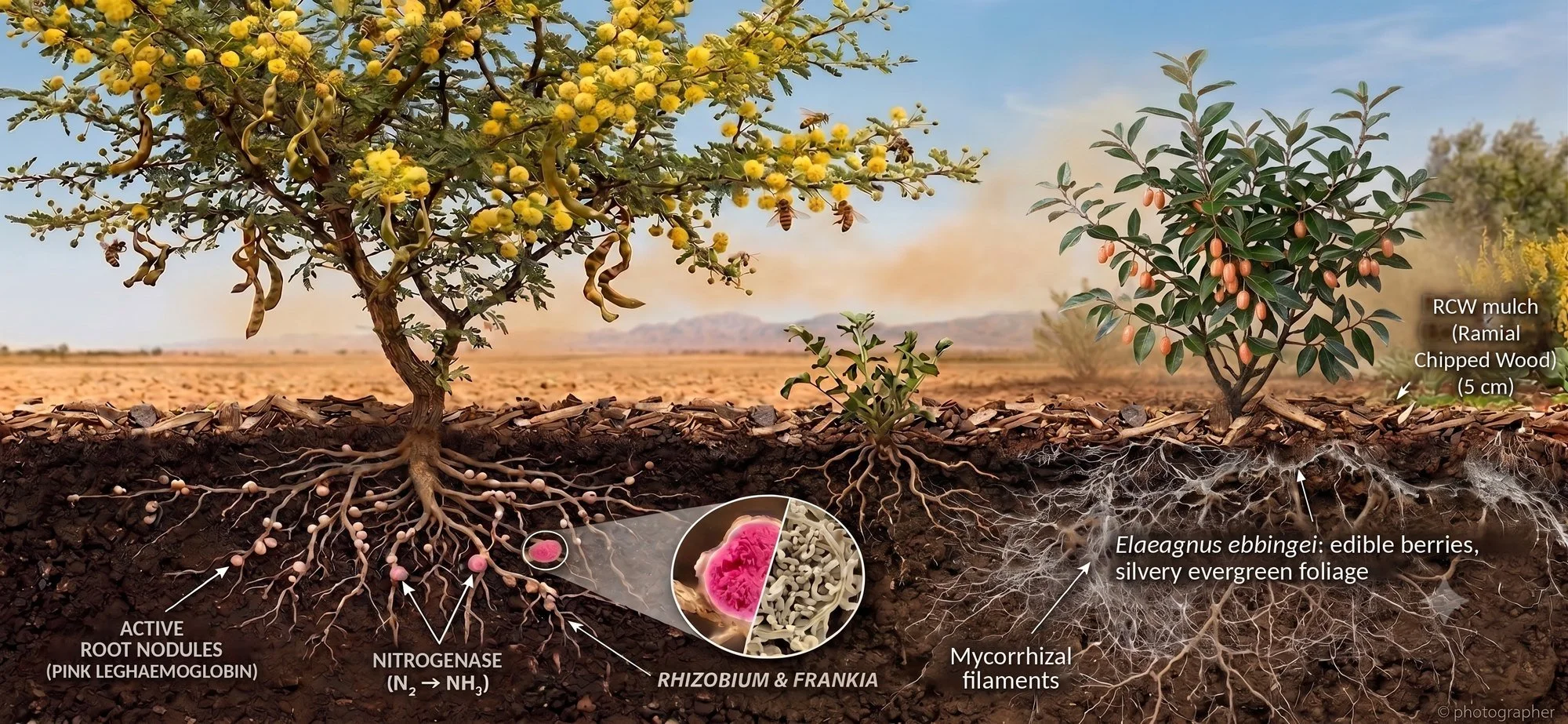
March, on the Haouz plain. The soil has been cracked since November. No rain for weeks, the chergui blowing in from the east, the earth the colour of burnt ochre. And there, on the bank of a dry wadi, a shrub covered in yellow flowers, as if drought were not an ordeal but a normal state of affairs. Its roots are at work in a soil that agronomists would class as unfit. Overhead, the bees ask no questions: they know how to recognise life when they find it.
Further on, on the stony slopes that run down towards Essaouira, the argan tree does something similar, but by another route. It does not fix nitrogen. That is not its trade. Its trade is to go down. Its taproots sink to depths that few plants ever reach, seeking water that the surface forgot long ago. Its trunk, twisted by decades of wind, does not fight against constraint: it has come to terms with it so completely that it has made a shape of it. Beneath its canopy the soil differs from the soil next to it: cooler, looser, richer in organic matter built up from leaves fallen over decades. It creates around itself a zone of life that other species come to inhabit. It does not fix nitrogen, but it prepares ground where others will do so after it. It is a colleague practising another speciality, with the same discretion and the same efficiency.
What the acacia of the wadi and the argan tree of the slope have in common is not technique. It is attitude: an ability to make their own fertility where nothing was given to them, to turn a hostile soil into a living one, to leave behind them, beneath their roots, more than they found when they arrived.
Years of fieldwork between France and Morocco, from the embankments of the Paris region to the dry wadis of the Atlas, have built a conviction: gardens that last are not bought from a catalogue. They are built with shrubs that work, that feed the soil, that are pruned into good quality ramial chipped wood (RCW), and that do all of this with an art of living that assisted species never achieve.
The invisible stage beneath our feet
To understand what really happens, you have to go down into the soil. Not with a spade, not in the laboratory. With the eyes of someone who has spent his life looking at what others step over.
In the first hours after a clover, a black locust or a broom germinates, something happens at the tip of the rootlet that has just broken through the soil. The seedling is tiny, vulnerable, barely anchored. And yet it is already releasing, into the soil water around it, particular molecules called flavonoids. They are not nutrients. They are not toxins. They are signals. Chemical messages of remarkable precision, specific to each plant family, readable only by certain soil bacteria.
These bacteria are called Rhizobium. In the ordinary way they live freely in the soil, without fixing a single atom of nitrogen, like any saprophytic microorganism busy breaking down whatever organic matter is available. They cannot capture nitrogen from the air on their own. In their free state it is beyond them. But when the chemical message from the legume reaches them, something changes in their behaviour. They start to move. They swim through the film of water that coats the soil particles, following the concentration gradient of the flavonoids the way a dog follows a scent, step by step, all the way to the source.
The source is the root hair of the young root.
What happens next looks like mutual recognition. In response to the flavonoids, the bacterium produces its own signalling molecules, the Nod factors. The plant receives these Nod factors and immediately changes the curvature of its root hair. The hair curls in on itself slightly, like a hand closing, and traps the bacterium in a curve of plant cells. This is the start of a partnership that will last the whole life of the plant.
The bacterium enters the root not by force but by invitation. The plant builds around it an infection thread, a corridor of plant cells that guides it towards the deeper layers of the root cortex. And there, in that sheltered depth, the cortical cells begin to divide abnormally. They swell, multiply and form a growth visible to the naked eye on the root: the nodule. A small whitish or pinkish ball, from one to a few millimetres across, which every gardener has seen without knowing what he was looking at.
Inside this nodule the bacteria have changed state. They are no longer free. They have become bacteroids, a specialised form, unable to survive outside this particular environment, but endowed with a new ability: the fixation of atmospheric nitrogen.
This ability rests on an enzyme of extraordinary complexity, nitrogenase. It can break the triple bond that holds together the two atoms of molecular nitrogen, N₂, one of the most stable chemical bonds in nature. To do so it consumes a considerable amount of energy: sixteen molecules of ATP per molecule of dinitrogen fixed, that is eight per atom of nitrogen reduced. This is where the plant comes in. It supplies the bacteroids with the sugars made by photosynthesis, their energy fuel. In return the bacteroids hand back ammonium nitrogen that the plant can use directly, building it into its proteins, its chlorophylls and its nucleic acids.
The partnership is perfectly balanced. Each gives what the other cannot produce alone. The plant captures light but cannot seize nitrogen from the air. The bacterium can seize nitrogen but has no access to solar energy. Together they achieve what neither could manage separately: turning the invisible nitrogen of the atmosphere into living matter.
There is one more detail that Fabre would not have missed. Nitrogenase is destroyed by oxygen. It only works in an environment strictly deprived of air. Yet the nodule is vascularised, irrigated by the plant’s own blood. How can the necessary anoxia be maintained in an organ that receives flows of oxygenated sap? The plant solves the problem with a particular molecule, leghaemoglobin, a protein related to the haemoglobin in our blood, which captures oxygen in the nodule and neutralises it before it reaches the bacteroids. It is what gives an active nodule its characteristic pink colour. A white or brown nodule no longer fixes anything: the partnership is broken, the leghaemoglobin absent or degraded.
For non-leguminous species, such as alder, sea buckthorn or Elaeagnus, another bacterium plays this role: Frankia, a filamentous actinomycete living in the soil. Recognition, infection and nodulation follow a comparable pattern, but the chemical signals exchanged are different, the internal structures of the nodule more complex, and the fixing capacity often just as high, sometimes higher. Alder in riparian woodland can fix up to 300 kg of nitrogen per hectare per year in the ideal conditions of a cool, well-lit riverbank. That is twice the average value for a shrubby legume.
What is formed in the soil beneath a young black locust or a newly planted Elaeagnus is therefore an alliance several hundred million years old. Fossil traces of root nodules go back to the Devonian, a time when seed plants did not yet exist. This symbiosis predates the dinosaurs, predates flowers, predates almost everything we call vegetation. It has co-evolved with life on land itself, to the point where the genes involved in Rhizobium and legume recognition share sequences with those governing the mycorrhizal symbiosis, which is also very ancient.
When you plant an Elaeagnus ebbingei or a black locust on the edge of a garden, you are not just planting a shrub. You are introducing a microbial ecosystem into a soil that may have lacked one, setting up a nitrogen workshop that will run silently for decades, and renewing one of the oldest collaborations in the history of life.
Atmospheric nitrogen is fixed by bacteria living in symbiosis in root nodules. The main ones, Rhizobium and Frankia depending on the species, convert nitrogen gas into mineral nitrogen that plants can use directly. In a sandy or chalky soil, like those on building sites around Paris or on the Haouz plain, this is an irreplaceable function. The plant produces the nitrogen that the bedrock cannot supply.
Now, when the branches of this shrub are chipped and spread on the surface, the nitrogen fixed in its tissues returns to the soil in a gradually released form. It is not a nitrogen fertiliser with an immediate effect. It is a nitrogen-rich organic matter that will feed the lignin-degrading fungi, which will turn it into stable humus over a period of 12 to 36 months depending on the climate. In the semi-arid Moroccan setting, decomposition is faster at the surface and slower deeper down. In an Atlantic or Paris-region setting, the reverse is often true.
This double effect, root fixation over the long term and nitrogen return through the above-ground biomass, is what sets these shrubs apart from any other mulching material or ordinary RCW.
Here are the species proven by use, on both sides of the Mediterranean. Black locust (Robinia pseudoacacia) remains the benchmark for productivity in temperate settings. Fast growth, dense wood, one of the highest fixing capacities: between 50 and 150 kg of nitrogen per hectare per year depending on soil quality and rhizobial inoculation. In May its ivory-white racemes hang a scent in the air that beekeepers know well. Black locust honey is one of the rare honeys that crystallise slowly: its fructose content, higher than its glucose content in a ratio of about 1.4 to 1, inhibits the nucleation of glucose crystals and delays setting for months. Its branches give an RCW with a high carbon to nitrogen ratio, ideal for very depleted soils. One reservation must be made, however: its running roots can spread 8 to 12 metres from the trunk and send up suckers at a distance. Mixed with fruit shrubs or productive perennials, it quickly competes for water. Root allelopathy is mentioned in some studies, although the evidence in situ is still debated; competition for water and light is enough to explain most of the observed effect. It is planted as a specimen or as a single-species multi-stemmed clump, kept in check by regular pruning, at least 4 metres from any productive neighbour.
Common alder (Alnus glutinosa) is indispensable in wetlands and riparian woodland. Its symbiosis with Frankia is formidably effective: between 100 and 300 kg of nitrogen per hectare per year in well-exposed riparian woodland, values that fall to 40 to 80 kg on free-draining soil outside wetlands. The fall of its small deciduous leaves enriches riverside soils every autumn with a material that mineralises easily. In winter its small purple catkins persist on the bare branches like punctuation marks in a stripped landscape. Its cousin the Italian alder (Alnus cordata), more tolerant of drought, is better suited to Mediterranean areas and carries persistent cones of an intense brown all winter.
Sea buckthorn (Hippophae rhamnoides) tolerates dry, sandy, even saline soils. In coastal regions or in the reforestation of wasteland, it is a first-rate pioneer fixer. In autumn its branches fill with bright orange berries of an almost unreal density, packed tightly along the whole length of the shoot. These fruits, rich in vitamin C at levels few plants reach, have long been used in the culinary traditions of Central Asia and Northern Europe for syrups, coulis and herbal teas. The branches, thorny admittedly, give a chemically very rich RCW.
Elaeagnus deserves a longer pause, because the genus covers several species with distinct characters.
Elaeagnus angustifolia, Russian olive, is a tree or large shrub with silvery leaves that shimmer at the slightest breeze. Its small yellow flowers in May give off a scent of vanilla and honey that can be recognised from afar. It produces floury, sweet fruits that the peoples of Central Asia have made into flours and pastes for centuries. A vigorous fixer, it colonises the most hostile soils.
Elaeagnus umbellata, autumn olive, fruits abundantly in autumn with translucent coral-red berries, slightly tart, rich in lycopene. Hardy to minus 25 degrees, it adapts to an exceptional range of soils.
Elaeagnus ebbingei, Ebbinge’s silverberry, is the species that Mediterranean and Atlantic gardens should systematically include in their hedges. Evergreen, dense, remarkably tolerant of pruning, it produces in autumn and early winter tiny silvery-white flowers whose scent, discreet but penetrating, can be noticed several metres away in the cool evening air. The following spring its orange-red fruits, slightly sweet and tart, ripen before almost all other fruiting shrubs. Its evergreen branches make an RCW of remarkable quality, rich in leaf proteins and fixed nitrogen.
Elaeagnus multiflora, goumi, produces elongated fruits, bright red when they ripen in spring, distinctly sweet, valued in Japanese cooking. It is the Elaeagnus with the largest and tastiest fruits in the genus.
Alpine laburnum (Laburnum alpinum) and common broom (Cytisus scoparius) belong to the Fabaceae family. In April and May the laburnum covers its branches with a cascade of golden-yellow flowers that make it one of the most striking sights in our mountain hedgerows. Broom, for its part, structures the heath with its upright green stems and flowers of a slightly warmer yellow. Their fine branches are excellent for a finishing RCW on the surface. Take care with laburnum, though: its lifespan does not exceed 15 to 25 years, and it often dies suddenly. Use it as an isolated pioneer species, not a structural one, with a long-lived shrub planned to succeed it.
Dyer’s greenweed (Genista tinctoria) is more modest in habit, but it is an effective coloniser of chalky soils and a historic source of yellow dye used by the dyers of the Middle Ages. Its small, tightly packed flowers attract bumblebees in large numbers.
Siberian peashrub (Caragana arborescens) is still little known in France but deserves a mention: native to Siberia, it withstands intense cold and prolonged drought, and in spring produces bright yellow flowers in light clusters. Its pods are edible when green and are used in Central Asia as a cooked vegetable. It fixes nitrogen effectively on skeletal soils.
Wisteria (Wisteria sinensis) belongs to the Fabaceae and forms nodules with Rhizobium, but its nitrogen contribution measured in real conditions does not exceed 10 to 15 kg per hectare per year: agronomically negligible, too little to feature in a fertility strategy. It is mentioned here not as a useful fixer but as a reminder that root symbiosis runs across botanical families, right into plants nobody suspects. In May its mauve racemes on a façade are one of the most intense moments of the year in a Mediterranean or Loire Valley garden. That is its true purpose.
For the Moroccan setting, and more broadly for Mediterranean and arid ones, the species change but the logic stays the same.
Acacias (Acacia tortilis, Acacia raddiana, Acacia gummifera) form the backbone of Sahelian and pre-Saharan agroforestry. In the Atlas and the Anti-Atlas they colonise dry wadis, protect banks from erosion and produce a considerable above-ground biomass. In March Acacia tortilis covers its thorns with small yellow balls that scent the whole understorey with a faintly honeyed smell, a signal visible from afar in a landscape still brown. Its pods, twisted into spirals, have been eaten by camels and goats for thousands of years, and its chipped branches make one of the most effective RCWs for severely deficient soils.
Acacia saligna (Acacia cyanophylla), introduced on a large scale in North Africa to fix dunes, is a source of RCW often available in large quantities. Listed among the proven invasive species in the Mediterranean by the IUCN, it has an aggressive lateral root system and its allelopathy has been documented on several native species. It does not belong in a mixed hedge: an isolated stabilising specimen only, on areas already colonised where competition is no longer an issue. Its above-ground biomass is nevertheless among the most productive on the Moroccan coast and can be used as RCW, provided its spread is strictly controlled. Its yellow flowers in dense pompoms in early spring create bright patches on the dunes.
Leucaena (Leucaena leucocephala) is probably the most productive nitrogen-fixing shrub in a subtropical climate. Its small flat pods follow one another almost all year round in Morocco’s coastal areas. Its biomass is extraordinarily rich in nitrogen, but the presence of mimosine calls for precise vigilance: metabolised into DHP by rumen bacteria, it causes hair loss, thyroid suppression and serious reproductive disorders in unadapted ruminants (European cattle and sheep in particular). Moroccan goats show a tolerance that varies with their rumen microbiota. Leaving livestock aside, its explosive growth (4 to 6 metres in two years in favourable conditions) and its allelopathic leaf litter make it incompatible with a mixed hedge. Isolated specimen or single-species row only, never mixed.
Calliandra (Calliandra calothyrsus), native to Central America and naturalised in sub-Saharan Africa and South-East Asia, is being tested in a few agroforestry trials in Morocco but is not yet naturalised there. Its flowers, with bright red stamens in brushes, give the shrub the look of a vegetable lantern. It produces high-quality biomass for RCW in humid subtropical areas and attracts bees in great numbers. To be considered as a trial species in Moroccan coastal areas under Atlantic influence, not as a reference species.
Spanish broom (Spartium junceum) covers the Mediterranean garrigue with its evergreen green stems and its intense yellow flowers with their heady June scent. It colonises sloping chalky ground, stabilises embankments and produces fine branches well suited to a surface RCW. The question of when to cut is at least as important as the choice of species.
The best quality RCW comes from branches taken when the sap is rising, typically between March and May in France, between February and April in Morocco depending on altitude. This is when the cambial tissues hold the most sugars, proteins and fungal activity. Chipping lignified branches in autumn will give a more carbon-rich material, slower to break down, useful as a winter mulch but less biologically active.
Chipping should produce mixed fragments between 1 and 5 centimetres. Too fine, and the fragments pack down into a crust. Too coarse, and they lie inert on the surface for months without enough contact with mycorrhizae.
An agronomic point is needed here. RCW from legumes is not a very long-term structural RCW. Its carbon to nitrogen ratio, often between 30 and 40, is much lower than that of oak or beech RCW, which can reach 50 to 100. It is a stimulating RCW, quick to mineralise, which wakes the soil up and releases usable nitrogen in the weeks after spreading. To build stable humus over the long term, a mix is essential: two thirds carbon-rich RCW from non-fixing species (oak, hornbeam, hazel, ash depending on the area) to one third RCW from fixers. The fixer brings nitrogen and bacterial activity, the carbon-rich wood brings structure and duration. Either one alone optimises one function at the expense of the other.
Spread alone and in excess, legume RCW carries a specific risk: temporary nitrogen hunger. The microorganisms triggered by the input of fresh matter undergo a population explosion. To build their own biomass, they lock up in their cells the nitrogen they have just released, temporarily depriving the plants already in place of that nitrogen for 4 to 8 weeks depending on soil temperature and moisture. An apparent paradox: you spread a material rich in nitrogen and the plants go short of it for two months. The two thirds carbon-rich to one third fixer mix neutralises this risk by slowing mineralisation, spreading the release of nitrogen over time and removing the sharp peak of immobilisation. Another solution when spreading pure legume RCW: do it in autumn on bare soil, outside the growing season. The immobilisation phase then takes place over winter without affecting crops, and in spring, when plants start growing again, the microbial biomass begins to break down and returns the nitrogen in usable form at the very moment the roots need it.
RCW is spread in a layer 5 to 7 centimetres deep, never dug in. RCW from fixers is naturally rich in nitrogen, but incorporating it into the soil before it has partly mineralised can temporarily lock up that nitrogen from the plants already in place. Let the fungus do its work on the surface.
But the real question is not which species to plant. It is where to put it, and how many.
A garden, even a small one, even an urban one, should be thought of as a territory. And every territory works better when it has nodes of fertility spread through space rather than concentrated in a single spot. This is exactly what the farmers of the Normandy bocage did without ever putting it into words: they did not plant their hawthorn and hornbeam hedges to look pretty. They were building a network that regulated water, tempered the wind, sheltered livestock and fed organic matter to the enclosed fields.
A bocage hedge of nitrogen fixers works on the same principle, scaled to a garden of 500 square metres or an estate of several hectares.
The guiding idea is simple. Each nitrogen-fixing shrub planted on an edge, at the bottom of a plot or as a divider between areas is an active node in a network of fertility. Its roots inject nitrogen into the top 80 centimetres of soil around it, within a radius that can reach 2 to 3 metres depending on age and species. Its deciduous leaves enrich the surface litter. Its branches, pruned every year, feed the stock of RCW available on site. And after a few years, the soil right next to each shrub shows organic matter levels noticeably higher than the rest of the plot.
If these nodes are placed every 4 to 6 metres along the boundaries of the garden, they create a diffuse belt of fertility that radiates towards the centre. If a few are slipped into the inner beds, alternating with productive shrubs or perennials, every area of the garden becomes a passive beneficiary of a continuous nitrogen supply. This is not a decorative hedge around a garden. It is a feeding system built into its architecture.
In France, plots redesigned around this principle always include an Elaeagnus ebbingei or an Elaeagnus umbellata at the north or north-east end, where the light is too poor for most fruit trees but where these species thrive. One or two black locusts grown as shrubs, kept pruned to 2.50 metres, frame the vegetable garden on the west side to break the prevailing wind. Bands of sea buckthorn on embankments or along the road boundary provide fixation where the soil is most depleted by compaction or the passage of machinery. And wherever space is short, a single laburnum or two common brooms are enough to start fixation in a bed that is still establishing.
In Morocco the logic is the same but the priorities are reversed. The first step is protection from the hot, drying east wind, the chergui, which can kill a planting in two days in June. A screen of acacias or Elaeagnus angustifolia on the eastern boundary is at once an effective windbreak, an active nitrogen fixer and a major source of RCW in a setting where available organic matter is scarce. Seguias and khettaras already trace a geography of water through traditional Moroccan gardens. Nitrogen fixers complete that geography by adding the dimension of fertility: planted along the seguias, where the residual moisture in the soil lasts longest, alders or leucaenas enjoy ideal conditions and return their nitrogen to the most productive areas of the garden.
This network produces effects that go beyond nitrogen alone. A bocage hedge of fixers of varied habit, mixing evergreen species such as Elaeagnus ebbingei with deciduous ones such as black locust or laburnum, creates a vertical layering that regulates soil temperature. In high summer, around Paris or in Morocco, the soil in the partial shade of a bocage hedge rarely goes above 28 degrees at the surface, while bare soil can reach 55 to 60 degrees at the same hour and kill the surface fungal network within a few hours. That fungal network is precisely what allows RCW to turn into humus rather than into burnt compost.
A bocage hedge of fixers also attracts beneficial insects. Flowering follows on through almost the whole growing season: black locust in May, laburnum and broom in April, Elaeagnus in November, sea buckthorn in March. Each flowering window matches a moment in the life of wild pollinators: the early bumblebees of March find their first pollen of the season in alder catkins, and the solitary bees of November forage on the discreet flowers of Elaeagnus when the rest of the garden is asleep.
Finally, the bocage network buffers changes in soil moisture. The roots of fixers, which often go deeper than those of the surrounding herbaceous plants, draw water from the capillary fringe and release it through root exudation in dry periods. This phenomenon, studied under the name of hydraulic redistribution, is particularly marked in Moroccan acacias and in black locust on chalky soils. It does not replace irrigation, but it cushions the harshest jolts of summer drought.
A garden well networked with nitrogen fixers uses less water, fewer inputs and fewer corrective interventions. It becomes more resilient with every year that passes, because each pruned and spread branch enriches a soil that enriches itself faster and faster, in a self-reinforcing dynamic that the old gardeners of the Normandy bocage simply called good ground.
The impertinence of well-being
There is one thing that long years of observation in the field end up making obvious, and that nursery catalogues never mention: these shrubs look well.
Not well kept. Not well pruned. Well in the deepest sense of the word, the sense in which an animal is well when it lives in the setting that suits it. In the habit of an Elaeagnus ebbingei planted in a soil it has been allowed to colonise at its own pace, there is something that resembles fullness. Its leaves are a glossy dark green that nothing spoils, even in August, even in a soil forgotten for years. It makes no demands. It does not yellow. It does not stretch towards a light it lacks. It occupies space with a calm that ends up being noticed.
Black locusts grow in demolition rubble, between blocks of crushed concrete, in ground that the building trade had turned over and sterilised. Two years later they were one metre eighty tall. Five years later they were giving shade. Their pinnate leaves, a tender, almost unreal green in spring, sway at the slightest breeze with a lightness that contrasts with the hardness of the substrate holding them. Nobody pities a black locust. You watch it with something that resembles respect.
Sea buckthorn has a different presence. Its narrow, silvery leaves make the light glitter in a way that recalls the olive trees of the garrigue, but sharper, more nervous. In autumn, when the orange berries pile up on the thorny shoots until they bend them slightly, the spectacle is of an almost indecent generosity for a shrub planted in dune sand. The colour of these berries exists nowhere else in the plant spectrum of a temperate autumn. It is a saturated, almost fluorescent orange that catches the eye at ten metres and stays hanging on the plant for weeks after the first frosts, when the rest of the garden has faded away.
Laburnum is of another nature again. Its flowering in May is an excess. There is no other word. An Alpine laburnum in full flower in a mountain hedgerow does not produce beauty sparingly. It pours it out. Its drooping golden-yellow racemes cover the whole branch, leave no leaf visible and turn the entire shrub into a luminous mass that trembles slightly in the wind. The May bumblebees, whose buzzing you hear before you see the plant, have no doubt about the quality of what is on offer.
What is striking, when you observe these shrubs together, is their complete lack of compromise. They do not fix nitrogen at the expense of their vigour. They do not flower at the expense of their fruit. They do not settle into difficult soils wearing the impoverished look of species that merely endure. They do everything at once, with an ease that commands the attention of anyone who knows how to look.
In Morocco this observation takes on an extra dimension. An Acacia tortilis on the Haouz plain in March, covered in its small yellow flowers against ochre earth that is still dry, is one of the most intense images in the Mediterranean plant landscape. The tree has had no water since November. The soil around it is cracked. And yet it flowers, punctually, abundantly, as if drought were a normal state of affairs and not an ordeal. This is not resistance. It is adaptation taken to the point where the constraint has become invisible.
Elaeagnus angustifolia in the same landscape, its silvery leaves shimmering in the hot afternoon wind, produces a visual effect that landscape architects spend years trying to recreate with costly, demanding species. It needs nothing, or almost nothing. It fixes its nitrogen, stabilises the soil around it, scents the air in May with honey and vanilla, and produces its floury fruits with the regularity of a species that has taken millions of years to come to terms with this setting.
This, precisely, is the impertinence. These shrubs render a considerable agronomic service, and they do it with an art of living that the supposedly noble species, the catalogue ones, the ones that demand soil improvers and water and careful pruning and winter protection, never achieve. There is something in this observation that ought to call into question the usual hierarchy of garden plants.
What is useful is not condemned to be austere. What is tough is not necessarily coarse. And what fixes nitrogen silently beneath our feet can, above the hedge, hang out clusters of flowers that stop bees and passers-by in their tracks.
Fieldwork between France and Morocco has forged a simple conviction: the fertility of a soil is not bought by the tonne. It is cultivated, with species that have spent millions of years learning to do it better than we do.
Nitrogen-fixing shrubs are among those species. Ignoring them means going without a free nitrogen factory, a first-class raw material for RCW, a network of fertility that works silently twelve months a year, and often a source of food that nobody thought to plant.
The next time you see an Elaeagnus hedge heading for the skip in spring, think of the orange berries you are throwing away with it, the nitrogen you are sending to the tip, and the November bees that will have nothing left to find.
Yves Nicolas, Expert Consultant in Functional Ecology, yvesnicolas.com · France · Morocco