
Push your hand into a heap of wood chips a few weeks old, at the bottom of a garden, on a November morning. The surface is cold and grey. Twenty centimetres down, the hand meets an unexpected warmth, almost animal, and when you draw it out it brings up chips held together by a white felt, as fine as a spider's web. This felt does not come from the wood. It arrived from the soil, climbed into the heap, and is busy eating it.
Cover photo: A large heap of plant waste steams in the night: at its core, the temperature can reach 50 to 70 °C. Photo Patrick Nicolas, 30 September 2014.
This whole text starts from that gesture. Chipped wood is neither a fertiliser nor a waste product: it is a meal offered to an underground people, and that people, as it eats, makes the earth. Still, one has to know which wood to serve it, in what form, and at what moment.
This text follows the path of a branch, from pruning to the soil, in ten stages. We look first at what separates RCW from ordinary wood chips, then at what happens beneath a wood mulch, then at what scientific trials measure and what they leave in the shadows. Next comes the quarrel between fresh and pre-composted material, with the way to pre-compost wood chips and seed them with the micro-organisms of the site. The other mulches of the garden, grass clippings, leaves, straw and assorted waste, have their place before the instructions for use, situation by situation. Can RCW heal? We will ask the question, then go back in time to see what peoples have done with wood and leaves, and what neighbouring techniques are worth. The mistakes that make people believe the method does not work close the journey. The full bibliography appears at the end.
1. Two Woods That Do Not Resemble Each Other
After a pruning, pick up two pieces at random. A branch as thick as a wrist, and a shoot of the year as thick as a little finger. Snap them both. The branch is dry at the core, pale, inert. The shoot bends before it breaks, it is green beneath the bark and it smells of sap. These are two different materials, and the whole difference between a pile of wood and RCW lies there.
A tree does not store its riches in its trunk. Over most of its volume, the trunk is a dead framework. What lives is the periphery and the tips: the young bark, the cambium, the buds. That is where the tree places its nitrogen, its phosphorus, its sugars and its proteins, because that is where it grows.
This observation was formalised in Quebec, at Laval University, around the forester Gilles Lemieux. The term ramial chipped wood appears in Quebec publications as early as 1982, and it was Lemieux who formalised and popularised it, notably in a 1986 text written with Lapointe. The starting question was simple: how does the forest maintain deep soils without anyone ever bringing it anything? The answer is simple too. The forest does not feed on its trunks, which stay standing or rot over a century. It feeds on what it lets fall each year, twigs, sprigs and leaves. Forest soil is made by small wood.
Hence the definition. RCW is chipped broadleaf shoots less than seven centimetres in diameter. Below that threshold, living tissue dominates. Above it, heartwood takes over and the chemistry changes. Quebec research gives ramial wood a carbon to nitrogen ratio of 30 to 170 depending on the species, against 400 to 750 for trunk wood. A three-centimetre shoot is not a small trunk; it is another organ.
Ordinary wood chips, for their part, are everything that comes out of a tree surgeon's chipper when the whole tree goes through it: large branches, conifers, bark, sometimes pallet wood. It is raw carbon. It is far from useless, but it does not behave like RCW, and most disappointments come from this confusion. Many gardeners have tried RCW without knowing it, with trunk chips, and concluded that the method did not work.
The Quebec tradition adds two rules. Conifers should make up only a small share of the mix, around ten to twenty per cent, fifteen per cent at most in the data sheet from Cemagref, now INRAE, and certain woods are to be avoided, such as Thuja, whose heartwood contains thujaplicins, antifungal compounds that hinder soil fungi. It also recommends chipping during dormancy. On this last point I part company with it: to my eyes the pruning season makes little difference, and trying to time it complicates everything for nothing. RCW is made all year round, at the pace at which the garden produces its prunings.
To find my way among the species, I work with a catalogue of seven behavioural groups rather than lists of species: nitrogen fixers and soft shoots, biomass factories, woody structurers, aromatics and tannin-rich species, toxic species for controlled use, fruit trees and climbers, palms and fibres. An Alnus cordata from Meudon and a Leucaena leucocephala from Marrakech do the same job in the heap; both bring the nitrogen that gets things started. A Quercus robur and an Olea europaea do the other job, that of the lignin that lasts. The species change from one shore of the Mediterranean to the other; the functions remain.
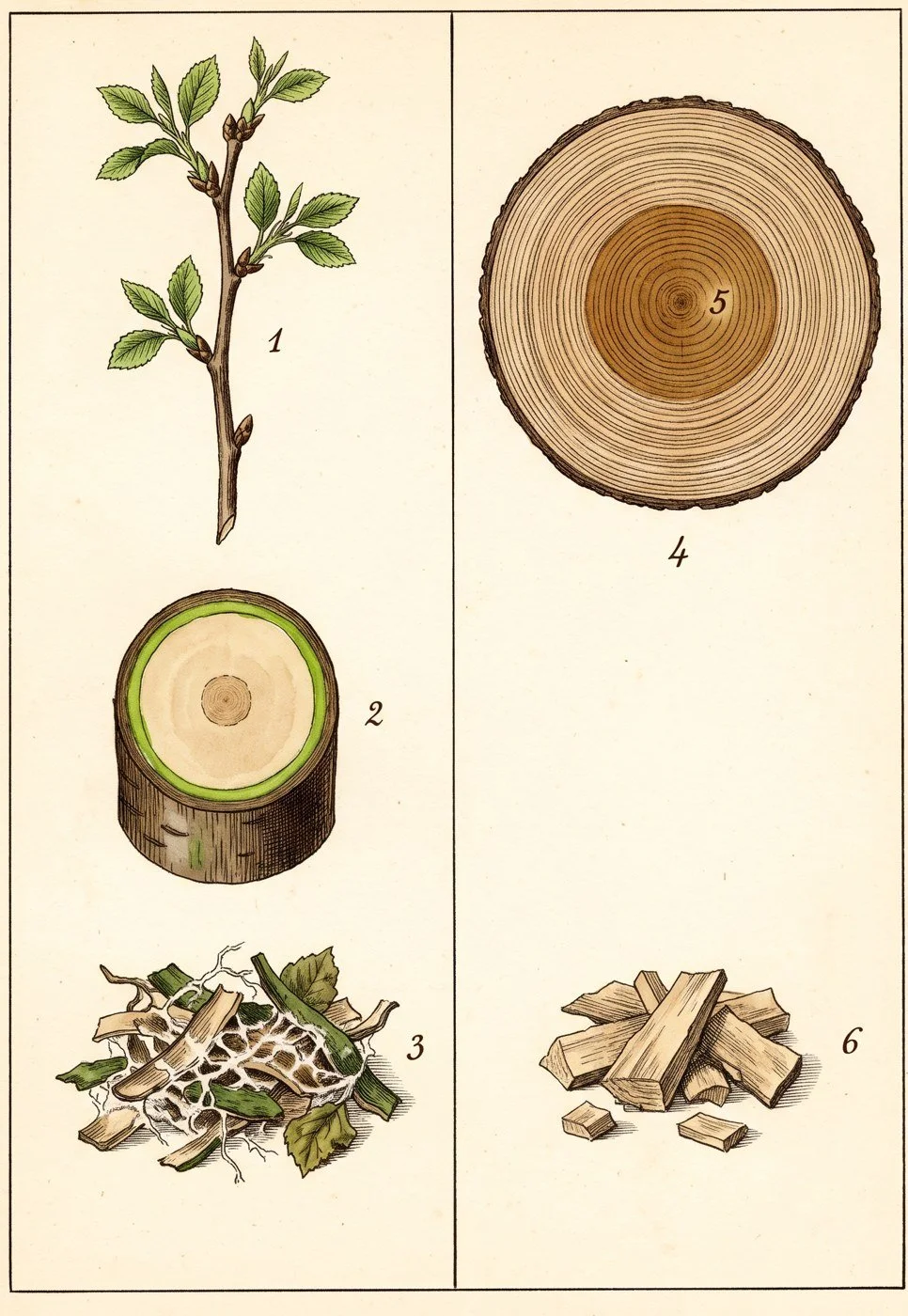
Above: Two woods that do not resemble each other. On the left, the shoot under 7 cm (1), its green bark, home to the cambium and the reserves (2), and its chips already colonised by mycelium (3). On the right, the old trunk (4), its dark heartwood (5) and its hard chips, which the fungi have not yet found (6). AI-generated illustration, naturalist engraving style.
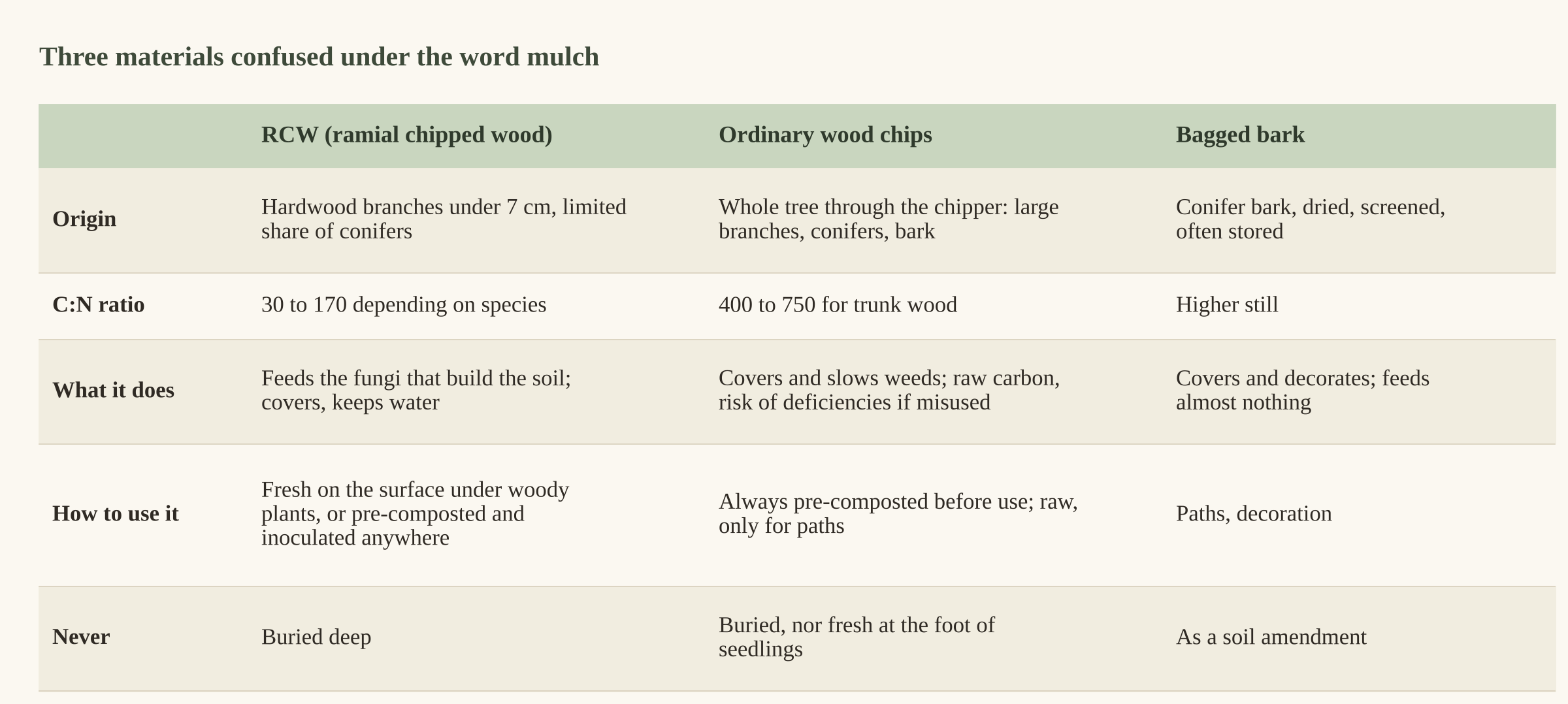
Above: Table 1. Three materials confused under the word mulch.
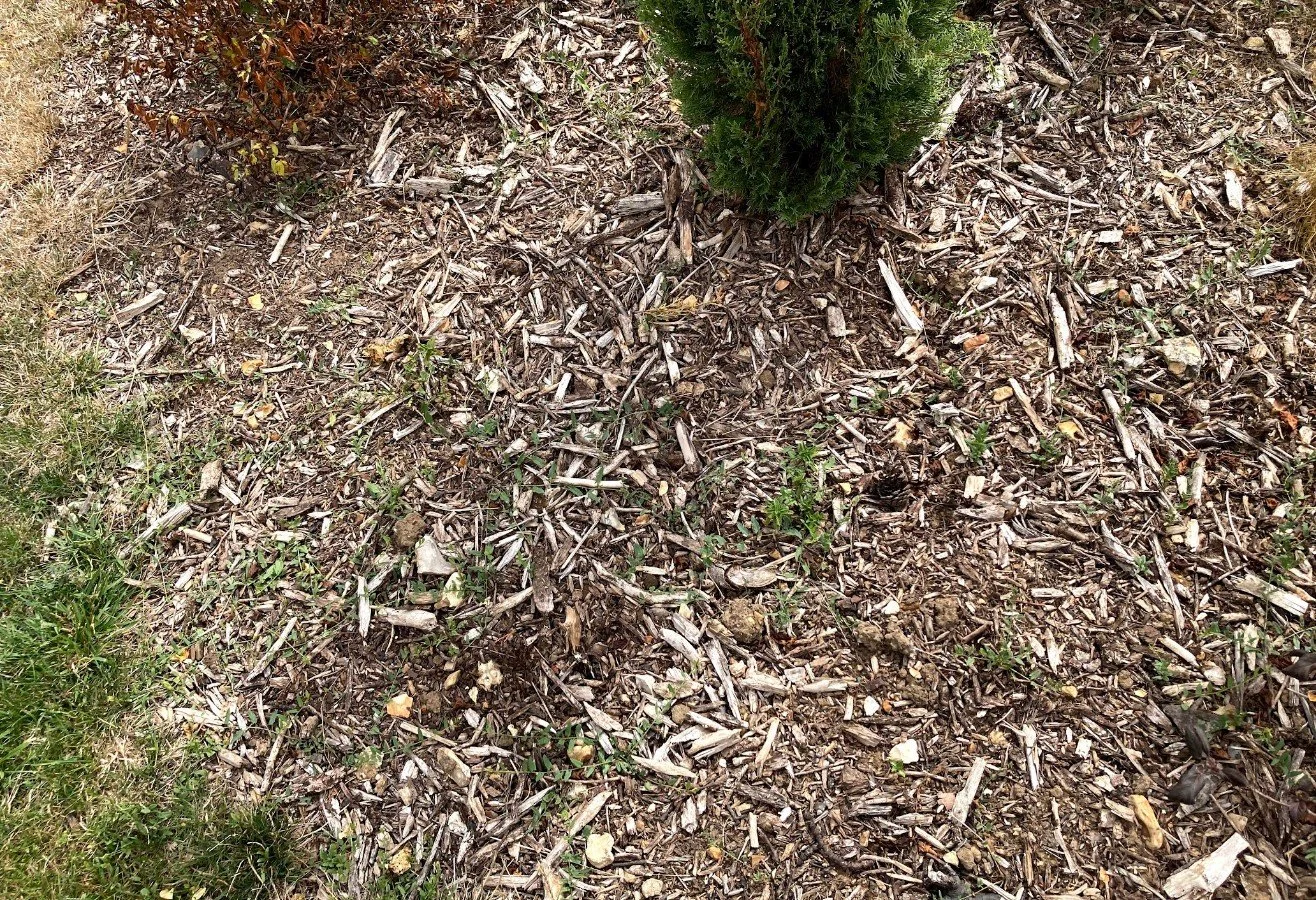
Above: Wood chip mulch at the foot of a young conifer, in Normandy. Photo Yves Nicolas, August 2020.
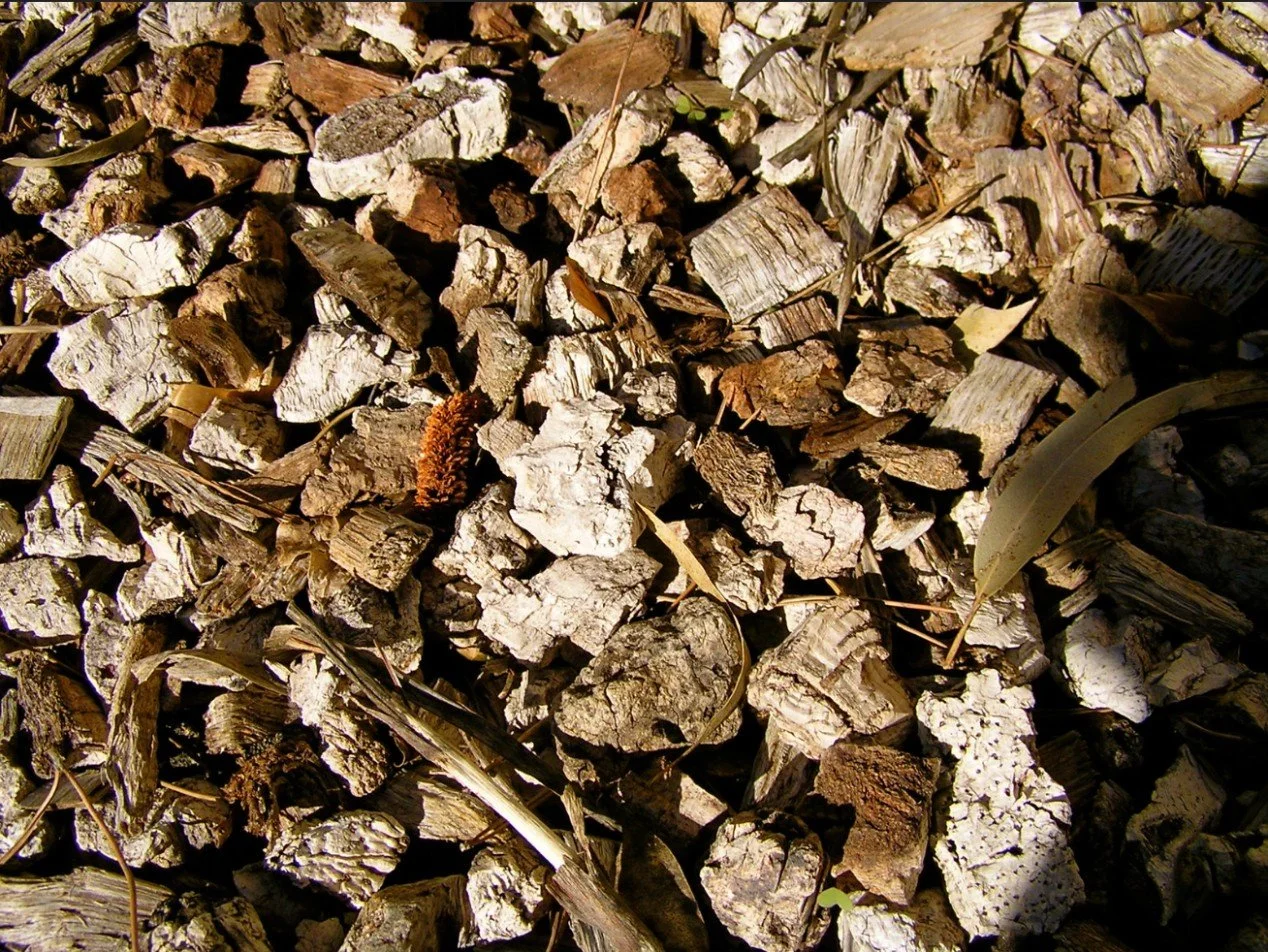
Above: Cork oak bark mulch, Quercus suber, at Bormes-les-Mimosas. Photo Patrick Nicolas, December 2011.
RCW from Nitrogen Fixers: Useful, but Not Magic
It remains to be seen whether RCW from nitrogen-fixing trees is better than the rest. By fixers I mean first of all perennials, shrubs and trees: Alnus, Robinia pseudoacacia, Elaeagnus, Leucaena leucocephala, the Acacia. Their wood seems the obvious answer to nitrogen hunger. The answer is more nuanced.
First, fixation takes place in the root nodules, not in the wood. What we chip is the nitrogen the tree has stored in its shoots and above all in its leaves. Their prunings have a low carbon to nitrogen ratio, 15 to 30 in my catalogue, and they decompose quickly. A study from the University of Pretoria on prunings of four leguminous trees showed that Leucaena leucocephala decomposed and released its nitrogen fastest, Acacia karoo slowest, and that the gap was explained by the ratio of lignin plus tannins to nitrogen. These prunings clearly improved yields of leafy vegetables compared with soil given nothing. In the Philippines, Lasco had also found that mulch from woody legumes improved soil and harvests more than a grass mulch. In Nigeria, Tian, Kang and Brussaard compared, in litter bags, prunings of Gliricidia sepium, Leucaena leucocephala, a non-fixing tree, Acioa barteri, rice straw and stalks of Zea mays: the two legumes gave back their nitrogen, Acioa locked it up, and the speed of decomposition ran inversely to the carbon to nitrogen ratio and the lignin. In Côte d'Ivoire, Budelman measured that a mulch of Gliricidia leaves lost half its mass in 22 days, and one of Leucaena in 31 days. To my knowledge, no published trial deals with woody chips of Alnus, Robinia or Elaeagnus: everything we know comes from leaves and fresh prunings.
But when we move on to RCW proper, chipped shoots, the advantage fades. The review by Barthès finds no clear advantage for leguminous RCW, and in Kenya, Kwabiah and his colleagues had even obtained poorer results with it than with other woods. There are two reasons for this, in my view: the nitrogen is in the leaf more than in the shoot, and many woody legumes are rich in tannins, which slow everything down.
I draw three rules from this. RCW from fixers is an excellent starter: it goes into the mix as a minority share, with its leaves when possible, to shorten the nitrogen loan of the structuring woods, and it is precious in the pre-compost heap. It does not replace wood that lasts: on its own, it breaks down quickly and builds little. And nitrogen is better made alive than chipped: a fixer planted in the border or the hedge works all year without a machine, and its prunings come as a bonus.
RCW Without a Chipper: Cutting with Secateurs
The chipper is not compulsory. Cutting with secateurs also serves as RCW. At pruning time, you cut the shoots again into short lengths, directly above the border, and let them fall at the foot of the plants, where they grew. This is what the forest does with its twigs, with no machine, no transport and no noise.
The principle stays the same: young wood, under seven centimetres, laid on the surface and never buried. What changes is the size of the pieces. The smaller they are, the greater the surface offered to the fungi and the faster the work goes. A secateur cutting is longer than a chipper chip, so it decomposes more slowly, but it stands up better to the wind and lets the air through. For a private gardener, for a small garden, or for a border where no machine can get in, it is the simplest way to take nothing out of the garden.
2. What Happens Beneath the Mulch
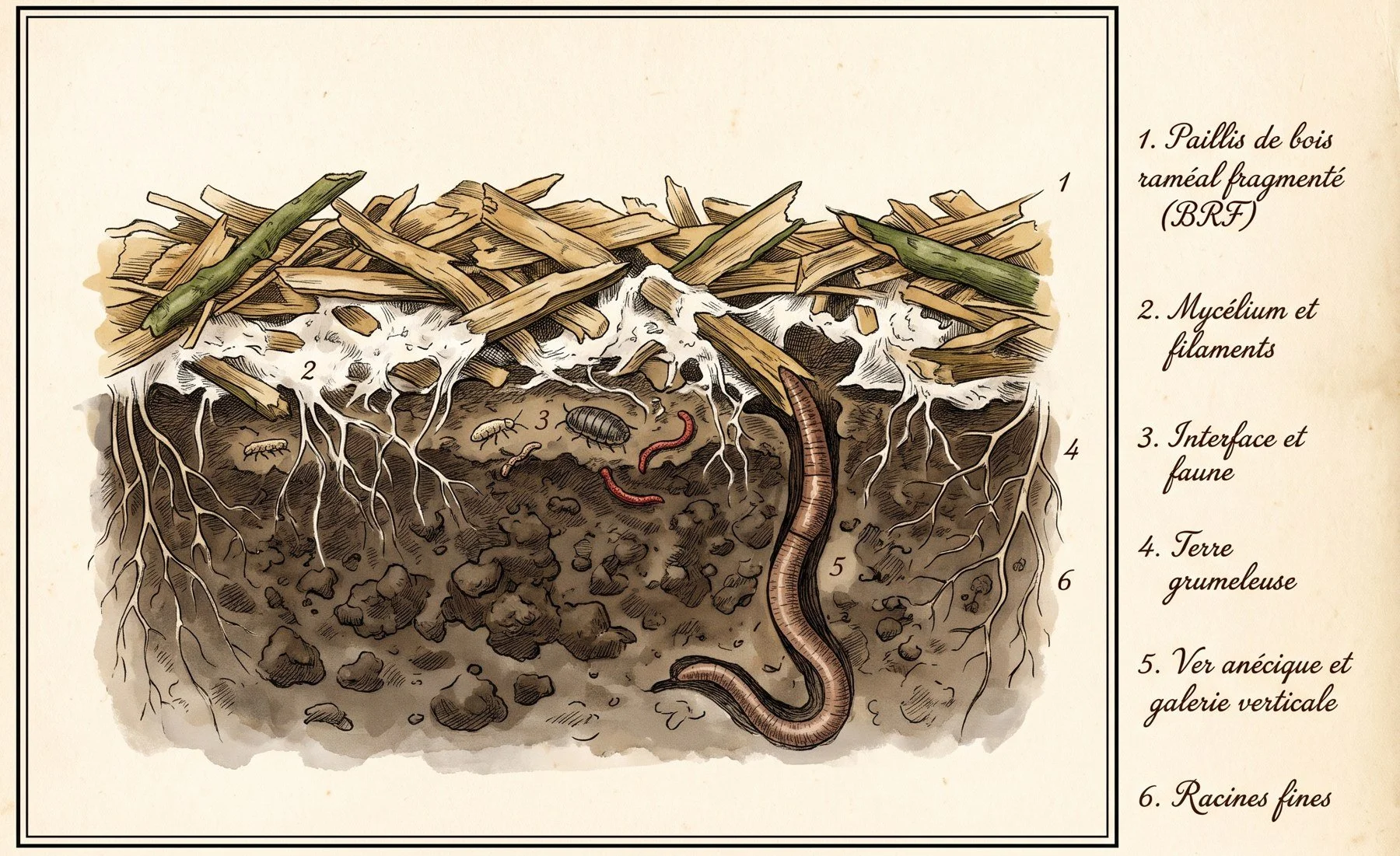
Above: Section of a soil under RCW mulch: the felt of mycelium wraps the chips and goes down towards the earth, the fauna works at the interface, the anecic earthworm drags leaves and decomposed fragments downwards, the fine roots rise. AI-generated illustration, naturalist engraving style.
The Fungi Do the Work
A soil does not digest wood. Lignin, which gives wood its rigidity, is a molecule that almost nothing knows how to undo, and that is exactly why trees invented it. Only a few fungi are capable of it, above all the basidiomycetes known as white rot fungi, which possess the enzymes able to open it up. It is they, and not bacteria, that do the bulk of the work.
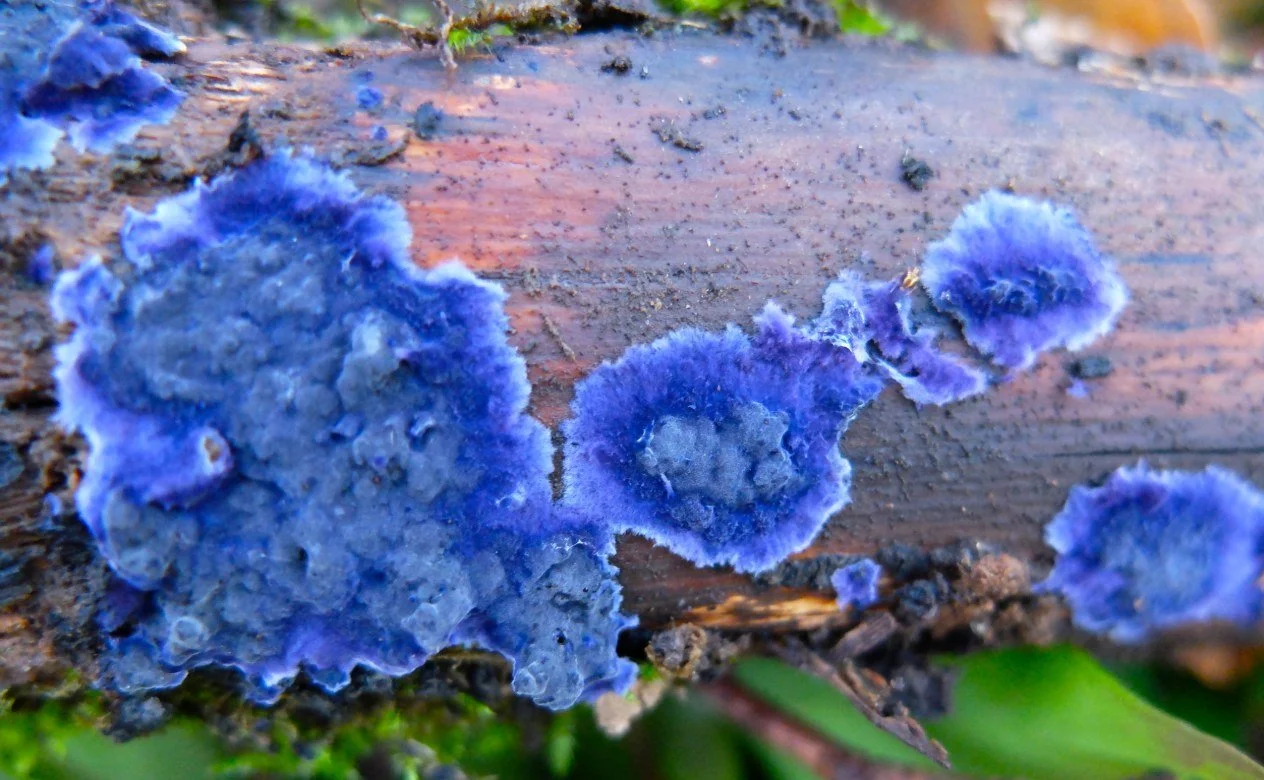
Above: The cobalt crust, Terana caerulea, a fungus that decomposes dead broadleaf wood, on a fallen branch at Clamart. Photo Patrick Nicolas, January 2015.
Canadian measurements show this clearly. On a Quebec loam, Lalande and his colleagues followed a soil amended with chipped shoots over two seasons. The bacteria reacted quickly and then fell back. The fungi, on the other hand, multiplied up to twenty-four times, and the effect held for two years running. In the second year, the water stability of aggregates rose sharply, which the authors attribute precisely to this fungal network, and the wood had brought trace elements along the way, zinc in particular. In another Quebec trial, on potatoes, Tremblay and Beauchamp observed the same fungal surge, a rise in soil carbon and in its water-holding capacity, and no worsening of common scab or rhizoctonia.
This network of filaments carries more than carbon. It carries water, it glues soil particles together and it makes the aggregate, that crumb of earth which lets air through and holds water. RCW does not feed the plant. It feeds the fungus that builds the soil where the plant will go and find for itself what it needs. The small animals follow: a Quebec study cited in the Barthès review counted up to twenty-three times more mesofauna, mainly mites and springtails, under the amended plots.
Nitrogen Hunger, a Loan and Not a Tax
Here is the reproach made against wood, and it has to be faced squarely. Wood is rich in carbon and poor in nitrogen. The organisms that attack it need both to build their own bodies. Not finding enough nitrogen in the wood, they go looking for it in the soil, where the roots draw, and the crop turns yellow. This is nitrogen hunger.
The phenomenon is real, but it is temporary and it is localised. Temporary, because the nitrogen has not disappeared: it is stored in microbial bodies and returns to the soil when they die. A team from Laval University measured this strikingly in Benin. Chipped shoots of Gmelina arborea and Sarcocephalus latifolius, buried in bags for eighteen months, had become richer in nitrogen, up to 2.6 times their initial content for the former. Wood does not steal nitrogen; it concentrates it, before giving it back. In the Lalande trial, nitrate immobilisation appeared only in the first season.
Localised, because everything depends on the gesture. Buried, the wood touches the soil with its whole volume and the loan is taken across the entire root zone. Laid on the surface, it touches the soil only with its underside, and the loan stays confined to a thin interface where crop roots do not feed. This is the conclusion of the reviews by Linda Chalker-Scott and James Downer on arborist chips: used as mulch, they do not lower the nitrogen of the soil beneath, and rather raise it over time.
For me, burying RCW or wood chips is a mistake, and not only because of nitrogen. Nature set the cycle and organised the whole pattern. In the forest, no branch is ever buried: it falls, settles on the litter, and everything decomposes from above. Fungi move down from the litter to the soil, worms come up to fetch the material and carry it off, and the soil builds itself in layers, from the surface downwards. To bury wood is to reverse this order, to put woody matter where there is neither the air nor the organisms made for it. The mechanism of nitrogen hunger only confirms what the forest has always shown. I am not alone in saying so. Claude and Lydia Bourguignon, soil microbiologists who left INRA to found their laboratory in 1990, explain it in Le sol, la terre et les champs (The Soil, the Earth and the Fields). Lignin, the substance that yields the most humus, is attacked only by fungi, and these fungi all need air: buried deep by ploughing, straw can no longer turn into humus, so that, in their view, modern agriculture has tripled straw production per hectare while dividing soil organic matter by three (p. 48). The farmer who leaves his straw on the soil, on the contrary, copies the natural environment, "la forêt où la litière reste sur le sol", the forest where the litter stays on the ground, in the shade of the trees (p. 84 and 88). And for RCW, they speak of a layer of 4 to 8 cm laid on the soil, never of burial (p. 88).
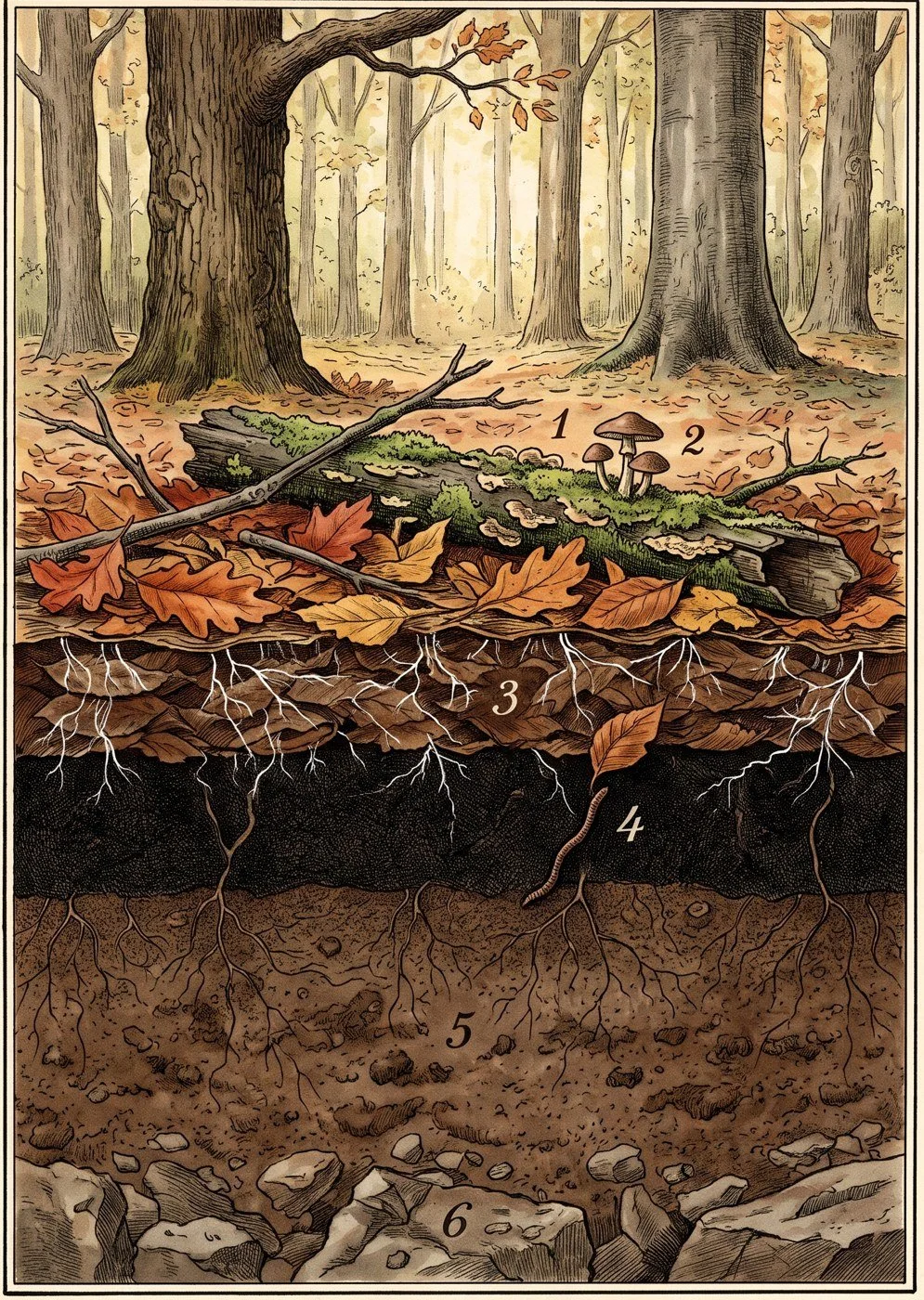
Above: The forest never buries itself. The fallen branch and the litter stay on the surface (1), where the fungi of dead wood attack them (2); beneath, the leaves come apart in the mycelium (3), the worm carries the material down to the humus (4), then come the earth threaded with roots (5) and the weathered rock (6). AI-generated illustration, naturalist engraving style.
On established trees and shrubs mulched on the surface, nitrogen hunger is almost a ghost: their reserves and the depth of their roots put them out of reach. It concerns only one case, that of the vegetable garden, seedlings and annuals, especially in the first year. It is in this case that pre-composting takes on its full meaning, as we shall see.
Water, Heat, Erosion
In Senegal, Soumare and his colleagues measured, after an application of chipped shoots, soil water retention increased by 21 to 24 % and bulk density reduced by 8 to 13 %. In Nigeria, a trial cited in the Barthès review recorded erosion reduced by 69 % under chip mulch compared with bare soil. In the Southern Alps, on gullied marls where summer storms and drought prevent any vegetation from taking hold, Breton, Crosaz and Rey showed that chip mulch improved the establishment of revegetation plants, precisely under conditions of erosion and drought.
In the field, I make the same observation in another form. On sandy soil, from my own observations, a single mulching, even of grass clippings of Cenchrus clandestinus, kikuyu, keeps markedly more water in the soil, through the shade it casts and through the soil insects it sets to work. I have not measured it; I see it in the plants. My criterion is simple: for the same daily watering, the mulched plant never reaches its wilting point. Under a wood mulch, the soil loses a fraction of what it would lose bare, the surface stays several degrees cooler, and the evening water reaches the roots instead of going back into the air. In Morocco, RCW serves first as a cover, well before it serves as a soil improver.
3. What the Trials Say, and What They Leave Unsaid
Let us be precise, for RCW has suffered from being presented as a cure-all. The best synthesis in French remains the review published in 2010 in Cahiers Agricultures by Bernard Barthès, with Manlay and Porte. It retains only statistically significant results, and its assessment is nuanced.
In temperate climates, the first yield after burial falls, sometimes sharply: by 20 to 80 % for wheat, Triticum aestivum, on sandy-gravelly soil, by 13 to 34 % for barley, Hordeum vulgare, on silty clay soil. In the following years it recovers, and can exceed the control by 30 to 75 % in the fourth year. Soil carbon rises by 10 to 40 % in the year after the application, more with repeated applications. The most favourable effects on water and soil structure are obtained with mulch, not with burial. But the authors also conclude that the results, few and heterogeneous, nearly half of them Canadian, hardly allow precise recommendations to be made. Species, diameter, chip size and dose modulate everything, and their influence remains poorly quantified.
Two long trials shed light on the rest. The first is old and almost forgotten. From 1951 to 1966, on the Marcellus research farm in New York State, a vegetable rotation was grown for fifteen years with or without broadleaf chips. According to Free's bulletin, organic matter at the end of the trial stood between 4.9 and 5.8 % under chips, against 3.6 to 4.2 % without. But Free also recommended adding nitrogen on the chip plots, and over three years sweet Zea mays did not differ significantly from the control: the extra nitrogen benefited mainly the chip plots.
The second is African and harsher. At Gampéla, in Burkina Faso, Georges Félix's team followed applications of shoots of Piliostigma reticulatum, a shrub that farmers already use: seven years at three tonnes of fresh matter per hectare per year, four years at twelve tonnes, or about six tonnes of dry matter. At the low dose, nothing stopped carbon and yields from declining. At the high dose, surface carbon stabilised and sorghum, Sorghum bicolor, doubled, but from very low yields everywhere. Yet the authors conclude that ramial wood cannot on its own replace what harvests export, and they suspect the termites, which are very active, of carrying part of it away.
These results do not condemn the method; they place it. RCW is not a fertiliser, it is an engine of soil life, and its effect is counted in seasons, between six months and two years, sometimes four depending on climate and dose, not by the following spring. It gives its best on the surface, in repeated applications, and paired with a second leg that most trials have not tested: a living cover of legumes that makes on the spot the nitrogen the wood does not bring.
What Recent Trials Say, from Switzerland to the Sahel
Since that review, trials have multiplied, and they confirm the picture while sharpening it.
In Switzerland, at the Agroscope station in Changins, Fontana and his colleagues worked a single application of 150 m³ of RCW per hectare into the soil with a rotavator in 2015, then followed five years of rotation. Yields did not move. But soil carbon on the treated plots went from 18.8 to 20.7 g per kg, a rise of 10 %, while the control stayed at 17.6, and the gap with the control was significant at the end of the trial; soil density fell, and readily available water rose by nearly 74 %. The other side of the coin: the crops contained less iron, manganese and zinc, as the wood holds back part of the trace elements while it decomposes.
Around the Mediterranean, the University of Barcelona team has been following market garden plots amended with RCW at Sant Boi de Llobregat since 2021. At a high dose, about 22 % of the carbon applied was still in the soil after a year, with no significant rise at a low dose or with compost. On tomatoes, yield was not significantly different from the control, but it was lower in raw figures under RCW, which one of the team's publications attributes to nitrogen immobilisation in the first year. In the Penedès, under organically grown chardonnay vines, Vitis vinifera, a 20 cm layer of Scots pine chips, Pinus sylvestris, laid under the row kept grass to around 10 % cover at most for two very dry years, without penalising the harvest. In Andalusia, olive pruning chips, Olea europaea, at 10 or 30 tonnes per hectare, cut soil losses by more than 95 % compared with tilled soil, as well as a cover of spontaneous grasses did, under simulated rain. Near Málaga, Aleppo pine chips, Pinus halepensis, kept the soil moister and improved the survival of reforestation seedlings, with no effect on carbon.
In the Maghreb, two Tunisian trials. In the oases of Tozeur, Dhaouadi and his colleagues buried RCW from nectarine trees, Prunus persica: the amended soil was usually moister after irrigation, but its salinity rose, and the authors warn that wood can store the salts of a heavily charged irrigation water and then release them as it decomposes. At Médenine, in an arid zone under saline irrigation, Oueriemmi and his colleagues combined 12 tonnes of RCW with palm compost: soil carbon was multiplied by 2.6 and then 3.7, but with no gain in barley yield, and no synergy between RCW and compost.
In the Sahel, the choice of species decides everything. At Thiès, in Senegal, RCW from Piliostigma reticulatum, which is very woody, penalised millet, Pennisetum glaucum, when the dose was pushed: without urea, above-ground biomass was half as large at 6 tonnes per hectare as at 4, whereas with the softer Guiera senegalensis it rose slightly with the dose. An incubation carried out at Gembloux on a soil from the Groundnut Basin confirmed it: Piliostigma immobilises nitrogen. Conversely, when Guiera shrubs are kept in the field, coppiced and left on the ground, millet rose by 126 % in a long-term trial, and the soil surface stayed below 35 °C. In Congo, 30 tonnes of RCW buried before planting raised cassava, Manihot esculenta, from 19 to 26 and 29 tonnes per hectare depending on the species. In Benin, RCW from Gmelina arborea kept the soil moister under irrigation cut by half.
Put end to end, these trials say the same thing. Yield is most often neutral, sometimes lower in the first year; the gain comes first in water and carbon, and it depends on the dose; failures almost always come down to wood that is too woody, to burial, to a first year without nitrogen, or to salt. To my knowledge, no trial on RCW has yet been published in Morocco; the gardens I have run there nonetheless give results that I describe in part 7.
One remark is needed in reading these figures. Many of these trials buried the wood, at Changins, at Tozeur, in Congo, at Laval itself: it is the agronomists' gesture, since they want a uniform and measurable treatment. I cite them because they measure something, not because I recommend their gesture. The negatives they show, the nitrogen loan, the drop in trace elements in the crops, the salt held and then released, probably owe something to this contact between the wood and the whole mass of the soil. Surface mulch has its failures all the same, as we shall see with the Ohio trials; in New Mexico, buried chips did not lower soil nitrogen; and at Gampéla, burial kept carbon a little better at depth. No trial, to my knowledge, directly compares the two gestures with the same wood. My preference for the surface rests on the mechanism described above, on the example of the forest and on the observation of my own gardens, not on a comparative trial.
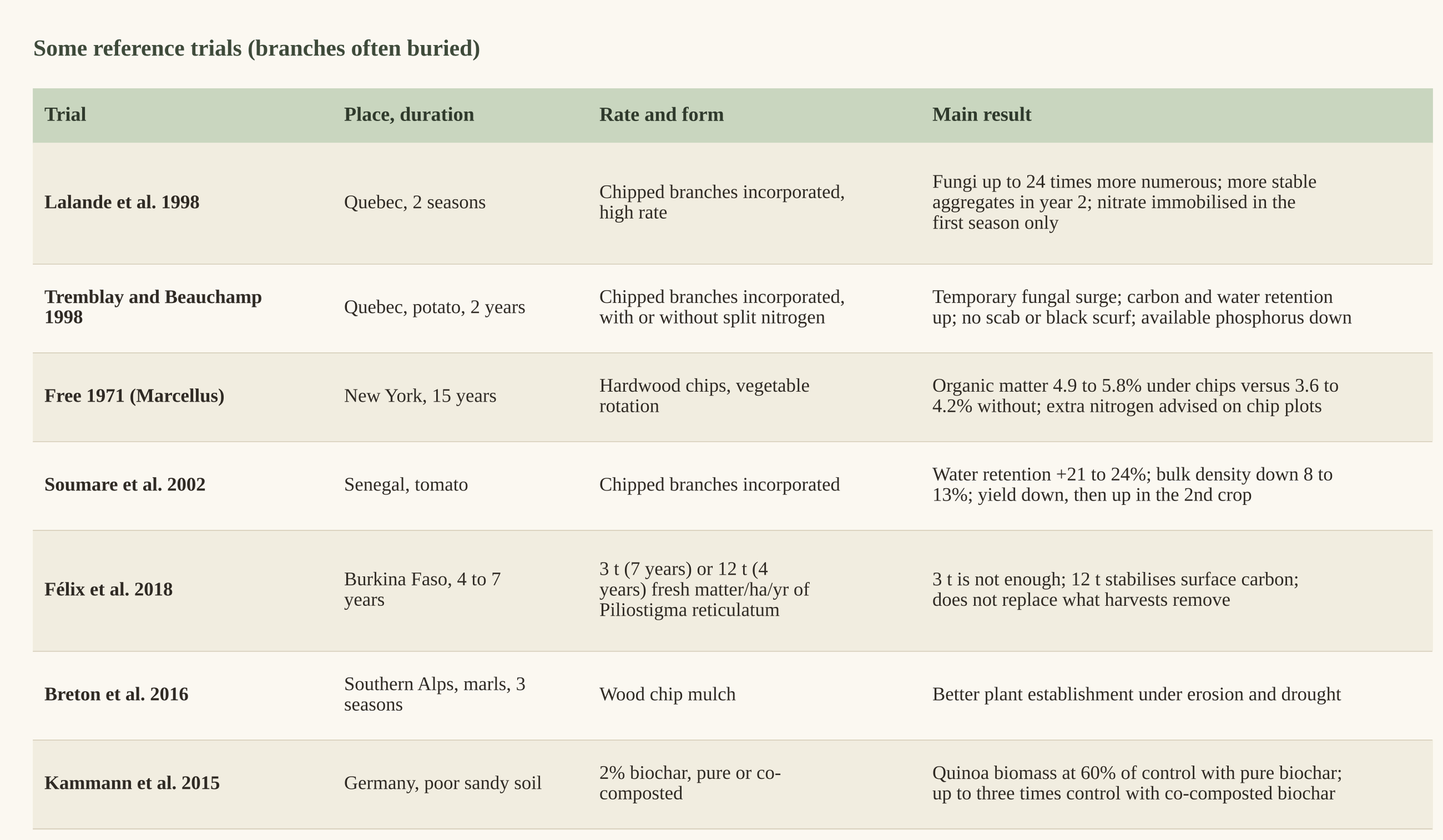
Above: Table 2. Some reference trials, their doses and their results.
4. Fresh or pre-composted: two schools
On one point practitioners have been quarrelling for thirty years, and it is better to watch the quarrel than to settle it too quickly.
The Laval school stands for fresh wood. Ramial chipped wood (RCW) should be spread soon after chipping, ideally within forty-eight hours, because longer storage starts a composting process that would degrade the natural fungal flora of the wood. This is the instruction the Cemagref adopted in its work on erosion. In Morocco, for fresh RCW, I apply an even stricter rule, the same-day rule: cut, chip, spread. The reason is climatic rather than doctrinal. Under the Moroccan heat, decomposition runs much faster than in a temperate climate. A heap of twigs left for a few days has already lost its water, its pioneer fungi have begun elsewhere the work we wanted to see done on the ground, and it draws pests. Inoculated pre-compost is another matter: a deliberate heap, moist, shaded and turned, which works instead of drying out.
American arborists also favour fresh material, but for other reasons. Linda Chalker-Scott, whose 2007 review of mulches is a standard reference, shows that coarse woody mulches laid on the surface are among the most effective, and, with Downer, that most of the fears raised against arborist chips do not stand up to the literature.
Opposite them, work from Ohio State University strikes a different note. Daniel Herms, Benjamin Stinner, Harry Hoitink and Mary Ann Rose compared, on Betula nigra, Rhododendron and Taxus, a mulch of composted green waste and a mulch of chipped pallets. The compost improved growth and flowering. The raw chipped wood caused deficiencies, slowed growth and increased root rot in the rhododendrons. It was pallet wood, admittedly, the exact opposite of RCW, but the gap says something about ordinary wood chips.
Lastly there is the question of plant health. Downer and his colleagues placed pathogens in heaps of chipped green waste that were left undisturbed: Sclerotinia sclerotiorum survived there for eight weeks, at the surface as well as in the core. Their conclusion is that heaps must be turned so that every part passes through the hot zone where it is destroyed. A heap of wood chips forgotten behind a shed is not compost. Over time, Hartz and Giannini followed green waste windrows in California, sampled every three weeks: nitrogen immobilisation appeared in almost every sample and decreased as the compost aged, and the authors conclude that at least nine to twelve weeks of composting are needed. Conversely, in New Mexico, Tahboub and his colleagues buried pecan prunings, Carya illinoinensis, chipped, for three years without seeing any fall in soil mineral nitrogen. Nitrogen hunger is not inevitable; it depends on the soil and on the wood.
So this is how I decide, according to climate and according to wood. Pure fresh RCW, laid on the surface under established trees and shrubs, remains beneficial, and I would not advise anyone against it. Ordinary wood chips, on the other hand, I always pre-compost before use: the result is far better. And the best technique I know combines the two. You mix RCW and wood chips, seed them with the micro-organisms of the site, fungi and bacteria, taken from its old compost, and pre-compost the whole. The seeding is done in two stages, for a reason we shall see in the next part: the heat of the heap kills some of what has been put into it. From the very first day, the inoculum brings the wood the population that will work it.
The Laval fear, of losing the fungal flora, seems to me well founded for a heap that ferments on its own and badly. It no longer holds when one inoculates on purpose. Inoculated pre-compost does not destroy the life of the wood; it selects it. It makes the nitrogen loan be paid in the heap rather than at the foot of the seedlings, it cleans the material, and it evens out very different kinds of chips. To my knowledge, no published comparative trial sets this inoculated mixture against fresh RCW. It is a field practice, and I offer it as such.
5. Pre-composting and inoculating wood chips
This is not about making compost in the usual sense, that dark material we bring in already digested. It is about pre-composting the wood chips or RCW before laying them, and using this spell in the heap to seed them with the micro-organisms of the site, fungi and bacteria. The wood remains wood, it reaches the ground barely touched, but it arrives inhabited.
The ferment, an idea eight centuries old
The idea of priming a fermentation is not new. Ibn al-Awwam, in the book of agriculture he composed in Seville at the end of the 12th century, takes from the Nabataean Agriculture the recipe for long, deep pits in which manures, pigeon droppings, leaves and vine shoots are mixed, and to which black silt, still wet, drawn from rivers or wells is added. In Clément-Mullet's translation he also names substances "which may serve as ferment", bat droppings, urine, blood, to bring on fermentation. That the silt serves as a starter rather than as food is my own reading: one goes to a damp bottom to fetch a material charged with life to set the work going. If my reading is right, this is already inoculation, centuries before microbiology, and it is the gesture I take up.
Why the inoculum must come from the site
Ready-made inocula are sold commercially, often based on Trichoderma harzianum or on white-rot fungi such as Phanerochaete chrysosporium. In the laboratory they speed up the breakdown of lignin. But a review published in BioCycle in 2022 points out that in open heaps, exposed to competition from the flora already present, inoculation may have no noticeable effect, and results vary widely from one study to the next. A strain from elsewhere arrives in a setting that is not its own and soon gives way. Two trials point in this direction. In Chiang Mai, Karnchanawong and Nissaikla compared two commercial inocula with plain mature compost on household waste and dry leaves: with 5 % mature compost the material decomposed the most, and the authors conclude that commercial products are probably unnecessary. In Spain, on woody plant waste, Jurado and his colleagues increased lignin breakdown by a quarter by inoculating microbial strains, and they attribute the effect to the stimulation of the flora already present rather than to the strains themselves.
So I take the micro-organisms, fungi and bacteria, on the spot, from the old compost of the site. They are already adapted to this soil, this water, this climate, and to the flora they will meet once the chips are laid. You do not import a population; you multiply the one that has already proved itself on the ground. And it costs nothing.
Managing the heap
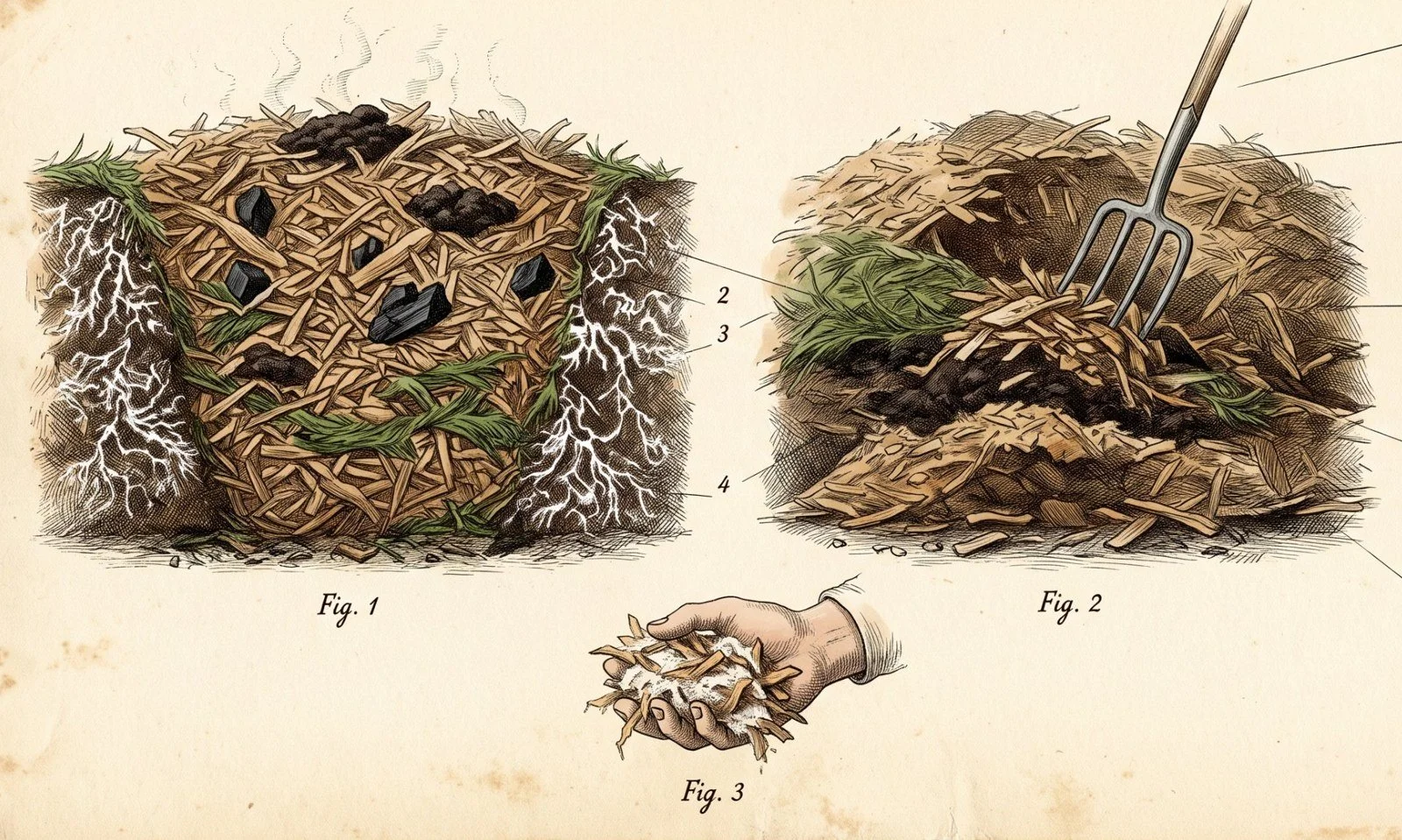
Above: Inoculated pre-compost: RCW and wood chips mixed with grass clippings, a starter of old compost and biochar (fig. 1), turned with a fork, the moment when the main inoculum is added once the heat has fallen (fig. 2), laid when the chips are covered with white felt (fig. 3). AI-generated illustration, naturalist engraving style.
The recipe comes down to a few actions. Mix RCW and wood chips. Since wood alone is too poor in nitrogen to get going, add green matter, grass clippings, fresh leaves or soft twigs from the first group, or manure when you have it, together with the share of biochar discussed further on. Add a first handful of old compost, one shovelful per barrowload at most: this is the starter, the ferment of Ibn al-Awwam. Build a heap of at least one cubic metre, since below that it does not heat, keep it as moist as a wrung-out sponge, and turn it. Turning is no detail. As we saw with Sclerotinia sclerotiorum, it is the mixing that brings every part of the heap into the hot zone where the pathogen is destroyed.
Inoculating at the right time, and in the right place
Here you must watch the thermometer. A well-built heap heats up within a few days, and its core can exceed 55 °C, sometimes 65 °C when one has been generous with grass clippings or manure. At these temperatures most of the inhabitants of old compost do not survive. The fungi that break down wood, white rots and Trichoderma, are organisms of moderate temperature: they stop growing at around 40 to 45 °C and vanish from the core during the hot phase. In Denmark, Klamer and Sochting followed this in a straw compost: before the heat peak Penicillium and Trichoderma dominated, after it heat-loving fungi such as Thermomyces lanuginosus. Ordinary bacteria retreat as well. What holds out are the bacteria that can shut themselves inside a spore, the Bacillus, the actinomycetes and those few thermophilic fungi, which do the work of the hot phase. Pouring in all your inoculum at the building stage therefore means losing a good part of it.
Hoitink's team, whom we shall meet again in part 8, showed this with composted hardwood bark. Chen and his colleagues took bark from the core of the heaps, at over 60 °C, and from their cooler edges. The substrate made from the edges protected cucumber seedlings from damping-off, while the one made from the core did not; mixing in 10 % of edge bark was enough to restore that power, and heating edge bark to 60 °C for five days made it lose it. In a second paper they watched core bark, left at 25 °C, become recolonised within three or four days by organisms of moderate temperature and turn protective in its turn.
A Spanish trial compared the two moments directly. In Murcia, Bernal-Vicente and her colleagues introduced a Trichoderma harzianum into heaps of vineyard waste, either at building or on the sixtieth day, at the start of maturation, when the heap had fallen back to 30 or 35 °C. The heap inoculated late kept more living Trichoderma at the end of composting, and it gave melons the best protection against fusarium wilt: 16 % of plants diseased after 43 days, against 50 % without inoculation. This was a commercial strain and not the old compost of a site, but the lesson about timing holds for both.
Hence the rule I apply. The small starter added at building sets off the fermentation, and part of it survives at the edges. The main inoculation takes place at the first turning after the heat peak, when the core has come back down below about 40 °C. A long-stemmed compost thermometer is enough, and failing that the hand, which should no longer want to pull away. In Île-de-France this often happens after two to four weeks, in Morocco much sooner. The old compost is then spread through the whole mass while turning, never in a layer or on top, where it would dry in the sun, and you water if need be, for an inoculum laid on dry wood colonises nothing. If the heap heats up a little afterwards, at the next turning bring the material from the edges, cooler and more populated, towards the centre. A very woody heap, poor in green matter, heats less, often without going above 50 °C: there, part of the inoculation made at building survives, and the second dose reinforces it.
The pre-compost is laid once the first heat has passed and the chips are covered with the white felt described at the start of this text. The population is established, and the nitrogen loan has been taken in the heap rather than at the foot of the plants. Climate sets the duration: a few weeks in Morocco, two to three months in Île-de-France. In Morocco, where everything moves much faster, the main thing is to keep the heap shaded and moist so that it does not dry out before it has done its work.
A mulch that is being colonised must not be trampled
Once laid, the pre-compost enters its most fragile period. During the first weeks, and sometimes the first months, the white felt seen in the heap has to leave the chips and go down in search of the soil. These are filaments finer than a hair, throwing bridges from one chip to another, then from the layer to the soil. These bridges have been measured. Frey, Six and Elliott followed labelled straw laid on soil: through their filaments the fungi carried carbon from the straw down into the soil aggregates and brought nitrogen from the soil up into the straw, and when they were held back with a fungicide these exchanges fell by about half. A single pass of a wheelbarrow, a few steps repeated in the same place, and these bridges are broken, the layer packed down, the air driven out. The fungus starts again elsewhere, but it has lost weeks, and on a footpath it never settles at all. In woodland near Basel, Waltert and his colleagues measured what walkers cost: where people trampled, the litter had shrunk by more than 70 % at two sites, and at one of them the fungal biomass on the roots of young beeches had fallen by 66 %. The large trees, deeply rooted, held out; it was the young plants and the surface layer that paid. Nothing proves that a mulch being colonised reacts like those young beeches, but it is the mulch, and not the established tree, that is fragile.
A new mulch must therefore be treated like a sowing. Plan the paths before mulching, lay boards or stepping stones where you will need to walk, top up starting from the back and working backwards, and do not walk on the layer, above all when it is wet. Avoid raking it or turning it over to "aerate" it as well: it aerates itself, through the burrows of soil fauna, provided it is left in peace. When the felt has reached the soil and the first fine roots are growing up into the layer, the mulch has taken. It will then bear an occasional pass, never regular traffic, which belongs to a path and not to a planted bed.
A share of biochar from the first day
A share of biochar in the heap is an undeniable plus, provided it is incorporated at the building stage. The review by Sanchez-Monedero and his colleagues gives about 10 % of the mixture as the optimal dose and shows that between 10 and 30 %, biochar reduces nitrogen losses as ammonia and nitrous oxide. Above all, the time in the heap charges the charcoal. Claudia Kammann and her team grew Chenopodium quinoa on a poor sandy soil: with 2 % of pure biochar and little nitrogen, biomass dropped to 60 % of the control; with the same biochar co-composted, it reached up to three times that of the control. Empty biochar starves the soil; biochar charged in the heap feeds it. In Belgium, Vandecasteele and his colleagues confirmed this at the scale of a composting platform: added from the start, biochar speeds up decomposition in the active phase and reduces greenhouse gases; added later, it mainly increases the carbon in the compost. A team from the University of Liège drew from this a co-composting factsheet for Burkina Faso, published on ORBi.
6. The garden's other mulches: grass, leaves, straw and all the rest
Wood is not alone. Every week a garden produces other materials that cover the soil just as well, provided you know their character. They do not replace wood chips, they complement them, and the rule stays the same: nothing leaves the garden.
Grass clippings
Cut grass is the opposite of wood. It is rich in nitrogen and comes apart very quickly. Kopp and Guillard followed grass clippings placed in bags in the thatch of a lawn: in sixteen weeks they had lost 86 to 94 % of their nitrogen, released into the soil. It is a free green manure that works fast and does not last. In south-west China, Fang and his colleagues measured that a mulch of fresh grass, Imperata cylindrica, released 55 % of its nitrogen in four months and 72 % in a year.
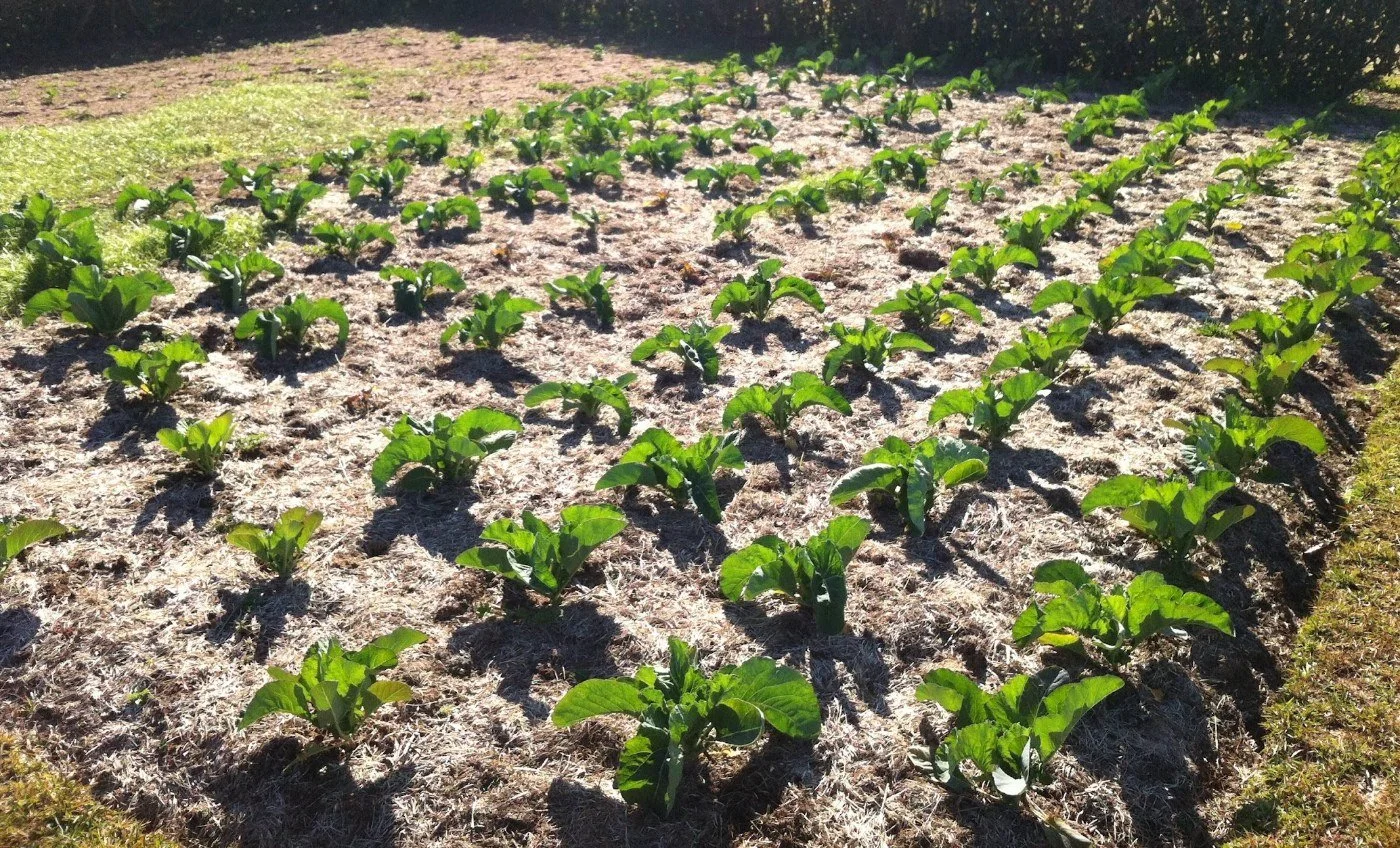
Above: Young cabbages planted in a mulch of grass clippings, Rabat. Photo Yves Nicolas, 20 February 2012.
Its fault lies in its fineness. Laid fresh in a thick layer, grass packs down into a wet cake that ferments, smells and cuts the soil off from the air. American extension services all give the same advice: let it dry before spreading it, lay it only in thin, renewed layers, and never use clippings from a lawn treated with weedkillers, whose residues can harm crops. Grasses that root from a single fragment, such as Cynodon dactylon, are also best avoided.
Well handled, it works wonders. On sandy soil, as I have said, a single mulching with clippings of Cenchrus clandestinus keeps, by my observations, markedly more water in the soil. And it is the best partner for wood: slipped in a thin layer under the wood chips, it pays at the interface the nitrogen loan the wood is about to take, and mixed into the pre-compost heap, it supplies the nitrogen that gets it started.
Dead leaves: to shred or not, and how
Dead leaves are the litter the forest lays down by itself every autumn, and that alone says a great deal. The question that keeps coming back is simple: should they be shredded? The answer depends on where you put them.
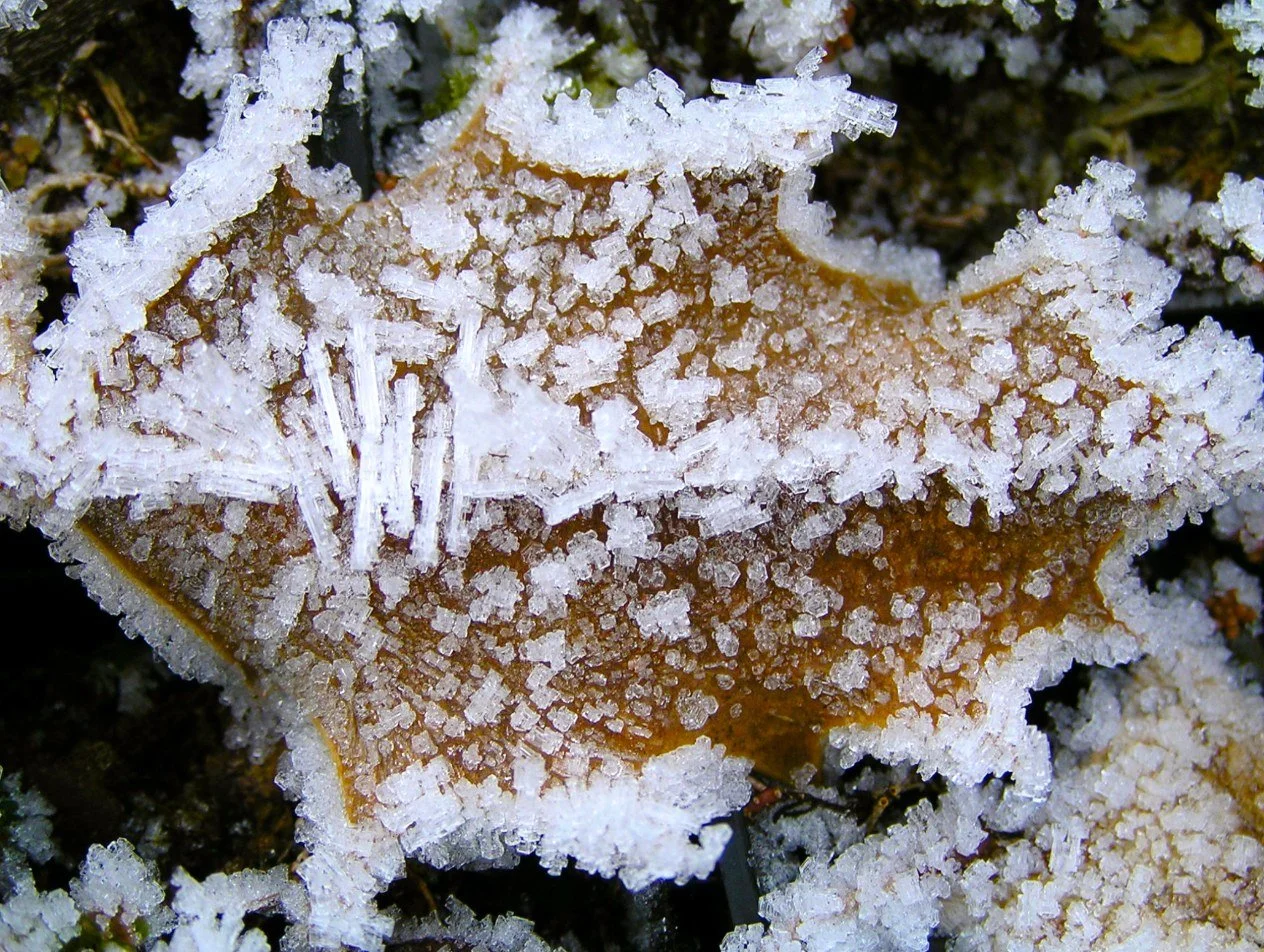
Above: Dead holly leaf, Ilex aquifolium, under hoar frost, Meudon. On the ground, the leaf is already protecting what lives beneath it. Photo Patrick Nicolas, December 2013.
Under trees and shrubs, leave them where they fall, whole. This is the natural litter; it protects the soil all winter and feeds its fauna.
Everywhere else, shred them. Whole, they stick together in the rain and form impermeable mats that smother small plants and let water run off. Shredded, they no longer pack down, they decompose faster and stay put better in the wind. The simplest tool is the mower: run it over them with the box open and in a few minutes you have a fine mulch to carry to the beds. On the lawn you can even leave them shredded where they lie. At Michigan State University, Kowalewski and his colleagues mowed maple and oak leaves into turf: the grass greened up earlier in spring, and dandelions fell by up to 80 % in the first year. In these trials, whether the pieces were fine or coarse made no difference to the result.
Leaves feed crops too. In New Jersey, Wyenandt and his colleagues mulched pumpkins, Cucurbita pepo, with leaves collected by the town: the fruits weighed on average 5 to 6 kg instead of 3.6 to 4.1 kg on bare soil, and 89 to 95 % were clean against 16 to 35 % without mulch. Yellowing appeared in the three weeks after emergence, the time of the nitrogen loan, and the first nitrogen application soon corrected it. Heckman and his colleagues later showed that this mulch went on feeding the following crops for several years.
There is one case where shredding is not merely convenient but a matter of hygiene: the leaves of diseased fruit trees. Apple scab, on Malus domestica, caused by Venturia inaequalis, overwinters in fallen leaves and starts again in spring through its spores. In Canada, Vincent and his colleagues cut spore production by 85 % by shredding these leaves in autumn. In South Africa, under a Mediterranean climate, von Diest and her colleagues reduced scab on young fruit by 49 % in one orchard and 20 % in the other by shredding fallen leaves, and Meitz-Hopkins and her colleagues later showed that this shredding, combined with mancozeb sprays, slows the fungus's drift towards fungicide resistance; on its own it had no clear effect on that point. In the United States, Sutton, MacHardy and Lord estimated that shredding all the litter in November or April reduced scab risk by 80 to 90 %. In Belgium, the CRA-W at Gembloux measured, in an organic orchard, a 42 % drop in spores by shredding the leaves in place, and 75 % by collecting them and burying the rest. Here the aim is no longer to feed the soil but to clean up the orchard: diseased leaves I prefer to shred and then hot-compost rather than bury. Shredding speeds up the decomposition of the leaf and deprives the fungus of its shelter.
For the vegetable garden, leaves are left to overwinter in a heap before being spread, as one American agricultural service advises, because some freshly shredded leaves can hold back certain crops. Mixed with grass clippings, the two balance each other: the leaf brings carbon and air, the clippings nitrogen. And whatever is left in spring joins the wood chip pre-compost heap.
Finally, the oldest technique of all: leaf mould. Pile the wet leaves in a wire-mesh enclosure, in the shade, add nothing, and forget them. It is mainly fungi that do the work, slowly. Out of it comes a brown material, fine and light, that holds water like a sponge and makes the best mulch for seedlings and delicate plants.
Straw and hay
Straw covers well and keeps in water: a study cited in Chalker-Scott's review measured evaporation reduced by 35 % under a straw mulch. In semi-arid Texas, Unger showed that with 12 tonnes of straw per hectare, water available at sowing rose from 12 to 21 cm and sorghum yield from 1.8 to 4 tonnes. But in Kansas, Klocke and his colleagues measured that almost complete cover is needed: at 25 or 75 % of soil covered, the effect on evaporation remained small. Straw suits the vegetable garden, strawberries and single-season crops. But it readily shelters rodents, which rules it out at the foot of trees and shrubs, it blows away and it burns. Hay brings more nitrogen, especially when it comes from legumes, but it also brings its seeds. Cut it before it sets seed, or pre-compost it.
All the rest
Vegetable tops, perennial stems cut back at the end of the season, weeds pulled before they seed, soft hedge trimmings: all of this can be laid on the surface, roughly cut, or go into the wood chip pre-compost heap, where it plays the part of the green matter. In Morocco, shredded palm fronds make a fibrous, long-lasting cover, provided they are shredded on the day they are cut because of the red palm weevil. Peelings and kitchen scraps are better sent to the wormery, which they feed better than a mulch that would draw animals.
Good cover is almost always a mixture. Wood brings duration and structure, grass and green matter bring nitrogen and speed, leaves bring fine litter. A soil covered with all of these at once at last looks like what it is under a forest.
Ranking mulches: from green manure to framework
All these mulches sit on a single scale, that of the C:N ratio. At the bottom, green materials, rich in nitrogen, which feed quickly and vanish quickly. At the top, woody materials, rich in carbon, which feed slowly, last a long time and borrow nitrogen along the way. In between, leaves and straw. The values below are orders of magnitude: they can vary twofold depending on species, season and diameter.
This scale is a tool for composing. For a quick start or a vegetable garden, go towards the bottom. For cover that lasts and a soil that builds itself, go towards the top. And the best mulch is almost always a mixture of the two ends.
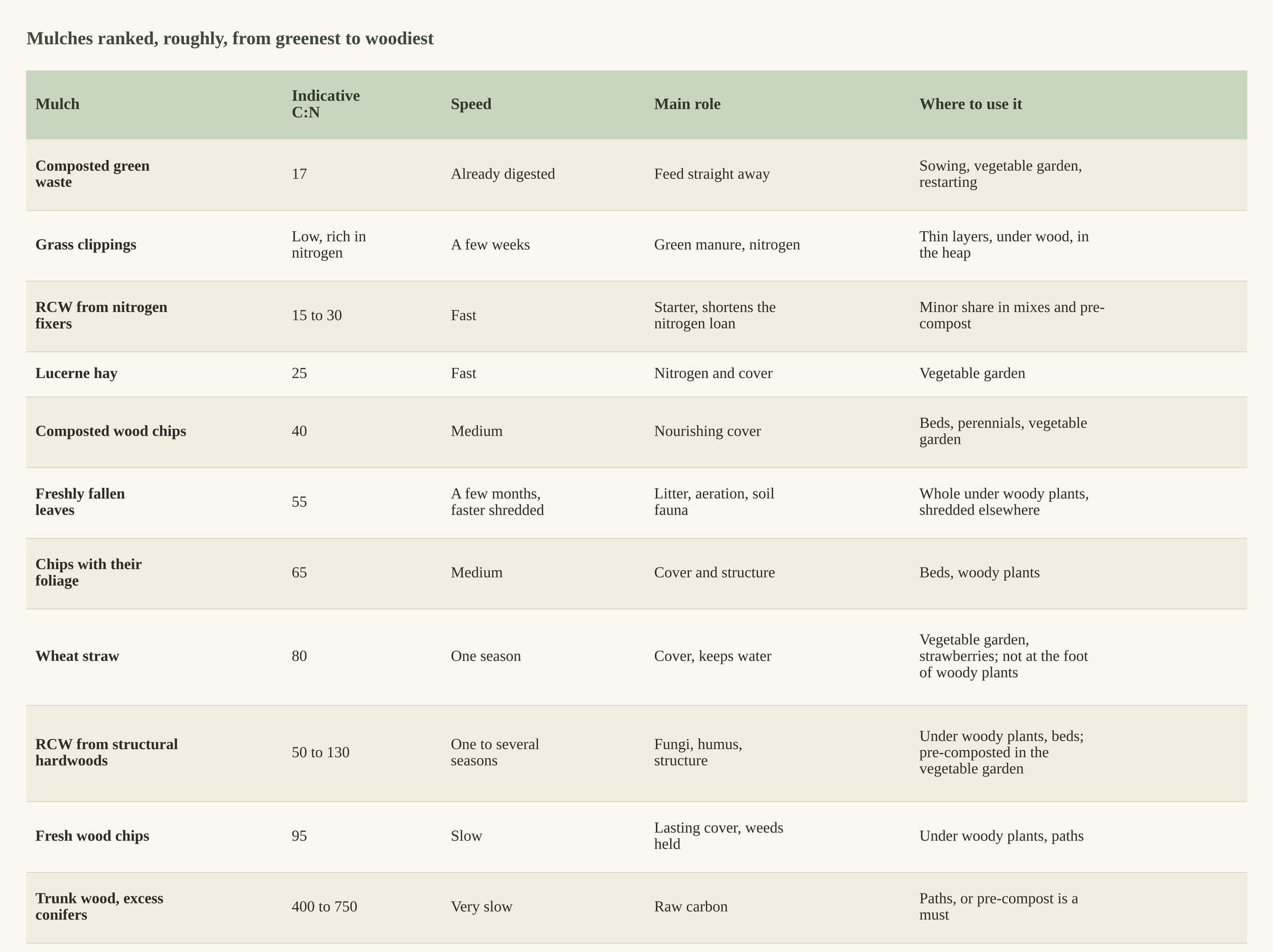
Above: Table 3. Mulches ranked by their C:N ratio. Indicative values: NRCS (2018), Caron (2015) for trunk wood, my own catalogue for RCW; ranges overlap depending on species and sources.
7. How to use it, situation by situation
The right thickness, according to climate and moisture
This is the question I am asked most often, and the answer is not a single figure. The thickness depends on what you want to achieve, on the material, and above all on the climate and the moisture of the soil.
Let us begin with what the measurements say. The rules of arboriculture recommend five to ten centimetres at the foot of trees. A systematic review published in 2026 in Arboriculture & Urban Forestry by Martin, Klein, Koeser and Hauer notes that few negative effects are reported within this range and more beyond it, but concludes that the evidence remains inconclusive and that no maximum thickness has been established. Greenly and Rakow compared pine and hardwood chips at 7.5, 15 and 25 centimetres on a heavy loam: young trees grew best at 7.5 centimetres, and the grass retreated further the thicker the layer. Billeaud and Zajicek, working with four wood and bark mulches, saw plant growth falter beyond ten centimetres, the coarse mulches always outperforming the fine ones.
Where water is concerned, most of the gain comes from the first few centimetres. An old study from Kansas, cited in a literature review on mulching, had already measured that a little over one centimetre of mulch cut evaporation by 41 %, and that six centimetres more only raised the reduction to 67 %: the return falls off quickly with thickness. In a semi-arid climate, in Nebraska, van Donk and his colleagues followed chips at 2.5, 5 and 10 centimetres for three years without any watering: every thickness conserved soil water better than bare soil, but the grass was only really held back from five centimetres upwards. In Beijing, under simulated rain, Wang and his colleagues even found that a mulch that was too thick, at one kilo per square metre, held the rain at its surface to the point that the soil received less water than bare soil did: the optimum lay between 0.25 and 0.5 kg per square metre. In Lithuania, in a humid climate, straw, peat and sawdust at 5 or 10 cm kept the soil moister, whereas cut grass gained almost nothing there. In Phoenix, in the heart of the desert, Singer and Martin measured that organic mulches kept the soil cooler at depth, even when their own surface grew hotter in the sun.
And the air? People fear that a thick mulch will smother the soil. For coarse wood, the measurements say the opposite. Under forty-five centimetres of fresh chips laid over tree roots, Watson and Kupkowski found no significant drop in oxygen diffusion in the soil after two years, and the roots had colonised the mulch. Shahzad, Chalker-Scott, Flury and their colleagues measured that gas passes through a layer of chips about a hundred times more easily than through landscape fabric, and that the soil oxygen beneath the chips stayed equal to that of bare soil. Asphyxia comes from deep burial, from fine materials that pack down and from thick layers on heavy waterlogged soil, not from the thickness of coarse wood laid on the surface. The American soil conservation service sums it up in one sentence: avoid mulches that are too thick or too dense, which create soggy, airless conditions at the soil surface.
Conifers raise a separate question, but it is a chemical one rather than a matter of oxygen. Their monoterpenes slow down nitrification: Paavolainen and his colleagues showed this on a spruce soil, where these vapours also increased microbial respiration. This is probably one of the reasons for the limit of ten to twenty per cent conifer wood in ramial chipped wood (RCW), and one more argument for pre-composting wood chips that contain a lot of it, since these compounds break down in the presence of air.
From all this, and from my own sites, I draw a rule for each climate. It does not come from a single trial: it is a synthesis, and it is adjusted in the field.
In a humid climate on heavy soil, as on the clays of Île-de-France, keep to five centimetres at rest under the beds. A thick mulch there slows the warming and drying of the soil in spring, and on clay saturated with water, that is where the risk of asphyxia becomes real. Keep the wood chips coarse, and do not mulch a waterlogged soil.
In a temperate climate on healthy or sandy soil, five to ten centimetres at rest. Under trees and shrubs, when the aim is to hold back the grass, you can go much higher with coarse wood, up to twenty centimetres, without any measured asphyxia, but at the cost of a soil that is slower to warm up: this is a thickness for weeding, not for growth.
In a Mediterranean climate and in Morocco, the wood decomposes much faster and the layer melts away. I spread seven to eight centimetres so that five remain at rest a month later, and I renew it every year. In the pre-Saharan zone, where the cover disappears in three or four weeks, one reasons in terms of frequency rather than thickness: three centimetres renewed every three or four weeks is better than a thick layer laid down once.
The material counts as much as the climate. The finer it is, the thinner the layer must be. Grass clippings are laid dry and in layers of only a few centimetres, sawdust in a very thin layer because it crusts over, straw and dry leaves more thickly because they are airy and settle. Coarse wood is the only material that tolerates great thicknesses.
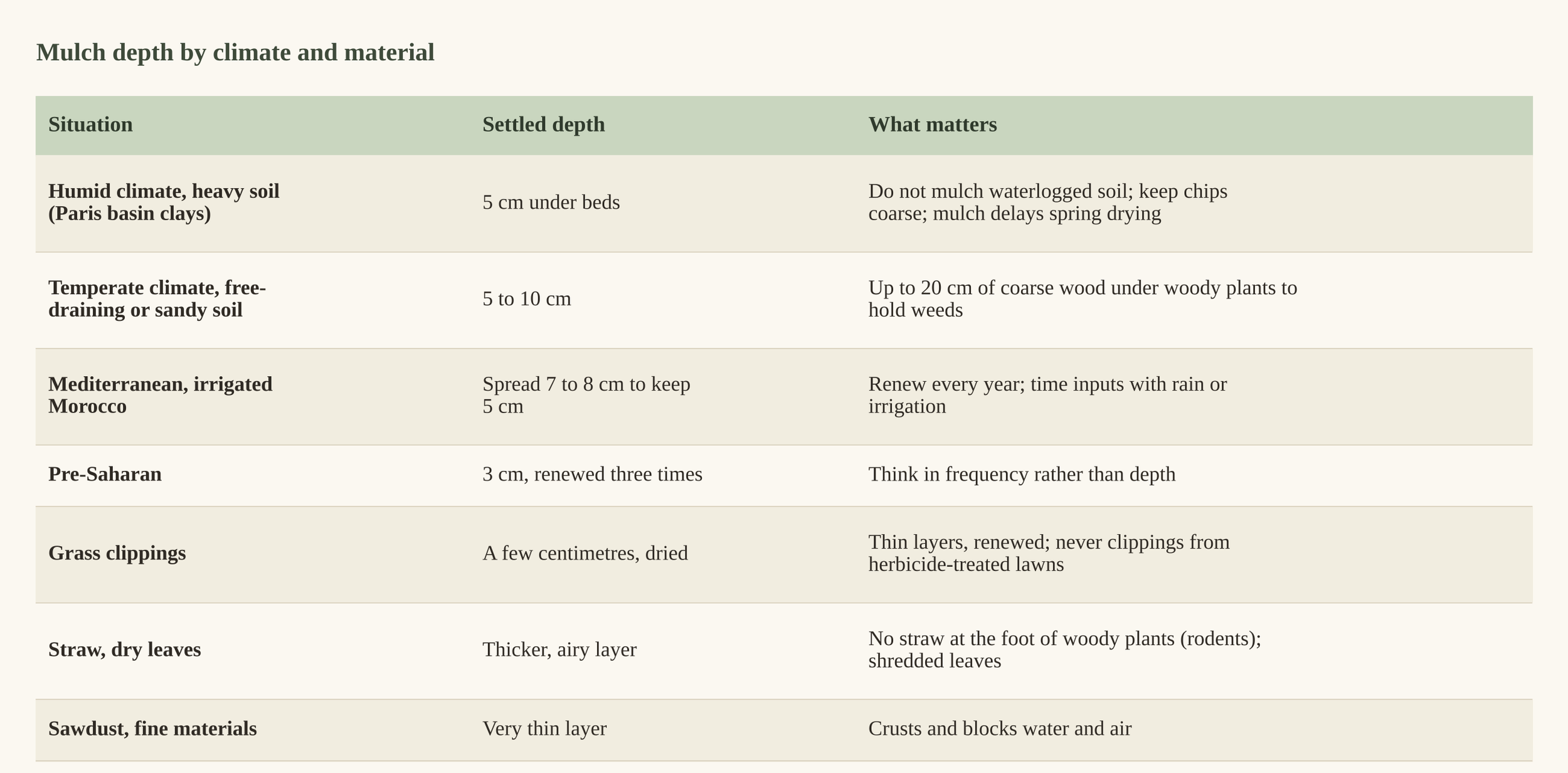
Above: Table 4. Mulch thickness at rest, according to climate, soil and material.
When to renew: the mulch will tell you
How often should you top it up? No calendar holds good, because the same wood chips vanish in three or four weeks in the pre-Saharan zone and last more than a year under an oak in Île-de-France. The frequency can be read on the mulch itself. You only need to go and look at it, scratch it with your hand, and watch for a few simple signs.
The first sign is the most obvious: when the soil reappears in patches between the chips, the cover is no longer doing its work of shading, and the water goes back into the air. Top it up before the soil is bare, not after.
Measure the thickness a month after spreading, once it has settled, and again as the season goes on. When it has fallen below half the thickness aimed at for the local climate, it is time to add another layer.
When you scratch it, you should see three storeys: at the top, chips that are still recognisable; in the middle, a brown layer where the wood crumbles and is covered with white filaments; at the bottom, a dark, crumbly earth where nothing can be told apart any longer. As long as the top storey exists, wait. When the recognisable wood has gone and everything has turned to earth, the cover has been eaten: the soil has done its work, and it needs feeding again.
Weeds sprouting on the surface of the mulch tell you that the layer has become too thin or too fine to block their light. Roots of cultivated plants rising into the mulch tell you, on the contrary, that it is alive and that they find coolness and food there: this is a good sign, and it is also the reason never to tear it up to replace it, but always to top it up from above.
In summer, slip your hand under the mulch in the middle of the day. If the earth feels dry and warm to the touch, the layer no longer protects it, whatever its apparent thickness. If it is cool, you can wait.
A matted cake of grass clippings, a crust of sawdust, whole leaves lying in waterproof sheets are not topped up as they are. Break them up or rake them lightly, then put coarse material on top.
The measurements confirm that not all woods melt away at the same pace. In Florida, Duryea and her colleagues followed six mulches for a year: tree-trimming chips, wood and leaves mixed, had lost 32 % of their mass, eucalyptus 21 %, whereas pine bark, pine needles, cypress and melaleuca had lost only 3 to 7 %, and the layer of pine needles had settled from 9 to 4 cm. The richer a mulch is in lignin, the longer it lasts; the richer it is in leaves and nitrogen, the more often it must be topped up.
In practice, this gives very different rhythms. Under trees in a humid climate, one top-up a year, sometimes every two years. In Morocco, at least one top-up a year, often more on watered beds, where soil life consumes quickly. In the pre-Saharan zone, every three or four weeks in the hot season. Grass clippings, which lose most of their nitrogen in a few weeks, are renewed as the mowing goes on. But these are orders of magnitude: the rule is the eye. A gardener who looks at his mulch once a month needs no calendar.
Box. The new garden: five years of compulsory mulching
Most gardens created today do not grow on a soil, but on displaced earth. Imported topsoil bought by the lorryload, earth stripped and stored in heaps during the works, earth turned over, compacted by machinery, levelled and then put back in place: this is the lot of almost every new building and almost every new garden. This earth has kept its minerals. It has lost its living organisation.
The studies confirm it. In heaps of stored soil in England, Abdul-Kareem and McRae measured a lack of air at the core of the heaps, with a fall in mycorrhizas, in microbial biomass and above all in earthworms, while noting that many of these effects seem to fade once the soil is spread out again. In Western Australia, Birnbaum and her colleagues found the weakest growth in the greenhouse in soils stored for ten years, and estimate that mycorrhizal fungi, disrupted by stripping and storage, only re-establish themselves after five to ten years. In the south-western United States, recent gardens harboured fewer species of these fungi than those created twenty to forty years earlier. Not every disturbed soil is sterile, but all of them have lost time.
That is why I regard it as imperative, during the first five years after planting, to mulch the whole garden with RCW or pre-composted wood chips, inoculated with old compost or living soil from the site, and enriched with a share of biochar from the very start of composting. To my mind, it is the only way to rebuild in a few years what the building works destroyed: the network of surface mycelium, the nitrogen-fixing bacteria that carry nitrogenase, the enzyme that transforms nitrogen from the air, and more broadly the whole set of symbioses between roots and soil. The wood feeds the fungi that weave this network. The inoculum brings in the missing inhabitants. The biochar offers them a porous shelter, and it has been shown to favour nitrogen fixation: in Colombia, in a pot trial, Rondon and his colleagues saw the share of nitrogen that the bean, Phaseolus vulgaris, draws from the air rise from 50 to 72 % at the highest dose of biochar, and the quantity of nitrogen fixed increase by 49 to 78 % at medium doses.
The most telling example comes from the sand pits of Quebec, to which I return in part 9: on a soil laid bare by extraction, only the pines planted under a continuous layer of ramial wood formed a forest, and the researchers found there a soil richer in fungi, nitrogen, phosphorus and potassium, with signs of nitrogen fixation by free-living bacteria; each seedling had, however, received a small dose of fertiliser at planting. Conversely, in a new garden left bare or covered with fabric, the roots remain alone, the earth closes up, and one makes up with watering and fertiliser for what the soil does not do.
In practice: a continuous layer over all planted surfaces, never only at the foot of the plants; a top-up as soon as the mulch grows thin, according to observation; no burial; no walking on the layer while it is being colonised; no soluble fertiliser, which spares the roots the trouble of seeking their partners. After five years, when the white felt of the fungi appears under the mulch and the earthworms come back up, the garden has regained a soil, and one can move on to the ordinary maintenance rhythm.
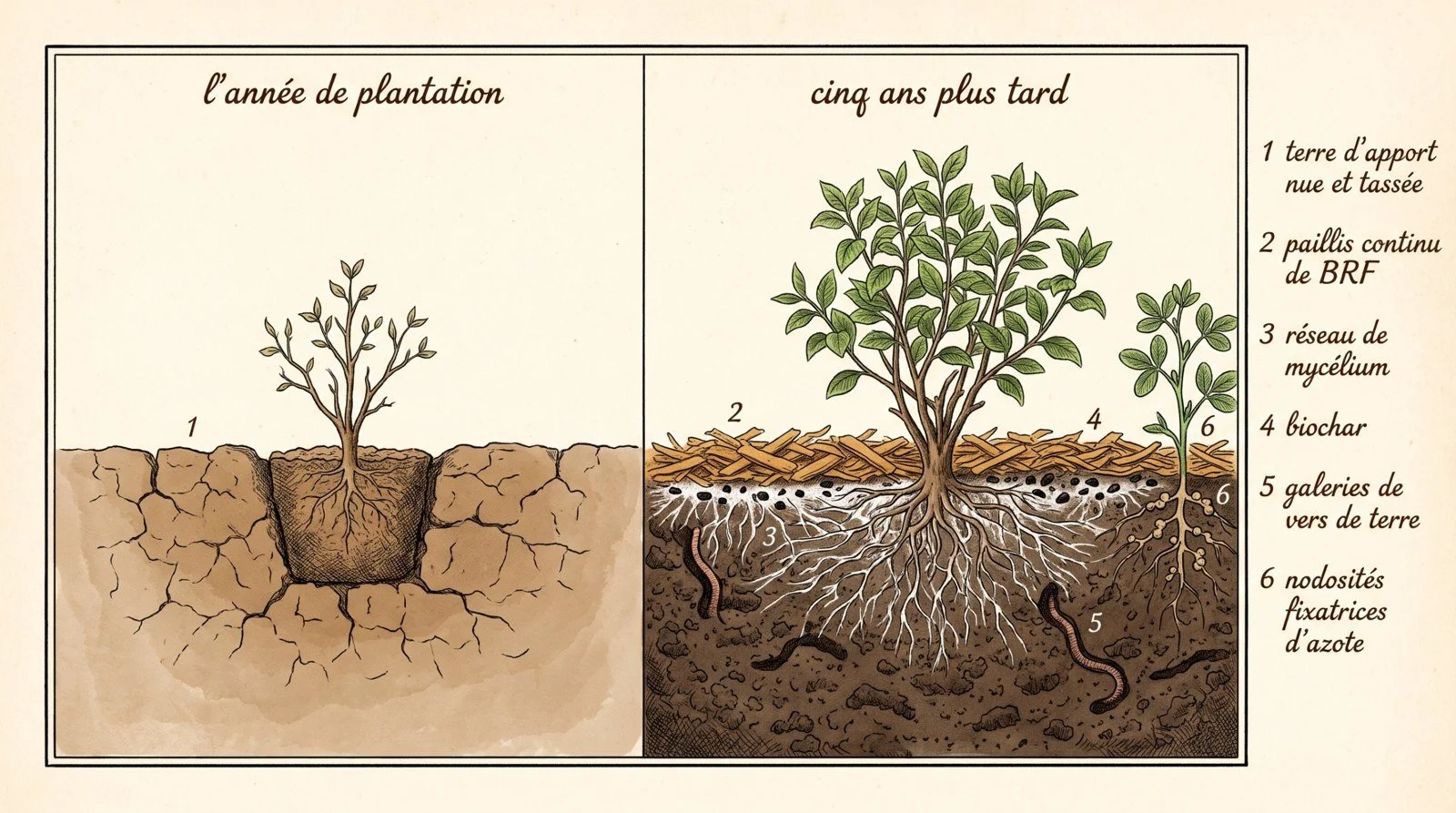
Above: The new garden. On the left, the year of planting: bare, compacted imported topsoil, roots imprisoned in the root ball. On the right, five years of continuous mulching with pre-composted RCW and biochar: mycelium, earthworm burrows, nitrogen-fixing nodules, roots spread wide. AI-generated illustration, naturalist engraving style.
Holding back the grass
Many gardeners mulch first of all so as to stop weeding. A weed seed germinating under a layer of wood chips seeks the light and does not find it: it exhausts its reserves before reaching the surface. The thicker and coarser the layer, the longer it takes to get through, and wood, which lasts, holds this barrier longer than any other mulch. This was seen under the vines of the Penedès, where 20 cm of pine wood chips kept grass cover at around 10 % through two dry years, and in Michigan, where a straw mulch reduced weed mass by 78 %.
The heat of the pre-compost does the rest: it kills a large share of the seeds brought in with grass clippings and prunings. In Canada, Larney and Blackshaw buried the seeds of thirteen weeds in compost windrows: after three weeks, only one species still germinated. Some died as early as 39 °C, others required more than 60 °C, and heat explained only part of the deaths, other factors in the heap playing a role as well. Pre-composted and turned wood chips therefore lay down fewer seeds than fresh wood chips mixed with greenery.
Mulch stops seeds, but not perennials with rhizomes or bulbils, which pass through the layer or travel beneath it: couch grass and Cynodon dactylon, bindweed, Convolvulus arvensis, and in Morocco nutgrass, Cyperus rotundus. These are pulled out before mulching, then watched: a thick mulch weakens them and makes pulling easy, but it does not make them disappear. Finally, a layer that grows thin or breaks up becomes a seedbed again; as we have seen, that is the sign it needs topping up.
Under established trees and shrubs
This is the simplest and safest case. Fresh RCW or a pre-composted mix, on the surface, never buried. Keep to the thickness suited to the climate and leave a clear ring around the collar: mulch pressed against the bark maintains a dampness that opportunistic pathogens take advantage of. It is also the only means I know of having less grass over the long term. A Washington State University thesis shows that a chip mulch smothers weeds all the better for being coarse and thick: the thesis recommends particles of at least one centimetre and a layer of at least twenty centimetres for this use. RCW has one last advantage that is less often noticed: it makes layering and suckering easier for many shrubs, which take root in the cool layer.
Perennial beds
Preferably a pre-composted mix, on the surface, renewed every year. Fresh wood also suits well-established perennials, but pre-compost avoids the yellowing of young plantings and gives a finer mulch that is more pleasing to the eye.
Vegetable garden, sowings and annuals
This is the only case where nitrogen hunger is a real risk. Never bury wood, fresh or pre-composted. Inoculated pre-compost on the surface, or mature compost at the foot of the seedlings and wood on the paths. A cover of legumes sown under the mulch repays the loan in place of the crops. Pieces of wood hinder root vegetables, carrots above all, and attract slugs and field mice: take this into account when planning the beds.
Banks, eroded soils, building sites
A chip mulch holds up against moderate storms when it is well laid, and helps plants establish themselves on bare soil. On a steep slope, combine it with cuttings and fascines; wood alone will not hold a bank.
Sandy soils and hot climates
RCW was born in a cold, humid climate, on deciduous broadleaves, in deep acid soils. In Morocco, we apply it in a hot, dry climate, on species that are often evergreen and aromatic, in thin limestone soils. The mechanism travels, but the dominant function changes. In a boreal climate, the wood builds a humus that lasts. In the Moroccan climate, part of the wood burns off before being transformed, and what one gains shifts towards water conserved, temperature lowered and the fungal network maintained. And the inputs are timed to the rains or the irrigation, because wood laid dry on a dry soil does not decompose.
In Marrakech: wood in the furrow
There is another way of using prunings, which I put into practice in the vegetable garden of a private estate in Marrakech. The principle is on my website, and I describe it here as it stands. The beds alternate ridges of 30 to 40 cm with furrows 40 cm wide and deep. At the bottom of the furrows, fresh olive prunings are laid, wood and leaves mixed, cut with secateurs into pieces of 3 to 10 cm, up to the level of the ridges, so that once filled the bed becomes flat again; this is then covered with various waste, wood chips and grass clippings, mixed or not. The ridges receive about 5 cm of RCW, the furrows a thin mulch of grass clippings, RCW or straw depending on what the garden provides. All the furrows, filled with wood, are flooded at a frequency that depends directly on the weather: the wood soaks up the water and releases it slowly to the deep roots, while the ridges stay aerated and are never drowned. The large pieces do not pack down like a fine RCW, and air circulates. The wood is not mixed into the earth: it fills an open hollow, like the branches that collect at the bottom of a ditch or a ravine, and remains in contact with the air from above.
The result I observed, in spring 2016 as in the years that followed: watering once a week instead of daily, without any chemical input, and crops more vigorous and more resistant to heatwaves than those grown under a simple RCW cover on the same site, with only a slight nitrogen lock-up at the start. This is a field observation on one estate, compared with the conventional cover at the same place, not a replicated and measured trial. But it agrees with what the trials on coarse wood say, since coarse wood keeps air and water, and with what the Sahel trials say about shrubs left in the field.
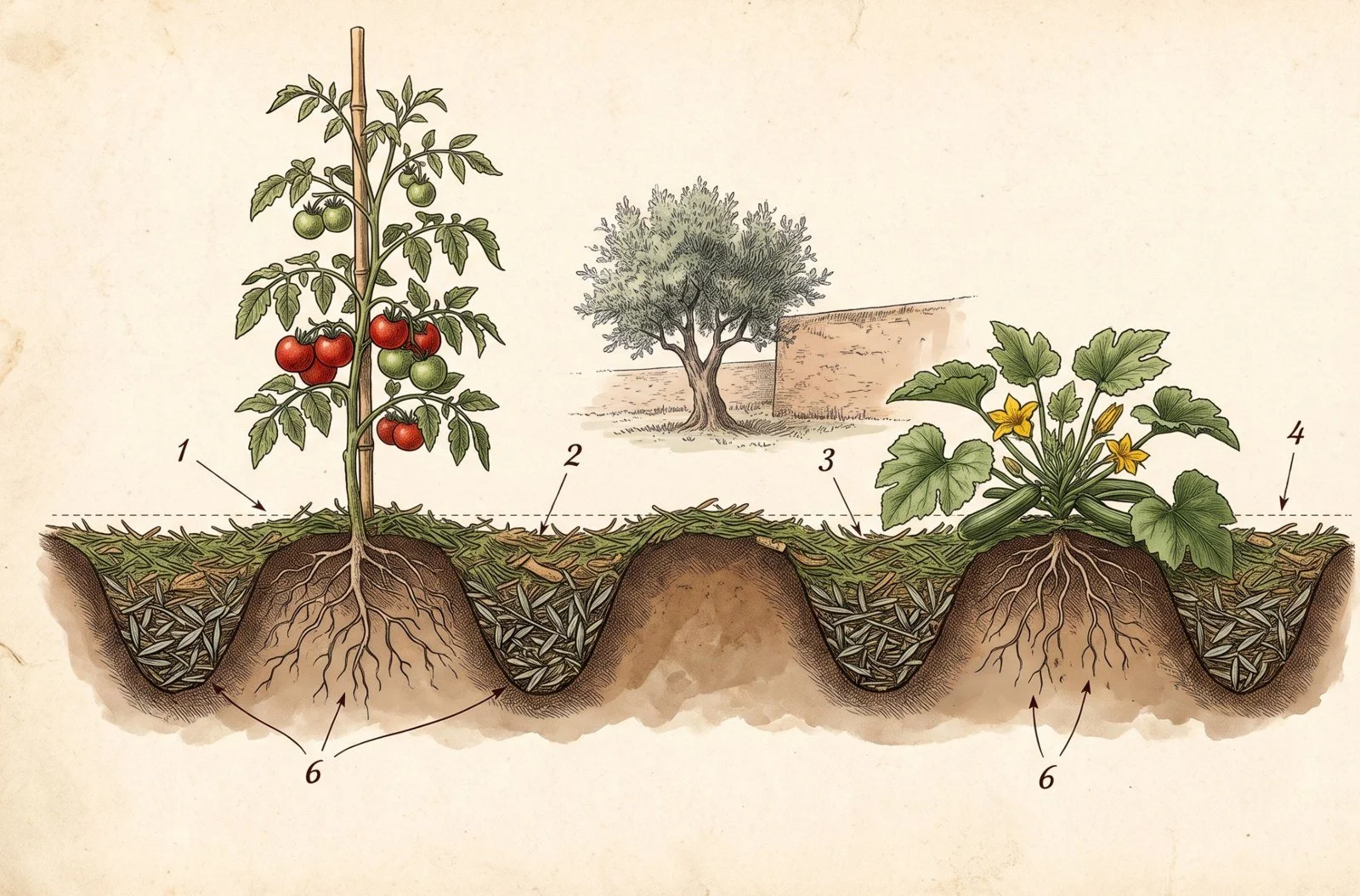
Above: The principle of the feeding furrow: ridges covered with RCW (1), furrows filled with fresh olive prunings, twigs and leaves mixed (2), under a thin mulch of grass clippings or RCW (3), the whole levelled off at the same finished height (4); the roots of the crops (6) go in search of the water that the wood in the furrows has stored during the floodings, whose frequency depends on the weather. AI-generated illustration, naturalist engraving style.
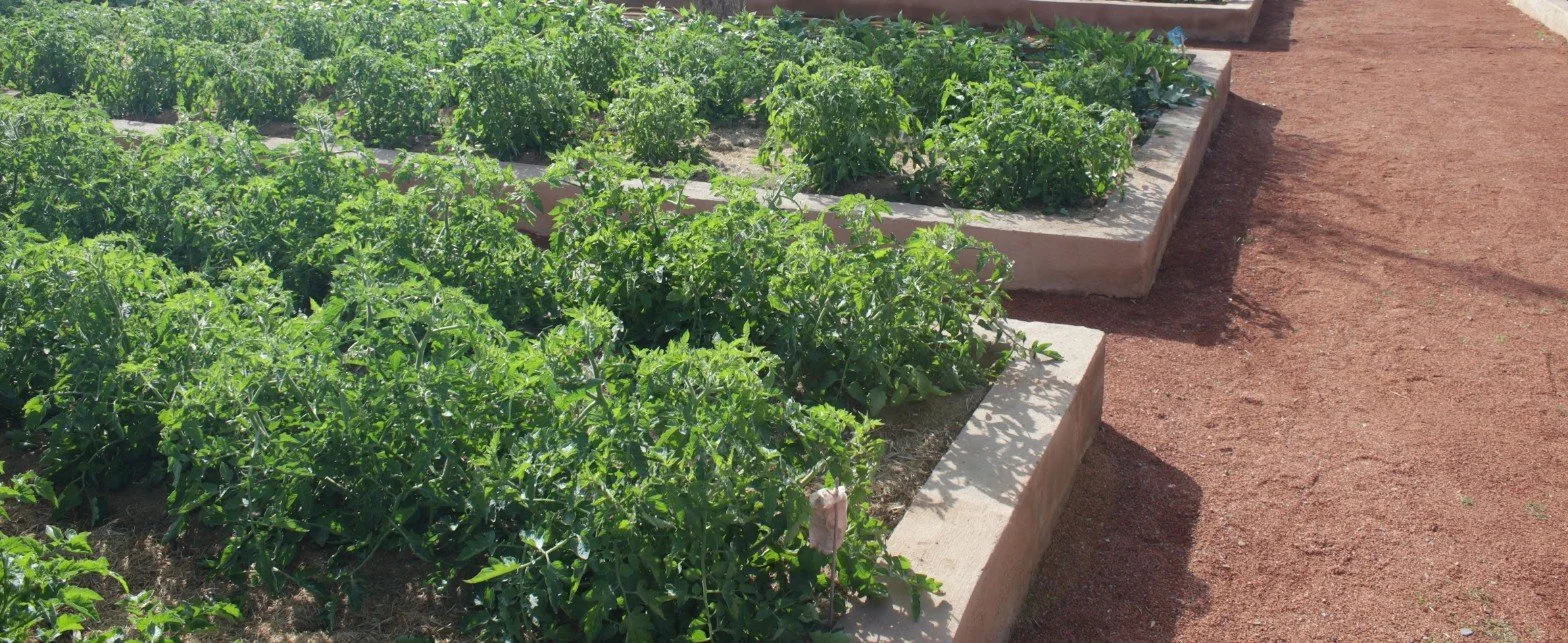
Above: Beds of tomatoes in full production, Marrakech. Photo Yves Nicolas, 15 May 2016.
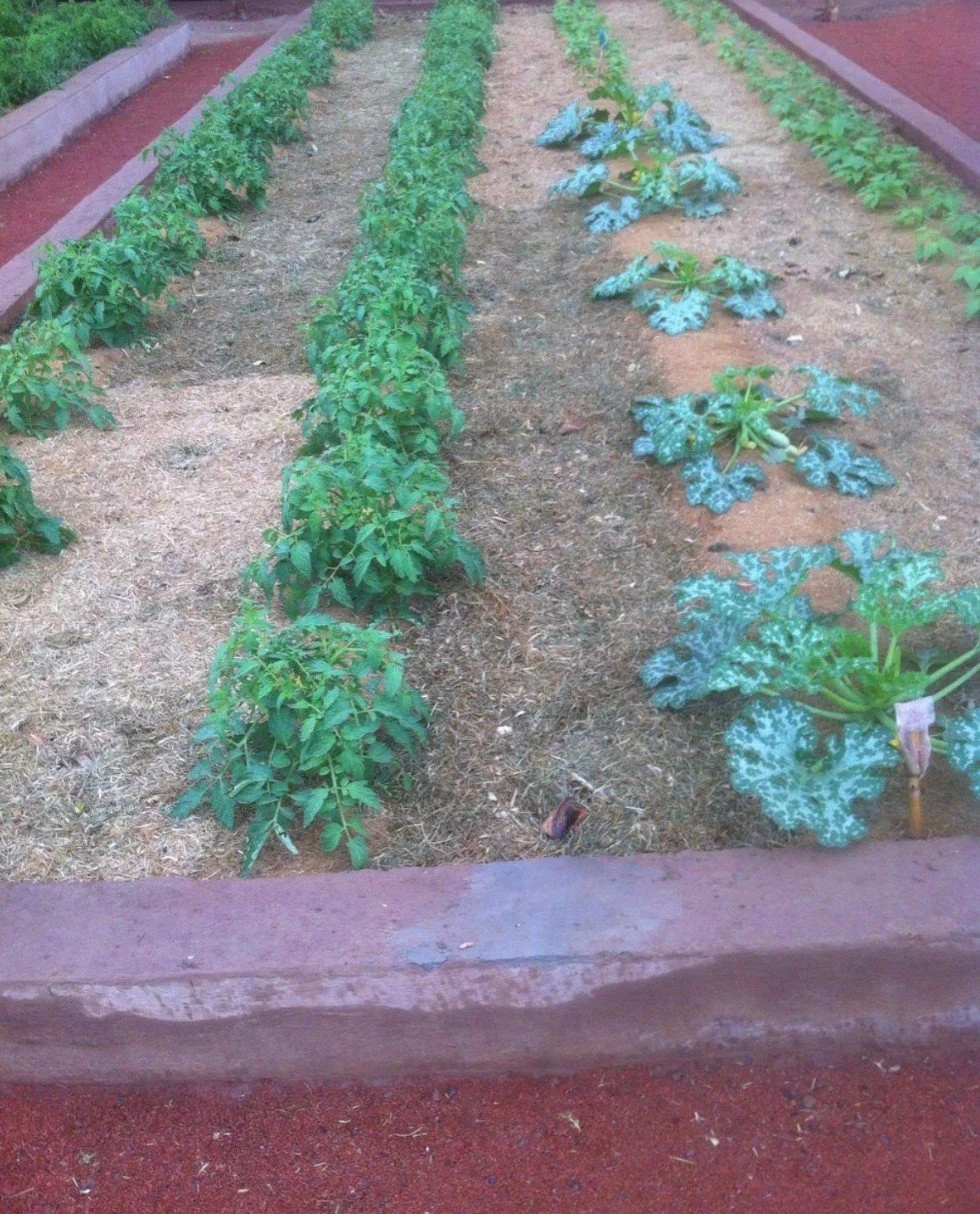
Above: A bed seen close up, under a mulch of dry grass clippings. Marrakech. Photo Yves Nicolas, 4 May 2016.
Finally, a warning specific to oases and irrigated soils: with salt-laden water, the wood can retain salts and then release them as it decomposes, as the researchers at Tozeur observed. On these soils, keep an eye on conductivity, and prefer surface mulch to burial.
In Morocco: what my gardens show
For want of a published trial, I can offer the Moroccan reader only my own gardens, and I do so with the usual precautions: these are field observations, followed season after season, not replicated and measured plots. But they all point in the same direction. Since 2010, in the gardens and vegetable plots that have been in my care, from Rabat to Marrakech, mulches have given more than promising results.
The first example is the most modest. In a vegetable garden in Rabat, in 2012, I planted Brassica oleracea, cabbages and cauliflowers, in a mulch of kikuyu clippings, Cenchrus clandestinus, the grass that covers so many lawns on the Atlantic coast and that is usually thrown away. The photos show what followed: young plants set in the dry grass on 20 February, close, vigorous rows three weeks later, then full white heads. The kikuyu, which is pulled out of flower beds, here covered the vegetable garden.
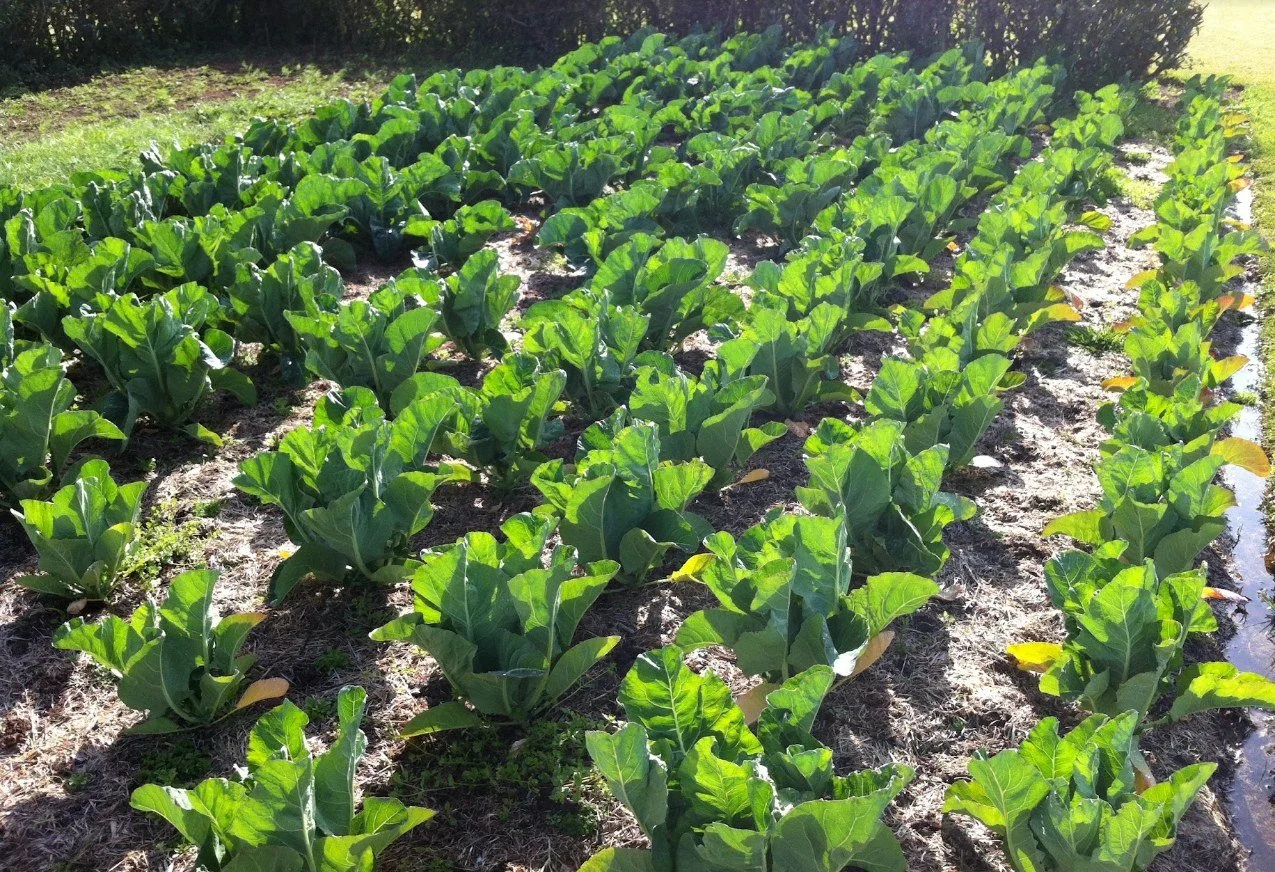
Above: The same vegetable garden three weeks after planting, cauliflowers under a mulch of kikuyu clippings. Rabat. Photo Yves Nicolas, 14 March 2012.
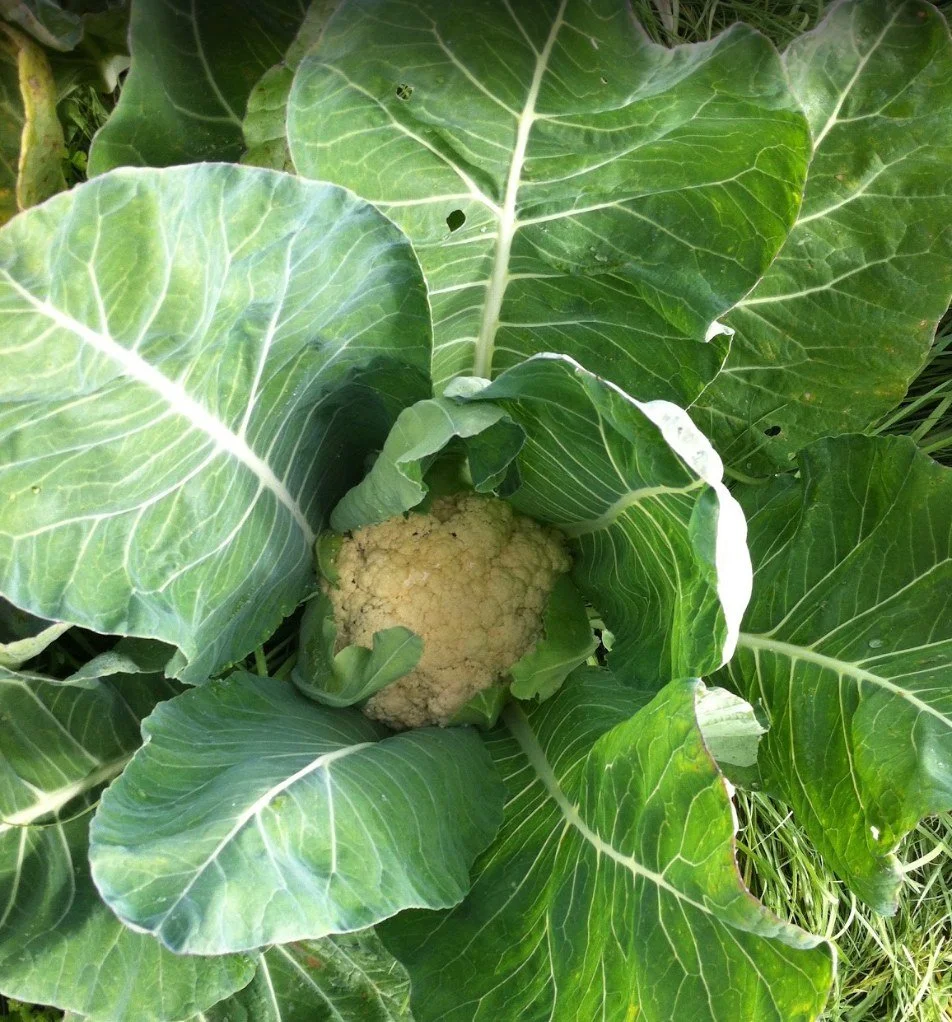
Above: Harvest under kikuyu mulch: the head has formed, and the blades of grass clippings still cover the soil between the leaves. Rabat, 2012. Photo Yves Nicolas.
The second example is the feeding furrow described above. At the start, in April 2016, the bed looks like a striped carpet. The ridges carry the young plants, under fresh or dry grass clippings; between them, the filled furrows can be recognised by the twigs and grey leaves of the olive prunings that still show through the thin mulch. A month later, the same beds were in full production.
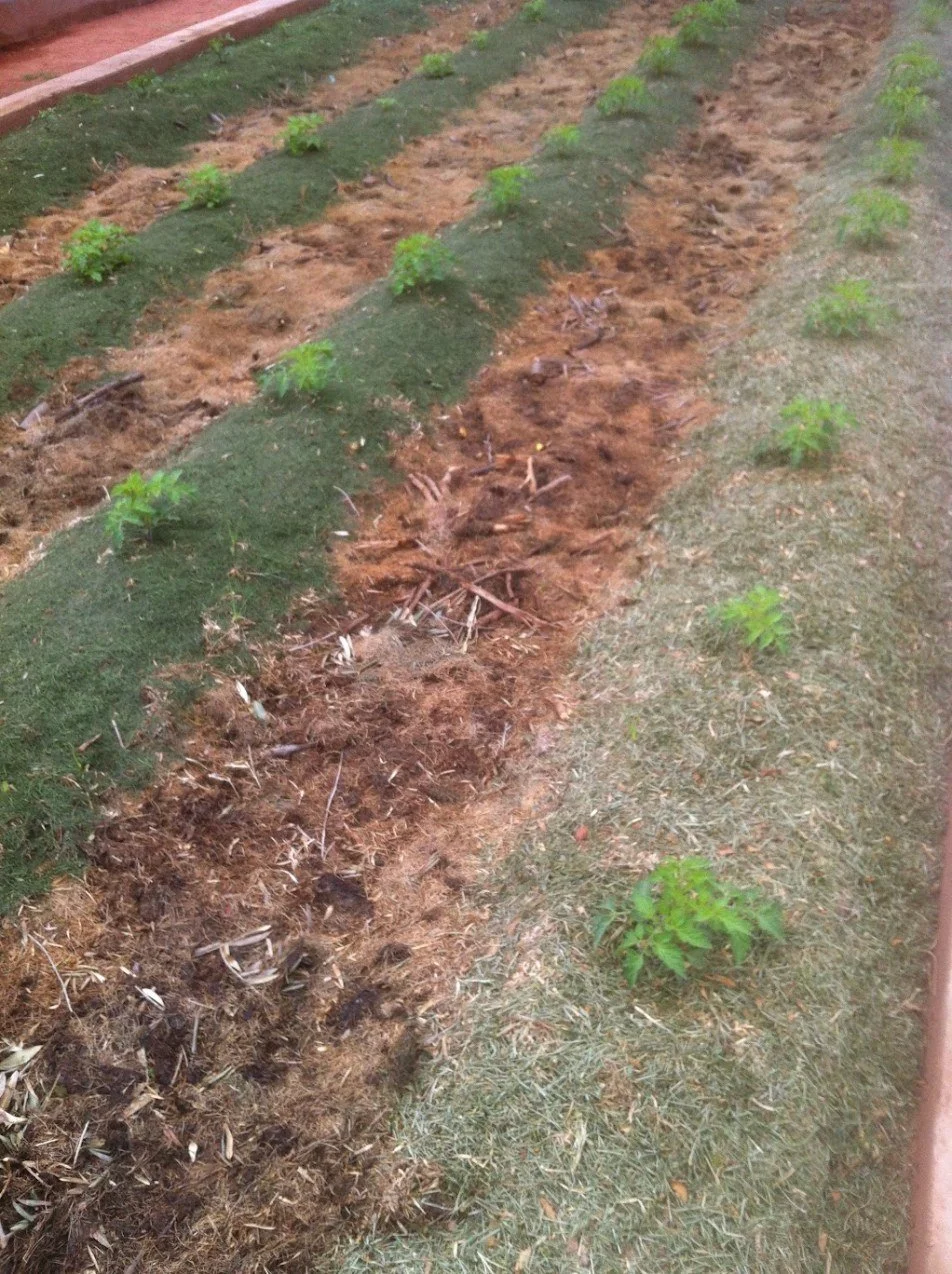
Above: A bed at the start: the young Solanum lycopersicum are on the ridges, under fresh or dry grass clippings; the brown strips without plants are the furrows filled with olive prunings, whose twigs and leaves can be seen. Marrakech. Photo Yves Nicolas, 19 April 2016.
Olive prunings, an RCW of great value
For Morocco, this is probably the most valuable wood. Olea europaea is everywhere, in orchards, gardens, avenues and estates, and it is pruned every year. Its prunings are all too often burnt or carted away. Yet they combine everything one expects of an RCW: young twigs, a high share of leaves, a hard wood that lasts, and a species perfectly adapted to the climate one wants to cover. It is with them that I filled the furrows in Marrakech.
In Spain, people have begun to measure them. In Andalusia, as we have seen, chipped olive prunings almost eliminated soil loss under simulated rain. Near Córdoba, Taguas and his colleagues laid 7.5, 15 and 30 tonnes of fresh prunings per hectare over four seasons in the inter-rows of a super-intensive hedgerow olive grove: the mulch only really kept the soil moist above 7.5 tonnes and as long as the debris itself stayed moist in spring, and it took 15 tonnes for soil carbon to increase significantly over twenty centimetres. Two lessons for Morocco: spread the prunings fresh, on the same day, as I have been saying from the start, and do not skimp on the dose.
One precaution, finally. The same researchers point out that leaving prunings on the ground raises the question of verticillium wilt, Verticillium dahliae, the great root disease of the olive tree. The prunings from a diseased orchard are therefore not laid fresh under other olive trees: they go first through pre-composting, turned until the heat has reached the whole mass.
What our Maghreb neighbours tell us
If Morocco has no published trial yet, its neighbours have made a start. To the Tunisian trials at Tozeur and Médenine we can add an Algerian one. At El Khroub, near Constantine, under a semi-arid Mediterranean climate with about 450 mm of rain a year, Kerrouche and his colleagues covered an uncultivated soil with about 4 cm of ramial chipped wood (RCW). Within a year, the biological soil quality index, which counts the small animals of the soil, mites and springtails above all, had almost doubled compared with the control, with or without manure. The authors link the low values to the lack of rain and to the heat that dries out the soil, even though their monthly minimum falls in April: and it is precisely this drying that mulch holds back.
Municipalities and large estates
Every municipality prunes its trees, pays to have the prunings taken away, then buys back as soil improvers and mulch what it has just sent off in a skip. RCW closes that loop. On my sites, chipping reduces the volume of a heap of branches by a factor of six to ten, with a slow-rotor chipper and broadleaved material. A well-planted garden of five hundred square metres produces, in my experience, around twenty cubic metres of cuttings a year, that is two to three cubic metres of wood chips, enough to cover a third to a half of its own beds. A single garden is therefore not self-sufficient in wood chips, even if secateur cuttings left where they fall cover part of its needs without any machine at all. A street of twenty gardens is amply so. Shared chipping is the scale at which the loop exists.
The principle behind all this ought to become a rule: nothing leaves a garden. Leaves, prunings and grass clippings stay where they are. My own garden in Meudon has received no fertiliser, no treatment and no bought soil improver for at least fifty years, and it is in profusion. I do not offer it as proof in the laboratory sense, but as a continuous observation over half a century.
8. RCW as healer
There is a question I am often asked at the foot of an ailing tree: can RCW heal? The answer takes two sentences. Yes, a well-managed wood mulch protects the roots, holds back certain diseases and gives vigour back to a tired tree. No, to my knowledge no trial has yet tested RCW, as the Quebec researchers define it, against a disease or a pest: what we know comes from wood mulches, composted bark and straw, the closest being a British trial on chips of single broadleaved species. RCW often has a reputation for protecting plants; that reputation has yet to be measured. Here, then, is what the trials say, and what the gardener should take from them.
The roots: the mulch that digests the fungus
The best-studied case is that of the avocado, Persea americana, in California, ravaged by root rot, Phytophthora cinnamomi. For three years at Somis, Downer, Menge and their colleagues mulched avocado trees planted in infested soil with chipped pruning waste, including chips of Eucalyptus globulus. In the orchard mulched with pruning waste the canopy grew by 43 %, and the harvest by 13 %, a difference that was not significant; in the one mulched with eucalyptus the harvest on the contrary fell by 39 %, which the authors put down to over-watering. The most interesting finding lies elsewhere: the roots grew into the mulch and at the interface between mulch and soil, and there they were scarcely infected, whereas those that stayed in the earth were clearly so. The fungus itself had not declined in the soil.
The same researchers found out why. Decomposing wood teems with fungi and bacteria that produce cellulases and laminarinases, the enzymes that break down the cell wall of Phytophthora. These enzymes are abundant in the mulch and collapse as soon as one goes down into the soil; it was at the interface that the pathogen was most often dissolved. In North Carolina, under Fraser firs, Abies fraseri, Richter and his colleagues found the same link: where cellulase activity was high, mortality fell, and certain wood or bark mulches reduced the disease on three sites out of five. In Britain, Percival mulched young horse chestnuts, Aesculus hippocastanum, in pots with chips of a single species: with beech, Fagus sylvatica, and pedunculate oak, Quercus robur, Phytophthora lesions shrank by up to 61 %, and the mulched trees photosynthesised more.
This mechanism confirms what I have been saying from the start: mulch heals where it lies, on the surface, because that is where the organisms that decompose it live. Buried, it would very likely lose its air and its power. But it also calls for a warning. In the first year, on avocados mulched with 15 cm of eucalyptus, Faber and his colleagues saw the disease advance, because of the moisture held under the mulch. Phytophthora loves water. On a heavy or over-watered soil, a thick mulch can make matters worse, at least in the first year: cut back the watering and keep the collar clear.
Why mature wood heals better than fresh wood
The work of Kuter, Nelson and their colleagues, in Harry Hoitink's team in Ohio, supplies the missing piece. It concerns composted hardwood bark. Bark composted for 44 weeks protected seedlings from damping-off, Rhizoctonia solani: 21 % of plants diseased, against 85 % in three-week-old bark. Heated to 60 °C, the mature bark lost its protection. Trichoderma harzianum made up 38 % of the fungi in it, against 3 % in young bark, and this Trichoderma protected only in mature bark, never in fresh. Chen and his colleagues added a detail every composter should know: bark taken from the cool edges of a four-month-old heap protected against Pythium, bark from the scorching core did not, but mixing in just 10 % was enough to restore the protective power of a substrate that had lost it.
This is the logic of the inoculated pre-compost in part 5. Fresh wood does not yet have its inhabitants; the heat of the compost kills some of the useful organisms; it is recolonisation by the flora of the site, brought in with the old compost, that turns wood into a healing material. Hoitink and Boehm also point out that the protection lasts as long as there is matter left to decompose: a healing mulch has to be renewed.
Leaves and fruit: cutting off the rain's road
Many diseases of leaves and fruit travel in the drops that bounce off bare earth. In Ohio, Madden, Wilson and Ellis followed strawberry anthracnose, on Fragaria ananassa, caused by Colletotrichum acutatum, around a focus of infection: near the source, no diseased fruit under straw, 7 % on bare soil, 16 to 19 % under plastic. Organic mulch cuts off the road of the splash, which plastic does not. I have already described above how chipping fallen apple leaves reduces scab; it is the same idea taken the other way round, destroying the fungus's winter shelter instead of barring its road.
Pests: what mulch attracts and what it drives away
In Hesse, Saucke and Doering mulched organic potatoes, Solanum tuberosum, with 4 to 5 tonnes of straw per hectare: every year there were fewer aphids, and less of the potato virus Y they transmit. Flying insects have trouble spotting a crop set on covered ground. Again in Germany, Winkler and his colleagues at the University of Kassel measured, under various mulches (triticale and vetch, clover and grasses, straw, grass silage), 30 to 40 % fewer large larvae of the Colorado beetle, Leptinotarsa decemlineata, which by their estimate meant 40 % less foliage eaten. Mulches also shelter ground predators, ground beetles and spiders.
Mulch is not neutral for all that. It also shelters slugs and voles, and in hot climates it feeds termites: in the laboratory, Pinzon and his colleagues saw subterranean termites, Reticulitermes flavipes, eat more of most mulches aged for a year, cypress and oak bark first, cedar last, and it was in pine bark that they gathered most; in Burkina Faso, termite activity rose under high doses of ramial wood. In Morocco I never pile wood chips against a trunk, a wall or woodwork.
There remains the line of work closest to my heart: an RCW that does not merely shelter but acts through its own molecules. Aromatic plants defend their territory with volatile compounds, phytoncides, and I already use essential oils to disorient pests. Against the red palm weevil, Rhynchophorus ferrugineus, I have written a prevention protocol resting on this principle: a very fine RCW, taken from a plant the insect avoids, combined with aromatic extracts and placed where it seeks to lay its eggs. Published trials support the idea without proving it: Guarino and his colleagues, working on weevils from Italy and the Near East, cut weevil catches in traps by about 57 % with geraniol and by 45 to 60 % with alpha-pinene, and in the laboratory geraniol slowed feeding and egg-laying, alpha-pinene much less so. But nobody has yet tested an aromatic mulch against this pest, and eucalyptus chips themselves hold back weed emergence only by covering the ground, not through their chemistry. This is a field waiting to be opened, and I present it as such.
The declining tree
This is probably where mulch heals best, because the illness of many urban trees is not a microbe but a compacted, dry and lifeless soil. In Illinois, Watson showed that under mulch, in place of lawn, the surface of fine roots could almost triple in certain species. In the United States, on red maples, Acer rubrum, in four cities, Fite, Smiley and their colleagues loosened the soil with compressed air, added compost, then mulched to 5 to 7.5 cm: on the most clayey site, soil resistance fell by 25 to 66 % in three years; the mulched soil held 31 % water by volume against 25 %, and of the treatments taken one by one, mulching was the most beneficial, even if the authors recommend combining methods. Some effects nonetheless lasted only a year: the tree needs topping up.
In Brandenburg, on sandy soils worn out by replanting apple trees, Djalali Farahani-Kofoet and her colleagues laid a 20 cm ridge of softwood planing shavings, which are not RCW, at the foot of the trees: trunk cross-section increased by 21 to 38 % and the harvest by up to 16 %, a difference that was not statistically significant, without treating the soil. It is the very model of the healing mulch: we do not fight an agent, we give back to the soil the life and water it lacked.
What I take from it
RCW heals first by giving the soil back a living layer, airy and moist, where roots find refuge and useful fungi digest the parasites. It protects better than it cures: the trials show a preventive effect that is partial and local, varies from one site to another and fades within one or two years. It heals better mature than fresh, better laid on than buried, better renewed than forgotten. And it is not without risk on a heavy, over-watered soil. With these limits in mind, it is one of the few treatments one can give a tree without injecting anything into it.
9. The cousins of RCW, past and present
RCW has a name, a date and a birthplace: Laval University, in Quebec, in the 1970s and 1980s. But the gesture it codifies, giving wood and leaves back to the soil instead of burning them or carting them away, is far older. I went to see what texts, archaeology and ethnography allow us to assert, separating what is documented from what belongs to the pleasing story.
What the Ancients did
The Roman agronomists knew the value of leaves and prunings, but they sent them through the byre or the manure pit. Cato, around 160 BC, counts among the materials for making manure straw, pods, bean haulms and the leaves of holm oak and oak. He also gives a piece of advice that looks very much like RCW: when a vine is sick, cut its canes into small pieces and bury them around it. The chopping is there, but the wood goes underground. Columella, two centuries later, advises anyone without livestock to gather all kinds of leaves and put them in a pit with ashes and sweepings, turning them. He also observes that forest soil does not become exhausted because every autumn it receives its leaves and grasses. The idea of litter feeding the earth is there, then, but the Roman model remains manure and burial, not covering.
The agronomists of Al-Andalus followed the same path. Ibn Bassal, in Toledo and then Seville in the 11th century, describes composts of manure and straw, and even a compost without manure, made of herbs, straw, ashes and water. Ibn al-Awwam, at the end of the 12th century, prepares his composts in deep pits and mixes manures with plant waste, and it is in his work that I found the idea of the ferment mentioned earlier. Spanish archaeologists remind us that these treatises describe the ideal of the great estates more than peasant practice. Fermented compost is the Andalusian legacy; wood mulch does not appear in it, to my knowledge.
Those who left the prunings on the ground
The practices closest to RCW come from the tropics. In Central America, frijol tapado, "covered bean", consists of broadcasting beans into the vegetation of a fallow, then cutting it and leaving it on the ground, without burning. Agronomists, beginning with Thurston, made it the model of slash-and-mulch systems. It is often said to be pre-Columbian; that is plausible but, to my knowledge, no archaeological evidence establishes it. In Honduras, the Quesungual system, described as indigenous to the Lempira region, goes further: the trees regrow in the field, they are pruned instead of burned, and the pruned wood stays on the ground as a mulch through which the crop is sown. Pauli and his colleagues described it and studied its soil fauna. Of all these systems it is the closest cousin of RCW: pruning wood, laid on the surface, never burned or buried. Its large-scale spread, on the other hand, dates from the 1990s, with the FAO.
In the Sahel, farmers long cleared and burned the shrubs Guiera senegalensis and Piliostigma reticulatum. It was agronomists, starting from what some farmers were already doing, who proposed keeping them in the field, coppicing them and leaving the prunings on the ground, with the results I quoted above. In Burkina Faso, Mando showed a valuable detail, later taken up with van Rheenen: a mulch of wood or straw attracts termites, which pierce the surface crust and let the water in; without termites, the mulch gave no significant gain. Zai, those planting pits filled with manure or compost that Yacouba Sawadogo brought back into favour in Yatenga, belong to localised manuring rather than to mulching.
Those who emptied the forest to feed the field
European history offers the counter-example. For centuries, in Switzerland, in Central Europe, in Portugal as in Japan, people raked up forest litter to bed their animals, and then made manure from it for the fields. In Valais, Gimmi and his colleagues estimate that around 1.5 to 2.5 tonnes of litter per hectare per year were removed between 1917 and the 1930s. In the Serra da Estrela, cut heather and gorse passed through the goat sheds before being buried in the terraces, and they provided almost all the fertility. In Japan, several hectares of woodland were needed to maintain one hectare of rice paddy, and the exhaustion of the forests came close to catastrophe in the Edo period. Everywhere, the forest that gave up its litter grew poorer. Fertility is not created by moving it about: that is why I hold so firmly that nothing should leave the garden.
Stone mulches
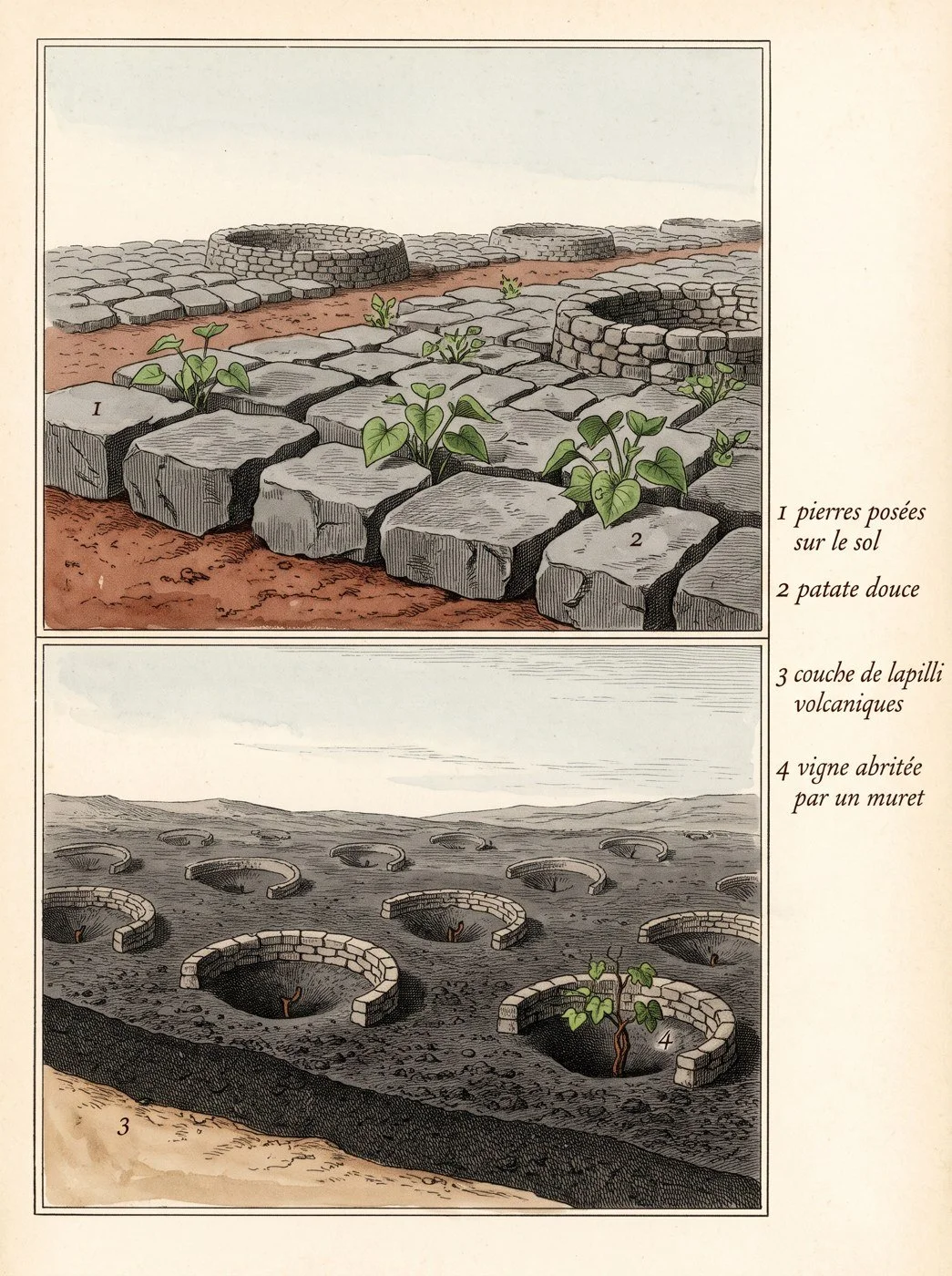
Above: Stone mulches: above, a stone garden of the Rapa Nui type, where sweet potato, Ipomoea batatas, grows between blocks laid on the ground; below, the enarenado of La Geria, on Lanzarote, where each vine is planted in a hollow of lapilli sheltered from the wind by a low wall. AI-generated illustration, naturalist engraving style.
The mulches best attested by archaeology are not organic. On Rapa Nui, Easter Island, cultivators covered tens, perhaps hundreds of hectares of gardens with stones according to the estimates, in the centuries following the clearing of the island, to keep in moisture, soften the temperature and hold back wind and weeds. The Pueblos of New Mexico spread gravel 5 to 11 cm deep in the 14th and 15th centuries. On Lanzarote, after the eruptions of 1730 to 1736, the inhabitants made general use of enarenado, a layer of volcanic lapilli under which vines and potatoes still grow. In north-west China, on the loess plateau, fields covered with gravel and sand have been farmed for more than three centuries, according to Li. These mulches hold water as well as wood does, but they do not feed the soil. RCW does both.
The modern cousins, and what we know of them
Several fashionable techniques claim the same logic. Not all of them have evidence behind them.
Growing on mounds of buried logs, Hugelkultur, is the opposite of what I defend: there the wood is buried under the earth. Linda Chalker-Scott, of Washington State University, notes that there is no published study of the technique, that the mound sinks within five or six years as the wood rots, and that wood belongs on the surface.
Chop and drop, pruning nitrogen-fixing trees and leaving the leaves on the ground between the rows, is the tropical cousin of fresh RCW. In Malawi, after eleven years of intercropping with Gliricidia sepium, Makumba and his colleagues obtained 3.8 tonnes of Zea mays grain per hectare against 1.1 without trees or fertiliser. But the nutrient balance remained negative: the tree brings up and recycles, it manufactures neither phosphorus nor potassium.
Living mulch, a sown cover that grows alongside the crop, controls weeds far less well than dead mulch. In Michigan, Tarrant and her colleagues measured that hoeing reduced weed biomass by about 94 % and straw mulch by 78 %, against 18 % on average for living covers, and in a dry year, on peppers, living covers and straw alike cut the harvest by 41 to 54 % compared with hoeing, for lack of water.
Inoculating chips with the wine cap mushroom, Stropharia rugosoannulata, to harvest mushrooms and feed the soil is appealing, but the most thorough trial to my knowledge, in New York State, saw fruiting on only two plots out of eighty, without demonstrating any gain for the crop. Johnson-Su fungal-dominant compost and bokashi, a compost fermented without air, do not yet have, to my knowledge, published evidence comparable to that for pre-compost.
Two recent uses of chipped wood, on the other hand, are well established. In Quebec, Stefani, Fortin and their colleagues studied jack pines, Pinus banksiana, seventeen years after they were planted on former sand pits: under a continuous layer of RCW the trees reached 6 m and formed a closed canopy, with three to six times more fungal biomass, dominated by ectomycorrhizal fungi; with RCW only at the foot of each plant they remained stunted; without RCW, none survived. And wood chips now serve to purify water: Addy and his colleagues brought together 26 studies on woodchip bioreactors placed at the end of agricultural drains; for woodchip beds, an earlier review cited by these authors gives rates of 2 to 22 g of nitrate nitrogen removed per cubic metre per day. Nitrogen hunger, the failing of wood in the garden, there becomes a service.
Finally, the mulches of our dry regions remain to be studied. In Spain, Rico Hernández and his colleagues measured that chipped date palm fronds, Phoenix dactylifera, reduced evaporation as well as straw, but to my knowledge no trial has been carried out in an oasis; and the sources I have read on oases show that dry palm fronds were burned or left in heaps, not used as mulch. Olive pomace, rich in polyphenols that hinder germination, is best composted before use, even if a recent Spanish trial found no lasting effect on the soil after direct applications at low doses. For argan shells and cork, to my knowledge, no study of their use as mulch exists. This is open ground for Morocco.
10. The mistakes that make people think the method does not work
Burying the wood. Even raked into the top few centimetres, as is sometimes advised, wood mixed with earth lacks air, decomposes badly, takes nitrogen from the whole root zone and can suffocate the soil if buried deeper. Nature never buries it: wood is laid on the surface, not buried.
Taking chips of trunk wood or pallets for RCW. Raw carbon starves crops and discourages the gardener, as the Ohio trials showed.
Leaving the heap to wait. A heap that is never moved does not heat up throughout, keeps its pathogens and becomes a refuge for rodents. Spread it the same day, or compost it properly, turning it.
Inoculating at the wrong moment. All the old compost added when the heap is built goes through the fire of the hot phase. Prime it at building, but seed it properly at the first turning, once the core has dropped below about 40 °C.
Walking on fresh mulch. A mulch being colonised is a network of filaments under construction: trampling breaks and compacts it. Plan the paths before mulching.
Expecting results the following spring. RCW builds a soil; it does not feed a harvest. Allow six months to two years, sometimes four depending on climate and dose.
Chipping fruit and palm fronds without care. Never chip a fruit, whether toxic or invasive. In Morocco, freshly cut palm fronds attract the red palm weevil, Rhynchophorus ferrugineus, even more than the standing tree: they are chipped on the day of cutting and never stored whole.
Believing everything said about allelopathy. People fear chips of Juglans nigra, Thuja or Eucalyptus. The Quebec tradition sets Thuja aside, and I respect that caution for fresh RCW. Chalker-Scott and Downer find no reliable evidence of chemical inhibition under garden conditions for walnut or thuja chips used as mulch. The case of Eucalyptus is debated: the 2007 review credits it with an effect on weed germination, but a more recent trial found no chemical effect from its leachate, and it was even the least effective of the mulches tested. Here again, it is better to observe the contradiction than to settle it.
What I do for municipalities and estates
I have nothing to sell in the way of wood chips: I am tied to no supplier of equipment or mulch. My work begins with reading the resource of a site, its species, its volumes, its seasons, and continues with management: choice of chipper, sorting of prunings, mixing and pre-composting recipes, composting platform and inoculation, drafting or reviewing specification clauses, and follow-up over several years. I also train staff and gardeners over three complementary days, on RCW, biochar and composting with inoculation, so that each site produces for itself what it used to buy.
Bibliography
Abdul-Kareem A.W., McRae S.G. (1984). The effects on topsoil of long-term storage in stockpiles. Plant and Soil 76 : 357-363.
Abuhabib M.M., Abarca-Rivas C. et al., Romanyà J. (2025). Sustainable fertilization with ramial chipped wood enhances antioxidant profiles in tomato varieties. Antioxidants 14 (11) : 1330. doi:10.3390/antiox14111330
Addy K., Gold A.J., Christianson L.E., David M.B., Schipper L.A., Ratigan N.A. (2016). Denitrifying bioreactors for nitrate removal: a meta-analysis. Journal of Environmental Quality 45 (3) : 873-881. doi:10.2134/jeq2015.07.0399
Ambler A., Warburton Brown C. (2019). Mulching review. Permaculture Association, cité pour Hopkins (1954).
Baer A., Ladefoged T.N., Stevenson C.M., Haoa S. (2008). The surface rock gardens of prehistoric Rapa Nui. Rapa Nui Journal 22 (2).
Barthès B.G., Manlay R.J., Porte O. (2010). Effets de l'apport de bois raméal sur la plante et le sol : une revue des résultats expérimentaux. Cahiers Agricultures 19 (4) : 280-287. doi:10.1684/agr.2010.0412
Barthès B.G., Penche A., Hien E., Deleporte P., Clermont-Dauphin C., Cournac L., Manlay R.J. (2015). Effect of ramial wood amendment on sorghum production and topsoil quality in a Sudano-Sahelian ecosystem (central Burkina Faso). Agroforestry Systems 89 (1) : 81-93. doi:10.1007/s10457-014-9743-0
Bennett-Jones J., Biala J., Johnston A. (2022). Are microbial inoculants a fit for lignocellulosic organics ? BioCycle, 12 juillet 2022.
Berglund B.E. (2008). Satoyama, traditional farming landscape in Japan, compared to Scandinavia. Japan Review 20 : 53-68.
Bernal-Vicente A., Ros M., Pascual J.A. (2012). Inoculation of Trichoderma harzianum during maturation of vineyard waste compost to control muskmelon Fusarium wilt. BioResources 7 (2) : 1948-1960.
Billeaud L.A., Zajicek J.M. (1989). Influence of mulches on weed control, soil pH, soil nitrogen content, and growth of Ligustrum japonicum. Journal of Environmental Horticulture 7 (4) : 155-157.
Birnbaum C., Bradshaw L.E., Ruthrof K.X., Fontaine J.B. (2017). Topsoil stockpiling in restoration: impact of storage time on plant growth and symbiotic soil biota. Ecological Restoration 35 (3) : 237-245. doi:10.3368/er.35.3.237
Bodjrènou R., Daassi R., Ahamidé B., Germain D., Stevanovic T., Khasa D., Amadji G. (2022). Impacts des amendements organiques sur les caractéristiques physico-chimiques d'un sol ferrallitique du Sud-Bénin. Tropicultura 40 (3/4) : 2115. doi:10.25518/2295-8010.2115
Bourguignon C., Bourguignon L. (2008). Le sol, la terre et les champs. Pour retrouver une agriculture saine. Paris, Sang de la Terre (édition consultée : 2009, ISBN 978-2-86985-188-7), p. 48, 84, 88.
Breton V., Crosaz Y., Rey F. (2016). Effects of wood chip amendments on the revegetation performance of plant species on eroded marly terrains in a Mediterranean mountainous climate (Southern Alps, France). Solid Earth 7 : 599-610. doi:10.5194/se-7-599-2016
Bright M.B.H., Diedhiou I., Bayala R. et al. (2021). An overlooked local resource : shrub-intercropping for food production, drought resistance and ecosystem restoration in the Sahel. Agriculture, Ecosystems & Environment 319 : 107523. doi:10.1016/j.agee.2021.107523
Budelman A. (1988). The decomposition of the leaf mulches of Leucaena leucocephala, Gliricidia sepium and Flemingia macrophylla under humid tropical conditions. Agroforestry Systems 7 : 33-45. doi:10.1007/BF01890468
Cabrera-Pérez C., Llorens-Calveras J., Escolà A. et al. (2026). Soil management in organic rainfed vineyards in the Penedès region (Catalonia, NE Spain) with cover crops and mulches. Effects on weed flora and vine vigor. Frontiers in Agronomy 8 : 1759319. doi:10.3389/fagro.2026.1759319
Caldwell B. Wood chips in vegetable production. University of Vermont Extension, résumé de l'essai de Marcellus.
Caron C. (2015). Ramial chipped wood, more than wood chips. The Maine Organic Farmer & Gardener, automne 2015.
Caton. De l'agriculture (De agri cultura), vers 160 av. J.-C., chap. 5 et 37. Trad. anglaise W.D. Hooper et H.B. Ash, Loeb Classical Library, 1934.
Chalker-Scott L. (2007). Impact of mulches on landscape plants and the environment, a review. Journal of Environmental Horticulture 25 (4) : 239-249. doi:10.24266/0738-2898-25.4.239
Chalker-Scott L. (2017, révisé 2022). Hugelkultur: what is it, and should it be used in home gardens? Washington State University Extension, FS283E.
Chalker-Scott L., Downer A.J. (2018). Garden myth busting for Extension educators : reviewing the literature on landscape trees. Journal of the NACAA 11 (2).
Chalker-Scott L., Downer A.J. (2022). Garden myth-busting for Extension educators : the science behind the use of arborist wood chips as landscape mulches. Journal of the NACAA 15 (2).
Chen W., Hoitink H.A.J., Schmitthenner A.F. (1987). Factors affecting suppression of Pythium damping-off in container media amended with composts. Phytopathology 77 : 755-760. doi:10.1094/Phyto-77-755
Chen W., Hoitink H.A.J., Schmitthenner A.F., Tuovinen O.H. (1988). The role of microbial activity in suppression of damping-off caused by Pythium ultimum. Phytopathology 78 : 314-322. doi:10.1094/Phyto-78-314
Cissé D., Cornelis J.-T., Nacro H.B. (2021). Fiche technique de production du co-compost au biochar. Université de Liège et Université Nazi Boni, projet ARES-BIOPROTECHSOL. ORBi, hdl.handle.net/2268/265682
Clément-Mullet J.-J., trad. (1864-1867). Le livre de l'agriculture d'Ibn al-Awam (Kitab al-Felahah). Paris, A. Franck. Tome I, chapitre II.
Columelle. De l'agriculture (De re rustica), vers 60-65, livre II, chap. 1 et 14-15. Trad. anglaise H.B. Ash, Loeb Classical Library, 1941.
Daassi R., Kasangana P.B., Khasa D.P., Stevanovic T. (2021). Monitoring transformation of two tropical lignocellulosics and their lignins after residence in Benin soils. Scientific Reports 11 : 21524. doi:10.1038/s41598-021-01091-y
Dhaouadi L., Karbout N., Zoughari B. (2020). Effets de l'apport en Bois Raméal Fragmenté (BRF) sur les caractéristiques physico-chimiques du sol oasien du Sud Tunisien. Journal of Oasis Agriculture and Sustainable Development 2 (1) : 29-34. doi:10.56027/JOASD.052020
Djalali Farahani-Kofoet R., Schneider B., Feller C. (2024). Apple growth and yield in replant soils supplemented by organic soil additives. Agronomy 14 (4) : 678. doi:10.3390/agronomy14040678
Downer A.J., Crohn D., Faber B., Daugovish O., Becker J.O., Menge J.A., Mochizuki M.J. (2008). Survival of plant pathogens in static piles of ground green waste. Phytopathology 98 (5) : 547-554. doi:10.1094/PHYTO-98-5-0547
Downer A.J., Menge J.A., Ohr H.D., Faber B.A., McKee B.S., Pond E.G., Crowley M.G., Campbell S.D. (1999). The effect of yard trimmings as a mulch on growth of avocado and avocado root rot caused by Phytophthora cinnamomi. California Avocado Society Yearbook 83 : 87-104.
Downer A.J., Menge J.A., Pond E. (2001). Association of cellulytic enzyme activities in eucalyptus mulches with biological control of Phytophthora cinnamomi. Phytopathology 91 (9) : 847-855. doi:10.1094/PHYTO.2001.91.9.847
Duryea M.L., English R.J., Hermansen L.A. (1999). A comparison of landscape mulches : chemical, allelopathic, and decomposition properties. Journal of Arboriculture 25 (2) : 88-97. doi:10.48044/jauf.1999.014
El Janati M., Akkal-Corfini N., Bouaziz A., Oukarroum A., Robin P., Sabri A., Chikhaoui M., Thomas Z. (2021). Benefits of circular agriculture for cropping systems and soil fertility in oases. Sustainability 13 (9) : 4713. doi:10.3390/su13094713
Estabrook G.F. (1994). Choice of fuel for bagaco stills helps maintain biological diversity in a traditional Portuguese agricultural system. Journal of Ethnobiology 14 (1) : 43-57.
Eulenberg E. (2012). Effects of wood chip mulches on weed suppression and woody plant establishment. Thèse de doctorat, Washington State University.
Faber B., Menge J., Downer J., Ohr H. (1995). Mulch effects on avocado root rot. Proceedings of the World Avocado Congress III : 412-416.
Fall Ba M., Colinet G., Samba S.A.N., Bassène E. (2014). Étude de quelques caractéristiques des bois raméaux fragmentés (BRF) de Guiera senegalensis J. F. Gmel et de Piliostigma reticulatum (DC) Hochst et de leur influence sur des propriétés chimiques et biologiques des sols ferrugineux tropicaux du Bassin arachidier, Sénégal. Journal of Applied Biosciences 81 : 7253-7262. doi:10.4314/jab.v81i1.5
Fall Ba M., Samba S.A.N., Bassène E. (2014). Influence des bois raméaux fragmentés de Guiera senegalensis et Piliostigma reticulatum sur la productivité du mil. International Journal of Biological and Chemical Sciences 8 (3) : 1039-1048. doi:10.4314/ijbcs.v8i3.18
Fang S., Xie B., Zhang H. (2007). Nitrogen dynamics and mineralization in degraded agricultural soil mulched with fresh grass. Plant and Soil 300 : 269-280.
Félix G.F., Clermont-Dauphin C., Hien E., Groot J.C.J., Penche A., Barthès B.G., Manlay R.J., Tittonell P., Cournac L. (2018). Ramial wood amendments (Piliostigma reticulatum) mitigate degradation of tropical soils but do not replenish nutrient exports. Land Degradation & Development 29 (8) : 2694-2706. doi:10.1002/ldr.3033
Fite K., Smiley E.T., McIntyre J., Wells C.E. (2011). Evaluation of a soil decompaction and amendment process for urban trees. Arboriculture & Urban Forestry 37 (6) : 293-300. doi:10.48044/jauf.2011.038
Fontana M., Johannes A., Zaccone C. et al. (2023). Improving crop nutrition, soil carbon storage and soil physical fertility using ramial wood chips. Environmental Technology & Innovation 31 : 103143. doi:10.1016/j.eti.2023.103143
Free G.R. (1971). Soil management for vegetable production on Honeoye soil with special reference to the use of hardwood chips. Cornell University Agricultural Experiment Station, Ithaca.
Frey S.D., Six J., Elliott E.T. (2003). Reciprocal transfer of carbon and nitrogen by decomposer fungi at the soil-litter interface. Soil Biology and Biochemistry 35 : 1001-1004. doi:10.1016/S0038-0717(03)00155-X
García-Randez A., Marks E.A.N., Pérez-Murcia M.D., Orden L., Andreu-Rodriguez J., Martínez Sabater E., Cháfer M.T., Moral R. (2023). Is the direct soil application of two-phase olive mill waste (alperujo) compatible with soil quality protection? Agronomy 13 (10) : 2585.
Gimmi U., Buergi M., Stuber M. (2008). Reconstructing anthropogenic disturbance regimes in forest ecosystems: a case study from the Swiss Rhone valley. Ecosystems 11 (1) : 113-124. doi:10.1007/s10021-007-9111-2
Greenly K.M., Rakow D.A. (1995). The effect of wood mulch type and depth on weed and tree growth and certain soil parameters. Journal of Arboriculture 21 (5) : 225-232. doi:10.48044/jauf.1995.036
Guarino S. et al. (2015). Behaviour-modifying compounds for management of the red palm weevil (Rhynchophorus ferrugineus Oliver). Pest Management Science 71 (12) : 1605-1610. doi:10.1002/ps.3966
Hartz T.K., Giannini C. (1998). Duration of composting of yard wastes affects both physical and chemical characteristics of compost and plant growth. HortScience 33 (7) : 1192-1196. doi:10.21273/HORTSCI.33.7.1192
Heckman J.R., Wyenandt C.A., Provance-Bowley M. (2011). Residual effects of leaf mulch on sweet corn and rye. Journal of Sustainable Agriculture 35 (6) : 639-649. doi:10.1080/10440046.2011.586592
Herms D.A., Stinner B.R., Hoitink H.A.J., Rose M.A. (2001). Soil management regimes for plant health care and integrated pest management programs in ornamental landscapes. OARDC Research Enhancement Competitive Grants Program n° 10, Ohio State University.
Hoitink H.A.J., Boehm M.J. (1999). Biocontrol within the context of soil microbial communities: a substrate-dependent phenomenon. Annual Review of Phytopathology 37 : 427-446. doi:10.1146/annurev.phyto.37.1.427
Hueso-González P., Martínez-Murillo J.F., Ruiz-Sinoga J.D. (2017). Benefits of straw and pinus mulch as forest management practices in Mediterranean forests. Cuadernos de Investigación Geográfica 43 (1) : 189-208. doi:10.18172/cig.3142
Jamar L., Lateur M. (2015). CRA-W, Centre wallon de recherches agronomiques. Effet de la gestion de la litière de feuilles en automne sur le développement de la tavelure en verger biologique. Journée de la recherche à l'action en agriculture biologique, Gembloux. Organic Eprints 51996.
Jurado M.M., Suárez-Estrella F., López M.J., Vargas-García M.C., López-González J.A., Moreno J. (2015). Enhanced turnover of organic matter fractions by microbial stimulation during lignocellulosic waste composting. Bioresource Technology 186 : 15-24. doi:10.1016/j.biortech.2015.03.059
Kammann C.I., Schmidt H.P., Messerschmidt N., Linsel S., Steffens D., Mueller C., Koyro H.W., Conte P., Joseph S. (2015). Plant growth improvement mediated by nitrate capture in co-composted biochar. Scientific Reports 5 : 11080. doi:10.1038/srep11080
Karnchanawong S., Nissaikla S. (2014). Effects of microbial inoculation on composting of household organic waste using passive aeration bin. International Journal of Recycling of Organic Waste in Agriculture 3 : 113-119. doi:10.1007/s40093-014-0072-0
Kerrouche I., Bendjaballah M., Bazri K.E.D., Gutiérrez López M., Zeltni A.E., Ouahrani G. (2018). Influence de l'apport du bois raméal fragmenté et du fumier sur l'indice de la qualité biologique du sol, sur un sol inculte, dans une région semi-aride méditerranéenne, Algérie. African Crop Science Journal 26 (4) : 515-527.
Klamer M., Sochting U. (1998). Fungi in a controlled compost system with special emphasis on the thermophilic fungi. Acta Horticulturae 469 : 405-416. doi:10.17660/ActaHortic.1998.469.43
Klocke N.L., Currie R.S., Aiken R.M. (2009). Soil water evaporation and crop residues. Transactions of the ASABE 52 (1) : 103-110.
Kopp K.L., Guillard K. (2004). Decomposition rates and nitrogen release of turf grass clippings. 4th International Crop Science Congress, Brisbane.
Kowalewski A.R., Buhler D.D., Lang N.S., Nair M.G., Rogers J.N. (2009). Mulched maple and oak leaves associated with a reduction in common dandelion populations in established Kentucky bluegrass. HortTechnology 19 (2) : 297-304.
Kuter G.A., Nelson E.B., Hoitink H.A.J., Madden L.V. (1983). Fungal populations in container media amended with composted hardwood bark suppressive and conducive to Rhizoctonia damping-off. Phytopathology 73 : 1450-1456. doi:10.1094/Phyto-73-1450
Kwabiah A.B. et al. (2003). Essai de bois raméal au Kenya, cité d'après Barthès et al. (2010), référence originale non consultée.
Lalande R., Furlan V., Angers D.A., Lemieux G. (1998). Soil improvement following addition of chipped wood from twigs. American Journal of Alternative Agriculture 13 (3) : 132-137. doi:10.1017/S0889189300007815
Larney F.J., Blackshaw R.E. (2003). Weed seed viability in composted beef cattle feedlot manure. Journal of Environmental Quality 32 (3) : 1105-1113. doi:10.2134/jeq2003.1105
Lasco R.D. (1991). Herbage decomposition of some agroforestry species and their effects as mulch on soil properties and crop yield. Thèse, University of the Philippines Los Baños.
Lemieux G., Lapointe R.A. (1986). Le bois raméal et les mécanismes de fertilité du sol. Université Laval, Québec.
Li X.Y. (2003). Gravel-sand mulch for soil and water conservation in the semiarid loess region of northwest China. Catena 52 (2) : 105-127. doi:10.1016/S0341-8162(02)00181-9
Lightfoot D.R., Eddy F.W. (1995). The construction and configuration of Anasazi pebble-mulch gardens in the northern Rio Grande. American Antiquity 60 (3) : 459-470. doi:10.2307/282259
Macías A.M., Morales G. (2009). Historia Agraria 49 : 41-71 (sur l'enarenado de Lanzarote).
Madden L.V., Wilson L.L., Ellis M.A. (1993). Field spread of anthracnose fruit rot of strawberry in relation to ground cover and ambient weather conditions. Plant Disease 77 (9) : 861-866. doi:10.1094/PD-77-0861
Maggard A.O. et al. (2012). Tree-based mulches and their leachate suppress weed seed emergence. Journal of Environmental Horticulture 30 (3) : 146-149.
Makumba W., Janssen B., Oenema O., Akinnifesi F.K., Mweta D., Kwesiga F. (2006). The long-term effects of a gliricidia-maize intercropping system in southern Malawi, on gliricidia and maize yields, and soil properties. Agriculture, Ecosystems & Environment 116 : 85-92. doi:10.1016/j.agee.2006.03.012
Mando A. (1997). Effect of termites and mulch on the physical rehabilitation of structurally crusted soils in the Sahel. Land Degradation & Development 8 (3) : 269-278.
Mando A., van Rheenen T. (1998). Termites and agricultural production in the Sahel: from enemy to friend? Netherlands Journal of Agricultural Science 46 (1) : 77-85. doi:10.18174/njas.v46i1.498
Marín-Moreno V., Castillo Amaro M., Barranco D., Cerdá A., Cobacho J.A. et al. (2017). Effects of different rates of olive pruning residues on soil moisture and organic carbon in superintensive olive orchards: a study case in Southern Spain. Geophysical Research Abstracts 19, EGU2017-12519.
Martin A.J.F., Klein R.W., Koeser A.K., Hauer R.J. (2026). Does excess mulch depth lead to poor tree growth and condition, root girdling, and decay ? A systematic literature review. Arboriculture & Urban Forestry 52 (1) : 93-108. doi:10.48044/jauf.2025.038
Meitz-Hopkins J.C. et al. (2023). Leaf shredding as an alternative strategy for managing apple scab resistance to demethylation inhibitor fungicides. Frontiers in Horticulture 2 : 1175168. doi:10.3389/fhort.2023.1175168
Millás Vallicrosa J.M., Aziman M. (1955). Ibn Bassal, Libro de agricultura. Tétouan, Instituto Muley el-Hasan.
Muchecheti F. (2013). Utilization of multipurpose tree prunings as a source of nitrogen for the production of rape and spinach. Mémoire de MSc, University of Pretoria.
Natural Resources Conservation Service (USDA). Backyard conservation : mulching. Fiche de vulgarisation.
Natural Resources Conservation Service (USDA, Indiana) (2018). Conservation practice standard 484, Mulching. Tableau des rapports C/N des matériaux de paillage.
Nelson E.B., Kuter G.A., Hoitink H.A.J. (1983). Effects of fungal antagonists and compost age on suppression of Rhizoctonia damping-off in container media amended with composted hardwood bark. Phytopathology 73 : 1457-1462. doi:10.1094/Phyto-73-1457
Nzobadila Kindiela B.W. et al. (2019). Impact de bois raméal fragmenté de Bridelia ferruginea et Acacia mangium sur la croissance et la production du manioc sur sol ferralitique au Congo. Journal of Animal and Plant Sciences 40 (2) : 6636-6647.
Oueriemmi H., Zoghlami R.I., Le Guyader E. et al. (2025). Addressing soil fertility challenges in arid agriculture : a two-year evaluation of combined soil organic amendments under saline irrigation. Soil Systems 9 (1) : 16. doi:10.3390/soilsystems9010016
Paavolainen L., Kitunen V., Smolander A. (1998). Inhibition of nitrification in forest soil by monoterpenes. Plant and Soil 205 (2) : 147-154.
Pauli N., Barrios E., Oberthuer T., Conacher A., Ayarza M., Welchez L.A. (2005). The effects of the Quesungual agroforestry system of western Honduras on soil macrofauna. Sociedade & Natureza, n° spécial 1 : 466-477.
Percival G.C. (2013). Influence of pure mulches on suppressing Phytophthora root rot pathogens. Journal of Environmental Horticulture 31 (4) : 221-226. doi:10.24266/0738-2898.31.4.221
Pérez-Llorca M., Jaime-Rodríguez C., González-Coria J. et al. (2025). Increasing soil organic matter and short-term nitrogen availability by combining ramial chipped wood with a crop rotation starting with sweet potato. Agriculture, Ecosystems & Environment 392 : 109740. doi:10.1016/j.agee.2025.109740
Pinzon O.P., Houseman R.M., Starbuck C.J. (2006). Feeding, weight change, survival, and aggregation of Reticulitermes flavipes (Kollar) (Isoptera: Rhinotermitidae) in seven varieties of differentially-aged mulch. Journal of Environmental Horticulture 24 (1) : 1-5. doi:10.24266/0738-2898-24.1.1
Repullo-Ruibérriz de Torres M.A., Pérez-Serrano F. et al. (2025). The use of pruning residue mulch and spontaneous groundcovers to control erosion and carbon loss in olive orchards. Agriculture 15 (7) : 677. doi:10.3390/agriculture15070677
Rey F., Breton V., Meistermann S., Crosaz Y. (s.d., après 2009). Le bois raméal fragmenté (BRF) en végétalisation pour la lutte contre l'érosion. Fiche technique, Cemagref Grenoble.
Richter B.S., Benson D.M., Ivors K.L. (2011). Microbial profiling of cultural systems for suppression of Phytophthora root rot in Fraser fir. Plant Disease 95 (5) : 537-546.
Rico Hernández J.R., Navarro Pedreño J., Gómez Lucas I. (2016). Evaluation of plant waste used as mulch on soil moisture retention. Spanish Journal of Soil Science 6 (2) : 133-144.
Robledillo Sais M., Camarero Castellano I., García-Contreras Ruiz G., Martínez-Álvarez C. (2025). Fertilization practices in al-Andalus: off-site records, domestic waste and manure management practices. Rural Landscapes 12 (1) : 3. doi:10.16993/rl.154
Rondon M.A., Lehmann J., Ramírez J., Hurtado M. (2007). Biological nitrogen fixation by common beans (Phaseolus vulgaris L.) increases with bio-char additions. Biology and Fertility of Soils 43 (6) : 699-708. doi:10.1007/s00374-006-0152-z
Sanchez-Monedero M.A., Cayuela M.L., Roig A., Jindo K., Mondini C., Bolan N. (2018). Role of biochar as an additive in organic waste composting. Bioresource Technology 247 : 1155-1164. doi:10.1016/j.biortech.2017.09.193
SARE (Northeast), projet FNE18-894. Rapport final sur la culture de Stropharia rugosoannulata dans des planches de copeaux, État de New York.
Saucke H., Doering T.F. (2004). Potato virus Y reduction by straw mulch in organic potatoes. Annals of Applied Biology 144 : 347-355.
Shahzad K., Bary A.I., Collins D.P., Chalker-Scott L., Abid M., Sintim H.Y., Flury M. (2019). Carbon dioxide and oxygen exchange at the soil-atmosphere boundary as affected by various mulch materials. Soil & Tillage Research 194 : 104335. doi:10.1016/j.still.2019.104335
Singer C.K., Martin C.A. (2008). Effect of landscape mulches on desert landscape microclimates. Arboriculture & Urban Forestry 34 (4) : 230-237. doi:10.48044/jauf.2008.031
Sinkevičienė A., Jodaugienė D., Pupalienė R., Urbonienė M. (2009). The influence of organic mulches on soil properties and crop yield. Agronomy Research 7 (Spec. I) : 485-491.
Soumare M.D., Mnkeni P.N.S., Khouma M. (2002). Effects of Casuarina equisetifolia composted litter and ramial-wood chips on tomato growth and soil properties in Niayes, Senegal. Biological Agriculture & Horticulture 20 (2) : 111-123.
Stefani F., Beguin J., Paré D., Morency M.-J., Martineau C., Fortin J.A., Thiffault N., Séguin A. (2023). Does wood mulch trigger microbially mediated positive plant-soil feedback in degraded boreal forest sites? A post hoc study. Frontiers in Plant Science 14 : 1122445. doi:10.3389/fpls.2023.1122445
Stutz J.C., Martin C.A. (1998). Arbuscular mycorrhizal fungal diversity associated with landscape plants in Phoenix, Arizona. Cité d'après Wiseman P.E., Wells C. (2005), Arboriculture & Urban Forestry 31 (6) : 296-302.
Sutton D.K., MacHardy W.E., Lord W.G. (2000). Effects of shredding or treating apple leaf litter with urea on ascospore dose of Venturia inaequalis and disease buildup. Plant Disease 84 (12) : 1319-1326.
Taguas E.V., Marín-Moreno V., Díez C.M., Mateos L., Barranco D., Mesas-Carrascosa F.J., Pérez R., García-Ferrer A., Quero J.L. (2021). Opportunities of super high-density olive orchard to improve soil quality: management guidelines for application of pruning residues. Journal of Environmental Management 293 : 112785.
Tahboub M.B., Lindemann W.C., Murray L. (2007). Nutrient availability in soil amended with pecan wood chips. HortScience 42 (2) : 339-343. doi:10.21273/HORTSCI.42.2.339
Tarrant A.R., Brainard D.C., Tiemann L.K., Hayden Z.D. (2024). Weed control, soil health, and yield tradeoffs of between-bed management strategies in organic plasticulture vegetable production. Frontiers in Sustainable Food Systems 8 : 1276415. doi:10.3389/fsufs.2024.1276415
Thurston H.D. (1997). Slash/Mulch Systems: Sustainable Methods for Tropical Agriculture. Boulder, Westview Press ; Londres, IT Publications.
Tian G., Kang B.T., Brussaard L. (1992). Biological effects of plant residues with contrasting chemical compositions under humid tropical conditions : decomposition and nutrient release. Soil Biology & Biochemistry 24 (10) : 1051-1060.
Tremblay J., Beauchamp C.J. (1998). Fractionnement de la fertilisation azotée d'appoint à la suite de l'incorporation au sol de bois raméaux fragmentés : modifications de certaines propriétés biologiques et chimiques d'un sol cultivé en pomme de terre. Canadian Journal of Soil Science 78 (2) : 275-282.
Unger P.W. (1978). Straw-mulch rate effect on soil water storage and sorghum yield. Soil Science Society of America Journal 42 (3) : 486-491. doi:10.2136/sssaj1978.03615995004200030023x
van Donk S.J., Lindgren D.T., Schaaf D.M., Petersen J.L., Tarkalson D.D. (2011). Wood chip mulch thickness effects on soil water, soil temperature, weed growth and landscape plant growth. Journal of Applied Horticulture 13 (2) : 91-95.
Vandecasteele B., Sinicco T., D'Hose T., Vanden Nest T., Mondini C. (2016). Biochar amendment before or after composting affects compost quality and N losses, but not P plant uptake. Journal of Environmental Management 168 : 200-209. doi:10.1016/j.jenvman.2015.11.045
Vincent C., Rancourt B., Carisse O. (2004). Apple leaf shredding as a non-chemical tool to manage apple scab and spotted tentiform leafminer. Agriculture, Ecosystems & Environment 104 (3) : 595-604. doi:10.1016/j.agee.2004.01.027
von Diest S.G., Meitz-Hopkins J.C., MacHardy W.E., Lennox C.L. (2016). The effect of leaf shredding on apple scab in South African orchards. Plant Disease 100 (10) : 2094-2098. doi:10.1094/PDIS-03-15-0294-RE
Waltert B., Wiemken V., Rusterholz H.-P., Boller T., Baur B. (2002). Disturbance of forest by trampling: effects on mycorrhizal roots of seedlings and mature trees of Fagus sylvatica. Plant and Soil 243 : 143-154.
Wang B. et al. (2021). Efficient organic mulch thickness for soil and water conservation in urban areas. Scientific Reports 11 : 6259. doi:10.1038/s41598-021-85343-x
Watson G.W. (1988). Organic mulch and grass competition influence tree root development. Journal of Arboriculture 14 (8) : 200-203. doi:10.48044/jauf.1988.048
Watson G.W., Kupkowski G. (1991). Effects of a deep layer of mulch on the soil environment and tree root growth. Journal of Arboriculture 17 (9) : 242-245.
Winkler J. et al. (2024). Reduction of Colorado potato beetle damage by various organic mulches. Frontiers in Agronomy 6 : 1335388. doi:10.3389/fagro.2024.1335388
Wyenandt C.A., Heckman J.R., Maxwell N.L. (2008). Pumpkin fruit size and quality improve with leaf mulch. HortTechnology 18 (3) : 361-364.