A raindrop is born in the belly of a storm.
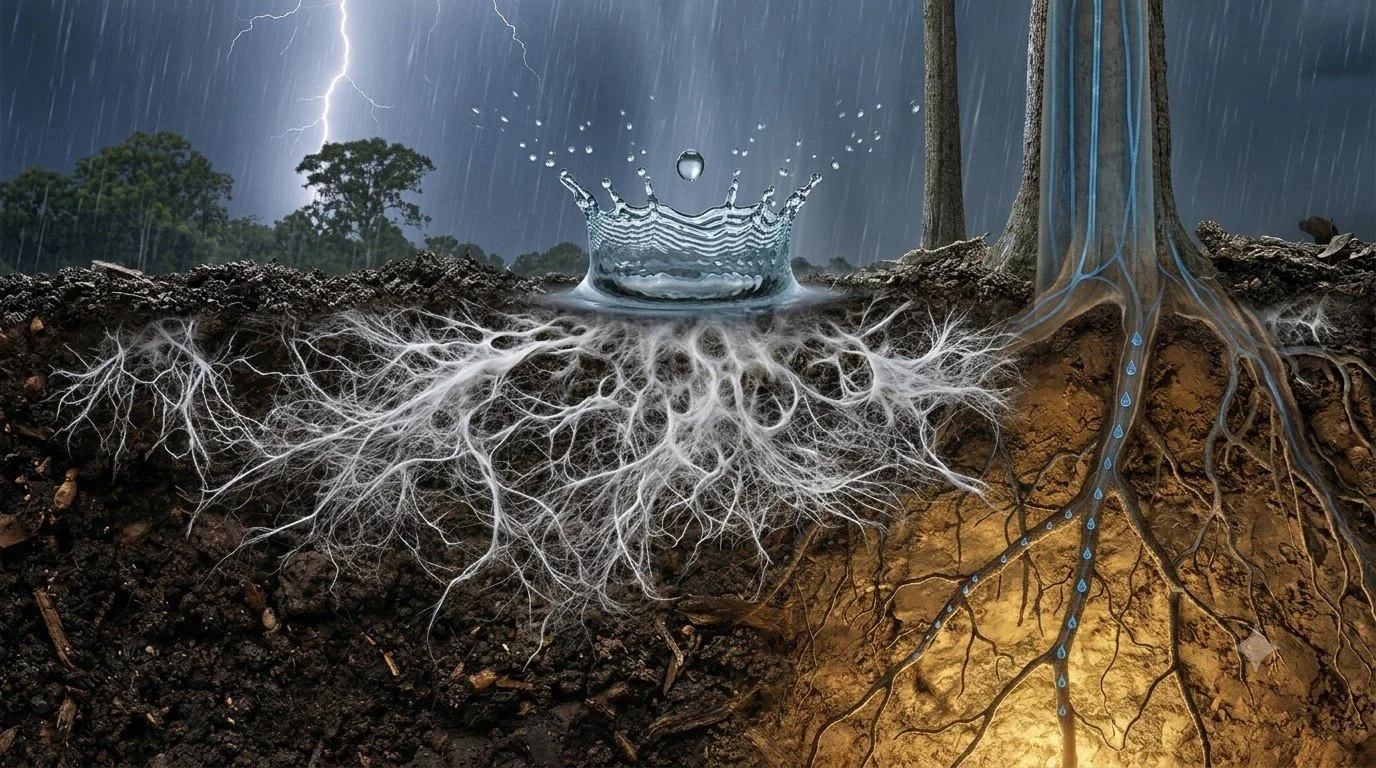
The lightning that comes before it has already been at work. It has broken apart the nitrogen molecules in the air, the N2 that plants cannot capture on their own, and turned them into soluble nitrates. Lightning does chemistry. For free. For three billion years. Before the drop even falls, it is already food.
It falls. It touches the ground. And there begins the most extraordinary journey nature has ever devised.
The top centimetre of earth receives it. But this centimetre is not just earth. It is an invisible metropolis. A gram of living soil contains more organisms than there are people on Earth. Bacteria, archaea, nematodes, protozoa, springtails. And in the midst of it all, the mycorrhizal hyphae. Filaments two microns thick, a hundred times finer than a hair, which sensed the drop before it arrived.
Like Leucophyllum frutescens, the small shrub of the Texas and Mexican deserts that local people call the barometer bush, which covers itself in purple flowers two or three days before a storm. No instrument. No algorithm. Just the sensitivity of a plant membrane that reads the humidity of the air at thresholds our most precise hygrometers struggle to reach. Living things measure what we are still learning to measure.
The hyphae, for their part, respond to tiny changes in humidity long before we could perceive them.
The drop seeps in. It goes down. It passes through the successive layers of the soil the way one passes through the storeys of a forest. In each horizon a different ecosystem awaits it, filters it, transforms it. Clays capture heavy metals. Organic matter absorbs toxic molecules. Bacteria break down what surface chemistry could not decompose. The drop is purified with every centimetre it travels. It reaches the water table cleaner than any treatment plant will ever make it.
Then comes the climb back up.
The rootlets, root tips less than a millimetre across, secrete exudates that dissolve minerals, attract bacteria and feed the fungi, which in return deliver to them the water and phosphorus drawn from the water table. A silent, fair market, negotiated in total darkness since land plants appeared four hundred million years ago.
The water rises. It becomes raw sap in the vessels of the xylem, carried by the transpiration of the leaves, which creates a pull reaching all the way down to the roots. It passes through the whole plant, takes on sugars in the leaves, and comes back down as elaborated sap to feed the roots and the fungi that helped it rise. Then it evaporates through the stomata, the millions of microscopic pores that open and close according to light, heat and thirst.
It returns to the atmosphere. It will become a cloud again. It will fall again.
This perfect cycle has been turning for three billion years. Without fossil energy. Without chemical reagents. Without waste.
And then man arrived with his plough.
Ploughing turns the soil over to a depth of thirty centimetres. It exposes to ultraviolet light organisms that have never seen the light of day. It severs the mycorrhizal networks that take years to weave. It destroys in a few hours what the forest built over centuries. The turned soil compacts under the rain, seals its surface and prevents infiltration. The drop no longer goes down. It runs off. It carries away with it the topsoil that took a thousand years to form.
Pesticides finish the job. Glyphosate blocks the shikimate pathway, the metabolic route that mycorrhizal fungi use to make their essential amino acids. Fungicides attack the membranes of the hyphae directly. Insecticides wipe out the springtails that break up organic matter. We kill the network. We cut the thread.
Without mycorrhizae, the rootlet searches for water alone. It no longer finds it at depth. It stays near the surface, fragile, dependent on watering, vulnerable to drought. The plant becomes addicted to irrigation like a patient on a drip.
And when the heatwave comes, when the surface soil dries out in a few days, the plant closes its stomata to survive. It stops transpiring. It stops cooling the air. It stops sending water up towards the clouds.
We have broken the cycle. Without knowing it. Without meaning to. But we have broken it.
Nature does not need us to improve it. It needs us to stop preventing it from doing its work.
Yves Nicolas, Expert Consultant in Functional Ecology, yvesnicolas.com